Journal of Chemical and Pharmaceutical Research, 2015, 7(8):257-261
Research Article
CODEN(USA) : JCPRC5
ISSN : 0975-7384
Pulping process for rice straw in basic ionic liquid [NH-(C
2H
4OH)
3]
+Zongyu Liu
1, Yu Deng*
2and Wei Song
31College of Environmental Science and Safety Engineering, Tianjin University of Technology, Tianjin, China 2School of Materials Science and Chemical Engineering, Tianjin University of Science &Technology, Tianjin, China
3
Tianjin Key Laboratory for Control Theory & Applications in Complicated Systems, Tianjin University of Technology, Tianjin, China
_____________________________________________________________________________________________
ABSTRACT
This paper makes study of pulping process for rice straw in basic ionic liquid [NH-(C2H4OH)3]+. The pulp yields increases with extended time, which the concentration of residual lignin in rice straw pulp gradually declines. The results indicate that the temperature 100℃ and time 60min are suitable for cooking pulping. Separated lignin is scanned by IR and fiber analysis. Triethanolamine ionic liquid [NH-(C2H4OH)3]+ can well dissolve lignin which contains large number of hydroxyl groups. The lignin with lilacs and guaiac structures has the better dissolving performance at 100℃. It is known that fiber length is 0.758mm, width 22.8µm by detecting its size. The pulp fibers are mainly fine ones, which are in line with straw pulp characteristics.
Key words: Ionic liquid; Lignin; Rice; Pulping; Fiber
_____________________________________________________________________________________________
INTRODUCTION
Traditional pulping technology is not only a waste of drug resources, large energy consumption, high cost, serious pollution, and the reaction time is long, the pulp yield is low [1-3]. It makes the pulp and paper industry development hindered seriously. In recent years, ionic liquids as a new type of environmentally friendly solvents, more and more get the attention of people [5, 6]. Ionic liquid pulping process not only can improve the selectivity of cooking reagent, make it easier for lignin dissolution, shorten the cooking time, reduce the consumption of chemicals, also cuts down the pollution load of black liquor [7-10]. This research includes the synthesis of ionic liquids, cooking experiments of different reaction temperature, reaction time, and extracted rough lignin is scanned by infrared and fiber analysis under different reaction conditions.
EXPERIMENTAL SECTION
2.1 Materials
Triethanolamine, analytical grade, Tianjin North Tianyi Chemical Reagent Factory; glacial acetic acid , analytical grade, from Tianjin Fuchen Chemical Reagent Factory; anhydrous ethanol, analytically pure, Tianjin shibei fine chemicals development co., LTD; rice straw, from pulping and papermaking laboratory of Tianjin University of Science and Technology.
2.2. Synthesis ionic liquid
Put solvent anhydrous ethanol into 250ml three-mouth flask, which contains a stirrer, thermometer and condenser. Then add triethanolamine and ice acetic acid according to the ratio of 1:1.1 after preheating at 25℃. After adding
N(CH2-CH2-OH)3+CH3COOH→[NH-(CH2-CH2-OH)3]++[CH3COO]-
2.3 Rice straw cooking pulping
Cut rice straw to 1.5cm pieces before cooking. Every time take 20g oven dry straw. Then add them and ionic liquid into digester according to the solid-liquid ratio of 1:5, and mix evenly. Cooking experiments are carried out in different temperature & cooking time at atmospheric pressure [13].
2.4 Lignin separation
After cooking, put the rice straw pulp into 200 mesh filter bag, rinse repeatedly it with distilled water and squeeze out cooking liquor in the end. Transfer liquid phase to a beaker, remain still for a period of time. Make centrifugal separation after a large amount of precipitate being separated out. The filtrate pH is adjusted neutral after the precipitate separated out undergoing alkali soluble and acid soluble. Lignin is separated out again in neutral solution. It is rinsed repeatedly with distilled water, dried and weighed [14].
2.5 Infrared analysis
Infrared spectrum are carried out using KBr pellets and recorded on WQF-510 FTIR spectrophotometer, the instrument resolution of 4cm-1, the scanning number is 16, the scanning range is 500 ~ 4200cm-1.
RESULTS AND DISCUSSION
3.1 Effects of cooking time on pulping process
3.1.1 Effects of cooking time on pulp yield and residual lignin of rice straw pulp
Effects of different cooking time on pulp yield and residual lignin of rice straw pulp are shown in figure 1 under the conditions: 20g oven dry straw, liquid-solid ratio 5:1, temperature 100℃.
0 1 2 3 4 5 6 7
2 0 3 0 4 0 5 0 6 0 7 0 8 0
t i m e ( m i n )
p u l p y i e l d ( % ) 19.5 20.0 20.5 21.0 21.5 22.0
20 30 40 50 60 70 80
time(min) r e s i d u a l l i g n i n ( g / g d r y s t r a w )
(a) (b) Figure 1 Effects of time on pulp yield and residual lignin
It can be seen from figure 1 (a) that the pulp yields show a trend of rising with extended time. It increases slowly in the early time and then rapid growth because a lot of fiber is dispersed to the cooking liquor after a period of time. Prolonging the cooking time makes the reaction more fully. In the late of the chemical reaction, the dispersed cellulose occur decomposition because of reaching the cooking limit under the experimental conditions. Figure 1 (b) shows that the longer the cooking time, the smaller the concentration of residual lignin in rice straw pulp. Comprehensive consideration pulp yields and the amount of residual lignin, appropriate cooking time is 60min.
3.1.2 Effects of cooking time on the infrared structure of the lignin
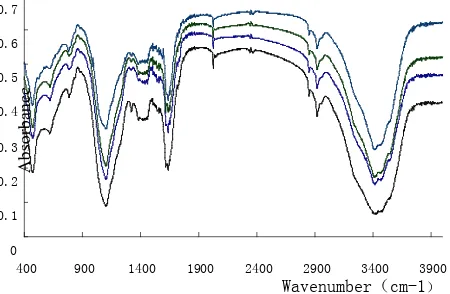
increase methoxyl content of black liquor only cooking a long time. (5) At 835 (1/cm), it can be seen that special C-H vibration of aromatic ring associated with guaiacol lignin is obviously on the 2, 6 place outside plane. But this vibration appears a trend of decrease with time, and the minimum intensity is at 60 min. It explains that guaiacol lignin can be dissolved easily for a long time cooking.
Figure 2 The IR spectrogram of lignin under different time
3.2 Effects of cooking temperature on pulping process
3.2.1 Effects of cooking temperature on pulp yield and residual lignin of rice straw pulp Effects of different cooking temperature on pulp yield and residual lignin of rice straw pulp are shown in figure 3 under the conditions: 20g oven dry straw, liquid-solid ratio 5:1, time 60min. It can be seen from figure 3 (a) that the pulp yields increases with temperature rise gradually, then gradually decreases before 100℃. The reason is that the rice straw does not come to
boiling at the low temperature. Only high temperature can make structure of straw fiber damaged and cellulose more easily dispersed. In the late of the chemical reaction, cellulose may decompose in the process of cooking, and even dissolve. Figure 3 (b) shows that residual lignin content reduces gradually with temperature rise, but reduce speed obviously different. Straw does not come to boiling at low temperature, so less lignin dissolved. But the dissolution rate decreases when temperature is too high. As the result 100℃ is suitable for lignin dissolution
0 1 2 3 4 5 6 7
70 80 90 100 110 120 130
Temperature(℃)
p u l p y i e l d ( % ) 18.5 19.0 19.5 20.0 20.5 21.0 21.5
70 80 90 100 110 120 130
Temperature(℃)
r e s i d u a l l i g n i n ( g / g d r y s t r a w )
[image:3.595.112.500.437.577.2](a) (b)
Figure 3 Effects of temperature on pulp yield and residual lignin
3.2.2 Effects of cooking temperature on the infrared structure of the lignin
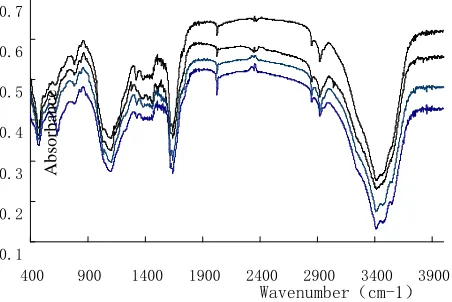
Figure 4 shows the infrared spectra of lignin at 80℃, 100℃, 110℃ and 120℃ respectively (from top to
bottom).The lignin functional strength is not the same when the temperature is different. (1) At 3397 (1/cm), stretching vibration relative strength of hydroxyl (OH-) decreases along with the cooking temperature, but it’s slightly higher at 120℃. It indicates that lignin which contains more hydroxyl is dissolved and separated out in a
large amount and retains the activity of its functional groups. The changing rules of relative strength are roughly decreases gradually at 1226 (1/cm) phenol hydroxyl. (2) At 1700 (1/cm), the relative strength of carbonyl (C=O mainly ester bond carbonyl) changes unobvious. Here is connected the lignin hydroxyl structure to other structural unit in the form of ester bond. (3) At 1328 (1/cm), the change of stretching vibration of lignin phenol ether bond (Ar-O) is not obvious. The relative intensity is smaller at 100℃. It can be concluded that the lignin dissolubility is
the largest, and the lilacs lignin can be determined. From 1029 (1/cm), we can see the relative strength of absorption is minimum at 100℃ and it appears increase at high temperature. That means higher temperature cooking may make
fatty ether bond of side chain fracture in a certain degree. (4) At 1421 (1/cm) of C-H in methoxyl group, it can be seen that stretching vibration change unobvious and is smaller at 100. It shows that this temperature is much better
0 0.1 0.2 0.3 0.4 0.5 0.6 0.7
400 900 1400 1900 2400 2900 3400 3900
for methoxyl group dissolving out. (5) At 835 (1/cm), it can be seen that special C-H vibration of aromatic ring associated with guaiacol lignin is obviously on the 2, 6 place outside plane. Relative absorption intensity is also small at 100℃. It explains that this temperature is more appropriate and can determine dissolved out lignin contains
[image:4.595.160.386.136.287.2]more guaiac lignin
Figure 4 The IR spectrogram of lignin under different temperature
Through the IR analysis of the relative strength of absorption peak, we understand that triethanolamine ionic liquid [NH-(C2H4OH)3]+can well dissolve lignin which contains large number of hydroxyl groups. The lignin with Lilacs and guaiac structures has the better dissolving performance at 100℃.
3.3 length & width of the pulp fiber
After cooking under the conditions of liquid- solid ratio 5:1 of ionic liquid to rice, cooking temperature 100 , ℃
cooking time for 60min, the treatments of beating pulp and dispersing are carried out. We detecte the size of the pulp fibers and get its length is 0.614mm, fiber width 26.5µm. The results show that the pulp fibers are mainly fine ones after cooking pulping, which is in line with straw pulp characteristics.
CONCLUSION
(1) Considering the effects of cooking temperature and time on pulping process of basic ionic liquid [NH-(C2H4OH)3]+ cooking rice straw based on the pulp yield and residual lignin in rice straw pulp, we can conclude that the cooking temperature 100℃ and cooking time 60min are suitable for cooking pulping. The pulp yields
increases with extended time, which the concentration of residual lignin in rice straw pulp gradually declines.
(2) Through the IR analysis, we understand that triethanolamine ionic liquid [NH-(C2H4OH)3]+can well dissolve lignin which contains a large number of hydroxyl groups. The lignin with lilacs and guaiac structures has the better dissolving performance at 100℃.
(3) The pulp fibers are dispersed by beating pulp after basic ionic liquid [NH-(C2H4OH)3] +
cooking rice straw pulping. It is known that fiber length is 0.758mm, width 22.8µm by detecting its size. The pulp fibers are mainly fine ones, which are in line with straw pulp characteristics.
Acknowledgment
The authors would like to thank the National Natural Science Foundation of China for providing financial support for this project (21176195).
REFERENCES
[1] SJ Zhang; XQ Yao; et al. Science In China Press, B: Chemistry, 2009, 39(10), 1134-1144. [2] Y Zheng; XP Xuan; AR Xu. Progress in Chemistry, 2009, 21(9), 1807-1812.
[3] CF Liu; WY Li; RC Sun; J Ye. Paper Science & Technology, 2007, 26(6), 37-40. [5] J S Wilkes. Green Chem,2002, 4(2), 73-80.
[6]Ze S Y Tan; DR MacFarlane. The Royal Society of Chemistry, 2009, 26(11), 339-345.
[7] B Li; I Filpponen; DS Argyropoulos. Industrial & Engineering Chemistry Research, 2010, 49(7), 3126-3136.
[8] Y J Xu; J Wang. China Pulp & Paper, 2011, 29(06), 46-48.
0.1 0.2 0.3 0.4 0.5 0.6 0.7
400 900 1400 1900 2400 2900 3400 3900
Wavenumber(cm-1)
A
b
so
rb
an
[9] R X Li, JJ Wang. Chemical Industry and Engineering Progress, 2002, 21(1), 43-48.
[10] N Shun. Shandong Chemical Industry, 2008, 37(2), 26-29.
[11] T Welton. Chemical Review, 1999, (99), 2071-2083.
[12] XH Li; B Zhao; ZF Fei; LF Wang. Science in China(Series B:Chemistry), 2006, 36(3), 181-196.
[13]SL Shi; FW He. Analysis and Detection of Pulp and Paper, 1st Edition, China Light Industry Press, Beijing, 2003, 28-45.