IMPROVED CUCKOO SEARCH BASED NEURAL NETWORK LEARNING ALGORITHMS FOR DATA CLASSIFICATION
ABDULLAH
A thesis submitted in
fulfillment of the requirement for the award of the Doctor of Philosophy in Information Technology
Faculty of Computer Science and Information Technology Universiti Tun Hussein Onn Malaysia
v
ABSTRACT
Artificial Neural Networks (ANN) techniques, mostly Back-Propagation Neural Network (BPNN) algorithm has been used as a tool for recognizing a mapping function among a known set of input and output examples. These networks can be trained with gradient descent back propagation. The algorithm is not definite in finding the global minimum of the error function since gradient descent may get stuck in local minima, where it may stay indefinitely. Among the conventional methods, some researchers prefer Levenberg-Marquardt (LM) because of its convergence speed and performance. On the other hand, LM algorithms which are derivative based algorithms still face a risk of getting stuck in local minima.
Recently, a novel meta-heuristic search technique called cuckoo search (CS) has gained a great deal of attention from researchers due to its efficient convergence towards optimal solution. But Cuckoo search is prone to less optimal solution during exploration and exploitation process due to large step lengths taken by CS due to Levy flight. It can also be used to improve the balance between exploration and exploitation of CS algorithm, and to increase the chances of the egg’s survival.
vii
TABLE OF CONTENTS
DECLARATION ii
DEDICATION iii
ACKNOWLEDGEMENT iv
ABSTRACT v
TABLE OF CONTENTS vii
LIST OF TABLES x
LIST OF FIGURES xi
LIST OF ALGORITHMS xiv
LIST OF SYMBOLS AND ABBREVIATIONS xv
LIST OF APPENDICES xviii
LIST OF PUBLICATIONS xix
CHAPTER 1 INTRODUCTION 1
1.1 Background of the Research 1
1.2 Problem Statements 4
1.3 Aims of the Research 5
1.4 Objectives of the Research 6
1.5 Scope of the Research 6
1.6 Significance of the Research 7
1.7 Thesis Outline 8
CHAPTER 2 LITERATURE REVIEW 10
2.1 Introduction 10
2.2 Artificial Neural Network (ANN) 11
2.3 Multilayer Perceptron (MLP) 12
2.4 Recurrent Neural Network (RNN) 14
2.4.1 Elman Recurrent Network (ERN) 15
2.4.2 Previous improvements on RNN 17
viii
2.6 The BP Training Algorithm Limitation 21
2.7.1 Delta Bar Delta Rule 23
2.7.2 Learning Rate ( ) 23
2.7.3 Momentum Coefficient ( ) 24
2.7.4 Parameters Selection 26
2.7.5 Improved Error Function 27
2.7.6 Improved Activation Function 27
2.8 Second Order Methods 29
2.8.1 Related works on Second Order Methods 30
2.8.2 Levenberg-Marquardt (LM) Algorithm 31
2.8.3 Improvement on LM Training NN 33
2.9.1 Meta-heuristic Techniques 37
2.10 Cuckoo Search via Levy Flight (CS) Algorithm 39
2.10.1 Levy Flight in Cuckoo Search 40
2.11 Artificial Bee Colony (ABC) Algorithm 43 2.12 Particle Swarm Optimization (PSO) Algorithm 46 2.13 Accelerated Particle Swarm Optimization Algorithm 47
2.14 Research Gap Analysis on BPNN 48
2.15 Summary 50
CHAPTER 3 RESEARCH METHODOLOGY 52
3.1 Introduction 52
3.2 The Proposed CSLM Algorithm 54
3.3 The Proposed CSBP Algorithm 61
3.4 The Proposed CSERN Algorithm 67
3.5 The Proposed CSBPERN Algorithm 72
3.6 The Proposed CSLMERN Algorithm 77
3.7 The Proposed HACPSO algorithm 85
3.8 The Proposed HACPSO-BP Algorithm 89
3.9 The proposed HACPSO-LM Algorithm 95
3.10 Data Collection 101
3.11 Variable Selection 102
3.12 Data Pre-Processing 102
3.13 Data partitioning 103
ix 3.15 Performance Comparison and Accuracy Measurement 104
3.16 Summary 105
CHAPTER 4 RESULTS AND SIMULATION 106
4.1 Introduction 106
4.2 Preliminaries 107
4.3 Wisconsin Breast Cancer Classification Problem 108
4.4 IRIS Classification Problem 113
4.5 Thyroid Benchmark Classification Problem 117
4.6 Diabetes Classification Problem 121
4.7 Glass Classification Problem 125
4.8 Australian Credit Card Classification Problem 129
4.9 Result and Discussion 133
4.10 Summary 134
CHAPTER 5 CONCLUSION AND FUTURE WORK 135
5.1 Introduction 135
5.2 Research Summary 135
5.3 Research Contributions 138
5.4 Future works 138
REFERENCES 140
Table A.1 Gantt-Chart of Project Activities 151
APPENDIX 152
x
LIST OF TABLES
4.1 Summary of algorithms performance for breast cancer
classification problem 110
4.2 Summary of algorithms performance for Iris
Benchmark classification Problem. 114 4.3 Summary of algorithms performance for Thyroid
Benchmark classification Problem 118 4.4 Summary of algorithms performance for Diabetes
Benchmark classification Problem. 122 4.5 Summary of algorithms performance for Glass Benchmark classification Problem 126 4.6 Summary of algorithms performance for Card Benchmark
xi
LIST OF FIGURES
2.1 Multilayer Perceptron (MLP) 12
2.2 The MLP the error function 13
2.3 Cuckoo search Variants 43
2.4 Previous Research On BPNN Algorithm 49
3.1 Flowchart of the Research process 53
3.2 The Proposed CSLM Algorithm 55
3.3 Proposed flowcharts for (CSBP) 64
3.4 Proposed flowcharts for (CSERN) 68
3.5 Proposed flowcharts for (CSLMERN) 78
3.6 Proposed flowcharts for (HACPSO-BP) 95
4.1 Comparison of average MSE, and SD for breast cancer
classification problem. 111
4.2 MSE Convergence comparison performances for breast cancer classification problem of the proposed
techniques 112
4.3 MSE Convergence comparison performances for breast cancer classification problem of the proposed
techniques 112
4.4 MSE Convergence comparison performances for breast cancer classification problem of the standerd
algorithms 113
4.5 Comparison of average MSE and SD for Iris
classification Problem 115
xii 4.7 MSE Convergence comparison performances for Iris
classification Problemof the proposed techniques. 116 4.8 MSE Convergence comparison performances for Iris
classification Problemof the standerd algorithms 117 4.9 Comparison of average MSE and SD for Thyroid
classification Problem 119
4.10 MSE Convergence comparison performances for Thyroid classification Problem of the proposed
algorithms 120
4.11 MSE Convergence comparison performances for Thyroid classification Problem of the proposed
algorithms 120
4.12 MSE Convergence comparison performances for Thyroid classification Problem of the standerd
algorithms 121
4.13 Comparison of average MSE and SD for Diabetes
classification Problem 123
4.14 MSE Convergence comparison performances for Diabetes classification Problem of the proposed
techniques 124
4.15 MSE Convergence comparison performances for Diabetes classification Problem of the proposed
techniques 124
4.16 MSE Convergence comparison performances for Diabetes classification Problem of the standerd
algorithms 125
4.17 Comparison of average MSE and SD of the algorithms
for Glass classification Problem 127
4.18 MSE Convergence comparison performances for Glass classification Problem of the proposed techniques 128 4.19 MSE Convergence comparison performances for Glass
classification Problem of the proposed techniques 129 4.20 MSE Convergence comparison performances for Glass
xiii 4.21 Comparison of average MSE and SD for Credit Card
classification Problem 131
4.22 MSE Convergence comparison performances for Credit Card classification Problem of the proposed
techniques 132
4.23 MSE Convergence comparison performances for Credit Card classification Problem of the proposed
techniques 132
4.24 MSE Convergence comparison performances for Credit Card classification Problem of the standerd
xiv
LIST OF ALGORITHMS
(i) Hybrid Accelerated Cuckoo Particle Swarm Optimization (HACPSO) algorithm.
(ii) Hybrid Accelerated Cuckoo Particle Swarm Optimization Back propagation (HACPSO-BP) algorithm.
(iii) Hybrid Accelerated Cuckoo Particle Swarm Optimization Levenberg-Marquardt (HACPSO-LM) algorithm.
(iv) Cuckoo Search Back Propagation (CSBP) algorithm. (v) Cuckoo Search Levenberg-Marquardt (CSLM) algorithm. (vi) Cuckoo Search Recurrent Elman Network (CSERN) algorithm. (vii) Cuckoo Search Back Propagation Elman Recurrent network
(CSBPERN) algorithm.
(viii) Cuckoo Search Levenberg-Marquardt Elman Recurrent network (CSLMERN) algorithm.
(ix) Conventional Back Propagation Neural Network (BPNN) algorithm.
(x) Artificial Bee Colony Neural Network (ABCNN) algorithm. (xi) Artificial Bee Colony Back Propagation (ABC-BP) algorithm. (xii) Artificial Bee Colony Levenberg-Marquardt (ABC-LM)
xv
LIST OF SYMBOLS AND ABBREVIATIONS
Number of output nodes in the output layer Desired output of the output unit Network output of the output unit Is the error for the output layer at node Is the error for the hidden layer at node Output of the hidden node
Output of the input node
Learning rate
Subscripts corresponding to input, hidden
Subscripts , corresponding to output nodes
Weight on the link from hidden node to output node Weight on the link from input node to hidden node
Is the velocity vector
Is the position vector
Is the learning parameter or accelerating constant Is the random vector drawn from N (0, 1)
Global best
New value obtained
Old value in the data
Maximum of the old data range
Minimum of the old data range
The Upper normalization bound
The Lower normalization bound
Predicts data Actual data
xvi The observed value
̅ Mean value of the observed value
ANN Artificial Neural Network
ALM Adaptive Learning Rate and Momentum
AF Activation Function
ACO Ant Colony Optimization
ABPNN Ant Back Propagation Neural Network ABC Artificial Bee Colony algorithm
APSO Adaptive Particle Swarm Optimization
APSO-BP Adaptive Particle Swarm Optimization Back Propagation ABC-LM Artificial Bee Colony algorithm Levenberg-Marquardt BP Back Propagation Neural Network
BPNN Back Propagation Neural Network BPFM Back Propagation with Fixed Momentum BPALM Back Propagation with Adaptive Learning
Rate and Momentum.
BPERN Back Propagation Elman Recurrent Network
BPGD-AG Back Propagation Gradient Descent with Adaptive Gain BPGD-AGAMAL Back Propagation Gradient Descent with Adaptive Gain and
adaptive momentum and learning rate BPTT Back Propagation through Time CSBP Cuckoo Search Back Propagation CSLM Cuckoo Search Levenberg-Marquardt. CSERN Cuckoo Search Recurrent Elman Network CSBPERN Cuckoo Search Back Propagation Elman
Recurrent network
CSLMERN Cuckoo Search Levenberg-Marquardt Elman Recurrent network
CG Conjugate Gradient DO Dissolved oxygen
ERNN Elman Recurrent Neural Network ERN Elman Recurrent Network
xvii FBP Firefly Back propagation algorithm
FCRNN Fully Connected Recurrent Neural Network GDAM Gradient Descent with Adaptive Momentum GN Gauss Newton
HACPSO Hybrid Accelerated Cuckoo Particle Swarm Optimization HACPSO-BP Hybrid Accelerated Cuckoo Particle Swarm Optimization
Back propagation
HACPSO-LM Hybrid Accelerated Cuckoo Particle Swarm Optimization Levenberg-Marquardt
IT Information Technology
IWS Initial Weight Selection LM Levenberg-Marquardt MLP Multilayer Perceptron
MLPNN Multilayer perceptron Neural Network
MSE Mean Squared Error
OBP Optical Back Propagation
PSO-BP Particle Swarm Optimization Back Propagation PSO Particle Swarm Optimization
PCA Principle Component analysis QN Quasi Newton
RNN Recurrent Neural Network
SLPNN Single Layer Perceptron Neural Network SI Swarm Intelligence
TN Total nitrogen
xviii
LIST OF APPENDICES
APPENDIX TITLE PAGE
A Table A.1 Gantt-Chart of Project Activities 151 B Table B.1 Algorithms Performance for Breast Cancer
Classification Problem 152 B Table B.2 Algorithms Performance for IRIS Classification Problem 156 B Table B.3 Algorithms Performance for Diabetes
Classification Problem 160 B Table B.4 Algorithms Performance for Glass
Classification Problem 164 B Table B.5 Algorithms’ Performance for Card
Classification Problem 168 B Table B.6 Algorithms Performance for Thyroid
xix
LIST OF PUBLICATIONS
1. N. M. Nawi, Abdullah Khan, M. Z. Rehman (2013). A New Optimized Cuckoo Search Recurrent Neural Network (CSRNN)Algorithm. In: ROVISP-2013,
Proceedings in LNEE Journal of Springer, Penang, Malaysia.
2. M. Z. Rehman, N. M. Nawi, Abdullah Khan (2013).Countering the problem of oscillations in Bat-BP gradient trajectory by using momentum. In: DaEng 2013, Proceedings in LNEE Journal of Springer. Kuala Lumpur, Malaysia. (indexed by ISI Proceedings, EI-Compendex, SCOPUS, EI Compendex, MetaPress, Springer link).
3. N. M. Nawi, Abdullah Khan, M. Z. Rehman (2013).CSBPRNN: A New Hybridization Technique Using Cuckoo Search to Train Back Propagation
Recurrent Neural Network. In: DaEng 2013, Proceedings in LNEE Journal of
Springer.Kuala Lumpur, Malaysia. (indexed by ISI Proceedings, EI-Compendex, SCOPUS, EI Compendex, MetaPress, Springer link).
4. N. M. Nawi, Abdullah Khan, M. Z. Rehman (2013).A New Back-propagation Neural Network optimized with Cuckoo Search Algorithm. B. Murgante et al. (Eds.): ICCSA 2013, Part I, LNCS 7971, pp. 413--426. Springer, Heidelberg. 5. N. M. Nawi, Abdullah Khan, M. Z. Rehman (2013). A New Cuckoo Search
based Levenberg-Marquardt (CSLM) Algorithm. B. Murgante et al. (Eds.): ICCSA 2013, Part I, LNCS 7971, pp. 438--451. Springer, Heidelberg.
6. N. M. Nawi, Abdullah Khan, M. Z. Rehman (2013). A New Levenberg-Marquardt based Back-propagation Algorithm trained with Cuckoo Search. In: ICEEI-2013, Proceedings in Elsevier Technology Journal.
7. N. M. Nawi, Abdullah Khan, M. Z. Rehman (2013).CSLM: Levenberg-Marquardt based Back Propagation Algorithm Optimized with Cuckoo Search, J.
xx 8. Nazri Mohd. Nawi, M. Z. Rehman, M. I. Ghazali, M. N. Yahya, Abdullah Khan (2014). Hybrid Bat-BP: A New Intelligent tool for Diagnosing Noise-Induced Hearing Loss (NIHL) in Malaysian Industrial Workers, J. Applied Mechanics and Materials, Trans Tech Publications, Switzerland, vol. 465-466, pp. 652— 656, 2014.
9. N. M. Nawi, M. Z. Rehman, Abdullah Khan(2013). The Effect of Bat Population in Bat-BP Algorithm. In: ROVISP-2013, Proceedings in LNEE
Journal of Springer, Penang, Malaysia.
10. N. M. Nawi, M. Z. Rehman, Abdullah Khan (2013). A New Bat Based Back-Propagation (BAT-BP) Algorithm. In: ICSS-2013, Proceedings in LNEE Journal
of Springer, Wroclaw, Poland.
11. N. M. Nawi, Abdullah Khan, M. Z. Rehman (2014).Data Classification Using Metaheuristic Cuckoo Search Technique for Levenberg-Marquardt Back
Propagation (CSLM) Algorithm. ICoMEIA 2014, Penang.
12. N. M. Nawi, M. Z. Rehman, Abdullah Khan (2014).WS-BP: A New Wolf Search based Back-propagation Algorithm. ICoMEIA 2014, Penang.
13. N. M. Nawi, Abdullah Khan, M. Z. Rehman (2014).Comparison of CSBP, CSRNN, and CSLM algorithms on Parity bit Classification datasets. SCDM
2014.
14. N. M. Nawi, Abdullah Khan, M. Z. Rehman (2014). CSLMEN: A New Cuckoo Search Levenberg-Marquardt Elman Network. SCDM 2014.
15. N. M. Nawi, Abdullah Khan, M. Z. Rehman (2014).Researching the Effect of Back Propagation Based Cuckoo Search on Data Classification. Accepted in IRECOS Journal for 2014.
16. N. M. Nawi, M. Z. Rehman, Abdullah Khan (2013).Verifying the Accuracy of GDAM algorithm on Multiple Classification Problems. In: InteliSys 2013, 11 -
12 October 2013, Jakarta, Indonesia.
17. N. M. Nawi, Abdullah Khan, M. Z. Rehman (2013).CSLMEN: A New Optimized Method for Training Levenberg-Marquardt Elman Network Based
Cuckoo Search Algorithm. In: InteliSys 2013, 11 - 12 October 2013, Jakarta,
CHAPTER 1
INTRODUCTION
1.1 Background of the Research
Classification is one of the main data mining processes that maps or sort items into a group of related predefined objects or classes. Data sorting however is a difficult practice, especially if it is carried out by hand. Data sorting is a vital step to gather useful information about an association’s working style. Data classification engages categorizing information to predefined levels or an object. For instance, to classify relevant data available (i.e. file type, working platform, normalizing file size in megabytes or gigabytes, to their appropriate groups or classes etc) a classification procedure is required which has to be done automatically (Chandra et al., 2011).
Machine learning techniques provide us one of the best classification approaches to perform the data organization in a systematic manner. The main goal of Machine Learning is to answer the rising levels of computerization in the information creation process, substituting a vast amount of time burly human activity with techniques that improve accuracy or efficiency by finding out and utilizing the irregularities in the training data. Many techniques are available under the machine learning and the most important objective of machine learning research is to automatically identify the complex patterns and construct intelligent decisions based on the data provided (Chandra et al., 2011).
2 artificial neurons that can be trained to perform complex calculations. Unlike conventional techniques in which an output is based on the input it gets, an ANN can be trained to learn and guess patterns without having the prior information about the form of the function (Zheng and Gong, 1992; Kosko, 1992; Basheer and Hajmeer, 2000; Krasnopolsky and Chevallier, 2003; Coppin, 2004). Multilayered ANN architectural models are most efficient when trained on complex patterns. Usually, multilayered networks are classified as Feed-Forward Networks and Recurrent Neural Networks with respect to the path of their connections (Haykin, 1994; Guler et al., 2005).
Recurrent Neural Network (RNN) can achieve incredibly non-linear vibrant mappings and thus have temporally complete applications, where multilayer feed forward networks are restrained to perform static mappings (Elman, 1990; Gupta et al., 2000; Saad et al., 1998). Fully recurrent networks use unrestricted fully
interrelated architectures and learning algorithms that can deal with time varying inputs or outputs in a non-linear manner. Therefore, this research’s primary focus is on partially recurrent networks, where connections are mainly feed forward, and they comprise a carefully selected set of feedback associates. The reappearance allows the system to memorize past history from the precedent without complicating the learning extremely (Guler and Ubeyli et al., 2005). One example of partially RNN is Elman which is set up as a usual feed forward network (Elman, 1990).
3 where it may stay indefinitely and the global minima of the error function will never be achieved (Ahmed et al., 2001; Wen et al., 2000; Nawi et al., 2011).
A number of research studies have recently attempted to improve the convergence of the back propagation and Elman RNN. Second order optimization method such as; Levenberg-Marquardt (LM) has been used for network training (Levenberg, 1944; Marquardt, 1963; Nawi et al., 2010; Nawi et. al., 2011; Yan, et al. 2009; Qing, et al., 2010; Bogdan and Wilamowski et. al., 2007; Hagan and Menhaj, 1994). But, as LM also follows gradient descent, therefore it can get stuck in local minima for indefinite time and global minima will never be achieved (Karaboga et al., 2011).
Seeing the problem of convergence in deterministic methods, many nature inspired meta-heuristic methods have been used to solve non-linear optimization problems, such as; artificial bee colony (ABC) algorithm (Karaboga, and Basturk 2007), particle swarm optimization (PSO) algorithm (Zhang, et al., 2007), bat algorithm (BA) (Yang, 2011; Yang, and Gandomi, 2012), firefly algorithm (FA) (Yang, 2010; Gandomi et al., 2013), and krill herd (KH) algorithm (Gandomi, and Alavi, 2012). It has been found through experimentation that meta-heuristic techniques are highly suitable for finding the optimal solution. Since these methods are known to have the capability of avoiding the local minima, therefore they are used in selecting the best weights and biases for the BPNN and Elman RNN networks (Ozturk and Karaboga, 2011). However, the algorithms still have a problem of slow convergence to global minima which has rendered them useless in real environments where the time constraint exists.
4 The Cuckoo search is prone to less optimal solution during exploration and exploitation process owing to large step lengths taken by CS due to Levy flight (Zheng and Zhou, 2012). Therefore, to improve the balance between exploration and exploitation of CS algorithm and to increase the chances of the egg’s survival which will lead to converge to global optimal solution, this research proposed an improved CS algorithm hybridized with Accelerated particle Swarm Optimization (APSO) algorithm.
The proposed hybrid Accelerated Cuckoo Particle Swarm Optimization (HACPSO) is used to train different variants of neural networks such as: simple Back propagation (Rumelhart and Hinton et al., 1986), feed forward neural network (FFNN), and Levenberg-Marquardt Back propagation Neural Network (Shereef and Baboo, 2011; Ozturk and Karaboga, 2011) by selecting the best weights and bias for avoiding the local minima and improving the convergence to global minimum.
1.2 Problem Statements
5 Among the conventional optimization methods researchers prefer Levenberg-Marquardt (LM) because of its convergence speed and performance. On the other hand, LM algorithm is derivative based having a risk of getting stuck local minima. To deal with this problem, global search optimized techniques, have gained great attention by researchers since they are known to have the capability of avoiding local minima (Ozturk and Karaboga, 2011).
Recently, natures inspired meta-heuristic based global search techniques have become popular in finding the global optimal solution (Yang, 2010). Cuckoo Search (CS) is a recently proposed meta-heuristic algorithm by Yang and Deb in 2009. CS is found to be quite efficient during convergence towards optimal solution but it is prone to less optimal solution during exploration and exploitation process due to large step lengths by Levy flight (Zheng and Zhou, 2012). Therefore, a modification of CS algorithm is needed to improve the balance between exploration and exploitation of CS algorithm, and to increase the chances of the cuckoo egg’s survival.
1.3 Aims of the Research
6 Levenberg-Marquardt algorithm (ABC-LM) (Ozturk and Karaboga, 2011; Nandy et al., 2012; Karaboga and Ozturk, 2009; Rumelhart et al., 1986) on selected
benchmark classification problems from UCI Machine Learning Repository.
1.4 Objectives of the Research
This research encompasses the following four objectives in order to achieve the research aims;
i. To implement and simulate the effect of levy flight in Cuckoo Search algorithm based on first and second order Neural Network algorithms in avoiding local minima towards converging to global minimum.
ii. To develop a hybrid algorithm known as HACPSO which further enhances CS by introducing APSO in finding the best solution or best nest from sub-search space and share this information to CS.
iii. To implement and assess the performance of the proposed HACPSO algorithm in (ii) to train the first and second order Neural Network to provide a better search direction for the network.
iv. To assess the performances of the proposed algorithms in terms of accuracy and mean square error comparing with conventional algorithms on selected benchmark classification problems.
1.5 Scope of the Research
7 Network (LMERN). Later, the proposed CS algorithm is integrated with Accelerated Particle Swarm Optimization (APSO) which is applied to first and second order Network. All these Networks were exploited on some selected benchmark datasets from University California Irvine Machine Learning Repository (UCIMLR) were employed in order to verify the efficiency of the proposed algorithm.
1.6 Significance of the Research
This research provides the following contributions to knowledge in the fields of meta-heuristic based learning algorithm for BPNN. In meta-heuristic learning algorithms, the performance highly depends on exploration and exploitation procedures:
i. Cuckoo Search with Levy flight algorithm has been simulated and implemented with different variants of Neural Network in order to remove the oscillations in the gradient path and to avoid local minima problem.
ii. An improved Hybrid Accelerated Cuckoo Particle Swarm Optimization (HACPSO) algorithm is proposed to improve the balance between exploration and exploitation of CS algorithm, and to increase the chances of the egg’s survival by intelligently selecting the best search space and the optimal solution in CS. This exploration method followed in the proposed HACPSO algorithm makes it to converge to global optimal solution with more efficiency than the original Cuckoo Search (CS) algorithm.
8 iv. Cuckoo Search with Levy flight and HCAPSO and their variants are finally compared by means of simulation on some selected benchmark classification problems taken from UCI Machine Learning Repository.
1.7 Thesis Outline
This thesis is divided into five chapters including the introduction and conclusion chapters. The outline of each chapter is given below;
Besides providing an outline of the thesis, Chapter 1, contains the overview on background of the Research, scope of the Research, objectives, aims, and significance of the Research.
Chapter 2 consists of some efficient learning methods for BPNN algorithm. The BPNN algorithm is one of the finest and widely used learning algorithms for Artificial Neural Network (ANN). However, BP algorithm has problem of slow convergence and local minima. This chapter reviews some of the fundamental theory about ANN, BPNN, Levenberg-Marquardt (LM) algorithm, and Recurrent Neural Networks (RNN). This chapter also sheds some light on the previous improvements proposed by various researchers on improving the training efficiency of these networks. Some of the fundamental theories about the meta-heuristics, such as; Cuckoo Search (CS) algorithm, Artificial Bee Colony (ABC) algorithm, Particle Swarm Optimization (PSO) and Accelerated Particle Swarm Optimization (APSO) algorithms are also reviewed. The problem of slow convergence in Cuckoo Search (CS) due to large step lengths taken by levy flight and the poor communication among cuckoos in CS are identified in the Chapter 2.
9
In Chapter 4, the new algorithms developed in Chapter 3 are further validated in terms of simulations on selected benchmark problems for UCI Machine Learning Repository. The performance evaluation is carried out based on accuracy and Mean Squared Error (MSE) and all the proposed algorithms are compared with conventional BPNN, ABCNN, ABC-BP, and ABC-LM algorithms.
1. CHAPTER 2
LITERATURE REVIEW
2.1 Introduction
In the past two decades, much advancement has been done in the Information Technology (IT) field. Previously, accessing large information was a time consuming process but due to recent developments in Artificial Intelligence (AI) accessing large information has become much easier and less time consuming. Artificial Neural Network is powerful technique in solving complex and non-linear problems. The main reason for ANN being usually used is the ability to present some properties such as learning from training data.
11 (PSO), Accelerated Particle Swarm Optimization (APSO), and Artificial Bee Colony (ABC) algorithms.
2.2 Artificial Neural Network (ANN)
Artificial Neural Network (ANN) is an analytical procedure modeled on the learning of human cognitive system and neurological function of the brain. ANN is one of the most popular approaches used extensively in machine learning, which involves the development of the algorithms that enables the computer to learn (Negnevitsky, 2005). ANN works by processing information like human neurons in the brain and is composed of small interconnected processing elements known as nodes (neurons), which can be trained to perform complex computations (Chen and Pei, 2008). ANN is a powerful set of adaptive learning techniques that can be trained to store, recognize, estimate and adapt to new patterns without having the prior information of the function it receives (Popescu et al., 2009).
12 2.3 Multilayer Perceptron (MLP)
Multilayer Perceptron (MLP) is the most popular Artificial Neural Networks (ANN) architecture used due to its simple construction (Popescu et al., 2009). MLP is also known as Multilayer Feed forward Neural Network (MLFNN), and consists of more than one layer of nodes and is appropriate for large number of applications (Fung et al., 2005). The MLP network comprises of a set of nodes (neurons) that represent the
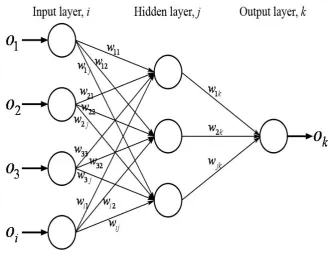
[image:29.595.151.480.370.628.2]input layer one or more hidden layers of computation, and output layer of nodes that calculate the output of the network. In MLP, nodes in any layer of the network are connected to all other neurons in the adjacent layer. The input signal propagates in forward direction from left to right through the network. Figure 2.1 shows the MLP network structure which consist of three layers; one input, one hidden, and one output layer.
Figure 2.1: Multilayer Perceptron (MLP)
13
∑ ( ) (2.1)
where;
: Number of output nodes in the output layer. : Desired output of the output unit. : Network output of the output unit.
[image:30.595.168.468.262.535.2]Error function can be visualized in one dimensional weight space as shown in Figure 2.2.
Figure 2.2: The MLP error function
Figure 2.2 shows that the MLP error function is a non-linear function of the weights and have many minimum, which satisfies the following equation:
( ) (2.2)
14 D) is called global minima, while point A is called local minima. There may be also other points, which satisfy the error condition in Equation (2.2) for instance local maxima (point B) or saddle point (point C) (Nawi, 2007).
Generally the MLP network is trained with one of the most popular and traditional algorithm known as back propagation neural network (BPNN) algorithm which will be discussed in detail in Section 2.5.
Although, MLP is stable and popular but its mapping performance is fixed, therefore, the network is not suitable for processing temporal pattern. Many attempts have been made to use the MLP to classify temporal patterns by transforming the temporal domain in to a spatial domain. An alternate neural network approach is to use recurrent neural network (RNN) which has the memory to train on the past history. (Gupta and Mcavoy, 2000; Saad et al., 1998). RNN is discussed in more detail in the next section.
2.4 Recurrent Neural Network (RNN)
Recurrent Neural Network (RNN) is an alternate neural network architectural approach which has the ability to store past inputs to a node in its memory for future use. Unlike, multi-layer feed forward neural network (MLFNN), it can be trained on temporal data easily (Ubeyli, 2008a).
15 contain a careful chosen set of feedback connections. One instance of such network is Elman which is usually set-up as a normal feed forward neural network (Elman, 1990).
2.4.1 Elman Recurrent Network (ERN)
Among some feasible network architectures, the feed forward and recurrent neural networks (RNN) are commonly used (Haykin, 1994). In a feed forward neural network the signals are transmitted only in one direction, starting from the input layer, consequently through the hidden layers to the output layer. A recurrent neural network (RNN) has local feedback connections to some of the previous layers. It is different from feed forward network architecture in the sense that there is at least one feedback loop. Thus in RNN, there can exist one layer with feedback connections as well as there can also be neurons with self-feedback link where the output of a neuron is fed back into itself as the input (Kazemy et al., 2007).
Thus, the partially recurrent network where the connections are largely feed forward consists of carefully chosen set feedback association. The recurrence allows the network to memorize output from the past without complicating the learning greatly (Ubeyli, 2008). One of the popular networks in the partially recurrent network is Elman Recurrent Network (ERN). An ERN is a network which in principle is set up as a normal feed forward network with a feedback connection from the hidden layer to the input layer. It means that all the neuron in one layer is connected with all neurons in the next layer called context layer which is a special container of hidden layer (Elman, 1990; Guler and Ubeyli et al., 2005).
16 network has an open memory of one time delay (Elman, 1990; Ubeyli, 2008; Kazemy et al., 2007).
Like MLFNN, the strength of all association among nodes is represented with weights. Initially, all the weight values are represented randomly and changed during the training process. In the Elman RNN the weights from the hidden layer to the context layer is set to one, and kept fixed because the values of the context nodes have to be copied accurately (Elman, 1990).
A simple ERN is mostly used with one input layer, one hidden or state layer, and one output layer. Each layer will have its own index variable: for output nodes, and l for hidden, and for input nodes. In a feed forward network, the input vector is propagated through a weight layer .
( ) ∑ ( ) (2.3)
where, the number of inputs is, is a bias, and is an output function. In a simple recurrent network, the input vector is similarly propagated through a weight layer, but also combined with the previous state activation through an additional recurrent weight layer,
( ) ( ( )) (2.4)
( ) ∑ ( ) ∑ ( ) ( ) (2.5)
where, is the number of ‘state’ nodes. The output of the network in both cases is determined by the state and a set of output weights ;
( ) ( ( )) (2.6)
17 where, is an output function and represents the weights from hidden to output layer.
In the next section, we will discuss the previous improvements by various researchers on Recurrent Neural Networks (RNN) to achieve faster convergence to global minima.
2.4.2 Previous improvements on RNN
There has been a lot of research on dynamic system modeling with recurrent neural networks (RNN). The Recurrent Neural Networks (RNN) has an inside feedback connection within the network which allows it to hold past presented pattern. This ability of dynamic modeling system makes this kind of neural network more superior than the conventional feed forward neural network because the system outputs are function of both the current inputs as well as their inner states (Barbounis et al., 2006; Peng et al., 2007).
As a part of supervised learning technique, different training algorithms were established for training the RNNs, such as BPNN through time (Ahmad et al., 2004) and second order optimization LM algorithm (Toha et al., 2008; Guler et al., 2005). However the existence of feedback loops in the network architecture, the calculation of the gradient becomes more complex which makes the BPNN procedure computationally more intricate. In addition the error surface of the recurrent network is more complex as compared to the static network. Therefore, the training is more likely to be trapped in to local minima (Peng et al., 2007).
18
Peng et al., (2007) trained RNN by integrating it with particle swarm optimization (PSO) and BPNN algorithm. The PSO-BP algorithm provides the optimal weights for identifying the frequency dependent impedance of power electronic system such as rectifiers, inverter and AC-DC converter. The experimental results showed that the proposed method successfully identified the impedance characteristics of the three phase inverter system, not only it can systematically help avoiding the training process getting trapped in local minima but also has better performance as compared to both simple BPNN and PSO algorithms.
Aziz and Hamed et al., (2008) carried out a research to improve the performance in ERN training with PSO algorithm. To discover the classification accuracy and convergence rate, the proposed algorithm is compared with simple ERN and BPNN algorithms. Based on the simulation results, the proposed Elman recurrent network with particle swarm optimization (ERNPSO) algorithm has better performance than the Back Propagation Elman Recurrent Network (BPERN) in terms of classification accuracy. However, in terms of convergence time the BPERN is much better than the proposed ERNPSO algorithm.
Cheng and Shen (2010) proposed an improved ERN to calculate radio propagation loss with three dimensional parabola method in order to decrease calculation time and to improve approximation performance of the network. Based on the results, the improved ERNs showed high performance in predicting propagation loss than the simple ERN.
19 can precisely compute and forecast the water quality parameters during the period of water diversion, but still it is not free from local minimum problem.
Tanoto and Ongsakul et al., (2011) proposed LM algorithm based on Elman and Jordan recurrent neural networks to forecast annual peak load of Java Madura Bali interconnection from 2009 to 2011. The research was carried out to check the performance of the proposed LM based recurrent networks with respect to their forecasting accuracy over the given time period. From the simulations, it is clear that the proposed LM based recurrent neural networks have better results.
Normally, most of the ERNs and FFNN are generally trained with back propagation (BP) algorithms, which will be explained in the next section.
2.5 Back Propagation Neural Network (BPNN)
Back propagation Neural Network (BPNN) is one of the most widely used supervisor learning model for updating the MLP weights during the training process. It was proposed in order to solve the problem of a single layer perceptron which fails to solve XOR patterns (Minsky and Papert, 1969). The BPNN algorithm has been individually calculated by many researchers working in different fields. Werbos (1974) presented the basic idea of BP algorithm while working on his doctoral thesis called back propagation of error. Parker (1985) redeveloped the BPNN algorithm and called it the learning logic algorithm. Finally Rumelhart et al., (1986) rediscovered the algorithm and since then the technique is commonly used. For this reason, the BPNN can be viewed as the standard method of complex patterns learning ANN technique. The BPNN learns by calculating the error of the output layer to find the error in the hidden layers. This capability makes it highly appropriate to be applied on problem in which no relation is set up between the output and the input.
20 rate, and activation function. An inappropriate use of these parameters can lead to slow network convergence or even network stagnancy (Zawei and Althoefer, 2005). The issues of convergence in back propagation is really important and to solve these problems different techniques were developed. And new modification is given in the Section 2.7. However this section explains the traditional implementations of the BPNN algorithm which is known as batch or offline BPNN. The procedure for conventional back propagation is given as follows:
i. Initialize all weights and present input patterns to the neural network. ii. Identify desired outputs for each input pattern.
iii. All the input is then propagated forward through the network, until the output layer.
iv. Calculate error by comparing the network output with the desired output using Equation (2.1).
v. The error is propagated backward through the network is used to adjust the weights using the following equation. The error for each unit in the output layer
( )( ) (2.8)
vi. The error is propagated backward to compute the error specifically, for each unit at the hidden layer. Using Equation (2.9);
( ) ∑ (2.9)
vii. The weights in the links connecting to output nodes, ( ), and hidden nodes, ( ), are then modified based on the gradient descent method as following:
(2.10)
(2.11)
21
: Is the error for the output layer at node : Is the error for the hidden layer at node : Output of the hidden node
: Output of the input node : Learning rate
: Subscripts , corresponding to input, hidden and output nodes, respectively
: Weight on the link from hidden node to output node : Weight on the link from input node to hidden node
Since, BPNN algorithm uses gradient descent (GD) to update weights therefore, BPNN cannot be guaranteed to reach global minima of the error function. This limitation of the BPNN will be explained in the next section.
2.6 The BP Training Algorithm Limitation
The traditional BP has been successfully applied in some real problems such as, predictions, pattern recognitions, and classifications. Despite providing many successful applications, BP faces several limitations which need to be solved. Since BP algorithm used gradient descent (GD) optimization technique to update weights, one of the limitations of these methods is that it does not guarantee to reach global minima of the error function (refer to Figure 2.2). BP contains slow learning convergence and can easily get trapped in local minima and fails to find the global best solution (Bi et al., 2005; Wang et al., 2004).
22 dimension, thus the weight value is adjusted by a small amount and many procedures are required to make major reduction in error (Nawi, 2007).
Another cause for the slow speed of convergence of the gradient descent is that the negative gradient vector direction may not point directly toward the minimum of the error surface (Nawi, 2007). It is also noted that the neuron saturation in the hidden layer is closely associated with many local minima problems. When such saturation occurs, neuron in the hidden layer will lose their sensitivity to the input signals and propagated chain is blocked severely and in some situations, the network can no longer be trained. Moreover, the BP algorithm convergence behavior depends on the selection of network architecture, initial weights, biases, learning rate, momentum coefficient and the activation function.
In the last decade, a significant numbers of different learning algorithms have been introduced by researchers in order to overcome those limitations of BP algorithm. The next section will discuss some improvements of BP proposed by previous researchers.
2.7 Improvements on BP Algorithm
In recent years, with many improvements in the research and applications, researchers have been investigating the problems associated with the learning efficiency and convergence rate of the BP algorithm. Much work has been done to improve the general capacity of the network. Several learning acceleration techniques have been proposed as modification to the original BP algorithm. The research on BP falls in three categories:
i. Heuristic technique which include variation of learning rate, using momentum and gain tuning of the activation function.
23 iii. Hybridization Techniques.
Based on the first category, various accelerating techniques have been proposed. This technique consists of Delta Bar Delta Rule, and involves varying the learning rate, momentum coefficient, and gain value of the activation function.
2.7.1 Delta Bar Delta Rule
The Delta- Bar- Delta rule, developed by Rich Sutton (1986) consists of a weights and learning rate update rule. The weights update rule is the same as the Delta Bar Delta rule in Equation (2.12);
( ) ( ) ( ) ( ) ( ) (2.12)
Jacobs (1988) has introduced a Delta- Bar- Delta rule modification, which consist of weight update rule and learning update rule. From his research, it is noted that if the consecutive change of the weights ( ) and ( ) in the opposite direction the weights value is oscillating, than the learning rate ( ), for that weight should be decremented. Similarly, if the consecutive derivative of the weights has the same direction than the learning rate for that weight should be increased. From the research, it is found the Delta -Bar-Delta shows a faster rate of convergence than the gradient descent.
2.7.2 Learning Rate ( )
24 choice of . Various methods have been developed to find out a better learning rate. However, these techniques are generally based on heuristics and do not present the best learning rate (Kandil et al., 1993).
Yu et al. (1995) proposed dynamic optimization of the learning rate using derivative information. It was shown that relatively large or less learning rates may change the training of BP algorithm and may be lead to failure of learning process.
While, Ye (2001) stated that the constant learning rate of the back propagation fails to improve the search for the optimal weight combination. Furthermore, Yemeni and Hong (2009) proposed an auto adapted learning rate, although the adjustment of the network weights is associated with error gradient during the training. When the training has fallen into a flat area, error gradient is closed to zero. Then the learning rate is large and the change of weights will be still slow, which may cause slow convergence to the target error.
Thota et al. (2013) proposed optimal learning rate for the stabilized and fast convergence of the BP learning algorithm. It was shown that the consistency of the total system mostly depends on the choice of value. A small value of results in slow learning while a great value of results in fast learning but may also face oscillations which leads to no learning at all. It states that 0.02 values is found to be the optimal learning rate value for minimum error, correct classification, and incorrect classification occurrence. Overall, it can be concluded that the small value of learning rate may cause slow convergence, and large value of the learning rate may lead towards oscillations.
2.7.3 Momentum Coefficient ( )
140 REFERENCES
Ahmad, A., Ismail, S., & Samaon, D. (2004). Recurrent neural network with backpropagation through time for speech recognition. Paper presented at the
Communications and Information Technology, 2004. ISCIT 2004. IEEE International Symposium on.
Ahmed, W. A. M., Saad, E., & Aziz, E. (2001). Modified back propagation algorithm for learning artificial neural networks. Radio Science Conference, 2001. NRSC 2001. Proceedings of the Eighteenth National, 1, 345-352.
Ampazis, N. P., S. J. (2000). Levenberg-Marquardt algorithm with adaptive momentum for the efficient training of feedforward networks. Neural Networks, IJCNN 2000, 1, 126-131
Aziz, M., Hamed, H. N. A., & Shamsuddin, S. M. H. (2008). Augmentation of Elman Recurrent Network Learning with Particle Swarm Optimization. Modeling & Simulation, 2008. AICMS 08. Second Asia International
Conference on, 625-630.
Barbounis, T. G., Theocharis, J. B., Alexiadis, M. C., & Dokopoulos, P. S. (2006). Long-term wind speed and power forecasting using local recurrent neural network models. Energy Conversion, IEEE Transactions on, 21(1), 273-284. Basheer, I. A., & Hajmeer. (2000). Artificial Neural Networks: fundamentals,
computing, design and application. Journal of Microbiological Methods 43 (1), 03-31.
Battiti, R. (1992). First-and second-order methods for learning: between steepest descent and Newton's method. Neural computation, 4(2), 141-166.
Becker, S., & Le Cun, Y. (1988). Improving the convergence of back-propagation learning with second order methods. Paper presented at the Proceedings of
the 1988 connectionist models summer school.
Bishop, C. M. (1995). Neural networks for pattern recognition.
141 Chandrasekaran, K., & Simon, S. P. (2012). Multi-objective scheduling problem: Hybrid approach using fuzzy assisted cuckoo search algorithm. Swarm and Evolutionary Computation, 5, 1-16.
Cheng, F., & Shen, H. (2010). An Improved Recurrent Neural Network for Radio Propagation Loss Prediction. Intelligent Computation Technology and Automation (ICICTA), 2010 International Conference on, 1, 579-582.
Coppin, B. (2004). Artificial Intelligence Illuminated. Jones and Bartlet illuminated Series, USA, 291-324.
Cortez, P., Cerdeira, A., Almeida, F., Matos, T., & Reis, J. (2009). Modeling wine preferences by data mining from physicochemical properties. Decision Support Systems, 47 (4).
Deng, W. J., Chen, W. C., & Pei, W. (2008). Back-propagation neural network based importance-performance for determining critical service attributes. Journal of Expert Systems and Applications 34(2), 1-26.
Dunham, M. H. (2002). Data Mining: Introductory and Advanced Topics.
Eberhart, J. K. R. C. (1995). particle Swarm Optimization. proce of IEEE International Conforences on Neural Network Piscataway NJ.,, 1942-1948.
Elhag, T. M. S., & Wang, Y.-M. (2007). Risk Assessment for Bridge Maintenance Projects: Neural Networks versus Regression Techniques. Journal of Computing in Civil Engineering, 21 (6), 769-775.
Elman, J. L. (1990). Finding structure in time. Cognitive Science, 14(2), 179-211. Evett, I. W., & Spiehler, E. J. (1988). Rule induction in forensic science. in (Eds.).
Knowledge Based Systems. Halsted Press, 152-160.
Fisher, R. A. (1936). The use of multiple measurements in taxonomic problems. Annual Eugenics 7, 179-188.
Fkirin, M. A., Badwai, S. M., & Mohamed, S. A. (2009). Change Detection Using Neural Network in Toshka Area. NSRC-2009,, 1-10.
142 Gandomi, A., Yang, X.-S., Talatahari, S., & Alavi, A. (2013). Firefly algorithm with chaos. Communications in Nonlinear Science and Numerical Simulation, 18(1), 89-98.
Gandomi, A. H., & Alavi, A. H. (2012). Krill herd: a new bio-inspired optimization algorithm. Communications in Nonlinear Science and Numerical Simulation, 17(12), 4831-4845.
Gandomi, A. H., Yun, G. J., Yang, X.-S., & Talatahari, S. (2013). Chaos-enhanced accelerated particle swarm optimization. Communications in Nonlinear Science and Numerical Simulation, 18(2), 327-340.
Güler, N. F., Übeyli, E. D., & Güler, İ. (2005). Recurrent neural networks employing Lyapunov exponents for EEG signals classification. Expert Systems with Applications, 29(3), 506-514.
Gupta, L., McAvoy, M., & Phegley, J. (2000). Classification of temporal sequences via prediction using the simple recurrent neural network. Pattern Recognition, 33(10), 1759-1770.
Hagan, M. T., & Menhaj, M. B. (1994). Training feedforward networks with the Marquardt algorithm. Neural Networks, IEEE Transactions on, 5(6), 989-993.
Haykin, S. (1994). Neural Network : A Comprehensive Foundation. Macmillan, New York.
Hyder, M. M., Shahid, M. I., Kashem, M. A., & Islam, M. S. (2009). Initial Weight Determination of a MLP for Faster Convergence. Journal of Electronics and Computer Science,, 10.
Nocedal, J. S. W. (1999). Numerical Optimization. Springer, Berlin.
Jacobs, R. A. (1988). Increased Rate of convergance Through Learning Rate Adaptation:. Neural Network, 1, 561-573.
Jeng-Bin, L., & Yun-Kung, C. (2005). A Novel Back-propagation Neural Network Training Algorithm Designed by an Ant Colony Optimization. Transmission and Distribution Conference and Exhibition: Asia and Pacific, 2005
IEEE/PES, 1-5.
143 Jin, W., Li, Z. J., Wei, L. S., & Zhen, H. (2000). The improvements of BP neural network learning algorithm. Signal Processing Proceedings, 2000. WCCC-ICSP 2000. 5th International Conference on, 3, 1647-1649.
Karaboga, D., & Basturk, B. (2007). Artificial bee colony (ABC) optimization algorithm for solving constrained optimization problems. Foundations of Fuzzy Logic and Soft Computing, 789-798.
Karaboga, D., & Ozturk, C. (2009). Neural networks training by artificial bee colony algorithm on pattern classification. Neural Network World, 19(3), 279-292. Kazemy, A., Hosseini, S.A.,& Farrokhi, M. (2007). Second order diagonal recurrent
neural network. In: Proceedings of the IEEE International Symposium on Industrial Electronics(ISIE), 251--256.
Kennedy, J. F., Kennedy, J., & Eberhart, R. C. (2001). Swarm intelligence.
Kermani, B. G., Schiffman, S. S., & Nagle, H. T. (2005). Performance of the Levenberg–Marquardt neural network training method in electronic nose applications. Sensors and Actuators B: Chemical, 110(1), 13-22.
Kolen, J. F., & Pollack, J. B. (1991). Back Propagation Is Sensitive To Initial Conditions. in R. P. Lippmann, J. E. Moody & D. S. Tpuretzky (Eds.). Advances in Neural Information Processing Systems. Denver, 860-867.
Kosko, B. (1992). Neural Network and Fuzzy Systems (1st Edition ed.). Prentice Hall of India.
Kotsiantis, S., Kanellopoulos, D., & Pintelas, P. (2006). Data preprocessing for supervised leaning. International Journal of Computer Science, 1(2), 111-117.
Krasnopolsky, V. M., & Chevallier. (2003). Some Neural Network applications in environmental sciences. Part II. advancing computational efficiency of environmental numerical models. Neural Networks, 16 (3), 335-348.
Thota, L.S. S. B. C. (2013). Optimum Leraning rate for Classification Problem with MLP in Data Mining. International Jounral of Advance in Engineering & Technology (IJAET), 6(1), 35-44.
144 Lee, T. L. (2008). Back-propagation neural network for the prediction of the
short-term storm surge in Taichung harbor. Taiwan. Engineering Applications of artificial Intelligence 21 (1) 63-72.
Levenberg, K. (1944). A method for the solution of certain problems in least squares. Quarterly of applied mathematics, 2, 164-168.
Li, J.-B., & Chung, Y.-K. (2005). A novel back-propagation neural network training algorithm designed by an ant colony optimization. Paper presented at the
Transmission and Distribution Conference and Exhibition: Asia and Pacific, 2005 IEEE/PES.
Lourakis, M. I. (2005). A brief description of the Levenberg-Marquardt algorithm implemented by levmar.
Marquardt, D. (1963). An algorithm for least square estimation of nonlinear parameter ,. SIAM Jounral on applied Mathematics 11(2), 431-441.
Marquardt, D. W. (1963). An algorithm for least-squares estimation of nonlinear parameters. Journal of the Society for Industrial & Applied Mathematics, 11(2), 431-441.
Minsky, M. L., & Papert, S. (1969). Perceptrons; An Introduction to Computational Geometry. MIT Press.
Møller, M. F. (1993). A scaled conjugate gradient algorithm for fast supervised
learning. Neural networks, 6(4), 525-533.
Mitchell, R. J. ( 2008). On Simple Adaptive Momentum. CIS-2008, 01-06.
Mo,L.(2011). An APSO optimized BP neural network. Electronics, Communications and Control (ICECC), 2011 International Conference on, 1297-1300.
Mohd Nawi, N., Ransing, R., & Abdul Hamid, N. (2011). BPGD-AG: A New Improvement Of Back-Propagation Neural Network Learning Algorithms With Adaptive Gain. Journal of Science and Technology, 2(2).
Kandil N, K. K., R.V.Patel, V.K. Sood,. (1993). Optimum Learning Rate for Back Propagation Neural Network. Electrical and Computer Engineering, , 1, 465-468.
145 Nandy, S., Sarkar, P. P., & Das, A. (2012b). Training a Feed-forward Neural Network with Artificial Bee Colony Based Backpropagation Method. arXiv preprint arXiv:1209.2548.
Nawi, N., Ghazali, R., & Salleh, M. (2010). The Development of Improved Back-Propagation Neural Networks Algorithm for Predicting Patients with Heart Disease. In R. Zhu, Y. Zhang, B. Liu & C. Liu (Eds.), Information Computing and Applications (Vol. 6377, pp. 317-324): Springer Berlin
Heidelberg.
Nawi, N., Ransing, R. S., Salleh, M., Ghazali, R., & Hamid, N. (2010). An Improved Back Propagation Neural Network Algorithm on Classification Problems. In Y. Zhang, A. Cuzzocrea, J. Ma, K.-i. Chung, T. Arslan & X. Song (Eds.), Database Theory and Application, Bio-Science and Bio-Technology (Vol.
118, pp. 177-188): Springer Berlin Heidelberg.
Nawi, M. N. (2007). Computational Issues in Process Optimsation using Historical Data, PhD. Disseration, Swansea University.
Nawi, N. M., Ransing, M. R., & Ransing, R. S. (2007). An improved Conjugate Gradient based learning algorithm for back propagation neural networks. International Journal of Computational Intelligence 4 (1), 46-55.
Negnevitsky, M. (2005). Artificial Intelligence a Guide to Intelligent Systems. 2 Harlow, England: Addison Wesley.
Ng, W. W. Y., Yeung, D. S., & Tsang, E. C. C. (2006, 13-16 Aug. 2006). Pilot Study on the Localized Generalization Error Model for Single Layer Perceptron
Neural Network. Paper presented at the Machine Learning and Cybernetics,
2006 International Conference on.
Norhamreeza A. H., Nawi. N. M., Rozaida Ghazali, Najib M S. (2011). Accelerating Learning Performance of Back Propagation Algorithm by Using Adaptive Gain Together with Adaptive Momentum and Adaptive Learning Rate on Classification Problems. Second International Conference, UCMA 2011, Daejeon, Korea, April 13-15, 2011. Proceedings, Part II, 151, 559-570.
Otair, M. A., & Salameh, W. A. (2005). Speeding up back-propagation neural networks. Paper presented at the Proceedings of the 2005 Informing Science
146 Ozturk, C., & Karaboga, D. (2011). Hybrid artificial bee colony algorithm for neural network training. Evolutionary Computation (CEC), 2011 IEEE Congress on, 84-88.
Parker D., (1985) Learning -logic: Technicle report TR-47.
Peng, X., Venayagamoorthy, G. K., & Corzine, K. A. (2007). Combined Training of Recurrent Neural Networks with Particle Swarm Optimization and Backpropagation Algorithms for Impedance Identification. Swarm Intelligence Symposium, 2007. SIS 2007. IEEE, 9-15.
Popescu, M.-C., Balas, V. E., Perescu-Popescu, L., & Mastorakis, N. (2009). Multilayer perceptron and neural networks. WSEAS Trans. Cir. and SysWSEAS Trans. Cir. and Sys, 8(7), 579-588.
Prechelt, l. (1994). A set of neural network benchmark problem and benchmarking rule (Web :ftp://.ira.uka.de/pub/neuron/problem1.tar.gz)).Technical report 21/94, 1-4.
Pyle, D. (1999). Data preparation for data mining (Vol. 1): Morgan Kaufmann. Quinlan, J. R. (1987). Simplifying Decision Trees. Man-Machine Studies 27,
,221-234.
Quinlan, J. R., Compton, P. J., Horn, K. A., & Lazurus, L. (1986). Inductive knowledge acquisition: A case study. Second Australian Conference on Applications of Expert Systems. Sydney.
Rajabioun, R. (2011). Cuckoo optimization algorithm. Applied soft computing, 11(8), 5508-5518.
Ransing, M. R. (2002). Issues in learning Cause and effect Relationships from Example: with particular emphasis on casting process. University fo Wales Swansea, .
Rehman, M., Mohd Nawi, N., & Ghazali, M. I. (2012). Predicting noise-induced hearing loss (NIHL) and hearing deterioration index (HDI) in Malaysian industrial workers using GDAM algorithm. Journal of Engineering and Technology, 3.
147 Rumelhart, D. E., Hinton, G. E., & Williams, R. J. (1985). Learning Internal Representations by error propagation. Parallel Distributed Processing: Explorations in the Microstructure of Cognition
Rummelhart, D., Hinton, G. E., & Williams, R. J. (1986). Learning representations by back-propagating errors. Nature, 323(9), 533-535.
Saad, E. W., Prokhorov, D. V., & Wunsch, D. C. (1998). Comparative Study of stock trend prediction using time delay, recurrent and probabilistic neural networks. Neural Networks, IEEE Transactions on, 9(6), 1456-1470.
Shereef, I. K., & Baboo, S. S. A New Weather Forecasting Technique using Back Propagation Neural Network with Modified Levenberg-Marquardt Algorithm for Learning. International Journal of Computer Science, 8.
Smith, J. W., Everhart, J. E., Dickson, W. C., Knowler, W. C., & Johannes, R. S. . (1988). Using the ADAP learning algorithm to forecast the onset of diabetes mellitus.Symposium on Computer Applications and Medical Care. 261-265, IEEE Computer Society Press.
Sudarshan Nandy, P. P. S., Achintya Das. (2012). Analysis of a Nature Inspired Firefly Algorithm based Back-propagation Neural Network Training. International Journal of Computer Applications (0975 – 8887), 43(22).
Mamat, R., Herawan, T., & Deris, M. M. (2013). MAR: Maximum Attribute Relative of soft set for clustering attribute selection. Knowledge-Based Systems, 52, 11-20.
Sun, Y. J., Zheng, S., Miao, C. X., & Li, J. M. (2007). Improved BP Neural Network for Transformer Fault Diagnosis. Journal of China University of Mining and Technology 17 (1), 138-142.
Sutton, R. S. (1986). Two problem with Back Propagation and other steepest descent learning procedure for network. procedding of the annual Conference of the Congnitive Science Socity, 823-831.
Swanston, D. J., Bishop, J. M., & Mitchell, R. J. (1994). Simple adaptive momentum: New algorithm for training multilayer Perceptrons. IEEE Journal of Electronic Letters 30 (18), 1498-1500.
148 TELKOMNIKA (Telecommunication, Computing, Electronics and Control),
9(2), 257-266.
Toha, S. F., & Tokhi, M. O. (2008). MLP and Elman recurrent neural network modelling for the TRMS. Cybernetic Intelligent Systems, 2008. CIS 2008. 7th IEEE International Conference on, 1-6.
Tuba, M., Subotic, M., & Stanarevic, N. (2011). Modified cuckoo search algorithm for unconstrained optimization problems. Proceedings of the 5th European conference on European computing conference, 263-268.
Übeyli, E. D. (2008b). Recurrent neural networks employing Lyapunov exponents for analysis of doppler ultrasound signals. Expert Systems with Applications, 34(4), 2538-2544.
Übeyli˙, E. D. (2008c). Recurrent neural networks with composite features for detection of electrocardiographic changes in partial epileptic patients. Computers in Biology and Medicine, 38(3), 401-410.
Valian, E., Mohanna, S., & Tavakoli, S. (2011). IMPROVED CUCKOO SEARCH ALGORITHM FOR FEEDFORWARD NEURAL NETWORK TRAINING. International Journal of Artificial Intelligence & Applications, 2(3).
Vazquez, R. A. (2011). Training spiking neural models using cuckoo search algorithm. Evolutionary Computation (CEC), 2011 IEEE Congress on, 679-686.
Walton, S., Hassan, O., Morgan, K., & Brown, M. (2011). Modified cuckoo search: a new gradient free optimisation algorithm. Chaos, Solitons & Fractals, 44(9), 710-718.
Wang, H., Gao, Y., Xu, Z., & Xu, W. (2011). An recurrent neural network application to forecasting the quality of water diversion in the water source
of Lake Taihu. Paper presented at the Remote Sensing, Environment and
Transportation Engineering (RSETE), 2011 International Conference on. Wang, X. G., Tang, Z., Tamura, H., Ishii, M., & Sun, W. D. (2004). An improved
backpropagation algorithm to avoid the local minima problem. Neurocomputing, 56 455-460.