Journal of Chemical and Pharmaceutical Research, 2016, 8(4):457-461
Research Article
CODEN(USA) : JCPRC5
ISSN : 0975-7384
Learning Methods of Radial Basis Function Neural Network
Weidong Ji
1,2, Liping Sun
1, Keqi Wang
1and Liguo Lv
21College of Mechanical and Electrical Engineering, Northeast Forestry University, Harbin, China 2Computer science and Information Engineering College, Harbin Normal University, Harbin, China
_____________________________________________________________________________________________
ABSTRACT
Radial Basis Function Neural Network( RBF) is widely used now; it can solve the following problems: the small sample, nonlinear, dimension and local minima. Firstly, this paper briefly introduces the basic principles of RBF, and then comprehensively accounts the RBF domestic and overseas study status, discusses the advantages and disadvantages of various methods, and compares the explanation, finally analyzes the existing problems and the development trend in the future.
Key words: Radial basis function; Feed forward neural network; Optimization
_____________________________________________________________________________________________
INTRODUCTION
RBF is a commonly used three layer feed forward neural network. Compared with BP network, RBF network not only has a physiological basis, but also the structure is simpler, the learning speed is faster. It not only has solid theoretical basis, a concise mathematical form and intuitive geometric, but also can solve the small sample, nonlinear, dimension and local minima, so it is widely used in the practice[1-4]. It is a very effective multilayer feed forward network after the multilayer perceptron.
At present, according to the characteristics of radial basis function neural network proposed many algorithms, this paper comprehensively describes the algorithm, analyzes the existing problems and the prospect of development trend.
THE PRINCIPLE OF RADIAL BASIS FUNCTION NEURAL NETWORK
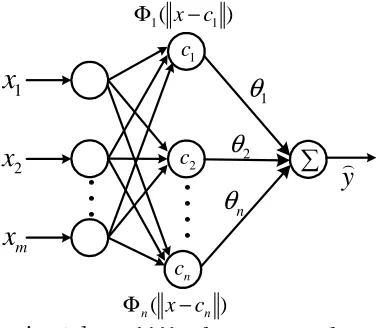
RBF neural network is a feed-forward neural network, generally divided into three layers of structure, if the output layer only has one node, consider as shown in Figure 1 of multi input single output of 3 layer RBF network design, the hidden layer radial basis function of Gaussian, the structure can be easily extended to multi output node.
1
x
2
x
m
x
1
θ
2
θ
y
)
∑
n
θ
1
c
2
c
n
c
1(
x c
1)
Φ
−
(
)
n
x c
n [image:2.595.209.397.78.242.2]Φ
−
Fig.1 Structure of the RBF Neural Networks
Figure 1 is a RBF m-n-1 network structure, network with M input, n hidden nodes, and 1 output.
Assuming the base width parameters are identical and known value, then the output of RBF network model as shown in formula (1).
2 2 1
ˆ( )
exp(
/ 2
)
n
i i
i
y x
θ
x c
ρ
=
=
∑
− −
(1)In the
x
=
[ ,
x x
1 2,
L
,
x
m]
T input vector for the network,θ
i is thei
connection weights of hidden nodes to the output,c
i=
[
c
1,i,
c
2,i,
L
,
c
m i,]
Tas the data center vector of hidden layer of thei
radial basis function,ρ
base width parameter function,⋅
is the Euclidean norm.The output layer RBF network is linear neurons, in the network hidden center vector
c
i and base width parameterρ
is determined, using simple linear learning algorithm can derive the output weights ofθ
i network. So the key to set up RBF network model is to determine the parameters of hidden center vector, base width parameters andnumber of nodes, or to find the parameter
Ξ =
{
c
i, ,
ρ
n
}
.COMMON LEARNING ALGORITHM OF RADIAL BASIS FUNCTION NEURAL NETWORK
By formula(1) shows, given training samples, learning algorithm of RBF network should address the following issues: (1) structure design, that is how to determine the number of hidden nodes of network; (2) determine the
hidden center vector
c
i and the base width parameterρ
of radial basis function; (3)output weight correction. In general, if known network hidden nodes, data center and propagation constant, RBF net from the input to the output is a linear equation group, the weights learning can use the least squares method. Therefore, this need to solve is the first two problems.According to the method of choosing the data center, the design method of the RBF network can be divided into two categories.
(1)Selected the data center from the sample input
This kind of method is relatively easy to implement, and determine the number of hidden nodes in the weight learning, and to ensure that the learning error is less than a given value. Algorithm of selecting the data center in the sample input, typical methods of the OLS algorithm, ROLS algorithm, ROLS+D-opt algorithm. These methods of data center will no longer change, and the numbers of hidden nodes have been identified in the beginning, or dynamic adjustment in the network learning process.
most commonly used with K- clustering, C- clustering, Kohonen clustering method, gradient descent method and RAN. Clustering method is a heuristic algorithm process, not through optimization of an objective function are derived, which are very sensitive to the selection of the initial value. Advantages of clustering method is able to determine propagation constants of the hidden nodes according to the distance to each cluster center, defect is identified in the data center uses the information of input samples and did not use the output information, so that not only affects the pattern classification of network capacity, but also restrict the regression ability of network, at the same time clustering method is unable to determine the number of clustering.
A COMPREHENSIVE DESCRIPTION OF THE LEARNING METHOD FOR RADIAL BASIS FUNCTION NEURAL NETWORK
In the RBF network learning method, proposed by Chen Orthogonal Least Squares is a common RBF network design method, this method is based on the error OLS algorithm derived from the drop rate index, according to each of the orthogonal vector decline rate of contribution to the size of the error, according to the order of selection for the center vector network, automatically avoids numerical the ill posed problem caused by random selection center [19]. Many scholars have conducted further study, in 1996 Chen proposed Regularized Orthogonal Least Squares RBF network design method, the orthogonal forward regression and regularization method, through the Bayesian method to generate the regularization coefficient, avoid network over fitting in a sample of noise data, so as to improve the generalization ability of network [20]; In 2001 Hong and Harris OLS algorithm and A-Optimality Design combination, the regression model selection methods, the method is introduced into the composite cost function, by using the approximation capability of OLS optimization method, the improved model performance of A- optimal design, simulation results show that, the RBF network design with the conventional OLS method has better performance ; based on the same principle, in 2002 Hong and Harris proposed OLS algorithm and D-Optimality Experimental Design combination selection method based on regression model. Optimal approximation ability model in the use of the OLS method at the same time, the design matrix by D- optimal design to maximize the selected sub model to improve the model robust performance of [21]; the 2003 Chen, Hong and Harris combined with ROLS algorithm and D- optimal experiment design method, by introducing D- optimal costs to the price function, automatic design of RBF network structure frugal at the same time, improve the performance of regression model selection, improve the parameter robust regression model[22]; In 2003, Hong used a significant regression factor optimization method put forward regression and Predicted REsidual Sums of Squares statistics, the characteristic of this method is that: in the prior to the orthogonalization process framework, calculation of PRESS value to reduce the amount of calculation, economical model structure, Gou Jianyong has good generalization performance model[23]; Hong systematic review three kinds of learning methods, ROLS combined with A-opt method, ROLS combined with D-opt method, ROLS and PRESS statistics method, the three methods are extensions to the OLS method or the ROLS method, which can improve the computational efficiency also can improve the performance of the regression models[24]. Due to the structure characteristics of RBF network and the multilayer perceptron is different, the key RBF network design is the hidden layer centers position selection, and selection of network center position can be attributed to the selection problem in linear regression model of the neutron, so the methods can be effectively applied to the design of RBF network.
CONCLUSION
A key problem in RBF network design is the design meets the accuracy requirements of the minimum structure of neural network, in order to ensure the generalization ability of the network. In recent years, the theory and application of RBF algorithm has made considerable progress, but in the process a large number of training data in the practical application, there are still problems such as computing speed and storage capacity. With the continuous development and improvement of the theory, RBF in pattern recognition, regression analysis, technology, medicine and other fields of biological information, will get the more extensive application.
Acknowledgements
It is supported by Key Laboratory of inetlligent education and information engineering project in Heilongjiang province,the special funds innovative talents of science and technology research project in Harbin 2015(2015RAQXJ040),Heilongjiang province key discipline of computer aoolication technology(081203), Harbin Normal University 2016 annual practice innovation team.
REFERENCES
[1] Mingli Song, Dacheng Tao, Xiaoqin Huang et al. Three-Dimensional Face Reconstruction From a Single Image
by a Coupled RBF Network. IEEE Transactions on Image Processing. 2012, 21(5):2887–2897
[2] Ke Meng, Zhao Yang Dong, Dian Hui Wang et al. A Self-Adaptive RBF Neural Network Classifier for Transformer Fault Analysis.IEEE Transactions on Power Systems. 2010, 25(3):1350–1360
[3] Muzhou Hou, Xuli Han. Constructive Approximation to Multivariate Function by Decay RBF Neural
Network.IEEE Transactions on Neural Networks. 2010, 21(9):1517–1523
[4] X. Hong, C. J. Harris. Nonlinear Model Structure Design and Construction Using Orthogonal Least Squares and
D-Optimality Design. IEEE Transactions on Neural Networks. 2002, 13(5):1245–1250
[5] Platt J. A resource-allocating network for function interpolation. Neural Computation, 1991,3(2):213-225 [6] Lu Y W, Sundararajan N, Saratchandran P. A sequential learning scheme for function approximation using minimal radial basis function neural networks.Neural Computation, 1997,9(2):461-478
[7] Esposito A, Marinaro M, Oricchio D, Scarpetta S. Approximation of continuous and discontinuous mappings by
position parameters of radial basis function networks for function approximation. IEEE Transactions on Neural
Networks,2003,14(6):1478-1495
[9] L. Guo, D. S. Huang,W. B. Zhao. Combining Genetic Optimisation with Hybrid Learning Algorithm for Radial
Basis Function Neural Networks. Electronics Letters,2003,39(22):1600–1601
[10]Fu X J, Wang L P. Data dimensionality reduction with application to simplifying RBF network structure and
improving classification performance. IEEE Transactions on Systems,Man,and Cybernetics,Part
B:Cybernetics,2003,33(3):399-409
[11]Huang G B, Saratchandran P, Sundararajan N. A generalized growing and pruning RBF(GGAP-RBF)neural network for function approximation. IEEE Transactions on Neural Networks, 2005,16(1):57-57
[12]Feng H M. Self-generation RBFNs using evolutional PSO learning.Neurocomputing, 2006,70(1-3):241-251
[13]F. A. Guerra, L. dos S. Coelho. Multi-step Ahead Nonlinear Identification of Lorenz’s Chaotic System Using Radial Basis Neural Network with Learning by Clustering and Particle Swarm Optimization. Chaos, Solitons & Fractals. 2008,35(5):967–979
[14]Lian J M, Lee Y G, Scott D S, Stanislaw H Z. Self-organizing radial basis function network for real-time approximation of continuous-time dynamical systems.IEEE Transactions on Neural Networks, 2008,19(3):460-474 [15]Huang D S, Du J X. A constructive hybrid structure optimization methodology for radial basis probabilistic neural networks. IEEE Transactions on Neural Networks, 2008,19(12):2099-2115
[16]Chen S, Hong X, Luk B L, Harris C J. Construction of tunable radial basis function networks using orthogonal forward selection. IEEE Transactions on Systems, Man, and Cybernetics, Part B:Cybernetics, 2009,39(2):457-466
[17]QIAO Jun-Fei, HAN Hong-Gui. Optimal Structure Design for RBFNN Structure. Acta Automatica Sinica,2010,
36(6):865–872
[18]HAN Hong-Gui, QIAO Jun-Fei, BO Ying-Chun. On Structure Design for RBF Neural Network Based on Information Strength. Acta Automatica Sinica, 2012, 38(7):1083–1090
[19]S. Chen, C. F. N. Cowan, P. M. Grant. Orthogonal Least Squares Learning Algorithm for Radial Basis Function Neural Networks. IEEE Transactions on Neural Networks. 1991, 2(2):302–309
[20]S. Chen, E. S. Chng, K. Alkadhimi. Regularized Orthogonal Least Squares Algorithm for Constructing Radial
Basis Function Networks. International Journal of Control. 1996, 64(5):829–837
[21]X. Hong, C. J. Harris. Nonlinear Model Structure Detection Using Optimum Experimental Design and Orthogonal Least Squares. IEEE Transactions on Neural Networks, 2001,12(2):435–439
[22]S. Chen, X. Hong, C. J. Harris. Sparse Kernel Regression Modeling Using Combined Locally Regularized Orthogonal Least Squares and D-Optimality Experimental Design. IEEE Transactions on Automatic Control. 2003, 48(6):1029–1036
[23][X. Hong, P. M. Sharkey, K. Warwick. A Robust Nonlinear Identification Algorithm Using PRESS Statistic and
Forward Regression. IEEE Transactions on Neural Networks. 2003, 14(2):454–458