Evaluation of Mechanical Properties of Wood Particles
Reinforced Polymer Composites
H. V. Divya1,* , H. M. Kavya2, D. Saravana Bavan2, B. Yogesha1
1Malnad College of Engineering, Hassan, Visvesvaraya Technological University, Belagavi, Karnataka, India 2Dayananda Sagar University, India
Copyright©2018 by authors, all rights reserved. Authors agree that this article remains permanently open access under the terms of the Creative Commons Attribution License 4.0 International License
Abstract
Natural fiber composites are more attractive due to their high specific strength and lightweight. The focus in this work has been to study the influence of wood fibres on the mechanical properties of the polymer composites manufactured by extrusion and injection moulding process. Tensile and flexural tests were conducted to evaluate the tensile and flexural properties of the compounded composites. The interfacial properties, internal cracks are evaluated by using Scanning Electron Microscope. The results indicate flexural strength of the wood plastic composites increases with decrease in wood particles content. The tensile strength of pure plastic blend is higher compared to wood plastic composites.Keywords
Polypropylene, High Density Polyethylene, Injection Moulding, Mechanical Properties1. Introduction
Polymer composites are the class of composite materials for structural applications. Polymer composites are often used as the substitute for the metal based ones in the mechanical industries [1]. They are used in the penal of solar boards, automobile accessories, polymer gears, body of modern cars, sports ratchets etc. [2]. Natural fibre reinforced polymer based composite materials are new class of engineering materials. The development of natural fiber composite materials has been a hot topic recently due to the increasing environmental awareness. Natural fibers are one such proficient material which replaces the synthetic materials and its related products for the light weight and high strength applications. The advantages of natural fiber composites include lightweight, low- energy production, and environmental friendly [3]. The use of natural fibers reduces weight by 10% and lowers the energy needed for production by 80%, while the cost of the component is 5% lower than the comparable fiber
glass-reinforced component [4]. Interest in this area is rapidly growing both in terms of their industrial applications and fundamental research as they are renewable, cheap, completely or partially recyclable, and biodegradable [5]. The application of natural fiber reinforced polymer composites and natural-based resins for replacing existing synthetic polymer or glass fiber reinforced materials in huge [6]. In the plastic-based composites, the polymers, thermoplastics, act as a matrix and flour of wood or other natural flour are reinforcement [7].
density composite with improved mechanical performance. The addition of maleic anhydride-grafted polyolefin as a compatibilizer improves the level of adhesion between the wood fiber and the polyolefin matrix. The earliest wood– plastic composites appeared nearly a century ago where wood flour was combined with phenol–formaldehyde resin to create a composite material used as an automobile gearshift knob [10].
The present work focuses on wood–plastic composites manufactured from thermoplastic polymers and wood flour.
2. Materials and Methods
2.1. Materials
[image:2.595.305.535.371.498.2]Teak wood fibres from wood industry scrap are obtained from southern part of India were used as the reinforcement. Polypropylene of grade AM 650 and High Density Polyethylene were used as the matrix. Maleic anhydride used as the coupling agent. The properties of reinforcement, matrix and coupling agent were shown in Table 1.
Table 1. Properties of reinforcement, matrix and coupling agent Wood fiber Hard wood flour , Size: 150µm<D>300µm
Polypropylene(PP) temperature:1600C, Melt flow index: Density:0.9g/cm3, Melting 20g/10min
High density polyethylene (HDPE)
Density : 0.95g/cm3, Melting temperature : 1900C , Melt flow index:17.5g/10min.
Maleic anhydride Density : 1.48 g/cm³Melting temperature : 52.6 °Melt flow index: 1.1g/ 10min
2.2. Processing of Composites by Twin Screw Extruder.
Teak wood flakes obtained from wood industry scrap were initially grinded to obtain a mixture of various sizes. The grinded flakes were sieved using a sieving machine to obtain particles of desired dimensions. The required flour were obtained by passing through 600 microns sieve and retained in 300 microns sieve (Figure 1). The wood particles were then dried using a hot air oven for a period of 8 hours at a temperature of 800C to remove the absorbed moisture.
Figure 1. Wood fibres
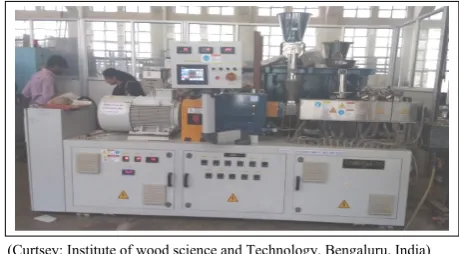
A blend of PP and HDPE were hand mixed in the ratio 1:4 (20% and 80% by weight respectively). The material compositions in weight percentage are reported in the Table 2. All the materials were dried at 85°C for 48 h to avoid plasticization, hydrolyzing effects from humidity and to obtain the sufficient homogeneity. The materials were mixed and the mixture was extruded using co-rotating twin screw extruder (Make: CMEI, Model: 16CME, SPL, chamber size 70 cc) (Figure 2). The temperature maintained in three zones of the extruder barrel were at 1800C, 1820C, 1840C respectively and the temperature at the die was set at 1850C. The extruder screw speed was set at 100 rpm which yielded a feed rate of 5 kg/h. The extruded material was obtained in the form of a cylindrical wire which was quenched in cold water and then palletized. Before compounding, all the pallets were dried at 100°C in vacuum oven for 24 h. The tensile test specimen of dimension 115mmx19mmx3mm (ASTM D638) and flexural test specimen of dimension 90mmx10mmx3mm (ASTM D790) were injection moulded from the wood polymer composites pellets using an Engel E-victory 30 with a 30 ton clamping force. The screw diameter is 22 mm with an L/D ratio of 30. Parameters of injection moulding are shown in table 3.
(Curtsey: Institute of wood science and Technology, Bengaluru, India)
Figure 2. Twin Screw extruder
Table 2. Formulations of composite in weight percentage
Composite Batch
PP/HDPE Blend (Weight in %)
Wood Fiber (Weight
in %)
Maleic Anhydride (Weight in %)
D1 100 0 0
D2 48 50 2
D3 58 40 2
D4 68 30 2
Table 3. Parameters of injection moulding
Barrel temperature (0C) 226.7
Injection speed (mm/s) 130
Injection pressure (bar) 150
Holding pressure (bar) 60
Holding time (s) 3
Cooling time (s) 60
[image:2.595.59.289.375.469.2] [image:2.595.59.536.525.754.2]2.3. Tensile Test
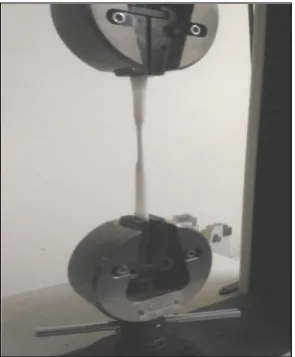
[image:3.595.304.546.79.234.2] [image:3.595.101.249.237.416.2]The tensile properties of composites were evaluated using a Universal Testing Machine (Bangalore Integrated System Solutions) according to ASTM D638-03 standards. The tests were performed at constant strain rate of 2.5mm/min. In every formulation 5 composites were tested and average is determined and noted. The load is applied until the specimen breaks and corresponding stress v/s strain curves were generated. Figure 3 shows the tensile testing setup. In tensile test, a uniaxial load was applied through both ends. Tensile test specimens are shown in the figure 4.
Figure 3. Loading arrangements for tensile test specimen
Figure 4. Tensile test specimens of D4 type formulation
2.4. Flexural Test
The flexural properties of WPCs were tested in a three point flexural setup (Figure 5) using BISS Universal Testing Machine (UTM) according to ASTM D790. The cross head speed was 2.0mm/min. Test specimens were placed in between two supports with a span length of 70mm and the load applied until the specimen breaks and corresponding stress v/s strain curves generated by data acquisition software. Flexural test specimens are shown in the figure 6.
[image:3.595.304.548.272.428.2]Figure 5. Loading arrangements for flexural test specimen
Figure 6. Flexural test specimens of D4 type formulation
2.5. Scanning Electron Microscopy
The surface characteristics of the composite material used for the investigation is studied through SEM. A scanning electron microscope (Carl Zeiss EVO 18) was used with an accelerated voltage of 20˚kV and magnification of 300× for visualization of fractured surfaces of test specimens. In order to avoid the accumulation of electrical charges during examination, the sample was covered with a thin gold layer.
3. Results and Discussions
3.1. Tensile Test Results
[image:3.595.58.291.442.592.2]Table 4. Tensile properties of the composites
Composite
Batch Load(N) Peak Ultimate Tensile Strength (MPa)
Tensile Modulus
(GPa)
D1 763 19.563 1.032
D2 531 13.621 2.646
D3 549 14.528 2.559
[image:4.595.304.536.78.261.2]D4 567 14.826 1.959
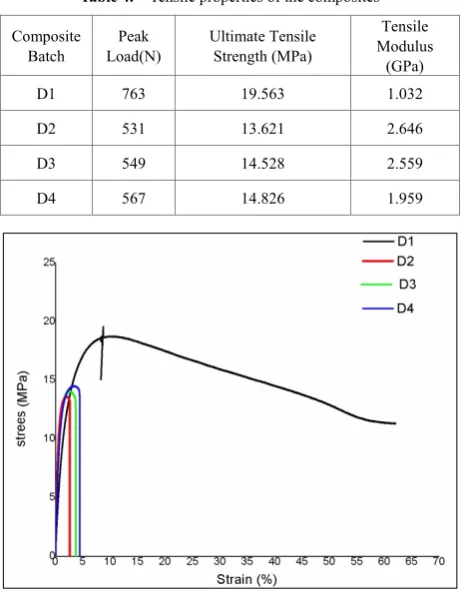
Figure 7. Stress v/s Strain graph of tensile test
The tensile strength of D1 (blend of PP and HDPE) is 19.563MPa and withstands a load of 763N. Among the three formulations of wood plastic composites i.e. D1, D2, D3, the D4 formulation exhibited higher tensile strengthof 14.826MPa. The D2 has the lower tensile strength of 13.621MPa. The composite D4 withstand the higher load of 567N.
3.2. Flexural Test Results
The ultimate flexural strength (UFS), flexural modulus and load are tabulated in the table 5. The stress v/s strain curve is shown in the figure 8. The flexural strength of D1 (blend of PP and HDPE) is 21.906MPa and withstands a load of 134N. Among the three formulations of wood plastic composites (D2, D3&D4) the composites D4 exhibited higher flexural strength of 24.724MPa and capable to withstand the load of 151N. The composites D2 have the lower flexural strength of 21.103MPa and withstands load of 129N.
Table 5. Flexural properties of the composites Composite
Batch Peak Load (N) Ultimate Flexural Strength (MPa) Modulus (GPa) Flexural
D1 134 21.906 0.642
D2 129 21.103 1.941
D3 133 21.802 2.389
D4 151 24.724 1.792
Figure 8. Stress v/s Strain graph of tensile test
3.3. Microscopic Analysis by SEM
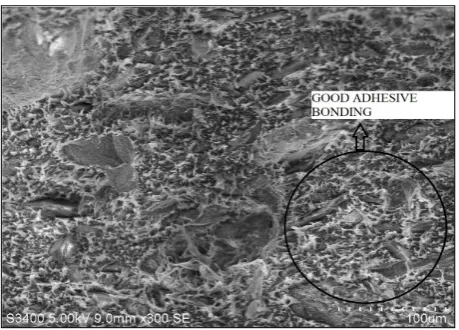
The SEM analysis has been carried out to study the failure surfaces of composite structure, particularly to examine the fibre/matrix interaction, void content, and fibre pull out of the specimens. The tensile strength of D1 specimen is 24.61MPa and this decreases with increase in wood fibre reinforcement content. This may be due to poor interfacial bonding.
[image:4.595.59.290.85.386.2]Figure 9. SEM analysis of D1 sample
[image:4.595.308.537.410.555.2] [image:4.595.310.535.579.733.2]Figure 11. SEM analysis of D3 sample
From SEM analysis, fractographic images were obtained and analysed. From Figure 9, it is attributed that the material is ductile due to the presence of wavy surfaces and web-like structure. Figure 10 indicates the presence of fibre pull-out due to poor bonding between matrix and reinforcement. From Figure 11, it is clearly evident that the material has good adhesive bonding due to the absence of fibre pull-outs and voids. Figure 12 shows good dispersion of wood particles in the matrix to provide homogeneous properties throughout the material.
Figure 12. SEM analysis of D4 sample
4. Conclusions
The composites are made using blend of PP and HDPE as matrix, wood particles as reinforcement and maleic anhydride. Mechanical properties are evaluated and following conclusions were drawn.
The composite D1 made of pure PP and HDPE blend exhibits higher tensile of 19.563MPa and flexural strength of 21.906MPa.
Composite D2 exhibited poor tensile strength.Among
three wood plastic composites i.e. D2, D3 and D4, the D4 composites with less wood particle reinforcement exhibited highest flexural strength. Hence flexural strength increases with decrease in wood particle reinforcement.
It is evident from the flexural test results that flexural strength of wood plastic composites D4 is much higher in comparison with pure plastic blend D1.
From the SEM analysis, it is attributed that the material is ductile due to the presence of wavy surfaces and web-like structure. A Good dispersion of wood particles in the matrix is observed to provide homogeneous properties throughout the material.
REFERENCES
[1] Lingesh, B. V., et al. "Hybridization effect of fibers on mechanical properties of PA66/PP blend-based thermoplastic composites." Advanced Composites and Hybrid Materials(2018): 1-11.
[2] Divya, H. V., Naik, L. L., &Yogesha, B. (2016). Processing techniques of polymer matrix composites–A review. Int. J. Eng. Res. General Sci, 4, 357-62..
[3] N Venkateshwaran, AElayaPerumal, A Alavudeen, M. Thiruchitrambalam (2011). Materials and Design 32, pp. 4017–4021.
[4] Arpitha, G. R., &Yogesha, B. (2017). An overview on mechanical property evaluation of natural fiber reinforced polymers. Materials today: Proceedings, 4(2), 2755-2760. [5] Sanjay, M. R., &Yogesha, B. (2017). Studies on
natural/glass fiber reinforced polymer hybrid composites: An evolution. Materials Today: Proceedings, 4(2), 2739-2747.
[6] Ramesh, M., Palanikumar, K., & Reddy, K. H. (2013). Mechanical property evaluation of sisal–jute–glass fiber reinforced polyester composites. Composites Part B: Engineering, 48, 1-9.
[7] Bhaskar, Jitendra, ShamsulHaq, and S. B. Yadaw. "Evaluation and testing of mechanical properties of wood plastic composite." Journal of Thermoplastic Composite Materials 25.4 (2012): 391-401.
[8] Ashori, A. (2008). Wood–plastic composites as promising green-composites for automotive industries!.Bioresource technology, 99(11), 4661-4667.
[9] Stark, N. M., &Rowlands, R. E. (2003). Effects of wood fiber characteristics on mechanical properties of wood/polypropylene composites. Wood and fiber science. Vol. 35, no. 2 (2003): Pages 167-174.
[image:5.595.61.289.79.236.2] [image:5.595.60.290.392.557.2]