Journal of Chemical and Pharmaceutical Research, 2015, 7(9):569-575
Review Article
CODEN(USA) : JCPRC5
ISSN : 0975-7384
Oral dispersible tablets: An over view
Haritwal Manish Kumar*, Kalyanwat Renu and Tiwari Ajay Kumar
School of Pharmaceutical Sciences, Jaipur National University, Jaipur
_____________________________________________________________________________________________
ABSTRACT
The need for delivering drugs to patients efficiently with minimum side effects has prompted pharmaceutical industries to be engaged in development of new drug delivery systems. Pediatric and geriatric patients find it difficult to swallow solid dosage forms like tablets. Oral dispersible tablet is solid unit dosage form. The objective of present investigation was to prepared oral dispersible tablet of Levocetirizine Dihydrochloride and Montelukast Sodium because it’s active working patients who are busy or travelling, especially those who have no access to water. This review depicts the various aspects of ODT formulation, superdisintegrants and technologies developed for ODT, along with various drugs explored, evaluation tests and marketed formulations in this field. Oral Dispersible tablets are prepared they are required to be evaluated for various parameters.
Keywords: Levocetirizine Dihydrochloride, Montelukast Sodium, superdisintegrants, Dry Granulation Technique etc.
_____________________________________________________________________________________________
INTRODUCTION
Levocetirizine (as levocetirizine dihydrochloride) is a third-generation non-sedative antihistamine, developed from the second-generation antihistamine cetirizine. Chemically, levocetirizine is the active enantiomer of cetirizine. It is the R-enantiomer of the cetirizine racemate. Levocetirizine works by blocking histamine receptors. It does not prevent the actual release of histamine from mast cells, but prevents it binding to its receptors. This in turn prevents the release of other allergy chemicals and increased blood supply to the area, and provides relief from the typical symptoms of hay fever.[2],[3].
Montelukast selectively antagonizes leukotriene D4 (LTD4) at the cysteinyl leukotriene receptor, CysLT1, in the human airway. Montelukast inhibits the actions of LTD4 at the CysLT1 receptor, preventing airway edema, smooth muscle contraction, and enhanced secretion of thick, viscous mucus. So Montelukast sodium is used in the treatment of asthma.
The tablet is the most widely used dosage form because of its convenience in terms of self administration, compactness, and ease in manufacturing. However, geriatric and pediatric patients experience difficulty in swallowing conventional tablets, which leads to poor patient compliance. To overcome this weakness, scientists have developed innovative drug delivery systems known as "Dispersible Tablets". Dispersible Tablets are also known as quick dissolves, fast melts, fast dissolving, fast disintegrating, rapid-dissolve, or orally dissolving tablets. Their characteristic advantages such as administration, anywhere, anytime lead to their suitability to geriatric and pediatric patients. They are also suitable for the mentally ill, the bedridden, and patients who do not have easy access to water. The benefits, in terms of patient compliance, rapid onset of action, increased bioavailability, and good stability. .[2],[3], [5]
EXPERIMENTAL SECTION
1. List of Chemicals and Solvents
S. No. Name Supplier / Manufacturer
1 Levocetirizine dihydrochloride Dagon pharmaceuticals pvt. Ltd, Vadodara, (Gujarat) 2 D-Mannitol Central Drug House (P) Ltd., Mumbai
3 Montelukast Sodium Ranbaxy Research Laboratories, Gurgaon 4 Magnesium Stearate Central Drug House (P) Ltd., Mumbai 5 MCC P101 Theramax Laboratories, Ambala, india. 6 Primojel (E. Merck, Mumbai)
7 Primellose Metro chemical Pvt. Ltd, Solan (H.P.) 8 Aspartame ZED pharmaceuticals Pvt. Ltd, Karnal
2. List of Instruments and Equipments
S. No. Name Supplier / Manufacturer 1 Melting Point Apparatus Hasslab Instrument ltd. China 2 Digital Weighing Balance Gottingen, Germany) 3 Double beam UV Spectrophotometer 1700-Shimadzu, Japan
4 Tablet Punching Machine Pharma tech international kolkata 5 Hardness Tester Rockwell , kolhapur
6 Friability Roche friability test apparatus 7 Disintegrator Pharma tech international kolkata 8 Heating mantle Rockwell , kolhapur
9 Magnetic stirrer Sunbim, India
3.Preparation of Powder Blend for Compression 3.1 Preparation of Granules
Step 1: All the in-active excipients and drug were passed through mesh no. 45 individually. Then dried at 50ºc for 4-5 min. So to assure that all the drug and excipients have to be used is dry in order to develop an optimized formulation through Dry Granulation Technique.
Step 2: All the drugs i.e. Levocetirizine dihydrochloride, and Montelukast Sodium along with Microcrystalline Cellulose (P101) were taken and mixed thoroughly. Then by using large mm die and punch the slugs of API + MCC p101 was formed and crushed in pestle and mortar to form granular material. Now to get fine granules the granular material passed through sieve no. 18. Finally the required size of granules was obtained
Step 3: In this step, the fine granules which were obtained again slugged using large mm die and punch because the desired hardness of tablets could not be achieved. So again it was slugged and grind in pestle and mortar and finally sieve through mesh no 18.
Step 4: In final step the excipients which were left first passed through sieve no. 18 and thoroughly mixed with granular material. Then this blend was further analyzed for its flow properties. .[2],[7],[8].
3.2Formulation of Tablet :
weighed accurately. Montelukast Sodium & Levocetirizine Hydrochloride. D-Mannitol MCC P101, Primojel, Primellose , aspartame are passed through sieve # 22.. All the above sieved ingredients were then mixed for 15 minutes. Magnesium stearate previously passed through sieve # 60 was then mixed with above blend for 5 minutes. The mixture(s) was then allowed to compress using 16 station rotary tablet compression machines with 16.0×8.0mm flat oval punches with tablet weight 500mg. .[13]
4.Evaluation of powder blend : 4.1 Bulk Density
Bulk mass Bulk Density = Bulk volume .[15]
4.2. Tapped Density ĉt = M/Vt
4.3 Compressibility Index and Hausner Ratio C = (ρt – ρb) / ρt * 100
Where:
ρt‐ Tapped density
ρb‐ Untapped bulk density
Hausner ration = ρt/ρd Where:
ρt is tapped density
ρd is bulk density.
Hausner’s ratio = (Tapped density x 100)/ (Poured density) Hausner’s ratio <1.25 – Good flow = 20% compressibility index 1.25– Poor flow =33% compressibility index
4.4 Angle of Repose
Ө =tan- h/r Where,
Ө is the angle of repose h is height of pile
r is radius of the base of pile
Table 1: Result of Powder Blend Evaluation
Parameters Batch A1 Batch A2 Batch A3 Batch A4 Batch A5 Batch A6 Batch A7 Batch A8 Batch A9 Bulk density 0.694 0.701 0.710 0.662 0.713 0.697 0.777 0.723 0.747 Tapped Density (TD) 0.857 0.877 0.839 0.813 0.856 0.872 0.919 0.913 0.955 Angle of repose 29.2º 27.3º 28.5º 26.2º 28.1º 25.2º 24.9º 25.4º 24.3º Carr’s Compressility index 19.25 20.06 16.57 19.68 19.41 16.70 20.06 20.78 14.37 Hausner Ratio 1.24 1.17 1.23 1.25 1.33 1.25 1.26 1.30 1.20
Evaluation of Oral Dispersible Tablet :
TABLE : 2 Result of Tablet Evaluation
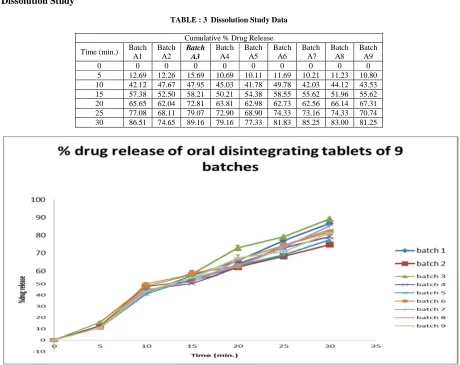
Dissolution Study
TABLE : 3 Dissolution Study Data
Cumulative % Drug Release Time (min.) Batch
A1
Batch A2
Batch A3
Batch A4
Batch A5
Batch A6
Batch A7
Batch A8
Batch A9
0 0 0 0 0 0 0 0 0 0
5 12.69 12.26 15.69 10.69 10.11 11.69 10.21 11.23 10.80 10 42.12 47.67 47.95 45.03 41.78 49.78 42.03 44.12 43.53 15 57.38 52.50 58.21 50.21 54.38 58.55 55.62 51.96 55.62 20 65.65 62.04 72.81 63.81 62.98 62.73 62.56 66.14 67.31 25 77.08 68.11 79.07 72.90 68.90 74.33 73.16 74.33 70.74 30 86.51 74.65 89.16 79.16 77.33 81.83 85.25 83.00 81.25
Figure :1 drug release of batch A1 to A9
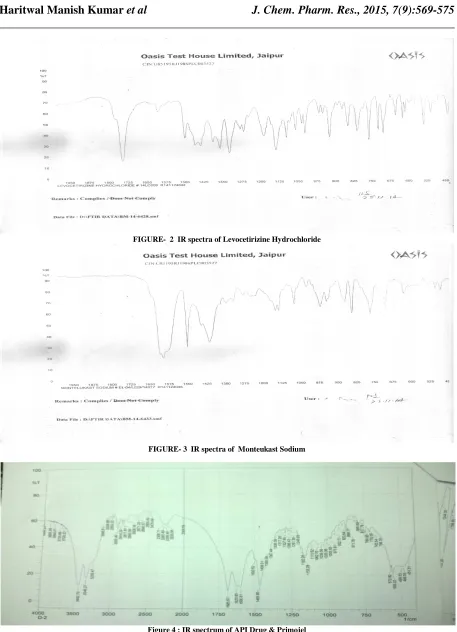
5.Drug Excipients Interaction Study : FT-IR Spectroscopy Method
FIGURE- 2 IR spectra of Levocetirizine Hydrochloride
[image:5.595.71.528.68.700.2]FIGURE- 3 IR spectra of Monteukast Sodium
Figure 5 : IR spectrum of API Drug & Primellose
Summary
The aim of present investigation was to formulate and evaluate of oral dispersible tablet of levocetrizine dihydrochloride and montelukast sodium. Levocetrizine dihydrochloride is Antihistaminic Drug, and Montelukast sodium is Antiasthmatic Drug. This oral dispersible tablet dissolved in pH 6.8 in saliva. Development of oral dispersible tablet dosage form can be advantageous, that can provide quickly disintegrate in saliva and increase efficacy of the dosage form. In dissolution profile batch A3 is give a good % release of drug with superdisintegration (primogel). In Simultaneous estimation curve show that three drugs (Levocetirizine Dihydrochloride and Montelukast Sodium) release in tablet simultaneous. So, finally obtained batch A3 which is suitable for our experiment.
CONCLUSION
Oral dispersible tablet of Levocetirizine Dihydrochloride and Montelukast Sodium was prepared by dry granulation method using primogel superdisintegrant. Tablets disintegration oral cavity and acceptance friability and hardness. In vitro drug releaseing from the tablets shows the significantly improved the drug dissolution. Hence it could be conclude that the superdisintegrant based oral dispersible tablet of Levocetirizine Dihydrochloride,and Montelukast Sodium would be quite effective in emesis, providing quick onset of action without need of water for administration
REFERECES
[1]Priyanka Nagar, Kusum Singh, Iti Chauhan, Madhu Verma, Mohd Yasir, Azad Khan, Rajat Sharma and Nandini Gupta , Journal of Applied Pharmaceutical Science 2011 01 (04) 35-45.
[2]Arindam Basu, Krishnendu Basak1, Mithun Chakraborty1, Inder Singh Rawat International Journal of
PharmTech Research CODEN (USA) Vol.3, No.1, Jan-Mar 2011 405-410.
[3]V. Choudhari ,A. Kale , S. Abnawe ,B.Kuchekar ,V.Gawli ,N. Patil , International Journal of PharmTech
Research CODEN (USA) Vol.2, No.1, Jan-Mar 2010 04-09.
[4]Patel Nilam K. and Pancholi S. S., Determinated the Montelukast Scholars Research Library Der Pharma
Chemica, 2011, 3 (5) 135-140.
[5]Smita Sharmaa, M. C. Sharma, D. V. Kohli, Scholars Research Library Der Pharmacia Lettre, 2010: 2 (1) 489-494
[6]Malay Kumar B Chotaliya , Sumit Chakraborty , International Journal of PharmTech Research CODEN (USA): IJPRIF Vol.4,Oct-Dec 2012 1712-1720.
[7]Snehalatha.,a Lakshmi Radhika.,aYogananda, R. Nagaraja, T.S. J. Pharm. Sci. & Res. Vol.1(4), 2009, 146-150. [8]Nagar M, Yadav AV: International Journal of PharmTech Research Oct-Dec 1(4):2009; 1079-1091.
[9]Debjit B, Chiranjib B, Krishnakanth, Pankaj, Margret Chandira R: Journal of Chemical and Pharmaceutical
Research 1(1):2009; 163-177.
[11]Tekade NP, Bhajipale NS, Ganesan V, Thenge RR, Dewade DR: International Journal of Chem Tech Research 2(1): Jan-Mar 2010; 400-405.
[12]Sharma C, Dangi V, Gupta A, Ahamad D, Ahmad , International journal of pharmacy & life sciences 1(5):2010; 250-256.
[13]Radke RS, Jadhav JK, Chajeed MR. International Journal of ChemTech Research. July-Sept 1(3):2009; 517-521.
[14]Ghorwade V, Patil A, Patil S. RJPBCS. 2(3):2011 , 882.
[15]Sammour OA, Mohammed AH, Megrab NA, and Zidan AS AAPS Pharm SciTech, 7(2), 2006,67-109
[16]Subramanian S, Sankar V, Manakadan AA, Ismailand S, Andhuvan G Pak.J. Pharm .Sci., 23(2), April 2010, 232-235.
[17]Fini A, Bergamante V, Ceschel GC, Ronchi C, Alberto C, Moraes FD, European Journal of Pharmaceutics and
Biopharmaceutics,, 2008, 335–341.
[18]Aly AM, , International Journal of Pharmaceutical Sciences and Nanotechnology, 1(3), Oct - Dec 2008,45-89. [19]Swathi S, Neeharika V, Lakshmi PK Drug Invention Today 3(10): 2011; 250-256.
[20]Gaur K, Tyagi LK, Kori ML, Sharmab CS, Nemac RK: International Journal of Pharmaceutical Sciences and
Drug Research 3(1): 2011; 19-22
[21]Bhardwaj V, Bansal M, Sharma PK: American- Eurasian Journal of Scientific Research 2010 5(4):; 264-269. [22]Dr. Lakshmi CSR, Patel NJ, Patel HP, Akul S nternational Journal of Pharmaceutical Sciences Review and
Research January – February 2011 6(2):; 178- 182.
[23]Patil A, Aman T, Bhargava NB, Abhilash P, Turaga M, Kulkarni S: Research Journal of Pharmaceutical,
Biological and Chemical Sciences July September 2011 2(3):; 268- 274.
[24]Valleri M, Mura P, Maestrelli F, Cirri M, Ballerini R. Drug Dev Ind Pharm. 2004; 30(5): 525-34.
[25]Hanawa T, Watanabe A, Tsuchiya T, Ikoma R, Hidaka M, Sugihara M. Chem Pharm Bull. 1995; 43(2): 284-288.
[26]Mallet L. J. Am. Pharm. Assoc. 1996; 36(11): 628-635. [27]Porter SC. Am Pharm Rev. 2001; 28-35.
[28]Bradoo R, Shahani S, Poojary S, Deewan B, Sudarshan S. JAMA. 2001; 27-31. [29]Dobetti L. Pharm Tech. 2001; 37: 44-50.
[30]Lorenzp- Lamosa M L, Cuna M, Vila-Jato JL, Torres D. J Microencapsul. 1997, 607. [31]Chang RK, Guo X, Burnside BA, Couch RA. Pharm Tech. 2000; 24: 52-58.
[32]Caraballo I, Fernandez-Arevalo M, Millan M. Drug Dev Ind Pharm. 1997; 23: 665–669.
[33]Liberman H.A, Lachman L, Schawstr JB. Pharmaceutical Dosage Forms: Tablets. 1989; vol 2: 173-177. [34]Aulton ME. Pharmaceutics; 2nd ed. 2001; Characteristic of Disintegrants; p 406-40.
[35]Cean CS, Glashan JMM, Neathercoat GC, Parsons AV. Martindale: The complete drug reference. Great Britain; RPS publishers. 35th ed. 2007. Vol. 1. p 815-817.
[36]Cooper J, Gunn C. Power flow and compaction: In: Caroter SJ, ed. Tutorial pharmacy. New Delhi, India; CBS publishers and distributors. 1986: p 211–233.
[37]Subrahmanyam CVS. Laboratory manual of physical pharmaceutics. New Delhi, India; Published by Vallabh Parkashan; 1st ed. 2002, 46-53.
[38]International Journal of PharmTech Research CODEN (USA): IJPRIF Oct-Dec 2009 Vol.1, No.4, 1079-1091
[39]Adel M, Semreen M K, Qato M K. 2005. Pharm Tech. 2005, 68-75..
[40]Sahu et al., International Journal of Pharmaceutical Science 2012, 1(3):204-211.
[41]Kizumi K., Watanabe Y., Morita K., Utoguchi N. and Matsumoto M. Int. J. Pharm. 1997. 152: 127-31. [42]Dong Y., Kulkarni R., Behme R.J. and Kotiyan P.N. Int. J. Pharm. 2007; 329,72-80.
[43]Abdelbary G., Prinderre P., Eouani C., Joachim J., Reynier J P. and Piccerelle P. Int. J. Pharm. 2004, 278: 423-33.
[44]Dobetti L. Drug Deliv. 2001,44-45.
[45]Seager H.J., Pharm. Pharmacol.1998,50:375-382
[46]Allen L.V., Wang B. and Davis J.D. US patent 5: 807 & 567, 1997. Acosta C., Tabare R. and Ouali A. US patent 5: 807, 1998..
[47]Kuno Y., Kojima M., Ando S. and Nakagami H. J. Control Release. 2005; 105: 16-22. [48]Biradar S.S., Bhagavati S.T. and Kuppasad I.J. Internet. J. Pharmacology. 2006,4(2): 122-155.
[49]Fu Y., Yang S., Jeong SH., Kimura S., and Park K. Crit. Rev. Ther. Drug Carrier Sys. 2004, 21: 433-76. [50]Debetti L. “ Pharm. Technol. 1980, 4, 49-57.