Journal of Chemical and Pharmaceutical Research, 2014, 6(5):808-814
Research Article
CODEN(USA) : JCPRC5
ISSN : 0975-7384
Research and application of carya cathayensis classification based
on fuzzy comprehensive evaluation
Songwei Zeng
1,2, Changying Ji
2and Qinfeng Yu
11
School of Information Engineering, Zhejiang Agriculture & Forestry University, Lin’an, PR China
2College of Engineering, Nanjing Agricultural University, Nanjing, PR China
_____________________________________________________________________________________________
ABSTRACT
The existing grading evaluation system of Carya cathayensis is not suitable for the development of Carya cathayensis market in China. In this paper, a new grading standard and evaluation system (GSES) is proposed for Carya cathayensis classification problem based on fuzz rules. The proposed scheme consists of three levels, namely, target layer, factor evaluation layer and further refinement layer. Finally, the proposed method is applied into the evaluation for Carya cathayensis of three different brands, and the results are satisfactory. Compared with the conventional method, the proposed scheme is effective and reasonable for the evaluation of Carya cathayensis.
Keywords: Carya cathayensis; Classification; Fuzzy comprehensive evaluation; Agriculture product quality
grading (APQG)
_____________________________________________________________________________________________
INTRODCUTION
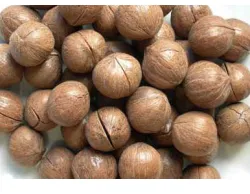
[image:1.595.244.369.600.697.2]Carya Nutt is one of the most popular nuts, which belongs to walnut carya of juglandaceae. It contains 18 species and 3 varietas, and is mainly distributed in Asia, Europe and America. In those species, there exists two species with features of high economic value and artificial cultivation, namely, Carya illinoensis from North America and Carya cathayensis from China. Carya cathayensis shown in Figure 1 is one of the oldest relic species, which mainly comes from the Mountain Tianmu district between Anhui and Zhejiang. As an important trees of nuts and wood oil, Carya cathayensis can be used as the source of fragrant oil, and can reduce blood lipoid, nourish lung, prevent and cure the heart and cerebral vascular diseases. Its pulp is delicious, and contains rich minerals, about 7-9% proteins, and 17 kinds of amino acids (including 7 kind of human body essential amino acids) [1-2].
Fig. 1. Carya cathayensis
national quality grade standard of 1987 and 1988 Edition in China, which is not suitable for expansion of products export, improvement of market efficiency, and sustainable development of Carya cathayensis industry[3]. In this paper, a new grading standard and evaluation system (GSES) is proposed for Carya cathayensis classification problem.
The remainder of this paper is organized as follows. Section 2 introduces the current development situation, discusses the insufficiency of Carya cathayensis GSES, and proposes a new grading standard and evaluation system. Section 3 presents model checking and results. Finally, a conclusion is given in Section 4.
EXPERIMENTAL SECTION
2.1 Materials
According to the most popular brand of Lin'an Carya cathayensis (2008), we select three brand products of “Donglin”, “Linjia”, “Longjing”, and 0.5 kg of each sample is used to analyze.
2.2 Instruments and tools
Vernier caliper: Mitutoyo-530
Electronic balance: Ab204-N(Mettler Toledo).
Automatic azotometer:(kjeltec2300).
Electric heating air-blowing drier : LDHG-9140AS(Ningbo)
2.3 Methods
To determine the nutritional composition, sensory, physical and chemical indicators, We adopt the mentioned methods in[4-6].
2.4 PRESENT CONDITION OF CARYA CATHAYENSIS GSES
Agricultural modernization depends heavily on an agricultural products market, which can efficiently allocate various resource factors. As the base of agricultural products market, agriculture product quality grading can reduce transaction costs of agricultural products, improve market efficiency, promote technology innovation.
Agriculture product quality grading (APQG) is generally divided into grade classification and size classification, involving many physical and chemical indicators[7]. The grade grading refers to excellent, good, medium, pass, substandard, etc., and its evaluation indicators refer to surface color, luster, internal sugar content, acidity, flesh firmness, nutrition and trace elements, kernel rate, external damage, internal defects, grotesque, etc.. The size grading refers to diameter, length, thickness, weight and other evaluation sites.
The quality grading of Carya cathayensis refers to classifying products into different quality grades according to its quality standards. Now, Carya cathayensis in Chinese markets mostly transacts business by mixed-grade or by manual rough classification. Naturally, it is difficult to improve the commercialization of products and to increase its industrial added value. In addition, the disadvantages caused by manual classification, such as time-consuming, inefficient, low accuracy and poor consistency, can affect the sequent product processing [8].
standards, and the classification is mainly reflected at the circulation of agricultural products, such as the needs of packaging, transport and storage. It lacks a synthetic consideration.
In short, the current grade criteria are mostly qualitative rather than quantitative. Therefore, the quality difference is very large even though among the same grade products owing to their different origins. Such case causes easily confusion or misunderstanding for consumers. APQG can play a certain role in the aspects of reduction of diversity and transaction costs. However, some aspects, such as scientificity of grading criteria, grading support services, and the actual combination degree among grading criterion, production, circulation and sales, need to be further strengthened. There are a series of problems to be solved, such as oversimplified and fuzzification, lack of quantitative indexes, lack of understanding of organoleptic indexes, physiochemical indexes and health indexes, lack of maneuverability and lagged update of graded indexes.
2.5 GRADING STANDARDS AND COMPREHENSIVE EVALUATION SYSTEM OF CRAYA CATHAYENSIS
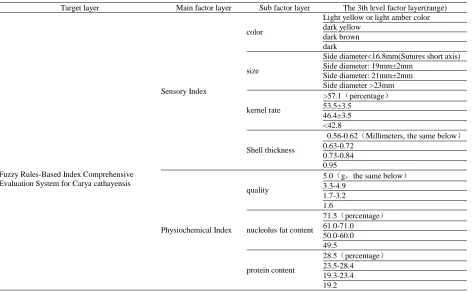
[image:3.595.73.548.396.688.2]A complete product quality classification system should include quality grades, quality standards, quality inspection, and quality certification. APQG and its different criteria are the foundation of the classification. Due to the quality indexes including size, chromaticness, saturation, palate, kernel ratio, nucleolus fat content and protein content, we should consider the above factors when formulating a scientific, normative and effective grading evaluation system of Carya cathayensis, which should follow the formulation principle of sciences, practicality, easy operating, diversification and guidance. The system is divided into three levels, the first level is a target layer; the second level is a factor evaluation layer including main factor layer and sub factor layer, and the sub factor layer is taken into account the different needs of production, sale and circulation, which consists of several parts such as sensory evaluation, physical and chemical evaluation; the third level is a further refinement for the second level, and the weights or grades are given according to the above-mentioned quality indexes. According to the above formulation principles, a new quality evaluation system of Carya cathayensis is proposed based on fuzzy rules as shown in Table 1.
Table 1: Quality evaluation system of Carya cathayensis based on fuzzy rules
Target layer Main factor layer Sub factor layer The 3th level factor layer(range)
Fuzzy Rules-Based Index Comprehensive Evaluation System for Carya cathayensis
Sensory Index
color
Light yellow or light amber color dark yellow
dark brown dark
size
Side diameter<16.8mm(Sutures short axis) Side diameter: 19mm±2mm
Side diameter: 21mm±2mm Side diameter >23mm
kernel rate
>57.1(percentage) 53.5±3.5
46.4±3.5 <42.8
Shell thickness
0.56-0.62(Millimeters, the same below) 0.63-0.72
0.73-0.84 0.95
Physiochemical Index
quality
5.0(g,the same below) 3.3-4.9
1.7-3.2 1.6
nucleolus fat content
71.5(percentage) 61.0-71.0 50.0-60.0 49.5
protein content
28.5(percentage) 23.5-28.4 19.3-23.4 19.2
2.6 Determination of Weights and Fuzzy Membership Functions System of Quality index evaluation for Carya cathayensis
(1) Main factor level set
U
is divided into two groups, namely{
1 2}
1
u
, u
U
=
, 2
{
3 4 7}
,
,
u
u
u
U
=
L
(2)Setting a judgment set
V
=
{
v
1,
v
2,
v
3,
v
4}
.where
v
i(i
=
1
,
L
,
4
) represent super,1th level,2th level and 3th level, respectively.(3) Determination of Judgment matrix
To obtain the index values of organoleptic and physiochemical by adopting the proposed method in[13]. Firstly, the membership values of single-factor are gained. Then, we determine the index value of evaluation in the same under the hierarchy of AHP[16-17]. To determine the matrix by pair-wise comparison method for the relative importance, we give the weight value of a combination for factors according to the expert experiences. Finally, we can obtain the priority of the layer of main factors.
Weights of the main factor Layer is drawn from expert experiences according to the importance of the main elements in grading evaluation.
Determination of the judgment matrix
A
andB
i(i
=
1
,
2
) uses the following procedure: firstly, the pairwisecomparison of their importance is conducted according to different expert experiences; then, the weights are determined by solving the characteristic value; finally, the matrix elements are given by using standard 1-9 scale method.
According to the above procedure, the judgment matrixes are given as follows:
= 1 3 3 1 1 A (1) and = 1 3 2 . 0 5 33 . 0 1 33 . 0 3 5 3 1 7 2 . 0 33 . 0 143 . 0 1 1 B , = 1 3 33 . 0 33 . 0 1 2 . 0 3 5 1 2 B (2)
2.7 Membership functions for quality indexes evaluation of Carya cathayensis
According to the statistical results of six economic properties (i.e. nuts diameter, average fruit weight, shell thickness, kernel ratio, nucleolus fat content and protein content) for 803 kinds of Carya cathayensis made by GUO Bao-lin, the fuzzy membership functions of each factor are given as follows:
Membership Function of Size:
(3)
where
a
1=
16
.
80
,a
2=
23
.
00
, respectively.Membership Function of Shell Thickness:
(4)
where
a
1=
0
.
62
anda
2=
1
.
26
, respectively.Membership Function of Quality:
(5) ≥ − ≤ = 1 0 ) C( 2 3 2 3 1 1 2 1 3 1 3 3 a a a a a a a χ χ χ χ
χ p p
≥ − ≤ = 1 0 ) C( 2 1 2 1 1 1 2 1 1 1 1 1 a a a a a a x a χ χ χ
χ p p
≥ − − − ≤ = 2 2 2 2 1 1 2 1 2 1 2 2 0 1 1 ) C( a a a a a a a χ χ χ χ
where
a
1=
2
.
30
anda
2=
3
.
70
, respectively.Membership Function of Kernel rate:
(6)
where
a
1=
42
.
80
anda
2=
53
.
20
, respectively.Membership Function of Nucleolus Fat Content:
(7)
where
a
1=
65
.
50
anda
2=
49
.
50
, respectively.Membership Function of Protein Content:
(8)
where
a
1=
28
.
50
anda
2=
19
.
20
, respectively.2.8 Total Sequencing Level and Consistency Checking
(1)Hierarchy single sorting and Consistency Check
From the above mentioned, the gained judgment matrixes maybe cause some problems, for example,
a
ija
jk≠
a
ik. To avoid such case, we should make a consistency check.The eigenvector
AW
, which corresponds to the maximum (absolute value) eigenvalue of the judgment matrix A,is calculated in the proceeding of Hierarchy single sorting. To gain the weight
w
i, the column of judgment matrixA
orB
should be normalized. For ease of presentation, we takeA
=
(
a
ij)
n×m for an example. AfterA
beingnormalized, we get
A
'
=
( )
a
'
ij n×m given as:(9)
Then the weight
w
i is given as:∑
==
=
m j iji
a
i
m
w
1,
,...,
2
,
1
,
'
(10)According to the values of Table 1, the eigenvector of
AW
is given as:T
AW
=
(
0
.
25
,
0
.
75
)
(11)Then
AW
corresponds toλ
max , given as: = ∑ ∑ ∑ ∑ = = = = n i im nm n i i n n i im m n i i a a a a a a a a A 1 1 1 1 1 1 1 1 11 ' L O M L ≥ − ≤ = 1 a 0 ) C( 2 4 2 4 1 1 2 1 4 1 4 4 a a a a a x a χ χ χ
χ p p
≥ − ≤ = 1 a 0 ) C( 2 5 2 5 1 1 2 1 5 1 5 5 a a a a a x a χ χ χ
χ p p
≥ − ≤ = 1 0 ) C( 2 6 2 6 1 1 2 1 6 1 6 6 a a a a a a x a χ χ χ
995 . 1 ) ( 1
max =
∑
== n i i i nw AW n λ (12)
So, random consistency is entirely consistent. By the same token, other parameters are given as follows:
1 . 0 / 1 -n n -) 23 . 0 13 . 0 58 . 0 06 . 0 (
1 = = max =≤
R C BW R λ , , , , (13) 1 . 0 028 . 0 / 1 -n n -), 26 . 0 10 . 0 64 . 0 (
2 = C = max R = p
BW R
λ
,
, (14)
(2) Total ranking and its consistency test Total ranking: ) 195 . 0 , 075 . 0 , 480 . 0 , 058 . 0 , 033 . 0 , 145 . 0 , 015 . 0 ( 26 . 0 10 . 0 64 . 0 0 0 0 0 0 0 0 23 . 0 13 . 0 58 . 0 06 . 0 75 . 0 25 . 0 = ) , ( (15) Consistency index: 1 . 0 06 . 0 1
1 = p
=
∑
∑
= = m i i i m i i i R R a C a C (16)So, we can get Carya cathayensis quality evaluation results.
RESULTS AND DISCUSSION
[image:6.595.63.544.91.389.2]The results of each sample are shown in Table 2.
Table 2: Values of various indexes
index Value brands
Size(mm) kernel rate(%)Shell thickness(mm)Quality(g)nucleolus fat content (%)protein content(%) AVG STD AVG STD AVG STD AVG STD AVG STD AVG STD DongLin 22.43 1.140 0.520 0.031 0.8653 0.200 3.403 0.209 0.618 0.008 25.8 0.249 LongJing 22.51 1.429 0.487 0.053 0.7040 0.193 3.361 0.418 0.634 0.009 22.8 10.6 LinKang 22.75 1.340 0.509 0.047 0.700 0.17 3.565 0.378 0.637 0.004 27.3 5.13
And the scores of every index are shown in Table 3.
Table 3: Results of every index
Score
Brand Size(mm)
kernel rate(%)
Shell thickness(mm)Quality(g)
nucleolus fat content (%)
protein content(%) total score
DongLin 0.908 0.885 0.617 0.714 0.769 0.709 0.746 LongJing 0.921 0.567 0.865 0.686 0.869 0.387 0.738 LinKang 0.960 0.779 0.875 0.832 0.868 0.871 0.883
We set the total score over 0.85 for premium, 0.7 for level 1, 0.6 for level 2 , 0.5 for level 3. Therefore, we can be drawn conclusion from the table, The sample of “DongLin” is premium, the sample of “LongJing” and “LinKang” are level 1 , the conclusion isn’t same of the traditional methods.
Compared with the existing grading standards of Carya cathayensis, the fuzzy hierarchical classification method takes into account the impact of sensory, chemical and other walnut grading weights. Which is better reflect the quality of walnut quality, It is more effective and more reasonable evaluation method.
CONCLUSION
[image:6.595.92.521.395.455.2]Acknowledgments
The authors would like to express their appreciation to the referees for their helpful comments and suggestions. This work was supported by the Zhejiang Provincial Natural Science Foundation of China (Grant No.LY13C200014 and Y3100367), Education Department of Zhejiang Province of China (Grant No.Y201225717) ,Forestry Department (Grant No.2010B13) of Zhejiang Province of China and the scientific research fund of Zhejiang University of agriculture and forestry(Grant No. 2012FR085).
REFERENCES
[1]JP Wang;YN Li;JW Ma.Food Scienee,1998,19(4):44-46.
[2]L Liu; M Gong;GH Xia;JQ Lv.Forest Research,2006,19 (3):376-378. [3]BL Guo;JX Yang.Acta Horticulturae Sinica,2000,27(3):161-166. [4]LL Shao;JJ Xu;L Zhang;et al..Food Science, 2010,31(24):424-426. [5]CY Xu;XR Su;YY Li;et al..Acta Nutrimenta Sinica,2009,31(4):384-387.
[6]XB Qian;WX Xu;YY Zhang;et al..Journal Of Zhejiang Forestry College,2009,26(4):511-515. [7]J. Chem.Pharm. Res., 2011,3(6):759-765.
[8]X He.M.S.Thesis,Xinjiang agriculture university,2010.
[9]YP Zhang,HC Zhang,WS Liu,et al.. High yield of walnut and quality of nuts(National standard), Chinese Standard Publishing House published, Beijing, 1987;1-14
[10] B Jia,Y Kang,SC Liu. Walnuts(National standard),Chinese Standard Publishing House published, Beijing,
1988;1-5
[11] WD Wang,G Wang, JK Zhang,et al..Carya cathayensis quality grade,Chinese Standard Publishing House published,Beijing, 2006;1-6.
[12] YP Wang,XH Yao,KL Wang,et al..Quality grades of products for Carya cathayensis Sarg, Chinese Standard Publishing House published,Beijing, 2009;1-12.
[13] JJ Liu;LJ Yao; ZL Peng.Journal of Zhejiang agricultural sciences, 2010,22(6):1976-1978. [14] JJ Liu;LJ Yao; ZL Peng. Acta Agriculturae Zhejiangensis ,2010,22(6): 854-858.
[15] Xiaoling Li;imin Yuan. Pharm. Res., 2014, 6(2):129-132
[16] JJ Xie;CP Liu.Press of Huazhong University of Science and Technology,Wuhan,2005;210-239 [17] ZL Cheng.Pharm. Res., 2014, 6(4):6-13