Journal of Chemical and Pharmaceutical Research, 2014, 6(5):1868-1872
Research Article
CODEN(USA) : JCPRC5
ISSN : 0975-7384
An optimal transporting timber control scheme in wood logistics networks
with minimized cost
Meng Li
1, Ronghua Ji
2and Lairong Chen
1*
1
The School of Technology, Beijing Forestry University, Beijing, China
2
College of Information and Electrical Engineering, China Agriculture University, Beijing, China
_____________________________________________________________________________________________ABSTRACT
This paper proposes an optimal transporting timber control scheme in wood logistics networks. Our approach is a time control model based on utility theory to minimize the transportation cost in wood logistics networks, three parameters are considered in the model: transportation cost, storage cost and congestion cost. A discussion of the solution to the model is given to prove the effectiveness of the model. It is shown that the optimal timber configuration can be obtained through the numerical results, the optimal timber and minimized cost can be obtained through the utility model.
Key words:Timber control, wood transportation, wood logistics network, utility function
_____________________________________________________________________________________________
INTRODUCTION
Wood transportation is one of the core parts in wood logistics network, which means transporting wood from logistics centers to wood required places after being cut from forest regions [1]. It includes transportation between forest regions and logistics centers, between logistics centers and wood required places, and timber management in the transportation step. In order to control the transportation cost, it is essential to research the transporting timber control in wood logistics networks, which has attracted a great deal of research interests all over the world.
Transporting timber control is a challenging issue for transportation cost control in wood logistics networks, because timber transportation cost occupy a large proportion in the total cost of wood logistics system [2]. Lots of works have been down on transportation route optimization [3-6], but the transporting timber control is one of the key problems need to be researched to control the transportation cost after the route optimization. In [7], authors establish a stochastic control model and find the optimal dynamic strategy about harvesting quantity in the continual and multiple periods in conditions of stochastic commodity price and timber growth by using portfolio approach. In [8], authors firstly defines the concept of wood logistics base, secondly analyzes three key problems on the design of logistical processes. In this work, we take a utility-based approach to transporting timber control problem in wood logistics networks, that utility theory has been widely used to solve the control and optimization problems in logistics networks. In this paper, the utility function will consider the transportation cost, storage cost and congestion cost. Some kind of works have been down in our previous work [9], which didn’t consider the congestion cost for the optimal timber control.
SYSTEMMODEL
Fig.1 System Model
We focus our analysis on the timber control in the wood logistics networks (Shown in Fig.1). In our model, the logistics centers are assumed to be located in the wood cutting place. Assuming there are M
1, 2,3, , m
logistics centers, and N
1, 2,3, , n
wood required places, the transportation expense between logistics center iand wood required place j is Cij, then Cij can be expressed as follows: ij ij ij ij
C r d W (1)
Where rij is the transportation expense rate between logistics center i and wood required place j , in unit of transportation expense per kilometers per ton. dij is the transportation distance between logistics center i and wood required place j, andWij is the timber volume between logistics center i and wood required place j.
Generally, there is an upper-limit of timber volume for logistics center, which is given by
1 2 1
n
ij i i in i
j
W W W W W
(2)WhereWi is the storage up limit of logistics center i.
For each logistics center, in order to transport timber for wood required places, it will have storage cost. Let Sij denote the storage cost of logistics center i store timber for wood required place j. And Sij can be expressed as
2ij ij ij i
S W W (3)
Where ij is the storage unit cost, Wi is a storage threshold. In the wood transportation, some wood may be congested on the road, had has additional cost, which can be expressed as
ij ij ij
D W (4)
Where ij is a positive congestion cost parameter. Then the utility function (cost function) between logistics center
i and wood required places j can be expressed as
2
2
ij ij ij ij
ij ij ij ij ij i ij ij
ij ij ij ij ij ij i
U C S D
r d W W W W r d W W W
(5)
1 1 2 1 1 m n ij i j m nij ij ij ij ij ij i i j
U U
r d W W W
(6)Note that (6) demonstrates the utility functions interdependence among logistics centers and wood required places. In the utility-based framework, it is desirable to minimize the cost earned by logistics networks. Then, as our objectives here are to minimize the utility function under upper-constraint of timber for logistics center, the proposed utility minimization problem can be expressed as follows.
1 1 2 1 1 min min min m n ij i j m nij ij ij ij ij ij i i j
U U
r d W W W
(7) Subject to 1 2 1 nij i i in i
j
W W W W W
,for all i M M ,
1, 2,3, , m
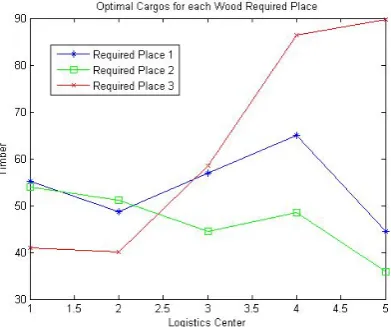
(8)In the above optimization problem, the minimization can be achieved with optimized timber level. Formula (7) is the total utility level of the transportation networks. Formula (8) is the crucial timber constraint of every logistics centers. Solving the optimization problem of formula (7) and (8), yielding in finding the optimized timber control of every logistics centers under constraint to minimize the total cost.
SOLUTIONS
In this section, the dynamic optimization programs and solutions to the utility function (7-8) will be discussed. The utility function (7-8) can be solved by Lagrange multiplier technique. The Lagrange equation for the optimization problem in (7-8) is
2
1 1
1 1
m n
ij ij ij ij ij ij i i j
m n
i ij i
i j
F r d W W W W W
(9)By taking the derivative of (9), we get
1 1
2 m n
ij ij ij ij ij i ij i j
dF r d W dW
(10)Let the partial derivative to be zero, and then we have
2 0
ij ij ij ij ij i
r d W (11)
Solve the above formulas and the solutions are
2 i ij ij ij ij
ij
r d W
(12)
Substituting formula (8) into (12), we can find that i follows the below equation.
1 2
n
i ij ij ij i j ij r d W
(13)Then we can get i as
1 1 2 1 2 nij ij ij i j ij i n j ij r d W
(14)
1 1
1
1
2 2
1 2
2
n n
ij ij ij
i ij ij
j ij j ij
ij n
ij j ij
r d
W r d
W
(15) [image:4.595.69.546.189.479.2]As we have solve the optimization problem based on the Lagrange multiplier approach. As being proposed in the above, the Lagrange multiplier approach results in different solutions for every logistics centers.
TABLE I. SIMULATION PARAMETERS
Parameters Value
Number of logistics centre M 5
Number of wood required places N 3
Upper-limit of freight volumeWi 150 140 160 200 170
Congestion cost parameter
ij
i1 i2 i3 i4 i5
1
j 13 14 5 6 17
2
j 4.5 5.5 16.5 17.5 18.5
3
j 12.5 11.5 10.5 1.5 2.5
Transportation expense rate
ij
r i1 i2 i3 i4 i5 1
j 0.2 0.3 0.4 0.5 0.6
2
j 0.25 0.35 0.45 0.55 0.65
3
j 0.22 0.32 0.42 0.52 0.62
Transportation distance
ij
d i1 i2 i3 i4 i5 1
j 20 30 40 50 60
2
j 35 25 50 65 70
3
j 40 45 30 20 15
Unit storage cost
ij
i1 i2 i3 i4 i5
1
j 0.7 0.73 0.82 0.85 0.89
2
j 0.75 0.78 0.85 0.91 0.95
3
j 0.89 0.85 0.78 0.75 0.67
Simulations
[image:4.595.206.402.588.751.2]Fig.3 Minimized utility for every logistics centers
CONCLUSION
In this paper, we have discussed the transportation cost minimization problem in wood logistics network based on utility function. A utility-based mode is given and it is proved that optimal timber configuration can be obtained and the transportation cost can be minimized.
ACKNOWLEDGEMENT
We wish to acknowledge the help of China Agricultural University. This work was supported by National Key Technology R&D Program of China during the 12th Five-Year Plan Period (Grant #: 2012BAJ18B07)
REFERENCES
[1]Na-cui L I U, Ya-hui L I N, Rong-zu Q I U.Logistics Technology,2006, 8: 006.
[2]Carlsson D, Rönnqvist M.European Journal of Operational Research,2005, 163(3): 589-616.
[3]Fellows M R, Fernau H.Discrete Applied Mathematics,2011, 159(11): 1118-1130.
[4]Troncoso J J, Garrido R A.Forest Policy and Economics,2005, 7(4): 625-633.
[5]Gen M, Choi J, Ida K.Artificial Life and Robotics,2000, 4(2): 96-102.
[6]Syarif A, Gen M.Journal of Intelligent Manufacturing,2003, 14(3-4): 389-399.
[7]Xiao J, Kang W, Yin S. A Stochastic Model and a Portfolio Approach to the Optimal Forest Management[C]. Business Intelligence and Financial Engineering (BIFE), 2010 Third International Conference on.IEEE,2010: 201-204.
[8]guo Jiang Q, Mu D, Wang L. Design on logistics processes of wood logistics base[C]. Logistics Systems and Intelligent Management, 2010 International Conference on.IEEE,2010,2: 857-860.