http://www.scirp.org/journal/aces ISSN Online: 2160-0406 ISSN Print: 2160-0392
Morphological and Electrochemical
Characterization of Ti/M
x
Ti
y
Sn
z
O
2
(M = Ir or Ru) Electrodes Prepared
by the Polymeric Precursor Method
Jussara F. Carneiro
1, Jéssica R. Silva
2, Robson S. Rocha
3, Josimar Ribeiro
2*, Marcos R. V. Lanza
11Instituto de Química de São Carlos, USP-Universidade de São Paulo, São Carlos, SP, Brazil 2Departamento de Química, UFES-Universidade Federal do Espírito Santo, Vitória, ES, Brazil 3Escola de Engenharia de São Carlos, USP-Universidade de São Paulo, São Carlos, SP, Brazil
Abstract
This paper describes the effect of the composition of the oxide films on the proper-ties of electrodes Ti/MxTiySnzO2 (M = Ir or Ru) prepared by the polymeric precursor
method. XRD studies showed that the anodes are formed by solid solutions. The electrodes containing IrO2 exhibit lower activity for the oxygen evolution reaction.
The doping of the electrode surface with SnO2 improves the catalytic properties of
the anodes. However, it should be held in appropriate compositions, because the change in the atomic ratio of this element shows a marked effect on the stability of the oxides. Electrode Ti/Ir0.2Ti0.3Sn0.5O2 has lower lifetime, i.e. 6 hours. The 20%
de-crease in the stoichiometric amount of SnO2 increases the time to a value above 70
hours, as observed for Ti/Ir0.3Ti0.4Sn0.3O2. Electrode Ti/Ru0.3Ti0.4Sn0.3O2 shows lifetime
of 11 hours; therefore IrO2 is more stable than RuO2 under the conditions
investi-gated. These results suggest that electrode Ti/Ir0.3Ti0.4Sn0.3O2 is promising for
differ-ent applications, such as water electrolysis, capacitors and organic electrosynthesis.
Keywords
Dimensionally Stable Anodes (DSA), Oxide Films, Electrochemical Properties, Polymeric Precursor Method
1. Introduction
Oxide electrodes have been technologically important since the discovery of dimensio-How to cite this paper: Carneiro, J.F., Silva,
J.R., Rocha, R.S., Ribeiro, J. and Lanza, M.R.V. (2016) Morphological and Electrochemical Characterization of Ti/MxTiySnzO2 (M = Ir or Ru) Electrodes Prepared by the Polymer-ic Precursor Method. Advances in ChemPolymer-ica Engineering and Science, 6, 364-378. http://dx.doi.org/10.4236/aces.2016.64037
Received: June 28, 2016 Accepted: September 27, 2016 Published: September 30, 2016
Copyright © 2016 by authors and Scientific Research Publishing Inc. This work is licensed under the Creative Commons Attribution International License (CC BY 4.0).
nally stable anodes (DSA®) by Beer [1] and their applications in chlor-alkali industries. These electrodes constitute a mixture of oxides frequently prepared by standard ther-mal decomposition (SD) of metallic precursor salts in aqueous or alcohol solution, supported by metallic titanium [2].
The electro-catalytic properties of metal oxides are associated with electronic and geometric factors [3]. The electronic factor is related to the chemical composition of the film, hence the physico-chemical properties of the constituent oxides, affecting the ad-hesion strength surface/intermediate. The geometric factor is directly related to the morphology of the film.
Research has been conducted to find new materials and procedures to improve the performance of DSA, for example, thermal decompositon of iridium and/or ruthenium precursor salts [4] [5], thermal decomposition of hydroxo-aceto-chloro-based precur-sors [6], Ti/TiO2 nanotubes prepared by anodization method [7] spin coating
deposi-tion technique [8]. The total or partial deactivadeposi-tion of thin films prepared by SD can be observed when they operate under drastic conditions and in a short period of time [4]
[9] [10]. Electrodes as Ti/RuO2 and Ti/IrO2, prepared by the decomposition of
poly-meric precursors (Pechini method) [11], have shown better electrochemical activity, i.e. longer life and higher active area than those prepared by the method of chlorides [12]-[14]. Moreover, the chemical or mechanical stability of oxide electrodes can be enhanced by incorporating/doping other metal ions into the films [3].
The polymeric precursor method consists in the formation of chelates between metal cations and carboxylic acid and subsequent polymerization by a polyesterification reac-tion with polyalcohol [15]. The central idea is to distribute the careac-tions throughout the polymeric structure. Heat treatment causes the release of organic matter and the forma-tion of crystallites duly ordained [16]. This result is particularly interesting when the aims are to obtain materials with high crystallinity and controlled distribution of the constituents in the crystalline lattice.
This study investigates the morphological and electrochemical properties of oxide electrodes Ti/Ir0.3Ti0.4Sn0.3O2; Ti/Ir0.2Ti0.3Sn0.5O2 and Ti/Ru0.3Ti0.4Sn0.3O2 prepared by the
thermal decomposition of polymeric precursors.
2. Experimental
2.1. Preparation of Electrodes
Thin film electrodes of nominal compositions Ir0.3Ti0.4Sn0.3O2, Ir0.2Ti0.3Sn0.5O2 and
Ru0.3Ti0.4Sn0.3O2 were prepared by the thermal decomposition of a polymeric precursor
solution (DPP) [11]. This method consists in synthesizing resins of metallic precursors by mixing citric acid (CA) in ethylene glycol (EG). The Ru, Ir, Sn, and Ti resins were prepared separately. First, 8 g of citric acid (Merk) were dissolved in 9 mL ethylene glycol (Merk) at 60˚C - 65˚C. After the dissolution of the acid, a solution of the precur-sor metal in isopropanol with 0.1 mol∙L−1 concentration (RuCl
3∙xH2O, IrCl3∙xH2O,
TiCl2∙6H2O all purchased from Aldrich and C6H5O7Sn2 synthesized from SnCl2
then raised up to 85˚C - 90˚C and the solution under was kept under rigorous stirring (300 rpm) for 1 - 2 hours for esterification and total isopropanol evaporation.
The precursor solutions were deposited on both sides of the pretreated metallic tita-nium (2.5 × 2.5 cm) by brushing, as described in the literature [12]. After the applica-tion of the coating, the electrodes were dried at 130˚C for 5 minutes and then calcined at 450˚C for 5 minutes. This procedure was repeated until the desired mass (125 mg∙cm−2) had been achieved. The layers were finally annealed at 450˚C for 1 hour
un-der air flow.
2.2. Morphological and Electrochemical Characterizations
This measurement and others are deliberate, using specifications that anticipate your paper as one part of the entire journals, and not as an independent document. Please do not revise any of the current designations. The crystalline structures were physically characterized by X-ray diffraction (XRD) using an XRD-6000 diffractometer (Shimad-zu) with a CuKα radiation source (λ = 1.5406 Å) operating in the continuous scan mode (4˚ min−1) from 10˚ to 90˚.
The surface morphology and microstructure of the deposited oxide films were ana-lyzed through optical microscopy and scanning electron microscopy (SEM). Photomi-crographs were obtained by a Zeiss LEO model 440 SEM coupled to an OXFORD oper-ating with electron beam of 15 kV. The average composition was analyzed by PGT PRISM energy dispersive X-ray spectrometer (EDX) coupled to the SEM instrument.
2.3. Electrochemical Measurements
Electrochemical experiments were conducted with AUTOLAB model PGSTAT30 in-strumentation. Voltammetric curves were recorded at scan rate of 50 mV∙s−1 using 0.5
mol∙dm−3 of H
2SO4 as the supporting electrolyte. A platinum foil served as the auxiliary
electrode and the KCl saturated calomel electrode (SCE) was used as the reference. The cell was thermostated at 25˚C.
Impedance spectra were recorded at constant potential between 0.3 and 1.4 V vs Ag/ AgCl. Electrochemical impedance spectroscopy (EIS) measurements were obtained in the 5 mHz - 10 kHz frequency interval using the “single sine” method and a sine wave amplitude of 5 mV (p/p). An AUTOLAB software program (FRA analyzer) was used for the analysis of the impedance data.
The stability of the electrodes was assessed based on their lifetime (LT) under galva-nostatic conditions at a high current density (400 mA∙cm−2) in 0.5 mol∙dm−3 of H
2SO4.
The electrode lifetime was considered the time necessary for the electrode potential to achieve a value of 8.0 V.
3. Results and Discussion
3.1. Morphological and Chemical Characterizations
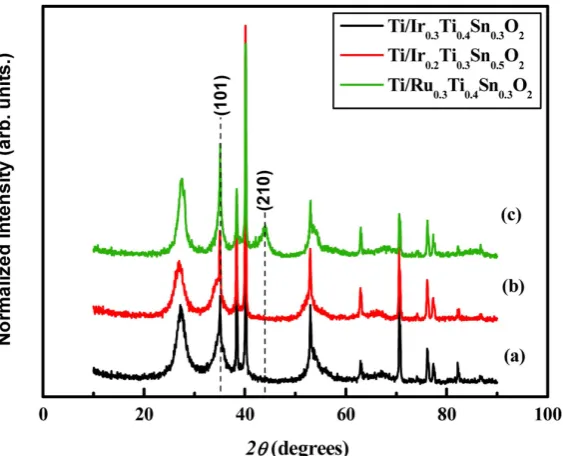
Figure 1. XRD patterns obtained for the oxide electrodes with different nominal compositions (a) Ti/Ir0.3Ti0.4Sn0.3O2; (b) Ti/Ir0.2Ti0.3Sn0.5O2; (c)
Ti/Ru0.3Ti0.4Sn0.3O2.
observed and attributed to IrO2, according to JCPDS PDF #15-0870. Ti/Ru0.3Ti0.4Sn0.3O2
showed two peaks, one at 2θ = 43.7˚ and another at 2θ = 53.6˚, which correspond to RuO2 JCPDS PDF #40-1290. However, by comparing the positions of the peaks in the
XRD obtained with the respective pure oxide, it is possible to observe that Sn-rich elec-trode composition displays peaks shifted toward the pure SnO2 pattern JCPDS PDF
#46-1088, indicating that Ir and/or Ti atoms may be incorporated into the SnO2
crystal-line reticule. The opposite trend is observed for Ru-electrode composition, which have their peaks shifted toward the pure RuO2 pattern due to the incorporation of Sn and/or
Ti atoms into the RuO2 crystalline reticule. All samples displayed typical crystalline
characteristics of tetragonal, with space group P42/nm. All those evidences suggesting the formation of a saturated solid solution for all the compositions investigated, one for Ir/Ti/Sn and other for Ru/Ti/Sn compositions. The XRD patterns show that all mate-rials synthesized contained the Ti phase attributed to the Ti metallic subtract.
The average crystallite sizes of the oxide particles were estimated by the Debye- Scherrer equation [18] at crystalline planes ((210): 2θ = 43.7˚) for Ti/Ru0.3Ti0.4Sn0.3O2,
and ((101): 2θ = 34.5˚) for Ti/Ir0.2Ti0.3Sn0.5O2 and Ti/Ir0.3Ti0.4Sn0.3O2. The values obtained
were approximately 4 and 5 nm, respectively.
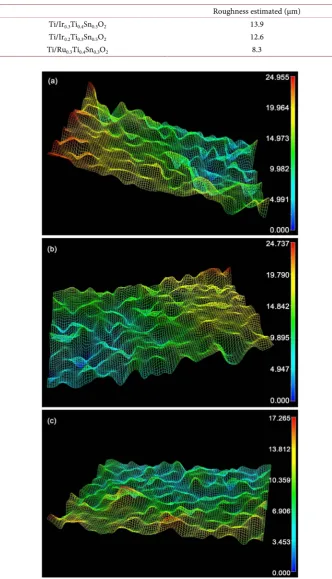
The roughness of the oxides Table 1 was estimated from the optical microscopy analyses Figure 2 performed in random areas of the film (average of five analyses). The electrode with nominal composition of Ti/Ru0.3Ti0.4Sn0.3O2 showed the lowest
rough-ness, which suggests that the morphology of the oxide layers is highly dependent on the physicochemical properties of the oxides and the nature of the precursors.
Table 1. Roughness estimated for the oxide films prepared by the polymeric precursor method.
Roughness estimated (μm)
Ti/Ir0.3Ti0.4Sn0.3O2 13.9
Ti/Ir0.2Ti0.3Sn0.5O2 12.6
Ti/Ru0.3Ti0.4Sn0.3O2 8.3
Figure 2. Optical microscopy of the oxide electrodes, original magnification 350× (a)
Ti/Ir0.3Ti0.4Sn0.3O2; (b) Ti/Ir0.2Ti0.3Sn0.5O2; (c) Ti/Ru0.3Ti0.4Sn0.3O2. Beside each picture is displayed
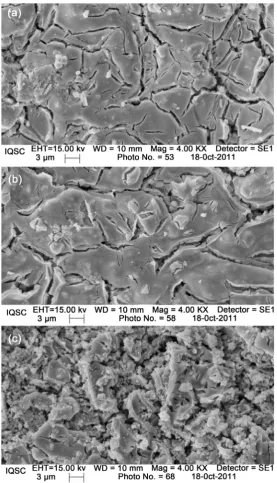
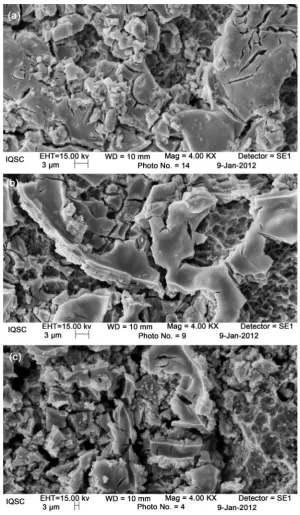
Figure 3. SEM surface image of the oxide electrodes, original magnification 4000× (a) Ti/Ir0.3Ti0.4Sn0.3O2; (b) Ti/Ir0.2Ti0.3Sn0.5O2; (c) Ti/Ru0.3Ti0.4Sn0.3O2.
IrO2 (a, b) show uniform and continuous structures with cracks, i.e., mud-cracked-type
morphology which are typical of thermally prepared oxide layers [10] [12]. Moreover, one observe that due to the increase in the amount of SnO2 in the electrode
composi-tion, cracks become larger (b), however the surface becomes less rough (see Table 1). However, the SEM image of the films containing RuO2 (c) indicate a distinct
coating compositions investigated.
Table 2 shows the EDX analyses of the micrographs Figure 3. The EDX analysis of the electrodes indicated a good correlation between experimental and nominal compo-sitions. The control of the composition of the films can be explained by the method used, since this polymer is formed before the calcination and the metal atoms are trapped in the matrix, which hinders its evaporation and consequent loss. All electrodes exhibited a homogenous distribution of particles on the electrode surface.
3.2. Electrochemical Characterizations
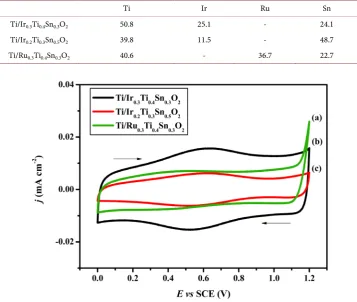
Figure 4 shows the j/E curve obtained in the cyclic voltammetric experiments. This profile is typical of thermally prepared oxide layer electrodes [19] [20] and characteris-tic of DSA® electrodes [21]. The figure also shows a blurred peak at around 0.5 V asso-ciated with the Ru (III)/Ru(IV) redox transition [22] for the Ti/Ru0.3Ti0.4Sn0.3O2
elec-trode. The voltammograms of the electrodes containing IrO2 showed a peak typical of
the Ir(III)/Ir (IV) transition in the region between 0.4 and 0.8 V [6].
The oxygen evolution reaction occurs at a more positive potential for the electrode containing the largest amount of SnO2. According to Fukunaga et al. [23], the doping of
[image:7.595.194.552.374.676.2]the electrode surface with SnO2 is an effective strategy to improve performance even in
Table 2. Atomic ratios (%) of the oxide films with different nominal compositions.
Ti Ir Ru Sn
Ti/Ir0.3Ti0.4Sn0.3O2 50.8 25.1 - 24.1
Ti/Ir0.2Ti0.3Sn0.5O2 39.8 11.5 - 48.7
Ti/Ru0.3Ti0.4Sn0.3O2 40.6 - 36.7 22.7
Figure 4. Cyclic voltammograms at 50 mV·s−1 in 0.5 mol·dm−3 of H
2SO4 of the oxide electrodes
the treatment of degradation of organic compounds thus our results are in agreement with previous report.
The comparison between the electrode containing IrO2 and those containing RuO2
shows the IrO2 exhibits lower activity for the oxygen evolution reaction.
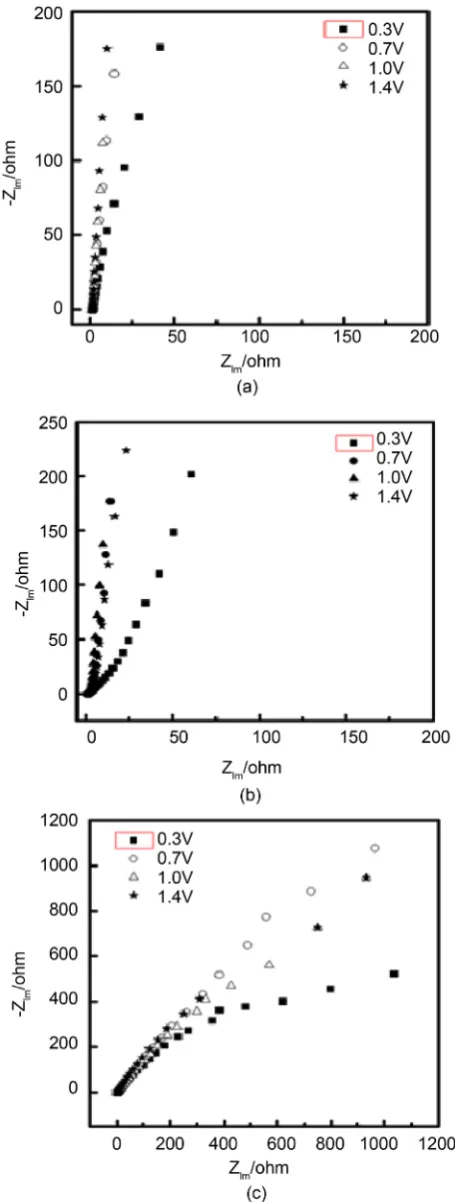
The impedance behavior of the electrodes was investigated to further characterize the different Ti/Ir0.3Ti0.4Sn0.3O2; Ti/Ir0.2Ti0.3Sn0.5O2 and Ti/Ru0.3Ti0.4Sn0.3O2 systems. The
Ny-quist diagram (Z' vs Z") of the electrodes obtained between 0.3 and 1.4 V vs Ag/AgCl is shown in Figure 5. In the low frequency domain, electrodes Ti/Ir0.3Ti0.4Sn0.3O2 and
Ti/Ir0.2Ti0.3Sn0.5O2 formed a straight line parallel to Z", characteristic of an ideally
pola-rizable electrode, and a slight deviation from the straight line along Z", suggesting a non-ideally polarizable electrode [24] [25]. The shift from the ideal capacitor behavior is a consequence of the material’s porosity [24] [26]. In the low-frequency domain re-gion a decrease in impedance was found when the applied potentials were positively shifted. This result suggests that the EIS responses in this domain region indicate a fa-radaic process of the bulk redox transitions of the oxide material. The difference ob-served between the Ir-based electrodes and Ru-based electrodes maybe could be ex-plained due to the higher electronic conductivity in the Ru-Ti-Sn/solution than in the Ir-Ti-Sn/solution interfaces.
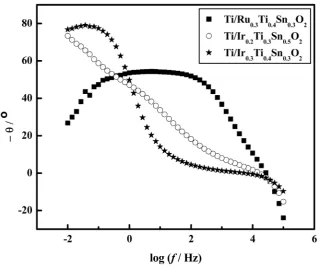
The Bode plot (θ vs. log f) obtained at 0.3 V vs Ag/AgCl for electrodes is shown in Figure 6. An analysis of this figure indicates that the main feature of these electrodes is the appearance of a well-defined time constant (τ) for the Ti/Ru0.3Ti0.4Sn0.3O2 electrode,
which is characterized by a maximum phase angle ranging from 1 to 100 Hz. This be-havior can be ascribed to the large number of RuO2 transition states contributing to the
charging system [27]. This results corroborated with the Nyquist plot interpretation above because the Ru-based electrode shows more pseudo capacitive behavior than the Ir-based electrode [10] [24].
The stability of the electrodes was assessed based on their lifetime, considering the time necessary for the electrode potential to reach 8.0 V. The electrode containing larg-er amounts of SnO2 (Ti/Ir0.2Ti0.3Sn0.5O2) has a shorter lifetime. The 20% decrease in the
stoichiometric amount of this oxide as well as the high amount (10%) of IrO2 (Ti/
Ir0.3Ti0.4Sn0.3O2) increase the time to a value above 70 hours. Comparing the electrode
Ti/Ir0.3Ti0.4Sn0.3O2 with Ti/Ru0.3Ti0.4Sn0.3O2, IrO2 has higher stability under drastic
condi-tions of electrolysis than RuO2 (Table 3).
The lifetime of oxide electrodes is directly correlated with two factors: passivation and dissolution of the coating [21]. The first factor is due to the penetration of the elec-trolyte through the pores or cracks towards the substrate, resulting in the oxidation of the metallic support and forming a non-conductive layer between the substrate and the oxide coating [28]-[30]. The second factor involves the loss of electroactive material (erosion or dissolution), resulting in a gradual reduction of the voltammetric charge. This may occur due to the pores in the layer and the rapid evolution of gas on the sur-face, inducing the separation of weakly bound parts of the active layer [28] [31] [32].
Figure 6. Bode plot at 0.3 V vs. Ag/AgCl as a function of the oxide electrodes. (-○-) Ti/Ir0.2Ti0.3Sn0.5O2; (-■-) Ti/Ir0.3Ti0.4Sn0.3O2 (--) Ti/Ru0.3Ti0.4Sn0.3O2.
Table 3. Lifetime values obtained for the oxide electrodes under galvanostatic conditions at a high current density (400 mA·cm−2) in 0.5 mol·dm−3 of H
2SO4.
Lifetime (h)
Ti/Ir0.3Ti0.4Sn0.3O2 >70
Ti/Ir0.2Ti0.3Sn0.5O2 6.16
Ti/Ru0.3Ti0.4Sn0.3O2 11.65
through microstructural analysis (Figure 7), which shows worn structures with erosion of the active layer. The EDX analysis revealed a decrease in the quantity of Ir and Ru, confirming the loss of the electroactive material, well as a decrease of Sn (Table 4).
The curves obtained for the lifetime showed a slow increase in the potential followed by an abrupt increase at the end of the experiment for all compositions investigated. This behavior indicates a rise in the electrode structure resistance. Such an increase may have resulted from the loss of Ir or Ru in the top layers of the electrode and/or the formation and growth of a non-conductive oxide film between the metallic substrate and the conductive oxide [9] [31].
[image:10.595.191.553.416.494.2]Figure 7. SEM surface image of the oxide electrodes after the lifetime test, original magnification 4000×. (a) Ti/Ir0.3Ti0.4Sn0.3O2; (b) Ti/Ir0.2Ti0.3Sn0.5O2; (c) Ti/Ru0.3Ti0.4Sn0.3O2.
Table 4. Variation in the atomic ratios (%) of the oxide films after the lifetime test.
ΔIr (%) ΔRu (%) ΔSn (%)
Ti/Ir0.3Ti0.4Sn0.3O2 −10.7 - −20.3
Ti/Ir0.2Ti0.3Sn0.5O2 −58.3 - −61.2
[image:11.595.194.555.647.705.2]4. Conclusion
This study has demonstrated the effect of the composition of oxide films on the proper-ties of DSA prepared by the thermal decomposition of polymeric precursors. IrO2-
based electrodes are more stable than RuO2-based electrode under the conditions
inves-tigated and show lower activity for the oxygen evolution reaction, which makes it at-tractive in the oxidation of organic substances. The introduction of tin oxide in the composition film enhances the catalytic properties of the anodes. However, it should be held in appropriate compositions, because the change in the atomic ratio of this ele-ment produces marked effects on the stability of the oxides. The thin films formed are composed of a solid solution among the various oxides constituents of the film. The procedure employed for the preparation of the anodes is a good alternative to SD, mi-nimizing the volatilization of the metal.
Acknowledgements
The authors would like to acknowledge the Conselho Nacional de Desenvolvimento Científico e Tecnológico-CNPq, the Fundação de Amparo à Pesquisa do Estado de São Paulo-Fapesp (2013/02762-5) and Fundação de Amparo à Pesquisa do Estado do Espírito Santo-FAPES for the financial support provided to this research.
References
[1] Beer, H.B. (1980) The Invention and Industrial Development of Metal Anodes. Journal of the Electrochemical Society, 127, 303-307. http://jes.ecsdl.org/content/127/8/303C.abstracy
http://dx.doi.org/10.1149/1.2130021
[2] Varela, H., Câmara Júnior, G.A.H.S. and Gonzalez, E.R. (2000) Oxygen Evolution Reaction on Mn2O3 Electrodes Supported on Stainless Steel. Quimica Nova, 23, 721-726.
http://www.scielo.br/scielo.php?script=sci_arttext&pid=S0100-40422000000600002
http://dx.doi.org/10.1590/S0100-40422000000600002
[3] Klink, M.J., Makgae, M.E. and Crouch, A.M. (2010) Physico-Chemical and Electrochemical Characterization of Ti/RhOx-IrO2 Electrodes Using Sol-Gel Technology. Materials
Chemi-stry and Physics, 124, 73-77.
http://www.sciencedirect.com/science/article/pii/S0254058410003846
http://dx.doi.org/10.1016/j.matchemphys.2010.05.016
[4] Trasatti, S. (1991) Physical Electrochemistry of Ceramic Oxides. Electrochimicam Acta, 36, 225-228. http://www.sciencedirect.com/science/article/pii/0013468691852442
http://dx.doi.org/10.1016/0013-4686(91)85244-2
[5] Lipkowski, J. and Ross, P.N. (1994) The Electrochemistry of Novel Materials. VCH, Uni-versity of Michigan.
[6] Ferro, S., Rosestolato, D., Martínez-Huitle, C.A. and DeBattisti, A. (2014) Charge-Storage Process in IrO2-SnO2 Mixed-Oxide Electrodes. Role of Coating Composition, Solution pH
and Temperature. Electrochimican Acta, 148, 85-90.
http://www.sciencedirect.com/science/article/pii/S0013468614020490
http://dx.doi.org/10.1016/j.electacta.2014.10.045
Pro-duction Plant. Journal of Environmental Chemical Engineering, 1, 183-188.
http://www.sciencedirect.com/science/article/pii/S2213343713000298
http://dx.doi.org/10.1016/j.jece.2013.04.017
[8] Fierro, C. and Comninellis, C. (2010) Kinetic Study of Formic Acid Oxidation on Ti/IrO2
Electrodes Prepared Using the Spin Coating Deposition Technique. Electrochimica Acta, 55, 7067-7071. http://www.sciencedirect.com/science/article/pii/S0013468610008820
http://dx.doi.org/10.1016/j.electacta.2010.06.066
[9] Ribeiro, J. and de Andrade, A.R. (2004) Characterization of RuO2-Ta2O5 Coated Titanium
Electrode Microstructure, Morphology, and Electrochemical Investigation. Journal of the Electrochemical Society, 151, D106-D111. http://jes.ecsdl.org/content/151/10/D106.abstract
http://dx.doi.org/10.1149/1.1787174
[10] Tilak, B.V., Birss, V.I., Wang, J., Chen, C.P. and Rangarajan, S.K. (2001) Deactivation of Thermally Formed Ru/Ti Oxide Electrodes: An AC Impedance Characterization Study.
Journal of the Electrochemical Society, 148, 112-116.
http://jes.ecsdl.org/content/148/9/D112.short
http://dx.doi.org/10.1149/1.1388630
[11] Pechini, M.P. (1967) Method of Preparing Lead and Alkaline Earth Titanates and Niobates and Coating Method Using the Same to Form a Capacitor. US Patent No. 3330697.
[12] Forti, J.C., Olivi, P. and de Andrade, A.R. (2001) Characterisation of DSA®-Type Coatings with Nominal Composition Ti/Ru0.3Ti(0.7−x)SnxO2 Prepared via a Polymeric Precursor.
Electrochimica Acta, 47, 913-917.
http://www.sciencedirect.com/science/article/pii/S0013468601007915
http://dx.doi.org/10.1016/S0013-4686(01)00791-5
[13] Terezo, A.J. and Pereira, E.C. (1999) Preparation and Characterization of Ti/RuO2-Nb2O5
Electrodes Obtained by Polymeric Precursor Method. Electrochimica Acta, 44, 4507-4511.
http://www.sciencedirect.com/science/article/pii/S0013468699001826
http://dx.doi.org/10.1016/S0013-4686(99)00182-6
[14] Lassali, T.A.F., Boodts, J.F.C. and Bulhoes, L.O.S. (2000) Effect of Sn-Precursor on the Morphology and Composition of Ir0.3Sn0.7O2 Oxide Films Prepared by Sol-Gel Process.
Journal of Non-Crystalline Solids, 273, 129-133.
http://www.sciencedirect.com/science/article/pii/S0022309300001526
http://dx.doi.org/10.1016/S0022-3093(00)00152-6
[15] Marciel, A.P., Longo, E. and Leite, E.R. (2003) Nanostructured Tin Dioxide: Synthesis and Growth of Nanocrystals and Nanoribbons. Quimica Nova, 26, 855-861.
http://quimicanova.sbq.org.br/imagebank/pdf/Vol26No6_855_13-RV02099.pdf
[16] Mourão, H.A.J.L., de Mendonça, V.R., Malagutti, A.R. and Ribeiro, C. (2009) Nanostruc-tures in Photocatalysis: A Review about Synthesis Strategies of Photocatalysts in Nanome-tric Size. Química Nova, 32, 2181-2186.
http://www.scielo.br/scielo.php?pid=S0100-40422009000800032&script=sci_arttext&tlng=pt
http://dx.doi.org/10.1590/S0100-40422009000800032
[17] Besso, M.M. (1965) Tin Salts of Citric Acid and Method of Preparation. US Patent No. 3213120.
[18] Klung, H.P. and Alexander, L.E. (1975) X-Ray Diffraction Procedures for Polycrystalline and Amorphous Materials. Journal of Applied Crystallography, 8, 573-580.
http://scripts.iucr.org/cgi-bin/paper?S0021889875011399
http://dx.doi.org/10.1107/S0021889875011399
http://www.sciencedirect.com/science/article/pii/S0304389406002160
http://dx.doi.org/10.1016/j.jhazmat.2006.02.045
[20] Motheo, A.J., Gonzalez, E.R., Tremiliosi, G., Olivi, P., de Andrade, A.R., Kokoh, B., Leger, J.M., Belgsir, E.M. and Lamy, C. (2000) The Oxidation of Formaldehyde on High Overvol-tage DSA Type Electrodes. Journal of the Brazilian Chemical Society, 11, 16-21.
http://www.scielo.br/scielo.php?pid=S0103-50532000000100004&script=sci_arttext
http://dx.doi.org/10.1590/S0103-50532000000100004
[21] Forti, J. F., Ribeiro, J., Lanza M.R.V., de Andrade, A.R. and Bertazzoli, R. (2010) Electro-chemical Characterization of DSA®-Type Electrodes Using Niobium Substrate. Electro-
catalysis, 1, 129-138. http://link.springer.com/article/10.1007%2Fs12678-010-0020-3 [22] Ardizzone, S., Fregonara, G. and Trasatti, S. (1990) “Inner” and “Outer” Active Surface of
RuO2 Electrodes. Electrochimica Acta, 35, 263-267.
http://www.sciencedirect.com/science/article/pii/001346869085068X
http://dx.doi.org/10.1016/0013-4686(90)85068-X
[23] Fukunaga, M.T., Guimarães, J.R. and Bertazzoli, R. (2008) Kinetics of the Oxidation of Formaldehyde in a Flow Electrochemical Reactor with TiO2/RuO2 Anode. Chemical
Engi-neering Journal, 136, 236-241.
http://www.sciencedirect.com/science/article/pii/S1385894707002495
http://dx.doi.org/10.1016/j.cej.2007.04.006
[24] Sugimoto, W., Iwata, H., Yokoshima, K., Murakami, Y. and Takasu, Y. (2005) Proton and Electron Conductivity in Hydrous Ruthenium Oxides Evaluated by Electrochemical Im-pedance Spectroscopy: the Origin of Large Capacitance. The Journal of Physical Chemistry B, 109, 7330-7338. http://pubs.acs.org/doi/abs/10.1021/jp044252o
http://dx.doi.org/10.1021/jp044252o
[25] De Carvalho, L.A., de Andrade A.R. and Bueno, P.R. (2006) Electrochemical Impedance Spectroscopy Applied in the Study of Heterogeneous Reactions at Dimensionally Stable Anodes. Química Nova, 29, 796-804.
http://quimicanova.sbq.org.br/imagebank/pdf/Vol29No4_796_28-RV05188.pdf
http://dx.doi.org/10.1590/S0100-40422006000400029
[26] Terezo, A.J., Bisquert, J., Pereira, E.C. and Garcia-Belmonte, G. (2001) Separation of Transport, Charge Storage and Reaction Processes of Porous Electrocatalytic IrO2 and
IrO2/Nb2O5 Electrodes. Journal of Electroanalytical Chemistry, 508, 59-69. http://www.sciencedirect.com/science/article/pii/S0022072801005228
http://dx.doi.org/10.1016/S0022-0728(01)00522-8
[27] Horvat-Radosevic, V., Kvastek, K., Vukovic, M. and Marijan, D. (1999) Impedance of Ru-thenium Electrodes in Sulphuric Acid Solution. Journal of Electroanalytical Chemistry, 463, 29-44. http://www.sciencedirect.com/science/article/pii/S0022072898004306
http://dx.doi.org/10.1016/S0022-0728(98)00430-6
[28] Martelli, G.N., Ornelas, R. and Faita, G. (1994) Deactivation Mechanisms of Oxygen Evolving Anodes at High Current Densities. Electrochimica Acta, 39, 1551-1558.
http://www.sciencedirect.com/science/article/pii/0013468694851344
http://dx.doi.org/10.1016/0013-4686(94)85134-4
[29] Jovanovic, V.M., Dekanski, A., Despotov, P., Nikolic, B. and Atanasoski, R.T. (1992) The Roles of the Ruthenium Concentration Profile, the Stabilizing Component and the Sub-strate on the Stability of Oxide Coatings. Journal of Electroanalytical Chemistry, 339, 147- 165. http://www.sciencedirect.com/science/article/pii/002207289280449E
http://dx.doi.org/10.1016/0022-0728(92)80449-E
RuO2-TiO2 Coated Titanium Anodes Obtained by the Sol-Gel Procedure and Their
Elec-trochemical Behaviour in the Chlorine Evolution Reaction. Colloids and Surfaces A: Physi-cochemical and Engineering Aspects, 157, 269-274.
http://www.sciencedirect.com/science/article/pii/S0927775799000941
http://dx.doi.org/10.1016/S0927-7757(99)00094-1
[31] Loucka, T. (1977) The Reason for the Loss of Activity of Titanium Anodes Coated with a Layer of RuO2 and TiO2. Journal of Applied Electrochemistry, 7, 211-214.
http://link.springer.com/article/10.1007%2FBF00618987#page-1 http://dx.doi.org/10.1007/BF00618987
[32] Iwakura, C. and Sakamoto, K. (1985) Effect of Active Layer Composition on the Service Life of (SnO2 and RuO2) -Coated Ti Electrodes in Sulfuric Acid Solution. Journal of the
Electro-chemical Society, 132, 2420-2423. http://jes.ecsdl.org/content/132/10/2420.short
http://dx.doi.org/10.1149/1.2113590
Submit or recommend next manuscript to SCIRP and we will provide best service for you:
Accepting pre-submission inquiries through Email, Facebook, LinkedIn, Twitter, etc. A wide selection of journals (inclusive of 9 subjects, more than 200 journals)
Providing 24-hour high-quality service User-friendly online submission system Fair and swift peer-review system
Efficient typesetting and proofreading procedure
Display of the result of downloads and visits, as well as the number of cited articles Maximum dissemination of your research work