http://www.scirp.org/journal/eng ISSN Online: 1947-394X ISSN Print: 1947-3931
A New Hybrid Order Approach to Morphological
Color Image Processing Based on Reduced Order
with Adaptive Absolute Reference
S. Ouattara
1,2,3*, A. Kouassi
1,4, J. C. Okaingni
1,2, A. Koffi
1,2, G. Loum
1,2, A. Clement
1,31Laboratory of Signals and Electrical Systems (L2SE)), Institut National Polytechnique Houphouët Boigny, Yamoussoukro, Cote D’Ivoire 2Institut National Polytechnique Houphouët Boigny, Yamoussoukro, Cote D’Ivoire
3LaboratoireAngevin de Rechercheen Ingénieriedes Systèmes (LARIS), Institut Universitaire de Technologie d’Angers, Angers, France 4Ecole Supérieure des technologies de l’information et de la communication Zone 3 Km4 Boulevard de Marseille, Abidjan, Côte D’ivoire
Abstract
Mathematical morphology can process the binary and grayscale image successfully. This theory cannot be extended to the color image directly. In color space, a vector represents a pixel, so in order to compare vectors, vectoriel orderings must be de-fined first. This paper addresses the question of the extension of morphological op-erator to the case of color images. The proposed method used the order by bit mixing to replace the conditional order. Our order is based on a combination of reduced and bit mixing ordering of the underlying data. Additionally it is a total ordering. Since it not only solves the problems of false color generated by the marginal order but also those of multiple extrema generated by reduced order. The performance of the in-troduced operators is illustrated by means of different applications: color gradients for segmenting, image smoothing (noise suppression) by median filter operator and Laplacian operators. Examples of natural color images and synthetic color images are given. Experimental results show the improvement brought by this new method.
Keywords
Multicomponent Image, Vector Order, Adaptive Absolute Referent, Bit Mixing, Morphological Operators
1. Introduction
With recent scientific advances made in the development of high resolution image sensors and in the increase of memory capacity, image processors have no technical How to cite this paper: Ouattara, S.,
Kou-assi, A., Okaingni, J.C., Koffi, A., Loum, G. and Clement, A. (2016) A New Hybrid Order Approach to Morphological Color Image Processing Based on Reduced Order with Adaptive Absolute Reference. Engi-neering, 8, 633-645.
http://dx.doi.org/10.4236/eng.2016.89057
Received: August 25, 2016 Accepted: September 26, 2016 Published: September 29, 2016
Copyright © 2016 by authors and Scientific Research Publishing Inc. This work is licensed under the Creative Commons Attribution International License (CC BY 4.0).
problem to acquire multicomponent images of all types (spectral, temporal, etc.). They provide more detailed information of the properties of a scene, and allow more precise discrimination of objects.
Unfortunately, the processing methods of scalar images do not apply directly to mul-tivariate-image [1]. This is not a new issue, since many authors have studied the case of color images which represent the most frequent case of multivariate images. Some works were based on the extension of the median filter to color images [2] and others on mathematical morphology extension to color images and more generally to the mul-timodal image [3]-[5].
But this requires the definition of new orders for the extension of the scalar algo-rithms vector case. The main issue with this kind of extension is based on the definition of a suitable vector ordering, because there is no natural ordering for vectors particu-larly in the case of mathematical morphology that makes it complex for color images application. Owing to the vector like nature of the data, five approaches have retained our attention to order multivariate data [3] [4], namely: i) the marginal order or M- order, ii) the conditional order or C-order, iii) the reduced order or R-order, iv) the partial order or P-order, and v) bit mixing order.
In marginal order, vector components are ordered separately. This approach pro-duces new colors that are not from the colors of the original image, commonly called false colors. Also, it does not take into account the correlation between the components. In order to preserve the vectors output colors, conditional order was proposed.
In this approach, vectors are ordered components by components; unfortunately this order favors the first components. Moreover, the color metric in the sense of a metric is not guaranteed.
In reduced order, each vector is transformed into a scalar and vector data are sorted according to the order of the values obtained. Unfortunately it generates multiple extremums and requires the choice of a referent which is arbitrary.
As for the partial order, the vectors are grouped into subsets and are then ordered. This order is based on the geometric structure of the vectors. The disadvantage of this approach is that it does not propose an order within each partition.
Finally, the bit mixing order attempts to standardize the contribution of each modal component, but merges with the lexicographical order in its final principle.
have proposed a vector order based on the fuzzy and then built up morphological oper-ators. The proposed operators have a high filtering performance of color images [12]. Various complex mathematical tools such as support vector machines [13], the PCA [14]
components, probabilistic estimation extremas [15] are used to develop the multivariate morphological operators and improve filtering and segmentation of color images.
A useful idea consists in the introduction of a reference color as well as a metric and then defines the order between two points relatively to their distances to the reference color [16]. This concept of reference has already been used to define a partial order on the unit circle [17], and another way of seeing the reduced order with the notion of color reference is the use of vector projection. However, the reduced order is only aimed for a partial so as to avoid multiple extremas, that is to say two different points which have the same distance compared to the reference, a total order is then required to complete it. This question was highly studied by Angulo et al. [18]. In this approach, the total order used is the conditional order, therefore the first image components are preferred.
To have a uniform distribution of the spectral or multimodal components of the im-age, unlike the conditional order, we propose a hybrid vector order that combines the reduced order and bit mixing order proposed by J. Chanussot and P. Lambert [6], and offer this method which provides uniform contribution components while maintaining proximity metric between colors.
The structure of this paper is organized as follows. Section 2 presents the general concepts: A new hybrid order and definitions for mathematical morphology, on which our approach is based. In Section 3, we focus on their application to color images processing. The performance of the morphological operator is illustrated with some examples. Then the conclusions close the paper in Section 4.
2. New Vector Order Based on Adaptive Absolute Reference
Complemented by the Bit Mixing
2.1. Principle
Selecting an order ensuring the entire property ensures that all vectors are comparable. Thus, it is certain that no new values are introduced into the result. Solutions based on reduced orders have disadvantages, based on the release of the asymmetric constraint. In this case, it is possible to obtain several equivalent extrema. Various solutions have been offered in the literature, including the selection of one of the candidate values ac-cording to a function of the position of the pixel in the considered neighborhood or comparison of candidate values using a total order. But the order used is the condition-al order, which is highly asymmetric.
dis-symmetry between the components.
The approach is that, this time we offer to use absolute adaptive referents. It has the advantage of not choosing arbitrarily the reference colors and also it solves the problem of false color generated by the marginal order.
Let I be the matrix associated with a multicomponent digital image of N plans and V the matrix of order 3 × 3 of neighboring pixels of a spatial (i,j) of a coordinate pixelp. We note Max and Min conventional comparison operators that are the maximum and minimum, respectively.
And either define as:
Let Vm∈V, 1≤ ≤m 9 des N-uplets and define VRef so as:
( )
(
)
_min Min , 1 9
k k
Ref m
V = V ∀ ≤ ≤m (1)
And
( )
(
)
_max Max , 1 9
k k
Ref m
V = V ∀ ≤ ≤m (2)
The dilated Vmaxandthe erodedVminof theneighborhood V of the pixel p are
de-fined by the following expressions:
(
)
{
}
{
}
MAX , Min , ref_ max
V = X∈V dist X V (3)
(
)
{
}
{
}
Min , Min , ref_ min
V = X∈V dist X V (4)
In the case of no unicity of Vmax and Vminthesolutionvectorsareorderedaccording
tothevectororderby bit mixing.
2.2. Bit Mixing Coding
Following the formalism introduced in [6], the proposed technique; here is based on a transformation h that codes each pixel (vector) of the multicomponent image as a sca-lar. One may therefore order any group of vectors by placing their images h. The trans-formation h proposed here is based on the binary representation of each of the compo-nent of the vector C which one considers. If the N components are encoded on the same number p of bits we then have N × p bits which are mixed so as to construct a scalar N × p bit-coded by image. There are of course many ways to mix these bits, but in the absence of apriori knowledge about the relative share of information carried by each component the most symmetrical combination is chosen .Therefore we placed al-ternately the first bit of C(1) and the first bit of C(2) till and the C(N) bit and then moves to the second bit and so on until pth bit. Analytically, this can be expressed by the
following formula:
( )
( )( )
1 1
2 2
p N
N p j N i
j i
h C − − C i j
= =
= ⋅ ⋅
∑
∑
(5)2.3. Algorithm
around a pixel p of coordinates (i,j) and, L and M are respectively the number of rows and columns of the image.
Fori = 1 toL do Forj = 1 toM do
1. DeterminationoftheneighborhoodW = V(p) aroundthepixelp(i,j) 2. Determinationofthefollowingparameters: VRef_ min and VRef_ max 3. IfseveralVmaxandVmin:
• IncaseofseveralVmax
CalculationoftheimageofVmaxbythefunctionh, thenchoose the tuplewhich has
thelargestVmaxobtainedbyh.
• IncaseofseveralVmin
CalculationofVminimagebythefunctionh, thenchoosethetuplethathasthe
smal-lestVminobtainedbyh.
Endfor Endfor
2.4. Performance of the Approach
To study the performance of this approach, we first studied the impact of different or-ders on a set of vectors of compact histogram [20] of synthetic and real images orderly default in lexicographical order. Moreover, we studied the influence of those orders on the detection of color contours through the implementation of morphological operators such as gradient and Laplacian as well as their edge detection quality through evalua-tion methods [21] in Table 1. Then we check the noise effect on images from impulse noise power levels to examine the robustness of our median filter and our vector order in face of noise.
We designed the following three color synthetic image Synt3a_Sie and used the Sa-voise image to illustrate the operation of the studied orders. The presented compact histograms contain colors and their numbers are sorted in lexicographical order.
3. Results and Interpretations
3.1. Tuples Ranking Analysis by Vector Orders
[image:5.595.193.555.614.699.2]In Figure 1, the compact histogram by itself always present colors or tuples ordered
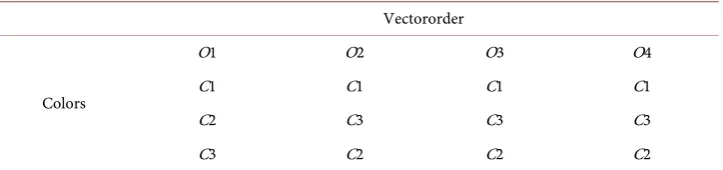
Table 1. Ascending ranking of different vector orders on Synt_3a image. Crefmin = (57, 50, 50) for
the proposed order and Crefo = (68, 50, 50) for the reduced order. O1: Order Lexico, O2: Order by
bit interlacing, O3: Reduced Order, O4: Proposed Order.
Vectororder
Colors
O1 O2 O3 O4
C1 C1 C1 C1
C2 C3 C3 C3
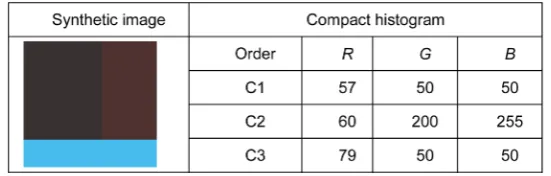
Figure 1. Synthetic Image Synt3a_Sie and its compact histogram lexico-graphical order.
according to the lexicographical order. We naturally note that the colors C1 and C3 are
similar, but this order put C2 near C1 relatively to C3. In fact, we can say that this order
does not favor the concept of the closest neighbor of real numbering the sense of a me-tric or the classical order of its own.
By applying the marginal order to all colors {C1, C2, C3}, we get Min {C1, C2, C3} = (57,
50, 50) and Max (C1, C2, C3) = (79, 200, 255). Through this example two disadvantages
of the partial order are highlighted. First, the maximum does not belong to the whole definition of the image, hence it generally does not favor the classification of the colors of the image. Secondly this order produces only two colors instead of three. Therefore, in the general case where the image contains (N> 2) colors this order also produces two colors, one as minimum and the other as maximum.
In the case of reduced order, the reference color is chosen arbitrarily. If we consider color reference CrefO = (68, 50, 50).
We notice that the colors C1 and C2 are equal. Indeed, in such a way that, for a
com-pact histogram of any given image we can always find a reference color CrefO so as two
colors different or distant may be equal .Thus the choice of an optimal reference is mandatory. To solve the problem of multiple extremas, some authors have reclassified targeted tuples generally by choosing lexicographical order to obtain a total order.
Through the analysis of the tuples ranking based on vector orders, we can note that the choice of a single or absolute reference in the case of reduced order would help to avoid different scenario. Moreover, the lexicographical order is highly dissymmetric. This gives way to operators who are not homogeneous in their processing of space.
For theimageSynt3a, seeing the Table 1, the proposed order gives the desired natural result of ascending order of colors in the compact histogram. Here, the reduced order gives the same result, which would be a chance due to the choice of Crefo.
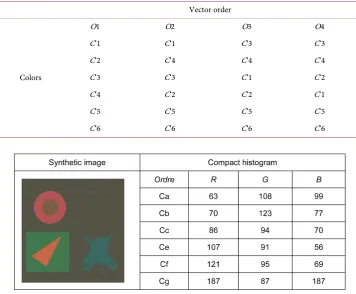
Table 2 presents the results of different vector order in ascending order. The color of the compact histogram Savoise image is illustrated in Figure 2. In this table we notice that the lexicographical orders and order by bit mixing could have a similarity but with significant difference in some tuples. It is the same for the reduced order and the pro-posed hybrid order.
Table 2. Ascending ranking of different vector orders on Synt_3a image. Crefmin = (57, 50, 50) for
the proposed order and Crefo = (68, 50, 50) for the reduced order. O1: Lexicographical Order, O2:
Order by bit mixing, O3: Reduced Order, O4: Proposed Order.
Vector order
Colors
O1 O2 O3 O4
C’1 C’1 C’3 C’3
C’2 C’4 C’4 C’4
C’3 C’3 C’1 C’2
C’4 C’2 C’2 C’1
C’5 C’5 C’5 C’5
C’6 C’6 C’6 C’6
Figure 2. Synthetic Savoise image and its lexicographical compact histogram order.
solve the problem of reduced order. And that the similarity between these two orders is due partly to the content (CrefminandCrefmax) oftheimage and/or in the other hand, the
arbitrary choice of Crefo which worths here (0, 0, 0).
However, the similarity between the lexicographical and order by bit mixing is due to the symmetry in base 2 of the level of each color compact histogram component.
In fact, our contribution includes firstly the determining of a minimum reference or absolute maximum, and then by successive eliminations, is classified in ascending order of the colors compact histogram. Here Crefmin = (57, 50, 50) and Crefmax = (79, 200, 255).
In case of equality, the targeted colors are ranked by the order of bit interlacing which limits the asymmetry between the components.
3.2. Morphological Gradient and Laplacian
following formulas describe these operators:
Let I be a multicomponent image with n (n> 1) component and B a structuring ele-ment. We notice δB(I) the dilated form of I with respect to B and εB(I) the eroded form
of I with respect to B. Let Max and Min respectively be the maximum and minimum of the elements of a set.
( )
Max{
( )
}
,B I B I p p B
δ
= ∀ ∈ (6)( )
Min{
( )
}
,B I B I p p B
ε
= ∀ ∈ (7)which lead us to the following expression of the Gradient (GradB) and Laplacian (LaplB),
respectively noted:
( )
( )
( )
B B B
Grad I =
δ
I −ε
I (8)( )
( )
( )
2B B B
Lapl I =
δ
I +ε
I − I (9)3.3. Analysis of Gradient and Laplacian Operators
The determination of Laplacian and gradient images is simple. In one word, one must know that the processing is carried in the image plan. First, for each pixel to be processed, a minimum reference and an absolute maximum adaptive reference are de-termined around a predefined neighborhood. Then the gradient and the Laplace are calculated through analytical expressions depending on the minimum and maximum previously determined.
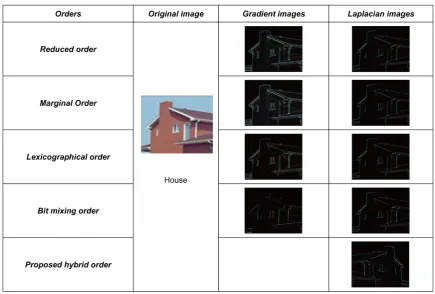
Figure 3 shows a comparison of the gradient and Laplacian image with image House deriving from the reduced order, the order by bit mixing, the lexicographical order, the marginal order, and the proposed hybrid order. Contrast calculation or expert truths can allow us to quantify the differences between the orders but visually, gradient images show that our hybrid order is close to the reduced order and the marginal order but present the best results compared to the results of order by bit mixing and the lexico-graphical order on all of the processed images.
The Laplacian images show that the studied orders appear to produce similar results to ours, but are the best contrasted. However, it should be noted that our approach is designed to correct some shortcomings inherent to the studied orders. In fact, our or-der is a total oror-der and therefore can build a complete lattice, the main ingredient for the definition of the main operators of the vector mathematical morphology. Our pro-posal allows comparing two tuples in contrast to the marginal order, also, it does not generate multiple extrema as opposed to the reduced order; and finally does not favor the first components unlike the conditional order, allowing him to have a uniform dis-tribution of the spectral or multimodal components of the image.
However, a quantitative validation of our gradient and Laplacian operators through the proposed hybrid order is necessary. Unfortunately, there are no direct methods to assess results of these operators.
Figure 3. Gradient and Laplacian images for different orders of the House image.
[22]. At this stage, we used several methods to evaluate segmentation contours [21] to assess indirectly our gradient and Laplacian results also, in the literature the evaluation methods proposed are supervised like type that is to say, they require ground truth or expert segmentations.
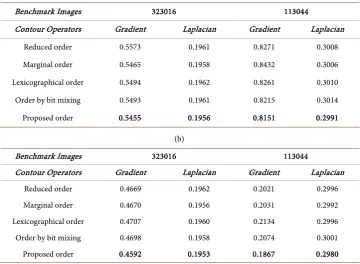
In fact, the database Benchmark BSDS300 [23] with an image database and an expert contour segmentation has allowed us to evaluate our edge detection operators through various vector order. Figure 4 shows two (02) images of the benchmark based on their ground truths.
From a quantitative point of view, different contours segmentation assessment mea- sures were calculated to assess the relevance of our edge detection operators. This is the case of the Haussdoff distance, merit of the figure of Pratt and the extent of Vinet.
Figure 4. Images of the Benchmark base BSDS300 with their expert segmentations.
Table 3. (a) Performance of gradient and Laplacian operators relating to the different vector or-ders (Measure of Pratt); (b) Performance of gradient and Laplacian operators relating to the dif-ferent vector orders (Measure of Vinet).
(a)
Benchmark Images 323016 113044
Contour Operators Gradient Laplacian Gradient Laplacian
Reduced order 0.5573 0.1961 0.8271 0.3008
Marginal order 0.5465 0.1958 0.8432 0.3006
Lexicographical order 0.5494 0.1962 0.8261 0.3010
Order by bit mixing 0.5493 0.1961 0.8215 0.3014
Proposed order 0.5455 0.1956 0.8151 0.2991
(b)
Benchmark Images 323016 113044
Contour Operators Gradient Laplacian Gradient Laplacian
Reduced order 0.4669 0.1962 0.2021 0.2996
Marginal order 0.4670 0.1956 0.2031 0.2992
Lexicographical order 0.4707 0.1960 0.2134 0.2996
Order by bit mixing 0.4698 0.1958 0.2074 0.3001
Proposed order 0.4592 0.1953 0.1867 0.2980
3.4. Noise Robustness
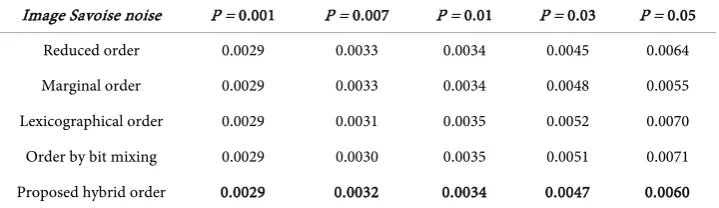
[image:10.595.193.554.383.647.2]filter. Here, we have illustrated the performance of our approach through an image base. For the presentation we chose two images a natural one corresponding to image House and the other a synthetic named Savoise. Different noise powers were added to the im-ages described by the parameter p.
For each noise image we applied the median filter using: the reduced order, marginal order lexicographical order, order by bit mixing and our proposed hybrid order. Then we calculated the error rate generated by each order. The results are shown in Table 4
and Table 5.
We notice that the results depend on the image content. Indeed the error rate for all orders are high for the image House, see Table 3 while they are relatively low for Sa-voise image, see Table 4.
The median filter produces the same error rate for taking p values 0.001, 0.007 and 0.01 for the different studied orders. But for p = 0.03 and 0.05, our proposal is robust as lexicographical order, the reduced order and the order by bit mixing.
4. Conclusions and Perspectives
Mathematical morphological has been widely used to process binary and grayscale im-ages and its techniques have been applied to noise reduction, image enhancement, and feature detection. To perform a morphological operation on vector-valued image, an ordering of vector field is required. The problem of ordering of multivariate data is not new since a possible classification of such ordering was discussed in [3].
In this article, we have offered a contribution aiming to define an hybrid vector or-
Table 4. Comparison of median filters relating to different vector orders studied on image House.
Image house noise P = 0.001 P = 0.007 P = 0.01 P = 0.03 P = 0.05
Reduced order 0.8083 0.8119 0.8119 0.8143 0.8143
[image:11.595.194.554.447.549.2]Marginal order 0.9231 0.9254 0.9265 0.9319 0.9388 Lexicographical order 0.8137 0.8137 0.8193 0.8286 0.8398 Order by bit mixing 0.8121 0.8141 0.8210 0.8394 0.8412 Proposed hybrid order 0.8052 0.8089 0.8091 0.8120 0.8122
Table 5. Comparison of median filters relating to different vector orders studied on image Sa-voise.
Image Savoise noise P = 0.001 P = 0.007 P = 0.01 P = 0.03 P = 0.05
Reduced order 0.0029 0.0033 0.0034 0.0045 0.0064
Marginal order 0.0029 0.0033 0.0034 0.0048 0.0055
[image:11.595.195.555.596.700.2]dering which combines both reduced order and the bit mixing order. In fact, this order is total, in such a way it appears as the key or fundamental element in the definition of the mathematical morphology.
Several of the above tests showed that our proposal was robust as lexicographical or-der, the reduced order and the order by bit mixing for noise suppression.
In future work, we intend to make a more detailed study of the correlation or the ex-isting similarity between different orders and still propose a new more robust order, taking a best similarity into account. Besides, we would also take a look at the develop-ment of a new method for morphological segdevelop-mentation vector-thresholding.
References
[1] Plataniotis, K. and Venetsanopoulos, A.N. (2000) Color Image Processing and Applications. Springer Verlag, Heidelberg.
[2] Lukac, R., Smolka, B., Martin, K., Plataniotis, K.N. and Venetsanopoulos, A.N. (2005) Vec-tor Filtering for Color Imaging. IEEE Signal Processing Magazine, 22, 74-86.
http://dx.doi.org/10.1109/MSP.2005.1407717
[3] Barnett, V. (1976) The Ordering of Multivariate Data. Journal of the Royal Statistical Socie-ty. Series A (General), 139, 318-354. http://dx.doi.org/10.2307/2344839
[4] Angulo, J. (2007) Morphological Color Operators in Totally Ordered Lattices Based on Dis-tances: Application to Image Filtering, Enhancement and Analysis. Computer Vision and Image Understanding, 107, 56-73. http://dx.doi.org/10.1016/j.cviu.2006.11.008
[5] Aptoula, E. and Lefevre, S. (2007) A Comparative Study on Multivariate Mathematical Morphology. Pattern Recognition, 40, 2914-2929.
http://dx.doi.org/10.1016/j.patcog.2007.02.004
[6] Chanussot, J. and Lambert, P. (1997) Bit Mixing Paradigm for Multivalued Morphological Filters. Proceedings of 6th IEEE International Conference on Image Processing and Its Ap-plications (IPA’97), Dublin, July 1997, 804-808. http://dx.doi.org/10.1049/cp:19971007
[7] Valle, E. and Vicente, D.M.G. (2013) Sparsely Connected Autoassiative Lattice Memories with Implementation Year for the Reconstruction of Color Images. Journal of Mathematical Imaging, 32, 786-796.
[8] Angulo, J. (2005) Unified Morphological Color Processing Framework in Lum/Sat/Hue Re-presentation. Proceedings of the 7th International Symposium on Mathematical Morphol-ogy, Paris, 18-20 April 2005, 387-396. http://dx.doi.org/10.1007/1-4020-3443-1_35
[9] Aptoula E. and Lefevre, S. (2008) α-Trimmed Lexicographical Extrema for Pseudo-Mor- phological Picture Analysis. JournalofVisualCommunicationandImage Representation, 19, 165-174. http://dx.doi.org/10.1016/j.jvcir.2007.10.001
[10]Louverdis, G., Vardavoulia, M.I., Andreadis, I. and Tsalides, P. (2002) A New Approach to Morphological Color Image Processing. PatternRecognition, 35, 1733-1741.
http://dx.doi.org/10.1016/S0031-3203(01)00166-2
[11]Angulo, J. (2010) Geometric Algebra Color Picture Representations and Derived Total Or-derings for Morphological Operators—Part I: Color Quaternions. JournalofVisual Com-municationandImageRepresentation, 21, 33-48.
http://dx.doi.org/10.1016/j.jvcir.2009.10.002
Interna-tionalConferenceonImageProcessing(ICIP’ 13), Melbourne, 15-18 September 2013, 3031- 3034. http://dx.doi.org/10.1109/icip.2013.6738624
[13]Velasco-Forero, S. and Angulo, J. (2011) Supervised Ordering in IRp: Application to
Mor-phological Processing of Hyperspectral Images. IEEETransactionsonImageProcessing, 20, 3301-3308. http://dx.doi.org/10.1109/TIP.2011.2144611
[14]Li, J. and Li, Y. (2004) Multivariate Mathematical Morphology Based on Principal Compo-nent Analysis: Initial Results in Building Extraction. Proceedingsofthe 20thInternational SocietyforPhotogrammetryandRemoteSensing(ISPRS’ 04), Vol. 35, 1168-1173.
[15]Caliman, A., Ivanovici, M. and Richard, N. (2014) Probabilistic Pseudo-Morphology for Grayscale and Color Images. PatternRecognition, 47, 721-735.
[16]Pitas, I. and Tsakalides, P. (1991) Multivariate Ordering in Color Image Processing. IEEE Transactions on Circuits and Systems for Video Technology, 1, 247-256.
http://dx.doi.org/10.1109/76.97987
[17]Hanbury, A. and Serra, J. (2001) Morphological Operators on the Unit Circle. IEEE Trans-actions on Image Process, 10, 1842-1850. http://dx.doi.org/10.1109/83.974569
[18]Angulo, J. (2007) Morphological Color Operators in Totally Ordered Lattices Based on Dis-tances: Application to Image Filtering, Enhancement and Analysis. Computer Vision and Image Understanding, 107, 56-73. http://dx.doi.org/10.1016/j.cviu.2006.11.008
[19]Lezoray, O., Meurie, C. and Elmoataz, A. (2008) Graph-Based Ordering Scheme for Color Picture Filtering. International Journal of Image and Graphics, 8, 473-493.
http://dx.doi.org/10.1142/S0219467808003192
[20]Clement, A. and Vigouroux, B. (2001) A Compact Histogram for Analyzing Multicompo-nent Pictures. Proceedings of the 18th Symposium on Signal Processing and Images, 1, 305- 307.
[21]Chabrier, S., Laurent, H., Rosenberger, C. and Emile, B. (2008) Comparative Study of Con-tour Detection Evaluation Criteria Based on Dissimilarity Measures. EURASIP Journal on Image and Video Processing, 2008, Article ID: 693053.
http://dx.doi.org/10.1155/2008/693053
[22]Otsu, N. (1979) A Threshold Selection Method Fromgrey-Level Histograms. IEEE Transac-tions on System, Man, and Cybernetics, 9, 62-66.
http://dx.doi.org/10.1109/TSMC.1979.4310076
Submit or recommend next manuscript to SCIRP and we will provide best service for you:
Accepting pre-submission inquiries through Email, Facebook, LinkedIn, Twitter, etc. A wide selection of journals (inclusive of 9 subjects, more than 200 journals)
Providing 24-hour high-quality service User-friendly online submission system Fair and swift peer-review system
Efficient typesetting and proofreading procedure
Display of the result of downloads and visits, as well as the number of cited articles Maximum dissemination of your research work