Copyright © 2000, American Society for Microbiology. All Rights Reserved.
Synthesis and Posttranslational Regulation of Pyruvate
Formate-Lyase in
Lactococcus lactis
CLAUS RIX MELCHIORSEN,1* KIRSTEN VÆVER JOKUMSEN,1JOHN VILLADSEN,1
MADS G. JOHNSEN,2HANS ISRAELSEN,2ANDJOSE´ ARNAU2
Department of Biotechnology, Center for Process Biotechnology, Technical University of Denmark,
DK-2800 Lyngby,1and Biotechnological Institute, DK-2970 Hørsholm,2Denmark
Received 20 December 1999/Accepted 15 June 2000
The enzyme pyruvate formate-lyase (PFL) from Lactococcus lactis was produced inEscherichia coli and purified to obtain anti-PFL antibodies that were shown to be specific forL. lactisPFL. It was demonstrated that activatedL. lactisPFL was sensitive to oxygen, as inE. coli, resulting in the cleavage of the PFL polypeptide. The PFL protein level and its in vivo activity and regulation were shown by Western blotting, enzyme-linked immunosorbent assay, and metabolite measurement to be dependent on the growth conditions. The PFL level during anaerobic growth on the slowly fermentable sugar galactose was higher than that on glucose. This shows that variation in the PFL protein level may play an important role in the regulation of metabolic shift from homolactic to mixed-acid product formation, observed during growth on glucose and galactose, respectively. During anaerobic growth in defined medium, complete activation of PFL was observed. Strikingly, although no formate was produced during aerobic growth of L. lactis, PFL protein was indeed detected under these conditions, in which the enzyme is dispensable due to the irreversible inactivation of PFL by oxygen. In contrast, no oxygenolytic cleavage was detected during aerobic growth in complex medium. This observation may be the result of either an effective PFL deactivase activity or the lack of PFL activation. InE. coli, the PFL deactivase activity resides in the multifunctional alcohol dehydrogenase ADHE. It was shown that inL. lactis, ADHE does not participate in the protection of PFL against oxygen under the conditions analyzed. Our results provide evidence for major differences in the mechanisms of posttranslational regulation of PFL activity inE. coliandL. lactis.
The industrially important lactic acid bacteriumLactococcus
lactisis characterized as an aerotolerant anaerobe. The
organ-ism is able to grow in an oxygen-rich environment but is un-able to use oxygen for energy generation since it lacks a func-tional electron transport chain (15). Since energy generation relies solely on substrate-level phosphorylation during both an-aerobic and an-aerobic growth, the biomass yield is roughly inde-pendent of the oxygen supply, as opposed to what occurs in organisms capable of oxidative phosphorylation (22). The pres-ence of oxygen is, however, known to affect lactococcal metab-olism dramatically, leading to an end product profile different from that produced during anaerobiosis. The formation of di-acetyl, an important aroma compound in buttermilk, is favored during aerobic conditions, whereas even low levels of oxygen preclude the formation of formate.
The metabolism ofL. lactisis normally homofermentative, i.e., lactic acid is produced as the major end product. However, under certain growth conditions, such as growth in chemostat cultures at low dilution rates (27) or on slowly fermentable sugars such as galactose, maltose, and lactose (20, 28), a con-siderable fraction of the carbon flux is diverted from lactic acid towards the mixed-acid fermentation products formate, ace-tate, and ethanol. Under anaerobic conditions, the carbon flux from pyruvate is distributed mainly between two competing enzymes: lactate dehydrogenase (LDH) and pyruvate formate-lyase (PFL).
PFL converts pyruvate and coenzyme A to formate and
acetyl coenzyme A and represents the initial step in the for-mation of mixed-acid end products. When we study the shift from homofermentative to mixed-acid product formation in
L. lactis, PFL is of particular interest, since its activity is
reg-ulated by several different mechanisms. Previous results from our group have shown that transcription of thepflgene, which encodes PFL, is increased during growth on galactose com-pared to what occurs with glucose and by anaerobiosis (2). It is therefore likely that the PFL enzyme level also depends on the growth conditions. Furthermore, it has been proposed that the glycolytic intermediates glyceraldehyde-3-phosphate and di-hydroxyacetone phosphate allosterically inhibit the in vivo ac-tivity of PFL in L. lactis(9, 10, 28). The inhibitory effect of glyceraldehyde-3-phosphate and dihydroxyacetone phosphate was verified by in vitro characterization of purified PFL from the related organismStreptococcus mutans(25). Moreover, at least inEscherichia coli, the PFL enzyme is regulated by post-translational modifications that result in the interconversion of the active and inactive forms. These regulatory mechanisms may all participate in the overall regulation of PFL activity in a bacterium growing in a changing environment.
InE. coli, the PFL protein exists in three different forms that
may be interconverted as illustrated in Fig. 1 (see reference 19 for a review). PFL is a homodimeric enzyme complex that is synthesized in an inactive form. The enzyme is activated post-translationally via an iron-dependent activating enzyme that introduces a glycyl radical to the one monomer in the enzyme complex (30). The presence of the radical causes extreme sen-sitivity of active PFL to molecular oxygen, with a half-life of approximately 10 s in an air-saturated buffer at 0°C (18). Ex-posure to oxygen results in irreversible inactivation due to peptide bond cleavage near the C terminus of the subunit * Corresponding author. Mailing address: Center for Process
Bio-technology, Department of BioBio-technology, Technical University of Denmark, Building 223, DK-2800 Lyngby, Denmark. Phone: (45) 45252669. Fax: (45) 45884148. E-mail: [email protected].
4783
on January 7, 2021 by guest
http://jb.asm.org/
containing the radical. InE. coli, active PFL may be reversibly inactivated by removal of the radical. This reaction is catalyzed by PFL deactivase, and a multifunctional alcohol dehydroge-nase, ADHE, has been identified to harbor this activity (16). PFL deactivase activity has also been recognized in the oral bacteriumStreptococcus sanguisbut is absent inS. mutans(1, 26, 33). It has until now been unknown whether L. lactis is capable of protecting its PFL via a deactivase, although the
adhE gene inL. lactishas recently been cloned by our group and displays significant homology to itsE. colicounterpart (3). The shift from homofermentative to mixed-acid product for-mation in lactic acid bacteria has been studied intensively. Regulation of the shift has been associated primarily with the influence of allosteric effectors acting on the LDH and PFL enzymes (1, 10, 28, 32). The regulatory significance of the PFL enzyme level has not yet been studied in detail. This fact may be due to the oxygen-sensitive nature of the enzyme, which severely complicates application of in vitro techniques for mea-suring enzyme activities, although methods to circumvent these problems have been reported (25, 31). In this study,
recombi-nant L. lactisPFL enzyme was purified and polyclonal
anti-bodies were produced to develop immunochemical techniques allowing measurement of PFL in cell extracts of L. lactis. Enzyme-linked immunosorbent assay (ELISA) was used for measuring the total PFL protein levels under different growth conditions. These results showed that regulated expression of
pflmay play an important role in the regulation of anaerobic pyruvate metabolism in L. lactis. Additionally, posttransla-tional modifications of lactococcal PFL were examined by Western blot analysis, and it was demonstrated that activation of PFL inL. lactisdepends on the growth conditions.
MATERIALS AND METHODS
Bacteria and plasmids.Recombinant protein was produced inE. coliM15 (Qiagen) carrying the low-copy-number pREP4 plasmid, which confers kanamy-cin resistance and mediates constitutive expression of the Lac repressor protein encoded by thelacI gene. The pQE30 plasmid (Qiagen) was used for expressing recombinant His-taggedL. lactisPFL in M15 by selection for ampicillin resis-tance.L. lactissubsp.cremorisMG1363 (11) was used throughout this study for examining PFL expression. TheL. lactis pflmutant strain MGKAS13 (2) was used to test the specificities of the anti-PFL antibodies produced. TheL. lactis adhEmutant strain MGKAS15 (3) was used to analyze posttranslational modi-fications of PFL inL. lactis.
Media and culturing conditions.E. coliM15 was grown in Luria-Bertani broth or agar at 37°C. Kanamycin (25g ml⫺1) and ampicillin (50g ml⫺1) were
added as required. Protein production inE. coliwas initiated by addition of 1 mM IPTG (isopropyl--D-thiogalactopyranoside).L. lactiswas grown at 30°C in M17 broth or agar (Oxoid) supplemented with 0.5% (wt/vol) galactose or glucose. To enable measurement of end products by high-performance liquid chromatography (HPLC),L. lactiswas also grown in the defined medium MS10 (7), supplemented with 1% (wt/vol) glucose or galactose. Erythromycin (1g ml⫺1) was added to MGKAS13 and MGKAS15 cultures to retain mutations.
AnaerobicL. lactiscultures were grown statically in shake flasks in an anaerobic work station (Don Whitley) operating with a gas mixture consisting of 10% H2,
10% CO2and 80% N2. AerobicL. lactiscultures were grown with shaking (200
rpm) in 500-ml baffled shake flasks containing 100 ml of medium. Samples for
protein analysis and measurement of end products were taken at an optical density at 600 nm of 1.2⫾0.1.
PCR amplifications.PCR primers were designed to amplify a DNA fragment containing thepflgene flanked byBamHI andPstI restriction sites (underlined) in the 5⬘and 3⬘termini, respectively (BamHI-pfl-5⬘,5⬘-TATGCGGATCCATG AAAACCGAAGTTACGGAAAAT-3⬘, and PstI-pfl-3⬘,5⬘-TATGCCTGCAGT TAGATATTTGAAGTGTGCATTACTTCTT-3⬘). PCR amplification was car-ried out using a GeneAmp DNA amplification kit from Perkin-Elmer Cetus. Chromosomal DNA fromL. lactissubsp.cremoris MG1363 was isolated as described previously (14) and used as the template for the reaction.
Recombinant-DNA techniques.DNA modifications were performed according to standard procedures (24). DNA fragments were isolated from agarose gels and purified using Jet Sorb kits (Genomed, Bad Oeynhausen, Germany). Prep-aration of competentE. coliM15 cells and transformation were carried out as previously described (13). Plasmids were purified using Jetstar kits (Genomed). DNA sequencing was performed using Cy-5-labeled primers, and reactions were analyzed using an ALF Express apparatus (Pharmacia Biotech, Uppsala, Swe-den).
Expression and purification of recombinantL. lactisPFL.E. coli transfor-mants were screened by colony PCR using the BamHI-pfl-5⬘ and PstI-pfl-3⬘ primers. The plasmid was purified from one of these positive clones, and se-quencing confirmed an open reading frame encoding a His-taggedL. lactisPFL protein (His-PFL). The 12-amino-acid His tag was fused to the N terminus of the native PFL protein containing 787 amino acids (2). Expression of His-PFL was carried out essentially as described in the Qiagen handbook (23), and protein extracts were analyzed by sodium dodecyl sulfate-polyacrylamide gel electro-phoresis (SDS-PAGE) using 10% Tris-glycine gels (Novex, San Diego, Calif.) according to the supplier’s protocol. After Coomassie blue staining, we observed a major 90-kDa band corresponding to PFL from L. lactissubsp. cremoris MG1363, which has a predicted molecular mass of 89.1 kDa (2). His-PFL protein was produced inE. coli, and affinity purification was carried out under denaturing conditions as described in reference 23. To ensure high purity of His-PFL, a second purification step was applied using preparative SDS-PAGE. After Coo-massie blue staining, the His-PFL protein band was isolated from the gels and the protein was subsequently electroeluted using a Little Blue Tank (Isco Inc., Lincoln, Nebr.). The recovered protein was freeze-dried and used for production of rabbit polyclonal antibodies (DAKO A/S, Glostrup, Denmark).
Antibody purification and conjugation.The immunoglobulin G (IgG) fraction of the rabbit serum was purified on a protein A-agarose column (Kem-En-Tec, Copenhagen, Denmark) essentially as described in reference 12. The method of Nakane and Kawaoi (21) was used to conjugate horseradish peroxidase (Boehr-inger Mannhein, Mannheim, Germany) with purified IgG.
Preparation of crude extracts.Cells were harvested by centrifugation (4,000⫻ g, 10 min). After the cells were washed in 0.3% (wt/vol) KCl and centrifuged (4,000⫻g, 10 min, 4°C), the cell pellet was resuspended in 250l of extraction buffer (50 mM Tris-HCl, pH 8.0) and transferred to a 2-ml Fastprep tube containing 500l of glass beads (diameter, 106; Sigma). Cells were disrupted three times in a Fast Prep 120 apparatus (Bio 101, La Jolla, Calif.) with cooling on ice in between. The lysate was cleared by centrifugation (10,000⫻g, 10 min, 4°C). The protein concentration was quantified using the Bradford assay (6) with bovine serum albumin as the protein standard. Anaerobic protein extraction was carried out in an anaerobic workstation essentially as described above except for the disruption of cells, which was accomplished by Whirley mixing (30 s), re-peated eight times with cooling on ice in between.
Western blot analysis.SDS-PAGE was carried out using 10% Tris-glycine gels (Novex) as recommended by the supplier. Protein was transferred to nitrocellu-lose membranes (Novex) using a Novex X Cell Blot module. The membrane was blocked using 3% (wt/vol) skim milk (Difco, Detroit, Mich.) in Tris-buffered saline buffer (150 mM NaCl, 50 mM Tris [pH 7.5]). Incubation with purified PFL IgG and subsequently with alkaline phosphatase-conjugated goat anti-rabbit IgG (DAKO A/S) was carried out in 1.5% (wt/vol) skim milk in Tris-buffered saline. Blots were developed in 5-bromo-4-chloro-3-indolylphosphate (BCIP)–4-nitroblue tetrazolium chloride according to the protocol of the sup-plier (Boehringer Mannhein).
ELISA measurement of PFL.Total PFL was measured by sandwich ELISA essentially as described in reference 12. ELISA plates (Nunc, Roskilde, Den-mark) were coated by overnight incubation at 4°C with 5g of purified anti-PFL IgG per ml in phosphate-buffered saline (PBS) (0.9% NaCl, 10 mM PO43⫺[pH
7.2]). The plates were washed and blocked with PBS-Tween (PBS supplemented with 0.1% [vol/vol] Tween 20) before a series of sample dilutions (20 to 200g of protein per ml) were applied in doublets. The plates were washed and incu-bated with 3g of horseradish peroxidase-conjugated anti-PFL IgG per ml in PBS-Tween. After a subsequent wash, 100l of the substrate (5l of 30% H2O2
and 8 mg ofo-phenylenediamine dihydrochloride per 12 ml of substrate buffer [35 mM citrate, 67 mM PO43⫺, pH 5.0]) was added to each well and the plates
were incubated in the dark for 15 min at room temperature. The reaction was stopped by addition of 150l of 1 M H2SO4. The absorbance was measured at
492 nm, and the slope of a plot of theA492values of the protein was used as a
measure of the total PFL level per mg of total protein.
Analysis of extracellular metabolites.For determination of extracellular me-tabolites, 1 ml of sample was filtered through a 0.45-m-pore-size cellulose acetate filter (Sartorius AG, Goettingen, Germany). The filtrate was stored at
FIG. 1. Interconversion of different forms of PFL inE. coli(19). act, PFL activase; deact, PFL deactivase;F, the free radical of active PFL.
on January 7, 2021 by guest
http://jb.asm.org/
⫺20°C until analysis. Glucose, galactose, lactate, formate, acetate, and ethanol were separated on an Aminex HPX-87H column (Bio-Rad, Hercules, Calif.) using 0.6 ml of 5 mM H2SO4per min as the mobile phase. Glucose, galactose,
and ethanol were measured refractometrically using a Waters 410 differential refractometer detector (Millipore Corp., Bedford, Mass.). Lactate, formate, and acetate were detected using a Waters 486 tunable absorbance detector at 210 nm. As indicated in Table 1, no formate was detected in the samples from aero-bically growingL. lactiscells, i.e., the formate concentration was below the detection limit of 0.2 mM.
RESULTS
Production and characterization of specific PFL anti-bodies.The PFL enzyme fromL. lactiswas produced recom-binantly inE. coli. Thepflgene fromL. lactiswas amplified by PCR, cloned into the pQE30 vector, and transformed into
E. coli. The genetic construct hereby obtained was analyzed by
sequencing, which confirmed an open reading frame encoding a His-tagged lactococcal PFL protein. His-PFL was produced and purified by affinity chromatography using a Ni-nitrilotri-acetic acid column and further purified by preparative SDS-PAGE. Polyclonal rabbit antibodies were produced and puri-fied.
The specificities of the antibodies produced were tested by Western blot analysis using protein extracts of L. lactis
MG1363 and the pfl mutant strain MGKAS13. L. lactis
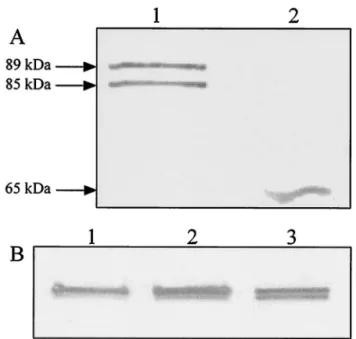
MGKAS13 contains an interruptedpflgene encoding a trun-cated PFL protein. Two bands were observed for strain MG1363 (Fig. 2A, lane 1) corresponding to the full-length (89-kDa) and the cleaved (85-kDa) PFL subunit produced after exposure of active PFL to oxygen, e.g., during protein extraction. These two bands were absent for strain MGKAS13 (Fig. 2A, lane 2), with which only a single band was observed. The molecular mass of this protein (65 kDa) corresponded with the expected molecular mass of a truncated PFL protein (2). Thus, the antibodies were specific towards PFL and there-fore suitable for measuring the PFL level in physiological ex-periments withL. lactisby Western blotting and ELISA. The
L. lactisPFL sequence displays a high homology (40.3%
iden-tity) to theE. coliPFL protein, but the antibodies obtained did not recognizeE. coliPFL in Western blot analysis (data not shown).
Oxygen is required for cleavage ofL. lactisPFL activated during anaerobic growth. As mentioned previously, E. coli
PFL is activated by introduction of a free radical to a glycine residue (30) in one of the subunits of a PFL homodimer (29). The PFL subunit containing the free radical is cleaved when it is exposed to oxygen. Thus, when cells growing in an anaerobic environment are subjected to oxygen, the PFL activity de-creases due to oxygenolytic cleavage of active PFL protein (18).
Assuming full inactivation of active PFL during the aerobic protein extraction procedure, the relative intensities of the two
PFL bands in a Western blot reflect the fraction of PFL that is present in its active form in anaerobically growing cells. Equal levels of intensity of the two bands therefore indicate that the PFL protein pool is fully activated, if we ignore the small difference in molecular mass between cleaved and full-length PFL subunits of 85 and 89 kDa, respectively.
The effect of oxygen on L. lactis PFL was examined by Western blot analysis.L. lactiscells were grown anaerobically, and protein extraction and SDS-PAGE were carried out under strict anaerobiosis. Only one distinct band corresponding to the full-length PFL subunit was detected in Western blot anal-ysis (Fig. 2B, lane 1), demonstrating that cleavage ofL. lactis
PFL did not occur in the absence of oxygen. When the anaer-obically prepared extract was subjected to air for 5 min, PFL was partially cleaved (Fig. 2B, lane 2), confirming that active PFL is sensitive to oxygen. The oxygenolytic cleavage of PFL was even more apparent from the analysis of an aerobically prepared extract of anaerobically grown L. lactiscells. In the Western blot (Fig. 2B, lane 3), two distinct bands were ob-served, demonstrating that extensive cleavage of active PFL took place during the aerobic protein extraction procedure.
The PFL level and product formation inL. lactisdepend on growth conditions.It has previously been demonstrated thatpfl
transcription in L. lactis is strongly induced (6- to 15-fold) under anaerobiosis and that growth on a less favorable carbon source such as galactose results in a higher pfl mRNA level than on glucose under both aerobic and anaerobic conditions (2). Physiological experiments have shown that formation of the mixed-acid end products formate, acetate, and ethanol is enhanced during anaerobic growth on galactose compared to that during growth on glucose as a consequence of a higher PFL in vivo activity (10). Using the developed tools, we inves-tigated whether a correlation exists between the PFL protein level and in vivo activity. In this way, it could be assessed whether the PFL protein level plays a role in regulation of the anaerobic pyruvate metabolism of L. lactis besides allosteric
FIG. 2. Specificities of anti-PFL antibodies and analysis of PFL cleavage by Western blotting. (A) Western blot analysis ofL. lactisMG1363 (lane 1) and the pflmutant strain MGKAS13 (lane 2). (B) Western blot analysis of extracts of MG1363. Lane 1, anaerobic growth and extraction; lane 2, anaerobic growth and extraction with subsequent exposure to air for 5 min; lane 3, anaerobic growth and aerobic extraction.
TABLE 1. End product formation inL. lactisMG1363 Conditions Yield of indicated end product (mol/mol of sugar)
a
Lactate Formate Acetate Ethanol
O2, glucose 1.63 ND 0.08 0.02
N2, glucose 1.85 0.05 0.04 0.03
O2, galactose 0.86 ND 0.79 0.03
N2, galactose 1.39 0.64 0.31 0.36
aYields of end products during exponential growth in shake flasks containing defined MS10 medium supplemented with glucose or galactose. Growth took place in an O2or N2atmosphere. Samples were taken in the mid-exponential
phase (optical density at 600 nm, 1.2⫾0.1). The relative standard deviation on HPLC measurements was less than 5%. ND, not detectable.
on January 7, 2021 by guest
http://jb.asm.org/
modulation of PFL activity, which is generally considered to control the distribution of carbon at the pyruvate branch point (10, 28).
We analyzed the PFL protein level in exponentially growing
L. lactiscells by Western blotting and by ELISA. Experiments
were carried out with both complex M17 medium and defined MS10 medium, the latter allowing measurement of end prod-ucts by HPLC. Use of defined medium enabled us to compare the PFL in vivo activity to the cellular content of PFL protein. The influence of aeration and the nature of the sugar fer-mented were examined.
During anaerobic growth on glucose, lactate was the major end product formed, corresponding to 96% {100⫻[1.85 mol of lactate/(1.85 mol of lactate⫹0.04 mol of acetate⫹0.03 mol of ethanol)]} of the carbon flux from pyruvate (Table 1), whereas the remaining 4% was recovered in the mixed-acid end products formate, acetate, and ethanol. During anaerobic growth on galactose, the formation of mixed-acid products was 33% of the total carbon flux from pyruvate. ELISA measure-ments showed that the total level of PFL was induced fivefold (7.3 versus 1.5) on galactose compared to the level observed on glucose during anaerobic growth in defined medium (Table 2). The observed correlation between the cellular PFL content and the end product profile shows that regulation of pfl ex-pression may represent an important mechanism in regulating the shift from homolactic to mixed-acid product formation in
L. lactisunder anaerobic conditions.
Aerobic growth ofL. lactisled to no detectable formation of formate either on glucose or on galactose, indicating that the PFL enzyme is not present in its active form under these conditions. Despite there being no PFL activity, 47% of the pyruvate pool was directed towards acetate during growth on galactose (Table 1), indicating that either pyruvate dehydro-genase or pyruvate oxidase is active under these conditions. The measured metabolites cannot account for the consump-tion of carbohydrates under aerobic condiconsump-tions, indicating that compounds other than those measured were produced. It may be diacetyl or acetoin that is reported to be produced in sig-nificant amounts under aerobic conditions (5).
Remarkably, a significant level of PFL was present during aerobic growth although the enzyme is dispensable under these conditions. ELISA measurements showed that PFL protein synthesis was induced only 1.5- and 2.3-fold (7.3 versus 3.2) by anaerobiosis on glucose and galactose, respectively (Table 2). Maintenance of a certain PFL level may represent an advan-tage as it ensures a rapid adaptation to fermentative growth upon oxygen depletion. However, this advantage is condi-tioned by the ability of the organism to protect PFL present during aerobic conditions from oxygenolytic cleavage. The mechanism involved in regulation of PFL activation inL. lactis
was examined and is described below.
Different PFL levels were observed during growth in com-plex M17 medium under the same conditions as described above (Table 2), showing that factors other than the carbon source and aeration affect the level of PFL inL. lactis. How-ever, the overall induction pattern was the same as with de-fined medium, suggesting that the major regulation ofpfl ex-pression depends on the examined physiological conditions.
L. lactisregulates the activation of PFL depending on the growth conditions.Western blot analysis allowed us to study posttranslational regulation of PFL in L. lactis. The protein extracts prepared for ELISA measurements were therefore also analyzed by Western blotting.
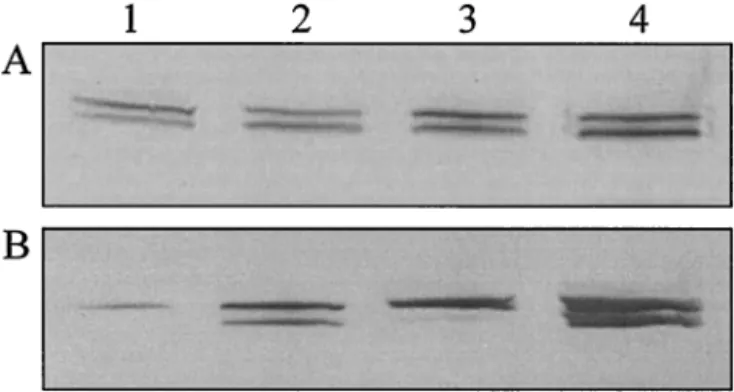
For growth in defined medium, two bands were observed for all growth conditions (Fig. 3A), showing that active PFL was oxygenolytically cleaved during either growth or protein ex-traction. For cells grown under aerobic conditions (Fig. 3A, lanes 1 and 3), the upper band, corresponding to full-length PFL, was slightly stronger than the lower, indicating that a small fraction of PFL may exist in the reversibly inactivated form during aerobic growth in the defined medium. This effect is clearly evident during growth in complex medium, where PFL is almost entirely present in the deactivated form, as demonstrated by the strong upper band for extracts of cells grown aerobically (Fig. 3B, lanes 1 and 3). These results pro-vide epro-vidence thatL. lactisis capable of regulating the activa-tion of PFL, depending on the growth condiactiva-tions. The mech-anism for this regulation is unknown but is assumed to be mediated either by a controlled PFL activase or by PFL deac-tivase activity. The protection mechanism is favored in a com-plex medium, whereas its capacity is insufficient to fully protect PFL in defined medium.
Analysis of PFL deactivase activity inL. lactis.E. coliis able to protect active PFL against oxygen by reversible removal of the free radical via a PFL deactivase activity. The multifunc-tional alcohol dehydrogenase ADHE harbors this activity in
E. coli(16). The gene encoding the alcohol dehydrogenase in
L. lactishas recently been cloned by our group (3), and the
lactococcal protein sequence displays high homology to its
E. colicounterpart (44% identity). The L. lactisADHE may
therefore possess a PFL deactivase activity. To investigate this,
L. lactisMG1363 and theadhEmutant strain MGKAS15 (3)
were cultivated aerobically in complex medium supplemented with glucose.L. lactis MGKAS15 contains a truncatedadhE
gene that results in a 13-kDa ADHE protein, rather than the 98-kDa full-length protein. If ADHE is responsible for the protection of PFL during aerobic growth in complex medium
FIG. 3. Western blot of protein extracts fromL. lactisMG1363 grown in defined MS10 medium (A) and complex M17 broth (B). Aerobic (lane 1) and anaerobic (lane 2) growth on glucose is shown. Aerobic (lane 3) and anaerobic (lane 4) growth on galactose is also shown. Protein extracts were prepared aerobically, which led to oxygenolytic cleavage of activated PFL subunits. TABLE 2. Total PFL protein level during exponential
growth ofL. lactisMG1363 Broth
Relative total PFL levelawith:
Glucose Galactose
O2 N2 O2 N2
MS10 1b 1.5 3.2 7.3
M17 1.0 3.0 5.4 13.0
aELISA measurements of the total PFL protein level in extracts ofL. lactis MG1363 under different growth conditions in shake flasks. The relative standard deviation of measurements was less than 10%.
bAll values were normalized with respect to the ELISA signal obtained for aerobically grown cells in glucose-MS10 broth.
on January 7, 2021 by guest
http://jb.asm.org/
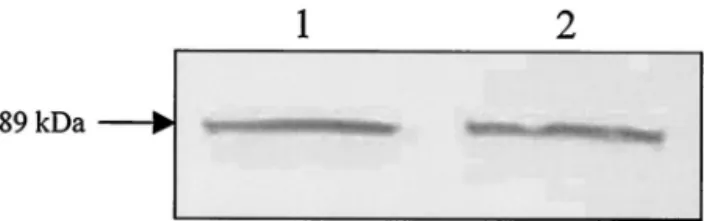
as observed in Fig. 3B, two PFL bands should be obtained on Western blotting when protein extracts of strain MGKAS15 grown under these conditions are analyzed. However, only a single PFL band was observed for both strains MGKAS15 and MG1363 (Fig. 4), and hence PFL is present only in its inactive form under these conditions in either of the two strains. Thus, ADHE was not involved in the reversible inactivation of PFL under these conditions. PFL may be deactivated by a different mechanism, or alternatively, PFL might not be activated under aerobic conditions as a consequence of low PFL activase ac-tivity.
To investigate whether the observed protection of PFL re-sults from the absence of PFL activase activity or the presence of PFL deactivase activity,L. lactisMG1363 and MGKAS15 were grown in complex medium under anaerobic conditions to ensure activation of PFL. Fractions of these cultures were subsequently exposed to aeration by shaking the cultures in baffled shake flasks for 5 and 30 min, and protein extracts of these cells were analyzed by Western blot analysis (data not shown). The aeration did not lead to an altered distribution between the full-length and cleaved PFLs compared to the distribution in anaerobically grown cells, and no significant difference was observed between the two strains. These results show thatL. lactisADHE was not responsible for the protec-tion of PFL, in contrast to the situaprotec-tion inE. coli(17). More-over,L. lactiswas not able to protect activated PFL against oxygen during the transition to aerobiosis by an alternative mechanism. The apparent lack of PFL deactivase activity in
L. lactissuggests that the protection of PFL observed during
aerobic growth in complex medium is brought about by regu-lated activity of the PFL-activating enzyme.
DISCUSSION
We have purified the PFL protein from L. lactisand pro-duced polyclonal antibodies for the analysis of PFL protein level using Western blot analysis and ELISA. These techniques not only provided us with a tool for measuring the cellular content of PFL in physiological experiments withL. lactisbut also enabled us to investigate the biochemistry of the PFL enzyme in L. lactis. The PFL enzyme in E. coli has been subjected to considerable fundamental research for decades, but to our knowledge, a detailed analysis of the biochemical nature of the PFL enzyme inL. lactishas not been published. A few reports are available on specific activity measurements of PFL inL. lactis. These were determined either for perme-abilized cells (28) or as in vitro activities in protein extracts (10). These methods are cumbersome, requiring strict anaer-obiosis during sample withdrawal and protein extraction, and neither of them allows discrimination between the active and the inactive form of PFL. Thus, immunochemical analysis by Western blotting and ELISA represents an advantageous al-ternative. ELISA allows a reliable measurement of the total
PFL level, while Western blotting discriminates between the different forms of PFL, thereby providing an indirect measure of the level of active PFL.
InE. coli, the half-life of activated PFL has been estimated
to about 10 s in an air-saturated buffer at 0°C (18). The amino acid sequence around the activation site is highly conserved in the PFLs ofE. coliand L. lactis, and the lactococcal PFL protein was therefore expected to be equally sensitive to oxy-gen. By Western blot analysis of an anaerobically prepared protein extract of L. lactis, we confirmed that oxygen is re-quired for irreversible inactivation of the L. lactis PFL by peptide bond cleavage. A short exposure of the anaerobically prepared protein extract to air resulted in partial cleavage of PFL, and aerobic protein extraction led to extensive cleavage of PFL, confirming the oxygen sensitivity of lactococcal PFL.
Due to the oxygen sensitivity of the active PFL, it is reason-able to assume that virtually all active PFL is cleaved during an aerobic protein extraction procedure. Therefore, with a known radical stoichiometry of one per homodimer (29), the relative intensities of the two bands reflect the fraction of PFL existing in its active form. A PFL pool consisting of 100% active PFL will after complete irreversible inactivation result in approxi-mately equal intensities for the two bands, if the small differ-ence in the molecular weights of the cleaved and full-length subunits does not affect antibody recognition. The presence of only a full-length PFL band under a given growth condition implies that PFL exists only in its nonradical form and is therefore not catalytically active. The Western blot analysis showed that PFL was fully activated during anaerobic growth in defined medium. Similar findings have been made withE. coli, in which PFL is present exclusively in its active form during growth under strictly anaerobic conditions (8).
It was demonstrated that L. lactis protects its PFL from oxygenolytic cleavage when it is grown aerobically in a complex medium (Fig. 3B) but does not significantly do so in a simple defined medium (Fig. 3A). During aerobic growth in complex medium, PFL was exclusively present in its nonactivated full-length form. Protection of PFL results either from reversible removal of the radical via PFL deactivase activity or from no or low PFL activase activity, precluding activation of PFL. We investigated whether the multifunctional alcohol dehydroge-nase ADHE is responsible for protection of PFL via deactivase activity inL. lactis, as inE. coli. By comparing the Western blot profiles of PFL in aerobically growing cells ofL. lactisMG1363 and theadhEmutant strain MGKAS15 (3), it was concluded that the lactococcal ADHE protein was not responsible for the observed protection ofL. lactisPFL during aerobic growth in complex medium. The protection of PFL from oxygenolytic cleavage was therefore assumed to be due to down-regulation of PFL activase activity, conceivably in combination with an alternative mechanism for PFL deactivation. The deactivation may be catalyzed by a different protein. Alternatively, if the PFL turnover inL. lactisis very high, the requirement for PFL deactivation would be obviated. The PFL-activating enzyme remains unidentified inL. lactis, and the recent release of data on theL. lactisgenome (4) has not revealed a candidate for a PFL activase.
SinceL. lactisis able to control the activation of PFL and thereby protects PFL against oxygenolytic cleavage, it is clear that the total PFL level is not proportional to the PFL activity under all growth conditions. However, since PFL seemed fully activated during anaerobic growth in defined medium (Fig. 3A, lanes 2 and 4), ELISA measurements of total PFL were as-sumed to give a reliable measure of the cellular contents of active PFL under these conditions. A fivefold higher level of PFL was observed during anaerobic growth on galactose than FIG. 4. PFL Western blot analysis ofL. lactisMG1363 (lane 1) and theadhE
mutant strain MGKAS15 (lane 2) grown aerobically in complex medium. Protein extraction was carried out aerobically.
on January 7, 2021 by guest
http://jb.asm.org/
on glucose, correlating with the previously reported fourfold induction ofpfl transcription (2). Intracellular concentrations of the glycolytic intermediates glyceraldehyde-3-phosphate and dihydroxyacetone phosphate, acting as allosteric inhibitors of PFL, have been reported to be lower on galactose than on glucose (9, 10). These observations have been used to explain the different product profiles obtained with the two sugars. Even though allosteric modulation of PFL activity may partic-ipate in the regulation of the shift from homolactic to mixed-acid product formation, the higher PFL protein level observed during growth on galactose than during growth on glucose clearly shows that regulatedpfl expression may also play an important role.L. lactisstrains with constitutive expression of
pflare currently being constructed to investigate the role of the PFL protein level in the regulation of the anaerobic pyruvate metabolism ofL. lactis.
The induction of PFL during anaerobic growth on galactose is significantly higher forL. lactisMG1363 than was previously reported forL. lactisNCDO 2118, with which the PFL in vitro activity was observed to be twofold lower on glucose than on galactose or lactose (10). This discrepancy may be due to differences in the strains investigated; NCDO 2118 was origi-nally isolated from plants, an atypical habitat for strains of
L. lactis normally associated with the manufacture of dairy
products.
It is notable that a significant level of PFL was produced under aerobic conditions, during which no in vivo activity of PFL was observed. Although PFL appears to be dispensable under these conditions, a certain level of PFL may represent an advantage when it grows in a variable environment. The ability to activate PFL upon oxygen depletion will presumably ensure a more rapid transition to fermentative metabolism than that of organisms restricted to de novo synthesis of the PFL pro-tein.
The methods presented here will be used for measuring the PFL protein level in further physiological studies ofL. lactis. These experiments aim at quantifying the relative significance of the mechanisms involved in the regulation of PFL in vivo activity, which in our opinion plays a central role in the regu-lation of the shift from homofermentative to mixed-acid prod-uct formation.
ACKNOWLEDGMENTS
This work was financed by the Center for Process Biotechnology at the Technical University of Denmark.
We thank Lars B. Nielsen and Henriette S. Egeblad (Biotechnolog-ical Institute) for fruitful discussion and advice concerning antibody purification and labeling.
REFERENCES
1.Abbe, K., S. Takahashi, and T. Yamada.1982. Involvement of oxygen-sensitive pyruvate formate-lyase in mixed-acid fermentation byStreptococcus mutansunder strictly anaerobic conditions. J. Bacteriol.152:175–182. 2.Arnau, J., F. Jorgensen, S. M. Madsen, A. Vrang, and H. Israelsen.1997.
Cloning, expression, and characterization of theLactococcus lactis pflgene, encoding pyruvate formate-lyase. J. Bacteriol.179:5884–5891.
3.Arnau, J., F. Jorgensen, S. M. Madsen, A. Vrang, and H. Israelsen.1998. Cloning of theLactococcus lactis adhEgene, encoding a multifunctional alcohol dehydrogenase, by complementation of a fermentative mutant of Escherichia coli. J. Bacteriol.180:3049–3055.
4.Bolotin, A., S. Mauger, K. Malarme, S. D. Ehrlich, and A. Sorolin.1999. Low-redundancy sequencing of the entireLactococcus lactisIL1403 genome. Antonie Leeuwenhoek76:27–76.
5.Boumerdassi, H., M. Desmazeaud, C. Monnet, C. Y. Boquien, and C. Cor-rieu.1996. Improvement of diacetyl production byLactococcus lactisssp. lactisCNRZ 483 through oxygen control. J. Dairy Sci.79:775–781. 6.Bradford, M. M.1976. A rapid and sensitive method for the quantification of
microgram quantities of protein utilizing the principle of protein-dye bind-ing. Anal. Biochem.72:248–254.
7.Cocaign-Bousquet, M., C. Garrigues, L. Novak, N. D. Lindley, and P. Lou-biere.1995. Rational development of a simple synthetic medium for the sustained growth ofLactococcus lactis. J. Appl. Bacteriol.79:108–116. 8.Conradt, H., M. Hohmann-Berger, H. P. Hohmann, H. P. Blaschkowski, and
J. Knappe.1984. Pyruvate formate-lyase (inactive form) and pyruvate for-mate-lyase activating enzyme ofEscherichia coli: isolation and structural properties. Arch. Biochem. Biophys.228:133–142.
9.Fordyce, A. M., V. L. Crow, and T. D. Thomas.1984. Regulation of product formation during glucose or lactose limitation in nongrowing cells of Strep-tococcus lactis. Appl. Environ. Microbiol.48:332–337.
10. Garrigues, C., P. Loubiere, N. D. Lindley, and M. Cocaign-Bousquet.1997. Control of the shift from homolactic acid to mixed-acid fermentation in Lactococcus lactis: predominant role of the NADH/NAD⫹ratio. J.
Bacte-riol.179:5282–5287.
11.Gasson, M. J.1983. Plasmid complements ofStreptococcus lactisNCDO 712 and other lactic streptococci after protoplast-induced curing. J. Bacteriol.
154:1–9.
12.Harlow, E., and D. Lane.1988. Antibodies: a laboratory manual. Cold Spring Harbor Laboratory Press, Cold Spring Harbor, N.Y.
13.Inoue, H., H. Nojima, and H. Okayama.1990. High efficiency transformation ofEscherichia coliwith plasmids. Gene96:23–28.
14. Johansen, E., and A. Kibenich.1992. Characterization ofLeuconostoc iso-lates from commercial mixed strain mesophillic starter cultures. J. Dairy Sci.
75:1186–1191.
15. Kaneko T., M. Takahashi, and H. Suzuki.1990. Acetoin fermentation by citrate-positiveLactococcus lactissubsp.lactis3022 grown aerobically in the presence of hemin or Cu2⫹. Appl. Environ. Microbiol.56:2644–2649.
16. Kessler, D., I. Leibrecht, and J. Knappe.1991. Pyruvate-formate-lyase-de-activase and acetyl-CoA reductase activities ofEscherichia colireside on a polymeric protein particle encoded byadhE. FEBS Lett.281:59–63. 17. Kessler, D., W. Herth, and J. Knappe.1992. Ultrastructure and pyruvate
formate-lyase radical quenching property of the multimeric AdhE protein of Escherichia coli. J. Biol. Chem.267:18073–18089.
18. Knappe, J., F. A. Neugebauer, H. P. Blaschkowski, and M. Ganzler.1984. Post-translational activation introduces a free radical into pyruvate formate-lyase. Proc. Natl. Acad. Sci. USA81:1332–1335.
19. Knappe, J., and G. Sawers.1990. A radical-chemical route to acetyl-CoA: the anaerobically induced pyruvate formate-lyase system ofEscherichia coli. FEMS Microbiol. Rev.75:383–398.
20. Lohmeier-Vogel, E. M., B. Hahn-Ha¨gerdahl, and H. J. Vogel.1986. Phos-phorus-31 NMR studies of maltose and glucose metabolism inStreptococcus lactis. Appl. Microbiol. Biotechnol.25:43–51.
21. Nakane, P. K., and A. Kawaoi.1974. Peroxidase-labeled antibody. A new method of conjugation. J. Histochem. Cytochem.22:1084–1091.
22. Nielsen, J., and J. Villadsen.1994. Bioreaction engineering principles. Ple-num Press, New York, N.Y.
23. Qiagen.1997. The QIAexpressionist, a handbook for high-level expression and purification of 6xHis-tagged proteins, 3rd ed. Qiagen, Hilden, Germany. 24. Sambrook, J., E. F. Fritsch, and T. Maniatis.1989. Molecular cloning: a laboratory manual, 2nd ed. Cold Spring Harbor Laboratory Press, Cold Spring Harbor, N.Y.
25. Takahashi, S., K. Abbe, and T. Yamada.1982. Purification of pyruvate for-mate-lyase fromStreptococcus mutansand its regulatory properties. J. Bac-teriol.149:1034–1040.
26. Takahashi, N., K. Abbe, S. Takahashi-Abbe, and T. Yamada.1987. Oxygen sensitivity of sugar metabolism and interconversion of pyruvate formate-lyase in intact cells ofStreptococcus mutansandStreptococcus sanguis. Infect. Immun.55:652–656.
27. Thomas, T. D., D. C. Ellwood, and V. M. Longyear.1979. Change from homo- to heterolactic fermentation byStreptococcus lactisresulting from glucose limitation in anaerobic chemostat cultures. J. Bacteriol.138:109–117. 28. Thomas, T. D., K. W. Turner, and V. L. Crow.1980. Galactose fermentation byStreptococcus lactisandStreptococcus cremoris: pathways, products, and regulation. J. Bacteriol.144:672–682.
29. Unkrig, V., F. A. Neugebauer, and J. Knappe.1989. The free radical of pyruvate formate-lyase. Characterisation by EPR spectroscopy and involve-ment in catalysis as studied with the substrate-analogue hypophosphite. Eur. J. Biochem.184:723–728.
30. Wagner A. F. V., M. Frey, F. A. Neugebauer, W. Scha¨fer, and J. Knappe.
1992. The free radical in pyruvate formate-lyase is located on glycine-734. Proc. Natl. Acad. Sci. USA89:996–1000.
31. Wood, N. P., and D. J. O’Kane.1964. Formate-pyruvate exchange reaction in Streptococcus faecalis. J. Bacteriol.87:97–103.
32. Yamada, T., and J. Carlson.1975. Regulation of lactate dehydrogenase and change of fermentation products in streptococci. J. Bacteriol.124:55–61. 33. Yamada, T., S. Takahashi-Abbe, and K. Abbe.1985. Effects of oxygen on
pyruvate formate-lyase in situ and sugar metabolism ofStreptococcus mutans andStreptococcus sanguis. Infect. Immun.47:129–134.