Equivalent Substitution Based Method for Calculation of
Best Installed Capacity of Pumped Storage Power Station
Jinming Li, Tao Yu, Huaizhi Wang
College of Electric Power, South China University of Technology, Guangzhou, Guangdong Province, China Email: [email protected]
Received 2013
ABSTRACT
This paper proposes a novel method to calculate the best installed capacity of pumped storage power station. First, we choose the day with maximum load as the typical day for every month and simulate the system running in two cases of whether the pumped storage power station is put into operation. The difference of the total coal consumption between the two cases is the peak load shifting benefit. Furthermore, we build load model and power generation model to calcu-late the benefit of emergency use and frequency modulation, which are the major projects of dynamic benefits. At last, on the premise of ensuring the system requirements, the developed method employs the maximum benefit of the unit capacity as the objective function to get the best installed capacity of pumped storage power station by simulations. Tests on a provincial power grid have shown that the developed method which combines of load characteristics, electric structure and other factors can get the best installed capacity of pumped storage power station easily and has a certain guiding significance for the planning and construction of the pumped storage power station.
Keywords: Static Benefits; Dynamic Benefits; Pumped Storage Power Station; Best Installed Capacity
1. Introduction
With the sustainable and rapid development of china economy, the electric power demand is also increasing rapidly, which make the fluctuation of load and peak valley load increasing year by year. Thermal power plants are the major producer of electricity in China,but the output regulating scope of most thermal power plants is less than 50% and cannot meet the demand of the load variation. The pumped storage power station is built to solve this problem. When the power system is in low load condition, the pumped storage units begin pumping water from the reservoir in downriver to the reservoir in upstream and release the water when the load begin to increase, in this time ,the pumped storage units work in the condition of generating[1,2]. In this way, the pumped storage units can store energy. The pumped storage power station is not affected by factors such as fuel, flood etc., and the regulating scope of pumped storage units is the double of its rating [3,4]. At this point, pumped storage units show great superiority comparing with other normal power supplies. Therefore, in the region with greatly fluctuating load but lacking of shift peak load capacity, building pumped storage power station is the best meas-ure to mitigate the difficulty of peak regulation and lack of peak power.
In addition, pumped storage power station has good dynamic function, such as frequency modulation, phase
modulation, spare, black start etc., which make it be a very effective tool and mean to ensure the security, economy and stability of power grid.
It involves many factors to determine the reasonable proportion of pumped storage power station in the power system, including the current situation of energy develop-ment and utilization, the electric structure, the distribution of power station, the load characteristic, the pumping power that power system can provide, the development condition and the investment and operation cost of all kinds of power plant. This paper employs the maximum benefit of the unit capacity as the objective function to get the best installed capacity of pumped storage power station by simulations [5]. Tests on a provincial power grid have shown the effectiveness of the method.
2. Static Benefits
pump-ing power of the pumped storage units. On the other hand, because the pumped storage units can replace thermal power unit to be the variable load plant and improve the operating conditions of thermal power unit. In this way, it can reduce the auxiliary power rate and the coal con-sumption rate of the thermal power unit, the difference value between the two cases is the pumped storage power station's shift peak and valley benefits. The calculation of capacity benefit calculation is relatively simple, but cal-culating shift peak and valley benefits is a complicated problem which involves many factors.
In this paper, we choose the day with maximum load as the typical day for every month and simulate the sys-tem running in two cases of whether the pumped storage power station is put into operation. The forecast of pumped storage power station 24 point output curve in the typical day bases on the data of historical average, and in consideration of the development of installed ca-pacity and load level, we revise the curve proportionally. The 24 point output curve of power from other areas de-pends on the fixed power energy of the agreement. Spe-cific steps to calculate the Static benefits are shown as follows:
1) Determine the output curve of the other units in the area except pumped storage unit. With the considering of load and emergency reserves, deduct pumped storage power station output and power from other areas from the load curve in the typical day (when the pumped stor-age power station is on pumping state, its output is a negative value).
2) Sort the units in the power grid. According to the principle of energy-saving power generation dispatching, clean energy unit such as hydropower unit, nuclear reac-tors are arranged to put into operation first, and how to decide the priorities of thermal power units depend on the unit coal consumption rate.
3) Unit Commitment (UC). The priority listing method is used to solve the UC problem. The method initially arranges the generating units based on lowest operational cost characteristics. The predetermined order is then used for UC such that the system load is satisfied [6,7].
4) Calculate shift peak and valley benefits of pumped storage power station. Add the coal consumption of all units in two cases respectively to get the total coal con-sumption of the system, then we can obtain the shift peak and valley benefits in the typical day by calculating the difference between the two cases. So it is easy to figure up the shift peak and valley benefits for month and year with monthly unbalanced coefficient and seasonal un-balanced coefficient.
3. Dynamic Benefits
Dynamic benefits of pumped storage unit include several aspects, and in the simulation of system operation, they
are related to each other. At present, quantitative evalua-tion algorithms for dynamic benefits usually adopt partial summation model method; its main idea is dividing pumped storage power station capacity into several parts according to the function it undertakes. Then put forward quantitative calculation formula for every part respec-tively, and calculate the dynamic benefit, the total dy-namic benefit of pumped storage power station is the sum of all parts [8].
This paper adopts equivalent replacement method that is widely used in the engineering economics. The first step is calculating the basic program, namely studying the system reliability index and annual cost when the studied station provides dynamic benefit service; The second step consider alternative program, namely calcu-lating the annual cost that is needed to keep the reliability index being same with the basic program when the stud-ied station doesn’t provide dynamic benefit service. Comparing with the basic program, the excess part of the annual cost in alternative program is the benefit annual value. This paper focuses on two important items in dy-namic benefit: emergency reserves benefit and frequency modulation benefit.
3.1. Emergency Reserves Benefit
Starting with the overall system, this paper builds a pumped storage power station accident emergency reserves benefit evaluation model to analysis emergency reserves benefit of pumped storage unit by dynamic simulating of system accident pattern analysis and accident reflection of all kinds of units after in the process of system accident. The emergency reserves benefit evaluation model includes two child models, the one is load model and the other is the power generation model.
Load model. The load model is based on historical load data of power system and the development of social eco-nomic characteristics in the future. The load mode con-sists of three parts: the annual peak load, the annual load curve, the typical daily load curve. The load on the ith moment in the typical day can be calculated as follow:
max m
=
mt hmt
L L L L (1)
where max is the annual peak load, m and hmt are
the annual load curve (seasonal unbalanced coefficient) and the typical daily load curve, respectively.
L L L
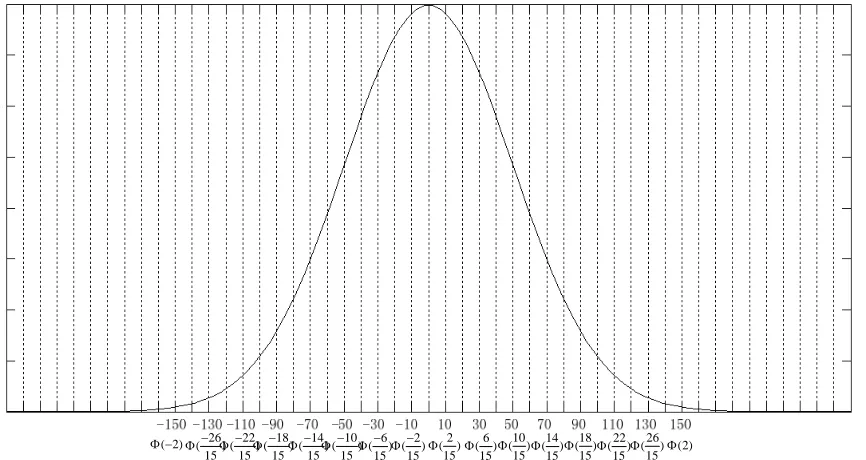
random fluctuations of load into the model. Take the China Southern Grid as an example, the load fluctuate about 150MW when the frequency fluctuate 0.03 Hz. For simplicity, we assume that the typical daily load fluctua-tion meet the standard normal distribufluctua-tion, so the prob-ability of load fluctuation within 150MW can be calcu-lated as (2) = 0.9772. Probability of load fluctuation amplitude is shown in Figure 2.
minute, respectively. Then remove the capacity of full load units from total unit-operating capacity of system and the remaining capacity is the response capacity in the system.
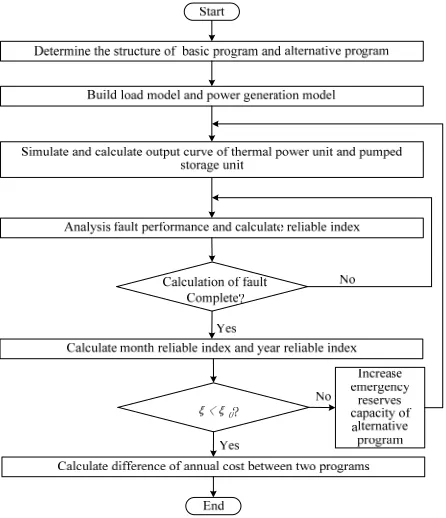
This paper adopt the lacking electricity caused by ac-cident in the year as the reliability index and the flow-chart of the method for emergency reserves benefit evalua- tion is depicted in Figure 1, where and 0 are
reli-able index of alternative program and basic program.
3.2. Frequency Modulation Benefit
Frequency modulation benefit consists of load reserve benefit and load tracking benefit. According to the re-search achievement of Prof. A. Ferreira from Electrical Power Research Institute of America, load reserve bene-fit and load tracking benebene-fit are approximately the same, so this paper only calculate load reserve benefit and Fre-quency modulation benefit is double of load reserve benefit.
The basic evaluation process of Frequency modulation benefit is similar to that of emergency reserves benefit, the only one difference between them is the load model and power generation model they adopt. Load reserve capacity adjustment of Pumped storage power station is usually due to the imbalance of system instant power caused by unscheduled increasing load and random fluc-tuations of load. Hence, it is necessary to do a detailed simulation analysis of random fluctuations of load when evaluate the load reserve benefit.
The load model in the evaluation of load reserve bene-fit is a 24-point typical daily load curve. On that basis,
then add short-term unscheduled increasing load and Figure 1. Flowchart of emergency reserves benefit evaluation.
2 ( )
15
(6)
15
(10)
15
(14)
15
(18)
15
(22)
15
(26)
15
(2)
2 ( )
15 6 ( )
15 10 ( )
15 14 ( )
15 18 ( )
15 22 ( )
15 26 ( )
[image:3.595.309.537.189.455.2]15 ( 2)
[image:3.595.83.516.487.717.2]On the promise that pumped storage power station have enough capacity to undertake the task of shift peak and valley and emergency reserve, pumped storage units make use of spare capacity and the remaining power for emergency reserve to provide load reserve to system. During low load period, pumped storage units work as a water pump and it will increase the load of system. In this state, it can’t be frequency modulation unit and frequency modulation is undertaken squarely by other kinds of units, these would often be thermal power unit. Therefore, the evaluation of load reserve benefit should be divided into rest time and power generation time.
The flowchart of the method for frequency modulation benefit evaluation is depicted in Figure 3, where and
0
are reliable index of alternative program and basic program.
4. Example Analysis
Increase the installed capacity of pumped storage power station according to the unit capacity of pumped storage unit in studied area in the case that load characteristic is known. Then evaluate the total benefit of every scheme, respectively. The capacity that correspond maximum benefit of unit capacity would be the best installed ca-pacity of pumped storage power station. For simplified calculation, we assume that pumped storage units make full use of their capacity. Thus, in the premise of satisfy-ing the requirement of dynamic task, includsatisfy-ing emer-gency reserve, load reserve, load tracking etc., all of the
Figure 3. Flowchart of Frequency modulation benefit evalua- tion.
remain capacity is put into pumping during low load pe-riod, and output in peak time is set be 75 percent of the pumping power in valley time [9].
In order to test the algorithm, summer and winter typical day of a provincial power grid in normal rainfall year day are selected to be the research subjects. Every planning scheme with different installed capacity is simulated detailed Based on the present status of power system, the main principles for the test is:
1) Basing on the installed capacity of every kind of power sets and the historical data of their output per year, the result of simulation for units except pumped storage units should be consistent with realities as far as possible. 2) The electric structure of this power grid is relatively complex, and all of the factors should be considered, in-cluding nuclear power, thermal power, hydropower, pneu-moelectric and power from other areas.
3) The main power sources for peaking in the simula-tion are thermal power and pneumoelectric. In order to reduce wasted water for peak modulation, hydropower doesn’t join peak-regulation in the summer and peak- shaving depth in the winter is set to be 50%. Moreover, nuclear power doesn’t join peak-regulation all over the year.
4) The alternative power is thermal power when the pumped storage power station is removed from power sys-tem. All benefits are converted into standard coal equiva-lent.
The maximum load, minimum load and peak-vale dif-ference are shown in Table 1. The load curves of sum-mer typical day and winter typical day are given in Fig-ure 4.
Table1. Load of two typical day load curves (MW).
Typical day
Maximum Load
Minimum Load
peak-vale difference
Summer 87000 43514 43486
Winter 25800 14500 11300
0 4 8 12 16 20 24
0 2 4 6 8x 10
4
Time (h)
Lo
a
d
(
M
W) Winter
[image:4.595.61.284.451.710.2]Summer
The operation period of pumped storage power station is set to be 50 years. Investment of pumped storage unit is 3500yuan per capacity. The annual operation cost is 0.5 percent of investment expenses. Spinning reserve of system is 4.2 percent of maximum load [10]. One part of it is emergency reserve which is about 3 percent of maxi-mum load and the remaining capacity is load reserve which is about 1.2 percent of maximum load. Prices of standard coal and nature gas are 900 yuan per ton, 3yuan per cubic meter, respectively.
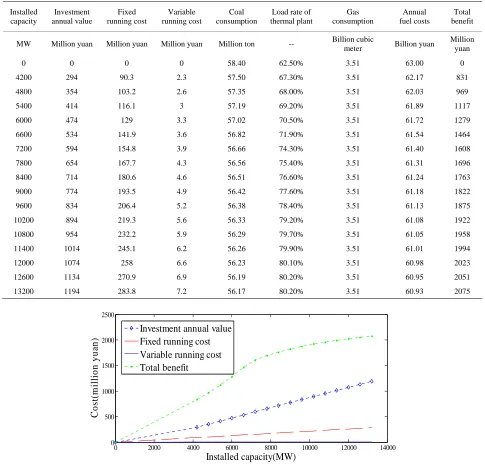
Simulation results for different installed capacity of umped storage power station are shown in Table 2. The
comparison of annual total cost, fuel cost, annual fixed running cost between alternative program and basic pro-gram is given in Figure 5. The results of this experiment lead to several conclusions:
[image:5.595.55.540.256.726.2]1) There is a linear relationship between fixed running cost and installed capacity of pumped storage power sta-tion, as well as investment annual value and installed capacity of pumped storage power station. The variable running cost show little changes with the increase of in-stalled capacity of pumped storage power station. So it can be ignored compared with fixed running cost and investment annual value.
Table 2. Simulation results for different installed capacity.
Installed capacity
Investment annual value
Fixed running cost
Variable running cost
Coal consumption
Load rate of thermal plant
Gas consumption
Annual fuel costs
Total benefit
MW Million yuan Million yuan Million yuan Million ton -- Billion cubic
meter Billion yuan
Million yuan
0 0 0 0 58.40 62.50% 3.51 63.00 0
4200 294 90.3 2.3 57.50 67.30% 3.51 62.17 831
4800 354 103.2 2.6 57.35 68.00% 3.51 62.03 969
5400 414 116.1 3 57.19 69.20% 3.51 61.89 1117
6000 474 129 3.3 57.02 70.50% 3.51 61.72 1279
6600 534 141.9 3.6 56.82 71.90% 3.51 61.54 1464
7200 594 154.8 3.9 56.66 74.30% 3.51 61.40 1608
7800 654 167.7 4.3 56.56 75.40% 3.51 61.31 1696
8400 714 180.6 4.6 56.51 76.60% 3.51 61.24 1763
9000 774 193.5 4.9 56.42 77.60% 3.51 61.18 1822
9600 834 206.4 5.2 56.38 78.40% 3.51 61.13 1875
10200 894 219.3 5.6 56.33 79.20% 3.51 61.08 1922
10800 954 232.2 5.9 56.29 79.70% 3.51 61.05 1958
11400 1014 245.1 6.2 56.26 79.90% 3.51 61.01 1994
12000 1074 258 6.6 56.23 80.10% 3.51 60.98 2023
12600 1134 270.9 6.9 56.19 80.20% 3.51 60.95 2051
13200 1194 283.8 7.2 56.17 80.20% 3.51 60.93 2075
0 2000 4000 6000 8000 10000 12000 14000
0 500 1000 1500 2000 2500
Installed capacity(MW)
C
o
st
(m
il
li
o
n
y
u
an
) Investment annual valueFixed running cost
Variable running cost Total benefit
2) When installed capacity of pumped storage power station is less than 7200 MW, the benefits are obvious. The benefit will increase about 166.7 thousand tons of standard coal for every 600MW increase, about 150 mil-lion yuan when converted into economic benefit. The growth begins lower with the increase of installed capac-ity of pumped storage power station. When installed ca-pacity is in the scope of 7200 MW to 9600 MW, the benefit will increase about 88.9 thousand tons of standard coal for every 600 MW increase, about 80 million yuan when converted into economic benefit. The benefit will be very low when the installed capacity continues to in-crease for there is only 24.4 thousand tons of standard coal increase for every 600 MW increases, about 22 mil-lion yuan when converted into economic benefit.
3) When the growth of benefit is higher than that of annual running cost (less than 7200 MW), we can in-crease the installed capacity appropriately. And with the increase of installed capacity of pumped storage power station, growth of benefit slows significantly. Therefore, it can be concluded that the best installed capacity of pumped storage power station is 7200 MW.
5. Conclusions
The rapid development of economy exacerbates the power peaking contradiction. Power programming should adjust in time as the load changes. So how to determine the best installed capacity become more and more important to power system. This paper choose the day with maximum load as the typical day for every month and simulate the system running in two cases of whether the pumped storage power station is put into operation. Then build load model and power generation model to calculate the benefit of emergency use and frequency modulation, which are the major projects of dynamic benefits. The developed method employs the maximum benefit of the unit capacity as the objective function to get the best in-stalled capacity of pumped storage power station by simulations. Tests on a provincial power grid have shown that the developed method has a meaningful guideline in practice.
REFERENCES
[1] H. L. Zhang, D. M. Xie, J. Y. Liu, et al., “Optimized Control of the Startup and Shutdown of Peaking Units,” Journal of Engineering for Thermal Energy and Power, Vol. 20, No. 5, 2005, pp. 300-303.
[2] X. M. Yu, X. G. Xiong, Y. W. Wu, et al., “Discussion on Optimal Mode for Peaking Units Expansion Planning and Its Application,” Electric Power, Vol. 36, No.1, 2003, pp. 48-51.
[3] J. Barton and D. Infield, “Energy Storage and Its Use with Intermittent Renewable Energy,” IEEE Transaction. Energy Conversion, Vol. 19, No. 2, 2004, pp. 441-448.
doi:10.1109/TEC.2003.822305
[4] W. Leonhard and E. Grobe, “Sustainable Electrical En-ergy Supply with Wind and Pumped Storage: A Realistic long-term Strategy or Utopia,” Proceedings IEEE Power Engineering Society General Meeting, 2004, pp. 1221- 1225.
[5] Anonymous, “Pumped-storage Project Updates,” Interna-tional Journal of HydropowerDams, Vol. 9, No. 5, 2002, pp. 104-109.
[6] R. M. Burns and C. A. Gibson, “Optimization of Priority Lists for a Unit Commitment Program,” in Proceeding IEEE Power Engineering Society SummerMeeting, 1975. [7] Narayana Prasad Padhy, “Unit Commitment—A Biblio-graphical Survey,” IEEE Transaction Power System, Vol. 19, No. 2, 2004, pp. 1196-1205.
doi:10.1109/TPWRS.2003.821611
[8] H. K. Song, Y. D. Tang, G. Q. Tang, et al., “Analy-sis of Power Generation Enterprise Bidding Strategies Considering Demand Side Bidding,” Electric Power Automation Equipment, Vol. 27, No. 6, 2007, pp. 47-50. [9] K. Aoki, M. Itoh, K. Nara. and M. Kanezashi, “Optimal
Long-term Unit Commitment In Large Scale Systems In-cluding Fuel Constrained Thermal And Pumped Storage Hydro,” IEEE Transaction Power System, Vol. 4, No. 3, 1989, pp.1065-1073.doi:10.1109/59.32600