New Matrix Tablet from Okra Gum: Effects of Method of
Preparation and Gum Concentration on Tablet Properties
Bakre Lateef Gbenga*, Abimbola Zulikha
Department of Pharmaceutics and Pharmaceutical Technology, Olabisi Onabanjo University, Sagamu, Nigeria. Email: *[email protected]
Received May 21st, 2013; revised June 28th, 2013; accepted July 14th, 2013
Copyright © 2013 Bakre Lateef Gbenga, Abimbola Zulikha. This is an open access article distributed under the Creative Commons Attribution License, which permits unrestricted use, distribution, and reproduction in any medium, provided the original work is properly cited.
ABSTRACT
The objective of this investigation is to study the effect of methods of preparation and concentration of gum on the compressional and mechanical properties of Okra gum matrix. The compressional behavior of Okra gum matrices pre- pared by direct compression and wet granulations is analyzed using density measurements, Heckel and Kawakita analy- sis while the mechanical properties of the formulations were assessed using crushing strength (CS) and friability (FR) as well as CSFR ratio. Formulations prepared by direct compression had lower Pk values than those prepared by wet
granulation while there was no significant difference between Py values of formulations prepared by direct compression
and wet granulations. Therefore, formulations prepared by direct compression underwent plastic deformation more eas- ily and rapidly than those prepared by wet granulation. The results show that DB values increased with decrease in con-
centration of the gum and granules undergo higher degree of fragmentation than powders. Formulations containing 90% w/w Okra gum exhibited the highest amount of total plastic deformation and gave the best packing. Tablets prepared by direct compression showed lower bond strength and higher friability values than those prepared by wet granulations. The crushing strength generally decreases with a decrease in the concentration of the gum while there was an inverse relationship between friability and gum concentration. CSFR decreases with a decrease in gum concentration and tab- lets prepared by wet granulations showed significantly higher values of CSFR (p < 0.001) than those prepared by direct compression. The results suggest that the concentration of gum and the method of preparation of materials for compres- sion are critical factors in the formulation of Okra gum matrices with acceptable compressional and mechanical proper- ties.
Keywords: Okra Gum; Wet Granulation; Direct Compression; Compressional and Mechanical Properties
1. Introduction
Natural polymers and their semi-synthetic derivatives gained popularity in development of novel drug delivery systems. They are degradable, compatible with bioactive agents, readily available, and possess ability for chemical modifications as well as have functional versatility [1-4]. A large number of natural polymers that are used for drug delivery are non starch polysaccharides, many of which are hydrogels with high swelling ratios and capa- ble of causing large viscosity increases in aqueous solu- tions even at small concentrations [5]. These are among the properties that make them overtly dependable in sev- eral conventional and novel drug delivery systems [6,7]. Thus, natural biopolymers like Okra gum along with
their modification products offer a wide range of proper- ties and applications.
Okra gum obtained from the fruits of Abelmuscus es- culentus, is a polysaccharide consisting of D-galactose,
L-rhamnose and L-galacturonic acid [8]. Okra gum had been evaluated as binder in tablet dosage formulation [9,10] and as a control release agent in modified release matrices in comparison with sodium carboxymethyl cel- lulose (NaCMC) and hydroxypropylmethylcellulose (HPMC) using paracetamol as the model drug. Okra gum matrices provided controlled release of paracetamol for more than 6 h and the release rates followed time-dependent kinet- ics. Okra gum compared favourably with NaCMC, and a combination of Okra gum and NaCMC, and further addi- tion of HPMC resulted in a near zero order release of paracetamol from the matrix tablet [11].
In the manufacture of matrix tablets, measures are taken to ensure that they possess a suitable mechanical strength to avoid crumbling or breaking on handling or subsequent processing and good release profile. The ef- fect of formulation factors on the properties of matrix tablets made from various natural gums has been widely reported [12]. However, there appears to be little infor- mation on the effect of method of preparation on the properties of Okra gum matrices. Thus, the aim of the present investigation is to study the effect of concentra- tion of gum and the method of preparation on the com- pressional and mechanical properties of Okra gun matri- ces.
2. Materials and Methods
2.1. Material
The materials used were Metformin (Lifeline Pharma- ceutical, Mumbai), acetonitrite, sodium carboxymethyl cellulose and magnesium stearate (BDH chemicals, UK). Okra gum was isolated from okra pods at the Pharma- ceutics Laboratory, Olabisi Onabanjo University, Nige- ria.
2.2. Extraction of Gum from Okra Pods
Okra gum was extracted from the pods of okra fruit. The fruits were cleaned, washed, sliced, crushed and then macerated in distilled water for 10 hours with intermit- tent stirring. The mucilage was filtered through a white muslin cloth to extract the gum and acetone was added to precipitate the extracted gum. The gum was then filtered under vacuum to remove acetone and dried in a dessica- tor.
2.3. Preparation of Granules
Batches (200 g) of the formulation of Okra gum and met- formin with or without sodium carboxymethyl cellulose were dry-mixed for 5 min in a Kenwood planetary mixer. Particle density was determined by using the Helium pycnometer. The dry mixed batches were moistened with 15 mL of distilled water and mixed in a Kenwood plan- ery mixer. Massing was continued for 5 min and, the wet masses were granulated by passing them through a num- ber 12 mesh sieve (1400 µm), dried in a hot air oven for 18 h at 50˚C, and resieved through a 16-mesh sieve (1000 µm). The granules were stored in air tight contain- ers.
2.4. Determination of Precompression Density The particle density was determined by the pycnometer method using the liquid immersion technique with ben- zene as the displacement fluid. The bulk density of for- mulation at zero pressure (loose density) was determined
by pouring the granules at an angle of 45˚ through a fun- nel into a glass measuring cylinder with a diameter of 21 mm and a volume of 50 mL. Determinations were made in triplicate. The relative density, D0, of each powder was
obtained from the ratio of its loose density to the tapped density.
2.5. Tablet Compression
Okra gum matrix (300 mg) were prepared by direct com- pression of each mixture containing 0%, 10%, 20%, 40% drug (Metformin) in Okra and 10% drug in Sodium car- boxymethyl cellulose (NaCMC), for 30 sec with prede- termined loads using a carver hydraulic press (Model C, Carver Inc., Menomomee Falls, WJ). Before each com- pression, the die (12.5 mm) and the flat faced punches were lubricated with a 2% magnesium stearate in ben- zene. After ejection, the tablets were stored over silica gel for 24 hr to allow for elastic recovery and hardening and to prevent false low yield values. Their weights and dimensions were determined to within ±1 mg and 0.01 mm respectively.
Matrix tablets (300 mg) were also prepared from the 500 to 1000 µm size fraction of granules by compressing them for 30 sec with pre determined loads on a hydraulic press as described above for tablets prepared by direct compression.
2.6. Crushing Strength and Friability Tests The load required to diametrically break each tablet (crushing strength, CS) was determined using a Mon- santo Hardness tester. The friability (F) of the tablets were determined using a friabilator (Veego scientific device, Mumbai, India) operated at 25 revolutions per minute for 4 minutes.
2.7. Tablet Disintegration Test
The disintegration times of the tablets were determined in distilled water at 37˚C using a BP Manesty disintegra- tion unit (Manesty Machines, Poole, UK). Six tablets from each formulation were placed on the wire mesh just above the surface of the distilled water in the tube and the apparatus was started simultaneously. The time at which each tablet disintegrated completely was observed and recorded. Determinations were made in triplicate and the mean time was recorded.
2.8. Compaction Data Analysis
The Heckel equation has by far been the most popular in recent years among pharmaceutical scientists, and many apparent yield pressure values (“in-die”, Py) and mean
drawbacks and limitations to its use have been reported. Some scientists have used more than one equation to try to eliminate the shortcomings of the others [14,15]. Hence, in this study, both Heckel and Kawakita plots have been used to assess the compressional behaviour of the materials.
2.9. Heckel Analysis
The plots constructed according to the Heckel equation [16] were used to characterize the consolidation behavior of the formulations:
Ln 1 1 D KP A (1)
where D is the ratio of the density of the powder mass at pressure P to the density of the powder mixture (i.e.,
relative density). K, the slope of the straight portion of the graph, reflects the reduction in porosity or the resis- tance to volume reduction of granules and A is a constant. The yield pressure, Py, is usually calculated as the recip-
rocal of the linear portion of the slope of the Heckel plot. The relative density DA was calculated from the intercept,
A, using the Equation 2:
A A
D 1 e (2) DB, the relative density during the rearrangement
phase was calculated from the difference between DA and
DO (relative density of the granules at nil pressure).
2.10. Kawakita Analysis
The Kawakita equation [17] describes the relationship between the volume reduction of powder column and the applied pressure;
0 0
C V V V abP1bP (3)
where, C, is degree of volume reduction, V0 is initial
volume, V is volume of powder column under the ap- plied pressure P. a, b are constants characteristic to pow- der being compressed. The equation above can be re ar- ranged in linear form as:
P C P a 1ab (4) From the graphical presentation of P/C versus P, the constant “a”, is given as a reciprocal of the slope from the linear portion of the plot and equivalent to the value of C at infinitely high pressures. 1/ab is the intercept. a, gives an indication of the maximum volume reduction available and is considered to describe the compressibil- ity of a powder, while b is considered to describe an in- clination toward volume reduction. However, the actual physical meaning of the constants a and b have been in question [18]. Values of 1 – a yield the initial relative
density of the material, DIwhich has been shown to pro-
vide a measure of the packed initial relative density of
tablets with the application of small pressure [19] The reciprocal of b is related to pressure term, Pk, which is
the pressure, required to reduce the powder bed by 50% [20].
2.11. Statistical Analysis
The data were analyzed using correlation analysis and two-way ANOVA.
3. Results and Discussion
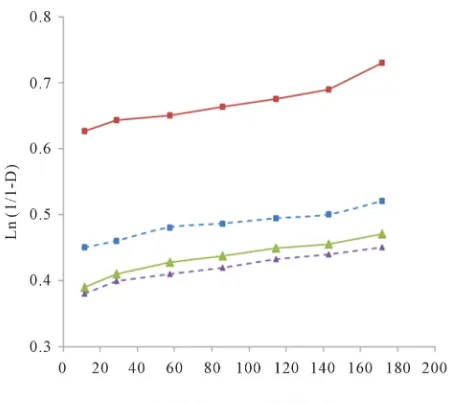
Powder compaction is a volume reduction process [16] and the Heckel equation is also based on volume change of a powder column during compression, hence the plots gave a general impression of the densification process of the powder column. Figure 1 shows representative Heckel plots for Okra gum matrices containing 90% w/w and 60% w/w of Okra gum prepared by direct compres- sion and wet granulation.
The mean yield pressure, Py, was calculated from the regions of the plots showing the highest correlation coef- ficient of ≥ 0.990 for all formulations (usually 84.93 - 226.47 MN/m2). The intercept A, was determined from
the extrapolation of the line. The values of the mean yield pressure Py, DA, DB and DO are presented in Table 1.
The DA values, which represent the total degree of
packing at zero and low pressures increases as the con- centration of the gum decreases. In general, formulations prepared by wet granulation gave higher DA values than
those prepared by wet granulations. The DB values rep-
[image:3.595.311.536.488.690.2]resent the particulate rearrangement phase in the early compression stages and tend to indicate the extent of particle or granule fragmentation, although fragmentation
Figure 1. Heckel plots for Okra gum matrix tablet prepared by direct compression (---) and wet granulation (…….).
Table 1. Parameters derived from Heckel and Kawakita plots for Okra gum matrices.
Direct Compresion Wet Granulation
Heckel Plot Kawakita plot Heckel Plot Kawakita plot Matrix
Tablet Composition
Py DA DB Pk a DI Py DA DB Pk a DI
10% Drug in Okra Gum 2.82 0.299 0.099 0.026 0.966 0.034 2.396 0.7720 0.290 0.113 0.965 0.035 20% Drug in Okra Gum 2.14 0.373 0.173 0.429 0.970 0.030 2.137 0.9998 0.722 0.018 0.979 0.021 30% Drug in Okra Gum 1.48 0.491 0.208 0.076 0.971 0.029 1.481 0.0002 0.412 0.381 0.957 0.043 40% Drug In Okra Gum 1.47 0.493 0.293 0.063 0.970 0.003 1.449 0.0002 0.286 1.360 0.995 0.005
10% Drug in NaCMC 2.14 0.374 0.174 0.015 0.987 0.013 2.133 0.0001 0.141 0.524 0.982 0.018
can occur concurrently with plastic and elastic deforma- tion of constituent particles. The DB values increase with
decrease concentration of the gum and formulations pre- pared by wet granulation exhibited higher values. This result indicates that granules undergo higher degree of fragmentation than powders. Powder particles were more resistant to movement once the initial phase of packing (as a result of die filling) had been completed. This could be attributed to the high cohesive forces likely present as a result of the powder’s amorphous nature.
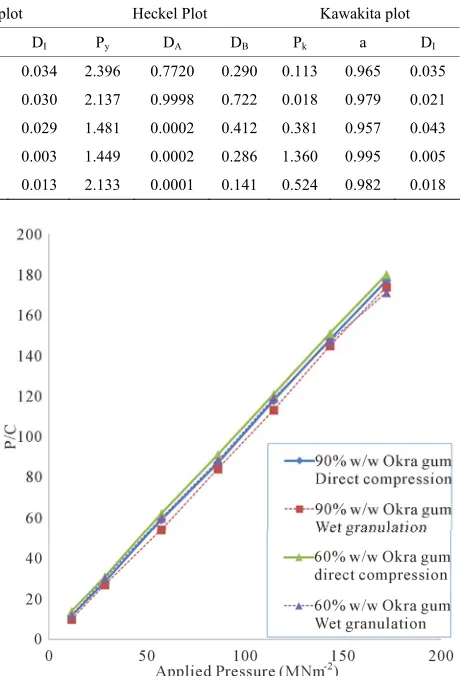
Figure 2 shows representative Kawakita plots for Okra gum matrices containing 90% w/w and 60% w/w Okra gum prepared by wet granulations and direct com- pression. A linear relationship was obtained at all com- pression pressures used with a 0.999 correlation coeffi- cient for all formulation. Values of a and ab were ob- tained from the slope and intercept of the plot respec- tively. DI , the initial relative density of the formulation
were obtained from 1-a while Pk values were obtained
from the reciprocal of b. The DI values, which are meas-
urements of the packed initial relative density of the formulation with application of small pressures or tap- ping [21] decreased as the concentration of the gum de- creases. The Pk and Py values, which are inverse meas-
urements of the plastic deformation occurring during the compression process also decreased with a decrease in concentration of gum. In addition, formulations prepared by direct compression had lower Pk values than those
prepared by wet granulation while there was no signifi- cant difference between Py values of formulations pre-
pared by direct compression and wet granulations. Thus, the method of preparation appears to have little or no effect on the onset of plastic deformation but the overall amount of plastic deformation occurring during the com- pression process was higher for formulations prepared by direct compression as indicated by the lower Pk values.
The results indicate that formulations prepared by direct compression underwent plastic deformation more easily and rapidly than those prepared by wet granulation. This also suggests that the wet granulation formulations are somewhat resistant to deformation. In tablets prepared by direct compression, formulations containing 90% of Okra
Figure 2. Kawakita plots for Okra gum matrix tablet pre- pared by direct compression and wet granulation.
gum exhibited the highest amount of total plastic defor- mation and gave the best packing as evidenced by the low value of “a”.
The mechanical strength of a tablet is associated with the resistance of the solid specimen to fracturing and attrition. An acceptable tablet must remain intact at all stages i.e. during production, packaging, warehousing,
Table 2. Values of Crushing strength (CS), Friability (FR), Crushing strength—Friability ratio (CSFR) and Disintegration time (D) for Okra gum matrices.
Direct Compression Wet Granulation Matrix
Tablet
Composition CS FR CSFR D CS FR CSFR D
10% Drug In Okra Gum 44 1.50 29.33 84.8 16.6 1.10 15.09 146
20% Drug in Okra Gum 28 1.88 14.89 67.3 46 1.70 27.06 106.7 30% Drug in Okra Gum 27 2.02 13.37 65.8 45.3 1.76 25.73 79.0 40% Drug in Okra Gum 25 2.21 11.31 64.8 41.2 1.83 22.51 68.5
10% Drug in NaCMC 13 0.52 25.00 45.1 51.01 0.62 82.27 63.3
of the gum while the friability increased for both formu- lations prepared by both direct compression and wet granulation. It is reasonable to assume that the presence of the polymer gum (binder) plays an important role in the formation of intergranular bonds. The polymer may fuse together locally and form binder bridges between the surfaces. The more the amount of polymer present, the more of such bridges and hence the resultant increase in strength.
Tablets prepared by direct compression showed lower bond strength and higher friability values than those pre- pared by wet granulations probably due to the fact that different types of adsorption bonds may be active be- tween granule surfaces (i.e. binder-binder, binder-sub-
strate and substrate-substrate bonds) compared to only intermolecular forces in powders. Moreover, the addition of water in wet granulation probably led to the formation of more solid bridges between the particles [23]. The values of crushing strength and friability provide a measure of tablet strength and weakness respectively. Thus the CSFR ratio can be a useful index of tablet qual- ity. Generally, the higher the CSFR values, the stronger the tablet. From the data presented in Table 2, the value of CSFR decreases with a decrease in gum concentration and tablets prepared by wet granulations had higher CSFR than those prepared by direct compression. Statis- tical analysis showed that tablets prepared by wet granu- lation showed significantly (p < 0.001) higher values of CSFR than those prepared by direct compression. The disintegration times of the formulation presented in Ta- ble 2 show that tablets prepared by direct compression disintegrated faster than those prepared by wet granula- tions. Moreover, disintegration became faster as gum concentration decreases.
4. Conclusion
The results suggest that the method of preparation ap- pears to have little effect on the onset of plastic deforma- tion of Okra gum matrices but significantly affected the total plastic deformation during compression. Tablets prepared by wet granulation were stronger but disinte- grated more slowly than tablets formulated by direct
compression. In addition, tablet strength generally de- creases with a decrease in the concentration of the gum.
REFERENCES
[1] A. Jain, Y. Gupta and S. K. Jain, “Perspectives of Biode- gradable Natural Polysaccharides for Site-Specific Drug delivery to the colon,” Journal of Pharmacy & Pharma-
ceutical Sciences, Vol. 10, No. 1, 2007, pp. 86-128.
www.cspsCanada.org
[2] P. B. Malafaya, G. A. Silva and R. L. Reis, “Natural- Origin Polymers as Carriers and Scaffolds for Bio- molecules and Cell Delivery in Tissue Engineering Ap- plications,” Advanced Drug Delivery Reviews, Vol. 59,
No. 4-5, 2007, pp. 207-233. doi:10.1016/j.addr.2007.03.012
[3] A. Shirwaikar, S. L. Prabu and G. A. Kumar, “Herbal Excipients in Novel Drug Delivery Systems,” Indian
Journal of Pharmaceutical Sciences, Vol. 70, No. 4, 2008,
pp. 415-422. doi:10.4103/0250-474X.44587
[4] C. E. Beneke, A. M. Viljoen and J. H. Hamman, “Poly- meric Plant-Derived Excipients in Drug Delivery,” Mole-
cules, Vol. 14, No. 7, 2009, pp. 2602-2620.
doi:10.3390/molecules14072602
[5] P. F. Builders, M. B. Agbo, T. Adelakun, L. C. Okpako and A. A. Attama, “Novel Multifunctional Pharmaceuti- cal Excipients Derived from Microcrystalline Cellulose- Starch Microparticulate Composites Prepared by Com- patibilized Reactive Polymer Blending,” International
Journal of Pharmaceutics, Vol. 388, No. 1-2, 2010, pp.
159-167. doi:10.1016/j.ijpharm.2009.12.056
[6] J. A. Boustra and H. E. Junginger, “Hydrogels,” In: J. Swarbrick and J. C. Boylan, Eds., Encyclopedia of Phar-
maceutical Technology Vol. 7, Marcel Dekker, Inc., New
York, 1993, p. 441.
[7] R. C. Rowe, P. J. Shesky and M. E. Quinn, “Hand Book of Pharmaceutical Excipients,” 4th Edition, Pharmaceuti- cal Press, London, 2003.
[8] M. Agarwal, R. Srinivasan and A. Mishra, “Study on Flocculation Efficiency of Okra Gum in Sewage Waste Water,” Macromolecular Materials and Engineering, Vol.
286, No. 9, 2001, pp. 560-563.
doi:10.1002/1439-2054(20010901)286:9<560::AID-MA ME560>3.0.CO;2-B
Dosage Forms,”Iranian Journal of Pharmaceutical Re-
search, Vol. 3, Suppl. 2, 2004, pp. 47-49.
[10] M.O Emeje, C. Y. Isimi and O. O. Kunle, “Evaluation of Okra Gum as a Dry Binder in Paracetamol Tablet Formu- lations,” Continental Journal of Pharmaceutical Sciences,
Vol. 1, 2007, pp. 15-22.
[11] V. D. Kalu, M. A. Odeniyi and K. T. Jaiyeoba, “Matrix Properties of a New Plant Gum in Controlled Drug De- livery,” Archives of Pharmacal Research, Vol. 30, No. 7,
2007, pp. 884-889. doi:10.1007/BF02978841
[12] M. M. Talukdar, A. Michoel, P. Rombant and R. Kinget “Comparative Study on Xanthum Gum and Hydroxypro- pylmethyl Cellulose as Matrices for Controlled Release Drug Delivery. I. Compaction and in Vitro Drug Release
Behavior,” International Journal of Pharmaceutics, Vol.
129, No. 1-2, 1996, pp. 233-241. doi:10.1016/0378-5173(95)04355-1
[13] J. M. Sonnergaard,” A Critical Evaluation of the Heckel Equation,” International Journal of Pharmaceutics, Vol.
193, No. 1, 1999, pp. 63-71.
doi:10.1016/S0378-5173(99)00319-1
[14] I. Krycer, D. G. Pope and J. A. Hersey, “The Interpreta- tion of Powder Compaction Data—A Critical Review,”
Drug Development and Industrial Pharmacy, Vol. 8, No.
3, 1982, pp. 307-342. doi:10.3109/03639048209022103 [15] T. Comoglu, “An Overview of Compaction Equations,”
Journal Faculty of Pharmacy,Vol. 36, No. 2, 2007, pp.
123-133.
[16] W. Heckel, “Density-Pressure Relationship in Powder Compaction,” Transactions of the Metallurgical Society
of AIME, Vol. 221, 1961, pp. 671-675.
[17] K. Kawakita and K. H. Ludde, “Some Considerations on Powder Compression Equations,” Powder Technology, Vol. 4, No. 2, 1971, pp. 61-68.
[18] G. Alderborn and C. Nystrom, “Studies on Direct Com- pression of Tablets. IV. The Effect of Particle Size on the Mechanical Strength of Tablets,” Acta Pharmaceutica
Suecica, Vol. 19, No. 5, 1982, pp. 381-390.
[19] O. O. Odeku and O. A. Itiola, “Evaluation of Khaya Gum as a Binder in a Paracetamol Tablet Formulation,” Phar-
macy and Pharmacology Communications, Vol. 4, No. 4,
1998, pp. 183-188.
[20] P. Shivanand and O. L. Sprokel, “Compaction Behaviour of Cellulose Polymers,” Powder Technology, Vol. 69, No.
2, 1992, pp. 177-184. doi:10.1016/0032-5910(92)85072-4 [21] F. Podczeck and M. Sharma, “The Influence of Particle
Size and Shape of Components of Binary Powder Mix- tures on the Maximum Volume Reduction Due to Pack- ing,” International Journal of Pharmaceutics, Vol. 134, No. 1, 1996, pp. 41-47.
doi:10.1016/0378-5173(95)04420-5
[22] O. O. Odeku and O. A. Itiola, “Evaluation of the Effects of Khaya Gum on the Mechanical and Release Properties of Paracetamol Tablets,” Drug Development and Indus-
trial Pharmacy, Vol. 29, No. 3, 2003, pp. 311-320.
doi:10.1081/DDC-120018205
[23] J. Sujja-Areavath, D. L. Munday, P. J. Cox and K. A. Khan, “Release Characteristics of Diclofenac Sodium from Encapsulated Natural Gum Mini-Matrix Formula- tions,” International Journal of Pharmaceutics, Vol. 139,