Counseling and Psychological Services
Dissertations Department of Counseling and Psychological Services
Summer 8-18-2010
Effects of Language on the Development of Executive Functions
Effects of Language on the Development of Executive Functions
in Preschool Children
in Preschool Children
Greer A. Ezrine
Georgia State University
Follow this and additional works at: https://scholarworks.gsu.edu/cps_diss
Part of the Student Counseling and Personnel Services Commons
Recommended Citation Recommended Citation
Ezrine, Greer A., "Effects of Language on the Development of Executive Functions in Preschool Children." Dissertation, Georgia State University, 2010.
https://scholarworks.gsu.edu/cps_diss/41
ACCEPTANCE
This dissertation, EFFECTS OF LANGUAGE ON THE DEVELOPMENT OF
EXECUTIVE FUNCTIONS IN PRESCHOOL CHILDREN, by GREER ALEXANDER EZRINE, was prepared under the direction of the candidate’s Dissertation Advisory Committee. It is accepted by the committee members in partial fulfillment of the requirements for the degree Doctor of Philosophy in the College of Education, Georgia State University.
The Dissertation Advisory Committee and the student’s Department Chair, as representatives of the faculty, certify that this dissertation has met all standards of excellence and scholarship as determined by the faculty. The Dean of the College of Education concurs.
_______________________________ _______________________________ Joel Meyers, Ph.D. Scott L. Decker, Ph.D.
Committee Chair Committee Member
_______________________________ _______________________________
Phill Gagné, Ph.D. Andrew Roach, Ph.D.
Committee Member Committee Member
________________________________ Date
________________________________ Joanna F. White, Ed.D.
Chair, Department of Counseling and Psychological Services
________________________________ R. W. Kamphaus, Ph.D.
AUTHOR’S STATEMENT
By presenting this dissertation as a partial fulfillment of the requirements for the
advanced degree from Georgia State University, I agree that the library of Georgia State University shall make it available for inspection and circulation in accordance with its regulations governing materials of this type. I agree that permission to quote, to copy from, or to publish this dissertation may be granted by the professor under whose direction it was written, by the College of Education’s director of graduate studies and research, or by me. Such quoting, copying, or publishing must be solely for scholarly purposes and will not involve potential financial gain. It is understood that any copying from or publication of this dissertation which involves potential financial gain will not be allowed without my written permission.
NOTICE TO BORROWERS
All dissertations deposited in the Georgia State University library must be used in accordance with the stipulations prescribed by the author in the preceding statement. The author of this dissertation is:
Greer Alexander Ezrine 1850 Dinsmore Road
Milton, GA 30004
The director of this dissertation is:
Dr. Joel Meyers
Department of Counseling and Psychological Services College of Education
VITA
Greer Alexander Ezrine
ADDRESS: 1850 Dinsmore Road Milton, Georgia 30004
EDUCATION:
Ph.D. 2010 Georgia State University School Psychology Ed.S. 2008 Georgia State University
School Psychology M.Ed. 2005 Georgia State University
School Psychology M.Ed. 2003 Harvard University
Mind, Brain, and Education B.S. 1989 University of Virginia
Finance, Management
PROFESSIONAL EXPERIENCE:
2009-2010 Doctoral School Psychology Intern NorthStar Educational and Therapeutic Services/Cherokee County School District Canton, GA
2008-2009 Neuropsychology Extern
Children’s Healthcare of Atlanta, Scottish Rite Atlanta, GA
2007-2008 School Psychology Intern
Fulton County School District, Atlanta, GA 2004-2005 School Psychology Practicum Student
Fulton County School District, Atlanta, GA 2003-2008 Graduate Research Assistant
Georgia State University, Atlanta, GA
PROFESSIONAL SOCIETIES AND ORGANIZATIONS: 2010-Present Georgia Psychological Association
2007-Present Georgia Association of School Psychologists 2007-Present American Psychological Association
2004-Present National Association of School Psychologists 2004-Present Student Affiliates in School Psychology,
PRESENTATIONS AND PUBLICATIONS:
Ezrine, G. A., Kiefel, J., & Hinton, V. J. (2009). Neuropsychological profile of Duchenne Muscular Dystrophy: A case study with implications for developmental dyslexia. Poster presented at the annual meeting of the National Academy of Neuropsychology, New Orleans, LA.
Carboni, J., Ezrine, G. A., Johnson, K., & Decker, S. L. (2009). Measuring developmental trajectories toward school readiness in preschool assessment. Poster presented at the annual meeting of the National Association of School Psychologists, Boston, MA.
Kiefel, J., & Ezrine, G. A. (2008). Spina Bifida Across the Lifespan: A Case Study. Presentation to advanced neuropsychology seminar, Children’s Healthcare of Atlanta, Scottish Rite Campus, Atlanta, GA.
Ezrine, G. A., Carboni, J., Shepps, A., & Decker, S. L. (2008). Prevention-focused preschool assessment: Measuring developmental trajectories toward school readiness. Poster presented at the annual meeting of the National Association of School Psychologists, New Orleans, LA.
Ezrine, G. A. (2008). Eligibility Refresher. In-service presentation to special education teachers at McNair Middle School, Atlanta, Georgia.
Ezrine, G. A. (2007). Promoting Social Skills in Young Children [white paper, electronic version]. Retrieved from Georgia State University Center for School Safety, School Climate and Classroom Management website: http://education.gsu.edu/schoolsafety/
Nichols, V., & Ezrine, G. A. (2007). Stress Management. Presentation to middle school students on mental health issues at McNair Middle School, Atlanta, Georgia.
Siegel, C., & Ezrine, G. A. (2004). An Evidenced Based Approach to Develop Reading in Elementary Students: Instruction, Progress Monitoring, and Intervention Strategies. Presentation to Cobb County school
ABSTRACT
EFFECTS OF LANGUAGE ON THE DEVELOPMENT OF EXECUTIVE FUNCTIONS IN PRESCHOOL CHILDREN
by
Greer Alexander Ezrine
The purpose of this research was to investigate the relationship between language
skills and the development of executive functions in a normative preschool population
over a 3 year period. Hierarchical Linear Modeling (HLM) was used to examine models
of individual change and correlates of change in the growth of 7 executive skills in a
sample of 39 children ages 3 to 5. Results of the analyses revealed significant positive
linear growth trajectories over time for 5 of the 7 executive skills measured (p < .05).
Maturation alone accounted for a significant amount of variance in nonverbal working
memory (Block Span, Stanford Binet-5th Edition (SB-5)) and problem solving skills
(Tower, NEPSY). Growth in verbal working memory (Memory for Sentences, SB-5) was
predicted uniquely by initial receptive vocabulary (Peabody Picture Vocabulary Test–3rd
Edition) and oral language (Comprehensive Assessment of Spoken Language) skills,
even after considering age. Language variables did not predict rate of change in the 6
other executive skills measured. Thus, the pattern of results extends previous
cross-sectional research by documenting that executive skills grow systematically with age in
individual children during the preschool period. Furthermore, results suggest that during
the preschool years, language ability is an important predictor of growth in working
memory for verbal information—a capacity associated both theoretically and empirically
discussed in relationship to the literature on school readiness and the development of
EFFECTS OF LANGUAGE ON THE DEVELOPMENT OF EXECUTIVE FUNCTIONS IN PRESCHOOL CHILDREN
by
Greer Alexander Ezrine
A Dissertation
Presented in Partial Fulfillment of Requirements for the Degree of
Doctor of Philosophy in
School Psychology in
the Department of Counseling and Psychological Services in
the College of Education Georgia State University
Copyright by Greer Alexander Ezrine
ii
ACKNOWLEDGMENTS
I would like to thank my committee members, Dr. Joel Meyers, Dr. Scott Decker,
Dr. Phill Gagné, and Dr. Andrew Roach for their expertise, input, and support. I am
especially grateful to my research team, my participants, and their parents for making this
study possible. I dedicate this dissertation to my family, whose unconditional love and
support have carried me throughout this long and arduous process. As well, I thank the
many other students, faculty, and friends who have challenged me, inspired my
iii
TABLE OF CONTENTS
Page
List of Tables ………...iv
List of Figures ………...…...v
Abbreviations ………...vi
Chapter 1 DOES LANGUAGE INFLUENCE THE RELATIONSHIP BETWEEN SELF-REGULATION AND SCHOOL READINESS IN EARLY CHILDHOOD? ... 1
Introduction……… 1
Purpose One: Review of Theory and Research.………. 3
Purpose Two: Implications for Research and Practice.……….. 23
References……….. 30
2 EFFECTS OF LANGUAGE ON THE DEVELOPMENT OF EXECUTIVE FUNCTIONS IN PRESCHOOL CHILDREN……… 40
Introduction………. 40
Method……… 44
Results………. 57
Discussion………... 73
iv
LIST OF TABLES
Table Page
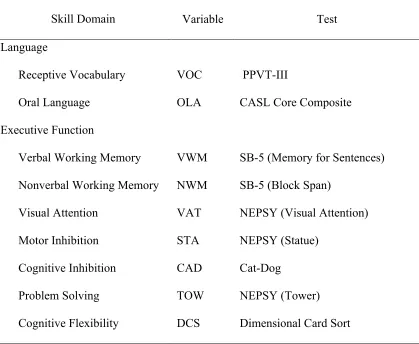
1 Language and Executive Function Variables 52
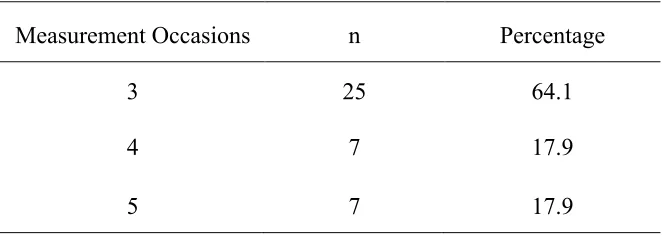
2 Measurement Occasions 53
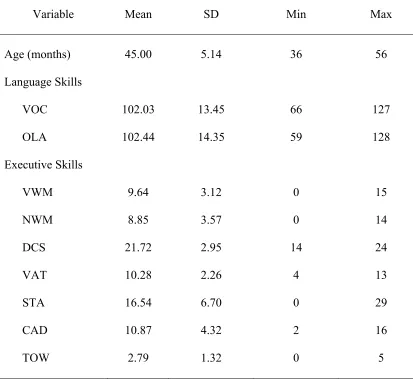
3 Descriptive Statistics at First Measurement Occasion 58
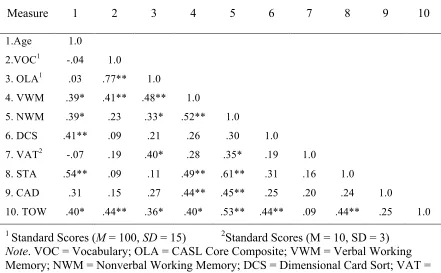
4 Correlations Among Variables at First Measurement Occasion 59
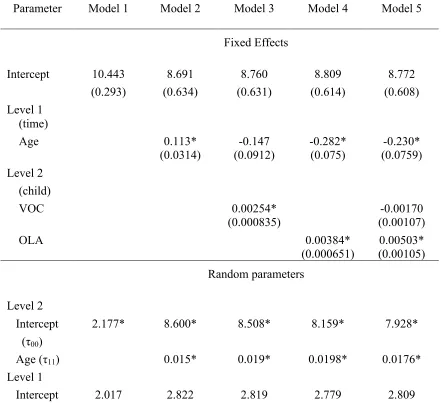
5 Results of the Unconditional and Conditional Models for VWM 61
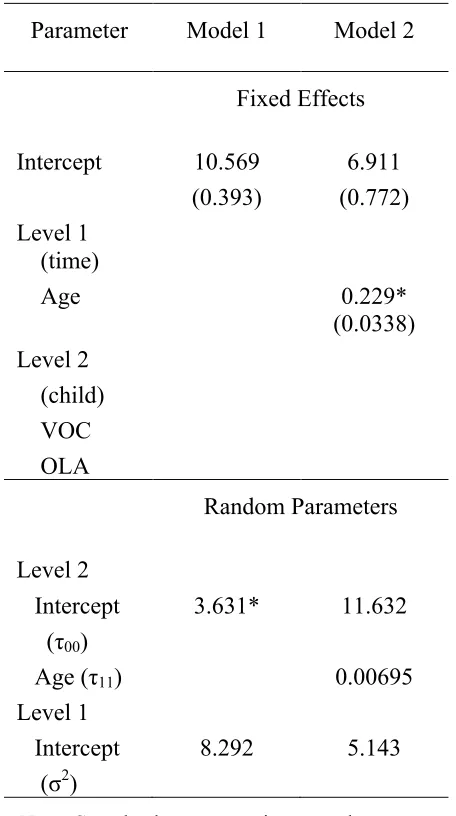
6 Results of the Unconditional Models for NWM 63
7 Results of the Unconditional Models for VAT 65
8 Results of the Unconditional and Conditional Models for STA 67
9 Results of the Unconditional and Conditional Models for CAD 69
10 Results of the Unconditional Models for TOW 71
v
LIST OF FIGURES
Figure Page
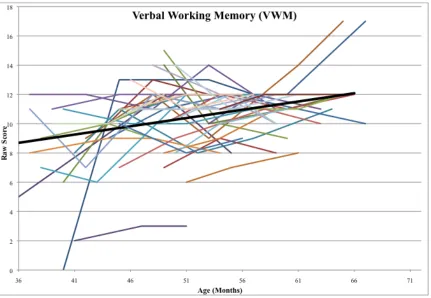
1 Verbal Working Memory Growth Trajectories 60
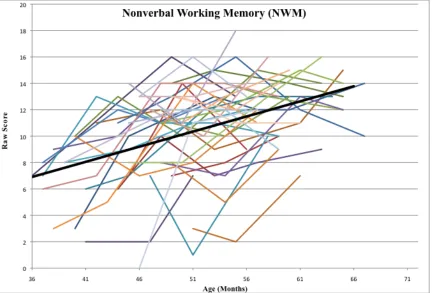
2 Nonverbal Working Memory Growth Trajectories 62
3 Visual Attention Growth Trajectories 64
4 Motor Inhibition Growth Trajectories 66
5 Cognitive Inhibition Growth Trajectories 68
6 Problem Solving Growth Trajectories 70
vi
ABBREVIATIONS
ADHD Attention Deficit Hyperactivity Disorder
ASD Autistic Spectrum Disorder
CAS Cognitive Assessment System
CASL Comprehensive Assessment of Spoken Language
DCCS Dimensional Change Card Sorting Task
EF Executive Function
HLM Hierarchical Linear Modeling
IQ Intelligence Quotient
PPVT-III Peabody Picture Vocabulary Test-Third Edition
SB-5 Stanford Binet Intelligence Scales-Fifth Edition
SOPT Self-Ordered Pointing Task
1
CHAPTER 1
DOES LANGUAGE INFLUENCE THE RELATIONSHIP BETWEEN
SELF-REGULATION AND SCHOOL READINESS IN EARLY CHILDHOOD?
During the preschool period, young children make significant progress in their
ability to control their behavior, emotions, and thought processes (Kopp, 1982). Flavell
(1977) described this movement toward self-regulation as “one of the really central and
significant cognitive-developmental hallmarks of the early childhood period” (p. 64). The
development of self-regulation is associated with maturity and self-control, including the
ability to comply with adult requests, to control behavior and emotions according to
social and situational demands, to sustain attention, to delay gratification, and to direct
and monitor thinking and problem solving (Bronson, 2000). While there continues to be
debate about the definition and components of self-regulation in early childhood, there is
general agreement among scholars that self-regulation is adaptive in nature and
encompasses self-monitoring, self-evaluation, and behavioral adjustment (Bandura,
1986). Further, as previously disparate lines of research across the developmental
sciences have begun to converge, there is a growing consensus that the development of
self-regulation is dependent, to some extent, on maturational changes in prefrontal cortex,
a region of the brain involved in executive functioning (Diamond, 2001).
A growing body of literature points to self-regulation as a primary mechanism
driving ‘school readiness’, a term used to describe children’s preparedness to learn and
multidimensional construct encompasses both pre-academic skills and socio-emotional
behaviors, including readiness to socialize with peers, follow directions, communicate
effectively, and stay on task (Rimm-Kaufman, Pianta, & Cox, 2000). Self-regulation has
also been linked to social-emotional competence (Kochanska, Murray, Jacques, Koenig
& Vandegeest, 1996), appropriate behavioral control (Eisenberg, Fabes, & Losoya,
1997), and academic achievement (Duncan et al., 2007; McClelland et al., 2007). As
well, researchers have documented the social and academic risks associated with
inadequate self-regulatory skills in early childhood including peer rejection (Ladd, Birch,
& Buhs, 1999) and lower levels of academic achievement (McClelland, Morrison, &
Holmes, 2000).
While it is becoming increasingly clear that self-regulatory skills are critical for
school readiness and optimal cognitive and social-emotional development, our
understanding of the developmental pathways through which self-regulation influences
academic and social outcomes remains unclear (NICHD Early Child Care Research
Network, 2003). As suggested by Shonkoff and Phillips (2000), there is still much to
learn about both normative and atypical patterns of regulatory development as well as the
mechanisms that underlie the “successful navigation of the many challenges encountered
en route to well-regulated behavior” (p. 122). Hence, researchers may ask, “What
developmental processes or mechanisms might influence the relationship between
self-regulation and school readiness?” Additionally, practitioners may ask, “What prerequisite
or foundational skills, if any, do children need to develop adequate self-regulation in
In this paper, these questions will be addressed by asking whether relations
between self-regulation and school readiness are influenced by individual differences in
children’s language ability. As such, this paper has two purposes. The first purpose is to
review the major theoretical perspectives and empirical evidence across the
developmental sciences suggesting that language influences the development of
self-regulation in ontogeny. The second purpose is to examine the research and practical
implications of a language-focused approach to investigating the relationship between
self-regulation and school readiness in both typically developing and special populations.
A review of relevant literature addressing these questions follows.
Purpose One: Review of Theory and Research
Theoretical Foundations Linking Language and Self-Regulation
Relations between language and thought have been of perennial interest to
linguists, psychologists, and cognitive scientists (Nelson, 1996; Pinker, 1994; Vygotsky
1978). An important theorist in this regard is Vygotsky (1978) who proposed that all
psychological functions originate in social interactions and that mental processes begin as
culturally supported external activities ultimately internalized through the course of
development. Notably, Vygotsky (1986) viewed the unique human capacity for language
as a cultural tool that facilitates children’s learning and allows for self-regulation of
thought and behavior. He drew a clear distinction between basic psychological processes,
such as perception, memory, and attention, which are shared by animals and are
reflexive, and higher psychological processes, which include abstract thought and
conscious behavior (Vocate, 1987). Voluntary in nature, these processes, including the
surpass the bounds of the immediate environment and sensory perceptions (Luria, 1982).
Thus, through our unique linguistic representational systems, humans are able to perceive
and manipulate objects and actions indirectly, without having to directly experience
them. Hence, language allows for the formulation of conceptual generalizations and
categories, the basis of concept formation and rational thought (Vygotsky, 1986).
Additionally, language permits the transmission of information and knowledge to others
across time, making it possible for humans to acquire the experience of previous
generations and consider future possibilities (Luria, 1982).
Luria (1961) extended Vygotskian theory by applying neurophysiological
mechanisms to the study of language and self-regulation. While Vygotsky focused on the
role of social and cultural factors to explain the regulative function of language, Luria
(1982) asserted a role for the frontal lobes, an area of the brain involved in the direction
and control of motor movement. He posited a gradual, three-stage process in the power of
speech to regulate behavior. Initially, children’s motor acts are initiated by adult verbal
commands on a social (i.e., interpsychological) plane of functioning. By focusing the
child’s attention to specific objects in the environment, the adult organizes and directs the
child’s actions with verbal instructions (e.g., “Where’s the ball?” “Pick it up!”). At this
stage, however, if there is a conflict between the semantic aspect and the impulsive aspect
of speech, the impulsive aspect will dominate. For example, children younger than 3 will
often become distracted by other, more salient, objects in the immediate environment
when acting on a verbal directive (e.g., child will not pick up the ball when asked, but
instead a more brightly colored block). During the second stage in the preschool period
child’s expanded and externally vocalized (i.e., egocentric) speech. Children’s
verbalizations are purposeful, in that they serve to solicit help from others and to support
rudimentary problem solving. Finally, egocentric speech gradually turns inward and
converts to inner speech in the third stage, becoming a tool for intellectual activity and a
method of organizing and regulating mental processes (Luria, 1982). In sum, Luria
(1961) argued:
This formation of internal speech, which is closely bound up with thought, leads
to a new, specifically human, stage of development. The verbal analysis of the
situation begins to play an important role in the establishment of new connections;
the child orients himself to the given signals with the help of the rules he has
verbally formulated for himself; this abstracting and generalizing function of
speech mediates the stimuli acting upon the child and turns the process of
elaboration of temporary connections into the complex, “highest-self-regulating
system” (Luria, 1961, p. 96).
The Role of Language in Contemporary Theories of Executive Functions
Contemporary conversations about self-regulation and school readiness
increasingly emphasize the importance of executive functions (Brock, Rimm-Kaufman,
Nathanson, & Grimm, 2009). Indeed, Blair (2002) has proposed a neurodevelopmental
approach to the study of school readiness suggesting that executive functions “underlie
many of the behaviors and attributes that are associated with successful school
adjustment” (p. 112). Although no firm consensus on a definition of executive functions
has been established, they are thought to involve a number of interrelated skills necessary
skills generally agreed to be subsumed under the executive functions umbrella include
inhibition, working memory, selective attention, goal setting, planning and organizing,
performance monitoring, and maintaining and shifting set (Anderson, 1998; Lezak,
Howieson, & Loring, 2005).
In recent years, a number of empirical studies have demonstrated that executive
functions can be measured in very young children using developmentally sensitive
assessment methods (Carlson, 2005) and that the preschool years, in particular, are
characterized by rapid changes in these abilities (Espy, Kaufmann, McDiarmid, &
Glisky, 1999). Developmental studies have also documented progressive incremental
growth in executive functions across childhood and adolescence, coinciding with growth
spurts in prefrontal cortex and associated neural projections (Diamond, 2001, 2002).
Neural imaging studies suggest that while prefrontal regions may play a critical role in
orchestrating behavior, the integrity of the entire brain may be necessary for efficient
executive functioning (Anderson, Anderson, Jacobs, & Smith, 2008). Cognitive
processes, such as perception, memory, and language, rely on posterior brain areas and
feed into anterior brain regions to sustain executive functions (Denckla, 1996). Hence,
executive functions are inherently integrative in nature and therefore dependent upon the
input and quality of information from other brain centers, like those responsible for
language. Three of the prominent contemporary models of executive functions ascribing
an important role to language are described here.
Neuropsychological Model of Executive Functions. According to Barkley
(2001), “an executive act is any act toward oneself that functions to modify one’s own
functions are future-oriented behaviors directed at the self for the purpose of
self-regulation. Grounded in an evolutionary perspective, Barkley’s (1997a) model argues that
self-regulation is instinctual and is employed in the service of our own self-interests. The
model is comprised of an overarching behavioral inhibition system and four distinct, yet
interactive, executive functions that control behavioral responses (e.g., nonverbal
working memory, verbal working memory, affect/motivation regulation, and
analysis/synthesis). Importantly, behavioral inhibition is thought to permit executive
functioning by either inhibiting the initial prepotent response, interrupting an ineffective
ongoing response, or providing interference control (i.e., resistance to distraction)
(Barkley, 2001).
In Barkley’s (1997a) model executive functions greatly facilitate adaptive
functioning by allowing an individual to evaluate the event at hand, modify his or her
eventual response, and improve the long-term future consequences related to that event.
As such, executive functions allow for purposive, effortful, or intentional actions
including the organization and planning of behavior across time and the delay of
gratification. Additionally, Barkley (2001) posited that executive functions represent
private, covert or internalized forms of behavior that emerge via a common process
across development. Similar to Vygotskian (1978) notions of internalization, Barkley
(1997a) proposed that executive functions originate as forms of behavior that are entirely
public, observable, and directed toward others. With maturation, they become
increasingly less observable to others and are directed toward the self as a means to
control one’s own behavior (Barkley, 2001). For example, egocentric speech becomes
and exploration and thereby permitting the individual to construct various hypothetical
messages or responses before choosing one to emit” (Barkley, 1997a, p. 87).
Barkley (1997a) borrowed from Vygotskian (1986) theory in proposing that the
development of internalized, directed speech supports the development of
self-regulation. However, Barkley challenged the social and cultural origins of self-regulation
by arguing that executive functions are a biological adaptation that evolved out of
interpersonal competition within our species (Barkley, 2001). That is, the social
environment sculpts rather than creates self-regulatory capacities (Bronson, 2000).
According to Barkley (1997a), language supports a behavioral shift in early childhood
from being externally guided to being “planned, organized, and regulated by internally
represented information—a shift from reactive to purposive or intentional actions, and
from context-dependent to self-determined (internally guided) behavior” (p. 91).
Moreover, self-directed speech is theorized to permit self-questioning through language,
thereby forming the basis of self-regulated learning and metacognition.
In sum, Barkley (1997a) emphasized the mediating role of language in the
development of self-regulation:
Self-directed speech is believed to provide a means for description and reflection
by which the individual covertly labels, describes, and verbally contemplates the
nature of an event or situation prior to responding to that event. Private speech
also provides a means for self-questioning through language, creating an
important source of problem-solving ability as well as a means of generating rules
Working Memory Model. Baddeley and Hitch (1974) proposed a narrower
conceptual model of executive functions focused on working memory, a specific
executive domain. In this model, working memory is defined as “a limited capacity
system allowing the temporary storage and manipulation of information necessary for
such complex tasks as comprehension, learning, and reasoning” (Baddeley, 2000, p. 418).
The working memory model consists of a limited capacity attentional control system
(central executive) aided by two subsidiary systems, the ‘phonological loop’ and the
‘visuospatial sketchpad’ (Baddeley, 2000). While the phonological loop is assumed to
temporarily hold and manipulate verbal and acoustic information, the visuospatial
sketchpad is assumed to hold and manipulate visuo-spatial information. The functions of
the central executive involve selective attention, switching attention, coordinating
concurrent activities, and retrieval of information from long-term memory (Baddeley,
2000; Baddeley & Hitch, 1994).
Based on neuropsychological evidence, the working memory model was recently
modified to include a fourth component, the ‘episodic buffer’ (Baddeley, 2000, 2002).
The episodic buffer, which is controlled by the central executive, is proposed to provide
temporary storage of integrated information from various sources, including the
subsidiary systems (e.g., phonological loop and visuospatial sketchpad) and from
long-term memory. Notably, Baddeley (2002) suggests that “the episodic buffer serves as a
system not only for representing the environment and making it accessible to conscious
awareness …but also for utilizing past experience to model the future” (p. 257). As such,
representations and is assumed to play an important role in learning by feeding
information into and retrieving information from long-term memory.
The phonological loop has been proposed as both temporary storage for verbal
information and a mechanism for subvocal rehearsal that is able to refresh decaying
memory traces in the phonological store (Baddeley, 1986). Importantly, Baddeley,
Gathercole, and Papagno (1998) suggested that the primary function of the phonological
loop is to mediate language learning by providing temporary storage of novel speech
input while more permanent memory representations are being constructed. In the case of
written input of verbal material, Baddeley and his colleagues (1998) argued that visual
information is also fed into the phonological store by means of self-directed speech. This
position is based on neuropsychological evidence from patients with defective
phonological loop function who have great difficulty learning new vocabulary (Baddeley
et al., 1998). Further, evidence comes from studies linking children’s phonological
memory skills (e.g., nonword repetition accuracy) and new word learning, even when
exposure to new words is controlled across subjects (Baddeley et al., 1998). Hence, it is
proposed that the ability to learn new words is constrained by phonological loop capacity.
The association between the phonological loop and long-term phonological learning has
also been proposed to be bidirectional, such that, children’s prior knowledge of the
structure of individual words and of language more generally benefits immediate memory
performance (Baddeley et al., 1998).
In sum, the working memory model of executive functions attributes an important
role to language in the form of the phonological loop, which supports immediate memory
memory (e.g., crystallized language and semantic knowledge). As Baddeley (2002)
suggested, the capacity of the working memory system to interface with long-term
memory would provide an important mechanism for self-directed speech to control
behavior as proposed by Vygotskian (1986) theory.
Cognitive Complexity and Control (CCC) Theory. Zelazo and Frye (1997)
expounded a conceptual framework to explain how executive processes operate in an
integrative manner to solve problems and/or achieve a goal state. According to CCC
theory, age-related changes in behavior control are due to changes in the acquisition of
increasingly complex language-based rule systems that children can formulate and use
when solving problems. In this model, complexity corresponds to the number of levels of
embedded rules (e.g., condition-action ‘if-then’ statements) that the child can represent
(Zelazo, Frye, & Rapus, 1996). Furthermore, developmental changes in complexity are
dependent upon the extent to which children can reflect on their own subjective
experiences (Müller, Jacques, Brocki, & Zelazo, 2009). According to CCC theory,
therefore, executive failures are attributed to “lack of reflection on rules, not to lack of
consciousness of rules per se” (Zelazo et al., 1996, p. 41). In other words, there is a
well-documented dissociation in very young children between knowing rules and using them
(Zelazo et al., 1996).
For example, a number of studies using the Dimensional Change Card Sorting
Task (DCCS; Frye, Zelazo, & Palfai, 1995) have shown consistently that 3-year-olds can
successfully use one pair of rules to sort cards (e.g., “If it’s a triangle it goes in this box;
if it’s a circle in goes in that box”). However, when two different pairs of rules are put
rule pair (e.g., sort by shape) despite being told to switch to a new pair of rules (e.g., sort
by color; “If it’s blue put it here; if it’s yellow put it there) (Zelazo et al., 1996). In
contrast, 4- and 5-year-olds tend to have little difficulty switching immediately to the new
pair of rules on post-switch trials.
According to CCC theory, language plays an essential role in the conscious
control of behavior because it allows for the separation of the child from his or her
immediate situation (Müller et al., 2009). That is, semantic descriptors can be maintained
in working memory and reflected on by the child, making recursive consciousness
possible. As such, “labeling subjective experience is the precondition, on this approach,
for further reflection on subjective experience – it transforms what was subjective into an
object of conscious consideration” (Müller et al., 2009, p. 57). Furthermore,
verbalizations stored in working memory lead not only to consciousness of rules, but also
to the ability of the child to “bring the right knowledge to bear on their behavior (and
their inferences) at the right time in specific situations” (Müeller et al., 2009, p. 57). On
the DCCS, therefore, 4- and 5-year-olds not only demonstrate knowledge of the pre- and
post-switch rules (as 3-year-olds do), they can also act on them in the right situation by
using self-directed speech (vocal or sub-vocal) to guide their behavior.
In sum, the contemporary theories of executive function described here all posit a
role for language in the development of self-regulation. Whether discussed in the context
of self-directed speech, the phonological loop, or sub-vocal rehearsal, these theories all
suggest that language has the power to both inform and instruct behavior. First, language
informs behavior by allowing the child to describe the situation at hand, reflect on it, and
self in the form of self-directed speech, children develop the capacity to use these
verbalizations to actually control their cognitive and motor responses. Finally, while
these contemporary theories emanate from a neuropsychological rather than sociocultural
research tradition, they all incorporate the Vygotskian (1986) notion of internalization,
placing language at the core of the movement from other- to self-regulation in early
childhood.
Research Examining the Link Between Language and Self-Regulation
Other veins of research primarily from the field of developmental psychology
have also explored the role of language in the development of self-regulation. For
example, a number of empirical studies investigating self-directed speech, its social
origins, and its relationship to task performance have shed light on how language
influences self-regulation in both normal and atypical development.
Developmental Trajectories in Self-Directed Speech. Vygotsky’s (1986)
original proposition regarding the emergence of self-regulation in early childhood
focused on merging preverbal thought and preintellectual language. This critical shift in
development occurs during the preschool period when children begin to use language, not
just as a tool for communication with others, but also as a cognitive instrument for
guiding, planning, and regulating their own thoughts and behavior (Diaz & Berk, 1992).
Vygotsky (1978) posited a three stage developmental progression from (a)
pre-intellectual, purely social and communicative speech, in infancy; to (b) overt egocentric
or private speech in the preschool period; to (c) internal dialogue, or covert inner speech,
Evidence of this developmental process in language internalization comes
primarily from research on children’s overt speech directed to the self, often referred to in
the neo-Vygotskian literature as ‘private speech’ (Winsler, Diaz, Atencio, McCarthy, &
Chabay, 2000). Research with normally developing children has largely confirmed
Vygotsky’s (1978) original observations and hypotheses of a global developmental
pattern in private speech (Winsler, 2009). In general, private speech has been found to
increase in frequency during the preschool period, peaking between the ages of 4 to 6.
Reducing in frequency during the elementary school years, private speech is then
gradually replaced with more covert-forms of self-directed speech (e.g., whispers,
inaudible muttering), and then eventually with silent inner verbal thought (Winsler,
2009).
Recently, Winsler and Naglieri (2003) extended previous private speech research,
focused almost exclusively on early childhood, with their cross-sectional study of verbal
strategy use in a large (N = 2,156) nationally representative sample of children and
adolescents between 5 and 17. Overt and partially covert (whispers, muttering) private
speech was observed and children’s self-reported use of inner speech was coded during a
standardized planning task from the Cognitive Assessment System (CAS; Naglieri &
Das, 1997), an individually administered test of cognitive abilities. The self-regulatory
demands were high due to the sequential planning and set switching demands of the task,
which was based on the Trail-Making Task (Reitan, 1971), a widely used
neuropsychological assessment of executive functions. Results showed clear support for
the notion that private speech moves from more externalized forms of speech to more
among 5-year-olds (43%) and declined linearly with age (10% for 17-year-olds).
Moreover, the self-reported use of silent, inner speech was rare for the 5-year-olds (4.1%)
and became common for the oldest age groups (33% for 16-year-olds and 28% for
17-year-olds). Importantly, the percentage of children and adolescents (60%) using some
kind of verbal mediation (overt, partially covert, or covert) remained constant across the
ages studied. Thus, it was the type of verbal strategy use rather than the simple presence
of a verbal strategy that varied by age. Even among late adolescents, a considerable
minority continued to use private speech to guide problem solving, which suggests that
the use and internalization of speech extends well beyond early and middle childhood, as
originally proposed by Vygotsky (1986). As argued by Winsler (2009), “the existence of
overt self-talk in older individuals is simply the continued and periodic use of a strategy
that was found to be important earlier in development” (p. 9).
Private Speech and Task Performance. In addition to the investigation of
developmental trajectories in private speech, researchers have also explored the relation
between private speech and task performance. A number of studies have demonstrated
that, for both children and adults, overt private speech appears to peak during moments of
initial task difficulty, gradually decreasing over time as the task is mastered or repeated
(Berk & Spuhl, 1995; Duncan & Cheyne, 2001). Moreover, children have been found to
be more likely to use private speech when (a) engaged in goal-directed, academic, or
problem-solving activities, as compared to free play or other activities (Winsler & Diaz,
1995); (b) when the problem-solving task is neither too simple nor too difficult
(Fernyhough & Fradley, 2005); and (c) when they are alone or with peers, as opposed to
‘other-
regulation’ (Winsler, Carlton, & Barry, 2000). It appears, therefore, that private speech is
maximized in problem-solving situations where executive control is required and there is
little regulation provided by adults (Diaz, 1992). Finally, there is also evidence that
private speech is associated with improved task performance in preschool children
(Winsler, Diaz, & Montero, 1997) and that private speech becomes more systematic,
strategic, and task relevant as children get older (Winsler et al., 2000).
Social Origins of Self-Regulation. Central to Vygotskian (1978) theory of
cognitive development, is the socio-cultural context in which the child operates. This
view suggests the development of rational thinking in the child is a gradual process of
assimilation emanating from social interaction, such that:
Every function in the child’s cultural development appears twice: first, on the
social level, and later, on the individual level; first, between people
(interpsychological), and then inside the child (intrapsychological). This applies
equally to voluntary attention, to logical memory, and to the formation of
concepts. All the higher functions originate as actual relations between human
individuals. (Vygotsky, 1978, p. 57)
With regard to self-regulation, it has been proposed that young children transition
during the preschool years from relying on adult assistance in problem-solving to
internalization of the skills necessary for independent problem-solving (Rogoff, Mistry,
Goncu, & Mosier, 1993). Relevant to this process is a specific form of social interaction
termed ‘scaffolding’, a term introduced by Wood, Bruner, and Ross (1976). When an
adult scaffolds a task for a child, his or her level of assistance adjusts according to the
down the task into manageable parts, focusing a child’s attention to specific features, and
organizing his or her verbal and physical responses (Wertsch, 1979).
Notably, during the preschool period when language skills are developing rapidly,
adult scaffolding is more likely to involve complex verbal support (e.g., explanations,
analogies, leading questions) to assist children in learning problem-solving strategies
(Bridges, 1979). Indeed, a number of studies have examined the effects of verbal
scaffolding on children’s concurrent and subsequent task performance. For example, in
their longitudinal study of verbal scaffolding and cognitive abilities, Smith, Landry, and
Swank (2000) demonstrated that higher levels of maternal verbal input at age 3, regarding
information about the association between objects, actions, and concepts, was predictive
of higher levels of verbal and nonverbal cognitive skills at age 5. Moreover, Landry,
Miller-Loncar, Smith, and Swank (2002) found, using structural equation modeling, that
maternal verbal scaffolding at 3 years positively predicted later executive skills at age 6.
Additionally, these researchers found that this path directly influenced children’s
language and nonverbal problem-solving skills at age 4, which suggests that verbal
scaffolding may not only facilitate children’s current developmental needs (e.g., level of
attention, motor skills), but may also facilitate future executive skills by giving children
instruction in how to use language to solve problems.
Focused on an at-risk population, Winsler, Diaz, McCarthy, Atencio, and Chabay
(1999) conducted a longitudinal study of the development of verbal self-regulation in 3-
to 5-year-old children identified by their preschool teachers as evidencing behavior
problems. Notably, patterns of mother-child interaction during collaborative
Mother-child interaction for the at-risk group was characterized by negativity, conflict,
less praise, and less physical withdrawal over time, as compared to interactions involving
the control group. To explain this finding, these researchers suggest that difficult to
manage children may elicit negative and controlling patterns of parent-child interaction,
which may reduce opportunities for appropriate scaffolding and verbally mediated joint
problem-solving, ultimately constraining or delaying the development of self-regulation.
Links between Language and Self-Regulation in Special Populations
Language competence is widely believed to be an important mediator of both
normal and atypical cognitive and behavioral development (Bronson, 2000; Nelson,
1996). Given the central role that self-regulation plays in behavioral adaptation, it is no
surprise that various forms of psychopathology involve executive dysfunction
(Pennington & Ozonoff, 1996). In particular, verbal self-regulatory deficits have been
implicated in two developmental disorders, attention-deficit hyperactivity disorder
(ADHD) (Barkley, 1997b) and autistic spectrum disorders (ASD) (Joseph, McGrath, &
Tager-Flusberg, 2005).
Attention-Deficit Hyperactivity Disorder. As proposed in Barkley’s (1997a)
neuropsychological model of executive functions, a core deficit in ADHD is the delayed
internalization of self-directed speech. As previously discussed, Barkley (1997a; 1997b)
has argued that directed speech is a means for reflection, description, and
self-questioning through language, thereby forming the basis for formulating rules, plans, and
ultimately metacognition. Furthermore, as self-directed speech matures and becomes
gradually internalized across development, behavior comes increasingly under its control.
are delayed in their internalization of self-directed speech relative to controls (Winsler,
2009). For example, Berk and Potts’ (1991) cross-sectional naturalistic observations of 6-
to 12-year-old boys engaged in independent math seatwork found significant differences
in the developmental patterns of private speech use in boys with ADHD compared to
controls. Interestingly, boys with ADHD were not found to be impaired in their
spontaneous production of private speech. Rather, boys with ADHD demonstrated a
developmental lag in their internalization of private speech such that they engaged in
more externalized, self-guiding, and less inaudible private speech than controls.
Additionally, the more distractible boys with ADHD used the greatest quantity of
externalized, task-relevant speech, yet such speech was effective in controlling behavior
for only the least distractible boys with ADHD, for whom it was positively associated
with attentiveness to task. Moreover, observation of a sub-sample of boys with ADHD
who were tracked both on and off stimulant medication showed that medication was
associated with the most mature internalized task-relevant speech, reduced motor
restlessness, and focused attention to task. In sum, Berk and Potts (1991) argue that
verbal self-regulation is less mature and less effective in the service of learning for
unmedicated boys with ADHD. Moreover, they suggest that these findings provide
support for reciprocal interaction between self-guiding private speech and behavior, such
that the eventual internalization and regulatory power of private speech is critically
dependent on an intact, maturely functioning attentional system.
Similarly, Winsler’s (1998) study of parent-child interaction and scaffolding
during joint problem-solving among 6- to 8-year-old boys with ADHD showed a delay in
ADHD were found to be more off-task and noncompliant than control boys. In addition,
their interactions with parents were characterized by more negative verbal control
strategies, poorer quality scaffolding, and less withdrawal of adult control and assistance.
In both the ADHD and control groups, withdrawal of adult control, good quality
scaffolding, and lack of negative control were positively related to children’s subsequent
individual attention and task performance. Hence, Winsler argues that children’s delay in
the internalization of speech and resulting poor verbal self-regulation may be negatively
influenced by both a dysfunctional attention system, as posited by Berk and Potts (1991),
and the consequences of negative and controlling parent-child social interactions.
Autistic Spectrum Disorders. Autism is another developmental disorder that has
been shown by a number of studies to involve a core executive deficit in verbal
self-regulation (Hughes, 1996; Joseph, Steele, Meyer, & Tager-Flusberg, 2005; Russell,
Jarrold, & Hood, 1999). For example, Russell et al. (1999) demonstrated that compared
to matched controls, children with autism were selectively impaired on executive tasks
that involve arbitrary, novel rules (e.g., ‘rule-bound’ task), but had little difficulty with
non-rulebound executive tasks— those that involved holding information in mind and
inhibition of a prepotent response, but do not contain ‘if-then’ rules. To explain these
findings, these authors argue that children with autism have trouble specifically with
using inner speech to guide behavior. That is, they are impaired in using verbal encoding
and rehearsal strategies in the service of working memory.
Joseph et al. (2005) attempted to further specify the nature of the verbal
self-regulation deficit evidenced by children with ASD by directly comparing their verbal and
ages 5 to 14 years, were matched with controls based on age, IQ, and receptive and
expressive vocabulary. In the SOPT, children were presented with an array of stimuli on
a single sheet of paper. Each stimulus set was presented repeatedly, in a new spatial
arrangement each time. The child’s task was to point to a different picture on each
presentation, with the goal of not touching the same picture more than once. In the verbal
condition, the stimuli were pictures of concrete, nameable objects, whereas in the
non-verbal condition, the stimuli were abstract and not easily named or encoded non-verbally. The
results showed that children with ASD performed as well as controls on a verbal span
task and the non-verbal SOPT. However, consistent with Russell et al.’s (1999)
hypothesis that individuals with autism fail to use language in the service of
self-monitoring, the ASD group performed significantly worse on the verbal SOPT. Overall,
findings from this study suggest that children with autism do not exhibit language
impairment per se, but rather exhibit a failure to use internal language in the service of
self-regulation. Hence, in the context of Baddeley’s (2000) working memory model of
executive functions, the authors propose that it is not impairment in ‘phonological loop’
capacity that is relevant, but impairment of the ‘central executive’ aspect of working
memory to use verbal mediation strategies to maintain and monitor goal-related
information in working memory.
In another recent study, Whitehouse, Mayberry, and Durkin (2006) investigated
the use of verbal mediation strategies in boys with autism and ability-matched controls
using verbal encoding and recall tasks (e.g., pictures and words) and a task-switching
paradigm. Researchers manipulated the extent to which stimuli could be encoded verbally
results demonstrated that children with autism did not benefit from a ‘picture-superiority
effect’, the tendency to recall significantly more pictures than words. That is, unlike
typically developing children, individuals with autism do not construct internal verbal
codes for pictorial information during memory tasks to the same extent as controls.
Moreover, while task performance of controls was disturbed when inner speech was
blocked via articulatory suppression, this was not the case with the autistic group. The
authors of this study suggest that these findings reflect a lack of inner speech in children
with autism, a delay in the development of inner speech, or alternatively, a poor
awareness of how to use inner speech.
In sum, the role of language in executive dysfunction has become of increasing
interest to researchers who study developmental disorders. While impairments of
language and executive functions have been found to coexist in a variety of disorders,
studies profiling these abilities in children with ADHD and ASD, in particular, have
advanced our understanding by identifying selective executive deficits in the area of
verbal self-regulation in both disorders. Specifically, the delayed internalization of
private speech in ADHD and the impairment of the executive (i.e., self-monitoring)
aspects of the verbal working memory system in ASD have been the focus of recent
studies. Future research will examine whether the co-occurrence of language and
executive impairment in these disorders is due to common genetic factors (Chein & Fiez,
2001) or etiologically distinct deficits in language and in the verbal working memory
Purpose Two: Implications for Research and Practice
As evident from this review, a number of prominent classical and contemporary
developmental theorists have ascribed an important role to language in the development
of self-regulation (Baddeley, 1998; Barkley, 1997a; Luria, 1961; Vygotsky, 1978;
Zelazo, 2004). While these theories differ in their emphasis of either the sociocultural or
neuropsychological origins of self-regulation, they all assert that self-directed speech
plays a transformative role, facilitating the move from other-regulation to self-regulation
in early childhood. The central premise being that the use of language in self-directed
speech renders children capable of voluntary, purposeful behavior in that it becomes a
tool for guiding, planning, and regulating thoughts and behavior (Diaz & Berk, 1992).
Additionally, studies of self-directed or private speech, emanating primarily from
neo-Vygotskian research in the sociocultural tradition, have provided empirical evidence
supporting a link between language and self-regulation in both children and adolescents.
These studies have shed light on the multitude of factors that contribute to the
development of self-regulation in normal and atypical populations, including task
conditions (e.g., level of difficulty, adult direction) and social context (e.g., quality of
verbal scaffolding, patterns of parent-child interaction). Taken together, the literature
reviewed here suggests that the development of self-regulatory skills is not just a result of
maturation, but rather, is a dynamic process shaped by a complex interplay between
physiological processes, environmental influences, and the child’s own socialization
Implications for Future Research
At the beginning of this paper, the following question was asked: “What
developmental processes or mechanisms might influence the relationship between
self-regulation and school readiness?” Based on the theory and research presented in this
paper, it is suggested that examining individual differences in children’s language skills
might yield benefits for researchers interested in investigating the developmental
pathways through which self-regulation influences school readiness. Of particular
importance may be the transformative process of speech internalization originally posited
by Vygotsky (1986).
This view is consistent with Blair’s (2002) assertion that the study of individual
differences in children’s capacity for self-regulation may be a particularly fruitful way to
advance school readiness research. Goals of future research, therefore, should be to more
fully capture the complexity of the developmental pathways through which
self-regulation influences school readiness. In particular, examining the effects of language on
these pathways using sophisticated analyses may yield important insights. For example,
studies using path analysis or structural equation modeling could help to clarify whether
language exerts a mediating or moderating effect on the relationship between
self-regulation and school readiness. Additionally, future studies should go beyond the use of
language as a control variable and examine the relations between different aspects of
language (e.g., semantics, syntax, pragmatics), different language-based abilities (e.g.,
verbal working memory), and different aspects of self-regulation (e.g., cognitive,
emotional, behavioral). Furthermore, as current research findings are largely based on
developmental trajectories of self-regulatory skills over time. Specifically, growth curve
analysis may be helpful in explaining how individual characteristics, such as a child’s
level of speech internalization or phonological loop capacity, affects the initial status and
rate of growth of self-regulatory skills during the preschool years and beyond (Singer &
Willett, 2003).
Practical Implications
The second question posed at the beginning of this article was: “What prerequisite
or foundational skills, if any, do children need to develop adequate self-regulation in
early childhood and how can we help them develop those skills?” Based on the literature
reviewed in this paper, educators and clinicians who are interested in fostering
self-regulatory skills in young children should consider a language-focused approach to
inform the design and development of early intervention programs. It appears from the
private speech research reviewed in this paper that socialization experiences are vital to
the development of self-regulatory skills. Indeed, intervention approaches that actively
teach self-regulation skills by modeling the use of language as a tool for thinking and
encourage children to engage in verbally mediated joint problem solving with peers and
adults have been shown to improve cognitive self-regulation in at-risk preschool children
(Diamond, Barnett, Thomas, & Munro, 2007). Moreover, Landry et al. (2002) have
shown that parent-child interactions in the form of scaffolded instruction (e.g, hints,
prompts, and other verbal supports) at age 3 predicted high scores on problem-solving
skills at age 6. Other language-focused techniques that may also support self-regulatory
development in both typical and atypical populations might include in-vivo labeling of
scaffolded instruction to assist children in using private speech during problem-solving
tasks (Bodrova & Leong, 2007; Deniz, 2009).
Bodrova and Leong (2007) recommend a number of instructional strategies to
support the use of private speech for self-regulation in preschoolers. In their Tools of the
Mind curriculum, Bodrova and Leong recommend that teachers label rules and standards
for behavior using simple and specific language. For example, instead of using
commands like, “stop it” or “don’t do that”, adults should model the language the child
should be using to regulate his or her behavior such as, “Don’t run with scissors because
they are sharp. If you fall you could hurt yourself.” Additionally, it is suggested that
teachers make explicit to children the relationship between speech and its effect on the
behavior of others. For example, games can be played that involve the adult and child
taking turns telling each other what to do and then doing it. This method helps establish
the relationship between giving commands and obeying them. Finally, Bodrova and
Leong recommend enriching make-believe play by using language extensively to label
props, explain character actions, and imitate the speech of others.
To summarize, a number of language-based instructional strategies may support
the development of self-regulation in young children. In general, it appears from the
research reviewed here that the use of self-directed speech should be encouraged and
monitored in preschool classrooms. Adults should model the use of language for problem
solving and engage in verbal scaffolding when opportunities are presented during play
and skill-based tasks. Likewise, as children gain proficiency in using self-directed speech,
adult regulation should be gradually withdrawn giving children the opportunity to
populations, language-based strategies may be useful to promote the development of
self-regulated learning and school readiness.
Conclusions
In recent years, self-regulation has emerged as a critical area of focus for policy
makers, researchers, and practitioners interested in the development and education of
young children (Shonkoff & Phillips, 2000). In educational settings, children who do not
meet age-appropriate expectations for behavioral, emotional, and/or cognitive self-control
generate concern. Expulsion of young children with self-regulatory deficits from
preschool programs is increasing at alarming rates (Gilliam & Shahar, 2006) and the rate
of special education referral for children with behavior and attention problems is on the
rise (Goldstein & Naglieri, 2008). Moreover, it appears that early childhood educators are
growing increasingly frustrated by the numbers of children exhibiting dysregulated
behavior in the classroom (Bodrova & Leong, 2006). For example, in a large, nationally
representative sample of kindergarten teachers, 46% reported that a majority of the
children in their class exhibited problems with self-regulation, including following
directions and working independently (Rimm-Kaufman et al., 2000). These findings
suggest that many children are arriving at school without the basic regulatory
competencies needed to be successful and that teachers are concerned with the capacity
of these children to learn (Blair, 2002).
Furthermore, as children advance in school, there is an implicit expectation of
increasing independence and self-generated, albeit externally reinforced, productivity
(Denckla, 1996). Even in elementary school, students must rely heavily on efficient
open-ended tests (Meltzer, Pollica, & Barzillai, 2007). Nonetheless, these skills are rarely
systematically taught, as classroom instruction tends to focus on content rather than
executive strategies such as planning, organizing, prioritizing, and monitoring progress.
As a result, many students underachieve in school, not because of impaired intellectual
performance or domain-specific information processing deficits, but because they
struggle with the executive requirements necessary for academic success (Meltzer et al.,
2007).
As argued by Shonkoff and Phillips (2000), “the growth of self-regulation is a
cornerstone of early childhood development that cuts across all domains of behavior” (p.
26). While a growing body of literature has demonstrated that self-regulation has been
shown to be a key component of school readiness, however, relatively little is known
about its developmental precursors, as few studies have addressed this question directly
(NICHD Early Child Care Research Network, 2003). To foster children’s development of
self-regulation in the preschool years, knowledge of the developmental processes that are
predictive of future academic and social outcomes is crucial. As other researchers have
argued, an important next step in the study of school readiness is a focus on the influence
of children’s characteristics on the development of self-regulation (Blair, 2002). As the
evidence presented in this paper suggests, a better understanding of the interaction
between language and self-regulatory skills in early childhood may yield insights about
the developmental pathways through which self-regulation influences important
outcomes in early childhood. In sum, by better understanding how language may
the development of self-regulation, not only will theoretical models be strengthened, but
30
References
Anderson, V. (1998). Assessing executive functions in children: Biological,
psychological, and developmental considerations. Neuropsychological
Rehabilitation, 8, 319-349.
Anderson, V., Anderson, P. J., Jacobs, R., & Smith, M. S. (2008). Development and
assessment of executive function: From preschool to adolescence. In V.
Anderson, R. Jacobs, & P. J. Anderson (Eds.), Executive functions and the frontal
lobes: A lifespan perspective (pp. 123-154). New York: Taylor & Francis.
Baddeley, A. D. (1986). Working memory. Oxford, England: Oxford University Press.
Baddeley, A. D. (2000). The episodic buffer: A new component of working memory?
Trends in Cognitive Sciences, 4, 417-423.
Baddeley, A. D. (2002). Fractionating the Central Executive. In D. Stuss, & R. Knight
(Eds.), Principles of Frontal Lobe Function (pp. 246-260). New York: Oxford
University Press.
Baddeley, A. D., Gathercole, S., & Papagno, C. (1998). The phonological loop as a
language learning device. Psychological Review, 105, 158-173.
Baddeley, A. D., & Hitch, G. J. (1974). Working memory. In G. A. Bower (Ed.). Recent
advances in learning and motivation (pp. 47-90). New York: Academic Press.
Baddeley, A. D., & Hitch, G. J. (1994). Developments in the concept of working
Bandura, A. (1986). Social foundations of thought and action: A social cognitive theory.
Englewood Cliffs, NE: Prentice Hall.
Barkley, R. A. (1997a). ADHD and the nature of self-control. New York: Guilford.
Barkley, R. A. (1997b). Behavioral inhibition, sustained attention, and executive
functions: Constructing a unifying theory of ADHD. Psychological Bulletin, 121,
65-94.
Barkley, R. A. (2001). The executive functions and self-regulation: An evolutionary
neuropsychological perspective. Neuropsychology Review, 11, 1-29.
Berk, L. E., & Potts, M. K. (1991). Development and functional significance of private
speech among attention-deficit hyperactivity disordered and normal boys. Journal
of Abnormal Child Psychology, 19, 357-377.
Berk, L. E., & Spuhl, S. T. (1995). Maternal interaction, private speech, and task
performance in preschool children. Early Childhood Research Quarterly, 10,
145-169.
Blair, C. (2002). Integrating cognition and emotion in a neurobiological
conceptualization of children’s functioning at school entry. American
Psychologist, 57, 111-127.
Bodrova, E., & Leong, D. J. (2006). Self-regulation as key to school readiness: How
early childhood teachers promote this critical competency. In M. Zaslow & I.
Martinez-Beck (Eds.), Critical issues in early childhood professional development
(pp. 203-224). Baltimore: Paul H. Brookes Publishing.
Bodrova, E., & Leong, D. J. (2007). Tools of the mind: The Vygotskian approach to early
Bridges, A. (1979). Directing two-year-olds’ attention: Some clues to understanding.
Journal of Child Language, 6, 211-226.
Brock, L. L., Rimm-Kaufman, S. E., Nathanson, L., & Grimm, K. J. (2009). The
contributions of ‘hot’ and ‘cool’ executive function to children’s academic
achievement, learning-related behaviors, and engagement in kindergarten. Early
Childhood Research Quarterly, 24, 337-349.
Bronson, M. B. (2000). Self-regulation in early childhood: Nature and nurture. New
York: Guilford.
Carlson, S. M. (2005). Developmentally sensitive measures of executive function in
preschool children. Developmental Neuropsychology, 28, 595-616.
Carlton, M. P., & Winsler, A. (1999). School Readiness: The need for a paradigm shift.
School Psychology Review, 28, 338-352.
Chein, J. M., & Fiez, J. A. (2001). Dissociation of verbal working memory system
components using a delayed serial recall task. Cerebral Cortex, 11, 1003-1014.
Denckla, M. B. (1996). A theory and model of executive function. In G. R. Lyon & N. A.
Krasnegor (Eds.), Attention, memory, and executive function (pp. 263-278).
Baltimore: Paul H. Brookes.
Deniz, C. B. (2009). Early childhood teachers’ awareness, beliefs, and practices toward
children’s private speech. In A. Winsler, C. Fernyhough, and I. Montero (Eds.),
Private speech, executive functioning, and the development of verbal
Diamond, A. (2001). A model system for studying the role of dopamine in prefrontal
cortex during early development in humans. In C. Nelson & M. Luciana (Eds.),
Handbook of developmental cognitive neuroscience (pp. 433-472). Cambridge,
MA: MIT Press.
Diamond, A. (2002). Normal development of prefrontal cortex from birth to young
adulthood: Cognitive functions, anatomy, and biochemistry. In D. Stuss, & R.
Knight (Eds.), Principles of Frontal Lobe Function (pp. 466-503). New York:
Oxford University Press.
Diamond, A., Barnett, W. S., Thomas, J., & Munro, S. (2007). Preschool program
improves cognitive control. Science, 318, 1387-1388.
Diaz, R. M. (1992). Methodological concerns in the study of private speech. In R. M.
Diaz & L. E. Berk (Eds.), Private speech: From social interaction to
self-regulation (pp. 55-81). Hillsdale, NJ: Erlbaum.
Diaz, R. M., & Berk, L. E. (Eds.). (1992). Private speech: From social interaction to
self-regulation. Hillsdale, NJ: Erlbaum.
Duncan, G. J., Dowsett, C. J., Claessens, A., Magnuson, K., Huston, A. C., Klevanov, P.,
et al. (2007). School readiness and later achievement. Developmental Psychology,
43, 1428-1446.
Duncan, R. M., & Cheyne, J. A. (2001). Private speech in young adults: Task difficulty,
self-regulation, and psychological predication. Cognitive Development, 16,