Public Health Theses School of Public Health
Fall 2010
An After School Program to Reduce Teen Violence,
Recidivism, and Prepare Teens for the Workplace in
Douglas County, Georgia
Christina E. Crane Georgia State University
Follow this and additional works at:https://scholarworks.gsu.edu/iph_theses Part of thePublic Health Commons
This Thesis is brought to you for free and open access by the School of Public Health at ScholarWorks @ Georgia State University. It has been accepted for inclusion in Public Health Theses by an authorized administrator of ScholarWorks @ Georgia State University. For more information, please contact
Recommended Citation
Crane, Christina E., "An After School Program to Reduce Teen Violence, Recidivism, and Prepare Teens for the Workplace in Douglas County, Georgia." Thesis, Georgia State University, 2010.
An After School Program to Reduce Teen Violence, Recidivism, and
Prepare Teens for the Workplace in Douglas County, Georgia
Christina E. Betsy Crane
Masters of Public Health Candidate
Fall 2010
Georgia State University
Table of Contents
Chapter 1: Introduction………3
Chapter 2: Literature Review………..7
Chapter 3: Program Design……….21
Chapter 4: Policy Implications………38
Chapter 5: Conclusion………...…..39
Appendix A………..42
Appendix B………...43
Appendix C………..44
Chapter 1. Introduction
Douglas County Georgia is located twenty miles due west of Atlanta, deeming it a
metropolitan Atlanta area. While many parts of the county are considered rural, with vast farm
land and acreage, there are many urban influenced sections in the county, particularly within the
Douglasville city limits. Currently, more than 50% of the world’s population lives in an urban
area (World Health Organization 2010). The urbanization of traditional rural areas creates
changes in lifestyles, social behavior, and health. These changes can particularly be seen in
relation to environment, violence and injury, and non-communicable diseases. The Census
Bureau estimated the population of Douglas County to be around 124, 495 in 2007 (Douglas
County). As of September 1, 2010 enrollment in Douglas County high schools was estimated to
be between 7800 and 7900 students in the ninth through twelve grades. This number can be
broken down into 7658 from the Douglas County public school system and approximately 230
from the three largest private schools. These numbers were obtained from the offices of the
Douglas County Board of Education, Colonial Hills Christian School, Harvester Christian
Academy, and Heirway Christian Academy.
School hours in Douglas County are determined by the individual schools (Douglas
County School System). Elementary school start times range from 7:15am to 8:00am with a
release time between 2:40pm and 2:45pm. Middle school start times range from 7:30am to
8:30am and release times of 3:30pm to 3:40pm. High schools are more standard with start times
of 8:30am and 8:35am and a release time of 3:30pm. During the time in which students are in
school, their activities are closely monitored and supervised. However, this is not the case for
after school. According to the Georgia Afterschool Investment Council, at least half of Georgia’s
and in the summer. Many students are required to spend the hours after school without adult
supervision. There are some available options, such as daycare for elementary students.
However, teenagers have been found to have fewer options (Forum for Youth Investment 2003).
It has been found that most at-risk behaviors teens exhibit occur between the hours of 3 pm and 6
pm, or the hours between the end of school and when adult supervision returns home (Fight
Crime, Invest in Kids 2009). There is a need for constructive, supervised activities to be
presented to this group of teens in order to reduce at-risk behaviors.
Public school systems continue to eliminate technical programs from high schools,
particularly in light of the failing economy (Brewer 2004). Programs that had previously been
mainstays, such as woodshop, cosmetology, graphic design, printing, and horticulture, are now
unavailable. The reasons for their removal can be attributed to budgetary problems and a shift in
thinking from work force preparation of students to a more college preparatory route. However,
not every graduate plans to attend college, especially low income, disadvantaged teens. Having
only received instruction in high school based on college entry, they are now without entry-level
skills to earn valuable and sufficient employment. These subjects and trades could be
incorporated into an after school program (ASP) focused on providing students with activities
that occupy their time after school in a safe, productive environment.
Currently when a juvenile is found guilty of a minor crime, the punishment is probation,
community service, and often court ordered therapy. For fiscal year 2009, Douglas County had a
higher average daily population of juveniles on probation versus any other type of intake, with a
daily average of 335 (Georgia Department of Juvenile Justice). Short term programs had a daily
average of seven days, and commitment programs, such as youth detention centers had a daily
In 2006 the Georgia Department of Juvenile Justice released a report detailing program
recidivism for the years 1998-2005. They studied the percentage of released youth that
reoffended during a follow-up period of either one year, two years, or three years. Data was also
released regarding time-to-failure (TTF), or the measure averaging the number of days between
the release date and the first new offense. A rate of increase or decrease was determined based on
a comparison of the 2005 rates to the rates from 1998-2004. Three year recidivism rates showed
an increase of 4.9% for those who participated in probation. Short-term programs showed a
decrease of 9.5% in recidivism. Regular commitments showed a decrease of 5.4%. Youth
detention centers, felon commitments, and non-secure residential commitments showed no
change in recidivism. Short-term programs showed an increase of 41 days, while regular
commitments showed an increase of 12 days. Again, probation and youth detention centers
showed no significant change in TTF. Probation is not positively affecting juvenile offenders by
aiding in the decrease of repeat offenders, neither are youth detention centers. Douglas County is
classified as Region 3, which released just over 26,000 youth and had a three year recidivism rate
of 41.3%, the second highest rate out of five regions.
Criminal activity is not the sole pathway in which a youth may receive punishment. In the
state of Georgia a parent or guardian is allowed to turn a juvenile over to the department of
justice as an unruly child (Georgia Department of Juvenile Justice). An unruly child is defined as
a child who is truant from school, disobedient of reasonable commands made by parents or
guardians, runs away from home, wanders the streets between midnight and five am, possesses
alcohol, disobeys court order supervision, commits a delinquent act, and therefore is in need of
supervision, treatment, or rehabilitation. In some cases, parents simply take their child to the
These youth receive the same penalties as those that commit a crime. More than 100,000 teens
are held in custody every day, with costs ranging from $100 to $300 per day (Peterson 2006).
One third of teens detained are charged with what are considered status crimes, such as running
away and truancy. These are the same offenses an unruly child may be charged with.
The goals of the proposed program are to provide a safe alternative to self care during
out-of-school time, improve academic performance, improve self attitudes and behaviors, and
prepare participants to become active and successful community members. Suggested policy
implications are ways to offer the program as a means of constructive consequences for juvenile
delinquents.
The goals of the following proposal are threefold. The first is to review existing ASPs
and violence prevention programs that may be adapted for implementation in Douglas County.
The second is to use information gathered to develop an ASP to reduce delinquency, recidivism,
and prepare juveniles for the workplace. The third and final aspect is to consider resources,
Chapter 2. Literature Review
According to the Centers for Disease Control and Prevention, homicide is the second
leading cause of death amongst people aged 15 to 24 years old. However, fatality is not the only
outcome. For every violence-related death, there were 111 nonfatal injuries for the same age
group. In 2007, a national sample of youth grades 9-12 reported that 35.5% had been a physical
fight in the 12 months prior to taking the survey. Males were more likely to have been in an
altercation than females (44.4%, 26.5% respectively). 18% reported carrying a gun, knife, or a
club within the 30 days preceding the survey, once again with males being more likely, reporting
at 28.5% versus females at 7.5%. Most of these incidents occurred someplace other than school
and outside of school time. The cost of this violence is upwards of $70 billion each year in the
United States. The Georgia Department of Juvenile Justice Service Population Forecasts outlines
eleven classes of the most serious offenses that a juvenile has committed. Of these eleven, ten
classes were estimated to produce growth for the fiscal years 2007-2011. Violent offenses were
projected to increase by 33%, 615 total per year, 450 of those male and 165 females.
Parental monitoring has been described as a make up of three types of involvement
(Stattin and Kerr 2000). The first is parental control, in which parents attempt to direct
adolescent’s behavior through rules and restrictions. The second is solicitation, which describes
the parent’s active efforts to obtain knowledge from their children. Finally, disclosure is the
inclination of the child to truthfully and willingly give parents information about their lives.
Parental monitoring has been shown as an effective strategy for inhibiting antisocial behavior
when adolescents resist or challenge parents’ rules and authority (Larid, Marrero, and Sentse
2009). A study of a central Alabama school district found that adolescents exposed to larger
Fitzpatrick 2006). Poor parental monitoring and inconsistent discipline has been linked to
delinquent and violent behavior (Capaldi and Patterson 1996). Poor monitoring has also been
linked to an increased risk of adolescents associating with friends who are substance abusers
(Kiesner, Poulin, and Dishion 2010). Poor parental monitoring and a lack of supervision allow
youth freedom to make choices with negative consequences and to associate with those behaving
in a destructive manner. An ASP provides a medium in which youth are supervised and gaining
life skills.
ASPs have been shown to impact a broad range of areas of a participant’s life. A study of
a positive youth development program to prevent substance abuse in an urban after school setting
showed that adolescents that participated in the program were more likely to view drugs as
harmful (Tebes 2007). An after school setting was chosen for this study because it provides a
unique opportunity, in a setting similar to school but not as restrictive. Even programs that do
not focus on academics and social attitudes still impact these areas. For example, a study of
Chicago’s After School Matters program found that while the goals of the program were to
acquire workplace skills and learn of career opportunities, academic improvement occurred as
well. Participants showed fewer course failures, higher graduation rates, and lower dropout rates
(George 2007). Graduation rates are not solely determined by poor academic performance or
perceived laziness of the student. They are impacted by lack of connection or engagement with
the school, economic stress, low self-esteem, frequent moves, high absenteeism, teen pregnancy,
or involvement with alcohol, drugs, and crime (Georgia Afterschool Investment Council). The
state of Georgia class of 2007 had 59,000 high school dropouts. If these students had graduated,
their collective lifetime earnings would increase by over $15 billion (Alliance for Excellent
healthcare costs. A mere increase of 5% graduation rate, among males alone, would show a $276
million savings and revenue increase due to reduced crime and increased earnings. ASPs have
shown to be effective prevention and intervention tools by creating positive opportunities and
attitudes. Participants in these types of programs are more likely to graduate and graduate on
time.
ASPs that are based in a school are positive strategies for engaging youth in encouraging
social, recreational and academic strategies (Grossman 2001). Participation in ASPs has also
been found to significantly improve their feelings and attitudes, school performance, and
behavior (Durak and Weissberg 2007). An ASP is often defined as any school or community
based activities in which children or youth participate that occur between the hours of three and
six pm. This field has been expanding for the past two decades as these programs become more
and more relied on by parents and others to provide supervisory care for their minors. The
overall goal of ASPs is the betterment of the children and youth that participate. This main goal
is divided into four parts: improvement of academic skills, improvement of civic and social
skills, improvement of individual and community safety, and provision of care.
ASPs that focus on specific skills are most effective when they utilize activities that are
sequential, active, focused, and explicit, or SAFE (Granger 2007). Sequential activities are ones
that use a pre-established set of activities to work in a specific order to accomplish a goal. Active
learning techniques have some component in which the participant must complete a task to
acquire a skill. Focused activities have a specific personal, academic, or social development
center. Explicit components signify that there is a specific objective that the activity hopes to
accomplish. They also grouped studied programs according to the program effects, focusing on
that ASPs that utilized the SAFE features showed positive effects for 70% of the outcomes
studied. Programs that utilized the evidence- based skill training approach of SAFE were able to
produce benefits in academics, feelings and attitudes, and behavior. Programs that did not use an
evidence-based approach did not show success in any of those same three areas.
The after school focus on high school teens has been largely nonexistent (Forum for
Youth Investment 2003). However, with developments in policy related to No Child Left
Behind, high schools are now eligible for ASP grants, and are now receiving some attention.
This development raises the following questions: what activities are teenagers participating in
after school since there aren’t many constructed programs, what would make a teen want to
participate in a program, what barriers are their to participation, and what type of activities do
they need for a program to be applicable and successful. This age group faces obstacles to
participation that younger groups do not encounter. Many high school students find their after
school time occupied with part time jobs, extracurricular sports, arts, and club activities, or
community service with churches and other organizations. However, the needs of many young
people are neglected, with large portions of time in which they have no constructed activities. As
a teen gets older, the measure reporting having an activity to participate in decreases; two-thirds
of 13-15 year olds are occupied during out of school time, only half of 16-17 year olds, and a
mere one-third of 18-19 year olds (Sipe 1998). Another decrease as a teen gets older is the
number of available out of school opportunities. While the opportunities through school increase,
those students that are not employed, do not play in sports, or are in a club have fewer structured
choices in which to participate. In a national survey, half of teens surveyed said they wish there
were more opportunities and two-thirds said that if they were more available, they would
There are many suggestions for areas of policy development. Durak and Weissberg
define five areas for policy development: the case for supporting ASPs, the need to work on
program improvement, using outcomes to guide the programming, the need to develop and have
accountability systems, and interventions for improving program quality. A part of the case for
supporting ASPs is to ensure that there is proper funding set aside to develop and maintain the
programs. Many ASPs are limited to the number of students they can help due to financial
restrictions. If a particular area does not receive funding in the budget, it cannot function to its
fullest potential. Policy makers must be aware of the importance of ASPs in order to make
certain programs receive funding through the budgetary process.
Beginning in the post Great Depression Era, government began to perform many of the
functions that were commonly executed by charities (Carlson-Thies 2009). As time went on,
these activities shifted back to the private sector, only now the private nonprofits and community
groups, including faith-based organizations (FBO), were conducting these activities under the
direction of the government. During his administration, President George W. Bush attempted to
make a change in the relationship between government and the private sector. The goal was to
change the dynamic from the private sector essentially working for the government to something
with more of a partnership quality. President Barack Obama, even as the opposing political
party, recognized the benefits of the faith-based initiative. In February of 2009 he announced the
creation of the Office of Faith-based and Neighborhood Partnerships (White House). This office
manages 12 Federal Centers for Faith-based and Community Initiatives. These Centers
coordinate partnerships between government agencies and local FBOs, grassroots organizations,
nonprofits, and other community groups. This office provides a basis for governments and
There are numerous programs that currently exist with components related to academic
achievement, workplace readiness, and violence preventi
not a program in which all three components are present.
After School Matters (ASM) is a Chicago program in which students receive job training
in sports, technology, and communications during out of school time (George 2007). The goals
of the program are to foster positive relationships with adults, acquire workplace skills, to learn
about career opportunities within their own neighborhood, and to value these skills at a level
high enough to urge them to academically perform. Students are required to submit an
application and are selected based primarily upon school attendance and academic performance.
Participating students receive a stipend for the work that they produce in hopes of encouraging
low-income students to apply.
Research conducted on the academic outcome has indicated that participants show an
increase in academic performance, school attendance, and a decrease in dropout rate. However,
the students that traditionally apply for the program are those that already display these qualities.
Also, students are required to attend school on the days in which they attend their ASM
apprenticeship. This calls to question the significance of the increased attendance motivation. Do
these students have better attendance because they merely want to attend their apprenticeship and
it is required, or has the program affected their mindset and they now realize the value of school
attendance? The short term outcome is the same, increased attendance, but if the sole motivation
is program participation, the long term outcome differs once program participation stops.
After School Matters provides participants with valuable workplace training that will
provide more options for low-income students. The program offers an incentive of stipends to
low-income students to participate, it provides obstacles to program availability. In offering stipends,
the program becomes more expensive than if it offered the apprenticeships with no monetary
income. This substantially increases the costs of operating the program, as well as finding job
site hosts who are able to contribute not only time, but finance as well.
Aggression Replacement Training (ART) is a violence prevention program targeted
towards those aged 12-17. It combines three components of Structured Learning Training, Anger
Control Training, and Moral Reasoning. The components use modeling, role-playing, discussion,
and shared experiences to teach participants to control impulsiveness and anger by using more
socially accepted responses. ART is administered to groups of 8 to 12 juveniles for one hour a
day for 3 days a week for 10 weeks, totaling 30 hours of intervention. Two studies of the
program revealed that ART was an effective intervention of incarcerated juveniles, showing
enhancement of pro-social skills, reduced impulsiveness, decreased frequency of misbehavior,
and enhanced levels of moral reasoning (Goldstein 1989 and Barnoski 2004). Another finding
revealed that in four of six areas ranked juveniles rated superior, including home and family,
peer, legal, and overall. However, the two areas where the ratings were not significantly superior
were school and work-ART. This program does work effectively as a reduction of violent
behaviors and recidivism in juveniles. Juveniles who received ART while incarcerated were
rearrested less than those that did not receive the program.
While ART does an effective job of decreasing juvenile violence and recidivism, it does
not have components related to improving academic performance or preparing them for the
workplace. The program reduces the violent tendencies, but neglects preparing participants for
other aspects of life outside of incarceration, such as job skills. This type of program would be
proposed after school program. This type of curriculum would be appropriate in an after school
setting due to the amount of sessions, the length of sessions, and the size of the group.
San Diego County Breaking Cycles (Breaking Cycles) consists of two components,
prevention and graduated sanctions. The prevention portion is targeted towards juveniles that
have not yet had an encounter with the juvenile justice system but are at risk for such an event.
Some of the problem behaviors displayed are disobeying parents, truancy, running away from
home, or drug and alcohol experimentation. Juveniles are also able to refer themselves to the
program if they feel they are experiencing neglect, abuse, or other problems at home. A
Community Assessment Team assesses the needs of the juvenile and provides services or
referrals to reduce the behaviors.
The graduated sanction portion attempts to prevent repeated acts of delinquency by
combining sanctions with treatment. A screening committee determines whether a juvenile will
enter the program based upon the offense committed, prior criminal history, and other personal,
family, and social characteristics. If a youth is entered into the program, he is evaluated at the
detention center for 10-14 days on educational performance, mental health, dependencies,
strengths, and future goals. A plan is then developed by a selected team, involving the parents
and the juvenile is placed in an appropriate facility. The youth may be released into less
restricted environments as goals are met according to the weekly reassessments based on
progress made and public safety threats.
The prevention portion of the program showed no real difference when weighed against a
comparison group (Burke and Pennell 2001). However, the graduated sanction section revealed
significant differences between the treatment group and comparison group. Those involved in the
in school. These youth were also more likely to abuse drugs and alcohol before the program but
less likely to do the same after. If a program such as this, that is not traditional incarceration or
probation, has been shown effective, there is a possibility that a similar program may work.
However, a less restrictive program would be required for those that fit the targeted population
for both the prevention and graduated sanction portions of the program. The juveniles targeted in
the prevention program, combined with first time offenders of misdemeanors similar to those
targeted in the graduated sanctions portions, only with lesser crimes, could benefit from a
multidisciplinary program that replaces the traditional punitive actions. Breaking Cycles has
been found to work in a comparable fashion for more serious offenders, the programs sanction
may succeed with slighter crimes.
Bridges is a program funded by a federal grant, operated by the Douglas County School
System, open to all high school students (Bridges, Douglas County Schools). The goal is to
improve the graduation rate and to prepare students for either further education or a career.
Components of the program include after school tutoring, open media center and computer lab,
graduation test review, mentoring, Shadow Day, parent meetings, freshman summer camp, field
trips to colleges and college fairs, and various other activities. This program focuses mainly on
academics and college preparation. There are no elements directed towards teaching life skills or
trades that can help students earn jobs post graduation. The program is primarily targeted
towards students planning to attend college, which does not include many low-income, at risk
students. Bridges also does not contain any elements related to social skills, counseling, or
violence prevention. Many of the academic components of Bridges would be beneficial to
incorporate into an additional after school program with a broader scope. Students that are
graduation test review, mentoring, and college fairs are all useful methods of ensuring that
academics receive proper attention.
Broader Urban Involvement and Leadership Development (BUILD) is a Chicago
program designed to prevent gang violence by reaching out to juveniles by providing alternatives
to violence. The program sends out trained street workers to establish relationships with gangs
and become positive role models. After school activities, such as sports and other recreational
events are organized for those at-risk or already involved in gangs. A violence prevention
curriculum is designed and delivered in both local schools and the juvenile temporary detention
center. Career training, college counseling, and financial aid is also offered to students from
low-income schools. There also exists a broader community component in which initiative and
coalitions are formed between BUILD and corporate sponsors, community leaders, parents and
activists.
A study conducted of the violence prevention curriculum delivered in the juvenile
detention center showed that those that received the program had significantly lower rates of
recidivism, with a difference of 33 percent of participants to 57 percent of non-participants
(Lurigio, Bensiger, and Thompson 2000). If a BUILD participant did recidivate, the average time
to recidivism was less than that of non-participants, 9.6 months as compared to 7.6 months,
respectively.
BUILD contains two of the three desired components of the proposed ASP, career
training and violence prevention. However, the program does not contain a focus on academics,
only a college counseling component. Students, whether tracked for college or career after
graduation, need academic assistance in order to reach graduation. This is a vital aspect to a
aspects involving violence prevention curriculum both in school settings and detention centers.
This curriculum may be advantageous as it is targeted towards juvenile offenders, much as it
would be in the proposed ASP. Also, BUILD recognizes the value of sports and recreation as a
means of occupying free time in a positive manner that can foster encouraging relationships.
These are both sections that could prove valuable in an ASP.
Peace Works is violence prevention curriculum that aims to give students the skills to
resolve conflicts peaceably. The goals of the program are to promote students behavior through
conflict resolution, enhance the school environment, teach parents problem solving and anger
management, and improve parent’s affiliation with the school. Six components make up the
curriculum: communication building, rules for fighting fair, understanding conflict, the role of
perceptions, anger management, and effective communication. Modules are designed for six age
groups from prekindergarten to twelfth grades, with 16 to 48 lessons per year. These lessons are
designed to be administered in a school setting.
There are no thorough studies evaluating the effectiveness of the Peace Works program.
The one study conducted only focuses on elementary and middle school students (Barnett et al.
2001). The results show significant increases in pro-social behaviors and a reduction in
demanding and disruptive behavior, but these same results were found in the control school. No
results were collected from the parent portions of the program. However, the recognition that
parents play a role in how a juvenile views violence and conflict is a valuable aspect of Peace
Works. The integration of parent involvement would be a beneficial portion of the ASP. If
parents become engaged in the program, they may gain conflict resolution skills in time with the
produce a positive attitude towards the program for the parent, thereby encouraging the juvenile
to continue participation with a positive outlook.
Positive Action is an evidence-based program that frames its curriculum upon the
premise that a person feels good about themselves when they perform positive actions in a
positive way through everything, creating a thoughts lead to actions lead to feelings circle. This
program has been implemented with all K-12 ages, genders, ethnicities, and locations. It has
been used in ASPs, detention centers, schools, youth programs, FBOs, and various other
institutions or programs targeted towards at-risk and disadvantaged families and communities.
Studies have shown that schools using Positive Action have reduced disciplinary referrals and
higher levels of achievement (Flay, Allred, and Ordway 2001). The more of the curriculum a
student receives, and for a longer period of time, the more effective the program is. The program
has a primary focus of improvement of social abilities and reduction of high risk behavior with
no academic or career components. However, it is a valuable resource because of the variety of
settings in which it has been used. It has been utilized previously in an ASP, thereby it is already
designed and would require little to no modification to use.
Supporting Adolescents with Guidance and Employment (SAGE) is a violence
prevention program targeted towards African-American adolescents aged 12-16. There are three
main components: Rites of Passages, summer jobs and training and placement, and an
entrepreneurial experience. The Rites of Passages portion is a series of seminars held over 8
months that aims to develop a sense of cultural and ethnic pride as well as promoting
self-esteem, positive attitudes, and avoidance of risky behaviors. The second component is summer
job placement in desirable worksites. The third is a tool to teach how to develop and operate a
program provide preliminary evidence that participation in the program can reduce the likelihood
of violent and other high risk behaviors (Flewelling et. al 1999). This program provides the
evidence that career and job training are valuable tools towards violence prevention. The
incorporation of job skills and training is a positive means to both decrease violent behavior and
prepare participants for the workplace.
The Georgia Department of Juvenile Justice operates youth wilderness development
programs. These outdoor treatment programs are alternatives to placement in a Youth
Development Campus. These programs are operated by private partners and are short term with
follow up contacts. This program is similar in the area that it is a method of non-traditional
repercussions for a juvenile delinquent. These types of programs use ropes courses and outdoor
experiences to urge teens to move out of their comfort zones and discover a depth about who
they are and who they want to become. It also strives to increase self-esteem and teamwork
skills. While these are valuable skills that juveniles may use to inspire personal development, the
treatment is short term and narrowly focused. A short, compressed version of this program could
be beneficially incorporated into an after school program as a field trip or possibly a weekend
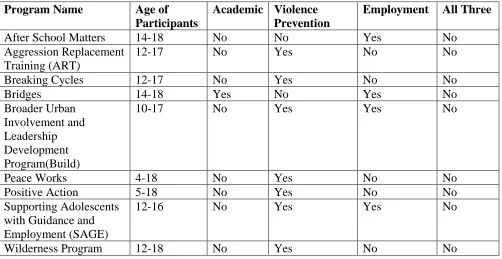
Table 1: Summary of Existing Programs
Program Name Age of Participants
Academic Violence Prevention
Employment All Three
After School Matters 14-18 No No Yes No
Aggression Replacement Training (ART)
12-17 No Yes No No
Breaking Cycles 12-17 No Yes No No
Bridges 14-18 Yes No Yes No
Broader Urban Involvement and Leadership Development Program(Build)
10-17 No Yes Yes No
Peace Works 4-18 No Yes No No
Positive Action 5-18 No Yes No No
Supporting Adolescents with Guidance and Employment (SAGE)
12-16 No Yes Yes No
Wilderness Program 12-18 No Yes No No
The Centers for Disease Control released a sourcebook entitled “Best Practices of Youth
Violence Prevention.” This book offers four strategies to prevent youth violence: parent and
family based, home visiting, social-cognitive, and mentoring. The type most closely related to
the proposed ASP is the social-cognitive intervention. The first step is to identify the populations
that the program will target. The second is to consider the demographics of the targeted
participants. The next step is to select a setting in which to house the program. Another aspect
discussed is to involve the community in the development of the program, such as schools,
parents, and others. Clear goals and objectives should be determined for the program outcomes
and the implementation. The next action is to select the intervention that will best fit the targeted
population and gather the materials. The following steps are implementation measures and
follow through of the program. They included selecting and training staff, recruiting participants,
Chapter 3. Program Design
General Program Information
Following the CDC Best Practices guidelines, the first element of program
implementation is identifying the target population. This ASP is targeted towards high school
students, grades 9-12, ages 14-18. This program will target those teens that have already had an
encounter with the juvenile justice system for a minor offense, or have been labeled as an unruly
child. It will also target at-risk populations referred from schools, such as truant or high
discipline referral students. The program would preferentially be located in a faith-based
organization. Some FBOs possess already established infrastructure to house a program of this
nature. This would save not only money, but time to get the program running and functional.
Multiple community groups should be involved in the development implementation of the
program because they will have active roles in its functioning. These groups are the FBO,
schools, juvenile justice system, and parents.
The goals of the program are to prevent teen violence, reduce recidivism, and foster
workplace preparedness. Another objective is to offer an alternative way to spend out of school
time that keeps them safe and gives them skills that would not otherwise be available for them to
learn.
In the initial stages, the participant capacity would be limited by the sponsoring FBO, as
well as awareness of the program’s existence in the community. A base number to begin would
be anywhere from 25-50 participants. As the program matures and becomes a more established
asset of the community, participants may increase to 100-150, depending on the physical space
Participants would have three options of attendance in the program. There would be a
two day a week track, where participants would only attend on Tuesday and Thursday. A three
day a week track, where attendance would be Monday, Wednesday, and Friday. And finally, a
five day a week track where participants would attend every day after school. Track placement
would depend on the reason for enrollment in the program and if their involvement is court
ordered for a specific time.
Staffing the program would mainly be through volunteers. If funding allows, there may
be a position available for director and/or coordinator of the program, as well as a licensed
counselor. The majority of the workload will be handled ether through volunteers or FBO staff.
There should also be some form of security, due to the potential use of the program as a form of
treatment for delinquent juveniles. Most of the crimes committed to result in enrollment in the
program should be minor, but the liability is potentially too great to not provide prevention. This
role needs to be filled through very careful consideration. Teens do not need to feel like the focus
of the program is to keep communities safe from them, but to feel like they are being kept safe.
They also do not need to feel as if they are being heavily monitored, but merely supervised.
Having an officer in a uniform guarding them is comparable to being guarded at a youth
detention center. Creating an atmosphere in which a feeling that the adults are anticipating the
participants continuing delinquency and misbehaving counteracts the goal of the program. This
role may be filled as an additional duty for a few volunteers, or as a quality necessary in the
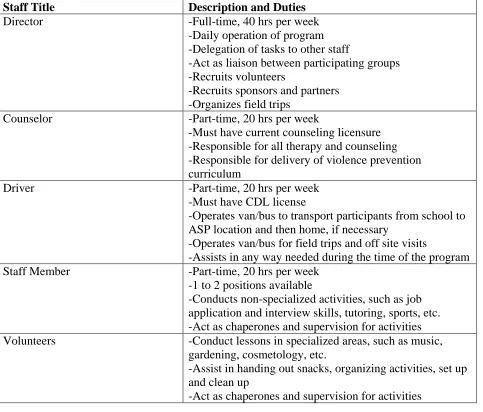
director. Table 2 provides a summary of the staff position descriptions and duties.
In addition to the daily operating staff, a board of trustees or directors needs to be
established to ensure that the interests of all parties are equally represented. This board should
county juvenile justice department, local high schools, students from the targeted population, and
the director of the program. If all parties are working together for the best interest of the program
[image:24.612.69.552.183.595.2]and its participants, the likelihood of success becomes greater.
Table 2: Summary of Staff Positions and Respective Duties
Staff Title Description and Duties
Director -Full-time, 40 hrs per week
-Daily operation of program -Delegation of tasks to other staff
-Act as liaison between participating groups -Recruits volunteers
-Recruits sponsors and partners -Organizes field trips
Counselor -Part-time, 20 hrs per week
-Must have current counseling licensure -Responsible for all therapy and counseling -Responsible for delivery of violence prevention curriculum
Driver -Part-time, 20 hrs per week
-Must have CDL license
-Operates van/bus to transport participants from school to ASP location and then home, if necessary
-Operates van/bus for field trips and off site visits
-Assists in any way needed during the time of the program
Staff Member -Part-time, 20 hrs per week
-1 to 2 positions available
-Conducts non-specialized activities, such as job application and interview skills, tutoring, sports, etc. -Act as chaperones and supervision for activities Volunteers -Conduct lessons in specialized areas, such as music,
gardening, cosmetology, etc.
-Assist in handing out snacks, organizing activities, set up and clean up
-Act as chaperones and supervision for activities
Funding
The source of funding for this type of program would come from four main sources:
Government Grants
The federal government has provided a website
applying for government grants that a program may qualify for. While this website provides
access to information in regards to virtually every government grant offered, its search abilities
are difficult to navigate and time consuming to muddle through.
This type of program, if developed appropriately, would be eligible for the 21st Century
Community Learning Centers grant (U.S. Department of Education). This is a part of the No
Child Left Behind Act, established in 2002. The funding for this grant comes from the federal
government, but is operated by the state. The state of Georgia awards these grants for a time
period of three years. Any public or private organization may apply for this grant. However, to
qualify the organization must operate an out-of-school time program that provides academic
assistance, additional services and activities that reinforce and complement academics, and offer
families of students literacy and educational development. The program must also serve students
that attend schools identified as needing improvement. Receipt of this type of grant would
guarantee funding for at least three years.
The 21st Century Community Learning Center grant is not the only type of federal grant
available. The Department of Labor, Department of Health and Human Services, the Department
of Justice, the Department of Education, The Department of Agriculture, the Department of
Housing and Urban Development, and the Corporation for National and Community Service all
offer grants applicable to out-of-school time. These grants focus on a variety of topics from
community development block, and Americorps. Multiple grants may be applied for and
received based upon the types of activities offered in the program.
Private Grants
The government is not the only entity that provides funding for ASPs. For example, The
Wallace Foundation is a philanthropic charitable organization, 501(c)(3), that provides monetary
resources for ASPs. The vision and mission of the foundation is that children living in urban
areas have access to good schools and quality programs outside of schools that prepare them to
be active and valuable community members. They do this by offering grants to fund programs
and research, then sharing the knowledge gained. One of the three main focus areas is
“Out-of-School Time Learning Grants and Programs.” Programs that receive grants are said to have the
following six components: a committed leadership team, a coordinating entity, multi-year
planning, reliable information, expanding participation to reach all children who need to be
reached, and a commitment to quality.
Other organizations, such as the William T. Grant Foundation, the W. K. Kellogg
Foundation, the W.H.O. Foundation, and many others all offer grants to groups focused on
education and ensuring students have the skills necessary to become active and proficient
community members. Organizations can also be found at
comprehensive website that provides an online directory to foundations that fund programs and
offer grants. There is a monthly fee for access to this service.
Faith Based Organization Hosting the Program
The responsibility of the FBO is dependent upon the size of the organization. The main
responsible for some staff and provision of whatever supplies they would be willing and able to
donate.
Donations
Funding and supplies may be received in the form of in kind donations. These donations
may come from local businesses and well as individuals in the community. The main type of
donations will be in supplies for the different activities offered. Many of the activities require
tools and supplies, such as art supplies, sewing machines, and gardening tools. Also, many local
businesses may be willing to donate goods or services in exchange for advertisement or
sponsorship advantages.
Budget (Annual)
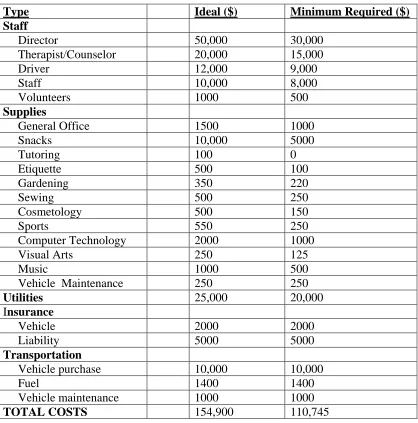
The following tables represent proposed budgets for the first year of the program. There
are two budgets presented in each table for the full operation of all suggested parts of the
program. The first listed in the “ideal” column is the budget for the average running of the
program at a comfortable level. The second budget offered as “minimum required” is the cost of
operating the program on the least amount of funding possible. The budgets presented in Table 3
do not account for the donation of supplies by the FBO or other community members. Therefore,
the budgets are the maximum amount that would be needed for each circumstance. Salaries for
the staff positions were estimated based upon the national average for these positions (Payscale).
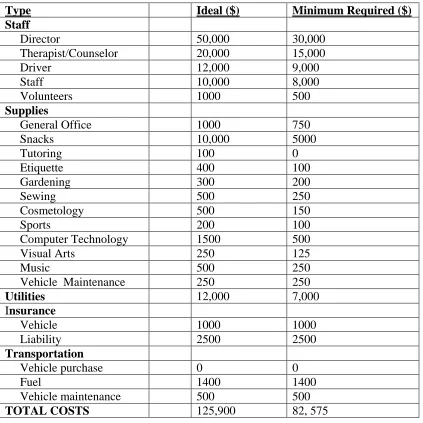
An amount was allotted to volunteers for appreciation dinners and gifts. Table 4 is a proposed
budget accounting for shared use of FBO supplies and property, such as church van or bus. This
would be the ideal situation in which to operate the program. The total cost based upon these
four proposed budgets is between $82, 575 and $154,900 for the initial start up year. Afterwards,
to Appendix A for a list of proposed supplies that were used as a guide to develop the following
[image:28.612.69.487.151.574.2]budgets.
Table 3: Proposed Budget
Type Ideal ($) Minimum Required ($)
Staff
Director 50,000 30,000
Therapist/Counselor 20,000 15,000
Driver 12,000 9,000
Staff 10,000 8,000
Volunteers 1000 500
Supplies
General Office 1500 1000
Snacks 10,000 5000
Tutoring 100 0
Etiquette 500 100
Gardening 350 220
Sewing 500 250
Cosmetology 500 150
Sports 550 250
Computer Technology 2000 1000
Visual Arts 250 125
Music 1000 500
Vehicle Maintenance 250 250
Utilities 25,000 20,000
Insurance
Vehicle 2000 2000
Liability 5000 5000
Transportation
Vehicle purchase 10,000 10,000
Fuel 1400 1400
Vehicle maintenance 1000 1000
Table 4: Shared Expenses with FBO Budget
Type Ideal ($) Minimum Required ($)
Staff
Director 50,000 30,000
Therapist/Counselor 20,000 15,000
Driver 12,000 9,000
Staff 10,000 8,000
Volunteers 1000 500
Supplies
General Office 1000 750
Snacks 10,000 5000
Tutoring 100 0
Etiquette 400 100
Gardening 300 200
Sewing 500 250
Cosmetology 500 150
Sports 200 100
Computer Technology 1500 500
Visual Arts 250 125
Music 500 250
Vehicle Maintenance 250 250
Utilities 12,000 7,000
Insurance
Vehicle 1000 1000
Liability 2500 2500
Transportation
Vehicle purchase 0 0
Fuel 1400 1400
Vehicle maintenance 500 500
TOTAL COSTS 125,900 82, 575
Types of Activities presented in the program
The types of activities the program provides will be broken down into two categories.
The first category, Category A, is types of skills or activities that all participants will benefit
from, and are therefore required. The second group, Category B, will consist of activities that are
considered electives, or activities that appeal to a participant’s interest. These activities would
offered more frequently. All activities strive to be SAFE, so that they will have the greatest
impact.
Category A:
Tutoring
While this particular program has a focus centered on social improvements, academics
are not neglected. Tutoring will be provided to ensure that all homework and school related
projects are completed before any other activity. Graduation from high school or obtaining a
Graduation Equivalency Diploma is crucial to self-esteem, obtaining a job, or entering secondary
education. If all the allotted time is spent on activities that enhance the opportunities after high
school graduation, and does not help participants reach the point of graduation, the program is
preparing them for a future they will not be able to obtain. Programs such as the Bridges program
have keyed into the importance of academics. Aspects of Bridges can be modified to suit the
needs of this ASP.
Job Application and Interview Skills
The first impression a person makes when applying for a job is the application. If the
application is not completed in a manner that best displays the candidate, the job may go to
another who is equally or less qualified yet completed a more satisfactory application. It is
imperative that graduates immediately entering the workforce know how to successfully fill out a
job application.
Once they learn how to correctly fill out an application, they need know how to properly
conduct themselves in an interview. A job candidate must be able to meet and exceed
expectations that are formed based on the submitted job application. A thorough knowledge of
job for the participant. Mock interviews could be used to prepare participants for a real interview
experience.
Etiquette
Often times, employees are required to attend meals as either part of the job interview
process or for the job itself. There are many rules of etiquette that are not common knowledge in
urban settings or taught in schools. The knowledge of how to properly use utensils and conduct
oneself at a respectable restaurant might be the deciding factor between employee candidates. It
may make the difference between which companies a client chooses to represent them. A
participant may be able to gain an advantage by having the knowledge of proper etiquette and
technique.
College Entrance Counseling
Often times, college is considered out of the question for the students targeted by this
program. They are written off as being delinquent; they do not meet the minimum academic
standards or they are financially unable to attend. Therefore, they are not informed about how to
properly prepare to apply for college or any type of secondary education.
There are many steps necessary to successfully apply to and gain entry to college. Not
only must student’s academic scores be competitive, but there must be involvement in either
extracurricular activities or community service projects. A student must also have a competitive
score on either the SAT or the ACT. SAT and ACT study guides and practice tests need to be
made available for those students who choose to utilize them.
Therapy
Due to the nature of participation in this program, many students have endured situations
the behaviors that have caused them to be in trouble, but also the underlying causes of why they
committed the behavior to begin with. Therapy would consist of small group sessions due to
limitations of time and staff.
Many of the violence prevention programs and curricula mentioned previously could be
utilized in this area of the program. Positive Action would be the ideal curriculum to be used
with these participants. Positive Action is not only evidence-based, but is also been used in an
after school setting. It has been implemented to various types of participants, ranging in age,
ethnicity, and socioeconomic statues, and has proven effective. ART would also be a valuable
resource to use as violence prevention curriculum. It is designed for the appropriate ages of
12-17 and is broken into sessions that are a suitable length for an ASP. It also offers a variety of
delivery methods to maintain participant interest. This curriculum would be presented every day
for groups of 10-15 youth at a time. They remaining time allotted for therapy would focus more
on traditional counseling services.
A licensed counselor would need to be on staff at all times in order to handle situations
that arise where a participant might confess abuse or suicidal thoughts.
Parent and Family Therapy
Many problems that land students in trouble are not completely of their own making.
There should be a form of family counseling available for parents and other household members
to participate and potentially better their home environment. If a problem is too large or
Category B:
Horticulture/Gardening
Horticulture Therapy is a term applied to interventions involving nature and spaces
associated with gardens, plants and related tools with the intention of improving health and
well-being, both physical and mental (Soderback 2004).
The supplies for this activity are minimal, the largest being the parcel of land suitable to
growing vegetation. Many of the other supplies, such as rakes, hoses, and seeds, can be
purchased inexpensively or donated by members of the sponsoring FBO. This activity also has
the potential to create an impact beyond the ASP. Participants may take home the harvest,
therefore relieving a burden from the provider by supplying a portion of food for the family. This
also ensures that the family is eating healthy by getting fresh vegetables. If the participants do
not want to take the produce home, it can be sold to the community either through a vegetable
stand or to congregation members. This would teach participants the monetary value of their
efforts, as well as business skills. It would also raise funds that could be put back into the
program. This would serve as a continuous activity during the planting and harvesting season. It
would be substituted during the winter months with a more seasonally appropriate activity.
Sewing
Being able to operate a sewing machine is a skill that participants could learn, and later
use to possibly gain employment. There are opportunities for employment in alterations shops,
monogramming stores, and/or clothing manufacturers. This is also an activity in which
participants would be able to have an end product to show for their effort. The completion of the
art project is a method to increase self-esteem and self-worth, as a project is seen from concept to
Cosmetology
The type of cosmetology activities that could occur would be limited based on licensure
requirements and the expense of the equipment and products. Salon equipment is incredibly
expensive and beyond the realm of a program such as this. However, a limited number of skills
could be taught, such as manicure and pedicure, hair styling, and possibly hair cuts. These
procedures require only small tools and no expensive, bulky equipment that would have to be
stored. The limiting factor for this activity is finding a certified volunteer to come in
approximately once a week and teach participants the skills. If proper licensing for the facility
was received, clients could come in and participants could earn hours towards their own license.
Sports
Research has shown that involvement in sports shows an inverse relationship with the use
of illicit drugs and cigarettes (Pate 2000). This is also a relatively inexpensive activity with the
start up costs being the purchase of sports equipment. Many FBOs, such as churches, have a
gymnasium on site, some already possessing equipment. If a sponsoring organization does not
already own equipment, items such as basketballs, footballs, dodge balls, and soccer balls are
relatively inexpensive.
Computer Technology
The field of computer technology is growing and enhancing rapidly. Many teenagers are
already interested in technology, but low income students may not have the resources or
opportunity to work with it. This activity would depend upon the correct amount of funding
received. Computers are not inexpensive, and neither are the programs that participants could use
Visual Arts
The visual arts consist of watercolors, oil paints, acrylic paints, photography, pottery, and
other mediums. Art has been proven to offer a safe avenue for exploring life as well as offering a
means of expressing emotions, both positive and negative (Wallace-DiGarbo 2006). Art is a
method of engaging youth and redirecting harmful behaviors towards a more positive outlet.
The cost of this activity depends on the type of art projects undertaken. Photography is a
more expensive medium, requiring advanced equipment and developing supplies. However, it
may also be a field where there are more job opportunities than pottery, for example.
The participants would be given a choice as to the outcome of their finished artwork.
They may either take it home, or it can be sold to members of the community as a fundraiser for
the program. This would also show members of the community what is happening in the
program and what a valuable resource it is.
Music
Music is another activity with a diversity of options available for participants. There is
vocal music where a choir could be formed. Participants could learn to play an instrument, such
as piano, guitar, woodwinds, and brass. They could write music and learn about music
production. There are numerous possibilities that could enhance the attitudes of students.
Instruments, however, are costly, as well as musical instruction. There must be a
volunteer with the knowledge and ability to not only play music, but to teach it. This may be an
Vehicle Maintenance/Mechanics
People rely heavily on their vehicles for work and living. Douglas County has no form of
public transportation, making personal vehicles the primary mode of transportation. These
vehicles require maintenance and upkeep to run properly and effectively. This is a field in which
skilled labor is necessary and in demand. If a participant has an opportunity to learn skills that
prepare them for licensure, they are ahead for achieving employment in this domain. The more
parts of the vehicle they become accustomed to and experienced with, the more proficiency they
have to place on a resume to be a better job candidate.
This type of activity would have to be in the form of a partnership with a local
auto-mechanic shop. Participants would have the opportunity to go into a working business to learn
not only how a car works but also how a business operates.
Field Trips
These field trips would be to local colleges and career fairs. They are placed in category
B because not everyone would be required to participate, but would be strongly encouraged.
Making connections within the community is a positive way to increase post high school
employment and education opportunities. These field trips would introduce participants to some
of the options available to them after high school.
Ethical Issues
There are two main ethical issues revolving around the proposed program. The first
concern is the placement of such a program with a FBO. Ordinarily, this would not present an
ethical struggle, but using a program as a policy source and receiving government funding raises
the issue of church versus state. In regards to religion, the First Amendment states “Congress
thereof;” (United States Senate). As a whole, many have transformed the first amendment into
the separation of church and state completely. Tax payer dollars would be awarded to a group
with a religious affiliation or connection. Most of this funding is appropriated from the federal
government and passes along to state governments, agencies, and local governments before it
ever meets the FBO. Even with the progress made through the presidential faith-based initiative
offices, many still believe that it is a political move to garner more religious votes. Therefore, it
is not guaranteed to prevent some from opposing a government funded program in a religious
atmosphere. Because of these attitudes, there must be measures taken to ensure no problems arise
in relation to church versus state. A way to alleviate this issue is for the faith based group to set
up a non profit organization specifically for the program. This would make the ASP a separate
entity but operating underneath the umbrella of the FBO. It would therefore be able to receive
the backing and support of the FBO while avoiding the violation of the first amendment. This
may not pose a problem, however, because there is no religious agenda in the operating of the
program. The FBO is merely an infrastructure already established in which to house the program.
The second ethical issue is creating a program that could benefit many students, but only
making it available to those who have shown some form of delinquency. Data is hard to collect
and analyze, but what data has been gathered indicates that the supply of ASPs is not meeting
demand. In a study of three major cities, only 10 to 35 percent of school aged children that
needed ASPs were enrolled, and this was just a study of elementary and middle students (Forum
for Youth Investment 2003). High school students have far fewer options and therefore it can be
concluded that their enrollment percentage is the same or lower than that of elementary and
middle students. This program could benefit not only the unruly and juvenile offenders, but even
many places are available to participants and who needs the service the most. Potentially a
program such as this could be used as a model for more programs to be developed and serve a
Chapter 4. Policy Implications
The mechanisms in which this type of ASP may be used in a policy manner are two fold.
The first is as a replacement for traditional punitive consequences for first time, minor juvenile
offenders. Some types of offenses that would qualify would be status offenses, first time minor
violent offenders, petty theft, and other minor, first time offenses. Instead of the current
probation, community service, and therapy or anger management, this program would be the
courts judgment. The court would specify an amount of time to remain in the program and what
specific activities were required. This would be similar to the graduated sanction portion of the
Breaking Cycles program. An activity such as this ASP begins as punishment but has the
potential to transform into something youth want to remain in. In addition to removing those
from unsupervised environments that lead to repeating offenses, it teaches them valuable skills
that they may one day se to obtain a job. It will also give juvenile offenders an opportunity to
form valuable relationships with adult mentors in a more relaxed environment, thereby creating a
connection.
Another means by which this ASP could be utilized as policy is in a referral basis,
particularly within schools. For example, when a student has shown a history of truancy, or is
bordering upon it, this program may be referred or required by the school counselor, teacher, or
disciplinary officer. ASPs have been shown to not only improve school attendance, but also
grades and graduation rates. This would be a method of prevention for a child becoming truant
and entering the juvenile justice system. Also, an ASP of this nature would teach students life
skills that would not occur in a traditional detention or in school suspension setting. An ASP
would be much preferred over out of school suspension, where the amount of unsupervised hours
Chapter 5. Conclusion
Evaluation of Program
The evaluation of the program is as essential to the effectiveness of the program as the
components themselves. A proper evaluation is needed to determine not only how well the
program is working, but also where the program needs improvement. Also, quantitative and
qualitative verification that the program is successful or improving will enhance the program’s
ability to receive funding. Data should be collected at the beginning and end of each academic
year and analyzed after the final collection. There are three parts to the programs evaluation.
1. Pre and post program participation questionnaire. A questionnaire would be given out
to participants at the beginning of the program, typically on the first day. This
pre-program questionnaire would contain questions about their feelings and view of the
program. It would also contain questions about their feelings towards school,
attitudes, their behavior, family and community. These questions will be presented as
a series of statements and ask the participant to assess a level of agreement, from do
not agree at all to extremely agree. It would also have questions related to their future
aspirations and life goals. The post-program questionnaire would contain many of the
same types of questions. The main difference being the specificity of questions
related to the activities offered in the program. Please refer to Appendix C to see an
example of a questionnaire that could possibly be used.
2. Juvenile Justice Data: At the initiation of the program, data regarding the number of
new juvenile offenders, number of repeat offenders, types of offenses, and types of
punishments would be collected. At the end of the program, the same data would
of juvenile offenders similar in age and number to program participants needs to be
selected as a control group.
3. School Data: Data from both public and private schools related to drop out rates,
graduation rates, and grade point averages should be collected and analyzed. Similar
to the juvenile justice data, a random sample of students that didn’t participate in the
program, yet share demographic characteristics with program participants, should be
selected and the same data gathered.
Another aspect of evaluation could be a research portion designed to gather the data and
academically evaluate the outcomes. This would help to more firmly establish evidence-based
measures of the effectiveness of ASPs and this specific model. An academic institution could
become a partner for this type of research.
Limitations
In developing an ASP such as this, it is difficult to define the best possible practices to
use. ASPs are a field where not much quantitative or qualitative data exists. This is especially
true with the high school population. Also, there are not many measures in place to show social,
behavioral, and attitude outcomes. Most research focuses on academic data, such as graduation
rates. Therefore, there is no model program by which to base a design on. The proposed program
would be entirely experimental in its infancy. This would limit the ability of the program to
receive funding and support from partners and the community.
Next Steps
A logic model should be constructed to concisely describe the issue the program is
attempting solve and how it will go about doing so. This will assist in earning grants from
A task force should be established to develop a more relevant program. Members of the
high schools, local juvenile justice system, FBO, and representatives from the target population
should be assembled to review the proposed program and give input and suggestions. A task
force would provide the opportunity for recommendations to be made regarding the types of
activities offered, particularly category B activities. The ability for all involved to express an
opinion would create buy in, enhancing the acceptance of the program.
All parties must then decide what their role is and what responsibilities they are willing to
take on. A system must be created to designate the logistics of how participants will flow
through the program. There must also be a reporting system for the program to inform the court
of progress and compliance. Also, a set of qualifications designating which juvenile offenders
may enter the program needs to be determined so that the program may benefit as many as