English Theses Department of English
Summer 8-18-2010
The Visual Rhetoric of Craftsmanship
The Visual Rhetoric of Craftsmanship
Amalia K. GonzalesGeorgia State University
Follow this and additional works at: https://scholarworks.gsu.edu/english_theses
Part of the English Language and Literature Commons
Recommended Citation Recommended Citation
Gonzales, Amalia K., "The Visual Rhetoric of Craftsmanship." Thesis, Georgia State University, 2010. https://scholarworks.gsu.edu/english_theses/93
This Thesis is brought to you for free and open access by the Department of English at ScholarWorks @ Georgia State University. It has been accepted for inclusion in English Theses by an authorized administrator of
THE VISUAL RHETORIC OF CRAFTSMANSHIP by AMALIA KALLEN GONZALES Under the Direction of Jennifer Bowie ABSTRACT Within the existing research about communicative devices within visual rhetoric, most published research exists regarding two‐dimensional design such as documents and media graphics. In this paper, I discuss the rhetorical value of handmade items and
TABLE OF CONTENTS
ACKNOWLEDGEMENTS iv
LIST OF TABLES vi
LIST OF FIGURES vii
1 INTRODUCTION 1
2 THE RHETORICAL CONNECTION: CONTEMPORARY FOUNDATIONS 9
3 THE VALUE OF CRAFTSMANSHIP 15
3.1 The Study: Primary Data 15
3.2 Furniture and Woodwork: Labor as a Persuasive Appeal 30
3.3 Art 38
3.4 Food and the Ethos of Visual Transparency 47
3.5 Textiles and Crafts 60
3.6 Automotives 64
4 THE WEBSITE AND USABILITY 70
5 DISCUSSION 74
6 CONCLUSIONS 76
REFERENCES 78
LIST OF TABLES
Table 3.1 Positive FreeResponses to the IKEA Wardrobe 24
Table 3.2 Negative FreeResponses to the IKEA Wardrobe 25
Table 3.3 Positive FreeResponses to the Antique Wardrobe 26
LIST OF FIGURES
Figure 3.1 Respondents by Age 20
Figure 3.2 Respondents by Ethnicity 21
Figure 3.3 Respondents by Highest Education Level 22
Figure 3.4 IKEA Wardrobe 24
Figure 3.5 Antique Wardrobe 26
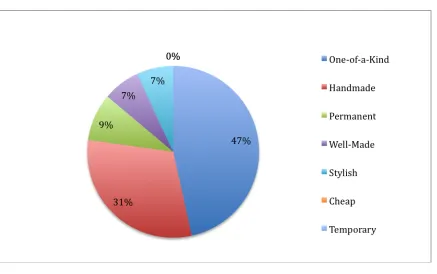
Figure 3.6 Primary Purchasing Factors – Furniture 33
1 INTRODUCTION
During a recent attempt to conceptualize the meaning of Aristotelian “ethos” as it
pertains to rhetoric and composition, specifically within the theoretical framework of
visual rhetoric, I pointed to a wardrobe from IKEA. I explained that the wardrobe is
aesthetically pleasing, with clean lines, and a great amount of functionality. With three flat
surfaces for storage, and a hanging rack, the utility of the piece is not only adequate, it is
superior to most wardrobes currently on the market in regard to price, and accessibility. In
spite of this, it will also likely be sold, or given away in an upcoming move to another
apartment. I then pointed to a coffee table, which I have owned for seven years. Purchased
from a consignment store, the surface of the table is assembled from three sections of
repurposed floorboards, and is held up by four legs, made out of spindles from a staircase
from the same house where the floorboards were sourced. Although I reasonably do not
have enough room to accommodate this piece of furniture, I will nonetheless make room
for it during the upcoming move, as it holds a greater amount of character, and value, based
upon its unique design, and artisan conception.
After providing this conceptualization, I realized for the first time the weight of
the comparison between the character of these physical pieces and the rhetorical
associations that can be drawn from tangible, physical objects and their associated
rhetorical value. The comments I receive from guests upon viewing the IKEA wardrobe
mostly include, “oh, I have that same one.” The comments I receive from guests upon
viewing the coffee table include a greater variety of praise, and include questions about its
origin, comments about its unique character, and admiration for the amount of time I’ve
replaced. Its character representation is minimal and directly related to the fact that it is
simply one out of millions of copies. In stark contrast, the handmade coffee table presents
an enormous amount of character, which can be directly related through a visually inherent
narrative regarding its imagined history. Though inanimate, this table holds the same
rhetorical criteria as a human orator. The table (though not alive, and without a voice) still
possesses the three qualities through which ethos is crafted, as stated by Aristotle. The
table has phronesis (sound sense), arête (moral character or excellence), and eunoia
(benevolence or goodwill). The table visually has an obvious “sound sense” of performing
the task for which it was built, as it a sturdy, reliable platform. Additionally, even without
knowing the item’s background, it is visually worn, imperfect, and mildly warped from
humidity. This provides the viewer with a sense that the table was cared for1, and comes
from decades of utility. These qualities fit not only the arête, but also the eunoia of the
piece, as it has a resilience that will likely last for several more decades in order to serve its
owner. It communicates a message to the end‐user that it is reliable, durable, ready to
perform, and able to handle weight, weather, dents, and scratches. Thus, although the table
is a non‐traditional communicative device, it does indeed have a character and voice that is
expressed through its visual appearance. It serves not only as a functional object but also as
a symbol of the value of handmade fabrication.
1 On an emotional level. Although the table is uneven and worn, its visual character and
This anecdote is veritably the basis for my examination of the visual rhetoric of
craftsmanship, and has inspired a multi‐media digital project related primarily to the ethos
(and secondarily, logos and pathos) of handmade items in contrast to mass‐produced items.
The project is meant to serve not only as a resource to fill the gap in existing academic
literature about the relationship between rhetoric and physical design, but to also act as an
available pedagogical tool for further study and discussion of visual rhetoric within the
realm of three‐dimensional product design and production.
As discussed in an upcoming review of existing literature, little has been written
about the ethos of tangible goods and products. It is my belief that through an examination
of several types of produced goods (furniture, textiles, food, automobiles, and artwork), I
can convey the rhetorical implications of some common items that have yet to be
commonly considered within the field of rhetoric and composition. I will focus on
handmade, or small‐batch items, as it is my belief that they have more character and
rhetorical value than mass‐produced items. Currently, there is a small niche of existing
literature within rhetoric and composition, and more within visual design and industrial
design studies that focuses on the emotion and logical appeal (but not ethos) of
manufactured and mass‐produced items. Within this existing literature, very few
references have been made regarding the ethos of handmade or artisanal items, and it is
this gap in research that this project aspires to fill. I will address the rhetorical aspects of
mass‐produced items as well, in order to establish the contrast between these two methods
of production. I intend to relate the study of three‐dimensional objects within this
framework of visual rhetoric, for as James Porter explains, the different methods of
changing, “because these past treatments, categories, and classifications, particularly the
systems of Greek and Roman classical rhetoric persist. They have an enduring power and
influence over our categories of thought, our systematic classifications, our vocabularies,
our ways of thinking about writing, technology, and production” (Porter, 4). It is method of
“production” that I intend to explore, utilizing visual rhetoric to examine the visual ethos of
objects fashioned by hand. This discussion will also include references to published
literature regarding mass‐produced items in order to provide contrast and a point of
reference to the importance of this study. As Porter notes, our method of discourse is
changing, and I believe that this dialogue should evolve to include not only the rhetorical
implications of two‐dimensional objects, but of three‐dimensional objects that are not yet
widely considered to have an obvious communicative purpose.
The project was intended to extend beyond the traditional delivery of a narrative
academic paper, and thus has been additionally modified for web‐delivery. As an endeavor
to discuss visual rhetoric, it was my belief that an online medium would be a more
appropriate container for not only the narrative aspect of the paper, but the photographs
taken during interviews, and hyperlinked media and videos leading to additional resources
such as articles and films which add additional depth and visual understanding to this
understanding about production and ethos. Though the text and material in this paper
differ only slightly from the material on the website (which will be found at
www.amaliakallen.com/vroc) the following primary research, speaking points, and
rhetorical purpose are found in both formats:
• The first tier of research includes quantitative data from an online survey about
mass‐produced items, such as plates made by an individual potter compared to
produced and sold by a major commercial retailer. This research was intended to
acquire a wider understanding of general perceptions about craftsmanship, and fill a
gap in existing academic publications about the perceived relationship between
product design and character value within rhetoric and composition. The population
sample was comprised of a diverse group of personal contacts, ranging in age from
18‐45, and spanned a spectrum of educational levels, professions, interests, income,
and aesthetic values. This population was chosen not because they fit a specific
demographic or skill set, but because they were likely mostly laypeople2, and all
consumers of basic and common household items, automobiles, or furniture.
• The second tier of research is drawn from interviews with a variety of
individuals associated with production and design, ranging from purchasers, artists,
and craftsmen/artisans. These interviews discuss the ethos of physical items
including food, textiles, artwork, and instruments. Each of these items are discussed
in their respective section further in this paper, and correspond to an interview with
their producer. The interviews, while perhaps seemingly disjointed in regard to
subject matter, were conducted to illustrate the collective relevance of the value of
craftsmanship across several end‐products regardless of the variety of their
production methods. It was my belief that the first‐hand report of these individuals
would provide greater credibility to the discussion of perceived value of
2 As the term “layperson” is typically utilized to describe one who is a non-expert in a field of
craftsmanship, as these producers make a living, or at least supplemental living on
the production of small‐batch goods / services, and could effectively speak to the
value and worth of their labor and end‐product. This is not to suggest, however, that
industrial designers do not have the same associated value and worth in their end‐
product. Literature regarding industrial design is prevalent in design studies, but in
few academic fields is handmade production and the visual character of handmade
objects represented. The central argument of this thesis is upon the ethos associated
with handmade products, and therefore there is a bias toward artisans and
craftspeople as I have not interviewed industrial designers about their work.
• Finally, I collected the data and developed a website, which is a digital display of
the quantitative and qualitative research associated with the exploration into
purchasers’ and producers’ perception of the ethos of objects. The site itself is an
exploration into the value of visual ethos within visual rhetoric, as it relies upon the
use of the rhetorical canons of invention, arrangement, style, memory, and delivery,
to fully translate my intended composition and platform to viewers of the project.
The site acts as the primary delivery device for the project, as it most successfully
supports the “visual” aspect of the work. The site allows users to easily browse
separate sections of the project and view photographs taken during interviews and
hyperlinked material to further resources and referenced material in a segmented
manner. The site also includes a link to this traditionally narrative text, which will
be available to readers as a double‐spaced document. This additional method of
longer sections of web‐text. The final text is available as a downloadable file at
www.amaliakallen.com/fullthesis.pdf
• The structure of the presentation addresses the purpose for the academic
research and speaks to the gap in existing research that influenced the development
of this resource. The rhetorical connection and existing literature is examined, and
connections between classical conventions of “visual rhetoric” and handmade
objects are formed. Findings from primary data are discussed, and support the
subsequent research and interviews with artisans and craftspeople regarding their
interest and method of production within their field of work. A discussion of the
characteristics of “visual rhetoric” and how these elements will tie into subsequent
interviews forms an introduction for the latter part of this project, and sections
containing primary data and insights into woodworking, art, food, textiles, and
automobiles are presented immediately afterward. Next, a discussion of the
rhetorical strategies of the multi‐media site are presented, followed by a discussion
of overreaching topics, themes, and issues presented in this project. Finally,
reflections and a projection of how this project can be utilized as a resource within
visual rhetorical studies concludes the project.
Upon experiencing the finished site or reading this full paper, it is my hope that
readers will have considered the rhetorical value of unassuming, everyday items and will
be led to identify the character of inanimate objects as well as gain a greater understanding
of how visual rhetoric can be viewed in a perspective apart from traditional academic
studies of two‐dimensional design. This type of research is important to the field, as the
dimensional objects, primarily focused upon photographs and the typography and layout of
documents. There is little research within the field of rhetoric and composition that
specifically addresses the rhetorical relationship between three‐dimensional, tangible
items, and the way in which our lives are impacted by the perceived character of these
objects.
It is my belief that the understanding of visual rhetoric can be easily expanded
outside the field of traditional examinations of two‐dimensional design and should include
the rhetorical influence of “everyday items”. This project specifically focuses on items that
are handmade, or produced in small quantities by an artisan or craftsperson, and addresses
the rhetorical aspects of this kind of production, focusing primarily upon the ethos that
unique or limited production items possess. Ultimately, it is my hope that this project will
inspire a greater study into the rhetorical considerations of physical goods and produced
items and will possibly act as a pedagogical tool for expanding the study of visual rhetoric
further outside of the traditional study of two‐dimensional graphics, media, and
documents.
2 THE RHETORICAL CONNECTION: CONTEMPORARY FOUNDATIONS
“Design is an art of thought directed to practical action through the persuasiveness of
objects and, therefore, design involves the vivid expression of communicating ideas about
life” (Buchanan 1985, 7).
As previously mentioned, within the field of rhetoric and composition, little if
anything has been published regarding the visual ethos of physical goods (however
produced). Visual rhetoric itself is fairly modern within the overall discipline of rhetoric
and composition3, and perhaps because of this, many authors have primarily explored
familiar topics within rhetoric and composition while engaging a visual lens within their
published articles. These articles have largely focused on document, web, or printed design
rather than the design of three‐dimensional goods, such as everyday household items,
automobiles, or other tangible items that simultaneously act as communicative and
operative devices. The omission of published studies about the rhetorical value of
consumer goods and domestic possessions is intriguing, especially since within Richard
Buchanan’s 1985 publication entitled “Declaration by Design: Rhetoric, Argument, and
Demonstration in Design” he asserts such a strong call for the advancement of scholarly
ties between rhetoric and design.
Buchanan’s 1985 article was published in Design Issues, a scholarly journal focused on
design history, theory, and criticism. Though the article does indeed appear in a primarily
3 In his foreword to Visual Rhetoric: A Reader in Communication and American Culture, Bruce
Gronbecksuggests that it was with Kenneth Burke’s 1950 publication of A Rhetoric of Motives
that the contemporary understanding of visual rhetoric was birthed. Burked “defined rhetoric as a symbolic action that raised several possibilities for subsequent scholarship across the
“design” focused publication, it has now been available and widely referenced for twenty‐
five years and has been cited and discussed by multiple scholars including many within the
field of rhetoric and composition. George’s “Analysis and Design”, Hocks’s “Understanding
Visual Rhetoric in Digital Writing Environments”, and Kostelnick’s “Process Paradigms in
Design and Composition: Affinities and Directions” (all from College Communication and
Composition), Fleming’s “Can Pictures be Arguments” from Argumentation and Advocacy,
and Kostelnick’s “Supra‐Textual Design: The Visual Rhetoric of Whole Documents” from
Technical Communication Quarterly all reference Buchanan’s article, yet focus primarily on
the pedagogical aspects of document design, written text, or photographs. Buchanan
himself acknowledges the potentially expansive definition of “design”, and specifies:
I refer not only to graphic design, where communication is an obvious goal, and
where the concepts of classical rhetoric are being applied with promising
results, but also to the larger field of design, which ranges from industrial and
product design to architecture and urban planning and for which there is no
unifying theory of rhetoric (4).
Thus, it is surprising that contemporary publications within the field of rhetoric and
composition have not continued to follow suit and explore the rhetorical properties of
produced, physical objects. The particularly striking introductory paragraph from
Buchanan continues with:
although not so obvious at first glance, the themes of communication and
rhetoric in this larger field exert strong influence on our understanding of all
objects made for our human use…ironically, a unifying theory of rhetoric
larger field of design (4).
Buchanan obviously references “all objects made for our human use” as being worthy of
rhetorical consideration. Yet twenty‐five years later, academic publications regarding the
rhetorical value of designed home goods and consumer items such as furniture,
clothing/accessories, automobiles, and food (to name a few) have seldom been written.
These objects have an undeniable rhetorical aspect in that they not only speak to us
(something about an item makes us purchase it instead of a comparable item, whether it be
appearance, packaging, price, or name), but also speaks to others about us (conspicuous
consumption4 has prompted us to take note of others’ belongings, and the rhetorical
communication in their value, character, and emotion). Nils Gore believes “the word craft
should be considered very broadly, meaning any human transformation of raw material
into another object” (39). In the Handbook of Visual Communication, Sonja Foss notes:
not every object is visual rhetoric. What turns a visual object into a
communicative artifact — a symbol that communicates and can be studied as
rhetoric — is the presence of three characteristics. The image must be symbolic,
involve human intervention, and be presented to the audience for the purpose of
communicating with that audience (144).
The objects5 discussed in the referenced, published literature have all been fashioned by
people, serve as a communicative or functional device, and have their own distinctive
characteristics and qualities that make them notable and apparently eligible for academic
4 From Thorstein Veblen’s The Theory of the Leisure Class: An Economic Study of Institutions,
page 121.
5 Documents, typography, media graphics, moving video, websites, etc. While these methods of
study. Therefore, the considerations taken in the subsequent sections about craftsmanship
and craft‐produced goods will touch upon a theoretical history, consider relative
symbolism, note the difference and method of human intervention, and argue for the
communicative and rhetorical strategies of an item or process.
To date, most journal articles continue to address the visual rhetoric within the scope
of document or photograph analysis, and while they sometimes reference Buchanan, the
primary focus of many academic publications within the field of rhetoric and composition
continues to be within the pedagogical nature of textual or web‐based documents, although
increasingly more articles have been written examining video, audio, and multi‐modal
resources as visually rhetorical devices, including Anderson et. al’s “Integrating Multi‐
Modality into Composition Curricula: Survey Methodology and Results from a CCCC
Research Grant”.
The rhetorical nature of visual acts within digital environments, and arguments for
visual rhetoric as a useful pedagogical tool are widely addressed (Hocks 2003, George
2002, LaSpina 1998), though they do speak primarily to documents, and online media and
not the rhetorical consideration of products or goods. George uses her article regarding the
visual communication in the teaching of writing to speak to the way in which visual
rhetoric can be employed in the writing classroom. George argues:
if we are ever to move beyond a basic and somewhat vague call for attention to
‘visual literacy’ in the writing class, it is crucial to understand how very
complicated and sophisticated is visual communication to students who have
grown up in what by all accounts is an aggressively visual culture (15).
visual rhetoric to be utilized within multi‐modal platform, in which multi‐modal
composition is viewed as having potentially beneficial ramifications for marginalized
students (Faigley 1999, Sherman 2007). Sherman references these aforementioned
publications in visual rhetoric and makes the argument that:
working through processes of composing and responding across multiple
modalities can create new conditions of possibility for previously marginalized
students not only to gain a voice, but also to be heard and seen in new ways by
classroom beholders.
Ranker speaks to the benefit of including multi‐modal visual rhetoric within the classroom,
as he explores the development of a documentary film in a middle school classroom:
I investigated another dimension of the overlap between digital media and
writing in pedagogical spaces by explicitly considering how digital video
production, in connection with other media, has the potential to influence the
writing processes of students in literacy classrooms (198).
Duffelmeyer mirrors these sentiments, noting “multimodal composing more meaningfully
reflects the environment in which students receive and generate text today.” Again the
pedagogical implications within the classroom in regard to digital media are explored, a
popular and widely researched topic within visual studies. Stroupe continues the theme by
presenting his essay regarding “a specific approach to reading, composing, and teaching the
problematic combination of verbal and nonverbal features in texts conceived for on in
electronic environments…” (608), likely influenced by Bernhardt’s 1986 text in which he
states, “The physical fact of the text, with its spatial appearance on the page, requires visual
from the perception of speech” (66). And Kostelnick speaks to the value of visual cues not
only in the textural narrative of the writing classroom, but of technical documents within
industrial or corporate fields. All of these articles touch upon the most commonly studied
practice of visual rhetoric as a tool for pedagogical efficacy, but still primarily focus upon
the examination of printed, or web‐based textual documents, and neglect to study the
impact of physical design and ability of three‐dimensional products to carry the same
rhetorical weight as two‐dimensional documents. These publications, while limited to two‐
dimensional studies, speak to the benefit of multi‐modal composition as a pedagogical tool
for understanding visual rhetoric, and have inspired the digital aspect of this project. It is
my belief that as a multi‐modal composition, the website can be utilized as a pedagogical
resource as it is an interactive and engaging website which directly relies on principles of
visual rhetoric to convey its message and additionally discusses visually rhetorical topics.
3 THE VALUE OF CRAFTSMANSHIP
In the following sections, common objects which are uncommonly considered to be
communicative artifacts are addressed, and include (by order of appearance) woodworked
items, artwork, food, textiles, and automotives. These items were chosen for they
commonly impact almost every person’s daily life, yet are not immediately considered to be
rhetorical objects. In addition to existing academic literature related to each section’s focus,
I have included interview data with individuals who produce or manufacture these items. It
was my belief that by speaking directly with people who, as Foss notes, “intervene” in the
method of production, the argument for the role of three‐dimensional objects could take on
another layer of insight which I myself could not provided, or have researched otherwise.
Therefore, the ensuing sections include a theoretical history, interview data, a discussion of
the ethos, pathos, and logos of handcrafted items, and (in some cases) a comparative and
contrasting look at existing mass‐production practices.
3.1 The Study: Primary Data
“The goddess Metis takes her name from this kind of intelligence [the fusion of teche (craft)
and metios (cunning), which denotes ‘wisdom, skill, craft’ as well as ‘counsel, plan,
undertaking’]” (Atwill, 56).
I will be the first to admit that I have purchased almost everything I own from Target.
Growing up, I lived in a suburban area with an abundance of strip‐malls, retail stores,
supermarkets, and the additional presence of a large shopping mall. If I needed clothes,
possessions”, I went directly to an inexpensive “big‐box” retailer. Becoming accustomed to
purchasing inexpensive and interim goods directly influenced my attitude about the value
of production, and while I’ve always held a reverence for craftspeople and artisans, it was
beyond my financial means (or so I thought) to purchase my goods and services from
independent businesses. Although I recognized the value of custom furniture, handmade
crafts, and boutique clothing, the convenience and financial ease of buying a mass‐
produced item seemed to outweigh the sentiment of character or importance of a unique
item. However, after attending countless craft fairs, trade shows, and art openings, I’ve
since become very aware that the money I spend on items can either go to a corporate
entity or a person who can then spend that money on being personally sustainable by
furthering their independent business. I realize that many people hold this realization as
something common, as they have either grown up with the aforementioned reverence for
personal production, or have recently become aware of the prevalence of craft and value of
personal sustainability. We live in habitation that we create for ourselves. Our domestic
aesthetic choices include cutlery, pots and pans, rugs, artwork, furniture, jewelry, neckties,
shoes, desks, pillows, candles, curtains, bathroom soap…the list is extensive to the point
where it can not adequately be fully addressed even in the context of a thesis. These
produced items have a rhetorical value that either consciously or subconsciously impacts
the way we feel in our daily, domestic environment, and the way we continue to develop
our perception of the worth of goods. These items “speak” to us in a way that impacts our
perception of value, and influences our general reverence for the importance or
significance of production. The fields of design and architecture have long associated
speak to within the overall discussion of the rhetorical value of this project. But unlike
primary discussions about “emotion” within traditional academic design publications,
where the focus is on projected sales based upon customer reaction to design and
packaging, my examination of emotion is combined with of ethos and character
development of produced items to consider overall rhetorical efficacy.
We tend to feel different when we walk into a beautiful, antiquated building with
marble columns and handmade stained‐glass windows or custom brass elevator buttons
than we do when we walk into a contemporary chain grocery store or retail business.
Entire fields of study and industry are built around the analysis and development of visual
design and the impact of labels and colors upon a consumer. The visual impact of book
jackets and wine bottles are just some of the more obvious displays of how visual rhetoric
impacts one’s perception regarding the value of an item. For example, I (and likely the
majority of this thesis’s readers) quite often judge a book by its cover.6
Websites such as The Lovely Package 7and The Dieline8 are excellent examples of how
commerce is propelled by visual rhetoric. These sites, as with most examinations about
rhetorical values of products, focus on the exterior packaging and visual representation of
the product, rather than the quality, character, and functional/logical considerations of the
item itself — that is, the taste of the wine, the weld seam of a gas tank, or the durability of a
chair. What I aim to explore in this project is not how the product is visually represented,
6 This is a common practice of course, and not surprising. Judging a Book by its Cover: Fans,
Publishers, Designers, and the Marketing of Fiction by Nicole Matthews and Nikianne Moody addresses the fact that books are indeed subject to aesthetic criticism based solely on their superficial appearance, as the dust jacket or cover of a book almost always provides visual clues about the content of the book, and speaks to a specific target audience, and demographic. 7 http://lovelypackage.com/
but how the handcrafted product sells itself, based on character value and innate quality.
Through implied visual knowledge that the thing one purchases or consumes has been
individually made, I suggest that the consumer may purchase items based on aesthetic
function or ease of purchase, but that they value the method of production more. That is,
the visual rhetoric and ethos of craftsmanship may be more a compelling emotional anchor
and purchasing consideration than mere convenience, cost, or aesthetic packaging. As we
will see in later sections, the majority of handmade or small‐batch items do not actually
employ any type of branding, marketing, or packaging. This is not only because of the cost
consideration that must be taken by the craftsperson, but because the product is believed
to have the ability to stand alone and does not require accompanying packaging.
As the author of this research, I understand how I personally feel about the value of
handmade objects, but felt it necessary to research how others felt about the same items to
which I have a particular, visceral response. I wanted to see if my evaluation of the worth of
individual production was as great as others’. Therefore, I conduced a survey to examine
the rhetorical choices others make in their buying habits and perceptions of produced
items. The first half of the survey asked respondents about their purchasing habits of
either hand‐made goods or mass‐produced goods. The second half of the survey relied on
respondents’ visual perception of different types of paired objects (a mass produced item
and a handmade item) and gauged respondents’ understanding of each object’s visual
ethos. For this sample, I sent the survey to the entire list of my contacts on Facebook. At the
time of delivery, I had 231 contacts, and projected that I would obtain at least 50 responses.
My personal contacts ranged in age from 20‐48, and were divided by sex fairly evenly, at an
at the time of delivery, though a very rough estimate9 placed my population sample at 60%
Caucasian, 25% African American, 10% Hispanic, and 5% unknown/other. The digital
delivery method was decided upon, for as Mary Sue MacNealy notes “computer‐delivered
surveys arrive faster as email can be sent to anywhere in the world in just a few seconds….
[they] allow the researcher to send the survey, receive replies, and read the data at their
own convenience” (150). While not technically “emailed”, the survey was conduced online
and was sent as an “event” on Facebook to each of my 241 contacts which notified each
contact of the opportunity on their Facebook home page. The survey was live for nineteen
days before the results were collected and tabulated by the SurveyGizmo software. Of the
241 invited participants, a total number of 45 respondents participated in the survey, and
42 respondents provided what can be considered “full answers” for the free‐response
portion of the survey10. According to Linda Sax in “Assessing Response Rates and
Nonresponse Bias in Web and Paper Surveys”, some individuals may not use the internet
primarily on their home computer and may have some level of distrust about third‐party
applications and security (410). Additionally, Sax notes that it is difficult to provide a
standard rate of response, as “the available literature on Web surveys points to widely
varying response rates. This is to be expected as access to Internet technology expands and
changes. Additionally, response rates are probably more dependant on the population
sampled than any other factor” (411). Therefore, it is difficult to accurately gauge why the
response rate was so low (18.6%), but informal estimates place the length of the survey,
method of delivery, and condition of anonymity as possible factors. It is my guess that the
9 Based upon a quick and informal tally of my personal Facebook contact list on April 10, 2010 10 While the SurveyGizmo software requires respondents to enter valid text into the free-response
survey may have been too long, and respondents provided incomplete answers due to time
restraints. SurveyGizmo collected 48 “abandoned” hits, which are considered to be visits to
the site in which no responses were collected, and 18 “partial” responses in which visitors
to the site finished some, but not all of the questions. Because the survey was anonymous,
respondents perhaps did not feel a particular obligation to respond and because the survey
was online, it was delivered in a medium that could be accessed only when Internet access
was available. In regard to gender, though about half of my contacts on Facebook are
female, and half male, the response rate of the SurveyGizmo survey goes against popular
conventions of gender‐based response, as Sax notes “men tend to respond to Web surveys
at higher rates than do women” (411). However, of the 45 respondents to my given survey,
67% were female and 33% were male. Additionally, respondents had to be over the age of
18, not only for approval purposes, but because the survey population would ideally
consist of regular consumers of household items, furniture, and decorative objects. As
respondents had to be at least 18 years of age to participate in the survey, 31% were
between the ages of 18 and 25, 67% were between the ages of 26 and 40, and 2% were
older than 41(see figure 3.1).
Figure 3.1 Respondents by Age
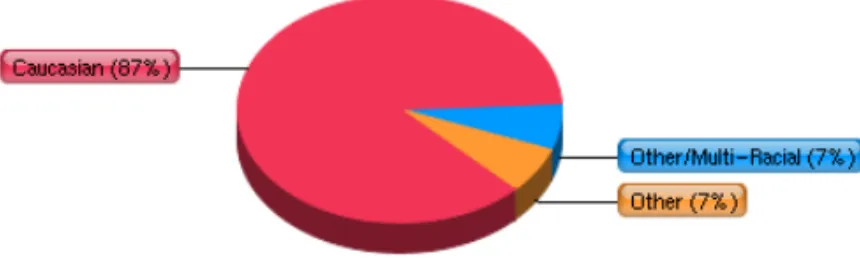
Regarding racial/ ethnic makeup, 87% were Caucasian, 2% self‐selected as multi‐racial, 2%
were African American, 2% were Asian, and 2% were Hispanic (see figure 3.2), a moderate
and notable shift from the projected demographics of the sample population. Though the
demographics of the participants were much different than the base population of 241
people to whom the invitations were sent, it is difficult to accurately gauge why exactly
there were a larger representative number of Caucasian respondents (87% responded
[image:30.612.91.521.311.445.2]from a 60% pool) and such a small number of every other ethnicity.
Figure 3.2 Respondents by Ethnicity
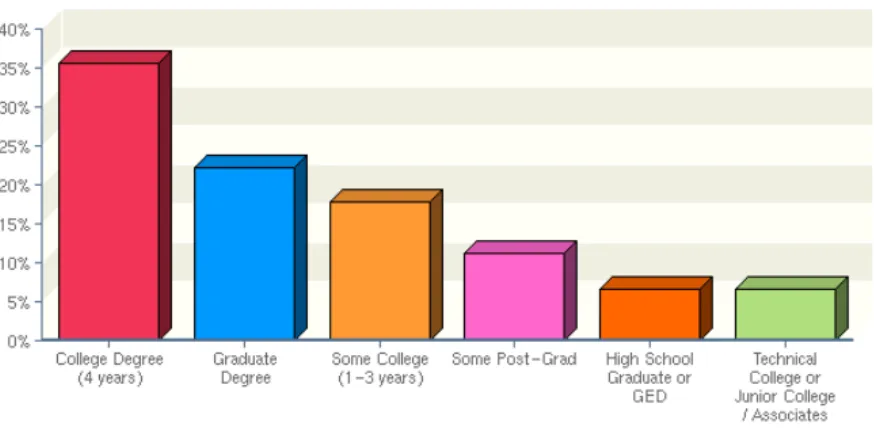
Additional changes in representation occurred in other areas of the survey. The majority of
respondents had a graduate or college degree (22% and 35%, respectively), 17% had some
college experience (between one and three years), 11% had post‐graduate experience, 6%
were high school graduates and 6% had been to a technical college (see figure 3.3). This
does not reflect the general public, as the average number of individuals who have obtained
the following as their highest level of education, as reported by the U.S Census in 200911 are
11 From The Educational Attainment of the Population 18 Years and Over, by Age, Sex, Race, and
Hispanic Origin, 2009 from the United States Census Bureau.
as follows: graduate degree, 10%; college degree, 18%, high school diploma, 31%.
Figure 3.3 Respondents by Highest Educational Level
My sample population has a marginally higher rate of educational attainment, and it
should be noted that this may have affected the data provided in subsequent sections. The
respondents’ fields of work were surprisingly diverse, and only a slim difference existed
between occupations ranging from those in the science/technology/programming field, to
accounting, arts, and research12. The majority (86.2%) of respondents were the primary
purchasers for home and consumer goods. The individual data about respondents’
perceptions to furniture, textiles, and artwork comprised the data for the first half of the
survey and appear in respective sections further into the paper.
The purpose of this introductory section was to understand how respondents felt
about attractive or unattractive qualities in regard to handmade or mass‐produced goods.
12 The field of work was fairly irrelevant to the data collection, and was only addressed to note
Individual results appear further into the paper, in appropriate sections, and address the
levels of interest or disinterest that respondents influenced respondents’ perception of
value.
For the second half of the survey, respondents were asked to free respond to a
number of paired items. The first pair included a mass‐produced wardrobe (the IKEA
wardrobe mentioned in the introduction (Figure 3.4)) and a second, antique wardrobe
(Figure 3.5). Of the 45 survey participants, 42 submitted full answers to the free‐response
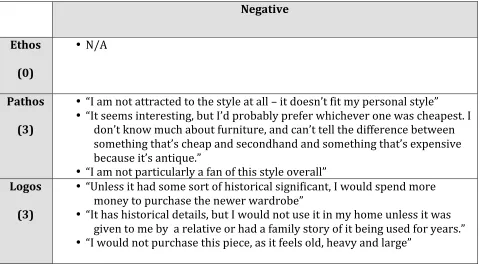
questions, and include the positive (Table 3.1 and Table 3.3) and negative statements
(Table 3.2 and Table 3.4). While additional responses were collected regarding perceptions
of places and sofas, only the responses to the wardrobes are detailed in this report of the
general perception of ethos, pathos and logos. The full report and all answers may be
viewed by visiting www.amaliakallen.com/vrocsurvey.pdf.
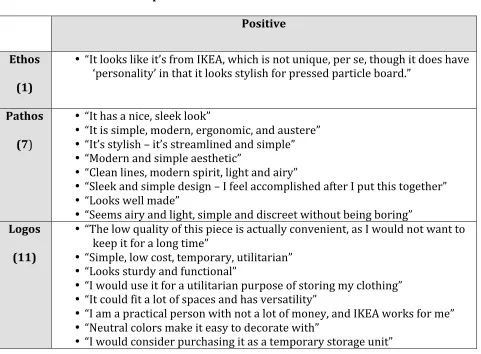
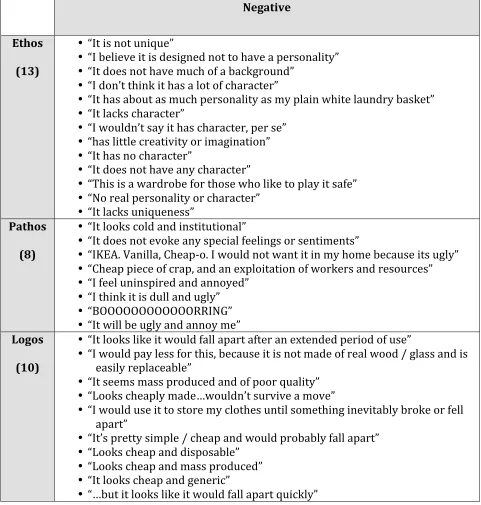
Overall, responses to the IKEA wardrobe received 1 positive comment regarding
associated ethos, 7 positive comments regarding pathos, and 11 positive comments
regarding logos. In contrast, the same wardrobe received 13 negative comments about
ethos, 8 negative comments about pathos (practically the same as positive comments), and
10 negative comments about logos (again, practically the same as positive comments.) The
antique wardrobe received 20 positive comments about ethos, 8 positive comments about
pathos, and 8 comments about logos. It also received negative comments about ethos, 3
negative comments about ethos, and 3 negative comments about logos.
Figure 3.4 IKEA Wardrobe
Table 3.1 Positive FreeResponses to the IKEA Wardrobe
Positive
Ethos
(1)
• “It looks like it’s from IKEA, which is not unique, per se, though it does have ‘personality’ in that it looks stylish for pressed particle board.”
Pathos
(7)
• “It has a nice, sleek look”
• “It is simple, modern, ergonomic, and austere” • “It’s stylish – it’s streamlined and simple” • “Modern and simple aesthetic”
• “Clean lines, modern spirit, light and airy”
• “Sleek and simple design – I feel accomplished after I put this together” • “Looks well made”
• “Seems airy and light, simple and discreet without being boring” Logos
(11)
• “The low quality of this piece is actually convenient, as I would not want to keep it for a long time”
• “Simple, low cost, temporary, utilitarian” • “Looks sturdy and functional”
• “I would use it for a utilitarian purpose of storing my clothing” • “It could fit a lot of spaces and has versatility”
• “I am a practical person with not a lot of money, and IKEA works for me” • “Neutral colors make it easy to decorate with”
[image:33.612.69.550.367.721.2]Figure 3.5 Antique Wardrobe
Table 3.3 Positive FreeResponses to the Antique Wardrobe
Positive
Ethos
(20)
• “This piece certainly has more ‘personality’ than the first piece.
• “I would go out of my way to make sure this wardrobe could fit into any new place into which I move in the future”
• “It is very beautiful, and looks like it has history. I imagine a woman owning it”
• “Somebody put love into making this”
• “This seems to have much more history and imagination in it. It has weight – both physical and metaphorical”
• “I would be interested in learning the history behind this piece” • “If it could speak, it would probably tell more detailed and intricate
recollections than of someone my age”
• “What this wardrobe lacks in versatility, it makes up for in character” • “Unique piece seems to require a room to be built around it”
[image:35.612.65.547.450.713.2]Table 3.4 Negative FreeResponses to the Antique Wardrobe
Negative
Ethos
(0)
• N/A
Pathos
(3)
• “I am not attracted to the style at all – it doesn’t fit my personal style” • “It seems interesting, but I’d probably prefer whichever one was cheapest. I
don’t know much about furniture, and can’t tell the difference between something that’s cheap and secondhand and something that’s expensive because it’s antique.”
• “I am not particularly a fan of this style overall” Logos
(3)
• “Unless it had some sort of historical significant, I would spend more money to purchase the newer wardrobe”
• “It has historical details, but I would not use it in my home unless it was given to me by a relative or had a family story of it being used for years.” • “I would not purchase this piece, as it feels old, heavy and large”
Recalling Foss’s assertion that for an object to be visual rhetoric, it must “communicate
with the audience”, there is no doubt after reading the numerous free responses to images
of handcrafted and mass produced items that these inanimate pieces of wood, glass, and
plastic have served as a rhetorical device. Each of the persuasive appeals of classic rhetoric
is evident in all of the response to pieces included in the visual survey13. The logos of the
wardrobes was addressed by respondents who noted their basic function as places to store
clothes, books, linens, and other miscellaneous items. Comments ranged from the
functionality of the piece, to the lack thereof. Ethos is present in the history that
respondents ascribed to each piece, whether it is basic or imaginatively detailed. Pathos is
achieved and documented by the number of descriptors used to identify how the piece
13 For a full view of the entire survey and all responses, please visit
made the respondent feel. It is significant to the range of feelings that a piece of furniture
can extract from someone simply through its visual appearance, from ambivalence, to
adoration, to annoyance.
3.2 Furniture and Woodwork: Labor as a Persuasive Appeal
“…People magazine dubbed him ‘The Hemingway of Hardwood’. But his business card
always said “woodworker”. ‘I like the word,’ he once said, his eyes brightening behind large,
owl‐eyed glass frames. ‘It's an honest word’.” New York Times obituary for Sam Maloof,
renowned designer and woodworker.14
It is outside of the discipline of rhetoric and composition, and within design studies,
that the majority of texts regarding three‐dimensional objects and their perceived
character and emotive properties exist. In her 2008 article about the depiction of craftsman
at the Qusayr ‘Amra complex in Aman, Jordan, Hana Taragan examines the visual rhetoric
of the wall paintings of builders and workers, and the curious portrayal of the Caliph15 as a
worker and laborer. This examination is pertinent to the overall discussion of ethos
associated with craftsmanship and labor, as the position of the ruler in the wall paintings
“convey the message that the Caliph or prince is a ‘‘glorious builder’’ surrounded by an aura
of prestige” (Taragan, 142). While interesting, and one of the few articles specifically
focusing on a relationship between craftsmanship and visual rhetoric (specifically the
development of ethos by the value of visual representation), Taragan’s scholarship
primarily concerns the anthropological implications of the role of the craftsman/builder
and associated value and ethos, and does not fill the gap in rhetorical literature about the
14 Grimes, William. “Sam Maloof, Furniture Craftsman, Dies at 93.” The New York Times 27
May 2009.
http://www.nytimes.com/2009/05/27/arts/design/27maloof.html?_r=1&scp=1&sq=sam%20malo of&st=cse
15 A “successor of Muhammed as temporal and spiritual head of Islam – used as a title.”
"caliph." Merriam-Webster Online Dictionary. 2010.
visual rhetoric and ethos of produced end‐products. To date, there have been numerous
articles published associating the value of objects within the scope of marketability or
design aesthetics within the field of design (specifically industrial design), but there is
limited discussion specifically addressing the rhetorical appeal of ethos and the
implications for this consideration to be utilized in the field of rhetoric and composition.
Even within the field of industrial design, very few publications have extended beyond the
focus of aesthetic or marketable value to include emotional/character considerations of
three‐dimensional objects. Research examining the role of the craftsperson tends to appear
in design journals and converges most heavily on the role of the craftsperson from a
historical perspective. The craftsman and process of craftsmanship is revered, but still,
publications tend to focus not on the value of the final product, but the way in which the
craftsman can pass his antiquated knowledge to a new generation of designers in the form
of observations, and studies (Wood et. al 2009, 68). Desmet does illustrate how consumers
can have strong reactions to commercial items’ emotional / aesthetic impact, though the
article utilize the example of a mass‐produced item and not a unique, hand‐made object, in
his 2007 article “Emotional Design: Application of a Research‐Based Design Application”. In
the referenced study, a number of mass‐produced telephone models were placed before a
panel, and judged based on their “product character”. The responses were meant to gauge
the “wow appeal” of the item, and participants were asked to note their emotional response
to the phones, including the feeling of desire, fascination, pleasant surprise, satisfaction,
amusement, boredom, contempt, dissatisfaction, disgust, and unpleasant surprise. While
focusing on product “character”, this examination tends to actually focus on how the item
the article focuses on mass‐produced industrial design and its impact on marketability, and
it is illustrative in the general lack of academic literature regarding the emotional value of
handmade items as rhetorical devices.
Few exceptions to this trend of design publications focusing on the marketability
of design exist, even in the context of industrial design, such as Demirbilek’s 2003 article
about the “semantics” of product designor Lacey’s 2009 case study regarding the emotive
quality of hand‐made ceramics. Lacey’s article, while existing within the discipline of
industrial design, is currently one of the few academic publication that aligns near to the
examination of the visual rhetoric of craftsmanship that this project seeks to discuss. Lacy
draws on research conducted upon a series of users who were asked to draw a design of
their favorite mug and then respond as to why they felt a certain way about the object. Lacy
groups the responses into visceral, behavioral, and reflective categories, but then focuses
more on the cognitive processes behind user responses, and does not venture into
exploring the ethos of the objects, based upon derivation. It is this article that inspired my
primary research into the ethos of objects based upon perception of origin, and I created an
online poll to measure respondents’ typical purchasing habits. It was interesting to see that
handmade or unique items were not heavily valued within furniture production, though it
was not surprising that the primary value of an item of furniture was in its quality.
Generally, woodworked items have a direct correlation between quality and handmade
production. As seen from the aforementioned responses about furniture, it is this ethos of
production that this section seeks to address.
For furniture, respondents generally noted that they primarily source pieces of