Middle-Secondary Education and Instructional Technology Dissertations
Department of Middle-Secondary Education and Instructional Technology (no new uploads as of Jan. 2015)
Summer 8-7-2012
Guided Wanderings: An A/r/tographic Inquiry into Postmodern
Guided Wanderings: An A/r/tographic Inquiry into Postmodern
Picturebooks, Bourdieusian Theory, and Writing
Picturebooks, Bourdieusian Theory, and Writing
Adrianne Nicole M. Pourchier Georgia State University
Follow this and additional works at: https://scholarworks.gsu.edu/msit_diss
Recommended Citation Recommended Citation
Pourchier, Adrianne Nicole M., "Guided Wanderings: An A/r/tographic Inquiry into Postmodern Picturebooks, Bourdieusian Theory, and Writing." Dissertation, Georgia State University, 2012. https://scholarworks.gsu.edu/msit_diss/99
This Dissertation is brought to you for free and open access by the Department of Middle-Secondary Education and Instructional Technology (no new uploads as of Jan. 2015) at ScholarWorks @ Georgia State University. It has been accepted for inclusion in Middle-Secondary Education and Instructional Technology Dissertations by an authorized administrator of ScholarWorks @ Georgia State University. For more information, please contact
This dissertation, GUIDED WANDERINGS: AN A/R/TOGRAPHIC INQUIRY INTO POSTMODERN PICTUREBOOKS, BOURDIEUSIAN THEORY, AND WRITING, by NICOLE M. POURCHIER, was prepared under the direction of the candidate’s
Dissertation Advisory Committee. It is accepted by the committee members in partial fulfillment of the requirements for the degree Doctor of Philosophy in the College of Education, Georgia State University.
The Dissertation Advisory Committee and the student’s Department Chair, as
representatives of the faculty, certify that this dissertation has met all the standards of excellence and scholarship as determined by the faculty. The Dean of the College of Education concurs.
_______________________ ________________________ Amy Flint, Ph.D. Teri Holbrook, Ph.D.
Committee Chair Committee Chair
_______________________ ________________________ Peggy Albers, Ph.D. Michelle Zoss, Ph.D.
Committee Member Committee Member
_______________________ Date
_______________________ Dana L. Fox, Ph.D.
Chair, Department of Middle-Secondary Education and Instructional Technology
_______________________ R. W. Kamphaus, Ph.D.
By presenting this dissertation as a partial fulfillment of the requirements for the advanced degree from Georgia State University, I agree that the library of Georgia State University shall make it available for inspection and circulation in accordance with its regulations governing materials of this type. I agree that permission to quote, to copy from, or to publish this dissertation may be granted by the professor under whose direction it was written, by the College of Education's director of graduate studies and research, or by me. Such quoting, copying, or publishing must be solely for scholarly purposes and will not involve potential financial gain. It is understood that any copying from or publication of this dissertation which involves potential financial gain will not be allowed without my written permission.
All dissertations deposited in the Georgia State University library must be used in
accordance with the stipulations prescribed by the author in the preceding statement. The author of this dissertation is:
Nicole M. Pourchier 2049 Newstead Court
Snellville, GA 30078
The directors of this dissertation are:
Dr. Amy Flint
Department of Middle-Secondary Education and Instructional Technology College of Education
Georgia State University Atlanta, GA 30302 -- 3978
Dr. Teri Holbrook
Department of Early Childhood Education College of Education
ADDRESS: 2049 Newstead Court Snellville, GA 30078
EDUCATION:
Ph.D. 2005 Georgia State University Teaching and Learning M.Ed. 2003 Auburn University
Elementary Education B.S. 2002 Auburn University
Elementary Education
PROFESSIONAL EXPERIENCE:
2005-Present Doctoral Fellow and Graduate Teaching & Research Assistant, Critical Thinking Through Writing Assistant
Georgia State University
2004-2008 Summer Writing Professional Development Coordinator Pharr Elementary School
2003-2006 Elementary School Teacher (Grades 1 & 3) Gwinnett County Public Schools
PROFESSIONAL SOCIETIES AND ORGANIZATIONS: 2010–Present International Reading Association 2008–Present National Council of Teachers of English
PRESENTATIONS AND PUBLICATIONS:
Holbrook, T., & Pourchier, N. (in-press). The exquisite corpse as a/r/t: Bodied troublings of qualitative research-as-usual. Visual Arts Research.
Holbrook, T., & Pourchier, N. (2012). The exquisite corpse as a/r/tographic space.
Presentation at the National Council of Teachers of English Assembly for Research, Tuscaloosa, Alabama.
Pourchier, N. M. (2011). A study of postmodern picturebooks: Theoretical and research considerations. Literacy web seminar hosted by Language and Literacy Education Department at Georgia State University.
Holbrook, T., & Pourchier, N. (2011). Guided wanderings: A/r/tography as living inquiry. Invited session at the Qualitative Research Conference at the University of Missouri, St. Louis, Missouri,
Pourchier, N. M. (2010). Art as Inquiry: A Book Review of Being with A/r/tography. The Qualitative Report 15(3), 740-745. Retrieved from
http://www.nova.edu/sss/QR/QR15-3/springgay.pdf
Pourchier, N. M. (2010). Confessions of a fairy godmother: Affairs with gender, the arts, and Pierre Bourdieu. Paper presentation at the Sixth International Congress of Qualitative Inquiry, Champaign-Urbana, Illinois.
Holbrook, T., & Pourchier, N. M. (2010). Literacy as art: Teaching and inquiring through drama and the visual arts. Roundtable paper presentation at the Annual Convention of the National Council of Teacher of English, Orlando, Florida.
Holbrook, T., Meyers, L. E., & Pourchier, N. M. (2009). Reclaiming professional
development: Counter-narratives to the banking model. Paper presentation at the Fifth International Congress of Qualitative Inquiry, Urbana-Champaign, Illinois. Pourchier, N. M. (2007). Born to be an artist: A teacher’s story. In P. Albers, Finding the
GUIDED WANDERINGS: AN A/R/TOGRAPHIC INQUIRY INTO POSTMODERN PICTUREBOOKS, BOURDIEUSIAN THEORY, AND WRITING
by
Nicole Manry Pourchier
! This dissertation is an a/r/tographic inquiry (Irwin & Springgay, 2008) that
explores postmodern picturebooks and writing theory. Postmodern picturebooks have
been described as texts that blur traditional literary boundaries and text-image
relationships, while employing devices like metafiction and playfulness (Goldstone,
2002; Sipe, 2008). As meaning becomes more ambiguous, readers are positioned as
co-constructors of meaning (Serafini, 2005). Research has shown students enjoy reading
postmodern picturebooks and constructing meaningful transactions despite the complex
nature of these texts (McGuire, Belfatti, & Ghiso, 2008; Pantaleo, 2004, 2007, 2008), but
few have begun to explore how these texts are written. Therefore, I used a/r/tography
(Irwin & Springgay, 2008) to theorize about the relationship between these texts and what
it means to write.
As a method of inquiry, a/r/tography is an arts-based approach to research that is
interested in how artistic practices produce meaning and a/r/tographers use art to
“construct the very ‘thing’ [they] are attempting to make sense of” (Springgay, 2008, p.
159). In this study, I wrote and illustrated a postmodern picturebook and interpreted how
this experience generated understandings about what it means to write. In response to the
process model of writing (Flower & Hayes, 1981), the data led to representations that
offer new perspectives on contemporary writing theory, in particular, the interpretive,
(Elbow, 1973, 1981; Flower & Hayes, 1981) and propose that a/r/tographic inquiry
creates openings for new possibilities within the post-process movement (Kent, 1999) by
demonstrating how a writer’s evolving questions (Irwin & Springgay, 2008) relate to
writing pedagogy.
INDEX WORDS: A/r/tography, Postmodern Picturebooks, Pierre Bourdieu, Writing
Process Theory, Writing Pedagogy, Arts-Based Educational
by
Nicole Manry Pourchier
A Dissertation
Presented in Partial Fulfillment of the Requirements for the Degree of
Doctor of Philosophy in
Teaching and Learning in
the Department of Middle-Secondary Education and Instructional Technology in
the College of Education Georgia State University
I would like to thank my committee members for their critique, support, and most importantly, for giving me the confidence to complete this dissertation. I also thank my family, especially my husband and my mother, for their patience and encouragement. I will forever credit my children for the inspiration to imagine what writing can be.
Page
...
List of Figures… iv
Chapter
1 UNDERSTANDING THE STUDY: A/R/TOGRAPHIC INQUIRY
...
AS COLLAGE 1
...
Foreword 1
...
Art as Inquiry 11
...
Crafting an A/r/tography 25
... 2 PIERRE BOURDIEU AND THE POSTMODERN PICTUREBOOK 35
...
The Postmodern Picturebook 35
... Agent in the Postmodern Picturebook Field: Lauren Child 48
... Understanding the Postmodern Picturebook Making Process 52
... 3 AN A/R/TOGRAPHIC APPROACH TO INQUIRY 55
... Articulating Purpose: Process Not Product 55
...
Data Collection 56
...
Analysis 64
...
(Re)presentational Structure 82
... Alternative Research: Alternative Qualities 85
...
An Invitation to Wander 91
...
INTERLUDE 93
...
The Self as Subject 93
...
The Self under Study 94
... 4 (RE)PRESENTATIONS: WRITING AS GUIDED WANDERINGS 96
...
Birds and Words 96
... How do I handle instances of foreignness? 100
... How do elements of my habitus relate to this process? 109
...
How do I act strategically? 118
...
What Guides a Wandering? 127
... 5 WHAT A PROCESS ENTAILS: WRITING AS METAPHOR 133
... An Exegesis as Interpretive Commentary 133
... A Post-Process Perspective on Guided Wanderings 147
... Keeping Metaphors Active: Process as Endangered Metaphor 156
...
References…... 168
...
Figure Page
...
1 Springgay Dissertation 24
...
2 Illustrated Research Journal 60
...
3 Collage Analysis 73
...
4 Painted Collage Papers 74
...
5 Birds and Words 96
...
6 Foreign Instances 100
...
7 Meticulous 102
...
8 Words from Bourdieu 1 108
...
9 Habitus 109
...
10 Persistence 111
...
11 Words from Bourdieu 2 117
...
12 Strategic Action 118
...
13 Confidence 120
...
14 Words from Bourdieu 3 126
...
15 Birds and Words 127
...
16 Stakes for an Artist 129
...
17 Words from Bourdieu 4 132
CHAPTER 1
UNDERSTANDING THE STUDY: A/R/TOGRAPHIC INQUIRY AS COLLAGE
! This dissertation is an a/r/tographic inquiry into postmodern picturebooks and is
best described as an “evolution of questions” (Irwin & Springgay, 2008, p. xxiii). As a
former elementary school teacher turned researcher, I began by exploring the postmodern
picturebook genre, asking what makes a picturebook postmodern and how theory--in
particular, Bourdieusian theory--can shape what is understood about these texts. I have
always been a children’s literature connoisseur and when I came across some of my first
postmodern picturebooks, I was attracted to the ways in which the author/illustrators
were experimenting with what a picturebook can do. Because there is a strong synergy
between words and images in most postmodern picturebooks (meaning the pictures and
words work together to carry meaning), I follow Nikolajeva and Scott (2006) in joining
the words “picture” and “book” to “distinguish [them] from picture books, or books with
pictures” (p. 8).
As I immersed myself in postmodern picturebooks, Bourdieu, and a/r/tography, I
began to question how the process of writing a postmodern picturebook might frame my
understandings about how these ideas are connected. Postmodern picturebooks play,
mock, interrogate, and trouble what readers know about how picturebooks work (Sipe &
Pantaleo, 2008), while Bourdieu suggests that humans are players of games that capture
their interests (1994/1998). A/r/tography evokes similar language about research,
proposing that it, too, can be “playful, exploratory, and expressive” (Springgay, Irwin, &
a/r/tography (Irwin & Springgay, 2008)--share a curiosity for all things epistemological
and call into question what we think we know and how we come to know it.
I began this inquiry wanting to know how Bourdieusian theory relates to my
postmodern picturebook making process, and I was interested in making connections
between this process and literacy theory and pedagogy. As I sought answers to these
questions, I was drawn deeper into a/r/tography as “a living practice” (Irwin &
Springgay, 2008, p. xxix) and recognized that as a methodology, a/r/tography is
concerned with understanding, “a questing if you will” (p. xxiii). Through this questing, I
began to see my a/r/tistic practices--in particular, my use of collage--as metaphors for
how I understand the world. In other words, I recognized my inquiry as an act of
collaging: a piecing together of fragments to create something new. My collage practices
led me into the unknown, places where connections are made within the folds of pieces
that maintain separation, but, at the same time, work together to construct new
understandings.
Research as understanding becomes “a process of exchange that is not separated
from the body but emerges through an intertwining of mind and body, self and other, and
through our interactions with the world” (Irwin & Springgay, 2008, p. xxii). Taking up
these perceptions, I became aware that the practices I engaged in as a postmodern
picturebook author/illustrator are forms of research that are not intended to find answers
to questions per say. Rather, “this active stance to knowledge creation through
questioning informs [my] practice, making [my] inquiries timely, emergent, generative
but questions that are “fresh” in the sense that Eisner (2008, p. 22) argues as valuable in
the case for arts-based educational research.
As readers enter into this work, it is important to recognize that “a/r/tographical
research as living inquiry constructs the materiality that it attempts to
represent” (Springgay, 2008, p. 159). As a collage a/r/tist, I interpret the world in
pieces--pieces that I cut, tear, repurpose, rearrange, and temporarily adhere--to craft
understandings about what and how the world means. In Chapter 3, I describe how I used
collage to interpret my writing experiences, but this dissertation is also crafted as a
collage in and of itself: It is a collection of fragments that I have pieced together to
perform the connections I have made between postmodern picturebooks, Bourdieusian
theory, and writing. My research interests began as pieces that I saw as connected, but
until I encountered a/r/tography, I was unable to articulate these connections or explain
why they were important.
Because I was interested in postmodern picturebooks and how they are written, I
explored my questions as pieces in a collage. I began by creating my own postmodern
picturebook and from this experience, I used collage (through both image and word) to
understand writing a postmodern picturebook as a guided wandering, a metaphor for
writing that I develop through this dissertation. These collages became my
representations of a guided wandering although I did not enter this inquiry intending to
translate my postmodern picturebook experience into a representational form that can be
evaluated in terms of “reliability, validity, [or] precision” because “those terms are
2008, p. 231). Instead, my work must be conceptualized as an a/r/tography that performs
the act of collaging, thereby it must be valued in terms of its attempt to “construct the
very ‘thing’ one is attempting to make sense of” (Springgay, 2008, p. 159). Thus, this
inquiry is significant because it began as an attempt to study my a/r/t making practices in
order to understand how Bourdieusian theory relates to creating a postmodern
picturebook, and when these pieces came together it became a catalyst for larger
questions about what it means to write and teach writing as opposed to solid answers that
might close off living inquiry (Gouzouasis).
When I began this inquiry, I conceptualized my imminent experience as
“creating” or “making” a postmodern picturebook. However, as I began writing the
dissertation, I chose to articulate the experience as “my postmodern picturebook writing
process.” I began this inquiry hesitant to use the word “writing”--opting for terms like
“make” and “create”--but in the end, it was not the term “write” that was out of line with
how I understood my experience. This shift in thinking came about when I recognized
that I conceived of writing as an expressive medium that is mediated through multiple
materials: words, images, sounds, gestures. I agree with Eisner’s (2002) definition of
artistry and propose that writers, too, are artists:
Artistry consists in having an idea worth expressing, the imaginative ability needed to conceive of how, the technical skills needed to work effectively with some material, and the sensibilities needed to make the delicate adjustments that will give the forms the moving qualities that the best of them possess. (p. 81)
Therefore, it was not the term writing that I was avoiding because I understand that
involved in writing the postmodern picturebook, I realized that it is the term “process”
that does not fully portray what I understand about writing a postmodern picturebook
because ultimately the purpose of engaging in a process is to get to a final product.
Understanding my postmodern picturebook as the product of a successful writing process
is not incorrect, but this perspective does not allow me to “perceive [of writing]
differently within [my] everyday practices” (Irwin & Springgay, 2008, p. xxiii).
Within the context of this inquiry, I understand the term “experience” as a
relational (Irwin & Springgay, 2008) concept in which specific experiences are
understood in terms of other kinds of experiences (Lakoff & Johnson, 1980/2003, p. 116).
Following Lakoff and Johnson, when I speak of my writing experience, I acknowledge
that I understand writing through my physical body’s perceptions of my interactions with
the physical environment as well as my interactions with other people (p. 117). I
understand my writing experiences as multimodal, but the idea that these experiences are
processes unsettles me. Lakoff and Johnson’s theories also suggest that I understand one
experience in terms of another which is foundational for a metaphoric perspective of how
humans understand the world. Through my experience in writing a postmodern
picturebook, speaking of my writing experience as a process has become a mere
skimming of the surface in terms of what I really understand about writing. Following
this shift in thinking, I was drawn to the question of writing in and of itself: What is
writing?
A/r/tography has shown me that writing is a slippery concept, and with any
neither” (Irwin & Springgay, 2008, p. xxx). Accepting writing in terms of one
thing--whether it be a process or a sociocultural action/practice--will never fully account for
what writing is because it is a concept that is perpetually “in-the-making” (Ellsworth,
2005, p. 1). In Chapter 5, I outline what the process metaphor “highlights” (Lakoff &
Johnson, 1980/2003) about writing and describe how my creative metaphor (Writing is a
Guided Wandering) highlights aspects of the writing concept that have been hidden by
the process metaphor that has been accepted as foundational knowledge on what it means
to write. I recognize my understandings about writing are not complete; instead, they are
being made as I continue to explore how I write, why I write, and what I write.
Taking up these questions, I position writing as an expressive medium through
which writers use multiple materials (Eisner, 2002) to interpret their situations in a public
world (Kent, 1999). I also recognize that writing is a concept that evolves through
theories that attempt to describe what it does, how it is done, and the purposes it serves.
When I use the term writing, I recognize that writing can be done through multiple
mediums: in particular, visual images and words. In this study, I use these perspectives to
imagine an alternative metaphor for the writing concept.
Even as theories of writing continue to expand, a/r/tography invites me to seek out
aspects of writing that continue to evade description. Therefore, the understandings I put
forth in this study are intended to “provoke and generate” (Springgay, 2008, p. 161) new
meaning about writing and to undo--or reveal the constructed nature of-- taken for
granted knowledge about writing. But my understandings of writing also undo
validity” (p. 161). Instead, my work is intended to invite readers to consider what their
own “imagination, experimentation, uniqueness, and conjecture” (p. 161) can add to the
conversation about what writing is.
I have crafted this dissertation to explore multiple questions in an attempt to share
how three concepts--postmodern picturebooks, a/r/tography, and Bourdieusian
theory--lead me towards new understandings about what it means to write and teach writing.
Each chapter in this dissertation is meant to speak back to a question, questions I have
asked myself and questions I that anticipate readers asking. Thus, this inquiry unfolds in
response to the following questions:
• What is a/r/tography?
• What are postmodern picturebooks?
• How can postmodern picturebooks be understood by creating one?
• What is it like to write a postmodern picturebook?
• What is writing, anyway?
All of these questions, ultimately, circle back to teaching, and the implications for writing
pedagogy that can be derived from taking an a/r/tographic stance toward picturebook
writing. At first glance, these questions may appear simple, but they speak to a/r/
tography’s call “for complexifying the simple and simplifying the complex by
questioning how things come into being and the nature of their being” (Irwin &
Springgay, 2008, p. xxx). Throughout this inquiry, my ideas about postmodern
picturebooks reverberate across complicated questions that push me toward meaning, but
A/r/tography has shifted my understandings about postmodern picturebooks to
new questions--questions that allow me to simplify complex questions but push me to
complicate what I understand about the nature of these concepts in general: writing,
postmodern picturebooks, and Bourdieusian theory. For these reasons, any assessment of
this dissertation should “depend upon its compelling ability to provide access to, and new
insights about, [the writing] phenomenon” (Irwin & Springgay, 2008, p. xxxi). Therefore,
I invite readers to consider (a) how their own understandings about picturebooks and
writing and (b) how theories enter into the understandings they take away from their own
writing experiences are complicated, shifted, and/or expanded as they interpret this a/r/
tographic work.
Because a/r/tography is interested in “reflectivity, insightfulness, and imaginative
aesthetic transaction” (Gouzouasis, 2008, p. 231), it makes sense that a/r/tographic works
are autoethnographic in nature. Carl Leggo (2008), practicing poet and a/r/tographer,
suggests “that by thinking about my own life I can enter into the lived experiences of
others, all of us engaging in conversations that contribute to the constitution of
understanding and connection” (p. 12). Numerous a/r/tographers answer the call for
“relational being” (Irwin & Springgay, 2008) by producing inquiry that focuses on the
self in relation to others. For example, Springgay (2008b) has created a/r/t about being a
nursing mother in the academy; Leggo (2008) writes about his life as a poet and how this
relates to his roles as researcher and teacher; Bickel (2008) explores the female body as a
(2008) use autoethnographic narrative, poetry, and photography to ask and explore
questions about a/r/tography as living inquiry.
Those who are not familiar with arts-based educational research may assume that
this work is indulgent, but Leggo (2008) argued that,
Writing about personal experiences is not only egoism, solipsism,
unseemly confession, boring prattling, and salacious revelation. We need to write personally because we live personally, and our personal living is always braided with our other ways of living--professional, academic, administrative, artistic, social, and political. (p. 5)
A/r/tography, through its focus on autoethnographic writing, becomes a platform for
“research [as] storytelling, thus the more stories told, the greater our fullness of
understanding” (Sameshima, p. 52). At this point, I caution readers to the
autoethnographic writing that follows in this study. It is everything that Leggo (2008)
claims for a/r/tography: confession, egoism, solipsism, prattling, and salacious revelation;
but it is my story, which “informs me, on the one hand, and then transforms me, on the
other” (Leggo, p. 9).
As I engaged in this inquiry, I was reluctant to divulge personal aspects of my
writing experience, but I have given in to the a/r/tographic call to write and create a/r/t to
“develop my own truth” (Sameshima, 2008, p. 52). From a Bourdieusian (1992/1996)
perspective, I have interpreted the call to reveal so much of myself as a “symptom” (p.
xx) of a field in which confession is a valuable form of capital. Despite these
reservations, I felt an overwhelming need to engage in inquiry that is “fundamentally a
personal, practical matter where our encounters with difference and otherness are brought
Embracing a/r/tography--along with its interests in personal experience--has allowed me
to consider how I understand writing through my relationships with others and I share
these understandings so readers can experience how an a/r/tists’ perceptions of the others
in her life play out in her writing. This a/r/tography has shown me that “for me to grow
professionally, I also need to grow personally” (Leggo, 2008, p. 5) and through this
inquiry, I suggest that writing teachers consider the role of personal growth in their
development as writers.
My writing experiences are both private and public, allowing me to develop a
deeper understanding of self as artist, researcher, and teacher. Leggo (2008) likens
autobiographical writing to “an ongoing performance,” proposing that he is “always
improvising in creative ways, never satisfied that what [he] knows is all there is to know,
never convinced that what [he] understands is all there is to understand” (p. 9). In this
study, I usher readers into personal aspects of my writing experience, but these insights
are intended to perform (as Leggo describes) the potential of a/r/tographic inquiry in
writing theory, research, and pedagogy.
The chapters in this dissertation are crafted as responses to the questions I have
put forth. Chapter 1 speaks to the first question I anticipate from readers: What is a/r/
tography? The chapter provides an overview of this methodological approach to
arts-based educational research followed by theoretical explanations for the ways in which I
chose to craft my a/r/tographic inquiry. Chapter 2 takes up the second question: What is a
postmodern picturebook? To follow my representations of what I understand about
described in the existing literature. Chapter 3 addresses the question of how postmodern
picturebooks can be understood by creating one, describing how I collected data and how
I drew upon a/r/t to analyze and represent my understandings about writing a postmodern
picturebook. Chapter 4 is an a/r/tographic work that represents my understandings about
what it is like to write a postmodern picturebook. This work consists of both images and
words, and I intended to stand alone as a piece of interpretive a/r/t. My interpretations of
the meaning in Chapter 4 are crafted as an exegesis--a critical commentary on the
meaning in a work--and presented in Chapter 5. Therefore, Chapter 5 speaks to a larger
question by complicating the nature of the writing phenomenon: What is it, anyway?
When considered as a collage, it follows that the chapters in this dissertation are
parts of a whole--parts that must be understood in terms of themselves, but also in
relation to the entire work. Thus, I encourage readers to read this study from the
beginning, recognizing it has been composed to unfold linearly. However, this inquiry
does not come to an end; instead, it moves towards openings-- or spaces of conversations
and relationships (Irwin & Springgay, 2008) that share the potential for “reflexive action
sparked by a creative impulse that can help to see things in a critically different
way” (Sullivan, 2008, p. 242).
Art as Inquiry
I begin this dissertation with a glimpse into a/r/tography as “a way of living,
inquiring, and being” (Irwin & Springgay, 2008, p. xxxi) in the world. Although I cannot
address the multiple facets of a/r/tography in one chapter, it is necessary for readers to
a/r/tographic inquiry. Therefore, I briefly outline the theoretical underpinnings of this
emerging field in arts-based educational research, but a/r/tography unfolds throughout
this study. This section begins with a description of the arts-based movement in
educational research, and I identify where a/r/tography is situated in relation to this
growing field. Then, I transition to a discussion about what it means to engage in “living
inquiry” (Irwin & Springgay) and the creative renderings that a/r/tography makes
possible because theory is conceptualized as practice: “an embodied, living space of
inquiry” (Springgay, 2008, p. 160). To contextualize this study, I have included an
overview of the topics of inquiry that other a/r/tographers are pursuing. In closing, I
describe the specific concepts (self-study and a/r/tistic understandings) and a/r/tistic
mediums (visual art and writing) that I drew upon to craft this a/r/tography.
Arts-Based Educational Research
It is necessary to situate a/r/tographic inquiry within the larger field of qualitative
research in order to convey the purposes behind the methods and modes of representation
that I use in my work. Carolyn Ellis and Art Bochner (2009) describe the field of
qualitative research as a continuum. They explain that at one end of the continuum lie
qualitative perspectives that rely upon concepts of objectivity, validity, replication and
generalizability. At the other end, postmodern/poststructural perspectives question these
concepts as well as the researcher’s ability to know. Situated within the polarities of the
continuum are qualitative research designs that seek to navigate the extremes. Ellis and
Bochner relate a researcher’s philosophical world-views to their positioning within this
end of the continuum, while those with more positivist perspectives occupy the opposite
end.
Polkinghorne (2007) explains that, in the 1970s, the field of qualitative research
began to undergo reform in response to the emergence of multiple epistemologies that
question the foundations of “realist” knowledge. The theme of this movement posits,
“There areimportant aspects of the personal and social realms that cannot be investigated
within the limitations of what has been conventionally accepted as evidenceand
arguments used to justify or validate knowledge claims” (Polkinghorne, p. 472). This
movement has resulted in the emergence of two subgroups within the field of social
science research: conventional social science and reformed social science. In response to
the recent political movements toward scientific educational research that aims to prove
what works and what does not, reformists are speaking out against the devaluing of
qualitative ways of knowing. Polkinghorne argues that discussions and negotiations
across these groups are unproductive because neither group is willing to compromise
their definitions of what counts as knowledge and/or science. Instead, the reform
movement must maintain focus on dialogue within the community to ensure that quality
work continues to be produced.
The reform movement has led to emergent traditions of inquiry, including critical
and postmodern ethnographies (Richardson, 1997), autoethnography (Bochner & Ellis,
2002), narrative inquiry (Polkinghorne, 2007), and numerous arts-based approaches, such
as poetry, music, dance, performance, and visual art (Leavy, 2009). Across and within
these traditions, there are some shared assumptions about the nature of knowledge and
individual who speaks from the position of the ‘I’ and who is willing to share what he or
she understands as true” (Pelias, 2009, p. 355).
Elliot Eisner (1997) advocates for a vision of “knowledge as process” (p. 7) in
opposition to the emphasis of hard data and facts that are associated with scientific
research in the current educational climate. The arts, he explains, provide “an approach to
educational research that relies upon the imaginative and expressive crafting of a form in
ways that enlarge our understanding of what [is] going on . . .” (Eisner, 2008, p. 18). This
situates the arts as ways of perceiving and understanding the world. Within the field of
arts-based educational research, there, too, exists a continuum. At one end, there are
studies in which the arts are used to represent findings, and, at the other, art is seen as a
method of inquiry through which researchers come to know their worlds. This study is
situated at the ‘art as a method of inquiry’ end of the continuum, as I set out to learn more
about Bourdieusian theory and postmodern picturebooks by engaging with the arts to
create my own text(s).
It was my intent to create postmodern picturebooks that reach beyond the typical
audience of academics and the occasional classroom teacher. I wanted to write a
postmodern picturebook that I imagine myself reading with my own students--exploring
new possibilities for what picturebooks can do. I learned more about postmodern
picturebooks through the processes of creating art, and the art stimulated “the social
imagination, [inviting] others to engage in a truly dialogical conversation about
granted knowledge about writing (i.e. writing is a process) and opens up space for
imaginative possibilities in theories of writing.
Tom Barone (2008a) also argues for arts-based educational research that is
“socially engaged” and “epistemologically humble,” implying that the work is created
with expanded notions of audience and intentions to generate meaningful change, while
maintaining a sense of plurality without imposing a singular viewpoint. Similar
observations have been made about postmodern picturebooks as researchers have
identified characteristics like antiauthoritarianism, the presentation of multiple
perspectives, irony, and contradiction (Goldstone, 2002). It is intriguing that arts-based
research and postmodern picturebooks share similar missions that call for the blurring of
boundaries, the troubling of structures in an effort to problematize the known, and
encouraging new questions and perspectives. I selected a/r/tography (Irwin & Springgay,
2008) as a method of inquiry to follow as I theorized about writing a postmodern
picturebook.
A/r/tography
A/r/tography questions how we might “begin to think of research methodologies
as relational situations that provoke meaning through contemplation, complication, and as
alternative models of space and time” (Irwin & Springgay, 2008, p.105). The term
a/r/tography was created to signify the multiple roles one plays in qualitative research:
artist-researcher-teacher. Practice-based underpinnings focus on how “theorizing through
inquiry seeks understanding by way of an evolution of questions within the living-inquiry
considered to be forms of research and the “intellectual, imaginative, and insightful
work” they create is “grounded in ongoing forms of recursive and reflexive inquiry
engaged in theorizing for understanding” (p.109).
Irwin and Springgay (2008) emphasize a kind of understanding that is relational,
embodied and active. A/r/tographers draw upon personal experiences as they work
through the arts to question, ponder, and theorize new questions and possibilities. The art
making processes are seen as acts of research and are grounded in writing. This focus on
the relationship between creating art and writing promotes new ways of “learning to
perceive differently within our everyday practices” (p. 110). Three ways of interpreting
experience--theoria (knowing), praxis (doing), and poesis (making)--are folded together
in a/r/tography to create “interstitial space[s], open and vulnerable where meanings and
understandings are interrogated and ruptured” (p.110). Although a/r/tography values
personal experience and a/r/tistic practices, inquiry is conceived of as relational. All
works are related to the works of others, and “a/r/tographers acknowledge the work of
others in the documentation of their own work. . . . Citational practices are important for
a community of practice-based researchers wanting to understand a body of literature and
work in their fields while positioning their work within those and potentially other
fields” (p.111).
A/r/tographic Renderings
Through embodied art-making and writing, a/r/tographers explore phenomena
through concepts rather than specific methods. This means focusing on the processes of
research methodology. Irwin and Springgay (2008) “interpret concepts to be flexible
intersubjective locations through which close analysis renders new understandings and
meanings” (p. 115). In keeping with these interpretations, they adopt the term
“renderings” to describe six concepts that assist a/r/tographers as they share their work
with others. Researchers are reminded that although it may seem routine to label these
renderings as criteria for a/r/tographic work, they are meant to represent a variety of
possibilities. Below I present a brief description of each of the six renderings.
Contiguity. This rendering represents the a/r/tographer’s understandings of the
adjacent and interconnected identities of artist, researcher, and teacher. Contiguity is also
found in the relationship between “the artform and writing with, in or about the
phenomenon [and] contiguity is found in the act of double imaging between art as an
activity or product and a/r/t as a symbolic representation of the three constituent
identities” (Irwin & Springgay, 2008, p. 116). This positions a/r/tographers within the
in-between spaces--places located in the folds of multiple identities--placing them in
relation to others through their questions, experiences, and understandings. Therefore, a/r/
tographers cite and situate their work within larger conversations among artists, teachers,
and researchers.
A/r/tography conceives of artists, researchers, and teachers from a broad
perspective. A/r/t is not confined to professionally trained artists, doctoral researchers,
and certified classroom teachers. Instead, “artists are committed to acts of creation,
transformation, and resistance [and] are committed to artistic engagement in ongoing
tography is committed to inquiry: “To engage in a living inquiry is to learn to let go, to
leave the spurious safety of Research--that crumbling roof over Education that often
separated us from life and rarely protected us anyway--and to enter an open field, ears
and wings bristling” (Neilsen, 2008, p. xvi). As for the teacher label, teachers are not
always classroom educators or higher education professors but anyone “committed to
educational engagement that is rooted in learning and learning communities through
ongoing living inquiry” (Irwin & Springgay, 2008, p. xxv). In Chapter 4, I share excerpts
from my reflective diary that illustrate the ways in which I understood the writing
experience through contiguous identities.
Living Inquiry. A/r/tography is a way of being in the world in which an
individual positions himself or herself in relation to others through constant reflection,
contemplation, and theorizing that is explored through art, research, and teaching. As a
methodology, it is one of embodiment that requires one to both trouble and delight in
meaning, as practice is lived through a life of inquiry in relation to the roles associated
with the a/r/tist’s numerous identities. Irwin and Springgay (2008) explain that a/r/
tography’s “rigour comes from its continuous reflective and reflexive stance to
engagement, analysis, and learning” (p.117). This can include any traditional qualitative
data forms as well as visual, musical, and/or textual works of art. As I wrote the
postmodern picturebook, I was able to experience how an a/r/tist is immersed in living
inquiry. Since I began to identify inquiry as a lifelong “quest for understanding” (Irwin &
Springgay, p. xxiii), I constructed a metaphor (in Chapter 4) to represent my writing
Metaphor/Metonymy. Irwin and Springgay (2008) explain that humans make
sense of the world through the use of metaphors and metonyms. Through metaphors,
connections are made between the new and the known; through metonyms, intimately
related concepts are used interchangeably. As artists make connections between their
thinking, ideas and experiences, they use their senses as meaning is deconstructed,
reconstructed, or neither. Each metaphor offers a new framework through which an artist
constructs understandings about concepts, relationships, situations, and/or phenomena. In
fact, metaphors and metonyms can operate in the same manner as theoretical
perspectives: Each metaphor/metonym can generate new understandings when applied to
a set of data. Metaphors position artists to grasp for meaning, leading them to struggle to
understand, but new awareness occurs throughout these slippery processes. In Chapter 3,
I discuss how I drew upon this specific rendering to understand my experience in writing
a postmodern picturebook.
Openings. The advantage of this a/r/tographic rendering is to stimulate dialogue
among communities of practice as opposed to reporting to readers what the artist has
learned. The purpose of a/r/tographic works is to raise new questions as the artist
confronts “what is seen and known and what is not seen and known” (Irwin & Springgay,
2008, p. 118). A/r/t in this sense is not created to report findings but to involve readers in
co-constructive processes where “meanings are negotiated by, with, and among a/r/
tographers as well as with their audiences” (p. 118). In Chapter 4, I share the a/r/t I
postmodern picturebook. This a/r/t is an opening where I invite readers to become active
participants in the construction of meaning about what it means to write.
Reverberations. The reverberation rendering refers to the movements that
materialize within and from a/r/tographic works. Reverberations may be striking or faint,
but they always demand that a/r/tographers rethink their understandings about the
phenomenon. These movements lead a/r/tographers “deeper into meanings or they shift
us toward a slippage of meaning” (Irwin & Springgay, 2008, p.118). A/r/tographers are
pushed toward new openings and possibilities as reverberations occur within and across
multiple renderings, leading to meaning-making processes that are constantly in flux and
in continuous relation to multiple understandings and perspectives. Therefore, a/r/
tographers are pushed into a state of constant becoming and knowledge is always in the
making. I experienced reverberations as I wrote the postmodern picturebook and these
reverberations are part of my representations in Chapter 4.
Excess. A/r/tographic practices are intended to be provocative, often leading to
transformations. These transformations stem from excess, “which is created when control
and regulation disappear and we grapple with what lies outside the acceptable” (Irwin &
Springgay, 2008, p.119). Stepping outside of traditional literacy research methods leads
me to the embodied perspectives of artist-researcher-teacher, providing “opportunities for
complexifying the simple and simplifying the complex by questioning how things come
into being and the nature of their being” (p.119). In the context of this study, I theorize
about what it means to write through my a/r/t. I share interests in children’s books,
postmodern picturebook. Thus, I question how texts like postmodern picturebooks come
into being, and exploring what it was like to make one led me to complexify the writing
concept.
A/r/tography as Practice
Springgay (2008) maintains that a/r/tography is “embedded in living
experience” (p. 159) and that it is impossible to separate our lives from our research
practices. As artists, our processes of creating art generate understandings that inform
how we interpret educational phenomena. Artworks are not created solely to report
findings; instead, “a/r/tography is concerned with inquiry--the mode of searching,
questing, and probing--insisting that these elements be informed by and through the
arts” (p. 159). Therefore, how one theorizes about an experience or phenomenon is
shaped by his or her embodied experiences as well as his or her interpretations of those
experiences. Because of the folded nature of the artist/researcher/teacher identity, the
theory and understandings generated through a/r/tographic practice address multiple
fields: art, pedagogy, and research. In other words, a/r/tographic inquiry is concerned
with the relationships among and between art, research, and pedagogy; hence, an
important quality of an a/r/tographic work is that it portrays understandings that relate to
these relationships.
A/r/tographers share interests in the relational aspects of knowledge construction
and ground their living inquiry in a/r/t. For example, Leggo (2008a, 2008b, 2008c)
inquires through poetry, as do Norman (2008) and Sameshima (2008), who also weaves
through which to “enter into the lived experiences of others, all of us engaging in
conversations that contribute to the constitution of understanding and
connection” (Leggo, 2008a, p. 12). For poets, words are artistic tools used to study their
lives in relation to the lives of others. For musicians, instruments, as well as the rich
metaphors of the music field, become utensils for inquiry and performing their
understandings.
Gouzouasis (2008) is a musician who draws upon the metaphor of a toccata as he
reflects upon a/r/tography as knowledge in process: “A toccata sounds like a highly
improvisatory composition. Literally a ‘touch piece’ in the Renaissance period, it was
used by organists to warm up to the feel, form, and function of an organ” (p. 227).
Through this metaphor, a/r/tography is positioned as a “lifelong endeavor” in which the a/
r/tist explores “layer upon layer of ideas, techniques, and theoretical foundations that
challenge understanding” (p. 227). The notion of becoming is central to a/r/tography, and
Gouzouasis performs this through metaphor as he relates a/r/tographic work to a toccata:
A/r/tography is not about finding “absolute answers to specific research questions” (p.
230). Instead, a/r/tography “enables us to think of all data as theory laden, that concepts
are rules for ordering human experiences, and that the rules themselves are constructed
by our active mind, heart, and spirit” (p. 230). Like a toccata, Gouzouasis’s description of
a/r/tography is grounded in the improvisation of real life, of the everyday, the practical,
the familiar, and the strange.
In keeping with the notion of becoming, other a/r/tographers draw upon the visual
2002, 2008b), Bickel (2008a, 2008b), and Suominen-Guyas (2008) are artists who
theorize through their visual art practices. These artists use painting, collage, sculpture,
multimedia, and photography as tools for both inquiry and representation. They are
interested in topics like motherhood (Springgay, 2008b), relationality (Suominen Guyas),
community art and ritual (Bickel, 2008a), embodied identities (Bickel, 2008b), and tactile
epistemologies (Springgay, 2001). Across artistic mediums, a/r/tographers consistently
use writing to theorize within and across their a/r/tworks. This writing is descriptive,
autobiographical, and highly theoretical.
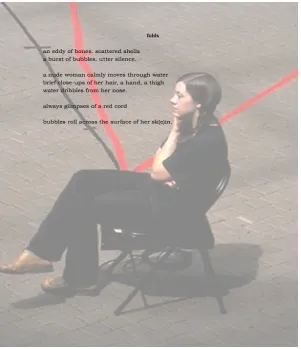
In her doctoral dissertation, Springgay (2001) used visual art, poetry, and
narrative to study and represent how youth generate understandings through touch in art
education. Not only does Springgay work through these mediums as she inquires, but she
uses multiple genres of representation to perform her understandings for the reader.
Throughout her dissertation, Springgay strategically embeds her art into the research
narrative. She explains,
The images that are threaded throughout these pages are not illustrations of the text. While some attempt has been made to include them in proximity to the sections in which they are addressed, they are also material embodied signifiers in their own right, performing additional and alternative narratives, maps, and body knowledge. They are living inquiry. (p. 21)
In this sense, the dissertation becomes a work of art within itself. Springgay’s careful
placement of text, page alignments, fonts, works of art, and images all work together to
create a reading experience that is in contrast to traditional notions of scholarly writing.
Springgay uses a variety of mediums and genres to interrupt, transform, and invite
a page from the dissertation. This photograph and poem appear unannounced between the
[image:37.612.109.410.128.477.2]introduction and first chapter, inviting the reader to enter into the a/r/tist’s experiences
Figure 1. Springgay Dissertation. This image is an excerpt from Stephanie Springgay’s dissertation.
with and understandings of touch as method of knowledge construction. Because I draw
upon autobiographical narrative and visual art in my study, I am most drawn to
Springgay’s (2001, 2008b) work because she uses each of these mediums.
Although a/r/tography encompasses many a/r/tistic mediums—performance,
dance, music, literary, and visual arts—my inquiry is grounded in visual art. Despite an a/
together” (Irwin & Springgay, 2008, p. xxvi), which allows a/r/tographers to take up
Eisner’s (2002) position that “work in the arts is not only a way of creating performances
and products; it is a way of creating our lives by expanding our consciousness, shaping
our dispositions, satisfying our quest for meaning, establishing contact with others, and
sharing a culture” (p. 3). Taking up a/r/tography’s methods and theories about
understanding the world through a/r/t-making practices, I ask my own questions about
writing and the role it plays my life. A/r/tography expands my consciousness, and
through this study I share my a/r/t with others in hopes that new ideas about writing
might be created to inform writing pedagogy. Now, I transition to a discussion about the
specific theoretical concepts that I drew upon to craft this a/r/tographic inquiry.
Crafting an A/r/tography
As I previously explained, the arts-based educational research field is made up of
an array of research purposes, theoretical frames, and methods. These purposes include
traditional qualitative research questions into the socialized experiences of specific
individuals and groups. Questions are often explored through familiar methods of data
collection and analysis, but researchers seeking to expand the research-reading audience
choose to represent their findings through expressive mediums including: visual art,
creative writing (i.e. narrative, fiction, poetry), drama, music, and dance (Barone, 2008;
Leavy, 2009; Seigusmund & Taylor, 2008). A/r/tography is an example of art-sbased
educationa research, but it poses deeply epistemological questions about how knowledge
is constructed through the processes of creating art. In other words, a/r/tography is
being made through the processes of representing and engaging in research as art.
Springgay (2008) explains, “a/r/tographical research as living inquiry constructs the very
materiality it attempts to represent” (p. 159). As an a/r/tographer, I sought to understand
postmodern picturebooks; therefore, I made a postmodern picturebook and studied that
experience. I study myself as practicing artist/researcher/teacher; thus, my acts of living
inquiry are “theoretical, practical and artful ways of creating meaning through recursive,
reflective, responsive yet resistant forms of engagement” (Irwin & Springgay, 2008, p.
xxix).
Metaphor as Conceptual Rendering
Throughout the inquiry process, I drew upon metaphor to render understandings
about the relationships between theoretical perspectives, the creative practices involved
in the writing of a postmodern picturebook, and writing theory. In a/r/tography,
metaphors serve as conceptual renderings for understanding inquiry experiences and are
artistic tools that a/r/tographers draw upon as they construct representations to share with
others (Irwin & Springgay, 2008). The process of crafting and selecting a conceptual
metaphor is important in a/r/tographic inquiry because whenever a metaphor is made,
“there is at once a loss of meaning, a realization of meaning, or neither” (Irwin &
Springgay, 2008, p. xxx).
Irwin and Springgay (2008) draw upon the work of Lakoff and Johnson
(1980/2003) to theorize about the possibilities of metaphor in how a/r/tists understand the
world. Lakoff and Johnson (1980/2003) define metaphor as “understanding and
conceptual system is largely metaphorical, [and] the way we think, what we experience,
and what we do every day is very much a matter of metaphor” (p. 3). Implying that the
human conceptual system is metaphorical leads to a type of understanding that is
grounded in making connections between, among, and across our experiences of things.
Therefore, “our concepts structure what we perceive, how we get around in the world,
and how we relate to other people” (Lakoff & Johnson, p. 3).
The role of metaphor in conceptual development entails that “metaphorical
structuring . . . is partial, not total. If it were total, one concept would actually be the
other, not merely understood in terms of it” (Lakoff & Johnson, 1980/2003, p. 12).
Hence, metaphors do not encapsulate all aspects of an object or experience; instead, they
highlight certain aspects and hide others. Therefore, it can be argued that the production
of alternative metaphors in response to “the taken for granted” metaphors accepted as
truths, creates possibilities for new understandings. “Thus they can give new meaning to
our pasts, to our daily activity, and to what we know and believe” (Lakoff & Johnson,
p. 139).
Through this study, I have come to understand writing as something messy,
incomplete, without beginning or end, but guided by multiple interpretive possibilities.
These understandings imply comparing the writing concept to something quite different
from the conventional metaphor of writing as a process. In Chapter 5, I return to Lakoff
and Johnson’s (1980/2003) theories to examine what the process metaphor implies about
what writing is and how writers do it, and to theorize about how new metaphors--like my
writing concept that have been excluded from mainstream understandings. Now, I
describe how a/r/tistic mediums (visual art and writing) allowed me to understand my
writing experiences through metaphor.
Making Art to Understand
Representation can be thought of, first, as aimed at transforming the contents of consciousness within the constraints and affordances of a material. Representation can and often does begin with an elusive and sometime evanescent idea or image. . . . Representation stabilizes the idea or image in a material and makes possible a dialogue with it. It is through “inscription” (I use the term metaphorically) that the image or idea is preserved--never, to be sure in the exact form in which it was originally experienced, but in a durable form . . . (Eisner, 2002, p. 6)
Elliot Eisner’s ideas about representation as a process of using materials to transform
ideas into expressions are central to arts-based inquiry. Arts-based educational
researchers recognize an a/r/tist’s inability to represent images or ideas through
“one-to-one correspondence between lives lived and lives represented” (Cole & Knowles, 2001,
pp. 212-213). Instead, a/r/tists “are the ‘instruments of understanding,’ [and their]
interpretations and eventual representations will reveal some of the ‘essential truths’ of a
person’s life” (Cole & Knowles, p. 212), and Eisner would add that the medium of
representation also mediates what is understood.
Cole and Knowles (2001) explain, the “development of an artful
representation . . . relies as much on the imagination of the researcher as it does on the
information gathered through inquiry” (p. 212). Thus, how I chose to represent
imaginatively my postmodern picturebook writing process affected how I interpreted the
imagination positions my data as materials that I transformed into media as I sought to
represent my understandings. Eisner (2002) poses that,
Materials become media when they mediate. What do they mediate? They mediate the aims and choices the individual makes. In this sense, to convert a material into a medium is an achievement. A material becomes a medium when it conveys what the artist or student intended or discovered and chose to leave. (p. 80)
Like the American pragmatist, John Dewey, Eisner recognizes “the medium is a mediator.
It is a go-between of artist and perceiver” (Dewey, 1934/1980, p. 200). Medium
structured the (re)presentations that my understandings took on, and it is the
“go-between” of myself and the reader. Now I describe how I used specific mediums--visual
art and expressive writing--to construct a working metaphor that represents my
experiences in writing a postmodern picturebook.
Visual Art
If all meanings could be adequately expressed by words, the arts of painting and music would not exist. There are values and meanings that can be expressed only by immediately visible and audible qualities, and to ask what they mean in the sense of something that can be put into words is to deny their distinctive existence. (Dewey, 1934/1980, p. 74)
In keeping with Dewey’s theory that there are particular meanings that can only
be represented in particular media, I position visual art as a medium that allows me to
express certain aspects of my understandings. I also acknowledge Eisner’s (2002)
position that a medium has consequences for what an artist understands because it
structures “which aspects of the world will be experienced” and “because people tend to
seek what they are able to represent . . . the tools [they] work with influence what [they]
constructed had a profound effect upon what I understand about writing a postmodern
picturebook.
In this inquiry, I represent through collage because I am confident in my ability to
work through this medium. Collage involves the cutting and pasting of multiple visual
mediums onto a single structure creating artwork that is whole but splintered.
Butler-Kisber (2008) argues that collage “can mediate understanding in new and interesting
ways for both the creator and the viewer because of its partial, embodied, multivocal, and
nonlinear representational potential” (p. 265). She also acknowledges that Pablo Picasso
and George Braque are most often recognized as the pioneers of collage, but paper
collage dates back at least 1000 years in the folk art tradition. Once photography became
a common practice, photographs appeared more frequently in collage work. In fact, the
Dadaists introduced the term “photomontage” to reference an art form in which images
were created from cut photographs and other printed materials (Butler-Kisber). Because
collage practices have varied across popular art movements, I clarify my approach to
collage as well as its interpretive possibilities within the context of this study.
As a young child, I was taught collage by my neighbor, a practicing collage artist
who had no children of her own and welcomed my childlike infatuation with visual art.
Ms. Mary (as I affectionately called her) invited me for tea, cookies, and collaging in her
studio of solid windows overlooking an endless pasture full of her husband’s prized
cattle. She made me an inspiration box, which she filled with various paper and tissues of
the most divine prints, hues, and textures. I watched as she demonstrated how she cut,
was some sort of cardboard, but looking back, it was likely something more like
masonite). She would spend days, weeks, sometimes months collecting and arranging
fragments on her boards before gluing. For myself--as both child and adult--I take a much
more compulsive approach, pulling out the glue much sooner, perfectly content to start
over if I must. Recently, I become more reluctant, resulting to tiny bits of tape loosely
adhered to each paper fragment; just enough to hold things in place but gentle enough to
allow movement and replacement. When I am content with the final image, I permanently
adhere the papers with Mod-Podge. I have no specific preference for work surfaces--I’ve
used cardstock, watercolor paper, canvas, metal, even stray scraps of cardboard.
In addition to technique, Ms. Mary also exposed me to a variety of materials. She
was quite the naturalist, so it was common for her to used pressed leaves and flowers;
odd rocks and sticks; even bleached animal bones and snake skins. She enjoyed doodling,
sketching, painting, and weaving and often incorporated pieces of each into her collages.
I doubt she threw anything away--instead, she meticulously cataloged stamps, magazines,
newspaper clippings, old calendars and other odd papers into her studio filing system.
Through my experiences with Ms. Mary, I have adopted my own approach--similar in
some ways, different in others--to working through collage. As I reflect on my collage
practices, I realize that as I acquire skills in new mediums, I incorporate them into my
work. For example, over the past year I have been experimenting with photography, even
taking a continuing education course at a local art college and my recent collage work has
included my photographs in various forms. Now I describe how I used writing to
Writing
As the painter places pigment upon the canvas, or imagines it placed there, his ideas and feelings are also ordered. As the writer composes in his medium of words what he wants to say, his idea takes on for himself perceptible form. (Dewey, 1934/1980, p. 75)
A/r/tographers value the multiple affordances of artistic mediums and articulate
that “to be engaged in a/r/tography means to inquire in the world through both [artistic
and writing] processes, noting they are not separate or illustrative processes but
interconnected processes” (Irwin & Springgay, 2008, p. xxviii). A/r/tography
distinguishes itself as an approach to arts-based inquiry that is concerned with what is
learned from the processes of creating art, the artworks themselves, along with writing
about what is learned through the making of art. Thus, an a/r/tographer’s attention is
drawn to “the relationship between art and graphy, that is, between the artform and
writing with, in or about the phenomenon” (Irwin & Springgay, 2008, p. xxviii).
Therefore, it was necessary for me to create art to understand my experiences in making a
postmodern picturebook, and this art includes both words and images.
A/r/tographers use writing in various ways; therefore, I articulate how I used
writing in this particular inquiry. The writing in this a/r/tography can best be described as
Laurel Richardson’s (1997) concept of a “writing story.” Writing stories seek to explain
how our works came to be, narrating “the goals and intentions of human actors; [making]
individuals, cultures, societies, and historical epochs comprehensible as wholes;
[humanizing] time; and [allowing] us to contemplate the effects of our actions and to alter
the directions of our lives” (Richardson, p. 27). I wrote “writing stories” about individual
meaning of each event is produced by its temporal position and its role in a
comprehensible whole” (p. 27) and these stories helped me understand the writing
experience in retrospect.
As I wrote the postmodern picturebook and wrote about this particular experience,
I drew upon what I knew about writing to understand how this knowledge related to what
I was understanding through this personal experience. I entered into this study as a
process pedagogue--a former elementary school teacher turned writing mentor to
preservice teachers--who practiced instruction from a process approach as I sought to
create writing workshops to allow my students to experience authentic writing processes.
I was influenced by all the great process theorists and subsequent practitioners who
translated these theories into practice: Caulkins (1994), Elbow (1973, 1981, 1986),
Fletcher and Portalupi (1998, 2001), Flower and Hayes (1981), Graves (1983, 1990),
Murray (1968, 1982, 1990, 1998), and Ray (1999, 2004). I understood the writing
process as series of recursive steps that can be described and modeled for students and
the writing workshop as a space where students can experience various aspects of this
process.
As I used a/r/tography to study my postmodern picturebook writing experience, I
began to question whether or not the term process created a metaphor for writing that
fully described what I was experiencing. I am still in agreement with Perl (1994) that
writing “is what each of us is engaged in when we shape our understanding of life” (p.
xx), and I recognize the work of sociocultural and critical literacy researchers, in