Parental Involvement And Their Relationship To Emotion Well-being Of Adolescent
Hamidah Sulaiman, Siti Hajar Halili &Nur Hasbuna Saleh Fakulti Pendidikan, Universiti Malaya
ABSTACT
The quality of parent - child relationship is often associated with children's behavior. Parenting style, family environment, education, morals and discipline an important factor in building a healthy adolescent personality and prosperous. This means that they are healthy mentally, physically and psychological.Level of parental involvement in the effort to build the success of my children understand the world as a teenager, is related to the emotional health and well-being of parents.Involvement either positively or negatively affect the award personal and social skills of adolescents. Parenting style of parents have a major impact on the development of children's. This article review researchrelated to adolescents' perceptions of parental involvement, the patenting style related to emotional well-being of adolescents, parentings style, research limitation and suggestions for futher research.
Keywords: parental styles; adolescent personality; emotional intelligence.
Introduction
Background of the Study
According to a study conducted by Baumrind (1971), there are three styles of parenting parents authoritarian, authoritative and permissive. The three styles of nursing is determined by two criteria: the warmth of support and acceptance of parents, and the level of parental control and demands on children (Mac coby & Martin, 1983). Itwas once shared by Bowlby (1973) in which the relationship between the parent-child provides a model of internal work to build relationships with others in the future. This relationship helps to maintain a set of rules to be emulated to build relationships with others. This example is based on the reaction pattern and responsive caregivers in childhood (Griffith, 2004).
Statement Of The Problem
parents affects the adolescent emotional well-being diabaikan.Perbezaan culture, upbringing style of parents practice and progress of society and the state to influence parents-son
relationship also makes the findings varied regarding the emotional well-being of youth. Previously, most research on emotional intelligence and how parental upbringing style regularly reviewed under a separate title (Alegre, 2012; Alegre &Benson, 2007; Berg, 2011; Scott-Ladd, &Chan, 2004; Smith, 2005, Spector, 2005; Wells, Torrie, &Prindle, 2000). This resulted in seemingly no correlation between emotional intelligence and how parents care style while studies have shown the involvement of parents in providing care to children with
emotional impact on the welfare of children. Thus emotional intelligence and how a proper upbringing parents studied together in order to see the relationship between both because developing emotional intelligence throughout the life of the parents involved in the process of formation secaralangsung and emotional development throughout human life. In other words, both of these factors are closely related to each other.
The Objective Of The Study
i. Investigate the relationship between emotional intelligence and upbringing style of parents of teenagers.
ii. Identifying the level of welfare of adolescent emotions parents directly involved in learning activities at school
Research Questions
1. What kind of nurturing style adopted by parents of teenagers as a whole?
2. Is there a relationship between emotional well-being of adolescents with parental upbringing style of those involved directly with learning activities in schools
Methodology
This study uses a design ex-post facto type of correlation. Design of ex-post facto type of correlation is often used to study the relationship between independent variables and the dependent variable.
Data analysis
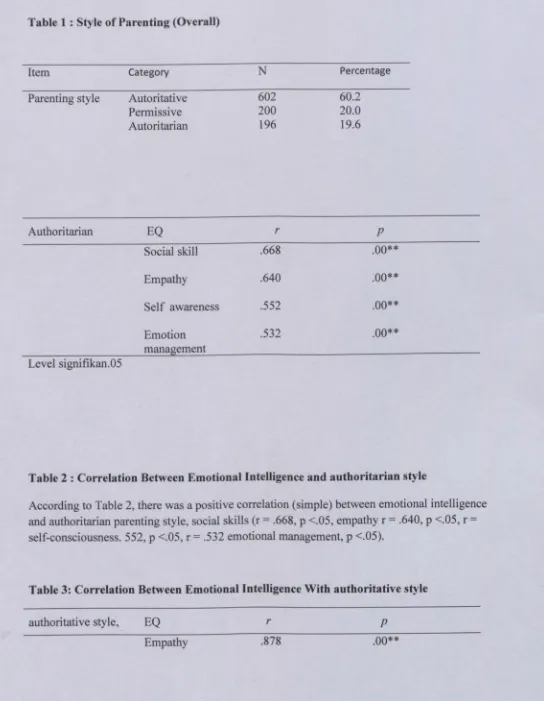
Table 1 : Style
of Parenting
(Overall)Item Category N Percentage
Parenting style Autoritative 602 60.2
Permissive 200 20.0
Autoritarian 196 19.6
Authoritarian EQ r p
Social skill .668 .00**
Empathy .640 .00**
Self awareness .552 .00**
Emotion .532 .00**
management Level signifikan.05
Table 2 : Correlation Between Emotional Intelligence and authoritarian style
According to Table 2, there was a positive correlation (simple) between emotional intelligence and authoritarian parenting style, social skills (r=.668, p <.05, empathy r =.640, p <.05, r=
self-consciousness. 552, p <.05, r=.532 emotional management, p <.05).
Table 3: Correlation Between Emotional Intelligence With authoritative style
authoritative style, EQ r p
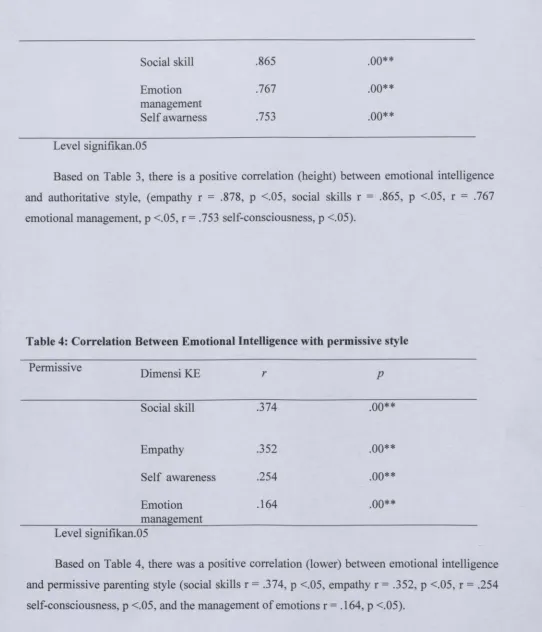
Social skill .865 .00** Emotion
management Self awarness
.767 .00**
.753 .00**
Level signifikan.05
[image:6.561.9.551.18.650.2]Based on Table 3, there is a positive correlation (height) between emotional intelligence and authoritative style, (empathy r = .878, p <.05, social skills r = .865, p <.05, r = .767 emotional management, p <.05, r=.753 self-consciousness, p <.05).
Table 4: Correlation Between Emotional Intelligence with permissive style Permissive
Dimensi KE r p
Social skill .374 .00**
Empathy .352 .00**
Self awareness .254 .00**
Emotion management
.164 .00**
Level signifikan.05
The findings show that there is a significant positive relationship between emotional
intelligence and emotional intelligence in all dimensions but different in terms of power relations
in the care of three styles adopted by parents of teenagers.
Pearson Correlation overall findings indicate that there is a high positive correlation between
emotional intelligence and authoritative parenting style. The dimensions of social skills showed
the highest positive correlation, followed by emotion management dimension, then the
dimension of self-consciousness and finally the dimension of empathy. For authoritarian
upbringing styles, the Pearson correlation test showed that there was a moderate positive
correlation between emotional intelligence and authoritarian parenting style. As for how
permissive parenting style, there is a weak positive relationship between emotional intelligence
and permissive parenting style.
Discussion and Recommendations
The development of biological, emotional, cognitive and social development experienced in
adolescence may be carrying a positive or negative impact on youth. This situation depends on
how the parents care is practiced in educating and bringing up teenagers. The situation in which
the three styles of parental care developed by Baumrind (1967, 1971, 1991) which is
authoritarian, authoritative and permissive. Two major dimensions that distinguish these three
styles of nursing degrees accountability are parents and parents demand (parental parental
responsiveness
and
demandingness).
Parental upbringing style of authoritarian parental attitude is reflected by the high demand but
low accountability. Parents put high expectations for children by practicing the approach control,
authoritative parents, parents are characterized as high and high accountability demands of
practice assertiveness balanced with a willingness to hear the views of children, tolerance,
solidarity, and participate fully in the process of helping and educating children. While the
permissive parenting style, parental attitude is characterized by accountability but low demand of
being too lenient, meet the children and treat children as individuals who are mature and can
decide yourself so there is no pressure, control or the rules on good behavior and not rigorously
prohibited.
How nurturing style adopted by parents of adolescents in this study to some extent affected
the level of emotional intelligence outfits. The findings of this study support the opinion
Santrock (2008) which says if a student switches from lower secondary school to upper
secondary education, the reduction of psychological well-being as a transition stage of life. At
the high school, hope the parents, the school and the families of adolescents is high on the side of
increasing responsibility. The same atmosphere felt by teenagers in this study because they are in
upper secondary level. The level of expectation of parents and the school so that they succeed
in
the Malaysian Certificate of Education is high. In addition to family duties at home and work
load at school becomes a pressure on young people in shaping self-image and their self-identity.
This will make teenagers worried and depressed if they do not get support and help from parents.
Teenagers need to be helped to realize and feel the freedom and responsibility they have. In
addition they need the awareness that they are responsible to lead ourselves and the capability to
address concerns that arise. The findings support the theory and model of emotional intelligence
Bar-On (1997). Theories and models are also in line with the opinion of Goleman (1995) in
disappointment, control impulses, not exaggerating pleasure, can set the mood and can not keep
the pressure load disable a person's ability to think and empathize. The concept and goals of this
theory is also fundamental to the concept and objective of enhancing emotional intelligence
programs in schools proposed by Gardner (2006), Goleman (2006) and Mayer, Salovey, and
Caruso (2008). They have suggested a program involving activities such as emotional
intelligence improves the efficiency of the management of emotions, empathy, responsibility,
conflict
resolution,
self-awareness,
communication
and
cooperation.
The findings of this study support the findings of previous studies (Alegre, 2010;
Alumran
&Punamaki, 2008; Baker
&Berenbaum, 2007; Baumrind, 1967; Cummings
&Davies,
1995; Greenberg, 2002; Kim, 2005; Simpson et al., 2007). Studies have shown that parental
upbringing style and parenting practices that were given to teach children different impact
depending on the two dimensions of parental behavior that is the first parent that is responsive,
friendly and full of love and affection and second, parents were disciplined in controlling
demand and control. This dimension depends on the expertise and maturity of parents formed the
behavior of children who are disciplined in accordance with what is stated by Pearson and Rao
(2003) in which children find in the nature of a democratic upbringing style has a high ability to
handle relations skills.
Inaddition, parents are skilled empathizing has to do with the practice of
child care that emphasizes understanding the feelings of others and respond positively.
The fmdings of this study have proven that emotional intelligence has a relationship
with the parents care and support statements made by Bar-On (2001) and Mayer, Salovey, and
has also been shared by Baumrind (1991) in which parents authoritative parenting style affects
children's development and Bowlby (1982), which asserts that emotional linkage between the
parent-child bond involves emotion and affect in particular the management of internal emotions
Self-control skills (Bowlby, 1988b). This is in line with the opinion of Mayer and Salovey
(1995), which affirmed that all psychological processes that impede the continuity of
information, is likely to reduce or degrading emotional intelligence. Thus, individuals who
escaped with their emotions showed the ability to focus and control the problem of low and
would
suffer
from
depression
(Baker
&Berenbaum,
2007).
The findings differ from studies conducted in the West where the only significant
authoritative style with emotional injury to a teenager. In this study, there is a positive
relationship despite moderate level and weak-style authoritarian and permissive parenting style.
This suggests an authoritarian and permissive parenting style is still accepted by society. This is
likely due to differences in culture than in the West. Thus these findings contradict the findings
of Western researchers where the authoritarian and permissive styles showed no significant
correlation with emotional intelligence (Baumrind, 1971; Carlo, McGinley, Heyes, Batenhorst,
& Wilkinson, 2007; Maccoby & Martin, 1983; Kaufmann et al., 2004). Their study also showed
that just
kind
of authoritative
parenting
style that
increases
children's
competence.
However, these findings are consistent with studies conducted in other cultures where an
authoritarian style of parenting and permissive parents still conducive and relevant to youth. For
example, there is a significant and positive relationship between the authoritarian parenting style
with adolescent behavior in a survey conducted by the Asia, Europe and the Arab States (Afriani
Rudy & Grusec, 2006). Thus, in deals with emotional intelligence and its relation to parental upbringing style, cross-cultural factors and parental involvement in learning activities in schools need to be addressed.
Conclusion
Since emotional intelligence has a very significant relationship with the parents, the care is appropriate when discussing the issue of emotional intelligence, the role of parents is also noteworthy. Even in the event that an authoritative parenting style is good practice parenting style and fit, then parents should make every effort to adapt its parents practiced by authoritative parents in their parenting style practices. The recommendation is in line with studies done on the relationship between emotional intelligence and parenting practices.
Reference
Aldea, M. A., & Rice, K. G. (2006). The role of emotional dysregulation in perfectionism and psychological distress. Journal of Counseling Psychology, 53, 498-510. Intelligence. Paper presented at the annual conference of the National Council of Family Research. Orlando FL.
Alegre, A., & Benson, M. (2004). The effects of parenting styles on children's emotional intelligence. Paper presented at the annual conference of the National Council of Family Research. Orlando FL.
Alegre, A., &Benson, M. (2007). Parental acceptance and late adolescents' adjustment: The role of emotional intelligence. In E. Fatos (Ed.), Acceptance: The essence of peace. (Selected Papers from the First International Congress on Interpersonal Acceptance and Rejection, pp. 33-49). Istanbul, Turkey: Turkish Psychology Association, Incekara Press.
Alumran, Jihan 1.A., &Punamaki, Raija-Leena. (2008, Jun). Relationship between gender, age, academic achievement, Emotional Intelligence and coping styles in Bahraini adolescents.
Individual Differences Research, 6(2), pp. 104-119.
Ainsworth, M. S. (1989). Attachments beyond infancy. American Psychologist, 44, 709-716. Baker, J. P., & Berenbaum, H. (2007). Emotional approach and problem-focused coping: A
comparison of potentially adaptive strategies. Cognition and Emotion, 21, 95-118.
Bar-On, R. (2001). Emotional intelligence and self-actualization. DIm. J. Ciarrochi, J. P. Forgas, & J. D. Mayer (Eds.), Emotional intelligence in everyday life: A scientific inquiry (hh. 82-97). New York, NY: Psychology Press.
Baumrind, D. (1971). Current patterns of parental authority. Developmental Psychology Monograph,4, 1-103.
Berg, Brook. (2011). The Effects of parenting Styles on a preschool Aged child's Social Emotional Development (6th ed.). American Psychological Association,
Bowlby, J. (1980). Attachment and loss. (Vol. 3): Loss. New York, NY: Basic Books.
Bowlby, J. (1982). Attachment and loss: Vol. 1. Attachment (2nd ed.). New York, NY: Basic Books.
Bowlby, J. (1988). A secure base: Parent-child attachment and healthy human development.
New York, NY: Basic Books.
Collins, N. L., &Read, S. J. (1990). Adult attachment, working models, and relationship quality in dating couples. Journal of Personality and Social Psychology, 58, 644-663.
Cummings, E. M., & Davies P. T. (1995). The impact of parents on their children: Anemotional security perspective. Annals of child development: A research annual, 10, 167-208.
London, UK: Jessica Kingsley.
DeHart, T., Pelham, B. W., & Tennen, H. (2006). What lies beneath: Parenting styles and implicit self-esteem. Journal of Experimental Social Psychology, 42(1), 1-17, doi:l0.l016/j.jesp.2004.12.005
Driscoll, Lucy C. (2013). Parenting Styles and Self Esteem. Scripps Senior Theses, p. 155. http://scholarship.claremont.edulscripps theses/155
Gallagher, E. N.,
&Vella-Brodrick, D.A. (2008). Social support and emotional intelligence as
predictors of subjective well-being.
Personality and Individual Differences,
44,
1551-1561.
Griffith, B. A. (2004). The structure and development of internal working models:
Anintegrated
framework for understanding clients and promoting wellness.
Journal of Humanistic
Counseling, Education, and Development,
43, 163-177.
Greenberg,
L.(2002).
Emotion-focused therapy.
Washington, DC: American Psychological
Association.
Hamidah Sulaiman, Siti Salina Abdullah,
&Farrah Dina Yusop. (2005). Kompetensi kaunselor
di dalam perhubungan
menolong.
Prosiding Persidangan Kaunseling Kebangsaan
2005.
Hotel Merdeka Palace, Kuching, Sarawak. 28-30 September.
Hazan, C.,
&Shaver, P. (1987). Romantic love conceptualized as an attachment process.
Journal
of Personality and Social Psychology,
52, 511-524.
Heer, P. A. (2008). The relationship between college students' retrospective accounts of
parenting styles and self-reported adult attachment styles.
Dissertation Abstracts
International, 69.
Heppner, P. P., Cook, S. W., Wright, D. M., & Johnson, C. (1995).
Progress in resolving
problems: A problem-focused style of coping.
Journal of Counseling Psychology, 42,
279-293.
Hosogi, M., Okada, A., Fuji, C., Noguchi,
K., &Watanabe, K., (2012). Importance and
usefulness
of
evaluating
self-esteem
in
children.
Biopsychosocial
Medicine,
6doi: 10.1186/1751-0759-6-9
Jeynes, W. H. (2007). The relationship between parental involvement and urban secondary
school student academic achievement: A meta-analysis.
Urban Education, 42,82-110.
Kim, Y. (2005). Emotional and cognitive consequence of adult attachment: The mediating
effects of the self.
Personality and Individual Differences,
39(5), 913-923.
LeFebvre, Joan E. (1999).
Parenting Styles. Positive Parenting of Teens.
Minnesota Extension
Service and University of Wisconsin Extension.
Maccoby, E. E.,
&Martin, J. A. (1983). Socialization in the context of the
family:Parent-child interaction. In P. H. Mussen
(Ed.) & E. M. Hetherington (Vol. Ed.),
Handbook of childpsychology: Vol. 4. Mahwah, NJ:Erlbaum
Mayer, J. D., Salovey, P. & Caruso, D.
R
(2008). Emotional Intelligence: New ability or eclectic traits. American Psychologist, 63(6), 503-517.McCarthy, C. J., Moller, N. P., & Fouladi,
R
T. (2001). Contineud attachment to parents: Its relationship to affect regulation and perceived stress among college students.Measurement and Evaluation in Counseling and Development, 33, 198-213.
Mikulincer, M. (2004). Attachment working models and the sense of trust: An exploration on interaction goals and affect regulation.
In
H. T. Reis & C. E. Rusbult (Eds.), Close relationships: Key readings. (pp.175-191), Philadelphia, PA: Taylor & Francis.Papalia, D. E., Olds, S. W., & Feldman, R. D. (2002). A child's world: Infancy through adolescence (9th ed.). New York, NY: McGraw-Hill.
Pomerantz, E. M.,Grolinck, W. S., & Price, C. E. (2005). The Role of parents in how children approach achievement. N ew York, NY: Guilford Press.
Santrock, J. W. (2004). Life-span development (9th ed.). New York, NY: McGraw-Hill.
Scott-Ladd, B., & Chan, C. C. A. (2004). Emotional intelligence and participation in decision-making: Strategies for promoting organizational learning and change.
Strategic Change, 13, 95-105.
Searle, B., & Meara, N. M. (1999). Affective dimensions of attachment styles: Exploring self-reported attachment style, gender, and emotional experience among college students.
Journal of Counseling Psychology, 46, 147-158.
Shaffer, D. R,& Kipp, K.(2010). Developmental Psychology: Childhood and adolescence (8th ed.). Belmont, CA: Wadsworth.
Shaver, P.
R,
Collins, N., & Clark, C. L. (1996). Attachment styles and interval working models of self and relationship partners.In
G. O. Fletcher, & J. Fitness (Eds.), Knowledge structures in close relationships: A social psychological approach (pp. 25-61). Hillsdale, NJ: Erlbaum.Siegler, R., DeLoache, J., & Eisenberg, N. (2006). An introduction to child development. New York, NY: Worth.
Simpson, J. A., Collins, A., Tran, S., & Haydon, K. C. (2007). Attachment and the experience and expression of emotions in romantic relationships: A developmental perspective.
Smith, G. T. (2005). On construct validity: Issues of method and measurement, Psychological Assessment, 17, 396-408.
Spector, P. E. (2005). Examining emotional intelligence and leadership. Dissertation Abstracts International, 66(11), 6323B. (UMI No. 3197949)
Vacek, K., Coyle, L., &Vera, E. (2010). Self-esteem, hope, optimism, stress and subjective well-being in urban ethnic minority adolescents. Journal of Multicultural Counseling and Development,
38,
99-111.HAMIDAH BINTI SULAIMA
FAKULTY EDUCATION,
IV
SITY
F MA AYA
Parental Involvement And
Their Relationship
To
Emotion Well-being Of
Adolescent
,