A Trust-Based Reputation Management System
A thesis submitted to the
University of Dublin, Trinity College,
in fulfilment of the requirements for the degree of
Doctor of Philosophy (Computer Science).
Elizabeth L. Gray
Distributed Systems Group,
Department of Computer Science,
Trinity College, University of Dublin
D
ECLARATIONI, the undersigned, declare that this work has not previously been submitted as an exercise for a degree at this or any other University, and that, unless otherwise stated, it is entirely my own work.
________________________________ Elizabeth L. Gray,
P
ERMISSION TOL
END AND/
ORC
OPYI, the undersigned, agree that the Trinity College Library may lend and/or copy this thesis upon request.
________________________________ Elizabeth L. Gray,
A
CKNOWLEDGEMENTSSunset is an angel weeping, holding out a bloody sword. No matter how I squint I cannot make out what it's pointing toward…
Sometimes the best map will not guide you, you can't see what's round the bend. Sometimes the road leads through dark places, sometimes the darkness is your friend. Today these eyes scan bleached-out land, for the coming of the outbound stage, pacing the cage.
~ Jimmy Buffett
Many times over the past several years, I caught myself ‘pacing the cage’, wondering where the research path would lead. During that time, many people proffered support and guidance, and they deserve so much recognition and thanks.
First, and foremost, I would like to thank my supervisor, Prof. Vinny Cahill, who provided an excellent map to guide me, both in terms of research and in terms of life, as well as so many words of encouragement, faith, kindness, and patience when I could not see what was ‘round the bend’. Thanks also to the members of various research groups for providing opportunities to collaborate and learn. In particular, special thanks to Christian Jensen for bringing me into the SECURE consortium. I am also so very appreciative of the members of the DSG research group, especially Stefan Weber, Anthony Harrington, Peter Barron, Yong Chen, Barbara Hughes, Ray Cunningham, Cormac Driver, Gregor Gaertner, John Keeney, René Meier, Andronikos Nedos, Jean-Marc Seigneur, and Kulpreet Singh. Much appreciation is also due Alan Mullally and Denise Leahy, of the Dept. of Information Systems, for creating an environment in which I could teach and learn. Thanks also to Yong Wang of the Beijing Institute of Technology. Furthermore, to Audun Jøsang of the Queensland University of Technology, thank you for sharing your vast experience in the field of reputation management. Thank you to the many friends who provided advice, support, caring, and willingness to listen to ramblings about trust-based decision-making models. Above all, this one’s for the girls: Treasa Ní Mhíocaín, Judith Murphy, Keelin Murphy, Elizabeth Daly, and Ivana Dusparic. Each of you is a guardian angel, and even when we lost the map entirely, somehow you managed to make sure I got to the end of the journey in one piece and with so many incredible memories. Also, Geraldine McNamara and Piers Gardiner, thank you for continually opening your hearts and home to me. Gratitude and appreciation especially to Niall Rea, who stayed fast during the lowest points, pacing with me, step by step, always shining a light around corners and bringing tranquillity.
Trust one who has gone through it.
S
UMMARYSince its inception in the early 1990s, e-commerce in consumer-to-consumer (C2C) markets has achieved great success, with significant projected growth. For example, the Internet auction provider, eBay, has established itself as the largest global player in this market, with $34.2 billion worth of merchandise being auctioned in 2004 and 135 million registered users in 32 markets worldwide. The C2C domain, analogous to its conventional physical marketplace equivalent, is built on trust. Buyers send payments to complete strangers from whom they have purchased goods and trust that the goods will be sent in return. Sellers trust buyers to make good on their payments. All users risk loss, both financial and of their time. Users establish reputations about their trustworthiness through an integrated feedback collection and distribution system, i.e., a reputation management system. Thus, an online marketplace approximates its traditional predecessors as a system in which the human concepts of trust, risk, and reputation are critical to performance.
The apparent benefits of interacting in such a strongly-networked global market are accompanied by innovative adaptations of traditional hazards. The Internet, while connecting disparate user groups to increase transaction potential and shared knowledge about the marketplace, also permits user anonymity and transactional intangibility, which can lead to fraud, theft, and collusion. Reputation management systems attempt to limit incorrect behaviour and to assist decision making by providing records of feedback about interactions, called recommendations, for each community participant. These systems are not without their own limitations. First, commercial reputation management systems typically promote usability over accurate evidentiary analysis, meaning that data which could be extremely useful to decision-making is disregarded by the evidence collection mechanism so that ease-of-use is maintained for community members when they are voluntarily providing feedback. This first issue leads directly to the second, which is inaccurate evidentiary analysis with regard to contextual relevance in terms of user role, timeliness of evidence, and environmental context. In this regard, trustworthiness is usually linked solely to the overall number of positive recommendations about a user, regardless of the interaction context being considered. Third, the dynamics of user interactions are not addressed, and interaction dynamics in such an evidence-rich environment are difficult, if not impossible, for an average user to manually detect. Without the ability to analyse interaction dynamics, the fourth and fifth issues arise, namely that the analysis of whether or not a user provides useful and accurate recommendations about another user or whether or not a group of users are colluding with malicious intent are both difficult to observe. Sixth, risk is not explicitly calculated by the reputation system, and may not be assessed by the user at all. Seventh, and finally, a reputation is often no more than an overall summary of a collection of thousands of individual recommendations rather than an explicit portrayal of the trust and risk involved in a context-specific interaction.
but with enhanced collection and analysis of evidence with regard to domain-specific behaviour. Furthermore, the system provides increased accuracy of evidentiary analysis with regard to context by assessing evidence in terms of role, timeliness, and environment. Interaction dynamics are also considered in the system’s decision-making process, thus providing for the ability to limit exposure to risk from unreliable recommendations as well as the ability to assess the likelihood of colluding behaviour. The risk of an interaction resulting in malicious behaviour is explicitly analysed and stated to the user. Finally, the reputation summary is replaced by the explicit assessment of the trust and risk involved in interacting with another user, providing a security decision as advice to a user on whether or not to engage in an interaction.
The RMS builds on the work of the SECURE (Secure Environments for Collaboration among Ubiquitous Roaming Entities) project. Grounded on a formal model, the SECURE trust-based decision-making framework applies trust and risk to evidence in a manner comparable to the human decision-making process. We use the SECURE model as a basis with which to design our own application-specific mechanisms for reputation management in Internet auctions, and these mechanisms provide for the observation of domain-specific behaviour such as fraud and theft, assessment of contextual relevance, and analysis of risk in financial terms that is made explicit to the end user. Additionally, in the reputation management for Internet auctions application domain, SECURE is deficient in analysing the dynamic aspects of marketplace networks, and therefore we design additional techniques for interaction management. These techniques underlie an extension to the SECURE framework that includes methods for the weighting of recommendations based on the application of recommendation weighting policy to trustworthy recommendation paths within the graph of marketplace participants; and the identification of colluding behaviour between users within the marketplace community, by assessing interaction dynamics between users over time.
T
ABLE OFC
ONTENTSDECLARATION...II
PERMISSION TO LEND AND/OR COPY... III
ACKNOWLEDGEMENTS... IV
SUMMARY ...VII
TABLE OF CONTENTS... IX
LIST OF FIGURES ...XII
LIST OF TABLES ... XIV
CHAPTER 1: INTRODUCTION...1
1.1 Reputation Management ...2
1.2 Issues with Reputation Management Systems...2
1.3 Aims and Objectives ...4
1.4 SECURE ...4
1.5 Contribution of this Thesis ...5
1.6 Organisation of this Thesis...6
CHAPTER 2: TRUST AND REPUTATION MANAGEMENT IN COMPUTER SYSTEMS ..7
2.1 Trust ...7
2.1.1 Defining Trust...8
2.1.2 A Summary of Trust Definitions ...13
2.1.3 Properties of Trust ...14
2.1.4 A Summary of Trust Properties ...29
2.1.5 Model of Trust ...29
2.2 Trust Models in Computer Security ...35
2.2.1 Formal Logics and Trust Models for Authentication...35
2.2.2 Trust Management Systems ...38
2.2.3 A Summary of Trust in Formal Logics and Trust Management Systems...42
2.3 Human Trust Models...42
2.3.1 Jøsang’s Trust Model...43
2.3.2 Marsh’s Trust Model ...44
2.3.3 Abdul-Rahman & Hailes’ Trust Model ...46
2.3.4 Secure Environments for Collaboration among Ubiquitous Roaming Entities...47
2.3.5 A Summary of Human Trust Models...50
2.4 Trust and Reputation ...50
2.4.1 Defining Reputation...51
2.4.3 Reputation Management ...58
2.4.4 A Summary of Academic Reputation Systems ...69
2.4.5 Outstanding Issues with Reputation Management Systems...69
2.5 Chapter Summary...70
CHAPTER 3: DESIGN OF THE REPUTATION MANAGEMENT SYSTEM...72
3.1 The SECURE Approach...74
3.1.1 Threat Taxonomy...74
3.1.2 The SECURE Trust Model ...76
3.1.3 The SECURE Collaboration Model...81
3.1.4 The SECURE Risk Model ...84
3.1.5 The SECURE Framework Components ...87
3.1.6 The SECURE Decision-Making Process ...88
3.1.7 The SECURE Kernel and API ...89
3.2 SECURE for Spam Filtering ...91
3.2.1 Trust ...91
3.2.2 Collaboration ...92
3.2.3 Risk ...93
3.2.4 Decision-Making ...94
3.2.5 Implementation and Evaluation ...95
3.3 Reputation Management in Internet Auctions...97
3.3.1 Internet Auctions...98
3.3.2 Reputation Management in Internet Auctions ...100
3.3.3 Domain-Specific Behaviour Taxonomy ...102
3.4 SECURE for Reputation Management in Internet Auctions ...106
3.4.1 Design Overview ...106
3.4.2 Requests ...107
3.4.3 Entity Recognition ...110
3.4.4 Event Structures ...110
3.4.5 Evidence ...118
3.4.6 The Evidence Gathering Process ...118
3.4.7 The eff Function ...120
3.4.8 The eval Function ...121
3.4.9 Risk Assessment ...123
3.4.10 Access Control...126
3.4.11 Conclusions...126
3.5 Extending the SECURE Model with Interaction Dynamics...127
3.5.1 Recommendation Weighting ...127
3.5.2 Collusion Detection ...132
3.5.3 Extending the SECURE Framework for Interaction Management ...137
3.5.4 Decision-Making in the Reputation Management System (RMS)...138
3.7 Chapter Summary...143
CHAPTER 4: EVALUATION ...144
4.1 Evaluation Plan ...144
4.1.1 Domain-Specific Evidence Collection and Analysis ...144
4.1.2 Context-Specific evidence Collection and Analysis ...145
4.1.3 Time-Specific Evidence Collection and Analysis...145
4.1.4 Limiting Exposure to Risk of Unreliable Evidence ...146
4.1.5 Colluding Behaviour Evidence Collection and Analysis ...146
4.1.6 Making Risk Explicit ...146
4.1.7 Advice Provision...147
4.1.8 Trust-Based Decision-Making ...147
4.1.9 Evaluation Methods ...148
4.2 Simulations...148
4.2.1 TNG Simulation Environment ...148
4.2.2 TNG Parameters ...149
4.2.3 Domain-Specific Evidence Collection and Analysis ...152
4.2.4 Context-Specific Evidence Collection and Analysis ...158
4.2.5 Time-Specific Evidence Collection and Analysis...164
4.2.6 Limiting Exposure to Risk of Unreliable Evidence ...169
4.2.7 A Summary of the Simulation Experiments and Results ...177
4.3 Case Study: Evaluation of the Collusion Detection Mechanism...179
4.4 Qualitative Analysis ...182
4.4.1 Making Risk Explicit ...183
4.4.2 Advice Provision...183
4.4.3 Trust-Based Decision Making ...183
4.5 Chapter Summary...185
CHAPTER 5: CONCLUSIONS AND FUTURE WORK ...186
5.1 Contributions...186
5.2 Open Research Issues...190
5.3 Conclusion...191
L
IST OFF
IGURESFigure 1: Diversity dimensions of trust ...15
Figure 2: Pay-off matrix for the Prisoner’s Dilemma...17
Figure 3: Trust transitivity leading to an unknown trust purpose...20
Figure 4: Trust transitivity leading to a known trust purpose...21
Figure 5: Parallel combination of recommendations to derive indirect functional trust ...21
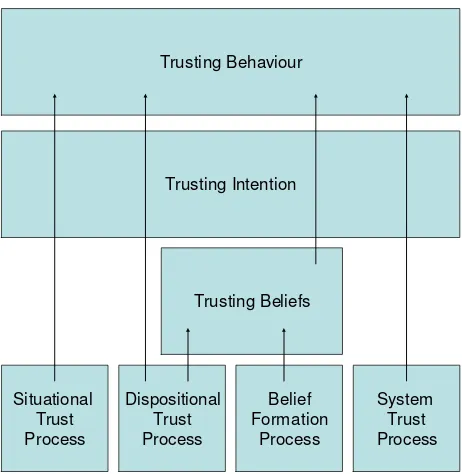
Figure 6: McKnight and Chervany model of trust ...31
Figure 7: Hierarchical trust model for certificate validation ...37
Figure 8: Abdul-Rahman Hailes trust model...47
Figure 9: SECURE trust model...48
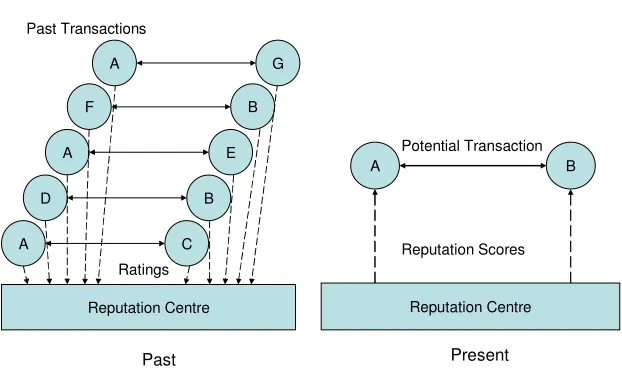
Figure 10: Evidence collection and distribution in a centralised reputation system...55
Figure 11: Evidence collection and distribution in a distributed reputation system...56
Figure 12: ESe-cash event structure for a simple e-cash scenario ...77
Figure 13: e cash ES
C
− Event configurations for a simple e-cash scenario...78Figure 14: SECURE evidence architecture ...82
Figure 15: SECURE framework...87
Figure 16: SECURE kernel and its configurable and pluggable modules...90
Figure 17: ESspam-filter...91
Figure 18: spam filter ES
C
− ...92Figure 19: SECURE spam filter...95
Figure 20: The SECURE evaluation framework configuration ...96
Figure 21: Behaviour types in virtual marketplaces with reputation management ...102
Figure 22: SECURE enhanced reputation management for Internet auctions ...106
Figure 23: Bid request ...109
Figure 24: Sale request...109
Figure 25: ESEmodelling feedback events in the eBay auction reputation system...111
Figure 26: ESA modelling feedback in the Amazon auction reputation system...111
Figure 27: ESY modelling feedback events in the Yahoo! auction reputation system ...111
Figure 28: ESB modelling feedback events in the BizRate merchant rating reputation system...111
Figure 29: ESRS modelling observations about a seller by a buyer...115
Figure 30: ESRB modelling observations about a buyer by a seller...115
Figure 31: RS ES
C
modelling the possible configurations observable by a buyer about a seller ...116Figure 32: RB ES
C
modelling the possible configurations observable by a seller about a buyer ...117Figure 33: Risk decision tree...125
Figure 34: Recommendation paths annotated with trust values ...130
Figure 36:
BS
ES
C modelling auction-duration event configurations ...135
Figure 37: The SECURE framework, extended for interaction management ...137
Figure 38: Bid request ...138
Figure 39: Sale request...140
Figure 40: Experiment 1.1 consistent behaviour ...154
Figure 41: Experiment 1.1 (initial 50 interactions) consistent behaviour...155
Figure 42: Experiment 1.2 oscillating behaviour ...157
Figure 43: Experiment 2.1 behaviour in two environmental contexts...160
Figure 44: Experiment 2.2 behaviour in four environmental contexts ...162
Figure 45: Experiment 3.1 consistent behaviour with time-fading ...166
Figure 46: Experiment 3.2 oscillating behaviour with time-fading...168
Figure 47: Experiment 4.1 varying recommendation weighting policy and path length...170
Figure 48: Experiment 4.2.1 10% unreliable recommendations ...172
Figure 49: Experiment 4.2.2 25% unreliable recommendations ...174
L
IST OFT
ABLESTable 1: Uncertainty in the Abdul-Rahman-Hailes trust model...27
Table 2: Threats in the global computing environment...74
Table 3: Behaviour types in virtual marketplaces with reputation management...103
Chapter 1:
Introduction
The way to gain a good reputation is to endeavour to be what you desire to appear.
~ Socrates
It is estimated that in the next five years e-commerce will be marked by innovations that will make online shopping easier and more engaging, thus boosting U.S. online retail sales from $172 billion in 2005 to $329 billion in 2010 (Forrester Research 2005). Within the e-commerce domain, consumer-to-consumer (C2C) offerings have achieved great success, as evidenced by the virtual marketplace eBay Inc.’s capture of 24% of all e-commerce in the U.S. in 2004, up from 16% in 2000 (eBay Inc. 2005).
The reasons for the growth of the virtual marketplace are manifold. Users easily make the paradigm shift from physical to virtual marketplace notions, where a C2C application functions as the digital equivalent of a traditional marketplace through which community members may offer goods and services for sale or auction and browse through and purchase available goods and services through a web interface. Other benefits of moving these processes online include increased trading potential amongst a much larger consumer base than exists in traditional marketplaces, which are bound by geographic and temporal constraints, and a highly networked environment in which information about product offerings and community members can be more efficiently shared.
In a 2005 survey of Internet users, however, 42% said concerns about online attacks have affected their online shopping behaviour, leading them to be more cautious about where they shop online and to buy fewer items than they normally would (Perez 2005). Moreover, the results of a recent fraud survey carried out by CyberSource Corp. estimate e-commerce fraud losses at having increased to more than $2.8 billion for 2005, an 8% increase over the year before, and the survey notes that ‘merchants used to be able to just throw people at this problem. But there’s an inherent limitation to that solution. What merchants need today is greater efficiency, greater intelligence, even technology breakthroughs. The bad guys have put the larger merchants in a challenging situation’ (CyberSource Corporation 2005).
return. Sellers trust buyers to make good on their payments. All users risk loss, both financial and of their time, e.g., products may be misrepresented more easily in an online environment, users may collude to defraud other community members, and payments and shipments between strangers may result in increased theft (Anderson 2005). Thus, a virtual marketplace approximates its traditional predecessors as a system in which the human notions of trust and risk in decision-making are critical to continued performance in the face of domain-specific threats.
1.1
Reputation Management
Determining whom to trust in a virtual marketplace is therefore a core issue, and users must calculate, either consciously or sub-consciously, the trustworthiness of a buyer or seller as well as the overall risk of participating in a transaction. In order to foster trustworthy behaviour and to help users make decisions about interacting with others, most virtual marketplaces incorporate some form of reputation management. Reputation management systems are proposed as a method to ensure trustworthy interactions and decreased risk in this domain, where users’ reputations are formed as recommendations about them accrue from gathered historical interaction data, e.g., a reputation for consistently providing high quality goods or a reputation for not always paying on time. After each interaction, a user may evaluate the outcome of an interaction by leaving feedback, i.e., a recommendation, about one’s interaction partner. The C2C application’s reputation management system thus serves as a central repository of historical interaction and reputation evidence which can be used by members to make decisions about the trustworthiness and risk involved in future transactions. In this way, reputation management systems attempt to limit exposure to threats by recording and publicising each user’s reputed behaviour, whether correct or incorrect.
1.2
Issues with Reputation Management Systems
together with a short qualitative statement, after completing transactions, suggesting that the eBay feedback model is simple and usable enough for members to operate. While maintaining usability, however, it is at the cost of not gathering observed and recommended evidence that might more accurately demonstrate relevant patterns of user behaviour.
The first issue leads directly to the second, i.e., inaccurate evidentiary analysis with regard to contextual relevance. Although in a C2C reputation management system it is possible to record much information about an interaction in addition to whether or not the outcome was simply positive or negative, e.g., the date and time a transaction took place, the roles of the users in a transaction, the details of the product or service being exchanged, etc., this context information is typically disregarded in the evidence evaluation process. In the absence of contextual relevance being incorporated into a system’s reputation evaluation process, a user must base a decision about a potential interaction upon evidence ranging from no information about another user to incalculable amounts of information that cannot be manually assessed. In this regard, trustworthiness is linked solely to the overall number of positive recommendations about a user, regardless of information that is more contextually relevant to a decision at hand.
In the C2C domain, it is also possible to observe information about relationships between sets of users, i.e., the dynamics of their interactions, such as whether or not a user provides useful and accurate recommendations about another user or whether or not a user employs a specific interaction strategy, such as collusion with malicious intent, when interacting with another user. As in the case of determining which information is more contextually relevant to a decision at hand, it is impossible for a user to manually assess an overwhelming number of system observations about interaction dynamics to determine which information is relevant when considering whether or not to interact with a given set of users.
Furthermore, risk is not explicitly calculated by these reputation systems, and may not be assessed by the user at all. In the C2C domain, risk is largely attached to the value of an item or service being sold or purchased, and the risk is highly variable. For example, in the eBay marketplace, the value of products offered for sale ranges from the nearly insignificant, e.g., a pair of sunglasses being sold for one cent, through many value ranges to very high value-based risk, e.g., the Gulfstream II jet sold for $4.9 million. In this environment, risk factors that should be explicitly analysed when making a decision include, but are not limited to, the rate of virtual marketplace fraud, the risk attached to interacting with a particular user based on a user’s direct and indirect experiences of interacting with that particular entity, the value of the transaction being considered, and the context in which the potential interaction is taking place.
interaction dynamics, and risk of interacting with another user or set of users in a particular transaction.
Many of the above issues arise from the current state of practice in commercial reputation management, and some methods proposed in academic research can be applied to resolve the concerns. These methods are discussed in Chapter 2. None of the reputation management systems proposed in academia, however, provides a cohesive model that unifies potential solutions to each of the issues noted above.
1.3
Aims and Objectives
The general objective of this thesis is the design of a reputation management system for virtual marketplace applications, particularly those that provide Internet auction services. The reputation management system should reduce complexity, increase accuracy, and yet maintain usability for a user wishing to determine whether or not to participate in a new interaction. Specifically, this thesis describes a reputation management system that addresses each of the issues highlighted above, i.e., maintaining the usability of evidence collection while increasing accuracy with regard to collecting evidence necessary to identify domain-specific behaviour types, and thus to limit the risk of exposure to untrustworthy entities; increasing the accuracy of evidentiary analysis with regard to contextual relevance; providing the ability to limit exposure to risk of unreliable recommended evidence; providing the ability to observe behaviour based on the assessment of interaction dynamics, and thus to limit the exposure to risk from colluding users; making risk explicit to the decision-maker; and, finally, providing advice to a decision-maker as to how to interact.
1.4
SECURE
collection mechanisms are provided. Moreover, evidence collection can be tailored to extract information that is most suitable to a particular domain, and thus gathered evidence can be used to identify domain-specific threats. Second, evidentiary analysis according to contextual relevance may be incorporated while maintaining usability. Third, risk assessment is made explicit in the SECURE decision-making framework, and both actor- and context- specific risk is addressed. Finally, SECURE provides a security, or access control, decision as the output of the decision-making process. In place of a general reputation summary, this decision can be used as advice regarding how to proceed by a user as it is based on more accurate evidence that is relevant to a decision at hand in terms of trustworthiness, context, and risk.
However, SECURE provides no viable means for assessing interaction dynamics such as recommendation integrity and user group interaction profiles. Thus, the SECURE model is a good tool for assessing user-centric behaviour in terms of trust and risk, but provides no methods for capturing and analyzing the dynamic behaviour of interactions between users. In this regard, this thesis proposes an extension to the SECURE framework whereby the dynamic nature of interaction relationships is observed and assessed with the aim of better evaluating the likely outcomes of participating in a given interaction within a given user group. These techniques underlie an extension to the SECURE framework that includes methods for the weighting of recommendations based on the application of recommendation weighting policy to trustworthy recommendation paths within the graph linking marketplace participants; and the identification of anomalous user behaviour, e.g., potential colluding users by analysing evidence about user group interactions over time.
1.5
Contribution of this Thesis
Our evaluation of the RMS shows that it reduces complexity, increases accuracy, and maintains usability of reputation management for Internet auction users. It validates that the RMS, in its observation and identification of normal and abnormal domain-specific behaviour, reduces complexity by providing accurate decision-making advice to users. Furthermore, the evaluation confirms that the analysis of context in terms of role, time, and environmental factors can further reduce complexity in the decision-making process while maintaining usability. Additionally, the evaluation demonstrates that recommendation weighting can protect a user against the potential unreliability of recommended evidence. Finally, the evaluation establishes that a reputation management system based on a computational trust-based decision-making model can counter the issues in existing commercial reputation management systems and provide increased benefit to users interacting in the Internet auction domain.
1.6
Organisation of this Thesis
Chapter 2:
Trust and Reputation Management in
Computer Systems
Every kind of peaceful cooperation among men is primarily based on mutual trust and only secondarily on institutions such as courts of justice and police.
~ Albert Einstein
In order to design decision-making tools, such as reputation management systems for virtual marketplaces, it is essential to understand the key features of the human decision-making processes of determining trustworthiness, assessing risk, and analysing social features of interaction groups. It is also necessary to understand what kind of evidence these processes require, how to collect that evidence, and how to determine evidentiary relevance for the types of decisions that need to be made. This chapter addresses current research into modelling and adapting traditional human decision-making processes based on trust and reputation for online interaction environments. Section 2.1 discusses various aspects of human trust, such that trust attributes and properties can be extracted and synthesised into a unified trust model. Section 2.2 presents recent research in formulating computational trust models in the computer security domain and examines whether any of these models capture the key trust characteristics. Section 2.3 explores more recent work on using human trust as the basis for devising a computational trust model. Section 2.4 addresses the use of recommendation and reputation in online environments. Note that trust-based decision-making systems and reputation management systems, sections 2.3 and 2.4 respectively, are considered separately for the purposes of presentation, even though there is ambiguity as to the definition of boundaries that would make one system type distinct from the other. Finally, section 2.5 presents some conclusions, including a list of techniques that could be used to build a reputation management system that incorporates the qualities of trust in such a way as to provide an electronic surrogate to the human trust-based decision-making process. We will incorporate these techniques as part of the design a reputation management system, discussed in Chapter 3.
2.1
Trust
trust may be characterised. From these definitions, the properties and operations that apply to trust are extracted and integrated into a unified model of human trust. We then apply this trust model in an analysis of existing computational trust mechanisms with the goal of identifying trust management systems that closely approximate the human trust-based decision-making process.
2.1.1 Defining Trust
Most daily interactions are based on trusting decisions, i.e., a decision in which one person depends on another person in a particular situation even though a negative outcome is possible. This is the case even if the decision-making is done implicitly rather than explicitly. For example, a customer in a commercial transaction may trust that the goods/services he is receiving meet expectations and that his personal payment details will be kept private and secure by the selling party. In return, the seller accepts payment in return for the goods/services, trusting that the money or credit card is not stolen or forged and that the customer is able and willing to pay the price in full. Yet, because trust is an abstract concept, it would be difficult for either the seller or customer in such a transaction to definitively answer the questions ‘what is trust?’ or ‘how would you define trustworthiness in this scenario?’
The answer to the question ‘what is trust’ is not easily provided. A basic definition of trust can be found in any dictionary, e.g., the Oxford English Dictionary (Oxford English Dictionary 2006) defines trust as follows:
1 : Confidence in or reliance on some quality or attribute of a person or thing, or the
truth of a statement.
2 : Confident expectation of something; hope.
2.1.1.1 Psychological Trust
Deutsch’s work (Deutsch 1962) in social psychology, resulted in what is the most widely accepted definition of trust.
• If an individual is confronted with an ambiguous path, a path that can lead to an event perceived to be beneficial (Va+) or to an event perceived to be harmful (Va-);
• He perceives that the occurrence of Va+ or Va- is contingent on the behaviour of another person; and
• He perceives the strength of Va- to be greater than the strength of Va+.
If he chooses to take an ambiguous path with such properties, I shall say he makes a trusting choice; if he chooses not to take the path, he makes a distrustful choice.
(Deutsch 1962)
The repeated uses of the word perceive in the definition implies that trust has a quality of subjectivity, or disposition which depends on the individuals involved. That is, that trust is shaped in part by the way in which an individual forms beliefs according to his own disposition or point of view.
Moreover, this definition implies that utility is at the basis of a trusting decision. Because the result of following the path can be good or bad, and the negative impact of the bad result is greater than the positive impact of the good result, a person is further motivated to make the correct choice.1 Thus,
when making a trusting choice, Deutsch proposes that an individual is weighing up costs and benefits before making a final decision, i.e., that trusting decisions are based on a form of cost-benefit analysis. While risk is not explicitly mentioned, it is important to note that trust is linked to the perceived harmfulness of the ambiguous path as well as the fact that utility analysis is a common way to determine risk. Deutsch breaks trust down into several different circumstances where such a choice would definitely be made, but he concentrates on the fact that trust ‘is strongly linked to confidence in, and overall optimism about, desirable events taking place.’ If the ambiguous path were known to be entirely beneficial, i.e., without any risk, the choice to follow it would not be so great a dilemma
1 The requirement that the bad outcome must have greater negative implications than the good
for the decision-maker. Yet when risk exists, if there were no optimism or hope about the ambiguous path and/or its pay-off, a trusting choice would never be made. Furthermore, in order to perform a cost-benefit analysis, some type of risk-related information is required, and this point is revisited below when discussing the evidentiary inputs to trust-based decision-making.
Additionally, this definition takes into account uncertainty. There is ambiguity both in regard to the path and in regard to the other party on which an individual is dependent. If there were no uncertainty, there would be no need to make a trusting decision because the correct path to take would be known. Gambetta concurs with Deutsch regarding uncertainty, stating:
If we were blessed with an unlimited computational ability to map out all possible contingencies in enforceable contracts, trust would not be a problem. (Gambetta 2000)
Thus, from Deutsch’s definition, grounded in psychology, we extract three key features of what trust is and what it means to make a trusting decision: trust is subjective and is necessitated by the existence of risk present in entering into a situation in which uncertainty is caused by the unavailability of perfect information regarding potential outcomes. When an individual decides to enter into such a risky situation with imperfect knowledge, he makes a trusting decision.
2.1.1.2 Sociological Trust
Luhmann approaches trust from a sociological background (Luhman 1979), suggesting that trust is dependent on human relationships within societal networks. Luhmann proposes that the relation of the world as a whole to all of the individual diverse identities within it is extremely complex. This proposition implies that in order to make a trusting decision, an individual requires information, or evidence, about his environment and the diverse individuals within that environment, which can lead to complexity, or evidence that may be so abundant that an individual may not be able to process it all. In this type of environment, trust is needed as a means to reduce complexity and promote adaptation through increasing the possibility for experience and interaction.
benefits, is also required as an input to making a trusting decision. Moreover, we find in the discussion below that evidence about context also plays an important part in a trust-based decision-making process. While humans do not explicitly use processes of evidence gathering and evidentiary analysis, they do make observations, request and assess recommendations, and perceive context and risk. Humans typically implicitly analyse this evidence in some manner when making a trusting decision.
Moreover, in a situation where full information is not available, the likelihood of making an incorrect choice is increased, and this leads to risk. Trust has been proposed as a mechanism for the reduction of complexity, and therefore a reduction in risk exposure, in situations by making assumptions based on the environment and situation in which interaction is taking place.
Luhmann’s definition also suggests that when faced with uncertainty due to complexity in decision-making, humans make context-based assumptions, i.e., assumptions about their environment, in order to proceed to the end of the decision-making process. With regard to the earlier discussion about evidence, we find that information about context is another type of evidence that needs to be assessed when making a trusting decision. For example, Alice might trust Bob to drive a car but not to fly a plane, and the context, i.e., ‘drive a car’ or ‘fly a plane’, must be specified in order for Alice to evaluate the purpose for which she is making a trusting decision about Bob.
Barber, like Luhmann, attempts to solidify a sociological definition of trust. He links trust to societal network relations rather than to individual cost-benefit assessments. He views trust ‘predominantly as a phenomenon of social structural and cultural variables and not...as a function of individual personality variables’ (Barber 1983). In ‘The Logic and Limits of Trust’, Barber gives three expectations that are taken into account when making trusting decisions:
1. Expectation of the persistence and fulfilment of the natural and moral social orders.
2. Expectation of ‘technically competent role performance’ from those we interact
with in social relationships and systems.
3. Expectation that partners in interaction will ‘carry out their fiduciary obligations and responsibilities, that is, their duties in certain situations to place
others’ interests before their own. (Barber 1983)
From the field of sociology, then, we find trust characteristics in common with those identified by Deutsch, i.e., uncertainty and risk, as well as additional features of trust-based decision-making, i.e., using the processes of evidence gathering and evidentiary analysis to collect and assess observations,
recommendations, and evidence about risk and context, as well assessing context and roles when using trust as a means to reduce complexity.
2.1.1.3 Philosophical Trust
In the article ‘Can We Trust Trust?’ which is included in the collection ‘Trust, Making and Breaking Cooperative Relations,’ Diego Gambetta amalgamates work from such diverse areas as biology, music, history, and economics to define trust philosophically, stating:
In this volume there is a degree of convergence on the definition of trust which can
be summarized as follows: trust (or, symmetrically, distrust) is a particular level of the subjective probability with which an agent assesses that another agent or group of agents will perform a particular action, both before he can monitor such action
(or independently of his capacity ever to be able to monitor it) and in a context in which it affects his own action... When we say we trust someone or that someone is trustworthy, we implicitly mean that the probability that he will perform an action
that is beneficial or at least not detrimental to us is high enough for us to consider engaging in some form of cooperation with him. Correspondingly, when we say that someone is untrustworthy, we imply that that probability is low enough for us to
refrain from doing so. (Gambetta 2000)
Gambetta’s definition provides several aspects of trust. This definition again reinforces the subjective
nature of trust. The definition also takes uncertainty into account by stating that trust is affected by actions that an individual may not be able to monitor. Another aspect of trust relates it to the amount of information available about one’s behaviour when interacting in a given situation, again alluding to
evidence gathering and evidentiary analysis processes. This means that in a situation where full information is not available, the quality and meaning of the information one can monitor will have a major effect on his calculation of threshold levels of trust. The definition also recognizes that trust is necessary only when there is a possibility of risk, i.e., probability of someone being untrustworthy in a given context.
2.1.1.4 Computational Trust
Recently, the notion of human trust has been taken up with interest by the computing community. McKnight and Chervany define trust as:
… the extent to which one party is willing to depend on something or somebody in a given situation with a feeling of relative security, even though negative consequences are possible. (McKnight and Chervany 1996)
This definition, like that of the Oxford English Dictionary, demonstrates that abstract entities as well as humans might be trustworthy, although they do not have the ability to act honestly or dishonestly in the way that humans do. Like Deutsch, McKnight and Chervany highlight the risk of a negative outcome, although their definition does not explicitly express the element of uncertainty. McKnight and Chervany also specifically address the element of context by saying that trust is formed in light of a particular situation. Finally, mentioning the possibility of negative consequences presupposes the existence of risk in entering into a given situation.
In a recent survey of trust in the context of networked and distributed computing systems, Grandison and Sloman (Grandison and Sloman 2000) define trust as ‘the firm belief in the competence of an entity to act dependably, securely, and reliably within a specified context (assuming dependability covers reliability and timeliness)’ and they define distrust as ‘the lack of firm belief in the competence of an entity to act dependably, securely, and reliably within a specified context.’ The subjectivity of trust is implied by the word ‘belief’ in this definition. Again, context is referred to as strongly linked to trust, and a time element of context is indicated.
These recent definitions of trust as developed in the computer science domain are therefore not dissimilar to the definitions provided from work on trust in psychology, sociology, and philosophy.
2.1.2 A Summary of Trust Definitions
The above definitions capture several characteristics of trust, many of which are found in more than one definition. First, trust encompasses some meaning about confidence or expectation regarding the outcome of an interaction in a situation in which it is necessary to rely upon another party. Additionally, trust is subjective and depends on the disposition of the individual person or entity
amount of evidence available is so copious that a person would not have the time or resources available in order to analyse it to make a trusting decision. In both of these cases, an individual relies on trust: in the former case, a person uses trust to make a decision despite the existence of uncertainty when complete information is unavailable; and in the latter case, a person uses trust to reduce complexity when information is so abundant that it cannot all be analysed in time to make a trusting decision. Thus, a trusting decision is made based on the explicit or, more typically, implicit, processing of evidence consisting of observations, recommendations, and evidence about risk and context, through evidence gathering and evidentiary analysis. In fact, using trust as a means to reduce complexity implies that a person analyses only the most relevant evidence to make a decision. Furthermore, the element of risk is required for trust to be necessary in decision-making, because without risk, there is no need to trust. Finally, trust can be quantified in some way, i.e., a trust measure can be subjectively calculated based on the analysis of collected evidence about a given person or entity in a particular context for which the outcome holds uncertainty and risk.
2.1.3 Properties of Trust
The discussion in the previous section provides working definitions with which to discuss trust. A set of trust characteristics were extracted from the definitions, and in this section we augment the characterisation of trust by defining several properties of trust that, regardless of how trust is defined, are held to be true. These properties include diversity, subjectivity, symmetry, transitivity, context, and measure.
2.1.3.1 Trust Diversity
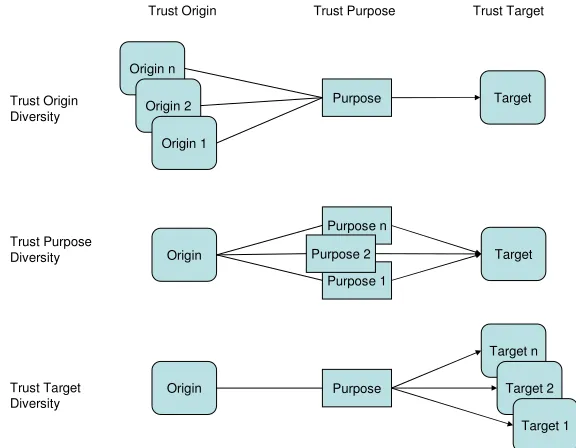
Purpose n Origin n
Origin 2
Trust Origin Trust Purpose Trust Target
Trust Origin Diversity
Trust Purpose Diversity
Trust Target Diversity
Origin
Origin Origin 1
Target n
Target 2
Target 1 Target Target Purpose
[image:29.612.167.455.66.290.2]Purpose Purpose 1 Purpose 2
Figure 1: Diversity dimensions of trust
Having specified trust in terms of trust origin, trust purpose, and trust target, other trust properties become apparent. First, as extracted from the definitions in the previous section, we know that the trust origin is subjective in calculating trust for a trust target for a given trust purpose. Next, the properties of symmetry and context can be applied to the trust purpose. Third, a trust measure can be determined by a trust origin for a trust target for a trust purpose. Finally, a trust measure can be recommended as evidence to a third party due to the transitive trust property. Each of these properties is more fully detailed below.
2.1.3.2 Trust Subjectivity
The subjective nature of trust is evident in most of the definitions presented in the last section. A trust origin can have personal interests on several levels, e.g., economic, emotional, and social (Jonker and Treur 1999), and the notion of subjective probability, i.e., the probability that a one’s subjective interest in an interaction outweighs the potential risk involved, can be used to capture those personal interests. Elofson notes that a subjective assessment when making a trusting decision is ‘the outcome of observations leading to the belief that the actions of another may be relied upon, without explicit guarantee, to achieve a goal in a risky situation,’ emphasizing that trust can be developed over time through a series of confirming evidentiary observations (Elofson 1998).
illustrate how trust-positive and trust-negative interaction results lead to different assessments of trustworthiness in agents with different subjective interpretations of observed evidence. For example, a blindly trusting agent will increase trust levels regardless of a positive or negative outcome with another agent, whereas a blindly untrusting agent will never trust another agent.
Various trust dynamic strategies lie in between these two extremes, as explored in (Axelrod 1984; Marsh 1994; Jonker and Treur 1999; Gray, O'Connell et al. 2005), and illustrate that disposition significantly impacts the evaluation of trustworthiness. For example, in (Jonker and Treur 1999; Gray, O'Connell et al. 2005), in addition to the blind trust and blind distrust extremes, trust may be evolved according to:
• a slow-positive-fast-negative policy, in which an entity is subjectively less trusting than distrusting, i.e., slow to increase trust in another party but rapid to decrease trustworthiness after having observed incorrect behaviour;
• a fast-positive-slow-negative policy, in which an entity is subjectively more trusting than distrusting, i.e., increases trust rapidly when correct behaviour is observed when interacting with another party, and giving the other party the ‘benefit of the doubt’ by decreasing trust slowly when incorrect behaviour is observed.
• a balanced-fast policy, in which case trust is evolved rapidly in both positive and negative directions; and
• a balanced-slow policy, in which an entity is more slow to evolve trust either positively or negatively. In (Gray, O'Connell et al. 2005), it is found that this strategy produces the smoothest trust evolution results due to the lack of large increases or decreases in trust assessment that occur when the other subjective assessments of correct or incorrect behaviour are used.
Player 2
Cooperate Defect
Cooperate R = 3, R = 3
R: reward for mutual cooperation
S = 0, T = 5 S: sucker’s pay-off T: temptation to defect Player 1
Defect T = 5, S = 0 S: sucker’s pay-off T: temptation to defect
P = 1, P = 1
P: punishment for mutual defection
Figure 2: Pay-off matrix for the Prisoner’s Dilemma
In 1979, Axelrod hosted a tournament to determine which cooperation strategies would perform best, i.e., result in the largest pay-off over time, in an Iterated Prisoner’s Dilemma (IPD) game. Researchers from various fields submitted IPD strategies in the form of computer algorithms, and the submitted strategies were tested against one another in repeated round-robin PD games. The strategy that accumulated the highest total pay-off in the end was declared the tournament winner.
The 14 strategies evaluated included those such as Always Cooperate and Always Defect, similar to blind trust and blind distrust, as well as more elaborate strategies, such as Nice (initial cooperation), Mean (initial defection), and Tit-for-Tat. The Tit-for-Tat strategy is one in which a player follows the Nice strategy in the first round against another player and then subsequently mirrors the strategy of the other player, i.e., if Player 2 cooperates in a game, Player 1 cooperates in the following game against Player 2; and if Player 2 defects in a game, Player 1 defects in the following game against Player 2. The result of the tournament reveals that a Tit-for-Tat cooperation strategy yields the best long-term results for interacting entities over time. Moreover, the single characteristic that distinguished the high-scoring strategies from the low-scoring strategies in Axelrod’s tournament was the property of ‘niceness’, i.e., never being the first to defect.
Marsh (Marsh 1994) extends Axelrod’s work in an IPD PlayGround for artificial agents that interact with each other according to subjective trusting strategies: optimist, pessimist, and realist. For the optimist strategy, an agent uses the highest remembered trust value for an interaction partner in a given situation. The pessimist strategy employs the lowest trust value available for an interaction partner in any situation. A realist agent uses the mean trust value for all past interactions with a particular interaction partner in a given situation, or, if the interaction partner is not known in a specific situation, the mean is taken for all other situations. Marsh’s findings include: optimists are quicker to cooperate than realists and appear to benefit, i.e., accrue more points, from repeated risk-taking, which is similar to Axelrod’s niceness results; if initial trust is too low, pessimists will never cooperate; trusting behaviour can be educated; cooperation can be encouraged; some of the agents behaved in a manner similar to humans; and, most importantly, that trust can be formalised and that the formalism can be embedded in artificial agents to produce subjective trust-like behaviour.
entity based on observed interaction behaviour. For example, an person or entity following a blind-trust or optimist blind-trust evolution policy or an Always Cooperate cooperation policy disregard the potential risk of interacting with another party and always believe that the other party may be relied upon during future interactions. The opposite holds true for a person or entity following a blind-distrust or Always Defect policy, whereby the potential pay-off from non-interaction is held to be greater than any possible reliance on another party. Moreover, an intermediate strategy, such as balanced-slow or Tit-for-Tat, resembles a moderate stance on determining the way in which to interact with another party based on that party’s past behaviour. In this way, evidence about an entity’s past behaviour is subjectively assessed when making a trusting decision about future interactions with that entity. Thus, disposition affects system performance and optimal trust evolution or cooperation strategies are typically those that allow for moderation.
2.1.3.3 Trust Asymmetry
From the discussion on trust dimension diversity, it is seen that a relationship between trust origin and trust target need not be, and indeed is not typically, symmetric. In addition to the possibility of one-to-many trust relationships, even in a one-to-one relationship Alice’s trust in Bob may not be the same as Bob’s trust in Alice. This phenomenon is evidenced in social network analysis (Coleman and Lal 1990; Watts 1999; Watts, Dodds et al. 2002; Latora and Marchiori 2003), where there is a directional relationship between nodes, e.g., teacher to student, employer to employee, seller to buyer, parent to child, etc. Where directional relationships exist, trust may be assessed differently depending on which entity is performing the role of trust origin and which is performing the role of trust target. Trustworthiness may be assessed differently, depending on the role, e.g., a trust origin who is a buyer of goods calculates trust for the trust target, a seller of goods, based on criteria such as quality and price, while the seller evaluates the trustworthiness of a buyer based on criteria such as ability and intention to pay. The trust purpose in each case is different depending on the directionality of the relationship being evaluated. Moreover, the evidence being input to make a trusting decision is also dependent on the directionality of the relationship. Evidence about a seller’s ability and intention to pay for goods when he acts in the role of a buyer will probably not be of as much importance to an entity assessing whether or not the seller can be trusted to provide goods of a high quality. Thus, trust purpose typically implies some notion of role context that is important to making trusting decisions.
2.1.3.4 Trust Context
Context is any information that can be used to characterize the situation of an entity. An entity is a person, place, or object that is considered relevant to the interaction between a user and application, including the user and applications themselves. (Dey
2001)
Dey’s definition of context highlights that context is variable and includes all of the possible information about an entity’s current state, i.e., if a piece of information can be used to characterize the situation of a participant in an interaction, then that information is context. This may include location and time, but it may additionally include situation-specific information or the acknowledgement that other actors have entered the interaction thus changing the situation.
Most trust definitions include the aspect of context, demonstrating that trust is context-specific. Moreover, context is the basis for one of the dimensions of trust, i.e., the trust purpose. The following statement is an example of this: ‘Alice trusts Bob to drive a car, but not to fly a plane.’ As the situation, or trust purpose, changes, so may the trust level calculated by the trust origin for the trust target. Contextual changes that affect trust purpose include variations in role, time, and other environmental factors.
For example, perhaps Alice trusts Bob in the role of car driver but not in the role of plane pilot. The trust purpose that Alice, the trust origin, evaluates for each role assumed by Bob, the trust target, is changed when the context of Alice’s situation is modified from deciding whether or not to get into a car with Bob to whether or not to get into a plane with Bob. In both cases, the trust purpose is essentially the same, i.e., Bob’s ability to navigate a vehicle, but Bob’s role modifies this general trust purpose somewhat in each case.
Time is another contextual component that affects trust because interactions between parties may take place over a period of time rather than occurring as once-off transactions (Coleman and Lal 1990; Marsh 1994; Jøsang, Gray et al. 2006). Quite obviously, a trusting relationship for a given trust purpose at one point in time might be evaluated differently at a later point in time. This means that time can be modelled as a set of discrete events taking place in which both the trust origin and trust target are involved. However, even if no transactions take place, a trust relationship will gradually change as time passes, e.g., eventually degrade. Therefore, in addition to the discrete changes that are made when events occur, it is also necessary to take into account the changes made to trust relationships when no recent evidence is available.
Other environmental factors that affect context include domain-specific factors. For example, in the domain of trade, a trust origin may evaluate the trust purpose for a trust target differently depending on the type of item being exchanged or the cost range of the item.
than they would in a system with no enforceable rules, e.g,. black market currency exchange on a dark corner of a shady neighbourhood. Thus, assessing risk is also context-dependent, e.g., Alice may not trust Bob to fly a plane unless Bob’s flying the plane is the only possible means to escape certain death. At some point, environmental constraints may become so all-encompassing that risk becomes irrelevant, meaning that trust is unnecessary when making a decision to interact because either sufficient safeguards are in place or because the interaction is essential. It is in cases below this threshold in which trust and risk assessment processes are necessary.
Finally, it has been stated that ‘evidence without context is ambiguous at best’ (Serafian 2003). When humans scrutinise collected observations and recommendations, each piece of information is examined in terms of its contextual relevance to the conclusion and resolution of the decision at hand. The contextual relevance of evidence, i.e., in terms of role, time, environmental factors, and environmental constraints, must be examined to lessen ambiguity when forming trusting decisions.
2.1.3.5 Trust Transitivity
Trust transitivity means that if Alice trusts Bob and Bob trusts Carl, then Alice will also trust Carl. This assumes that Bob actually tells Alice that he trusts Carl, i.e., as a recommendation based on Bob’s observations about Carl. It has been shown (Christianson and Harbison 1996) that trust is not implicitly transitive. For example, as illustrated in Figure 2, the fact that Alice trusts Bob to mind her children and Bob trusts Carl to drive a car does not imply that Alice trusts Carl to drive a car nor to mind her children.
Alice Bob Carl
trust purpose: mind children
trust purpose: drive a car transitive trust purpose: unknown
recommendation: drive a car
Figure 3: Trust transitivity leading to an unknown trust purpose
Carl based on his own observations about interacting with Carl for the purpose of driving. Bob’s recommendation is used by Alice as evidence with which to derive indirect functional trust in Carl. The recommendation chain between Alice and Carl can be arbitrarily long, but as long as the last leg in the chain is comprised of a functional trust purpose, or observation, and the other legs in the chain are comprised of referral trust purposes, or recommendations, trust transitivity is provided. Transitive trust propagation is thus possible when two variants of trust purpose, functional and referral, are explicitly assessed.
Alice Bob Carl
direct referral trust purpose: recommend car drivers
direct functional trust purpose: drive a car indirect functional trust purpose: drive a car
[image:35.612.148.345.538.675.2]recommendation: drive a car
Figure 4: Trust transitivity leading to a known trust purpose
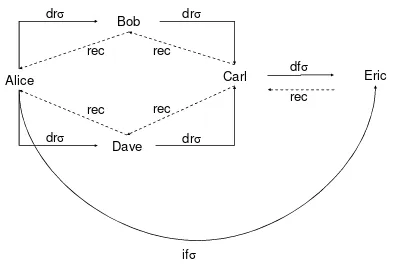
Moreover, Alice may wish to combine all collected evidence, both her own observations and recommendations from other parties, to form overall trust in a trust target. Parallel combination of evidence, i.e., the process of combining evidence from multiple paths between trust origin and trust target, is particularly useful in situations in which a trust origin has few or no observations with which to form direct functional trust in a trust target and must rely upon recommendations from other parties, i.e., rely on referral trust, in order to assess the target’s trustworthiness. For example, Figure 5 illustrates the available evidence Alice may need to combine in order to assess Eric’s trustworthiness when she has no direct functional trust in Eric for trust purpose σ and two indirect recommendations for Eric.
Alice
Bob
Carl
Dave
Eric rec
rec rec
rec rec
drσ
drσ drσ
drσ
dfσ
ifσ
Jøsang et al. (Jøsang, Gray et al. 2006) propose notation to describe the process of deriving indirect functional trust. Principals are denoted as A, B, C, D, and E, rather than Alice, Bob, etc. A directed graph represents the transitive trust network, with a single trust relationship between trust origin and trust target for trust purpose represented as a directed edge, e.g., the edge [A, B, σ] means that A trusts B for the trust purpose σ. We recall that the trust purpose, e.g., drive a car, can have two variants, functional and referral, and that the trust purpose can be direct or indirect, giving the set of possible trust purposes {dfσ, ifσ, drσ, irσ}. Additionally, the symbol “:” denotes the transitive connection of two consecutive trust edges to form a transitive trust path. Thus, the trust relationships in Figure 5 are expressed as: ([A, E, ifσ]) = ([A, B, drσ] : [B, C, drσ] : [C, E, dfσ]) and ([A, E, ifσ]) = ([A, D, drσ] : [D, C, drσ] : [C, E, dfσ]). Referral trust is calculated for each path and then applied to the functional trust being recommended on the last edge of the path, giving trust from parallel combination as ([A, E, ifσ]) = ((A, B, drσ] : [B, C, drσ]) ◊ ([A, D, drσ] : [D, C, drσ] : [C, E, dfσ])). The parallel combination operator, ◊, is trust system dependent, and examples of specific combination methods are given in the following section when discussing trust measures.
Intuitively, A’s trust in E is greater after performing the parallel combination of recommendations than if solely relying on one recommendation. Trust in E would be increased further by combining additional recommendations, as well as combining ifσ and dfσ when A has her own observations to input into the combination process. Parallel combination of transitive trust therefore has the effect of strengthening derived trust.
2.1.3.6 Trust Measure
When making a trusting decision, a human trust origin does not typically assign an explicit trust measure to a trust target. Humans generally determine trustworthiness implicitly, or intuitively, without explicitly analysing evidence about trust, risk, and context. However, it has been shown that trust can be measured in a similar manner to other abstract commodities such as information or knowledge (Dasgupta 2000). A measure can be associated with each trust relationship that captures a trust origin’s subjective degree of belief based on evidence about a trust target’s trustworthiness for a given trust purpose.
can be used to determine whether or not to assume the risk associated with interacting with the target for that purpose.
Many types of trust measure have been proposed in the literature, including binary measures of trusted and not trusted; discrete measures such as complete trust, high trust, medium trust, low trust, no trust (Zimmerman 1995; Abdul-Rahman and Hailes 1997; Manchala 1998; Cahill, Shand et al. 2003); or measures that are continuous in some form such as probability, Bayesian, and belief function representations (Beth, Borcherding et al. 1994; Marsh 1994; Jøsang 1996; Kohlas and Maurer 2000; Jøsang 2001; Kinateder and Pearson 2003; Gray, O'Connell et al. 2005).
Measuring Trust as a Probability
For example, Marsh uses probability to express the many aspects of social trust, i.e., representing the many facets of trust, such as ‘competence’ and ‘risk’, as continuous variables between 0 and 1. The variables are combined to produce an overall probability of trustworthiness. In this case, a trust origin calculates a trust measure as a probability that a trust target will behave competently, reliably, etc. for a trust purpose, capturing context, based on the percentage of time that trust target has behaved correctly in the past.
It has been argued (Luhman 1979; Zadeh 1986; Jøsang 1996; Abdul-Rahman and Hailes 1997) that probability is not the correct way to represent trust because it cannot express uncertainty and because computing transitivity may produce counterintuitive results, e.g., using multiplication to calculate transitive trust for a path of trust measures less than 1 will tend to produce a probabilistic trust measure that approaches 0, which expresses distrust rather than ignorance about likely outcomes of interacting with a trust target. Therefore, the Bayesian approach and belief functions have been proposed as mathematical theories of evidence to more accurately represent trustworthiness and capture uncertainty.
A Bayesian Approach to Trust Measurement