Peter Barron
A thesis submitted to the University of Dublin, Trinity College
in fulllment of the requirements for the degree of
Doctor of Philosophy (Computer Science)
I, the undersigned, declare that this work has not previously been submitted to this or any
other University, and that unless otherwise stated, it is entirely my own work.
Peter Barron
I, the undersigned, agree that Trinity College Library may lend or copy this thesis upon
re-quest.
Peter Barron
First and foremost I would like to express my deep gratitude to my supervisor, Prof. Vinny Cahill, for his support on this long journey. His encouragement and guidance have proven invaluable to me and I very much appreciate the time and eort he has given. I am lucky to have worked with him and I am thankful for the opportunities he has presented me.
In completing this research I was also privileged to work with a number of other academics in the Distributed System Group (DSG): to Dr. Simon Dobson my sincere thanks for starting me on this journey and for advising me during the early stages of my studies, to Dr. Siobhán Clarke my gratitude for sharing your expertise and for giving me the opportunity to work on the Carmen project. I am also grateful to Dr. Stefan Weber, Dr. Mads Haahr, Dr. René Meire, Dr. Jim Dowling, Dr. Christian Jensen and Stephen Barrett. Their advice and expertise has always been sought and greatly appreciated.
When I started in DSG I did not realise how much the people and the place would become so much a part of my life or how much I would enjoy it. As I reect now I see what a unique and wonderful place it is. Of those in DSG there are a few who I'd like to give a special mention to: Tim Walsh, Raymond Cunningham, Andronikos Nedos, Elizabeth Gray, Barbara Hughes, Vinny Reynolds, Kulpreet Singh, Greg Biegel, Anthony Harrington and Jean-Marc Seigneur. I am sure I have omitted some but I thank you all for making it such an enjoyable experience.
To Ciara, your friendship and love has undoubtedly seen me through this Ph.D. You have kept me sane and have always managed to bring a smile to my face. I cannot express my gratitude enough, I only hope I can nd the words some day.
I thank you all,
Peter Barron
Pervasive computing looks beyond the age of the personal computer to a time when everyday devices will be embedded with technology and connectivity. The goal of pervasive computing is to make such devices available throughout the physical environment to support people's usual activities with timely interventions without overwhelming them with inappropriate responses. So far, a number of research eorts have investigated dierent approaches to managing the complexities of developing these types of environments with varying degrees of success. The diculty still remains as to how to develop a pervasive computing environment that can support the integration and organisation of devices and applications in a spontaneous and robust manner. The problem is partly attributed to the highly dynamic and unpredictable nature of these types of environments, and is often further hampered by the limited resources found on devices.
The technology for pervasive computing is reaching a point where it is possible to convert may everyday environments into interactive spaces. Typically, these spaces have been designed from the ground up to support the anticipated needs of users, and are usually pre-installed and maintained over the period during which they are in use. Conceptually, these eorts are centralised in their approach, in that, eorts are focused around coordinating the resources of a particular geographical location in meeting the demands of users. However, in the future, the construction of pervasive computing environments is more likely to evolve accidentally from physical spaces as technology is incorporated into the space over time. This suggests there is a need to support the assembly of pervasive computing environments in a more ad-hoc fashion.
from nature and the observations made by the French biologist Grassé on how social insects co-ordinate their actions using indirect communication via the environment, a phenomenon that has become known as stigmergy. In the stigmergic approach there are fewer dependences be-tween entities allowing for the incremental construction and improvement of solutions without adversely eecting the rest of the pervasive computing environment. This thesis encapsulates this approach in a model that is used to underpin a framework for pervasive computing.
A prototypical implementation of the model is provided by Cocoa. Cocoa supports the use of stigmergy to build self-coordinating environments that promote the autonomy of entities. Designed to both support and complement the use of stigmergy, the framework employs a distributed architecture organised in a peer-to-peer fashion. To ease the implementation and deployment of entities Cocoa supports a programming abstraction encapsulated in a high-level scripting language. The scripting language exploits the methodologies used by social insects to construct a society of autonomous entities capable of responding to the environment in a stigmergic manner.
Acknowledgements iv
Abstract v
List of Tables xviii
List of Figures xix
List of Listings xxi
Chapter 1 Introduction 1
1.1 Pervasive Computing . . . 3
1.2 Enabling Technologies . . . 4
1.2.1 Sensors . . . 4
1.2.2 Communications . . . 6
1.2.3 Devices . . . 7
1.3 An Introduction to Context . . . 9
1.3.1 Context . . . 9
1.3.2 Context-Awareness . . . 10
1.4 Swarm Intelligence . . . 11
1.4.1 Stigmergy . . . 11
1.4.2 Harnessing the Principles of Stigmergy . . . 12
Chapter 2 Background and Related Work 16
2.1 Pervasive Computing . . . 16
2.2 Building System Software for Pervasive Computing . . . 19
2.2.1 Integration into the Real World . . . 19
2.2.2 Adapting to a Changing Environment . . . 21
2.2.3 Interoperability of Pervasive Computing Components . . . 21
2.2.4 Scalability . . . 23
2.2.5 Robustness . . . 24
2.2.6 Security and Privacy . . . 24
2.2.7 Programming Frameworks . . . 25
2.2.8 Summary . . . 26
2.3 Pervasive Computing Projects and Initiatives . . . 26
2.3.1 Aura . . . 28
2.3.1.1 A Task-Driven Approach . . . 28
2.3.1.2 Aura Architecture . . . 28
2.3.1.3 Developing Pervasive Computing Environments with Aura . 30 2.3.1.4 Summary . . . 31
2.3.2 Ambiente's Cooperative Project . . . 31
2.3.2.1 Roomware . . . 31
2.3.2.2 iLand Infrastructure . . . 33
2.3.2.3 Developing Roomware Components with BEACH . . . 34
2.3.2.4 Summary . . . 35
2.3.3 The Adaptive House . . . 35
2.3.3.1 ACHE . . . 36
2.3.3.2 Summary . . . 38
2.3.4 Project Oxygen - The Intelligent Room . . . 38
2.3.5 AT&T Laboratories - Sentient Computing . . . 42
2.3.5.1 A Sentient Computing System . . . 43
2.3.5.2 Programming with Space . . . 44
2.3.5.3 Summary . . . 45
2.3.6 Stanford Interactive Workspace Project . . . 45
2.3.6.1 iROS a Pervasive Computing System . . . 46
2.3.6.2 iRoom a Pervasive Computing Environment . . . 47
2.3.6.3 Developing Applications with iROS . . . 48
2.3.6.4 Summary . . . 48
2.3.7 Gaia . . . 49
2.3.7.1 Active Spaces . . . 49
2.3.7.2 The Gaia Operating System . . . 49
2.3.7.3 Developing Applications with Gaia . . . 52
2.3.7.4 Summary . . . 53
2.3.8 Portolano - One.World . . . 54
2.3.8.1 The One.World Approach . . . 54
2.3.8.2 The One.World Architecture . . . 54
2.3.8.3 Building Applications with One.World . . . 57
2.3.8.4 Summary . . . 58
2.3.9 Other Pervasive Computing Projects . . . 58
2.4 Summary and Conclusions . . . 60
Chapter 3 A Stigmergic Model for Pervasive Computing 63 3.1 Analysis and Requirements . . . 64
3.1.1 The Next Step for Pervasive Computing . . . 64
3.1.2 Requirements for a Pervasive Computing System . . . 66
3.1.3 Existing Support of Requirements . . . 71
3.2.2 Research Inspired by Stigmergy . . . 79
3.3 Using Stigmergy in a Pervasive Computing Environment . . . 81
3.3.1 Collections of Interacting Entities . . . 82
3.3.2 Autonomy and Decentralised Coordination . . . 82
3.3.3 Spontaneous Interoperability . . . 83
3.3.4 Robust, Adaptable Environments . . . 84
3.3.5 Simple, Scalable Solutions . . . 85
3.3.6 Incremental Construction and Improvement of Solutions . . . 86
3.3.7 Providing an Appropriate Level of Abstraction . . . 87
3.3.8 Security and Privacy . . . 88
3.3.9 Summary . . . 88
3.4 A Stigmergic Model for Pervasive Computing . . . 89
3.4.1 Overview of Model . . . 89
3.4.2 The Environment . . . 90
3.4.3 Entities . . . 93
3.4.4 Sensing the Environment . . . 95
3.4.5 Interpreting the Local Environment . . . 98
3.4.6 Manipulating the Environment . . . 99
3.4.7 Summary . . . 102
3.5 Key Features of Model . . . 103
3.5.1 The Local Environment . . . 103
3.5.2 Dening Entity Behavior . . . 104
3.5.3 Reacting to the Local Environment . . . 104
3.6 Summary . . . 105
Chapter 4 Dening Entity Behavior 107 4.1 Current Scripting Technologies . . . 108
4.3.2 Proximity Function . . . 114
4.3.3 Behavioral Set . . . 115
4.3.4 M Function . . . 116
4.4 Mapping . . . 122
4.4.1 Allen's Temporal Intervals . . . 123
4.4.2 Scripting Temporal Intervals . . . 124
4.5 Tailoring Entity Behavior . . . 129
4.5.1 Passing Context Information . . . 129
4.5.2 Using Embedded Functions . . . 130
4.5.3 Using the This Keyword . . . 133
4.5.4 Redening P . . . 133
4.6 Summary . . . 134
Chapter 5 Cocoa Framework 136 5.1 Architectural Overview . . . 137
5.2 Main Components . . . 138
5.2.1 Communication Drivers . . . 138
5.2.1.1 Context and Sensor Data Channels . . . 139
5.2.1.2 Concrete Driver Implementations . . . 140
5.2.2 Sensors . . . 142
5.2.2.1 Sensor Component . . . 143
5.2.2.2 Sensor Data . . . 144
5.2.2.3 Sensor Metadata . . . 145
5.2.3 Context Acquisition . . . 148
5.2.3.1 Context Acquisition Component . . . 148
5.2.3.2 Context Acquisition Models . . . 150
5.2.3.3 Dynamic Discovery and Use of Sensor Data . . . 151
5.2.4.2 Intermediate Objects used for Proximity . . . 160
5.2.4.3 Intermediate Objects used for Behaviors . . . 161
5.2.4.4 Intermediate Objects used for Mappings . . . 163
5.2.5 Stigmergy Runtime . . . 164
5.2.5.1 Observing the Local Environment . . . 165
5.2.5.2 Examining the Local Environment . . . 167
5.2.5.3 Manipulating the Environment . . . 169
5.3 Possible Congurations . . . 170
5.3.1 Cocoa Conguration File . . . 171
5.3.2 Loading Components . . . 172
5.3.3 Component Congurations . . . 172
5.4 Entity Development . . . 174
5.4.1 Overview of Entity Development . . . 174
5.4.2 Creating a Sensor Component . . . 175
5.4.3 Developing the Context Acquisition Model . . . 175
5.4.4 Implementing Behaviors for an Entity . . . 176
5.4.5 Dene Entity Behavior . . . 177
5.4.6 Instantiating the Entity . . . 178
5.5 Summary . . . 179
Chapter 6 Experimental Evaluation 181 6.1 Evaluating Pervasive Computing Systems . . . 182
6.1.1 Approaches used by Previous Projects . . . 182
6.1.2 Evaluation Frameworks for Pervasive Computing . . . 183
6.1.3 Simulating the Physical Environment . . . 185
6.2 Proposed Criteria for Evaluation . . . 186
6.3 Application Scenarios . . . 188
6.3.1.3 Results and Analysis . . . 192
6.3.2 Tour Guide . . . 193
6.3.2.1 Scenario . . . 193
6.3.2.2 Implementation . . . 193
6.3.2.3 Results and Analysis . . . 195
6.3.3 The Jukebox . . . 196
6.3.3.1 Scenario . . . 196
6.3.3.2 Implementation . . . 197
6.3.3.3 Results and Analysis . . . 199
6.3.4 Streetlights . . . 200
6.3.4.1 Scenario . . . 200
6.3.4.2 Implementation . . . 201
6.3.4.3 Results and Analysis . . . 202
6.3.5 The Voice . . . 204
6.3.5.1 Scenario . . . 204
6.3.5.2 Implementation . . . 205
6.3.5.3 Results and Analysis . . . 207
6.3.6 The Westland Row Development . . . 208
6.3.6.1 Scenario . . . 209
6.3.6.2 Implementation . . . 209
6.3.6.3 Results and Analysis . . . 212
6.4 Summary . . . 214
Chapter 7 Conclusions and Future Work 216 7.1 Achievements . . . 216
7.2 Open Research Issues . . . 218
Appendix B Cocoa Conguration File 222
Appendix C Application Scenarios 224
C.1 Location Sensor for Simulated Environment . . . 224
C.2 Activity Sensor for Simulated Environment . . . 226
C.3 GPS Location Sensor . . . 227
C.4 Punter Entity . . . 232
C.4.1 Script . . . 232
C.4.2 Conguration File for Simulated Environment . . . 232
C.4.3 Conguration File for the Jukebox Scenario . . . 233
C.4.4 Conguration File for the Voice Scenario . . . 234
C.4.5 Conguration File for Westland Row . . . 235
C.5 Help Assistant Entity . . . 236
C.5.1 Conguration File . . . 236
C.6 Tourist Attraction Entity . . . 236
C.6.1 Script . . . 237
C.6.2 Conguration File . . . 237
C.7 Electronic Tour Guide Entity . . . 237
C.7.1 Conguration File . . . 238
C.8 The Jukebox Entity . . . 238
C.8.1 Conguration File for Simulated Environment . . . 238
C.8.2 Conguration File for Westland Row . . . 239
C.9 Streetlight Entity . . . 240
C.9.1 Conguration File . . . 240
C.10 The Voice Entity . . . 241
C.10.1 Conguration File . . . 241
C.11 Siopa Entity . . . 242
C.12.1 Conguration File . . . 243
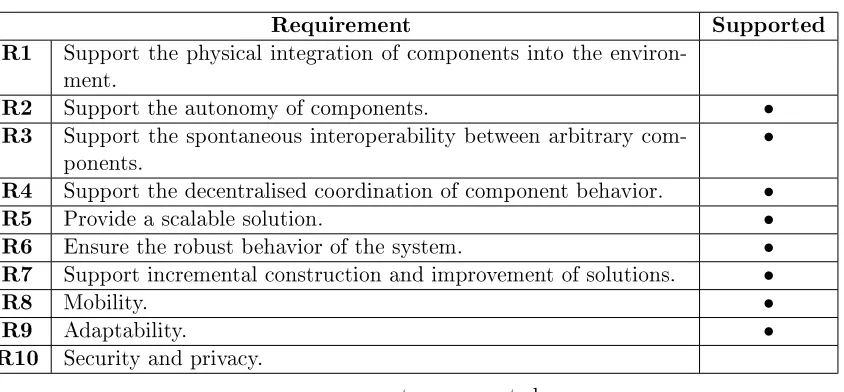
3.1 Features provided by the state-of-the-art approaches to develop pervasive com-puting environments. . . 72 3.2 A summary of the classications used to categorise the dierent forms of
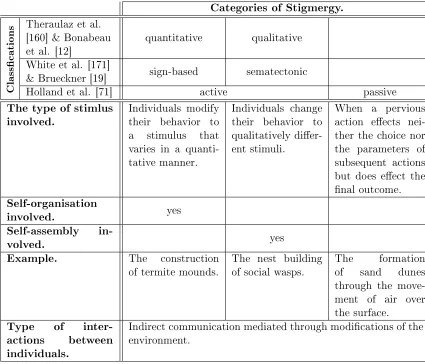
stig-mergy. . . 78 3.3 Summary of requirements addressed. . . 89
2.1 Aura architecture. . . 29
2.2 Roomware: ConnecTable, CommChair, DynaWall, InteracTable. . . 32
2.3 The Adaptive House 1926. . . 36
2.4 System architecture of ACHE. . . 37
2.5 Intelligent Room Architecture. . . 39
2.6 The iROS component structure. . . 46
2.7 Gaia architecture. . . 50
2.8 One.World architecture. . . 55
3.1 Stigmergic Model. . . 94
3.2 Possible Sensor Congurations. . . 96
3.3 Possible Congurations for Actuators. . . 100
3.4 Using Stigmergy in an Pervasive Computing Environment . . . 103
4.1 Script inheritance hierarchy. . . 113
4.2 Proximity . . . 114
4.3 Interval relationships . . . 123
4.4 Interval - contextA start contextB. . . 125
4.5 Interval - contextB start contextA, contextA nish contextB, contextA during contextC. . . 129
5.1 Cocoa Architecture . . . 137
5.5 Class Diagram of Sensor Component. . . 149
5.6 Dynamic selection and use of sensors. . . 152
5.7 Model of context information used in Cocoa framework. . . 153
5.8 Structure of scripting component . . . 158
5.9 Class Diagram of the YABS component. . . 159
5.10 Class Diagram of the intermediate objects used for proximity. . . 160
5.11 Class Diagram of the intermediate objects used for behaviors. . . 161
5.12 Class Diagram of the intermediate objects used for mapping. . . 163
5.13 Stages used in runtime environment. . . 165
5.14 Class Diagram of the main parts of stigmergic runtime use to observer the local environment. . . 166
5.15 Class Diagram of main parts of stigmergy runtime used in the mapping func-tion. . . 167
5.16 Interval slots. . . 168
5.17 Class Diagram of the environment conguration component. . . 171
5.18 Possible component congurations of Cocoa. . . 173
6.1 An illustration of the streetlight scenario. . . 200
6.2 The voice scenario. . . 205
6.3 User inferface of the voice entity. . . 206
4.1 Declaring a script. . . 112
4.2 Code for proximity functions. . . 114
4.3 Declaring behaviors. . . 116
4.4 Reassigning behaviors. . . 116
4.5 Declaring context predicate. . . 117
4.6 Assigning identity context. . . 117
4.7 Assigning location context. . . 118
4.8 Assigning an area for a location context. . . 118
4.9 Assigning activity context. . . 119
4.10 Assigning time context. . . 119
4.11 The any keyword. . . 120
4.12 Declaring context information for a dark room. . . 121
4.13 Example of mapping statement. . . 121
4.14 Changing the value of a context predicate. . . 122
4.15 Overwriting a mapping. . . 122
4.16 Mapping using temporal intervals. . . 124
4.17 Mapping statement contextA before contextB. . . 126
4.18 Mapping statement contextA meet contextB. . . 126
4.19 Mapping statement contextA overlaps contextB. . . 126
4.20 Mapping statement contextA during contextB. . . 127
4.21 Mapping statement contextA nish contextB. . . 127
4.25 Passing context information to a behavior. . . 130 4.26 Declaring embedded function. . . 130 4.27 Using embedded function. . . 131 4.28 Reassign embedded function. . . 132 4.29 Calling one embedded function within another. . . 132 4.30 Using the this keyword to dene context predicates. . . 133 4.31 Using the this keyword to pass context information. . . 133 4.32 RedeningP. . . 134
Introduction
Advances in technology are allowing pervasive computing to look beyond the realm of the per-sonal computer (PC) to a time when everyday devices will be embedded with technology and connectivity. It is expected that large numbers of these devices will populate environments to such an extent that the physical and computational infrastructures will become so integrated that they will be transformed into spaces capable of supporting the activities of those who use them. The goal for pervasive computing is to ensure that the assistance provided is done in a timely manner without overwhelming users with inappropriate responses.
Pervasive computing has been used in a wide variety of areas including education where it has been used to support students in attending lectures [1, 16], and in oces to assist workers in meetings [78, 64] or in group collaborative sessions [153]. It has also been used in scientic laboratories to support the work of scientists [60, 62], and in the home to ensure the ecient usage of resources [107]. In addition, pervasive computing has also been used to support the elderly in the home [111] and to guide tourists [33].
and applications in a spontaneous and robust manner. This task is made considerably more dicult by the highly-dynamic and unpredictable nature of these types of environments and the limited resources often found on devices.
The research presented in this thesis addresses some of these issues. Firstly, the thesis proposes an alternative method of constructing pervasive computing environments based on the swarm intelligence technique of stigmergy [58]. Secondly, the thesis uses the concept of stigmergy to describe a highly decentralised method of organising the components of a pervasive computing environment that supports spontaneous interaction between entities and provides robust system-wide behavior. Using this approach the thesis presents a framework that supports the use of stigmergy in building self-coordinating environments that promote the autonomy of entities. Lastly, the thesis describes a programming abstraction encapsulated in a high-level scripting language for developing pervasive computing applications.
The proposed approach seeks to establish a method for assembling pervasive computing environments in a more ad-hoc fashion. The objective is to allow pervasive computing en-vironments to evolve incrementally from physical spaces as the technology is incorporated into the space over time. This diers from current approaches where pervasive computing environments have typically been designed from the ground up to support the anticipated needs of users, and are usually pre-installed and maintained for the duration that they are in use. Conceptually, these eorts are centralised in their approach, in that, their focus is on co-ordinating the resources of a specic geographical location in meeting the demands of users. However, the future of pervasive computing lies in allowing physical spaces to evolve into pervasive computing environments with the inclusion of technology over time. The approach proposed in this thesis seeks to support such an approach.
1.1 Pervasive Computing
When Mark Weiser wrote his seminal paper on ubiquitous computing1 [167] he recognised
that the world of computing was moving towards an era where everyday devices would be embedded with technology and connectivity. He realised that the widespread proliferation of these devices would require a change in how people use and interact with computers. In [168] Weiser wrote:
Ubiquitous computing is the method of enhancing computer use by making many computers available through the physical environment, but making them eec-tively invisible to the user [168]
The statement indicates that the objective of ubiquitous computing is to transform physical spaces into interactive environments capable of reacting to, and meeting the needs of those who occupy them. However, the statement also illustrates Weiser's belief that for us to interact with hundreds of nearby wirelessly interconnected computers it is necessary for them to disappear from our awareness so that they may truly become an integral part of our daily lives.
Underlying this new wave of computing are advances in technology that have allowed computational devices to populate the environment around us in ever greater numbers. It is now reaching a point where the quantitative relationship between humans and computers has shifted so signicantly from the time when many users shared only a single computer to a situation where many computers now share the attention of only a single person. The increasing number of devices in our environment provides the initial infrastructure that makes pervasive computing a possibility.
However, the vision proposed by Weiser is more than just the quantitative relationship between humans and computers, it also describes how an environment composed of hundreds of these devices are to interact with those who use it. The aim is to provide users with timely interventions that assist them with their current task without overwhelming them
with inappropriate responses. Weiser describes this as calm computing [166] where technology requires little or no attention from users but is just there ready to be used when required.
Not surprisingly, the concept poses a number of substantial research challenges: integrating devices into an environment so they may sense and interact appropriately with users; sup-porting the spontaneous interoperability between devices to ensure their seamless integration into the environment; coordinating the behavior of devices to ensure a coherent environment can form; providing a system that can scale to the large collection of devices that are expected to be interwoven into the environment; ensuring a system behaves robustly in the presence of frequent failures of devices; supporting the high degree of mobility that is inevitable with users moving objects from one location to another; and maintaining the privacy of users who use the environment.
The task of accomplishing these challenges is made considerably more dicult by the general dynamic and unpredictable nature seen in these types of environments, and the often limited resources found on devices.
1.2 Enabling Technologies
The development of pervasive computing environments would not be possible without a num-ber of key enabling technologies. Sensors have allowed computational devices to observe their surrounding environment and react to it. The availability of wireless communication has allowed devices to be distributed across the environment in a more ubiquitous manner. The abundance of small, cheap, portable devices has provided the backbone to this new era of computing. The work presented in this thesis is technology independent but assumes an underlying infrastructure capable of supporting a pervasive computing environment. This section therefore provides an overview of these technologies.
1.2.1 Sensors
devices to adapt their behavior to meet the current situation. The process ensures that devices will always act appropriately in supporting the actions of users in their immediate environment. The increased variety of sensing technologies available at reasonable prices has allowed everyday objects to be embedded with these technologies allowing them to become part of society. For example, Point Six [147] provides a number of wireless sensors capable of measuring air temperature, humidity, and pressure. Their sensors run on batteries with a lifespan of up to 5 years and transmit data to receivers that can be up to 180 meters away.
The current generation of pervasive computing systems uses a wide variety of sensors, some of which are basic o-the-shelf components adapted for pervasive computing while others have been specically designed to operate within these kinds of environments. For example, the Adaptive House [108] uses a number of sensors embedded into a house to detect the ambient illumination, room temperature, sound level, and motion of users to predict the inhabitants needs and to manage energy usage in a more ecient way. AT&T's sentient computing project [2, 65] has developed a location system called BAT [165]. The BAT system uses a combination of radio frequencies (RF) and ultrasound signals to provide very accurate location information in three dimensions. Transmitter devices, known as bats, are attached to objects or given to users. The signals transmitted are received by devices placed in the ceiling. Using the information from three of these devices, the location of a bat device can be triangulated to high degree of accuracy. AT&T have used the system to build a series of location-aware applications. For example, applications that followed users from one computer to another, or a service that routes telephone calls to the nearest phone beside a person. The Tea project [142] has attached photo-diodes, accelerometers, passive IR sensors, plus temperature and pressure sensors to a mobile phone, so that the device can change its behavior to suit the situation it is in.
provide both more reliable and higher-level information on the environment. This derived information is generally described in pervasive computing as context information [42]. An introduction to context information is provide in section 1.3.
1.2.2 Communications
Wireless communication is playing an integral part in the development of pervasive computing as it encourages the ubiquitous nature of these types of environments. It ensures devices can retrieve information and coordinate their actions at any point without the restriction of having to be physically connected to a network. It allows devices to move through an environment and to be located in places that would not normally be covered by a wired network. A number of wireless technologies are used, some of which have been developed for generic use while others have been specically designed for pervasive computing.
In projects such as Aura [56], Gaia [134] and the Stanford Interactive Workspace Project [78] the IEEE 802.11 [73] standard has been used in combination with a wired Ethernet network to provide the underlying communication network for the environment. IEEE 802.11 is a wireless network standard that can typically span a building, or campus of up to a few kilometers is size. The standard is able to operate in either of two modes; an infrastructural mode that relies on base stations to mediate communication between nodes and an ad-hoc mode which allows peer communication between nodes. When used in combination with ad-hoc routing protocols, such as AODV [119], the ad-hoc mode can provide full multi-hop communication between nodes. The nominal bandwidth of the IEEE 802.11b standard is 11Mbps, though the newer IEEE 802.11g standard can achieve 56Mbps.
signals to perform short-range line of sight communications between devices and is used in a similar fashion to bluetooth. A number of wireless networks have been designed specically for severely energy constrained devices where the consumption of power has to be kept to a minimum. Normally these type of networks are used within sensors networks [82] or for connecting devices such as those developed by the Smart-Its project [72].
While wireless communication networks encourage the ubiquitous nature of pervasive com-puting, they do increase the complexity of building these types of environments. Unlike tra-ditional wired networks, which tend to be static, the nodes forming a wireless network are extremely dynamic within a pervasive computing environment. These nodes may have vary-ing degrees of mobility but they are continuously movvary-ing through the environment and may enter or leave a network for any number of reasons. For example, a mobile node may move out of range of other nodes causing a partition in the network or a node may fail due to the lack of power or a fault within the device. Any pervasive computing system has to assume that failure and disconnected operations are the norm and not the exception and so must develop appropriate mechanisms for dealing with it.
1.2.3 Devices
The abundance of small, cheap, portable computing devices is the backbone to Weiser's vision of pervasive computing. It is these devices that provide the computational infrastructure for transforming the environment into an interactive space capable of supporting the activities of those who inhabit it. The current generation of pervasive computing environments use a wide selection of devices to accomplish this some of which are freely available from vendors while others have been specically designed to be embedded into everyday objects.
performed by Want et al.
In more recent projects such as the Stanford Interactive Workspace Project [78] or the Intelligent Room [64], a combination of workstations, notebooks, tablet PCs, and PDAs are used to provide the infrastructure for the environment. The devices that are in these projects come in a range of sizes and would typically incorporate wireless technologies such as IEEE 802.11, Bluetooth, or IrDA and may utilise touch-sensitive screens and stylus for user input instead of using a keyboard. Some of the newer generation of PDAs also include a number of sensors, including biometric sensors, embedded into the device to determine light intensity, location, and to read nger prints.
In contrast, the TEA project [142] uses mobile phones to support the activities of users. The mobile phones incorporates a number of sensors that can be used to adapt the behavior of the phone. For instance, in a noisy environment the phone changes its prole to increase the volume of the ring tone used. In general, mobile phones provide an ideal platform for pervasive computing due to there widespread use in society. The next generation of phones now integrate personal information management and mobile phone capabilities on the same device. In doing so, they provide a very exible platform for developing pervasive computing applications.
Another project, called Smart-Its [72], has developed small devices of only a few cen-timeters in size that can be embedded into everyday objects. They incorporate a number of sensors and wireless communication and are designed to augment and interconnect artifacts within a pervasive computing environment. So far, they have been used to augment chemical containers to detect and alert potential hazardous situations [155], embedded into tables to track activity [143], and connected to skis to determine the performance of skiers [101, 102].
The progress of technology is reaching a point where computational devices are getting smaller and more numerous. It is possible to embedded large collections of these devices into our surrounding environment without us even knowing of their existence. While these de-vices provide the backbone for pervasive computing, a variety of issues arise from their wide spread proliferation within the environment. Unlike personal computers, which tend to be static and fairly robust, the devices forming a pervasive computing environment are extremely dynamic. Typically, they are small devices with limited resources for power, computation, communication, and storage. They also have varying degrees of mobility that allow them to move through the environment. While exepcted advances in storage capabilities will partly alivate this problem the limitations and tradeos between power, computation, and commu-nication are anticipated to remain for the foreseeable future. A pervasive computing system must assume that due to their mobility and limited resources that failure will be common place and so must create mechanisms to ensure the robust behavior of the environment can be maintained.
1.3 An Introduction to Context
An important aspect of meeting Weiser's vision for calm computing [166] is the ability for systems to observe and understand what is occurring within the environment and to use this information to adapt their behavior to suit the situation. This is an important requirement of pervasive computing and is necessary for any system if it is blend seamlessly into the background and to determine correctly how it is to interact with users. The use of context, i.e. the information that is derived from data retrieved from sensors embedded in the environment, has provided the means of accomplishing this.
1.3.1 Context
also note that context is more than just the location of users, but includes other information such as lighting, noise levels, social situations. For Brown et al. [18], a user's context is determined by a collection of information such as their location, the season, temperature. Pascoe [118] denes context to be the subset of physical and conceptual states of interest to a particular entity. However, as Dey et al. [42] points out many of the above denitions are too specic. They observe that context is about the whole situation relevant to an application and dene context as:
Context is any information that can be used to characterize the situation of an entity. An entity is a person, place, or object that is considered relevant to the interaction between a user and an application, including the user and applications themselves. [42]
Denitions of context vary considerably within the research community. However, some key concepts can be drawn from the literature. Namely, that context describes the state of the environment that is relevant to an entity. Where the identity of the entity, the time, the location of the entity, and the task being performed play a primary role in describing an entity's context.
1.3.2 Context-Awareness
Dey et al. [42] dene context-awareness as the use of context to provide relevant information and/or service to the user. Brown et al. [18] dene context-aware applications as those that change their behavior according to the user's context. Schilit et al. [138] dene it as the ability of software to adapt to the location of use, nearby people, and devices. There are a number of interpretations of context-awareness though the general consensus is that a system is context-aware if it uses or adapts to the context information derived from the surrounding environment.
there are a number of issues with using context information in pervasive computing. For instance, there is a level of uncertainty with the accuracy of the context information being provided due to the inherent inaccuracies of sensors. Another issue arises over the timeliness and frequency in which the context information is updated by the system to maintain the freshness of the information in use. There is also a question of how best to model the context information used to represent the environment in the system. While problems do exist with the use of context information, its use is what allows systems to meet Weiser's vision for pervasive computing.
1.4 Swarm Intelligence
The potential of simple behaving entities was rst noted by biologists in their observations of colonies of social insects. They noticed that through local interactions of individuals, a colony of insects could produce complex collective behaviors at the colony level. These type of behaviors are also seen in ocking birds and shoals of sh and are considered to be highly distributed and largely self-organising. The mechanisms used to organise these types of systems and the collective behavior that emerges from them has become known as swarm intelligence. Bonabeaus et al. [12] describes swarm intelligence as the attempt to design algorithms or distributed problem-solving devices inspired by the collective behavior of social insect colonies and other animal societies. The ability of these simple behaving entities to produce complex behaviors has not gone unnoticed and has provided the inspiration for several research initiatives [47, 45, 46, 95, 23, 83] that used the same coordination mechanisms to solve a range of computer-related problems. One of the coordination mechanisms used is known as stigmergy.
1.4.1 Stigmergy
interac-tions between insects resulted in the emergence of colony-wide behavior. Holland et al. [71] showed that stigmergy provides a mechanism that allows the environment to structure itself through the activities of the entities within the environment. The state of the environment, and the current distribution of entities within it, determines how the environment and the entities will change in the future. This approach provides a robust, self-organising environ-ment, which allows entities to coordinate their behavior in a highly decentralised manner. It is important to stress that individual entities have no particular problem solving knowledge, and that coordinated behavior emerges due to the actions of the society. It also worth noting that while no direct communication is used between individual entities, communication is still maintained through the medium of the environment.
The trail-laying and trail-following used by many species of ants [12, 41] when foraging for food is a classical example of the use of stigmergy in nature. Ants deposit pheromones on their way back from a food source. Foraging ants follow such trails. The process has been shown to be self-organising [41] and capable of optimizing on the shortest path to the food source [57]. The nest building of social wasps [160] is another example of stigmergy used within nature. Nests are built up from wood bers and plant hairs and cemented together with salivary secretions. These are then moulded by the wasp to form the dierent parts of the nest. Wasps coordinate the construction of a nest by each individual observing the local structure of the nest and deciding where to build the next part of the nest. Another example is the corpse gathering behavior seen in some species of ants. Worker ants pick up corpses in the nest and drop them in locations of higher concentrations to form piles of corpses in a process which acts to clean the nest.
1.4.2 Harnessing the Principles of Stigmergy
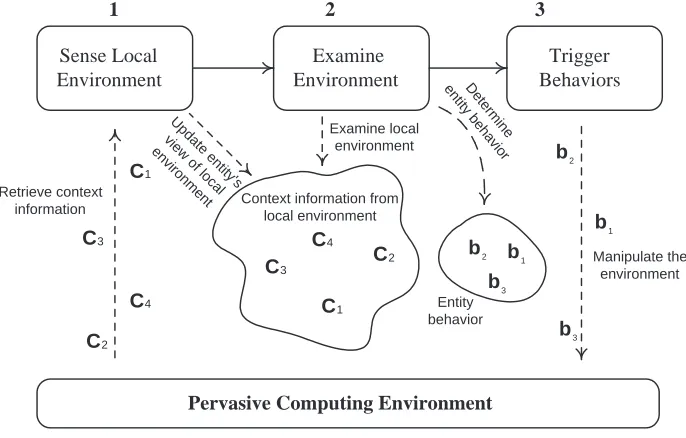
interact with each other. While the environment social insects use to coordinate their actions can be represented in a pervasive computing system by the context information derived from sensors.
The indirect communication mechanisms harnessed by social insects provide a means of decoupling devices and applications. Having fewer dependencies between components allows the overall system to be less fragile and more robust to disturbances in the environment. The system can grow organically and decay gracefully with the environment, as new devices are added and old ones upgraded or removed, without having an adverse eect on the overall system. The spontaneous interaction of devices and applications can be achieved as commu-nication is realised through the common medium of the environment. The use of stigmergy allows us to harness the robust, self-organising, coordinating mechanisms of social insects, which are all desirable attributes for pervasive computing.
The thesis proposes to use the principles of stigmergy to create a pervasive computing en-vironment, where context information from surrounding entities and the environment provide a common medium for an indirect communication mechanism to be used by entities. The social insects observed by Grassé are represented as entities within the pervasive computing environment. An entity is a person, place, or object as dened by Dey [42]. Co-ordinated behavior arises from entities observing their environment and reacting to the received context information according to a set of simple rules.
1.5 Research Scope, Aims and Methodology
The objective of the research presented in this thesis is to assess the use of stigmergy in supporting the development of pervasive computing systems. More specically, the objective is to mimic the methodologies used by social insects to construct a society of autonomous entities capable of supporting spontaneous interaction between entities and providing robust system-wide behavior for a pervasive computing environment. The primary research aims are therefore to:
comput-ing systems.
• Understand the implications of using techniques based on the phenomena of stigmergy
to construct pervasive computing environments.
• Develop a model based on these techniques for developing pervasive computing
environ-ments.
• Use the model to develop a framework that supports the use of stigmergy to build
self-coordinating environments that promote the autonomy of entities.
• Evaluate the eectiveness of using such an approach by developing a series of prototype
scenarios to access the implications of using these techniques.
The methods used in conducting the research presented use a rigorous survey of the literature and available information, modeling of techniques, the design and implementation of a pro-totype to indicate the feasibility of such an approach, and an evaluation to understand the implications of using the proposed techniques.
1.6 Research Contribution
The work presented in this thesis has focused primarily on the investigation of techniques based on stigmergy in the design and implementation of pervasive computing environments. Consequently, the main contributions of the thesis can be summarised as follows:
• An overview of pervasive computing systems with respect to the integration and organ-isation of devices and applications within these types of the environments.
• A highly decentralized method for organising components of a pervasive computing
environment that supports spontaneous interaction between entities and provides robust system-wide behavior.
• A framework, called Cocoa, that supports the use of techniques based on the phenomena
• A programming abstraction encapsulated in a high-level scripting language that
gen-eralises the methodologies used by social insects to construct a society of autonomous entities capable of responding to the environment in a stigmergic manner.
1.7 Thesis Outline
Background and Related Work
In order to set the scene for the thesis and provide necessary background for the work to be presented here, this chapter examines a number of research projects and reviews their eorts to overcome the hurdles posed by pervasive computing. Particular attention is paid to understanding the mechanisms used to integrate devices and applications into pervasive computing environments and to understand how they are organised within it. The chapter also notes the methodology used in their construction and the methods employed in developing applications for them. The aim is to gain a better understanding of the complexities of building pervasive computing environments and to develop an insight into how the current state of the art might be improved. The chapter begins with an introduction to pervasive computing.
2.1 Pervasive Computing
and embedded with technology and connectivity. In this world, people would be continually interacting with hundreds of interconnected devices that would meld into the background and eectively become invisible to those who use them. In his paper [167] Weiser wrote that:
The most profound technologies are those that disappear. They weave themselves into the fabric of everyday life until they are indistinguishable from it. [167]
The statement illustrates Weiser's belief that for technologies to truly become an integral part of our daily lives it is necessary for them to disappear from our awareness, to be so ingrained in our psyche that it is not necessary to have to think about using them. This would enable computer users to focus beyond the tools and so concentrate on their goals. Ubiquitous computing denes a technology that does not require our constant attention but at the same time is ready to be used at a glace.
In developing his vision of ubiquitous computing Weiser recognised that the millions of personal computers inhabiting society were largely isolated and disconnected from it and were, in fact, mostly getting in the way of people. He recognised that computers were not disappearing into the background but were increasingly demanding the attention of users. Weiser realised that the relationship between humans and computers had to change to one that ensured computers became vastly better at getting out of the way [168] of people. He realised for this to happen computers needed to become part of the natural human environment [167] and that it was necessary for them to vanish into the background [167] of our society. He argues that for computers to truly become an integral part of our lives it necessary for them to totally disappear from our awareness.
Such a disappearance is a fundamental consequence not of technology, but of human psychology. Whenever people learn something suciently well, they cease to be aware of it. [167]
to be interwoven into the fabric of society until it becomes indistinguishable from it [167] depends on how it is perceived and used. It is only when it is accepted that such technology can be thought as ubiquitous.
Ubiquitous computing requires a fundamental change in how computers are perceived and used in our society and demands a total rethink of how such systems are designed and implemented. For researchers the main question still remains: how do technologies disappear into the background? [167]. The answer lies in the widespread proliferation of devices that are suciently small and cheap enough to be built into everyday objects. The goal is to make these devices so pervasively distributed across society that they become such an intrinsic part of peoples lives that they no longer recognise them as computers. It is also necessary to have ecient, low-powered devices that can operate for considerable periods of time without having to change the source of power or maintain them in anyway. Devices need to be forgotten about and having to constantly support them in this manner does not allow them to meld into the background of society. With the increased numbers of devices expected to occupy ubiquitous computing environments it would become problematic to maintain devices in the same manner as we do with traditional forms of computing. As can be observed in the statement below, Weiser also noted that the real power of ubiquitous computing is only achieved when all the devices in the environment can interact with each other. It is therefore essential to provide a network that facilities the interconnection of devices.
The real power of the concept comes not from any one of these devices; it emerges from the interaction of all of them. [167]
instance, to recongure a system to handle the changing availability of resources, or to adapt the behavior of the system to meet the requirements of the user.
Weiser observed [167] that the technology required for ubiquitous computing comes in three parts: rstly, cheap, low-powered computers; secondly, software for ubiquitous computing applications; and lastly, a network that brings them all together. The thesis concentrates on the second requirement with the aim of providing a highly decentralized method for organising components of a ubiquitous computing environment that supports spontaneous interaction between entities and provides robust system-wide behavior. The objective is to develop a framework capable of supporting Weiser's vision for ubiquitous computing. The next section investigates the challenges in building such systems, while the following section reviews the eorts made be previous projects in tackling this objective.
2.2 Building System Software for Pervasive Computing
Weiser's vision of pervasive computing brings with it challenges not normally associated with traditional forms of computing: devices embedded in physical objects and places; the often restricted computational and network resources found in these types of environments; the high degree of mobility that is inevitable with users carrying objects from one location to another; the often inaccurate readings obtained from sensors; and the use of wireless networks to interconnect devices in the environment. Together with Weiser's vision of having technology meld into the background of society, they make supporting pervasive computing a complex and dicult task. A number of research eorts [86, 135, 81, 50, 92, 40, 126] have identied similar challenges in developing system software for supporting pervasive computing and in the discussion to follow the thesis focuses on those challenges that appear to be common to all.
2.2.1 Integration into the Real World
be achieved by providing low-level software interfaces to physical sensors and actuators, and high-level abstractions that allow applications to sense and interact with the environment.
It is therefore essential for the system software used to support these applications to abstract the complexities of dealing with the real world. It is not practical for applications to deal with all the low-level details of the physical world. It is necessary to provide high-level abstractions that applications can use to understand their environment and interact with it. The challenge for system software is to deliver appropriate levels of abstraction that allow applications to have enough understanding of the real world to enable them to disappear into the background while ensuring there is sucient low-level support for retrieving and manipulating the physical environment.
Dey's Context Toolkit [44, 43] provides one example of how this can be achieved. The toolkit consists of three main types of components: widgets, servers, and interpreters. The context widgets provide applications with a software abstraction that allows access to context information while hiding the complexities of dealing with sensors. Context servers collect context information related to particular entities and allow applications to receive notications of the context of particular entities. Context interpreters are used to transform context information into dierent formats or interpretations and can be queried by applications. The design of the Context Toolkit provides low-level abstractions for dealing with sensors while also providing high-level abstractions that can be used by applications in understanding their surrounding environment.
2.2.2 Adapting to a Changing Environment
Henricksen et al. [81] argue that adaptation is necessary in order to overcome the intrinsically dynamic nature of pervasive computing environments. Kindberg et al. [86] emphasise the need for adaptation in coping with the volatility principle where they state that the design of such systems should assume that the set of participating users, hardware, and software is highly dynamic and unpredictable. It is clear from this that the mobility of users, devices and software components leads to a situation where the virtual and physical environments are continuously changing. Moreover, the changing behavior of users makes it necessary for pervasive computing systems to have an inbuilt ability to adapt their conguration to both take advantage of available resources and to meet the changing requirements of users.
Adaption needs to occur at a number of points in a pervasive computing system to allow, for instance, the adaption of content, the tailoring of user-interfaces for dierent devices, and to make optimal use of the resources available in the environment. In the Intelligent Room [64] an agent-based system [35] is used that dynamically adapts the binding between agents to meet the changing resources and capabilities of the environment. The Stanford Interactive Workspace Project [78] uses a smart clipboard that allows content from one application to pasted into it and copied from it by other applications, in the process, transparently adapt-ing the content to meet the requirements of the other application. The Gaia [134] project's application framework [69, 131], based the on the Model-View-Controller [88] user interface paradigm, allows the separation of inputs, outputs, and the processing parts of the application making it possible to dynamically build and adapt applications to suit the available resources. For example, by changing the view component it is possible to adapt the user interface to reect the device used by users to view the application. The challenge for pervasive com-puting systems, as highlighted in [86], is that adaption needs to take place without human intervention.
2.2.3 Interoperability of Pervasive Computing Components
The system evolves as users introduce new components into their physical environment. Over the life time of a system it can be expected that a wide range of heterogeneous components will be integrated into the environment or will potentially move through it on a regular basis. It is not possible to reboot the world, let alone rewrite it [86] every time additional compo-nents need to be integrated into the system. These types of systems need to be able to grow organically and decay gracefully with the environment as new components are added or old ones upgraded or removed. It is necessary for components to be able to spontaneously interop-erate to ensure their seamless integration into the environment. Kindberg et al. [86] describes this as spontaneous interoperation. They believe it to be one of the main characteristics of a pervasive computing system. Edwards et al. describe it as impromptu interoperability [50] -not just the simple ability to interconnect, but the ability to do so with little or no advance planning or implementation.
The underlying goal is to ensure that components of varying functionality and origin can spontaneously interact with each other with little or no prior knowledge. Henricksen et al. [81] suggest that to accomplish this components will need to be able to dynamically acquire knowledge of each other's interfaces and behaviors in order to learn how to interact with unknown components. Edwards et al. [50] believe that it is implausible to expect all classes of devices or services to be known to others and that further work should concentrate on standardising communication at the syntactical level (protocols and interfaces) and leave the semantics of component interaction to developers. Davies et al. [40] argue that the design of such systems should be done in an open and extensible manner so that components can be rearranged to form applications unforeseen at the time of deployment. Kindberg et al. [86] considers a number of approaches to tackling the problem of spontaneous interoperation, including service discovery systems that dynamically locate components that match the cri-teria of the component, and the provision of a common interoperation model that allows all components of the pervasive computing system to interact.
of society and become invisible.
2.2.4 Scalability
One of the features of pervasive computing is the large number of devices and software compo-nents likely to be involved in any environment. It is only to be expected as these environments grow in size that the intensity of interactions will increase with the number of devices, software components, and users inhabiting the space. Thus, the scalability of pervasive computing sys-tems is considered [135, 81, 49] a critical problem due to the often limited bandwidth, energy, and computational power of devices typically founded in these types of systems.
Satyanarayanan [135] suggests one avenue of research is to look at the idea of localised scalability. They recognised that the density of interactions with any particular entity falls o as one moves away from it. In other words, the interactions with nearby entities are of more relevance to a user than those occurring at a distant location. Satyanarayanan et al. argue that pervasive computing systems can use this fact to obtain scalable solutions by severely reducing the interactions between distant entities. Kindberg et al. [86] draws a similar conclusion with the boundary principle. He suggests that pervasive computing system designers should divide the world into physical environments with boundaries that demarcate their content. The idea is to use administrative, territorial, and cultural considerations to dene each environment. The objective is not to have one single pervasive computing system that is unable to scale but numerous systems managing dierent parts of the world.
2.2.5 Robustness
It is accepted [86, 40, 126] that due to the highly dynamic state of pervasive computing envi-ronments that failure is to be expected. The occurrence of failure can, in part, be attributed to the increased use of wireless networks. The limited range and interference due to nearby structures are the usual causes for the unreliability of these types of communication networks. The failure of hardware due its fragile nature or the limited lifetime of batteries also leads to the routine failure associated with pervasive computing. The often inaccurate readings from sensors contributes to the unreliability of the system software. The inherent mobility of users and components also contributes to failures. System developers have to realise that failure is common place in these types of environments and to achieve robust system behavior it is necessary to address the problem from the start.
Pervasive computing systems have tackled the problem in a number of dierent ways. The Interactive Workspaces Project [78] uses a decoupled communication model to provide applications with asynchronous communication. The loose coupling of components ensures that applications are less aected by the failure of other components in the system. Com-ponents of the Gaia [134] infrastructure periodically advertises their presence with a heart beat. The system removes the failed components when a heart beat has not been received after a designated period of time. It then rearranges the remaining components to meet the requirements of the environment if possible.
The overall challenge for pervasive computing systems is to be able to degrade gracefully with disturbances in the physical and virtual environments without adversely aecting the experience of users in the space. To ensure that transient failures do not cause cascading failures, and that in recovery the whole system should not be made unavailable.
2.2.6 Security and Privacy
obtain information about users to anticipate what is required from them. However, this knowledge is sensitive and can easily be exploited against a user and potentially lead to a serious loss of privacy. The consequences are that users will become dissatised and unwilling to participate in the environment. In these cases users have to be able to trust that their information will not be misused or ensure the mechanisms used to obtain the information maintains the anonymity of the user.
Kindberg et al. [86] also highlights the problem of security, which is very much interrelated with the issue of privacy in many ways. Pervasive computing systems need to prevent the unauthorised use of devices to prevent their misuse and access to private data. For people the decision to grant access is made intuitively through indept understanding of the trade-os of conceding to a request. In pervasive computing traditional methods of securing computing systems are not easily applied when the spontaneous interoperation between components is sought. This is particularly the case when components do not have priori knowledge of one another or have a trusted third-party on which they can rely on. In these situations it is necessary to determine the trustworthiness of users while maintaining the balance between granting access and preserving the privacy of users.
A number of projects are in the process of addressing these issues. For instance, the SECURE project [24] has built a trust engine for determining the trustworthiness of users and of components within an pervasive computing environment. Priyantha et al. [128] have also built a location-based system, called Cricket, that allows a user's trusted device to passively determine its location, hence, maintaining the user's anonymity within the environment.
2.2.7 Programming Frameworks
facil-itating the incremental development of environments. It is necessary for such programming frameworks to dene suitable programming abstractions that separate the complexities of dealing with underlying infrastructure - sensors, actuators, and networks - while providing developers with an expressive means of constructing applications that are capable of adapting to the environment. The design of such frameworks must also consider that pervasive com-puting environments are developed in an incremental fashion over a period of time [86, 50]. Frameworks have to be designed in such a way that allows them to support the incremental construction and improvement of solutions without adversely eecting the rest of the system. Henricksen et al. [81] also argue that there is a need to provide methods that allow for the rapid development and deployment of pervasive computing environments. They suggest that such tools are required to support the number and diversity of software components in such environments. The challenge for pervasive computing is to provide a programming framework with a suitable programming abstraction that allows for the rapid and extensible development of pervasive computing systems.
2.2.8 Summary
In the previous sections the chapter outlined some of the main challenges facing pervasive computing in building system software that can support the development of these types of environments. In general, the challenges are all interrelated with Weiser's central idea of making computers disappear from our awareness: pushing them into the background of society so that they can truly become an integral part of our lives.
2.3 Pervasive Computing Projects and Initiatives
diver-sity of approach used in overcoming these challenges.
Section 2.3.1 describes the user-centric approach taken by Aura [56] in managing the tasks of users as they move from one pervasive computing environment to another. The Am-biente project [153], described in section 2.3.2, demonstrates how a human-centered approach supported through the use of computer augmented artifacts can assist in the collaboration of users. Section 2.3.3 shows how the Adaptive House [108] uses a proactive approach in learning the behavior of users in order to anticipate their needs in the future. The Intelligent Room [64] in section 2.3.4 demonstrates how an agent based system can be used to support the activities of users in a pervasive computing environment. Section 2.3.5 outlines the sentient computing [2] approach developed by AT&T Laboratories, in particular, the section describes how a geometric model of the environment in combination with an API that exploits spatial facts within such a model can be used to change the behavior of applications. Section 2.3.6 describes the work of the Stanford Interactive Workspace Project [78]. They have developed an approach that provides users of pervasive computing environments with access to services that support their work and collaboration with other users in a workspace environment. In developing the system the Interactive Workspace Project has focused on providing a portable system that is both extensible and robust. The Gaia project [134] described in section 2.3.7 demonstrates how pervasive computing environments can provide users with access to ser-vices that are independent of the user's location. The approach is centered on managing the computational presence of mobile users ensuring that as users move from one location to an-other that their associated computational sessions can be migrated with them. Section 2.3.8 describes the approach taken by the One.World project [60, 61, 62] in constructing pervasive computing applications for highly dynamic environments. They have focused on dynamically connecting devices and coordinating their actions seamlessly to help users complete tasks in the environment.
are reviewed in later chapters. The next section begins with a review of the Aura project.
2.3.1 Aura
The aim of the Aura project [56] is to provide users of pervasive computing environments with access to services that are independent of the user's location. To achieve this the Aura project has focused on managing the computational presence of mobile users ensuring that as users move from one location to another their associated tasks are able to move with them in a transparent manner. In so doing, Aura takes a user-centric approach to managing users' tasks and to adapting the available resources to meet the needs of users in a proactive manner.
2.3.1.1 A Task-Driven Approach
Garlan et al. [56] use a task-driven approach for Aura. Each task represents a particular aspect of what a user wants to achieve. For example, a task may be the organisation of a conference, or the preparation of a presentation by a user. The user's computational presence in the environment is modeled as a collection of these tasks. As users move from one environment to another the tasks associated with them are migrated by Aura so that the user may continue to work on the tasks. During this process Aura also renegotiates the support for the tasks in relation to the resources and capabilities of the given environment. The tasks in Aura are represented as a series of abstract services. Examples, of abstract services could be a text editing service, or a video playing service. Suppliers of these services are provided at each location at which Aura is present. When a user starts a task the system brings up all the services and les associated with that task. On nishing a task, or when a user moves out of the environment all the information associated with the task is checkpointed and stored for later retrieval.
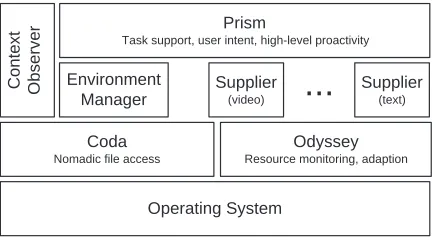
2.3.1.2 Aura Architecture
Operating System
Context Observer
Prism
Task support, user intent, high-level proactivity
Environment Manager
Supplier
(video)
Supplier
(text)
...
Coda
Nomadic file access
Odyssey
[image:52.595.212.430.139.261.2]Resource monitoring, adaption
Figure 2.1: Aura architecture.
nomadic le system. Coda also provides Aura with some support for security and privacy, in that, the data being stored is encrypted. Odyssey [137] is used to monitor resources within the environment and to adapt the conguration of Aura to maximise the use of available resources in each of the environments.
Prism, the task manager in combination with the Environment Manager and Context Observer provide the functionality for supporting the task-driven approach adopted by Aura. In each environment an instance of each of these components is provided. The Environment Manager keeps track of all the suppliers of services that are available in the environment and ensures that the most appropriate services are chosen when reconstructing a task for a user. It is also responsible for providing access to the distributed le system, Coda.
changes are observed Prism makes the necessary adjustments for the pervasive computing environment to continue to operate.
Context information is provided by the Context Observer, the design of which, is based on [80]. It uses a database abstraction, with an SQL-like query language, to retrieve context information from the environment. It provides the Aura architecture with the ability to integrate into the environment abstracting the low-level complexities of dealing with sensors and providing a high-level abstraction that can be used to query the state of the physical environment. The information gained allows Prism to adapt its behavior to suit the users in the environment.
It would also appear that Garlan et al. [56] draws on Kindberg et al.'s [86] notion of the boundary principle to scale their architecture. They dene the boundaries of an environment administratively. In practice this appears to correspond to a physical location such as a room or building. In each of these environments their exists a single instance of the architecture as described above.
2.3.1.3 Developing Pervasive Computing Environments with Aura
2.3.1.4 Summary
Aura provides a user-centric approach to the development of pervasive computing environ-ments. It pays particular attention to the migration of a user's computational presence from one environment to another. It models this presence as a series of tasks that are represented as a collection of abstract services and les. As users move into an environment their tasks move with them and are recongured to map onto the resources that are available in the environment.
2.3.2 Ambiente's Cooperative Project
Streitz et al. developed the concept of Cooperative Buildings [153] to provide exible and dynamic environments that provide cooperative workspaces supporting communication and collaboration between users. Their aim was not only to support human-computer interactions but to assist in human-human cooperation and communication by using real world artifacts as the interface to information and as the means of supporting the collaboration and commu-nication between users. iLand [154] is the realisation of this concept and provides a workspace for assisting human creativity within a meeting scenario. It uses computer-augmented objects - Roomware [153] - to provide information and support for group and individual interaction within the iLand environment. In taking this approach Streitz et al. have used a human-centered design where the human may also be part of a group or organisation.
2.3.2.1 Roomware
The concept of Roomware [153] was conceived by Streitz et al. as a way of creating exible, dynamic landscapes, that could integrate real architectural spaces with virtual information spaces in a way that supports the cooperation and communication of one human to an-other. So far Streitz et al. have created a number of Roomware components; an interactive electronic wall (DynaWall), an interactive electronic table (InteracTable), networked chairs (CommChairs), and a smaller interactive table called the ConnecTable. All of which can be seen in Figure 2.2.
Figure 2.2: Roomware: ConnecTable, CommChair, DynaWall, InteracTable.