A New Genetic Algorithm based Method for Topological
Optimization of Interconnection Networks
P. K. Tripathy
Asst. Prof., Dept. of CSE, Silicon Institute of Technology,
Silicon Hills, Bhubaneswar Odisha, India
R. K. Dash,
PhD. Reader, Dept. of CSA,College of Engineering & Technology, Bhubaneswar, Odisha, India
C. R. Tripathy,
PhD. Professor and Head,Dept. of CSE, VSS University of Technology, Burla,
Odisha, India
ABSTRACT
This paper addresses the topological optimization problem of interconnection networks where the overall cost of the network is minimized subjected to a predefined network reliability constraint. A new method based on genetic algorithm is proposed which uses more efficient encoding, cross over and mutation rate to ensure a better rate of convergence towards optimal solution. The proposed method is well equipped with some new algorithms for each of the operations stated above with suitable step wise illustration. The minimum cost of fully connected networks with up to 15 numbers of nodes and 105 numbers of links are computed with respect to different targeted values of reliability. Further the optimal layout of the interconnection networks within the above computed cost are presented that meets the network reliability constraints.
General Terms
Genetic Algorithm, Optimization , Interconnection Networks,
Keywords
Interconnection Network, Genetic Algorithm, Network Reliability, Topological Optimization.
1.
INTRODUCTION
We The design of very economical interconnection network is a complex multi constraint and multi optimization problem. Because it requires the simultaneous optimization of many objectives, they may be conflicting i.e. minimizing the cost of the network while meeting some criteria such as reliability, average delay and throughput. Out of these performance criteria the reliability may be treated as the most important performance criterion as it ensures the working of such networks in the presence of different types of failures [1]. Thus the design decision is to connect all the nodes with some known probability i.e. the network reliability while minimizing the overall cost of the network [2]. The type of topological optimization problem considering the network reliability along with other objectives such as cost is an NP-hard problem [3]. This is due to exponential growth of the solution space with respect to the size of the network. Review of literature revels mainly two approaches viz. enumerative based approach and heuristic based approach for solving this type of topological optimization problems. Some of the enumerative approaches are branch and bound [4], spanning tree [5]. The method using branch and bound technique divides the problem into several sub problems for an efficient search of the exact optimal solution. But this
The following Notations and assumptions are used throughout this paper.
Notations
ICN Completely connected interconnection network.
( , )
G N L
Probabilistic GraphG
of the given Interconnection Network having N number of nodes and L number of links.P
Populations
P
Population size
p
C
Crossover probability
Z
Objective function( )
R X
Reliability of network Xij
x
A decision variable.(1 if a link exist between node i and node j, 0 otherwise)
0
R
Minimum reliability constraint.
ij
C
Cost of the link connecting node i and j
ij
R
Reliability of link connecting node i and j
( )
f X
Fitness of the network x_
( )
Max Cost P
Maximum network cost of a population P( )
Cost X
Cost of every network x P1 and P2 Selected two networks forchromosome level cross over C1 and C2 Generated Child networks after
chromosome level cross over. Pt1; Pt2 Two nodes chosen from network
max
Cost
Maximum permissible Cost/Budget Constraint
K
The set of nodes having degree less than 2.K
The number of nodes in
K
set. NR Network ReliabilityAssumptions
1. Nodes are perfectly reliable. 2. Links are either operational or failed.
3.
Failures of links ares
-independent.
1.1
Problem Statement
An interconnection network can be modeled as a graph G (N, L), where N is the set of nodes (Stations, terminals or computer sites) and L is the communication links among them. As in practically, the nodes are far away from each other. The distance between them may vary. If the nodes of the network are fixed and the associated links are predefined, the main objective is to find out best layout of links within a minimum cost while satisfying a given reliability constraint, or mathematically the objective function is expressed as:
Minimize
Z
=1
1 1
N N
ij ij
i j i
C x
---(Eq1)
Subject to
R X
( )
R
0And degree of each node of
G
2
1.2
Fitness Function:
A network will be included in the population if it satisfies two conditions:
1. Each node of the network must have at least degree 2. 2. The computed reliability of the network must be greater
than the given value of the reliability constraint.
For the networks that satisfy the above conditions, the fitness function can be calculated as:
( )
_
( )
( )
F X
Max Cost P
Cost X
---(Eq2)2.
PROPOSED METHOD
2.1
Definitions
Definition 1. Spanning Tree is a maximal set of edges of G that contains no cycle, or as a minimal set of edges that connect all vertices.
Definition 2. A steady state is defined as the state of a system that does not change over time or in which any one change is continually balanced by another.
2.2
Encoding
The proposed method uses the following variable length integer encoding string representation:
(a)
(b)
Figure 1: (a) A fully connected network with 10 links that are labeled from 1 to 10. (b) A partially connected network with 7 links using the same labeling as (a)
Example :
Chromosome Encoding of the networks in Figure 1 are: (a) { 1, 2, 3, 4, 5, 6, 7, 8, 9, 10} and
(b) {1, 2, 4, 7, 8, 9, 10}
2.3
Initial Population
The proposed method only considers the candidate networks in the initial population that must meet the reliability constraint while minimizing the overall cost and satisfying the 2-connectivity test. Thus by enhancing the efficiency of the search for the optimal solutions.
Initial Population
Input: ICN
while (Population size is not reached) do
a) Randomly generate two spanning trees [22] from the given fully connected network b) Make it a two connected network using repair
algorithm
c) Apply crossover to generate children d) Estimate fitness of both parents and children e) Networks that satisfy the fitness criteria will
included in initial population End while
2.4
Chromosome level Cross Over
Crossover is the genetic operator that mixes two chromosomes together to form new offspring. The intuition behind crossover is exploration of new solution by exploitation of existing solutions. Chromosomes with high fitness got opportunity to be selected to take part in the crossover. The steps involved in crossover operator are present in the following algorithm:
Cross Over
Input: Networks P1 and P2
Step1 : Randomly select a common link (i ,j) from P1 and P2 and select two points Pt1 = i and Pt2 = j for cross over.
Step2 : The links adjacent to Pt1 and Pt2 in P2 are assigned to one child C1 and the links adjacent to Pt1 and Pt2 in P1 are assigned to child C2 Step3 : Determine added links
P′1 = P1- C2 and P′2 = P2- C1
Step4 : Assign C1 = C1 U P′1 and C2 = C2 U P′2
Example :
[image:3.595.98.247.69.372.2]Let
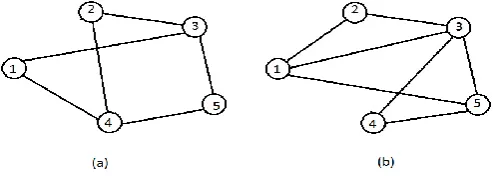
two networks P1 and P2 are selected after using some selection procedure for crossover. The two networks are shown in Figure 2.Figure 2: Two selected parent (P1 and P2) networks for crossover
Step:1 Let it chooses a common link (2,3) so the two cross over points are Pt1= 2 and Pt2=3.
Step:2 The links adjacent to Pt1 and Pt2 in P1 are P1(Pt1) = {(2,1), (2,3)} and P1(Pt2) = {(2,3), (1,3), (3,4), (3,5)}.
Similarly the links adjacent to Pt1 and Pt2 in P2 are P2(Pt1 ) ={(2,4), (2,3)} and P2(Pt2) = {(2,3), (1,3), (3,5)}.
Step:3 The Child C1 will be assigned with the adjacent links to the points of P2.
The links adjacent to the two points Pt1 and Pt2 in network P2 will be assigned to C1.
C1 = {(2,3), (2,4), (1,3), (3,5)}
Similarly the links adjacent to the two points Pt1 and Pt2 in P1 will be assigned to C2.
[image:3.595.317.564.397.486.2]The children after exchanging the links adjacent to the chosen point between P1 and P2 are shown in Figure 3.
Fig 3. The intermediate generated after applying the second step of Cross Over Algorithm on P1 and P2.
Step:4 The links that are not adjacent to the Pt1 and Pt2 in P1 will be added to C1.
Added links to C1are {(1,4), (4,5)}
The links that are not adjacent to the Pt1 and Pt2 in P2 will be added to C2.
[image:4.595.346.497.326.446.2]Added links to C2 are {(1,5), (4,5)} The new generated off springs are shown in Figure 4.
Fig 4. Two children networks C1 and C2 after applying the step 3 and step 4 of Cross Over Algorithm on P1 and P2.
2.5
Repair Algorithm
A repair algorithm is used here as mutation operator to add some additional links to the generated networks so as to satisfy the minimum 2-connectivity criteria. The updating is applied in the following steps:
Repair Algorithm
Input: G(N,L)
1. If
K
=1 then join that node with a node having least cost.2. If
K
=2 say N1 and N2 then2.1 Compute C1=The minimum cost between N1 and any other node Nk of the network.
else
2.2 Compute C2=The minimum cost between N2 and any other node NL of the network. if NL=N1 the join N1 with N2
else
2.3 Compute C=Cost between N1 and N2 if C< (C1+C2) then join N1 and N2 otherwise join N1 with Nk and N2 with NL.
3. If
K
2 thenAssign a link from ICN to the existing network by joining any two nodes of
K
-set with minimum cost.Example:
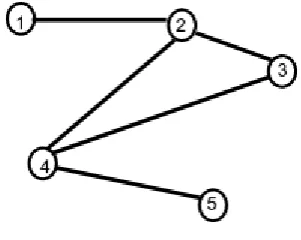
[image:4.595.49.267.377.482.2]The children networks C1 and C2 satisfy the 2-connectivity criteria. But the cases may arise where the child networks may not be a 2-connected as in Figure 5.
Figure 5: A network not satisfying the 2-connectivity criteria
The cost matrix of the above network is given below.
The network C2 does not satisfy the 2-connectivity criteria. So the Repair Algorithm is applied on C2.
In network C2, node 1 and 5 has degree less than 2, so K= {1, 5} satisfying step 2 of Repair Algorithm.
Here N1=1 and N2=5.
Step 2.1 C1=25, Nk is here N2 and Nk ≠ N5, Step 2.2 C5=29, Nk is here N3 and Nk ≠ N1, Step 2.3 C=47, and C1+C2=54
As C< C1+C2, Node N1 and N5 will be joined. Now the repaired network satisfying the minimum 2-connectivity criteria is given in Fig. 6.
25 52
36
47
65
23
40
43
29
71
Figure 6: The example given in Figure 5 after applying Repair Algorithm
2.6
Selection
[image:5.595.50.284.326.460.2]In selection only the fittest species can survive, breed and pass their genes to the next generation. The proposed method uses the Roulette Wheel selection algorithm for selecting individuals with a probability proportional to the fitness. The network reliability is computed using the method [21]. So the initial population taken for the example network (Figure 1) is given in Table I:
Table-I. Candidates of Initial Population
Network NR Cost
P1 0.957906 280
P2 0.918540 200
C1 0.957906 243
C2 0.905418 260
Applying the fitness function:
( )
_
( )
( )
F X
Max Cost P
Cost X
, ---(Eq 3) The Table-II shows the selection of candidate networks for the next generation by applying its fitness function (Eq 3).Table-II. Selection of Candidate networks based on fitness function
Network NR Cost
F X
( )
P1 0.957906 280 0
P2 0.918540 200 80
C1 0.957906 243 37
C2 0.905418 260 20
The candidate chromosomes selected for the next generation can be computed on its probability value of the fitness.
1
Pr
ii N
j j
F
F
Here the networks P2 and C1 are found to be fittest for the next generation.
2.7
Proposed algorithm
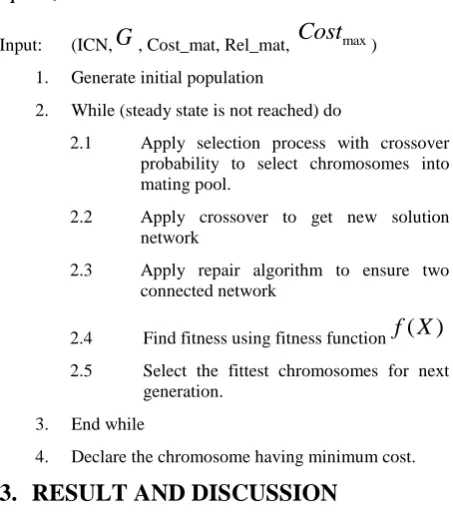
The proposed algorithm to solve optimization problem as formulated in Section 1 is presented below:
Optimize Network
Input: (ICN,
G
, Cost_mat, Rel_mat,Cost
max)1. Generate initial population
2. While (steady state is not reached) do
2.1 Apply selection process with crossover probability to select chromosomes into mating pool.
2.2 Apply crossover to get new solution network
2.3 Apply repair algorithm to ensure two connected network
2.4 Find fitness using fitness function
f X
( )
2.5 Select the fittest chromosomes for nextgeneration. 3. End while
4. Declare the chromosome having minimum cost.
3.
RESULT AND DISCUSSION
For the purpose of simulation, the following parameters are set:
Population size (Ps)=10, Crossover probability (Cp) =0.8, the mutation rates from 0.002 to 0.044 and the reliability of each link = 0.9. The costs of the links are set as per [16].
The considered mutation rate is in average smaller than its maximum value, which ensures the preservation of the original network.
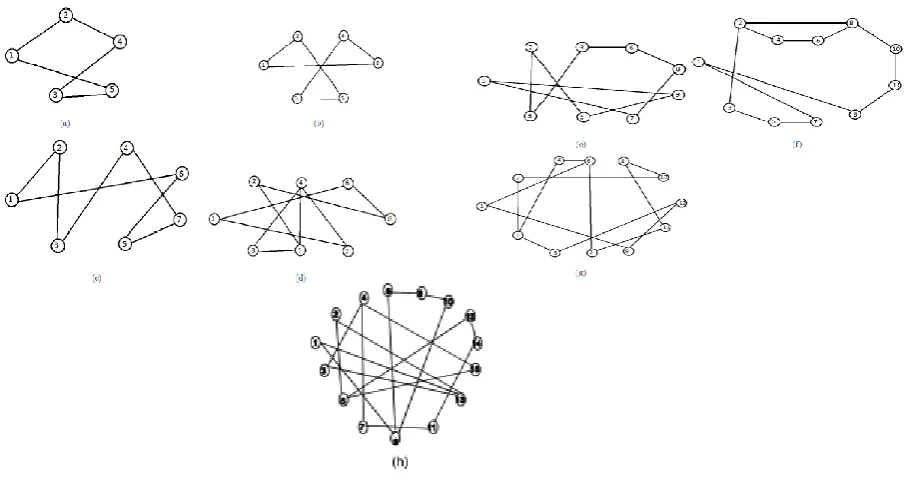
The cost of few fully connected interconnection networks having up to 15 numbers of nodes are computed under different reliability constraints (Table III).
Table-III. Application of proposed algorithm on some sample Networks
Sl.
No N
R
0Computed Optimum
Cost
Of the Network
NR of the Optimum Network
CPU Time in
sec
[16]
CPU Time in sec using proposed
method
Optimum Network obtained using proposed
method
1 5 0.9 167 0.9774075 * 11.3599 Fig. 7(a)
2 6 0.9 188 0.9672261 52.39 19.2113 Fig. 7(b)
3 7 0.9 260 0.9556194 135.98 23.9944 Fig. 7(c)
4 8 0.9 275 0.9637000 260.86 59.1566 Fig. 7(d)
5 9 0.85 295 0.9287880 378.91 102.838 Fig. 7(e)
6 11 0.85 429 0.8771490 1532.3 367.799 Fig. 7(f)
7 12 0.85 459 0.9115021 * 1098.12 Fig. 7(g)
8 15 0.9 644 0.986545 * 1205.87 Fig. 7(h)
[image:6.595.98.498.88.385.2]* Not computed in [16].
Figure 7: The optimal networks obtained after applying the proposed algorithm.
The proposed method is compared against method [16] in terms of Cpu time taken to get optimal solutions for different input networks of same interest. From this comparison it is quite clear that the proposed method requires much less Cpu time in minimizing the overall cost of the network under different reliability constraints.
[image:6.595.58.510.180.629.2] [image:6.595.59.512.408.647.2]generated in a cpu time of 1205 secs with a cost of 644 and reliability of 0.986545.
From the different observations as discussed above, it can be ensured that the proposed method generates an optimized network with a minimal computed cost while meeting the reliability constraint.
4.
CONCLUSION
This paper presents a genetic algorithm based method to address a topological optimization problem of interconnection network to minimize the overall cost of the interconnection network while satisfying some reliability constraint. The proposed method uses an efficient variable length chromosome encoding technique with chromosome level cross over to ensure a better convergence towards optimal solution i.e. generation of a network having the least cost. Further, a Repair algorithm is proposed for the situation when the generated networks are not 2-connected. The simulated results reveals the proposed method to be very efficient and less time consuming in optimizing the cost of different interconnection networks with in different reliability constraints. The works carried out in this paper can be further extended to solve similar topological optimization problems with additional complexity like network delay, throughput etc. as objective and/or constraints.
5.
ACKNOWLEDGMENTS
Sincere thanks to Mr. Ipsit Hota, student of MTech. (CS), Silicon Institute of Technology; who helped us in Matlab implementation of the proposed work. We are also thankful to the experts who have contributed towards review of our research article.
6.
REFERENCES
[1] Colbourn C. J. 1987 The Combinatorics of Network Reliability: Oxford Univ. Press.
[2] Coit D. W., Jin T. and Wattanapongsakorn N. 2004 System Optimization with Component Reliability Estimation Uncertainty: A multi-Criteria Approach, IEEE Transaction On Reliability, 53(3): 369-380. [3] Garey M. R. and Johnson D. S. 1979 Computers and
Intractability: A Guide to the Theory of NP-Completeness: W. H. Freeman & Co.
[4] Jan R. -H., Hwang F.-J., and Cheng S.-T., 1993 Topological optimization of a communication network subject to reliability constraint. J IEEE Transaction on Reliability, 42(1): 63-70.
[5] Aggarwal K. K., Chopra Y.C., and Bajwa J.S. 1982 Topological layout of links for optimizing the overall reliability in a computer communication system. J Micro electron and Reliability, 22( 3): 347-351.
[6] Coan B. A., Leland W. E., Vecchi M. P., Wwnrib A., and Wu L. T. 1991 Using distributed topology update and preplanned configurations to achieve trunk network survivability. J IEEE Transactions on Reliability, 40(4): 404-416.
[8] Rose C. 1992 Low mean intermodal distance network topologies and simulated annealing. J IEEE Transaction on Communications, 40(8): 1319-1326.
[9] Van Laarhoven P. J. M., and Aarts E. H. L. 1987 Simulated Annealing: Theory and Applications. D. Reidel, Dordrecht, Holland.
[10] AboElFotoh Hosam M. F., and Al-Sumait Loulwa S. 2001 A neural Approach to Topological Optimization of Communication Networks with Reliability Constraints. J IEEE Transactions on Reliability,50(4): 397-408. [11] Altiparmak F., Dengiz B. and Smith A. E. 2003
Reliability Estimation of Computer Communication Networks: ANN Models. Proc. Eighth IEEE international Symposium on Computers and Communication, 2: 1353-1358
[12] Ali M. K. M. and Kamoun F. 1993 Neural Networks for shortest path computation and routing in computer networks. J IEEE Transactions on Neural Networks, 4(6): 941-955.
[13] Coit D. W. and Smith A. E. 1996 Reliability Optimization of Series–Parallel Systems using a Genetic Algorithm. J Computers and Operation Research, 23(6): 515-526.
[14] Cox L. A., Davis L., and Qiu Y. 1991 Dynamic anticipatory routing in circuit-switched telecommunication networks. Handbook of Genetic Algorithms, New York: Van Nostrand Reinhold. [15] Dengiz B., Altiparmak F., and Smith A. E. 1997 Local
Search Genetic Algorithm for Optimal Design of Reliable Networks. J IEEE Transactions on Reliability,1(3):179-188.
[16] Dengiz B., Altiparmak F., and Smith A. E. 1997 Efficient Optimization of All-Terminal Reliable Networks, Using an Evolutionary Approach. J IEEE Transactions on Reliability,46(1):18-26.
[17] Marseguerra M., E. Zio, Podofillini L. 2004 Optimal reliability/availability of uncertain systems via multi objective genetic algorithm. J IEEE Transaction Reliability,53(3): 424-434.
[18] Elegbede C., Adjallah K. 2003 Availability allocation to repairable systems with genetic algorithms: a multi objective formulation. Reliability Engineering and System Safety, 82( 3): 319-330.
[19] Deb K., Jain P., Gupta N. K., Maji H.K. 2004 Multi objective placement of electronic components using evolutionary algorithms. J IEEE Transactions on Components Packaging Technology, 27(3): 480-492. [20] Kumar R., Parida P. P., Gupta M. 2002 Topological
design of communication networks using multi objective genetic optimization, Proceedings of World Congress on Computational intelligence, 1: 425-430.
[21] Tripathy P. K., Dash R. K. and Tripathy C. R. 2010 The reliability of the interconnection networks through self generating disjoint minimal cut-set method. IEEE 4th International Symposium on Advanced Networks and Telecommunication Systems (IEEE ANTS): 97-99. [22] Cormen T. H., Leiserson C. E. and Rivest R. L. 1990
Introduction to Algorithms, MIT Press.