How to cite this paper: Olkhovsky, V.S. (2014) On Time Resonances (Explosions) in High-Energy Nuclear Collisions. Open Access Library Journal, 1: e886. http://dx.doi.org/10.4236/oalib.1100886
On Time Resonances (Explosions) in
High-Energy Nuclear Collisions
V. S. Olkhovsky
Institute of Nuclear Research of NASU, Kiev, Ukraine Email: [email protected]
Received 28 July 2014; revised 18 September 2014; accepted 22 October 2014
Copyright © 2014 by author and OALib.
This work is licensed under the Creative Commons Attribution International License (CC BY).
http://creativecommons.org/licenses/by/4.0/
Abstract
The review of the results of time analysis at the range of high-energy nuclear collisions (with the bombarding-particle energies near 0.1 - 10 GeV/nucleon) is presented. It was shown that the for-mation of time resonances (explosions) in the decays of compound nuclei or final clots at the range of dense strongly overlapped energy resonances was possible. These time resonances rather well explain a lot of the experimental data.
Keywords
Time Resonance (Explosion) in Compound Nucleus Decay, High-Energy Nuclear Collision
Subject Areas: Modern Physics, Nuclear Physics
1. Introduction
OALibJ | DOI:10.4236/oalib.1100886 2 October 2014 | Volume 1 | e886 operator, canonically conjugate to the Hamiltonian. This model was only the initial step to the time-dependent approach and was not sufficiently justified.
We proposed a new version of the time-evolution approach, starting not only from the principal ideas [13], but also from the known correspondence between the exponential decreasing of behavior of any quantity in any (time or energy) representation and the Lorentzian behavior of its Fourier transformation in the canonically conjugate (i.e. energy or time) representation and then utilizing the results, obtained in [13]-[17] for the proper-ties of compound nuclei in the range of the non-resolved strongly overlapped energy resonances. Here we in-troduce concretely the phenomenon of time resonance and it is explained the similarity between energy and time resonances. Аnd also there are analyzed the energy and time properties of compound nuclei which are connected with the explosions of time resonances in the evolution decay of final particles.
2. The Theoretical Description of Time Resonances (Explosions)
Our theoretical approach is based on [18]-[20]. So far let us choose the reaction amplitude fαβ
( )
E and T-ma- trix Tαβ( )
E in such forms( )
n exp(
n 2 n)
fαβ E =Cαβ −E
τ
+iEt (1) and( )
n exp(
n 2 n)
Tαβ E =Tαβ −Eτ +iEt (1a) Here in the certain energy region Emin < < ∞E , where τn and tn are constants (with the dimension of time),
τn and tndefine the exponential dependence on energy for the corresponding cross section and the linear
depen-dence from energy for the amplitude phase, respectively. Tαβn is the constant or the very smooth function
(in-side ∆E) on energy E of the final particle. A resonant structure of Tαβn we so far do not taken evidently into
account, supposing it the totally averaged in the limits of the energy spread (or resolution) ∆E,supposing that
2 n
E τ
∆ .
In this case it is possible to write for the wave packet of final particle in one-dimensional radial asymptotic
limit
( )
( ) ( )
0
, d exp
z t E g E T E ikz iEt
β β αβ β
∞
Ψ =
∫
− the following equation(
)
(
)
(
)
min
, d exp exp n 2 n
E
R t E ikR E iE t t
β β β τ
∞
′ ′ ′
Ψ ≅
∫
− + − , (2)where Rβ is the radius of interaction in the final channel. Utilizing the simplest rectangular form of g E
( )
′ ,( ) ( )
1 2exp(
arg)
, for min 2 20, for 2 and 2
E i g E E E E E E
g E
E E E E E E
−
∆ ≤ − ∆ < ′< + ∆
′ =
′< − ∆ ′> + ∆
(3)
where argg is the smooth function of E inside ∆E we obtain
(
)
(
(
)
)
(
)
(
)
(
(
)
)
const
, exp 2
2
exp 2 2 exp 2 2 .
n n
n n
n n n n
R t E i t t
t t i
E i t t E i t t
β β τ τ
τ τ
Ψ = − + −
− +
⋅ ∆ − + − − −∆ − + −
(4)
If all energies in the large interval, beginning from Emin, are totally filled, i.е.
(
)
min
2 2 and
2 ,
n
E E
E E E
τ
+ ∆ → ∞
− ∆ →
(5)
then we arrive to
(
)
min(
(
)
)
const
, exp 2
2 n n
n n
R t E i t t
t t i
β β τ τ
Ψ = − + −
− + . (6)
OALibJ | DOI:10.4236/oalib.1100886 3 October 2014 | Volume 1 | e886 1
2
n n
t− +t iτ in (6), or explosion (for small values of τn). And inversely, if Ψβ
(
R tβ,)
has the form (6), theFourier transformation Ψβ
(
R tβ,)
will be equal(
)
(
)
[
min]
dt β R tβ, exp iEt const exp Eτn 2 iEtn E τn 2
∞
−∞
Ψ = ⋅ − + +
∫
. (7)It is proportional to the amplitude (1). Then we-write (2) in a following way:
( )
(
)
(
)
min
, d exp exp n 2 n
E
z t E ikR E iE t t
β β β τ
∞
′ ′ ′
Ψ =
∫
− + − (8)For the small energy spread
(
∆EE∆)
, utilizing the function (3) for g E( )
′ and introducing a new varia-ble(
)
(
)
2 2 2 n n n n m zi t t i
y k
m t t i
β β β τ τ − − ′ = − − −
, (9)
we finally obtain:
(
)
(
)
(
)
( )
(
)
0 0 00, for ;
, 2
const exp , for
n in
n n n
n in
z v t t t
R t iE t t t i
ikr EA t z v t t t
β β β
β τ
> − −
Ψ = − − −
⋅ − − ∆ ≤ − − (10) where
( )
02 2 .
n n n
A t = − − −t t t zβ v i−τ
The cross section has the following exponential form:
(
)
2
const exp n
f E
αβ αβ
σ = = ⋅ − τ (11)
When Tαβ or fαβ has the general form like
[
]
1 exp 2 n n n nf f E iEt
ν
αβ αβ τ
=
=
∑
− + (12)with several terms
(
ν =2, 3,)
, the cross section σ =αβ fαβ 2 contains not only exponentially decreasingterms, but also oscillating terms with factors cosE t
(
n−tn′)
or sinE t(
n−tn′)
.In the case of 2 terms(ν = 2) in (2), formula (12) transforms in the following expression
(
)
(
)
{
(
)
(
)
}
2 2
1 2 1 2
1 2 1 2 1 2
exp exp 2 Re exp 2
f E f E f f iE t t E
αβ αβ αβ αβ αβ
σ = − τ + − τ + • − − τ τ+
(13)
(where the terms with ∆E can be neglected, if we suppose that ∆EtnEτn and ∆EτnEtn.
The evolution of the survival of the compound nucleus (in the time moment t after its formation) is described by the following function:
( )
( )
0 1 d t c tL t = −
∫
tI t (14)where I(t) is defined by formula [13] [19]
( )
(
)
(
)
,
d ,
j R t
I t
t j R t
β β β β ∞ −∞ =
∫
with the probability flux density
( )
, Re( )
,2
i
j z t z t
m z
β
β β β β
β •
∂Ψ
= Ψ
∂
. The initial moment t
OALibJ | DOI:10.4236/oalib.1100886 4 October 2014 | Volume 1 | e886
0
in
t and to suppose that tin0 =0. However it is necessary to consider indeterminacy δ = ∆t E of the duration
of the initial wave packet before the collision. Therefore
0
0 n
t ≅ −t δt= − = − ∆δt E
In the region of the time resonance (10) the function L tc
( )
is essentially non exponential even in the appro- ximation t0 =0.The qualitative form of L tc( )
can be illustrated with help of the strongly simplified exam-ples, utilizing (8) for the very narrow interval near t=tn, and also for all the values of t, when(
)
(
)
(
)
2, Re , lim ,
z R i
j R t R t v R t
m β β z
β
β β β β β β
β β
•
→
∂Ψ
= Ψ ⋅ ≅ Ψ
∂
(15)
where v is defined by the integral theorem on the mean value, namely by the expression
(
)
(
)
min min
d exp n 2 d exp n 2
E E
EvA Eτ v EA Eτ
∞ ∞
− = −
∫
∫
. (16)Then
( )
(
)
(
)
(
)
(
)
(
)
(
)
1
2 2
2 2
1
2 2
4
, 1
2π
4
d , d 4
n n
n
n n
n n
t t
j R t
I t
t t
t j R t t t t
β β β β
τ
τ
τ τ
−
+∞ +∞ −
−∞ −∞
− +
= ≅ =
− +
− +
∫
∫
(17)
and
( )
( )
( )
( )
( 0)0
2
2
1 d 1 1 π arctan n n
n
y t t t c
y t
L t t I t y τ
τ = − − =
= − = − . (18)
Since the curve arctan(y) has the form, depicted in Figure 1, in the case 2t0 τ → −∞n (the quantity τn is
[image:4.595.203.422.406.566.2]small) the function L tc
( )
has the form, depicted inFigure 2 (the curve 1). [image:4.595.203.425.567.709.2]Figure 1. The function arctan(y) for 2t0/τn→ –∞.
OALibJ | DOI:10.4236/oalib.1100886 5 October 2014 | Volume 1 | e886 In this case
( )
1(
(
)
)
0
1 π arctan 2 π 2
c
n n
L t = − − t− −t t τ + (19а) and
( )
1, when 0 0(
20)
and0, when .
n n
c t t с t
L t
t
τ
≤ < = − → ∞
=
→ ∞
(19b)
From the simple form ofFigure 2, it is easy to see that tn can be interpreted as the Poincare’ period of internal
motion of the compound nucleus (after its formation and before its decay), when tn τn. Such behavior of
( )
c
L t was studied in [19] [20].
If we precisely consider the compound-resonance structure of Tαβ, then the strongly non exponential form of
( )
c
L t and I t
( )
will take place, as it is depicted inFigure 2, for the strong overlapping of the energy reson-ances, when2
JSΠ NJSΠ ρJSΠ
Γ π (20)
(ГJSПand ρJSП are the mean resonance width and level density, NJSПis the number of open channels, JSП are the
values of the total momentum, spin and parity, respectively). The small probability of the compound-nucleus decay for t<tn (inside the Poincare’ cycle) can be explained by the consequence of the multiply meta-stable states in the region of the overlapped energy resonances. In the case of several time resonances it can signify the superposition of several strongly overlapped groups of energy resonances with different values of JSП in the same compound nucleus or the formation of several compound nuclei with the different numbers of participating nucleons.
In particular, for the inclusive energy spectra of the k-th final fragment it is possible to use the following ex-pression
( )
(
)
(
)
{
(
) (
)
}
2 2
,
1
2 2
1 2 2 1 1 2
1
exp 2
exp 2 Re exp 2 .
inc k k n n n k
n
n k n k
n
E C it E
C E C C i t t E
σ τ
τ τ τ
=
∗ =
= −
= − + − − +
∑
∑
(21)
3. The Comparison with the Experimental Data
For the analysis of the observed experimental spectra of a single final fragment it is necessary to sum (or aver-age) the expressions like (13) or (21) over the subfamilies of the final states (with various quantum numbers JSΠ, where J, L, S and Π are quantum numbers of the total momentum, orbital momentum, spin and parity, re-spectively) and channels, sometimes coherently and sometimes incoherently. And for inclusive energy spectrum of k-th final fragment we will use the expression (21).
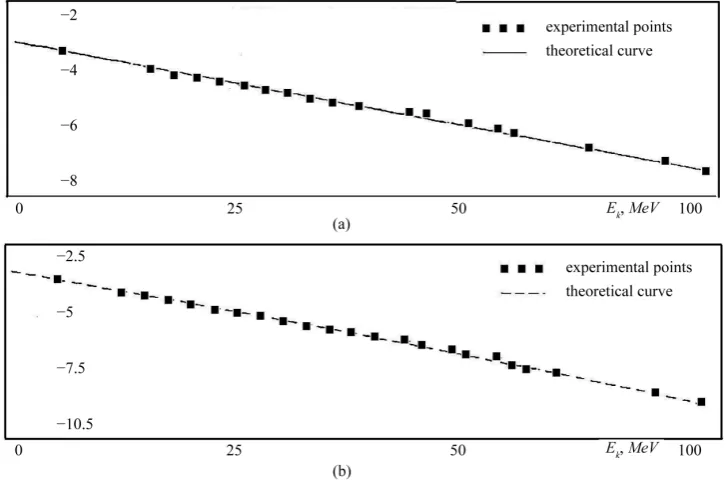
InFigures 3-6 are represented some calculated inclusive energy spectra σinc k,
( )
Ek in the semi-logarithmic scale in compare with the experimental data from [8] [10] [11]. [image:5.595.89.540.559.694.2](a) (b)
Figure 3. The inclusive process p + C →7Be +X(protons of 2.1 GeV), experimental data are taken from [10]. (a) C1 = 0.04,
OALibJ | DOI:10.4236/oalib.1100886 6 October 2014 | Volume 1 | e886
Figure 4.The inclusive process 4He + Ta → t + X(720 MeV/nucleon), experimental data are taken from [11]. (a) C1 = 0.18, C2 = 1.02 (θ= 60˚); (b) C1 = 1.13, C2 = 0.07 (θ= 90˚).
Figure 5. The inclusive process 20Ne + U → p + X(1045 MeV/nucleon), experimental data are taken from [11]. (a) C1 = 0.35, C2 = 5.65 (θ= 90˚); (b) C1 = 5.65, C2 = 0.35 (θ= 150˚).
InFigures 3-6, θ is the detected angle of k-th fragment in emission. The values of τ1, τ2 and t2 – t1, which
were found in [17] from the fitting of theoretical curves to the experimental data, are written inTable 1.
Since the inclination of energy spectra is essentially increases with the angle increasing, it signifies that the increasing contribution of the compound-nucleus states with larger values of tn and τn is connected with the
[image:6.595.130.496.369.614.2]OALibJ | DOI:10.4236/oalib.1100886 7 October 2014 | Volume 1 | e886
Figure 6. The inclusive process 40Ar + 51V → p + X(41 MeV/nucleon); experimental data are taken from [8]. (а) C1 = 0.002, C2 = 0.03 (θ= 97˚); (b) C1 = 0.03, C2 = 0.022 (θ= 129˚).
Table 1. Parameters of time resonances for some inclusive spectra.
Reaction Energy of bomb. particle
GeV/nucleon τ1, 10−23 sec τ2, 10−23 sec t2– t1, 10−22 sec
P + C →7Be + X 2.1 10.45 17.0 5.95 20Ne + Al → p + X 0.393 0.1 0.99 1.7
4He + Ta → t + X 0.72 1.72 3.15 1.22 20Ne + U → p + X 1.045 0.92 1.7 1.72 20Ar + V → p + X 0.041 7.5 9.0 0.20 132Xe + Au → p + X 0.044 6.0 7.0 1.0
20Ne + U → p + X 0.4 1.7 2.2 0.10 20Ne + U → d + X 0.25 4.2 7.2 0.10
It is possible that for the most easy compound system (p + C), represented here, there is a superposition of the direct process (i.e. n = 0 instead of n = 1) and the time resonance (n = 2), since the difference t2 – t1(0) is notice-ably larger than usually.
Later there were performed new calculations and their comparison with the experimental data. They are re- presented inFigure 7,Figure 8.
The values of τ1, τ2 and t2 – t1 in sec, which were found in [20] from the agreement of theoretical curves with
the experimental data, are represented inTable 2 forFigure 7 and in Table 3 for Figure 8, respectively.
4. The Explanation of the Time-Resonances Structure in the Cross Sections of
High-Energy Nuclear Reactions in the Region of the Densely Situated Strongly
Overlapped Energy Resonances
[image:7.595.89.541.378.522.2]OALibJ | DOI:10.4236/oalib.1100886 8 October 2014 | Volume 1 | e886
Figure 7. Inclusive energy spectrum of 4He + U → p + X, of 400 MeV/nucleon.
[image:8.595.136.493.280.504.2]Figure 8. Inclusive energy spectrum of 20Ne + U → p + X, of 400 MeV/nucleon.
Table 2. The parameters for time resonances in the case of the inclusive spectrum of 4He + U→ p + X, of 400 MeV/nucleon for different angles θ.
θ τ1 (10−23s) τ2 (10−23s) t2 – t1 (10−23s) C1 C2
30˚ 0.38 0.38 0.25 2.8 2.8
60˚ 0.64 0.64 0.25 2.6 2.6
90˚ 1.5 1.5 0.25 2.5 2.5
120˚ 2.1 2.1 0.25 2.3 2.3
At first sight, in the region of high energies the structure of energy resonances has to vanish not only due to the “smoothing” by energy spreads (since ∆EΓJSΠ,
(
)
1 JS
ρ −
Π ), but also de facto due to the strong decreasing
[image:8.595.91.539.551.631.2]OALibJ | DOI:10.4236/oalib.1100886 9 October 2014 | Volume 1 | e886
Table 3. The parameters for time resonances in the case of the inclusive spectrum of 20Ne +U→ P + X, of 400 MeV/ nucleon for different angles θ.
θ τ1 (10-23s) τ2 (10-23s) t2 – t1 (10-23s) C1 C2
30˚ 0.25 0.25 0.25 5 5
60˚ 0.6 0.6 0.25 4.5 4.5
90˚ 1.2 1.2 0.25 4.2 4.2
120˚ 1.7 1.7 0.25 3.6 3.6
saturation effects and the further strong decreasing of the densities. However namely for these energies the re-sonances of another structure can appear. These rere-sonances are connected with the local excitations of long- living intermediate many-quark-gluon states of the baryon subsystems (see [21]).
Let us consider the possibility of the abovementioned explanation of the structure of time resonances more attentively, limited ourselves only by the partial JSП-аmplitudes TαβJSΠ =
δ
αβ −SαβJSΠ, where SαβJSΠ is the ele- ment of the S-matrix.As it was said above, for the sufficiently high energies if we neglect bound and virtual states and the threshold particularities we can describe the S-matrix by the many-channel S-matrix [22] and for the simplest Baz’-New- ton conditions (see [23]) this many-channel S-matrix
( )
( )
( ) ( )( ) ( ) ( )T 1
ˆ ˆ 1 ˆ
2
J N
J J J
J J
i
S E U U
E E i
ν
ν= ν ν
Γ
= −
− + Γ
∏
, (22)where the unitary matrix Uˆ( )J and the projection matrixes Pˆν( )J (Pˆv( )J Pˆv( )J Pˆv( )J2
•
= = , Trace Pˆν( )J =1) are
practically do not depend on energy) acquires a such form:
2
ˆ ˆ ˆ 1
2
n n
b
n n n
i
S S a
i
ε ε ε ε
− − Γ
= − −
− + Γ
∏
(22a)where ˆ ˆ ˆT
b
S =UU and ˆ ˆ ˆT
ˆ
a=U P U . The averaged on energy the S-matrix Sˆ
ε
∆ in this case in accordance
with [22]:
(
)
ˆ ˆ ˆ 1 exp π
b E
S S a ρ
∆ = − − − Γ
for unresolved resonances in ( 1
E ρ−
∆ , Γ) and the fluctuating S-matrix ˆc
S (or S-matrix of the compound nucleus) is equal
(
)
2
ˆ ˆ exp π
2
c n n
n n n
i
S S S a
i
ε
ε ε ρ
ε ε ∆
− − Γ
= − = − − Γ
− + Γ
∏
(23)We repeat that Sˆb and ˆa almost do not depend on energy (slowly change with energy). For the strongly overlapped resonances when πΓρ1.
2
ˆ ˆ
2
c n n
n n n
i
S a
i
ε ε ε ε
− − Γ
→
− + Γ
∏
(23a)and the averaged over energy cross section of the processes, going through the step of formation of compound nucleus c
αβ ε
σ ∆ , is evidently proportional to aαβ 2:
2 2
c c
S a
αβ αβ αβ
ε σ
∆
∼ = (24)
(here and below we continue to omit the indexes JSΠ). If the initial energy of bombarding particles is fixed and therefore the total energy
ε
is also fixed (to within ∆ε ), the cross section (24) can be re-written in the form2 2
c c
E S a
αβ αβ αβ
ε σ
∆ ∼ ∆ ≅ , (24a)
OALibJ | DOI:10.4236/oalib.1100886 10 October 2014 | Volume 1 | e886 From [13] [19]) one can see that the averaged over energy time delay of compound nucleus and the variance of the time-delay-of-compound-nucleus distributions are defined by such general relations
2 arg c 2
c c S c
S S
E αβ
αβ αβ αβ
τ = ∂
∂
(25)
and
(
)
2 2(
)
22 2
2
2 2
arg
,
c c c
c E E c
c c
E E
S E S S E
D
S S
αβ αβ αβ
αβ αβ
αβ αβ
τ ∆ ∆ τ
∆ ∆
∂ ∂ ∂ ∂
= + − (26)
respectively (energy E is the kinetic energy of final fragment). From (23a) and (25) one can see (see also [13] [19]) that the mean time delay, averaged over all channels, is equal
(
)
2 2 2π4
c
n n n
E
τ ρ
ε ε ∆
Γ
= =
− + Γ
∑
(27)in the approximation of continuum ( d
n
ρ ε →
∑ ∫
for the quantities, averaged over energy). And Dτ
αβc in thesame continuum approximation
(
)
22 2 c E E a E D a αβ αβ αβ τ ∆ ∆ ∂ ∂
= (28)
if
(
)
(
)
2 2 2 2 , exp πc E E a E a αβ αβ
τ ρ ∆
∆
∂ ∂
− Γ (29)
Now it is possible to see the mathematical similarity (even coincidence) between the cross section of com-pound nucleus (24) under above-mentioned conditions (the Baz’-Newton condition and for the strong resonance overlapping when πΓρ1) and the time-resonance cross section (15) for a short time resonance. Therefore, returning to the expression Tαβ =δαβ −Sαβ with Sαβ →Sαφc , defined by (23а) for strongly overlapped
reson-ances (with πΓρ1), we can re-write (28) approximately in such form
( ) ( )2
(
)
exp
c n n
n
a E
αχ αβ
σ ∼ ∼ − τ (30)
(if τ > ∆n E for small ∆E).And under the same conditions
( )
24
c n
Dτ ≅ τ (31)
(here and further we write c
Dτ without indexes αβ).
If τn 2π ρ (it is possible when
1
E ρ−
∆ ), then Dτc≅
( )
τn 2 4( )
τc 2 and we have a narrow timeresonance (explosion) of the compound nucleus.
When there are some independent non-fluctuating projectors Pˆv Pˆ( ) ,v 1, 2, ,
ν η
= = (η is much lesser of
the resonance number), it is possible to obtain at the same reasoning the result like (21) for
σ
αβ with оsсillat- ing terms.Under more realistic Lyuboshitz conditions of the statistically equivalent channels of the compound-nucleus decay [14]-[16] (see also [13] [19]), when the fluctuations of Pˆn are the same in all open channels, it is possi-ble to show that
2π
c
NT
OALibJ | DOI:10.4236/oalib.1100886 11 October 2014 | Volume 1 | e886 where T = −1 exp
(
−2πρΓ N)
and the sum of last two terms in the right part of relation (26) for Dτc can be neglected in the continuum approximation. From (32) it is clear that for strongly overlapped resonances whenπρΓ N1 and T →1, we have:
2π
c
N
τ = ρ (32а)
In [13] [19] it was shown that under the same conditions and when Sb can be considered as independent from energy ε (and E), Dτc τc 2. If then one extend the Hauser-Feshbach formula for the compound- nuclear-reactions cross sections σαβc into the region of high energies, then under the same conditions it is possible to be easily convinced in such behavior of σαβc ≅N−1 ≅exp
(
−Eτn )
. Under the Lyuboshitz condi- tions for the strongly overlapped resonances, Dτc ≅( )
τn 2 4 τc 2—and the exponential decreasing ofenergy spectra of final fragments corresponds to the narrow time resonance (explosion) of the compound nuc-leus. There are possible also the cases when we can observe either one, or several time resonances (explosions) in cross sections.
5. Conclusion
The review of the results of papers [6]-[20], dedicated to time resonances (explosions) with utilization of the theoretic researches in [18]-[20] in the Simonius representation of the S-matrix [22], had been made. With rather simple assumptions it had been shown that in the region of the very dense overlapping resonances, the pheno-menon of time resonances (explosions) can well explain the experimental data for high-energy nuclear collisions even with the presence of slight oscillations in inclusive energy spectra.
References
[1] Gosset, J., Gutbrod, H., Meyer, W., et al. (1977) Central Collisions of Relativistic Heavy Ions. Physical Review C, 16, 629. http://dx.doi.org/10.1103/PhysRevC.16.629
[2] Westfall, G., Sexstro, R., Poskanzer, A., et al. (1978) Energy Spectra of Nuclear Fragments Produced by High Energy Protons. Physical Review C, 17,1368. http://dx.doi.org/10.1103/PhysRevC.17.1368
[3] Cumming, J., Haustein, P., Ruth, T., et al. (1978) Spallation of Copper by 80-GeV Ar40 Ions. Physical Review C, 17, 1632. http://dx.doi.org/10.1103/PhysRevC.17.1632
[4] Kaufman, S. and Steinberg, E. (1980) Cross-Section Measurements of Nuclides Formed by the Reaction of 0.20-6.0 GeV Protons with Au197. Physical Review C, 22,167. http://dx.doi.org/10.1103/PhysRevC.22.167
[5] Fortney, D. and Porile, N. (1980) Angular Distributions of Sc Fragments from the Interaction of U238 with 0.8-400 GeV Protons. Physical Review C, 21,2511. http://dx.doi.org/10.1103/PhysRevC.21.2511
[6] Sandoval, A., Gutbrod, H., Meyer, W., et al. (1980)Spectra of p, d, and t from Relativistic Nuclear Collisions. Phy- sical Review C, 21, 1321. http://dx.doi.org/10.1103/PhysRevC.21.1321
[7] Danielewicz, P. and Pan, O. (1992) Blast of Light Fragments from Central Heavy-Ion Collisions. Physical Review C,
46, 2002. http://dx.doi.org/10.1103/PhysRevC.46.2002
[8] Alba, R., Coniglione, R., Del Zoppo, A., et al. (1994) On the Origin of Fast Proton Emission in Intermediate Energy Heavy Ion Collisions. Physics Letters B, 322, 38-42. http://dx.doi.org/10.1016/0370-2693(94)90488-X
[9] Chen, K., Fraenkel, Z., Friedlander, G., et al. (1968) VEGAS: A Monte Carlo Simulation of Intranuclear Cascades.
Physical Review, 166, 949. http://dx.doi.org/10.1103/PhysRev.166.949
[10] Amsden, A.A., Goldhaber, A.S., Harlow, F.H. and Rayford, N.J. (1978) Relativistic Two-Fluid Model of Nucleus- Nucleus Collisions. Physical Review C, 17,2080-2096. http://dx.doi.org/10.1103/PhysRevC.17.2080
[11] Izumo, K. and Araseki, H. (1983) Time Compound Nucleus for High Energy Nuclear Reactions. Progress of Theoret-ical Physics, 69, 158-170. http://dx.doi.org/10.1143/PTP.69.158
[12] Goto, T., Yamaguchi, K. and Naka, S. (1980)The Time as an Observable in Quantum Mechanics. Progress of Theo-retical Physics, 64, 1-17. http://dx.doi.org/10.1143/PTP.64.1
[13] Olkhovsky, V.S. (1984) Investigation of Nuclear Reactions and Decays by Analysis of Their Duration. Soviet Journal of Particles and Nuclei, 15, 130-148.
OALibJ | DOI:10.4236/oalib.1100886 12 October 2014 | Volume 1 | e886
[15] Lyuboshitz, V.L. (1978) On Duration of Nuclear Reactions under Conditions of the Strong Overlapping of the Reson-ance Levels. Soviet Journal of Nuclear Physics, 27, 948-955.
[16] Lyuboshitz, V.L. (1978) Unitary Sum Rules and the Collision Time under the Strong Overlapping of the Resonance Levels. JETP Letters, 28, 32-37.
[17] D’Arrigo, A., Giardina, G., Taccone, A., Hassani, G. and Olkhovsky, V. (1993) A Way to Evaluate the Level Density, Total Width and Compound-Nucleus Decay Functions in the Range of Unresolved Resonances. International Journal of Modern Physics E, 2, 809-820.
[18] Olkhovsky, V.S. and Omelchenko, S.A. (1996) Joint Time-Evolution and Statistical Energy-Resonance Analysis of High-Energy Nuclear Collisions and Possible Phenomena of Time Resonances. In: Giardina, G., Fazio, G. and Lattua-da, M., Eds., Brolo, 15-19 October 1996, World Scientific, 410-420.
[19] Olkhovsky, V.S., Dolinska, M.E. and Omelchenko, S.A. (2012) On the Cross Section and Duration of the Neutron- Nucleus Scattering with a Resonance, Distorted by a Non-Resonant Background, in the Center-of-Mass System and Laboratory System. Proceedings of the 4th International Conference on Current Problems in Nuclear Physics and Atomic Energy, Kyiv, 3-7 September 2012, 198-201.
[20] Olkhovsky, V.S., Dolinska, M.E. and Omelchenko, S.A. (2009) Phenomena of Time Resonances Explosions for the Compound-Clot Decays in High-Energy Nuclear Reactions. 15 p.
[21] Prilepsky, Y.B. and Shmonin, V.L. (1987) On the Mechanism of Cumulative Proton and Nuclear Fragment Production.
Acta Physica Polonica B, 18, 729.
[22] Simonius, M. (1974) Overlapping Resonances and Unitarity of the Scattering Matrix. Nuclear Physics A, 218, 53-60.
http://dx.doi.org/10.1016/0375-9474(74)90019-0

![Figure 3. The inclusive process p + C → 7Be +X (protons of 2.1 GeV), experimental data are taken from [10]](https://thumb-us.123doks.com/thumbv2/123dok_us/8127243.795853/5.595.89.540.559.694/figure-inclusive-process-protons-gev-experimental-data-taken.webp)
![Figure 4. The inclusive process 4He + Ta → t + X (720 MeV/nucleon), experimental data are taken from [11]](https://thumb-us.123doks.com/thumbv2/123dok_us/8127243.795853/6.595.130.496.369.614/figure-inclusive-process-mev-nucleon-experimental-data-taken.webp)