A Novel Algorithm for Impulse Noise Removal
and Edge Detection
Akansha Mehrotra
Earthquake Engineering IIT Roorkee, Roorkee, India
Krishna Kant Singh
Earthquake Engineering IIT Roorkee, Roorkee, India
M.J.Nigam
E&C Department
Kirat Pal
Earthquake Engineering
IIT Roorkee, Roorkee, India
ABSTRACT
Edge detection of images is an important task in computer vision and image processing. Edge detection of noise free images is relatively simpler, but in most practical cases the images are degraded by noise. To find the edges from noisy images is a challenging task. This paper proposes a novel edge detection algorithm for images corrupted with noise. The algorithm finds the edges by eliminating the noise from the image so that the correct edges are determined. For making the image noise free the algorithm calculates closeness parameters, based on this parameter the noisy pixel is replaced by the most appropriate value. The edges of the noise free image are determined using morphological operators erosion and dilation. The proposed algorithm uses a combination of these operators to find the edges. This algorithm uses two different types of structuring elements so that all the edges of the image are determined efficiently.
KEYWORDS
Impulse noise , morphological operators ,edge detection.
1. INTRODUCTION
Edges in images provide low-level cues, which can be utilized in higher level processes, such as object detection, recognition, and classification, as well as motion detection, image matching, and tracking [1, 2]. Edges and textures in an image are typical examples of high-frequency information. High-pass filters remove low-frequency image information and therefore enhance high-frequency information such as edges. Many approaches to image interpretation are based on edges, since analysis based on edge detection is insensitive to change in the overall illumination level. Edge detection highlights image contrast. Detecting contrast, which is difference in intensity, can emphasize the boundaries of features within an image, since this is where image contrast occurs. This is how human vision can perceive the perimeter of an object, since the object is of different intensity to its surroundings. Edge detection is an important preprocessing step for any image processing application, object recognition and the follow-up analysis. However, the traditional edge detection method (Sobel operator, Prewitt operator, Laplacian operator, etc.) exists widespread paradox between detection accuracy and anti-noise performance[3], recently, edge detection of this problem in mathematical morphology has achieved better results. Mathematical morphology offers a set theoretic approach for image analysis [4,5].The morphological
representation and coding etc.[6]. The main morphological edge detection methods are morphological residual edge detection, top-hat method, ASF method [7], multi-scale method [8] and multi-grade method [9]. Salt-and-pepper impulse noise is one commonly encountered noise type during image and video communication [10].Salt and Pepper noise can be removed by Progressive Switching Median (PSM) filter [11], Extremum Median (EM) filter [12], Adaptive Median (AM) filter [13] and Weighted Median (WM) filter [14] and some other methods like those in [15,16,21,22]. Edge detection of noisy images is one of the challenging task in the field of image processing ,the literature survey shows that a number of algorithms have been proposed for this like [17] uses a separate wavelet based noise reduction block for preprocessing before edge detection. The morphological methods to denoise and find edges are proposed in [18,19] but they find edges in a single direction only based on its structuring element , this problem is resolved in [20] which uses eight structuring elements but it is time consuming and increases computational load.
2. PROPOSED WORK
In the proposed work a novel edge detection algorithm for noisy images is proposed. The algorithm works in two phases first it makes the image noise free and subsequently finds edges. For finding the edges regions where abrupt changes in grey level occur are to be identified.
PHASE 1: Identification of salt pepper noise: A sliding window WM of size (M+△) × (M+△), where M = 2L + 1
centered at xij (△ = 0 initially and M=3) is used for detection
of pixels as noise free and noise candidates. S is the set of noise free pixels and NC is the set containing noise candidate pixels,
𝑥𝑖𝑗 𝜖
𝑆 𝑖𝑓 min[𝑊𝑀] < 𝑥𝑖𝑗 < max[𝑊𝑀]
𝑁𝐶 𝑖𝑓 𝑥𝑖𝑗= min 𝑊𝑀 𝑜𝑟 𝑥𝑖𝑗= max 𝑊𝑀 (1)
Step 1: For the window WM, the mean of the values of the
window is calculated. While calculating the mean only those values are considered whose value lies between min[𝑊𝑀] and max[𝑊𝑀] .
Thus, the mean will be calculated as
𝛿 =1𝑛 𝑀+∆−1𝑖=0 𝑀+∆−1𝑗 =0 𝑃𝑖𝑗 ...(2)
Step 2 : Check if 𝛿= 0 , this implies that all pixels in the window have the value min[𝑊𝑀] or max[𝑊𝑀].Now two
cases arise as follows:
Case1:If min[𝑊𝑀] = max[𝑊𝑀] ,this implies that the window
contains a smooth region with all pixels in the window having the same value. Thus, 𝑥𝑖𝑗 is noise free and need not be
replaced
Case2: If min[𝑊𝑀] ≠ max[𝑊𝑀], this implies that the
window contains a cluster of noisy pixels. Thus , in this case the window size is increased by 2 (since window size should be an odd number) . So, △ = △ + 2 using this new value of △ , mean is calculated again as in step 1,this mean is known as adaptive mean.
Step 3: The next step is to find the most appropriate value which will replace the noisy pixel. For this the closeness parameter of all the pixels in the window WM , whose value
lies between min[𝑊𝑀] and max[𝑊𝑀] is calculated as
follows,
𝜎𝑐 𝑃𝑖𝑗 = (𝛿 − 𝑃𝑖𝑗) ...(3)
where i = 0,1...(M +△-1) , j = 0,1...(M +△-1) and min[𝑊𝑀] < Pij < max[𝑊𝑀]
The 𝜎𝑐 form a set 𝜎 as
𝜎 = 𝜎𝑐 ∶ 𝑐 = 0,1 … 𝑛 ... (4)
where n = number of pixels whose value lies between min[𝑊𝑀] and max[𝑊𝑀] The pixel which has the minimum
value of σc will be used to replace the noisy pixel , thus
R = 𝑃𝑖𝑗 ... (5) where 𝜎𝑐 𝑃𝑖𝑗 = min 𝜎
Thus,
𝑥𝑖𝑗 = 𝑅 … . . (6)
Step 4: The above steps are repeated for all the pixels in the set NC.
PHASE 2: Edge Detection
Once the noise free image denoted by I is obtained it can be used to detect edges. Edges can be detected using the morphological operators like erosion and dilation. Subtracting the eroded image from the original image gives the inner edges of an image while subtracting the original image from the dilated image gives the outer edges of the image. Thus, to find the edges
𝐺𝑖𝑛 = 𝐼 − (𝐼 ⊝ 𝐵) ....(7) 𝐺𝑜𝑢𝑡 = 𝐼⨁𝐵 − 𝐼 … (8) 𝐺𝑅 = 𝐼⨁𝐵 − (𝐼 ⊖ 𝐵) ...(9) But, the limitation with this technique is that it finds edges depending on the structuring element. If a single structuring element is used then some edges remain undetected. Thus, in the proposed work two structuring elements are used one for edges in vertical direction and other in horizontal direction as shown in figure 1 (a) and (b).
Figure1 (a) Horizontal structuring element Bh (b) Vertical structuring element Bv
In figure 1, „*‟ denotes a value and „●‟ denotes a 0. Using the structuring elements Bh and Bv horizontal and vertical edges
can be found as
𝐺𝑅= 𝐼⨁𝐵 − 𝐼 ⊖ 𝐵 ...(10)
and
𝐺𝑅𝑣= 𝐼⨁𝐵𝑣 − 𝐼 ⊖ 𝐵𝑣 ...(11)
The final edges are a combination of GRh and GRv , thus
𝐺𝐹= 𝐺𝑅2 + 𝐺𝑅𝑣2 ...(12)
Thus, GF contains the final edges of image I.
3. EXPERIMENTAL RESULTS
Figure 2 Standard test image LENA
(a)
(b)
(c)
(d)
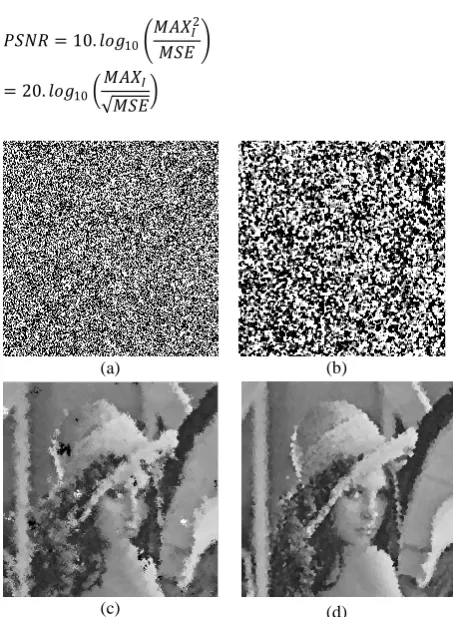
Figure 3 Restored LENA images using different filters (a) image corrupted with 30% salt pepper noise (b) SM (c)
AM (d) PA
(a) (b)
[image:3.595.318.542.72.210.2](c) (d)
Figure 4 Restored LENA images using different filters (a) image corrupted with 60% salt pepper noise (b) SM (c)
AM (d) PA
PSNR is a measure of the quality of the reconstruction; a higher PSNR would normally indicate that the reconstruction is of higher quality. It is most easily defined via the mean squared error (MSE) which for two m×n images I and K where one of the images is considered a noisy approximation of the other is defined as:
𝑀𝑆𝐸 = 𝑚𝑛1 𝑛−1[𝐼 𝑖, 𝑗 − 𝐾 𝑖, 𝑗 ]2 𝑗 =0
𝑚−1
𝑖=0 .... (13)
The PSNR is defined as:
𝑃𝑆𝑁𝑅 = 10. 𝑙𝑜𝑔10 𝑀𝐴𝑋𝐼
2 𝑀𝑆𝐸
= 20. 𝑙𝑜𝑔10
𝑀𝐴𝑋𝐼
𝑀𝑆𝐸
(a) (b)
(c) (d)
[image:3.595.54.284.204.470.2] [image:3.595.314.541.392.701.2]
Here, MAXI is the maximum possible pixel value of the
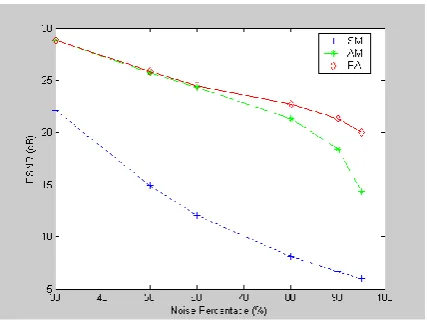
image.Table1 shows the PSNR values of three filters for different noise densities. Figure 9 shows the quantitative comparisons based on PSNR for the different filters.
(a) (b)
[image:4.595.316.544.73.325.2](c) (d)
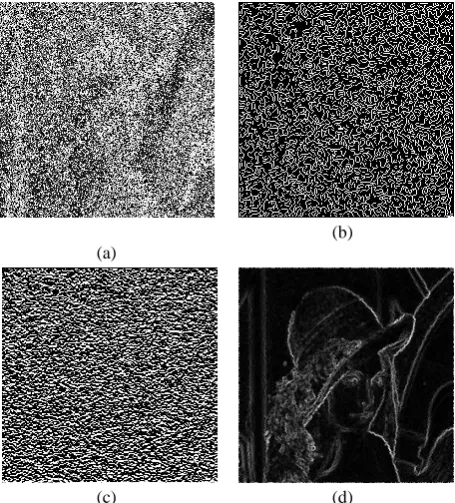
Figure 6 Edge detection using different filters (a) image corrupted with 5% salt pepper noise (b) CD (c) SO (d) PA
(a)
(b)
[image:4.595.55.283.116.358.2](c) (d)
Figure 7 Edge detection using different filters (a) image corrupted with 30% salt pepper noise (b) CD (c) SO (d)
PA
(a)
(b)
(c) (d)
Figure 8 Edge detection using different filters (a) image corrupted with 60% salt pepper noise (b) CD (c) SO (d)
PA
4. CONCLUSION
A novel algorithm for edge detection of noisy images is proposed. The algorithm first makes the image noise free with the help of a adaptive mean and closeness parameters. The noisy pixels are replaced by a value which is closest to the adaptive mean. The edges are then detected with the help of morphological operators erosion and dilation. Two different structuring elements are used so that all the edges of the image are detected efficiently. Since the proposed method employs a good identification scheme for noise pixels , it shows better performance for the noise removal and also edge detection as compared to other methods. The peak signal to noise ratio also shows improvement as compared to other methods.
TABLE1
PSNROFDIFFERENTFILTERSFORDIFFERENTNOISE DENSITIES
Noise level
Standard Median
Adaptive Median
Proposed Algorithm
30% 22.1454 28.8738 28.8784
60% 12.0530 24.3270 24.4751
80% 8.1378 21.3660 22.7459
90% 6.6231 18.3907 21.3305
[image:4.595.55.285.405.661.2] [image:4.595.295.562.570.661.2]Fig.9 Results in PSNR for different filters
5. REFERENCES
[1] H. Bay, V. Ferraris, and L. Van Gool. Wide-baseline stereo matching with line segments. IEEE Conf. on Comp. Vis. And Patt. Rec., 1:329 –336, 2005.
[2] K. Mikolajczyk, A. Zisserman, and C. Schmid. Shape recognition with edge-based features. British Mach. Vis. Conf., 2:779 – 788, 2003.
[3] Zhao CH, Zhang Q. “The edge detection of medical image based on mathematics morphological filtering operators.” Information Technology, vol.11, no.1, 2002, pp.49-50 [4] J. Serra, Image Analysis and Mathematical Morphology,
Vol. 1 and 2, Acad. Press, NY, 1983 and 1988.
[5] C. Giardina and E. Dougherty, Morphological Methods in Image andSignal Processing, Prentice Hall, Englewood Cliffs, 1988.
[6] P. Maragos and R. Schafer, "Morphological Systems for Multidimensional Signal Processing" Proc. IEEE,Vol. 78,No. 4,690-710,1990.
[7] X. Song, and Y.Neuvo, "Robust edge detection based on morphological filters", Pattern Recognition Lett., Vol. 14, 1993, pp. 889-894.
[8] B.Chanda, K.K.Malay, and Y.V.Padmaja, "A multiscale morphologic edge detection", Pattern Recognition, Vol. 31, 1998, pp. 1469-1478.
[9]M.Y.Jiang, and D.F.Yuan, "A multi-grade mean morphologic edge detection", 6th International Conference on Signal Processing, Beijing, China, 2002, pp.1079-1082.
[10] Raymond H. Chan, Chung-Wa Ho, and Mila Nikolova,“Salt-and-pepper noise removal by median-type noise detectors and detail-preserving regularization,” IEEE Transactions on Image Processing, vol. 14, no. 10, pp. 1479–1485, Oct. 2005.
[11] Z. Wang, D. Zhang, “Progressive switching median filter for the removal of impulse noise from highly corrupted images,” IEEE Transactions on Circuits and Systems, Ⅱ: Analog and Digital SignalProcessing, vol. 46, pp. 78-80, Jan. 1999.
[12] C. Xing, S. Wang, H. Deng, and Y. Luo. “A new filtering algorithmbased on extremum and median value,” Journal of Image and Graphics,vol. 6, pp. 533-536, Jun. 2001.
[13] H. Hwang, A. Haddad, “Adaptive median filters: New algorithms and results,” IEEE Transactions on Image Processing, vol. 4, pp. 499-502,Apr. 1995.
[14] D. Brownrigg, “The weighted median filter,” Communication Association Computer Machine, vol. 27, pp. 807-818, Aug. 1984.
[15] Changhong Wang , Taoyi Chen and Zhenshen Qu “A Novel Improved Median Filter for Salt-and-Pepper Noise from Highly Corrupted Images” in proc. Systems and Control in Aeronautics and Astronautics (ISSCAA), 2010 p.718 - 722
[16] Dagao Duan, Qian Mo,Yueliang Wan and Zhongming Han “A Detail Preserving Filter for Impulse Noise Removal” in Proc.ICCASM,2010,paper V2-265
[17] Feng-ying Cui , Li-jun Zou and Bei Song , “Edge Feature Extraction Based on digital Image processing techniques,”Proc. IEEE Int‟l conference Automation and logistics , Qingdao,China September 2008
[18] Chunhua Li,Kun He and Jiliu Zhou , “Edge Detection of Image on the local feature, ” Second international symposium on Intelligent technology Application 2008.
[19] Zhao Yu-qian , Gui Wei-hua , Chen Zhen-cheng , Tang Jing-tian , Li Ling-yun , “Medical images based on Mathematical Morphology, ”Proc. IEEE Engineering in Medicine and Biology 27th Annual conference ,Shanghai , China , September 1-4 , 2005.
[20] Yuqian Zhao , Weihua Gui and Zhencheng Chen “Edge Detection Based on Multi structure Elements Morphology,”Proc. IEEE Intelligent Control and Automation , June 21-23,2006,Dalian , China.
[21] Krishna Kant Singh, Akansha Mehrotra , Kirat Pal, M.J.Nigam, “A N8(P) Detail Preserving Adaptive Filter For Impulse Noise Removal” ,Proceedings IEEE, 2011 International Conference on Image Information Processing (ICIIP 2011).