http://dx.doi.org/10.4236/ijohns.2014.35055
Evaluation of Prognostic Factor for
Perforation Closure Rate in Patient with
Chronic Otitis Media
Hirokazu Katsura, Yasuo Mishiro, Miki Ikehata, Kenzo Tsuzuki, Masafumi Sakagami
Hyogo College of Medicine, Nishinomiya, Japan Email: [email protected]
Received 14July 2014; revised 15August 2014; accepted 16September 2014
Copyright © 2014 by authors and Scientific Research Publishing Inc.
This work is licensed under the Creative Commons Attribution International License (CC BY).
http://creativecommons.org/licenses/by/4.0/
Abstract
Objective: To evaluate factors affecting the perforation closure rate for perforated otitis media. Methods: Between 2008 and 2012, a total of 118 patients with perforated chronic otitis media un- derwent tympanoplasty at Hyogo College of Medicine Hospital by a single surgeon. Prognostic fac-tors were analyzed using multivariate analysis with logistic regression. Results: The success rate for tympanic perforation was 93.2%. Factors showing significance on multivariate analysis were dryness of perforation and patient age at the time of surgery. Conclusion: The results suggest that pre-surgical treatment is a key factor influencing the closure rate.
Keywords
Tympanoplasty, Underlay Method
1. Introduction
H. Katsura et al.
308
2. Material and Methods
Between 2008 and 2012, a total of 118 patients (age range, 6 - 83 years) with perforated chronic otitis media, excluding adhesion otitis media and cholesteatoma, underwent tympanoplasty at Hyogo College of Medicine Hospital. The same surgeon performed tympanoplasty under general anesthesia using the retroauricular ap-proach. Surgical procedures comprised the underlay technique, harvesting the temporalis fascia as a graft mate-rial, and application of fibrin glue [3]. We used the χ2 test to compare postoperative success rates, and logistic regression analysis to identify factors affecting reperforation. All patients were followed up for at least 1 year. The variables included in logistic regression analysis were sex (male versus female), patient age (<10 years ver-sus ≥10 years), side (right verver-sus left), laterality (bilateral verver-sus unilateral), size of perforation (<three quarters versus ≥three quarters), gelform in the middle ear space (yes versus no), otorrhea at surgery (discharge versus dry), chitin membrane (yes versus no), and methicillin-resistant Staphylococcus aureus (MRSA)-infected (yes versus no). Values of p < 0.05 were considered indicative of statistical significance. Statistical analyses were performed using Statview version 5.0 software (Hulinks, Tokyo, Japan).
3. Results
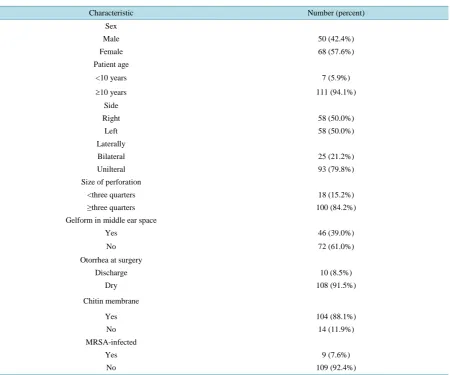
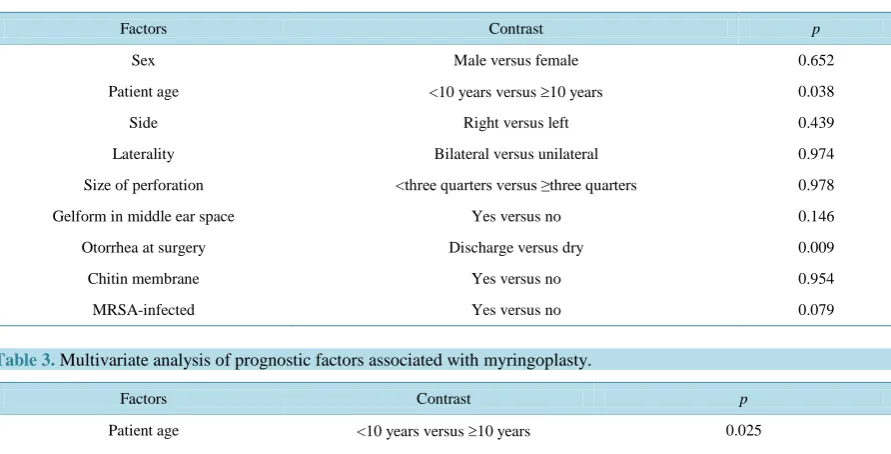
[image:2.595.88.539.347.722.2]The tympanic membrane perforation closure rate at more than 1 year after surgery was 93.2%. Demographic and clinical characteristics of the 118 patients are shown in Table 1. Results of univariate analysis of factors affect-ing the perforation closure rate usaffect-ing logistic regression analysis are shown in Table 2. The tympanic membrane perforation closure rate was higher in patients using gel form, with dry perforation and without MRSA. Presence
Table 1. Demographic and clinical characteristics of 118 patients.
Characteristic Number (percent)
Sex
Male 50 (42.4%)
Female 68 (57.6%)
Patient age
<10 years 7 (5.9%)
≥10 years 111 (94.1%)
Side
Right 58 (50.0%)
Left 58 (50.0%)
Laterally
Bilateral 25 (21.2%)
Unilteral 93 (79.8%)
Size of perforation
<three quarters 18 (15.2%)
≥three quarters 100 (84.2%)
Gelform in middle ear space
Yes 46 (39.0%)
No 72 (61.0%)
Otorrhea at surgery
Discharge 10 (8.5%)
Dry 108 (91.5%)
Chitin membrane
Yes 104 (88.1%)
No 14 (11.9%)
MRSA-infected
Yes 9 (7.6%)
of discharge in the ear and patient age were factors significantly associated with whether closure of the tympanic membrane was achieved. Results of multivariate analysis for factors affecting long-term closure using logistic regression analysis are shown in Table 3. As in univariate analysis, discharge in the ear and patient age were identified as significant factors on multivariate analysis.
4. Discussion
Successful closure of the perforation was achieved in 93.2% of the 118 ears. This success rate is comparable with results in the literatures [1][4]. Some authors have recently recommended cartilage tympanoplasty in pa-tients with high-risk perforation [5]. We also use cartilage tympanoplasty in revision cases and patients with ad-hesion otitis media, but the present study excluded utilization of cartilage, revision surgery, and cases of adhe-sion otitis media in order to perform simple analysis. In our study, all reperforation cases after surgery were found within 3 months. Albera et al. [2] reported that 89% of failures appeared within the first 3 months after surgery, including 63% within the first month. These results suggest good stability of the graft obtained by 3 months postoperatively affords good results in terms of healing of the tympanic membrane.
Controversy remains as to whether the size of perforation influences the success rate [1][2]. The transcanal method of simple underlay myringoplasty using fibrin glue was developed in Japan [3][6]. We performed the simple underlay myringoplasty using this technique only for dry, small-sized perforations. In the present study, almost all perforations were middle-sized or large and they were operated by the underlay method. Success rate thus did not differ significantly according to the size of the perforation.
Age is usually considered a major prognostic factor, and the proper age to perform myringoplasty remains controversial. Some authors have recommended performing the procedure as early as possible, while others recommend waiting until the child reaches 10 years of age, when Eustachian tube function has matured. In our previous study [7], the success rate for functional success, based on the presence of an intact membrane without adhesion or effusion, was significantly lower in children with abnormal contralateral ears. Multivariate analysis in the present study demonstrated age, but not laterality, as a significant factor, in the anatomical success of the underlay method.
[image:3.595.90.536.449.676.2]Otorrhea has previously been considered a negative prognostic factor because the mucosa is thick and micro-bial agents might reduce the ability of the graft to attach [8]. Some authors have found a significantly higher rate
Table 2. Univariate analysis of prognostic factors associated with myringoplasty.
Factors Contrast p
Sex Male versus female 0.652
Patient age <10 years versus ≥10 years 0.038
Side Right versus left 0.439
Laterality Bilateral versus unilateral 0.974
Size of perforation <three quarters versus ≥three quarters 0.978
Gelform in middle ear space Yes versus no 0.146
Otorrhea at surgery Discharge versus dry 0.009
Chitin membrane Yes versus no 0.954
MRSA-infected Yes versus no 0.079
Table 3. Multivariate analysis of prognostic factors associated with myringoplasty.
Factors Contrast p
Patient age <10 years versus ≥10 years 0.025
Gelform in middle ear space Yes versus no 0.265
Otorrhea at surgery Discharge versus dry 0.029
H. Katsura et al.
310
of graft uptake in patients who had dry ear for 3 months preoperatively [4]. Conversely, Albera [2] found no significant correlation with respect to dry ear. In our study, the only significant correlation with good outcome in both uni- and multivariate analyses was dry perforation. Our results indicate dryness of the perforation as an important predictive factor in the underlay method.
5. Conclusion
Multivariate analysis indicates dryness of perforation and patient age as important predictive factors in perform-ing the underlay method.
Acknowledgements
This study was supported by a Grant-in-Aid for Researchers, Hyogo College of Medicine, 2012.
References
[1] Nardone, M., Sommerville, R., Bowman, J. and Danesi, G. (2011) Myringoplasty in Simple Chronic Otitis Media: Crinical Analysis of Longterm Results in a 1000-Adult Patient Series. Otology Neurotology, 33, 48-53.
http://dx.doi.org/10.1097/MAO.0b013e31823dbc26
[2] Albera, R., Ferrero, V., Lacilla, M. and Canale, A. (2006) Tympanic Reperforation in Myringoplasty: Evaluation of Prognostic Factors. Annals of Otology, Rhinology, and Laryngology, 115, 875-879.
[3] Katsura, H., Sakagami, M., Tuji, K., Muto, T., Okunaka, M., Mishiro, Y., et al. (2005) Reevaluation of Bilateral Same-Day Surgery for Bilateral Perforated Choronic Otitis Media. Otology Neurotology, 26, 842-845.
http://dx.doi.org/10.1097/01.mao.0000185059.66715.e6
[4] Alub, S., Trabalzini, F. and Amadori, M. (2012) Usefullness of Cortical Mastoidectomy in Myringoplasty. Otology Neurotology, 33, 604-609. http://dx.doi.org/10.1097/MAO.0b013e31825368f2
[5] Boone, R.T., Gardner, E.K. and Dornhoffer, J.L. (2004) Succcess of Crtilage Grafting in Revision Tympanoplasty without Mastoidectomy. Otology Neurotology, 25, 678-681. http://dx.doi.org/10.1097/00129492-200409000-00006 [6] Sakagami, M., Yuasa, R. and Yuasa, Y. (2007) Simple Underlay Myringoplasty. Journal of Laryngology Otology, 121,
840-844. http://dx.doi.org/10.1017/S0022215106005561
[7] Takahasi-Tatumi, E., Mishiro, Y., Katsura, H., Sakaguchi, A. and Sakagami, M. (2013) Longitudinal Follow up after pediatric Myringoplasty: Long Term Outcome Is Defined at 12 Months. Otology Neurotology, 35, 126-128.
http://dx.doi.org/10.1097/MAO.0000000000000226