N A N O E X P R E S S
Open Access
Influence of the Shell Thickness and Ratio
Between Core Elements on Photostability
of the CdTe/CdS Core/Shell Quantum Dots
Embedded in a Polymer Matrix
Nataliia Doskaliuk, Yuriy Khalavka
*and Petro Fochuk
Abstract
This paper reports a study of photooxidation and photomodification processes of the CdTe/CdS quantum dots embedded in a polymer matrix under ambient condition. During the first few minutes of irradiation, the quasi-inverse increase in photoluminescence intensity has been observed indicating the passivation of the nanocrystal surface traps by water molecules. A prolonged irradiation of the polymer film containing CdTe/CdS quantum dots leads to a significant decrease in the photoluminescence intensity together with the“blue shift”of the photoluminescence peak energy associated with quantum dot photooxidation. The mechanisms of the CdTe/CdS core/shell quantum dot photooxidation and photomodification in a polymer matrix are discussed. We have found a correlation between the photostability of the quantum dots and the CdS shell thickness as well as the ratio of core elements.
Keywords:Quantum dots, Core/shell nanocrystals, Photoluminescence, Photooxidation, Layer-by-layer films
Background
Semiconductor nanocrystals or quantum dots (QDs) possess different optical, chemical, and electrical proper-ties from the bulk materials due to quantum confine-ment effects. QDs are highly luminescent materials with size-dependent emission and absorption spectra [1–3]. They can be used as active materials in optical and opto-electronic devices such as optical switches, sensors, and lasers [4–6]. The light-emitting diodes, lamps, and displays modified with QDs possess a significantly im-proved color quality [7–9]. A special attention should be paid to solid composites of QDs which are functional materials for luminescence solar light concentrators and spectrum converters [10–13] that are more effective and photostable than those containing organic dyes. The CdTe/CdS QDs are especially interesting in terms of creating luminescence light concentrators because they can be prepared in large quantity in water and have a high fluorescence quantum yield [14]. In addition,
CdTe/CdS QDs in aqueous solution have a large effect-ive surface charge that allows their implementation in a polymer matrix with the use of highly flexible and inex-pensive layer-by-layer electrostatic assembly [15].
Because of the fact that practical application of QDs composites is mainly related to the interaction with light, the investigation of irradiation influence on the optical properties of QDs in polymer matrix is an im-portant task. Light interaction with QDs can affect the latter in different ways. Very often, high-energy photons launch photoreactions on the surface of such nanocrys-tals. Under ambient conditions, there are two possible ways of such influence: (i) modification of nanocrystal surface leading to the increase of luminescence intensity and (ii) photooxidation of nanocrystals resulting in deg-radation of the luminescence spectra. During prolonged irradiation, the combination of both effects is expected.
The oxidation of semiconductors under the above-band irradiation occurs according to the electron-active photooxidation model which suggests the dissociation of molecular oxygen into more active atomic oxygen under the influence of excited charge carriers of QDs [16, 17]. The effect of quantum dot photooxidation has been * Correspondence:[email protected]
Department of Inorganic Chemistry of Solid State and Nanomaterials, Yuriy Fedkovych Chernivtsi National University, Kotsiubynskyi St, 2, Chernivtsi 58012, Ukraine
studied mostly on the CdSe nanocrystals. Those studies indicate the formation of CdSeOx (wherex= 2 or 3) as
the photooxidation products [18–20]. Depending on the presence of Cd-bound surface ligand, the physisorbed TeO2layer or CdO and separate TeO2 phase can form
due to nanocrystals oxidation [21, 22]. The X-ray photo-electron spectroscopy measurement of the CdTe QDs in living cells showed the additional peaks emerging and corresponding to Te–O bonds in CdTeO3after
photo-oxidation [23]. Due to the small difference between the Cd 3d peaks of CdTe and CdO (0.1 eV) with the limita-tions of the XPS resolution, the detected 0.2 eV shift to lower energy cannot give the clear evidence about the CdO formation. However, the CdO and TeO2were
sug-gested as products of CdTe QDs photooxidation [23]. Despite the fact that the semiconductor nanocrystal oxidation under irradiation is well known, approaches to design photostable QDs have not been thoroughly ex-plored. In this study, we focus on the influence of passiv-ation efficiency of CdTe core by CdS shell and the core element ratio on the photostability of CdTe/CdS QDs embedded in the polymer matrix. The photomodifica-tion of the nanocrystals causing initial increase in photo-luminescence (Pl) intensity is also discussed briefly.
Methods
Synthesis of CdTe/CdS Colloidal Solution
The CdTe QDs colloidal solutions were prepared ac-cording to a method proposed by Weller’s group [24]. The method is based on the interaction between cad-mium thioglycolate and Te2− anions in an aqueous medium. To prepare the initial precursor, aliquots of 0.01 M 3CdSO4·8H2O solution and 98 % thioglycolic
acid (TGA) from Sigma-Aldrich were mixed and the so-lution was titrated by 1 M sodium hydroxide until the pH became 11. As a Te2−source, we used electrolytically
generated hydrogen telluride which was bubbled
through the preceding solution deaerated by argon flow. The final step of the synthesis was CdS shell formation by refluxing the colloid for several hours.
The chemicals used in this study were сadmium sul-fate 8/3-hydrate salt, ≥99.0 %; thioglycolic acid ≥98 % (catalog number T3758); sodium hydroxide≥99 (S8045); and tellurium granular, 99.99 % trace metals basis (263303) all from Sigma-Aldrich.
Embedding CdTe/CdS QDs in a Polymer Film
Deposition of polymer films containing QDs was carried out on a glass substrate using layer-by-layer assembly proposed by Gero Decher [25]. This technique is based on an electrostatic assembly of oppositely charged mate-rials which are polycation poly(dimethyldiallylammo-nium chloride) (PDDA) and TGA-stabilized CdTe/CdS QDs in our case. Every QD colloidal solution was diluted
to a constant concentration of nanoparticles (2 × 10 −6
mol/l). The deposition of films was conducted auto-matically according to the scheme: “immersion of sub-strate in 0.125 % PDDA aqueous solution—washing in distilled water (1)—immersion in CdTe/CdS colloidal solution—washing in distilled water (2).”One deposition cycle corresponds to the formation of single bilayer
“PDDA—QDs” [26]. In this study, the films of 20 bilay-ers were prepared. We have obtained five series of CdTe/CdS-PDDA multilayer films containing QDs with different CdS shell thickness of three samples in each and three series of polymer films containing QDs with a different core element ratio.
The starting 20 wt% aqueous solution of poly(dial-lyldimethylammonium chloride) with the average high molecular weight 400.000–500.000 (409030) was from Sigma-Aldrich.
Film Irradiation and Photoluminescence Measurement The steady-state photoluminescence measurement was carried out using OceanOptics USB2000 array spectro-photometer. Using SpectaSuite software, we collected Pl spectra of the films and recorded the time dependence of the integrated Pl intensity measured every 10 s. Pl was measured in the course of irradiation of the films by two low pressure mercury lamps with total power of 8 W using optical fiber attached to the side of the films.
Results and Discussion
Both photomodification and photooxidation processes occur during irradiation of polymer films containing CdTe/CdS QDs with different shell thickness and core element ratio. The photomodification of QDs appears as the significant increase of the Pl integral intensity while the photooxidation is accompanied by the decrease of the Pl intensity and“blue shift”of the Pl energy (Fig. 1).
The first few minutes of irradiation lead to a 50 % in-crease of the Pl integral intensity and a remarkable“blue shift” of the Pl maximum. There are two proposed ex-planations of the QDs Pl photoactivation mechanism under short-term irradiation. Cordero et al. suggest that surface adsorbates, specifically water molecules, are re-sponsible for the initial Pl activation of CdSe QDs in monolayer Langmuir film [27]. The irradiation of the QDs monolayer has the effect of quasi-inverse H2O
absorption and the Pl spectra, the coupling between QDs increases greatly, providing alternative radiative decay channel for the excited carriers.
We assume that the main difference between those two mechanisms which can be figured out experimen-tally is the reversibility of the photomodification process. If the initial increase of the Pl intensity is associated with the coupling strengthening due to QDs oxidation, the photoactivated state should be irreversible. In contrast, reversible desorption of water molecules during irradi-ation should lead to the recovery of the initial value of intensity. In order to verify the reversibility of the initial Pl activation, we blocked the light from irradiation source when Pl intensity reached its maximum and mea-sured Pl again, after storage of the sample in the dark for 30 min. The increase of the Pl integral intensity under short-term exposure was quasi-inverse in the case of CdTe/CdS quantum dots in polymer matrix (Fig. 2a).
This observation supports the conclusion about passiv-ation of surface traps by physisorbed H2O molecules. The
presence of a large amount of H2O in PDDA-CdTe/CdS
films was confirmed by the observation of the band of asymmetric stretching of OH group in the Fourier trans-form infrared spectroscopy (FTIR) spectra at 3440 sm−1 (Fig. 2b). With each subsequent cycle of short-term expos-ure, the Pl integral intensity increases indicating the for-mation of extra surface traps. In addition, the increase of the Pl energy maximum has been observed during photo-activation (Fig. 1). Therefore, we propose that the fast oxi-dation of the most active surface center accompany the surface modification by H2O molecules. In our opinion,
the most suitable candidates for such centers are the anion vacancies or the Cd dangling bonds. The anion va-cancies oxidation is the most thermodynamically favorable process in the system and can be described by the scheme:
CdTe1‐nVTe n=CdS þ ½ O →CdTe1‐nOn=CdS ð1Þ
The CdTeOx formation can create extra non-radiative
levels in the QDs band structure resulting in the quasi-inverse Pl intensity changes during brief irradiation. The QDs surface modification by H2O molecules and the
photooxidation of nanocrystals are competing processes during the long-term irradiation, but the second one be-gins to dominate when the critical concentration of chemisorbed oxygen atoms is reached.
Further irradiation of the sample for 5 h leads to the Pl spectra degradation together with increase of the Pl energy maximum (Fig. 1). In addition, the increase in the full width at a half maximum and the degradation of the absorption spectrum have been observed indicating the photooxidation of the nanocrystals (Fig. 3).
In order to prevent such undesirable phenomena, en-hancement of the passivation efficiency of the CdTe core was proposed. As shown above, the photooxidation rate
200000 300000 400000
500000 5
4 3 2
I(Pl), counts
Irradiation time, min
1
0,0 0,5 1,0 1,5 2,0 2,5 3,0 500 1000 1500 2000 2500 3000 3500 4000 72
74 76 78 80 82
H
Wavelength, cm-1 H O
b
a
Fig. 2aIrradiation time dependence of the CdTe/CdS quantum dot photoluminescence integral intensity by each subsequent cycle of photoactivation from1to5. After reaching the maximum of photoluminescence intensity, the irradiation source was turned off. Each following curve was recorded after 30 min of storage of the sample without irradiation.bFTIR spectrum of PDDA-CdTe/CdS multilayer film
[image:3.595.57.290.88.231.2] [image:3.595.58.541.554.694.2]is much slower in the case of the CdSe/ZnS core/shell NCs compared to the CdSe nanocrystals under environ-ments containing O2 [31]. The significantly longer time
scale stability was observed in the case of CdSe/ZnS QDs with seven ZnS layers compared with those with five layers [32]. Given these results, it can be assumed that the shell thickness is an important factor that may affect the photostability of core/shell nanocrystals.
In order to investigate the influence of the CdS shell thickness on the CdTe/CdS QDs photostability, the starting colloidal solution of TGA-stabilized CdTe QDs with Cd/Te molar ratio of 1:0.3 was refluxed during 26 h with the sampling of aliquots after 0, 5, 2, 6, and 16 h. It is known that the refluxing of thiol-stabilized CdTe QDs colloidal solutions leads to cadmium-thiolates molecule hydrolysis resulting in release of S2− anions and forming of CdS shell on the Cd-reach surface of nanocrystals [33]. Therefore, the shell thickness in-creases during the thermal treatment. The growth of CdS shell can be monitored by optical spectroscopy. With increasing reflux time, the absorption and the Pl maximum shifts towards longer wavelength indicating
an increase of the QDs diameter due to the CdS shell growth (Fig. 4).
The irradiation of CdTe/CdS-PDDA multilayer films containing QDs with different CdS shell thickness has demonstrated clear correlation between their photo-stability and refluxing (core passivation) time (Fig. 5).
The rate of the Pl intensity drop decreases significantly with the increase of QDs passivation time. The first three kinetic curves corresponding to the thermal treat-ment period up to 6 h can be fit well by the biexponen-tial decay function with the average time constants 155, 230, and 255 min, respectively. Further increase of the passivation time leads to a slight and almost linear de-crease of the Pl intensity under irradiation. These facts indicate effective protection of CdTe core by CdS shell from photooxidation. We can also assume that only the CdTe core is mainly involved in the photooxidation of CdTe/CdS QDs. This assumption is based on the calcula-tion of Gibbs energy change for CdTe (ΔG=−406.7 kJ/
mol) and CdS (ΔG=−372.1 kJ/mol) oxidation
reac-tions—the oxidation of CdTe is more thermodynamically favorable. On the other side, the excited electrons in
0,0 0,1 0,2 0,3 0,4
D, arb.units
Wavelength, nm 0 min 60 min 120 min 180 min 240 min 300 min
400 450 500 550 600 0 50 100 150 200 250 300
0,11 0,12 0,13 0,14 0,15 0,16
FWHM, eV
Irradiation time, min
a
b
Fig. 3aDependence of full width at half maximum of the photoluminescence spectra of CdTe/CdS quantum dots embedded in polymer matrix on the irradiation time.bAbsorption spectra of CdTe/CdS quantum dots in polymer matrix recorded after different irradiation time
0,0 0,2 0,4 0,6 0,8 1,0 1,2
D, arb.units
Wavelength, nm 0,5 h 2 h 6 h 16 h 26 h
450 500 550 600 650 700 450 500 550 600 650 700 750 0,0
0,2 0,4 0,6 0,8 1,0
I(Pl), arb.units
Wavelength, nm 0,5 h 2 h 6 h 16 h 26 h
b
a
[image:4.595.57.540.88.232.2] [image:4.595.58.539.563.703.2]CdTe/CdS QDs are delocalized throughout all hetero-structure due to a similar value of lower occupied molecu-lar orbital of the core and shell which may promote the shell oxidation. The long refluxing and increase in the shell thickness leads to the type II heterostructure formation when the excited electrons are localized in the shell [33]. The probability of its photooxidation should in-crease in this case. In contrast, we observed the sig-nificant increase in the CdTe/CdS QDs photostability with increase in CdS shell thickness indicating the thermodynamic limitation of the photooxidation process.
The change of the Pl energy maximum under irradi-ation is also non-linear in all cases (Fig. 6a).
The best coefficient of determination was obtained by the fitting of the experimental data with monomolecular exponential growth function:
y¼A1−e−k xð−xcÞ;
where k is the rate of the Pl energy maximum shift. The rate of the Pl energy maximum shift decreases two times with the increase in the passivation time for 6 h and then remains almost unchanged (Fig. 6b).
It was suggested that the core photooxidation may be possible due to oxygen diffusion through the shell in core/shell nanocrystals [32, 34]. Due to large lattice mis-match of zinc-blende CdTe and CdS (11.3 %), the for-mation of defects such as low-angle boundaries or grain boundaries is possible that significantly accelerates the oxygen diffusion to the core. The photooxidation prod-ucts may even rupture the shell resulting in the rapid re-duction of the QDs size. We propose that at the short refluxing times, incomplete passivation of the core oc-curs similarly to the oxidation observed for the CdSe core partially coated with ZnS [18]. According to our re-sults, a complete CdS shell is formed in 6 h through refluxing. A slight photooxidation of the complete pas-sivated nanocrystals is related to the oxygen diffusion through the shell. The combination of these two pro-cesses may predetermine the biexponential Pl decay and nonlinear change of the FWHM and the Pl energy max-imum of the QDs with refluxing time of up to 6 h. The first time constant is one order less than the second in all cases. Therefore, we propose that it is related to fast photooxidation of uncovered areas of the core which are more able to the react with oxygen. At the same time, the formation of the CdO on top of those areas may pre-vent further photooxidation of QDs. The large second
0 50 100 150 200 250 300
0,2 0,4 0,6 0,8 1,0
Irradiation time, min
1 2 3 4 5
Fig. 5Irradiation time dependence of the photoluminescence integral intensity of the CdTe/CdS quantum dots with different passivation times: 1–0.5, 2–2, 3–6, 4–16, and 5–26 h. Lines are averaged through measurement of three different samples prepared with the same quantum dots and are presented witherror bars
5 6 7 8 9 10
Passivation time, hours 0 5 10 15 20 25 0 50 100 150 200 250 300
1,90 1,95 2,00 2,05 2,10 2,15 2,20 2,25 2,30
5 4 3 2
Irradiation time, min 1
b
a
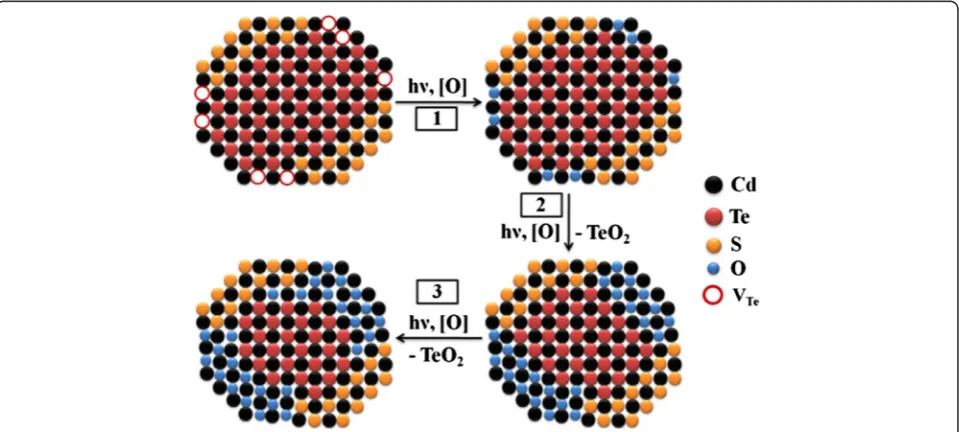
[image:5.595.58.291.87.259.2] [image:5.595.61.539.549.694.2]time constant can be attributed to the oxidation of the passivated area of the core due to the slow oxygen diffu-sion through the shell. It should be emphasized that the fast oxidation of the anion vacancies is preceded or pre-cedes (with no “by” following it) by these two stages. Hence, we can propose the three-step photooxidation model of CdTe/CdS core/shell QDs embedded in poly-mer matrix (Fig. 7).
During the first few minutes of irradiation, the fast oxidation of anion vacancies accompanied by the H2O
molecules physisorption occurs. At the second stage, the bare CdTe core is oxidized resulting in a fast Pl decay and sufficient decrease of core radii due to TeO2
forma-tion. The third photooxidation stage caused by oxygen diffusion through the shell results in a slow Pl decay and QDs radii decrease.
Taking into account that the uncovered area of CdTe core is highly reactive in the photooxidation process but optical properties of such nanocrystals are desirable in some cases, we propose to reduce the core reactivity by decreasing its defectiveness. By changing the stoichiometric composition of CdTe clusters, we can obtain the nanocrystals with different Te anion vacation concentration in the core. When the other synthesis conditions including Cd/TGA ra-tio, refluxing time, and pH remain constant, the passivation degree of this vacancies increases ap-proaching the stoichiometric Cd/Te ratio. The short-term refluxing, insufficient to complete passivation, is necessary to obtain the different anion vacancy con-centrations in the prepared CdTe/CdS QDs.
Photoinduced Pl decay curves of the CdTe/CdS QDs with different Cd/Te ratio embedded in polymer films are shown in Fig. 8.
Just like in the previous experiment, the dependence of Pl intensity on irradiation duration can be fit well by biexponential decay function with the average time con-stant 155 (curve 6), 230 (curve 7), and 255 min (curve 8). Therefore, the decrease in the Cd/Te ratio and ap-proaching to the stoichiometric core composition results in a remarkable decrease of the photooxidation rate. This observation confirms that the anion vacancies are involved in the photooxidation of the CdTe/CdS QDs in accordance with scheme 1. As has been discussed above, the vacancy oxidation occurs very fast during the first minutes of irradiation, and therefore, it does not appear on the part of kinetic curves relating to the photooxida-tion. Probably, the dependence of the photooxidation rate on the vacancies concentration is caused by forma-tion of CdTe1−nOn fragments which acts as active
cen-ters of further Te2− anions oxidation due to the shift of the electron density to oxygen and weakening of the Cd-Te bonds.
Conclusions
The photooxidation and photomodification of the CdTe/CdS quantum dots embedded in the polymer
matrix has been investigated. The quasi-inverse
photoluminescence intensity increase has been ob-served during the first few minutes of UV irradiation indicating the surface trap passivation by H2O
mole-cules accompanied by the anion vacancy oxidation.
[image:6.595.59.539.488.704.2]Further irradiation has led to quantum dot photooxi-dation manifested as a significant “blue shift” of the Pl energy maximum and the decrease in photolumi-nescence intensity. The increase in the CdS shell thickness and decrease in Cd/Te ratio lead to a sig-nificant increase in the CdTe/CdS quantum dot photostability. The three-step mechanism of CdTe/ CdS quantum dot photooxidation including anion va-cancies oxidation, oxidation of the bare core area, and slow core oxidation via oxygen diffusion through the shell has been proposed.
Abbreviations
FTIR:Fourier transform infrared spectroscopy; FWHM: full width at half maximum; PDDA: poly(dimethyldiallylammonium chloride); Pl: photoluminescence; QDs: quantum dots; TGA: thioglycolic acid.
Competing Interests
The authors declare that they have no competing interests.
Authors’Contributions
ND has conducted the synthesis ofСdTe/CdS nanocrystals and preparation of layer-by-layer films, performed the photooxidation experiments, analyzed and discussed the data, and wrote the manuscript. YK has contributed to the results discussion, photooxidation model suggestion, and the manuscript writing. PF has contributed to the results discussion and improvement of the final text of the manuscript. All authors read and approved the final manuscript.
Acknowledgements
The authors are grateful to Dr. Svitlana Filonenko for the assistance in the FTIR measurement.
Funding
This work was performed under the projects # 0115U003240 and "Optically active materials based on metallic and semiconductor nanocrystals embedded into the crystalline and amorphous matrix" with the financial support of the Ministry of Education and Science of Ukraine.
Received: 15 February 2016 Accepted: 13 April 2016
References
1. Nenadovic MT, Micic RT (1985) Size quantization in small semiconductor particles. J Phys Chem 89:397–9
2. Rossetti R, Ellison JL, Gibson JM, Brus LE (1984) Size effects in the excited electronic states of small colloidal CdS crystallites. J Chem Phys 80:4464 3. Masumoto Y, Sonobe K (1997) Size-dependent energy levels of CdTe
quantum dots. Phys Rev B 56:9734
4. Sridharan D, Waks E (2011) All-optical switch using quantum-dot saturable absorbers in a DBR microcavity. J Quantum Electron 47:31–9
5. Willard DM, Orden A (2003) Quantum dots: resonant energy-transfer sensor. Nature Materials 2:575–6
6. Henini M, Bugajski M (2005) Advances in self-assembled semiconductor quantum dot lasers. Microelectronics Journal 36:950–6
7. Sun Q, Wang YA, Li LS, Wang D, Zhu T, Xu J, Yang C, Li Y (2007) Bright, multicoloured light-emitting diodes based on quantum dots. Nature Photonics 1:717–22
8. Kim S, Imb SH, Kim SW (2013) Performance of light-emitting-diode based on quantum dots. Nanoscale 5:5205
9. Yang X, Mutlugun E, Dang C, Dev K, Gao Y, Tan ST, Sun XW, Demir HV (2014) Highly flexible, electrically driven, top-emitting, quantum dot lightemitting stickers. ACS Nano 8:8224–31
10. Kamat PV (2008) Quantum dot solar cells. Semiconductor nanocrystals as light harvesters. J Phys Chem C 112:18737–53
11. Kalytchuk S, Gupta S, Zhovtiuk O, Vaneski A, Kershaw SV, Fu H, Fan Z, Kwok ECH, Wang CF, Teoh WY, Rogach AL (2014) Semiconductor nanocrystals as luminescent down-shifting layers to enhance the efficiency of thin-film CdTe/CdS and crystalline Si solar cells. J Phys ChemС118:16393–400 12. Purcell-Milton F, Gun’ko YK (2012) Quantum dots for luminescent solar
concentrators. Mater Chem 22:16687
13. Bradshaw LR, Knowles KE, McDowall S, Gamelin DR (2015) Nanocrystals for luminescent solar concentrators. Nano Lett 15:1315–23
14. Liu YF, Yu JS (2009) Selective synthesis of CdTe and high luminescence CdTe/CdS quantum dots: the effect of ligands. J Colloid Interf Sci 333:690–8 15. Li Z, Wan S, Xu W, Wang Y, Shah BR, Jin W, Chen Y, Li B (2015) Highly
luminescent film functionalized with CdTe quantum dots by layer-by-layer assembly. J Appl Polym Sci 132:41893
16. Young EM (1988) Electron-active silicon oxidation. Appl Phys A: Solids Surf 47:259–69
17. Sato S, Nozaki S, Morisaki H (1997) Photo-oxidation of germanium nanostructures deposited by the cluster-beam evaporation technique. J Appl Phys 81:1518 18. Dabbousi BO, Rodriguez-Viejo J, Mikulec FV, Heine RJ, Mattoussi H, Ober R,
Jensen KF, Bawendi MG (1997) (СdSe)ZnS core-shell quantum dots: synthesis and characterization of a size series of highly luminescent nanocrystallites. J Phys Chem B 101:9463–75
19. Hines MA, Guyot-Sionnest P (1996) Synthesis and characterization of strongly luminescing ZnS-capped CdSe nanocrystals. J Phys Chem 100:468–71 20. Henglein A (1988) Mechanism of reactions on colloidal micro-electrodes
and size quantization effects. Top Curr Chem 143:113–80 21. Bowen Katari JE, Colvin VL, Alivisatos AP (1994) X-ray photoelectron
spectroscopy of CdSe nanocrystals with applications to studies of the nanocrystal surface. Phys Chem 98:4109–17
22. Hines DA, Becker MA, Kamat PV (2012) Photoinduced surface oxidation and its effect on the exciton dynamics of CdSe quantum dots. J Phys Chem C 116:13452–57
23. Zhang Y, He J, Wang PN, Chen JY, Lu ZJ, Lu DR, Guo J, Wang CC, Yang WL (2006) Time-dependent photoluminescence blue shift of the quantum dots in living cells: effect of oxidation by singlet oxygen. J Am Chem Soc 128: 13396–401
24. Rogach AL, Katsikas L, Kornowski A, Su D, Eychmüller A, Weller H (1996) Synthesis and characterization of thiol-stabilzed CdTe nanocrystals. Ber Bunsenges Phys Chem 100:1772–8
25. Decher G (1997) Fuzzy nanoassemblies: toward layered polymeric multicomposites. Science 277:1232–37
26. Kotov NA, DCkiiny I, Fendler JH (1995) Layer-by-layer self-assembly of polyelectrolyte-semiconductor nanoparticle composite. J Phys Chem 99: 13065–9
27. Cordero SR, Carson PJ, Estabrook RA, Strouse GF, Buratto SK (2000) Photo-activated luminescence ofСdSe quantum dot monolayers. J Phys Chem B 104:12137–42
28. Kepler KD, Lisensky GC, Patel M, Sigworth LA, Ellis AB (1995) Surface-bound carbonyl compounds as lewis acids. Photoluminescence as a probe for the
0 50 100 150 200 250 300
0,2 0,4 0,6 0,8 1,0
Irradiation time, min
6 7 8
[image:7.595.59.290.88.253.2]binding of ketones and aldehydes to cadmium sulfide and cadmium selenide surfaces. J Phys Chem 99:16011–7
29. Wang X, Zhang J, Nazzal A, Xiao M (2003) Photo-oxidation-enhanced coupling in densely packed CdSe quantum-dot films. App Phys Lett 83:162–4 30. Rogach AL, Klar TA, Lupton JM, Meijerinkd A, Feldmann J (2009) Energy
transfer with semiconductor nanocrystals. J Mater Chem 19:1208–21 31. Nazzal AY, Wang X, Qu L, Yu W, Wang Y, Peng X, Xiao M (2004)
Еnvironmental effects on photoluminescence of highly luminescent CdSe and CdSe/ZnS core/shell nanocrystals in polymer thin films. J Phys Chem B 108:5507–15
32. Sark WGJHМ, Frederix PLTM, Heuvel DJ, Gerritsen HC (2001) Photooxidation and photobleaching of single CdSe/ZnS quantum dots probed by room-temperature time-resolved spectroscopy. J Phys Chem B 105:8281–4 33. Dai MQ, Zheng W, Huang Z, Yung LYL (2012) Aqueous phase synthesis of
widely tunable photoluminescence emission CdTe/CdS core/shell quantum dots under a totally ambient atmosphere. J Mater Chem 22:16336–45 34. Sark WGJHM, Frederix PLTM, Bol AA, Gerritsen HC, Meijerink A (2002)
Blueing, bleaching, and blinking of single CdSe/ZnS quantum dots. СhemPhysChem 3:871–9
Submit your manuscript to a
journal and benefi t from:
7Convenient online submission 7Rigorous peer review
7Immediate publication on acceptance 7Open access: articles freely available online 7High visibility within the fi eld
7Retaining the copyright to your article