N A N O E X P R E S S
Open Access
A study on the effect of different chemical routes
on functionalization of MWCNTs by various
groups (-COOH, -SO
3
H, -PO
3
H
2
)
Pawan Kumar
1, Jin-Soo Park
2*, Prabhsharan Randhawa
1, Sandeep Sharma
1, Mun-Sik Shin
2and
Satpal Singh Sekhon
1*Abstract
Pristine multiwall carbon nanotubes [MWCNTs] have been functionalized with various groups (-COOH, -SO3H, -PO3H2) using different single- and double-step chemical routes. Various chemical treatments were given to MWCNTs using hydrochloric, nitric, phosphoric, and sulphuric acids, followed by a microwave treatment. The effect of the various chemical treatments and the dispersion using a surfactant via ultrasonication on the
functionalization of MWCNTs has been studied. The results obtained have been compared with pristine MWCNTs. Scanning electron microscopy, energy dispersive X-ray [EDX] spectroscopy, and transmission electron microscopy confirm the dispersion and functionalization of MWCNTs. Their extent of functionalization with -SO3H and -PO3H2 groups from the EDX spectra has been observed to be higher for the samples functionalized with a double-step chemical route and a single-step chemical route, respectively. TheID/IGratio calculated from Raman data shows a maximum defect concentration for the sample functionalized with the single-step chemical treatment using nitric acid. The dispersion of MWCNTs with the surfactant, Triton X-100, via ultrasonication helps in their unbundling, but the extent of functionalization mainly depends on the chemical route followed for their treatment. The
functionalized carbon nanotubes can be used in proton conducting membranes for fuel cells.
Keywords:functionalization, carbon nanotubes, dispersion, surfactant
Introduction
Currently, carbon nanotubes [CNTs] are the state-of-the-art materials actively studied by both experimental-ists and theoreticians because of their versatile struc-tural, electronic, mechanical, optical properties [1-3]. The pristine CNTs generally exist in bundled form due to the presence of strong Van der Waals interactions between them. In particular, these intermolecular forces of attraction are based on the pi [π] bond stacking phe-nomena between adjacent nanotubes, and there can be at least hundreds ofπstacking sites between two CNTs. Hence, intermolecular forces are very strong. CNTs should be unbundled prior to their use for any applica-tion. Dispersion of nanotubes can be achieved using
various surfactants, polymers, biomolecules, etc. via a physical or chemical method. In the case of surfactants, the surfactant groups get adsorbed onto the CNT sur-face without disturbing theπstacking system of the gra-phene sheet and result in dispersion. Out of the different surfactants being used for the dispersion of CNTs like sodium dodecylbenzenesulfonate [SDS], dodecyltrimethyl ammonium bromide, Tween 20 (Sigma-Aldrich, St. Louis, MO, USA), Tween 80 (ICI Americas, Inc., Wilmington, DE, USA), Triton X-100 (Dow Chemical Company, Midland, MI, USA), etc., the SDS and Triton X-100 have been reported to result in the minimum and the maximum dispersions of nano-tubes, respectively [4]. Triton X-100 is mainly used to disperse CNTs due to its number of advantages includ-ing a non-covalent approach for dispersion, and the pre-sence of a benzene ring in its chemical structure can be easily removed by washing. The most common approach is to disperse the CNTs in an aqueous surfactant
* Correspondence: [email protected]; [email protected]
1
Department of Physics, Guru Nanak Dev University, Amritsar, 143005, India
2Department of Environmental Engineering, College of Engineering,
Sangmyung University, Cheonan, Chungnam Province, 330-720, Republic of Korea
Full list of author information is available at the end of the article
solution, which is then subjected to ultrasonication in order to mechanically break the aggregation and even-tually yield fully separated CNTs. The surfactant mole-cules are adsorbed onto the surface of CNTs (as shown in Scheme 1, see Additional file 1), have repulsion between them, and hence help to disperse the CNTs [5]. Dispersion of CNTs depends upon a number of factors, such as the type of CNTs, their geometry, the relative ratio of CNTs, and the type of surfactant being used. After dis-persing the nanotubes, it is desirable to functionalize them with various chemical groups depending upon the applica-tion for which we want to use them.
Various chemical groups can be attached physically or chemically to the side walls or end caps of nanotubes, without significantly changing their desirable properties [6]. This process is called functionalization of nanotubes. A large number of methods are being used for the functio-nalization of CNTs, which can be broadly divided into the endohedral and exohedral methods. We have followed the exohedral mode in which the chemical groups are attached to the outer wall of the CNTs. Exohedral functio-nalization can be further subdivided into the covalent and non-covalent approaches. In the covalent approach, func-tionalization has been achieved by attaching the functional group on the side walls, end caps, or defect sites of nano-tubes with a covalent bond, whereas in the non-covalent approach, chemical groups are attached by the wrapping of polymers, biomolecules, etc. on nanotubes.
In the present study, MWCNTs have been covalently functionalized with different chemical groups (-COOH, -SO3H, -PO3H2) using various single- and double-step chemical routes. The effect of dispersion using Triton X-100 via ultrasonication, before the functionalization of CNTs, has also been studied. The defect concentration has been determined from Raman studies. The extent of functionalization with different groups has been deter-mined from the EDX results and chemical routes which results in the identification of sulfonation and phospho-nation of higher extents.
Experimental details
Multiwall carbon nanotubes [MWCNTs] (CNT M95, Carbon Nano-material Technology Co., Ltd., Pohang Si
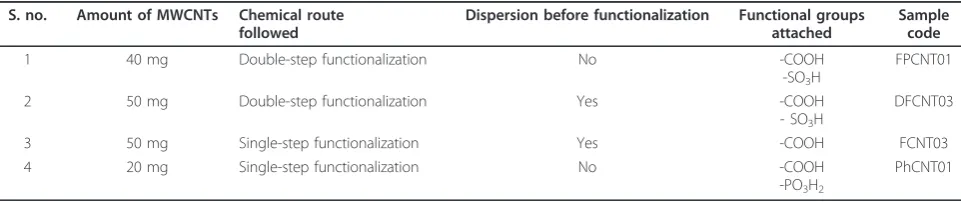
Nam-gu, Gyeongsangbuk-do, South Korea) with a dia-meter of 5 to 15 nm, a length of 10 μm, and a purity > 95% have been used as received in the present study. We have functionalized four different samples of MWCNTs. The details of these prepared samples and their codes are given in Table 1, and the methods of functionalization of each sample MWCNT are given as follows.
FPCNT01
Forty milligrams of MWCNTs had been taken, and 20 mL HNO3was added to it. The sample was refluxed for 240 min at 100°C. Furthermore, the sample was given multiple washings via centrifugation at 12, 000 rpm for 6 min (six times) and dried overnight in an oven at 60° C. For the second step of functionalization, a 1:1 v/v ratio of HNO3 and H2SO4 (15 mL each) was added to the dried sample. Microwave treatment was given for 5 min on an on/off basis. After this, 20 mL of HCl was added slowly to the sample, and it was refluxed for 60 min at an ambient temperature. In order to give the sample multiple washings, centrifugation was done at 12, 000 rpm for 6 min (six times). The functionalized sample was dried overnight in an oven at 60°C.
FCNT03
Fifty milligrams of MWCNTs had been taken and dis-persed with 1.9% Triton X-100 and 200 mL of deionized [DI] water via ultrasonication for 120 min. After this, the sample had been given multiple washings through centrifugation at 7, 000 rpm for 10 min (six times) and dried overnight in an oven at 60°C. For the functionali-zation, a 1:1 v/vratio of HNO3 and HCl (25 mL each) was added to the dried dispersed sample, and it was refluxed for 90 min at 80°C and then centrifuged at 12, 000 rpm for 10 min (six times). The functionalized sam-ple was dried overnight in an oven at 60°C.
DFCNT03
[image:2.595.57.538.630.731.2]Fifty milligrams of MWCNTs had been taken and dis-persed with 1% Triton X-100 and 200 mL DI water via ultrasonication for 60 min. After this, the sample had been given multiple washings through centrifugation at
Table 1 Sample codes
S. no. Amount of MWCNTs Chemical route followed
Dispersion before functionalization Functional groups attached
Sample code
1 40 mg Double-step functionalization No -COOH
-SO3H
FPCNT01
2 50 mg Double-step functionalization Yes -COOH
- SO3H
DFCNT03
3 50 mg Single-step functionalization Yes -COOH FCNT03
4 20 mg Single-step functionalization No -COOH
-PO3H2
12, 000 rpm for 6 min (six times) and dried overnight in an oven at 60°C. Furthermore, a 1:1v/vratio of HNO3and HCl (25 mL each) was added to the dried dispersed sam-ple, and it was refluxed at 80°C for 90 min. The sample had been given multiple washings via centrifugation at 12, 000 rpm for 6 min (six times) and dried overnight in an oven at 60°C. For the second step of functionalization, a 1:1v/vratio of HNO3and H2SO4(25 mL each) was added to the dried sample, and microwave treatment was given for 5 min on an on/off basis. After this, 30 mL HCl was added slowly to the above mixture. The sample was then refluxed for 60 min at an ambient temperature, followed by centrifugation at 12, 000 rpm for 6 min (six times). The sample was dried overnight in an oven at 60°C.
PhCNT01
Twenty milligrams of MWCNTs had been taken, and 10 mL of H3PO4was preheated at 60°C for 20 min and then added to the CNTs. Furthermore, 10 mL of HNO3 was added to the above mixture. It was mixed and refluxed at 130°C for 60 min. In order to give multiple washings, the sample was centrifuged at 12, 000 rpm for 6 min (six times) and dried overnight in an oven at 60°C.
Transmission electron microscopy
Transmission electron microscopy [TEM] (Libra 120, Carl Zeiss AG, Oberkochen, Germany) at an accelera-tion voltage of 120 kV was used to examine the size and distribution of the CNT surface of various samples. The TEM specimens were prepared by placing a few drops of the sample solution on a lacey carbon grid.
Scanning electron microscopy
Scanning electron microscopy [SEM] micrographs were obtained with a Hitachi S-4800 field-emission SEM (Hitachi High-Tech, Minato-ku, Tokyo, Japan) at an acceleration voltage of 0.5 to 30 kV. Specimens for high-resolution imaging were coated with Osmium.
Energy dispersive X-ray
The energy dispersive X-ray [EDX] (X-Max 50011, HORIBA Ltd., Minami-Ku, Kyoto, Japan) spectra were obtained to determine the elemental information on the CNT at 16 kV and 15μA.
Raman spectra
Raman spectroscopy was carried out at room tempera-ture using a FRA 106/S (BRUKER OPTIK GMBH, Ettlingen, Germany) Raman spectrometer, with a 1006-nm Nd-YAG laser and a 4-cm-1resolution.
Results and discussion
Pristine CNTs are generally chemically inert and insolu-ble in many solvents. In order to make them suitainsolu-ble for
various applications, they have to be functionalized with different groups. The functionalized CNTs are soluble in various organic solvents. The functionalization of CNTs strongly depends upon the chemical route followed. In the present study, different chemical routes have been used for the functionalization of CNTs with the -COOH, -SO3H, and -PO3H2 groups, and their effects on the functionalization have been studied. MWCNTs have been functionalized with the -COOH, -SO3H, and -PO3H2 groups using various chemical routes given in Scheme 2 (see Additional file 2):
- Single-step process (FCNT03 and PhCNT01) - Double-step process (FPCNT01 and DFCNT03) - Without dispersion with surfactant (FPCNT01 and PhCNT01)
- After dispersion with surfactant (DFCNT03 and FCNT03).
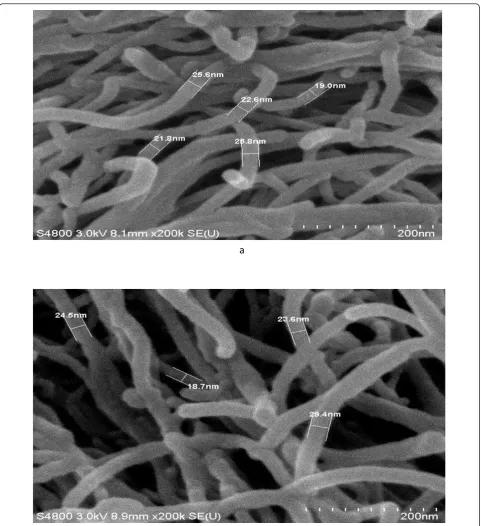
The photographs of MWCNTs before and after soni-cation are given in Figure 1. Pristine CNTs are not solu-ble in water and settle down at the bottom of the flask as observed in Figure 1. However, after sonication for one hour, CNTs are dispersed, and a uniform solution is obtained as observed in Figure 1. The dispersion of CNTs after sonication was also studied by SEM. The SEM micrographs of CNT samples before and after sonication are given in Figure 2. The SEM micrograph of pristine CNTs shows the presence of bundles and ropes of nanotubes, which have been observed to be dis-persed after sonication.
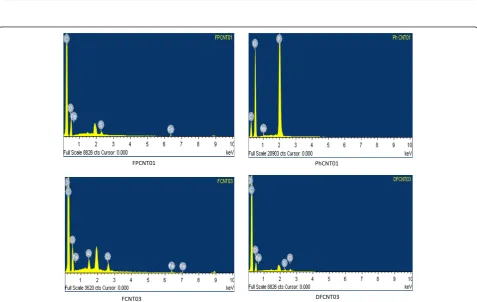
quantitative (weight and atomic percent) amounts of the different elements (C, O, S, P) present in these samples have been calculated from the EDX data, and their values are listed in Table 2. From the EDX data, it has been observed that out of the two samples, FCNT03 and PhCNT01, which have been functionalized by a sin-gle-step chemical route, sample PhCNT01 is better functionalized (phosphorus content 25 wt.%). The SEM results for this sample (Figure 3) also confirm its better functionalization. This shows that the use of H3PO4 acid for functionalizing CNTs is the most effective, and a large number of -PO3H2 groups are attached. For samples FPCNT01 and DFCNT03, which have been functionalized with the -COOH and -SO3H groups using a double-step chemical route, the EDX data show that the functionalization with the -SO3H group is bet-ter in sample FPCNT01 than in DFCNT03. The sulfur content in FPCNT01 and in FPCNT03 is 0.6 and 0.34 wt.%, respectively. This shows that the double-step che-mical route followed for the functionalization of sample
FPCNT01 is relatively more effective for the sulfonation (-SO3H) of MWCNTs, whereas the maximum phospho-nation (-PO3H2) has been achieved for sample PhCNT01 which was functionalized with a single-step chemical route. It shows that, ultimately, the more important step for functionalization of MWCNTs is the chemical route followed for their treatment even though dispersion assists in the unbundling of CNTs. Functio-nalization also assists in the dispersion of MWCNTs.
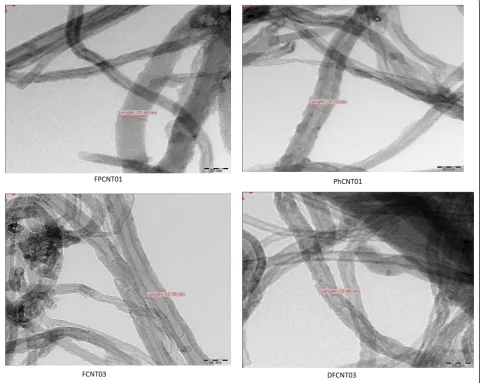
The dispersion and functionalization of MWCNTs with various groups were also confirmed by TEM stu-dies, and the TEM micrographs of the different samples are given in Figure 5. Sample FPCNT01, which has been functionalized with the -COOH and -SO3H groups, shows dispersion. Sample PhCNT01, which has been functionalized with -PO3H2groups, shows a larger func-tionalization which is also supported by the EDX results (Table 2). The TEM micrographs show that sample FPCNT01, which shows a relatively higher degree of sul-fonation (Table 2), also shows better dispersion as
[image:4.595.57.540.87.455.2]a b
compared with sample DFCNT03. Thus, for sulfonation of CNTs, the chemical route followed for the functiona-lization of sample FPCNT01 shows better results.
The chemical route followed for the functionalization of CNTs, as given in Scheme 1, involves the use of strong acids (HCl, HNO3, H2SO4, and H3PO4). These
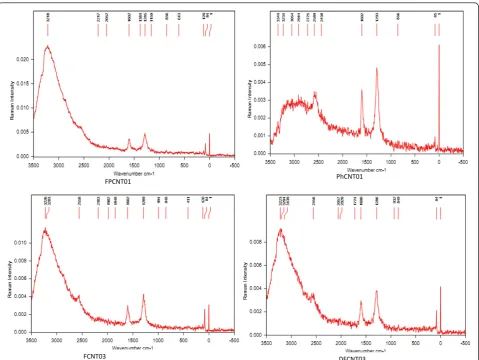
acids have been reported to damage the surface of CNTs and also create defects which generally act as potential sites for the attachment of different chemical groups. The defect concentration in CNTs can be stu-died by Raman spectroscopy. The Raman spectra of the different samples have been recorded and are shown in
a
[image:5.595.58.540.86.613.2]FPCNT01 PhCNT01
[image:6.595.58.542.87.385.2]FCNT03 DFCNT03
Figure 3SEM micrographs of different functionalized samples.
FPCNT01 PhCNT01
FCNT03 DFCNT03
[image:6.595.59.537.408.710.2]Figure 6. The most intense band near 1, 600 cm-1 is the characteristic band (G band) of graphene and is due to the in-plane vibrations of carbon atoms. The band near 1, 280 cm-1is due to the disorder or structural defects (D band) in the graphene sheet. The ratio of the intensi-ties of the D and G bands (ID/IG) is generally taken as a measure of the defect concentration. This ratio has been calculated for the different samples from the Raman data, and the values are listed in Table 3. The ratio is
highest for sample FCNT03, which shows that the che-mical route followed for the functionalization of this sample creates a larger number of defects on the surface of CNTs. Similarly, out of samples FCNT03 and DFCNT03, this ratio is higher for sample FCNT03 which also shows a higher degree of functionalization as observed from EDX results. Thus, it has been observed that the chemical route followed for the functionaliza-tion of CNTs plays an important role and must be opti-mized for proper functionalization.
Conclusions
[image:7.595.58.292.110.186.2]MWCNTs have been functionalized with different groups using various single- and double-step chemical routes. The maximum sulfonation (functionalization with -SO3H groups) has been achieved for sample FPCNT01 which was functionalized using a double-step chemical route, whereas the maximum phosphonation (functionalization with -PO3H2 groups) has been Table 2 Concentration of different elements from EDX
data
Element C O P S
Sample (w.%) (at.%) (w.%) (at.%) (w.%) (at.%) (w.%) (at.%)
FPCNT01 82 87 16 14 - - 0.60 0.24
PhCNT01 24 34 50 52 25 13 -
-FCNT03 78 83 18 15 - - -
-DFCNT03 86 89 13 10 - - 0.34 0.13
FPCNT01 PhCNT01
[image:7.595.58.543.333.716.2]FCNT03 DFCNT03
achieved for sample PhCNT01. The highest defect con-centration (ID/IG) has been observed for sample FCNT03, which has been functionalized with a single-step process using HNO3. The dispersion of CNTs using a surfactant helps in their unbundling, but the more important step is the chemical route followed for their functionalization as observed from EDX results. A proper choice of the chemical route and the amount of acid used can be helpful to control the extent of func-tionalization with various chemical groups. The
incorporation of CNTs functionalized with the -SO3H and -PO3H2 groups in sulfonated polymers can be used as high temperature fuel cell membranes.
Additional material
Additional file 1: Scheme 1. Mechanism of dispersion of CNTs [5].
Additional file 2: Scheme 2. Chemical route followed for the functionalization of different samples.
Acknowledgements
PR thanks CSIR, New Delhi for the award of SRF. This research is supported in part by the 2011 Basic Research Program of Korea Institute of Energy Research (KIER) and in part by the New and Renewable Energy of Korea Institute of Energy Technology Evaluation and Planning (KETEP) grant funded by the Korean government’s Ministry of Knowledge Economy (no. 2010T100100838).
Author details
1Department of Physics, Guru Nanak Dev University, Amritsar, 143005, India 2
Department of Environmental Engineering, College of Engineering,
FCNT03
FPCNT01 PhCNT01
[image:8.595.59.539.87.447.2]DFCNT03
Figure 6Raman spectra for different samples.
Table 3 Intensities of the G and D bands and intensity ratio (ID/IG) calculated from Raman data
Sample G band D band ID/IG
Position of
peak (cm-1) Intensity peak (cmPosition of-1) Intensity
FPCNT01 1602 0.00363 1285 0.00484 1.3333
PhCNT01 1602 0.00359 1293 0.00483 1.3454
FCNT03 1602 0.00304 1289 0.00428 1.40789
[image:8.595.58.291.645.730.2]Sangmyung University, Cheonan, Chungnam Province, 330-720, Republic of Korea
Authors’contributions
PR, PK, and SS prepared the samples. JSS and MSS helped in the
characterization studies. SSS and PR conceived the study and participated in the study and analysis. All authors contributed equally and also approved the final manuscript.
Competing interests
The authors declare that they have no competing interests.
Received: 3 August 2011 Accepted: 7 November 2011 Published: 7 November 2011
References
1. Dresselhaus MS, Dresselhaus G, Aouris P, (Eds):Carbon nanotubes: synthesis, structure, properties and applicationsNew York: Springer; 2001.
2. Iijima S:Helical microtubules of graphitic carbon.Nature1991,354:56-58. 3. Dresselhaus MS, Dresselhaus G, Jorio A:Unusual properties and structure
of carbon nanotubes.Ann Rev Mater Res2004,34:247-278. 4. Rastogi R, Kaushal R, Tripathi SK, Sharma AL, Kaur I, Bharadwaj LM:
Comparative study of carbon nanotube dispersion using surfactants.J Colloid Interface Sci2008,328:421-428.
5. Datsyuk V, Landois P, Fitremann J, Peigney A, Galibert AM, Soula B, Flahant E:Double-walled carbon nanotube dispersion via surfactant substitution.J Mater Chem2009,19:2729-2736.
6. Karousis N, Tagmatarchis N:Current progress on the chemical modification of carbon nanotubes.Chem Rev2010,110:53665397.
doi:10.1186/1556-276X-6-583
Cite this article as:Kumaret al.:A study on the effect of different chemical routes on functionalization of MWCNTs by various groups (-COOH, -SO3H, -PO3H2).Nanoscale Research Letters20116:583.
Submit your manuscript to a
journal and benefi t from:
7Convenient online submission
7 Rigorous peer review
7Immediate publication on acceptance
7 Open access: articles freely available online
7High visibility within the fi eld
7 Retaining the copyright to your article