
IJPSR (2020), Volume 11, Issue 1 (Review Article)
Received on 16 April 2019; received in revised form, 03 August 2019; accepted, 13 August 2019; published 01 January 2020
PTEN-A REVIEW
M. Mayuri 1 and G. V. Narasimha Kumar * 2
Department of Pharmacology 1, SRM College of Pharmacy, SRMIST, Kattankulathur - 603203, Tamil Nadu, India.
Department of Pharmacology 2, Drug Standardization Unit, Dr. D. P. Rastogi Central Research Institute for Homeopathy, Noida - 201301, Uttar Pradesh, India.
ABSTRACT: PTEN (phosphatase and tension homolog deleted on chromosome 10) is an important key factor in regulating intracellular for cell growth and proliferation by blocking the phosphatidylinositol -3kinase/ AKT protein kinase B (PI3K/Akt) pathway alteration in PTEN is concomitant with many diseases. PTEN is recurrently mutated in several pathological diseases which indicate its significance in general physiological activity. Various cellular proteins are initiated by phosphorylation; in contrast, PTEN is deactivated based on phosphorylation by specific kinases. Therefore, the development of therapeutic agents includes selectively targeting quickness and kinase-domain containing proteins affecting PTEN associated diseases. The present review focuses on the role of PTEN in pathological conditions and a comprehensive list of currently identified modulators of PTEN and explains potential new molecular targets which could be help in the development of drugs for the management of PTEN associated diseases like cardiovascular diseases, diabetes, obesity, cancer, autism, and Alzheimer’s diseases.
INTRODUCTION: PTEN (Phosphatase and
tension homolog deleted on chromosome 10) was initially recognized as a tumor suppressor, discovered in 1997 and it is most frequently mutated gene discovered so far in several
neoplastic diseases such as glioblastoma,
endometrial cancer, prostate cancer and some other diseases like diabetes and Alzheimer’s. Apart from its genetic alterations, PTEN expression is also affected by DNA methylation, mRNA degradation, post-translational modifications, transcription and translational regulation in the cell represents that PTEN is a highly targeted protein in many human diseases 1.
QUICK RESPONSE CODE
DOI:
10.13040/IJPSR.0975-8232.11(1).35-40
The article can be accessed online on www.ijpsr.com
DOI link: http://dx.doi.org/10.13040/IJPSR.0975-8232.11(1).35-40
PTEN is a regularly expressed protein, function as a dual function like specific protein phospholipid phosphatase. It maintains several processes and signals transduction pathway mediated through PtdIns (3,4,5) P3 has been widely considered and it shows a specific function in controlling various physiological and pathological important processes like cell proliferation, motility, cell growth, and
survival. This because of increased lipid
concentration upon exposure to various stimuli includes growth factors 2.
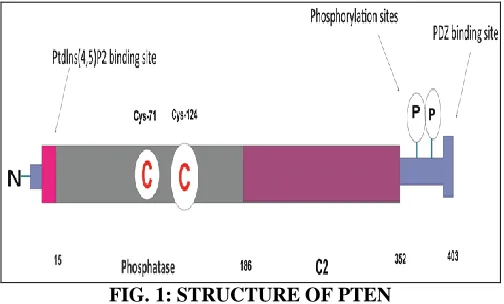
Structure of PTEN: PTEN Fig. 1 protein belongs to the PTP (protein tyrosine phosphatase) family, contains 403 amino acids. PTEN crystal structure determination revealed the N-terminal phosphate region and it strongly associated with the C-terminal (C2) domain. These two regions are combining together to form a small catalytic unit and constitute almost the complete protein 3. N-terminal chain consists of a polybasic substance where continued towards the phosphatase region.
Keywords:
PTEN, Diseases, Clinical application, Physiological
role, Therapeutic agents
Correspondence to Author: G. V. Narasimha Kumar
Department of Pharmacology, Drug Standardization Unit, Dr. D. P. Rastogi Central Research Institute for Homeopathy, Noida - 201301, Uttar Pradesh, India.
In opposite, the long C-terminal region has a group of serine and threonine residues that undergoes phosphorylation in several cells.
FIG. 1: STRUCTURE OF PTEN
Regulation of PTEN Function in Normal Cells:
Evidence of PTEN functions was being taken time to develop and show the nature of these regulatory mechanisms. Present various circumstances have been recognized, where PTEN expression is transcriptionally regulated 4. PTEN in human
Cowden disease patients shows various
developmental abnormalities and voluminous benign polyps due to the decreased expression of the PTEN protein.
It was helpful for the identification of agonist rosiglitazone as a site for the PPARγ (Peroxisome proliferator-activated receptor γ), widely used as an antidiabetic agent for the management of elevated sugar levels. In the promoter region of PTEN, where two PPARγ binding sites were recognized and PTEN expression is up-regulated in many cells in response to rosiglitazone 5. The evidence revealed that the phosphorylation of PTEN in its
C-terminal domain is quite constant and
dephosphorylation of these residues causes efficient stimulation of protein 6, 7.
Physiological Role of PTEN: The below paragraphs indicates the present studies explaining the conventional and potential new cellular functions for PTEN.
Cell Metabolism: It clearly stated the cellular
macromolecules production required being
associated with metabolic processes for cell
development. The PTEN–PI3K-AKT–mTOR
pathway plays a main part in controlling glucose absorption due to its downstream of the insulin receptor (INSR) and its adaptor molecule.
This signaling enhances insulin-mediated glucose absorption and membrane translocation of glucose transporter GLUT4 by the retardation of RAB-GTPase-activating protein (GAP) AS160 (also called as TBC1D4) 8. Furthermore, the PI3K-AKT pathway stimulates the fundamental lipogenic transcription factor sterol-regulatory element-binding protein 1C (SREBP1C). The loss of PTEN appears to produce adipogenic-like transformation in liver cells, and gene transcription occurs in lipogenesis and β-oxidation by PPARγ and SREBP1C 1.
Cell Motility and Polarity: It was illustrated that the PTEN and PtdIns (3, 4, 5) P3 have a protective role in the establishment of cell polarity in different cell types as well as neutrophils and neuron. PTEN blocks glioma cell migration and increases the effects of PI3K -independent action of PTEN on migration 9. Where, PI3K also improves membrane disarrangement, cell motility and cell spreading via downstream effectors like RHO, RAC1 and CDC42 10. During epithelial morphogenesis, PTEN restricted to the apical plasma membrane and induces the exchanging of PtdIns (3, 4, 5) P3 to PtdIns (4,5) P2 and PtdIns (4,5) P2 causes the binding of CDC42 to the partitioning defective 6
(PAR6)-atypical PKC (aPKC) complex by
initiating the annexing 2 (ANXA2) in which it promotes determination of polarity. Therefore, the loss of PTEN may slow down the development of the apical surface and lumen 11.
PTEN and Cellular Senescence: Present evidence states the important physiological functions of
cellular senescence in contrast to tumor
development and progression. Cellular aging is a programmed process which irreversibly inhibits the cell development and restricts the reflective lifetime of primary cells through the stimulation of oncogenes (a type of senescence that called as oncogene-induced senescence) or the loss of tumor inhibitor genes like PTEN, retinoblastoma-1 (RB1) and neurofibromin-1 (NF1). But, blockade of S
phase kinase-related proteins-2 (SKP2) in
lead to cell aging. Loss of PTEN promotes cellular aging (PICS) is a new approach of cellular aging, in contrast OIS and not initiate hyperproliferation or a DNA damage response 12.
Pathological Role of PTEN:
Role of PTEN in the Treatment of Type 2 Diabetes and Obesity: PTEN controls glucose uptake, where it blocks the formation of PIP3, a substrate for Akt and blockade of PTEN is identified as a potential drug target for type -II diabetes. For example, bisperoxovanadium agent (bpV), even though in nanomolar range it is reported to be efficient as PTEN inhibitors.
In hepatocyte-specific conditional PTEN null mice, PTEN is a main regulator of lipogenesis, glucose metabolism, hepatocytes homeostasis, and liver tumorigenesis. Leptin initiates phosphorylation of PTEN at C-terminal leads to the inhibition of phosphatase activity of PTEN. Specific inhibitors of CK2 and GSK3 hinder this leptin mediated phosphorylation of PTEN. This evidence shows the functions of PTEN in diabetes and obesity still is in the preliminary stage 1.
PTEN Inhibition to Prevent Heart Failure:
Retardation of PTEN functioning in the heart might provide a new therapeutic approach to decline the development of heart failure in response to pathologically induce biochemical stress. When the PTEN knockout mice were subjected to aortic banding, showed a mild decrease in systolic function with reduced ventricular dilation and heart dysfunction was observed and explaining that PTEN loss suppresses the progression of heart failure. Thus, inhibition of PTEN expression would be clinically important in the prevention of heart failure 13.
Genetic Role of PTEN in Autism: In PTEN gene, the three genetic mutations (H93R in exon4 and D252G and F241S in exon 7) have been recognized and it causes macrocephaly or an autistic syndrome. Specific deactivation of PTEN in neurons of cerebral cortex in mice caused an elevated action to sensory stimuli with neuronal hypertrophy, including hypertrophic and ectopic dendrites and axon tracts with increased synapses. This explains that an abnormality in PTEN induces macrocephaly and autistic syndrome in mice 10.
Other Diseases in which PTEN could be a Therapeutic Target: The current study also explains its role in various other diseases such as
Parkinson’s, Alzheimer’s and allergy or
inflammation. In neuronal cells, PTEN maintains neuronal insulin pathway and limits its phosphatase activity that blocks FAK/ERK signaling, where it significant for negative regulation of neuronal insulin. The increased support shows that reduce insulin signaling in the brain acts as a mediator for chronic neurodegenerative disease, it is clearly stated that regulation of PTEN could be a new approach to the management of disease 11.
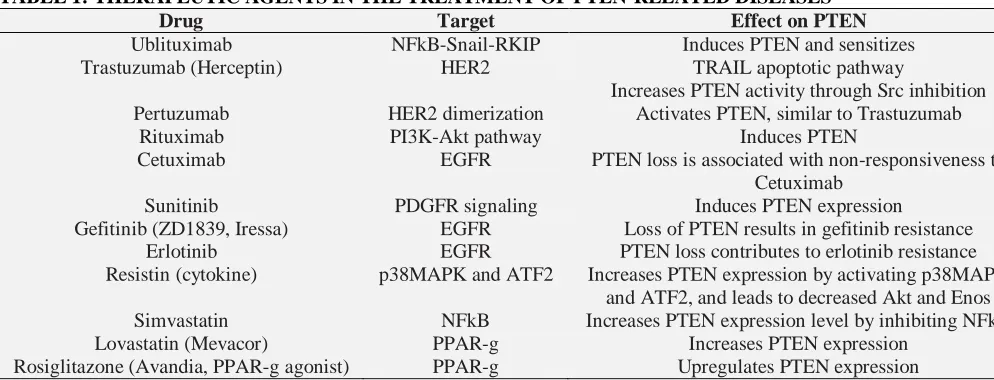
Therapeutic Inhibitors Used in the Treatment of PTEN - Related Diseases: Tyrosine kinase receptors are the growth factor receptor that mediates signals through cell survival pathways, frequently through PI3K/Akt or Ras/MEK and maintains the cell proliferation, migration, and intracellular metabolism. These kinases are targeted as a therapeutic benefit of PTEN regulation or inhibition in the management of targeted diseases. The inhibitors and Therapeutic agents used in the treatment of various PTEN-related diseases are listed in Table 1. 14
Applications of PTEN in Human Disease Therapy: The effect of PTEN is not only helped in inhibiting cancer cell growth and propagation, but also in controlling numerous cellular processes. Deactivation of PTEN is being explored as a potentially useful beneficial tool.
Nerve Regeneration and Neurosurvival-Related Diseases: Neuronal PTEN downregulates the signaling of PI3K/AKT/GSK-3β/mTORm pathway regulates axon development and nerve revival in both central and peripheral nervous system that take place during embryonic development and after the nerve damage or ischemia. Moreover, PTEN has the main function in decreasing the synaptic action mediated via NMDA and AMPA receptors. The blockage of PTEN is a sensible molecular
target to revert neurological injury under
TABLE 1: THERAPEUTIC AGENTS IN THE TREATMENT OF PTEN-RELATED DISEASES
Drug Target Effect on PTEN
Ublituximab NFkB-Snail-RKIP Induces PTEN and sensitizes
Trastuzumab (Herceptin) HER2 TRAIL apoptotic pathway
Increases PTEN activity through Src inhibition Pertuzumab HER2 dimerization Activates PTEN, similar to Trastuzumab
Rituximab PI3K-Akt pathway Induces PTEN
Cetuximab EGFR PTEN loss is associated with non-responsiveness to Cetuximab
Sunitinib PDGFR signaling Induces PTEN expression
Gefitinib (ZD1839, Iressa) EGFR Loss of PTEN results in gefitinib resistance Erlotinib EGFR PTEN loss contributes to erlotinib resistance Resistin (cytokine) p38MAPK and ATF2 Increases PTEN expression by activating p38MAPK
and ATF2, and leads to decreased Akt and Enos Simvastatin NFkB Increases PTEN expression level by inhibiting NFkB
Lovastatin (Mevacor) PPAR-g Increases PTEN expression
Rosiglitazone (Avandia, PPAR-g agonist) PPAR-g Upregulates PTEN expression
Ischemia or Reperfusion (I/R) Tissue Injury:
Ischemic reperfusion related diseases are the most common cause of deaths in humans because of tissue damage by the oxygen demand, which
activates ROS-mediated damage and
pro-inflammatory response. Where, the signaling mediated through PI3K/AKT/mTOR pathway is an important protective effect against ischemia-reperfusion associated damaged and inhibition of PTEN has been reported as a selective therapeutic involvement in I or R cardiac damage 19, 20. The treatment of bisperoxovanadium and vanadium derivatives showed protective effects against I/R cardiac damage and enhanced cardiac functions 21.
Wound Healing and Tissue Regulation: The tissue repair process is totally controlled by the PI3K/AKT/mTOR signaling pathway.
Therefore, the activity of PTEN has been related to slow down the healing process in various human cell types and rodent models such as lung epithelial damage, muscle regeneration and gastric mucosal integrity model 20.
During Infection: A negative activity for PTEN in the host protective phagocytic functions like reduced chemotaxis, employment to infected sites and Fcγ-R-mediated responses have been evaluated
through ex-vivo macrophage cell models and
myeloid cells PTEN knockout mice 22, 23, 24. This supports the possible usage of PTEN inhibitors to increase the phagocytic immune action after bacterial infection, particularly in decreased innate immune response or immune system reduction therapies 24.
Infertility: The study of acute PTEN knockout mice represents, the PTEN is needed to inhibit the stimulation of primordial ovarian follicles, not in developing follicles and failure of this PTEN activity might cause the premature ovarian failure. This proposes the potential usage of PTEN inhibition in in-vitro fertility intervention 25.
Therapy Based on Stem Cells: PTEN shows specific action in stem cell maintenance and self-renewal with specific alterations in growth and tumorigenesis 26, 27. PTEN knockout in mammalian spermatogonial stem cells resulted in enhanced
Nanog expression and in human cell
reprogramming and mouse fibroblast cells, where the PTEN role has also been documented based upon the increased generation of induced pluripotent stem cells 28, 29. This provides a possible use for PTEN inactivation in situations where bone formation and regeneration needs to be enhanced.
Cancer-Associated Diseases: Although, PTEN acts as a major tumor suppressor in various cancer types. Few shreds of evidence have underlined the feasibility of PTEN pharmacological inhibition, might be an anticancer therapeutic approach under certain condition. It has been explained that PTEN deleted prostate in mice and also in PTEN deleted MEFs or PTEN lack in human glioblastoma cell, a p53- dependent senescence program is enhanced (PTEN loss induced cellular senescence, PICS) that limits tumorigenic process 7, 30.
provides a potential therapeutic approach in the management of type-II diabetes 31, 32. Likewise, systemic decreasing PTEN levels with antisense oligonucleotides returned insulin resistance are needed to understand the regulation of PTEN expression in insulin-responsive tissues by TNFα and upon PTEN catalysis inhibition 33.
Pain Relief or Antinociception: PTEN plays a role in regulating hyperalgesia and nociception has been reported based on the results observed from rats and mouse models of migraine showed an increased mechanical threshold and minimal spinal trigeminal neuron activation upon PTEN knockout, in related with reduced tyrosine phosphorylation of the NMDA receptor 34, 35. Moreover, PTEN has been playing a crucial role in the negative regulation in the sensory of the d opioid analgesic receptor (δR) expression 36
.
CONCLUSION & FUTURE PERSPECTIVES:
PTEN is one of the most commonly mutated genes are often suppressed. Important efforts have been developing selective and biologically active PTEN inhibitors and to provide them as specific experimental and clinical interventions. It provides a molecule targeting PTEN that is commonly used in the research and also as a proof of concept where PTEN pharmacological inhibition would be useful for human welfare in most of the diseases or conditions. Further research needs to concentrate these studies will help and elucidate the exact actions of PTEN in the pathogenesis of diseases and provide a new path for early diagnosis and for recognizing of novel gene therapy approaches for treatment.
ACKNOWLEDGEMENT: I wish to thank the Department of Pharmacology, Sri Padmavathi School of Pharmacy, Tirupati, India for providing library facilities and my sincere thanks to Mr. G. V. Narasimha Kumar, for his support during review writing.
CONFLICTS OF INTEREST: There is no
conflict of interest.
REFERENCES:
1. Boosani CS and Agrawal DK: PTEN modulators: a patent review. Expert Opin Ther Pat 2013; 23: 569-80.
2. Chalhoub N and Baker SJ: PTEN and the PI3-kinase pathway in cancer. Annu Rev Pathol 2009 4: 127-50.
3. Eguez L, Lee A, Chavez JA, Miinea CP and Kane S: Full intracellular retention of GLUT4 requires AS160 Rab GTPase activating protein. Cell Metab 2005; 2: 263-72. 4. Horie Y, Suzuki A, Kataoka E, Sasaki T and Hamada K:
Hepatocyte-specific PTEN deficiency results in steatohepatitis and hepatocellular carcinomas. J Clin Invest 2004; 113: 1774-83.
5. Martin-Belmonte F, Gassama A, Datta A, Yu W and Rescher U: PTEN-mediated apical segregation of phosphoinositides controls epithelial morphogenesis through Cdc42. Cell 2007; 128: 383-97.
6. Lin H-K, Chen Z, Wang G, Nardella C and Lee SW: Skp2 targeting suppresses tumorigenesis by Arf-p53-independent cellular senescence. Nature 2010; 464: 374-9. 7. Alimonti A, Nardella C, Chen Z, Clohessy JG and
Carracedo A: A novel type of cellular senescence that can be enhanced in mouse models and human tumor xenografts to suppress prostate tumorigenesis. J Clin Invest 2010; 120: 681-93.
8. Schmid AC, Byrne RD, Vilar R and Woscholski R: Bisperoxovanadium compounds are potent PTEN inhibitors. FEBS Lett 2004; 566: 35-8.
9. Ning K, Miller LC, Laidlaw HA, Watterson KR and Gallagher J: Leptin-dependent phosphorylation of PTEN mediates actin restructuring and activation of ATP-sensitive K+ channels. J Biol Chem 2009; 284: 9331-40. 10. Kwon CH, Luikart BW, Powell CM, Zhou J and Matheny
SA: PTEN regulates neuronal arborization and social interaction in mice. Neuron 2006; 50: 377-88.
11. Gupta A and Dey CS: PTEN, a widely known negative regulator of insulin/PI3K signaling, positively regulates neuronal insulin resistance. Mol Biol Cell 2012; 23: 3882-98.
12. Sun Y, Zhang L, Chen Y, Zhan L and Gao Z: Therapeutic targets for cerebral ischemia based on the signaling pathways of the GluN2B C terminus. Stroke 2015; 46: 2347-53.
13. Oudit GY, Kassiri Z, Zhou J, Liu QC and Liu PP: Loss of PTEN attenuates the development of pathological hypertrophy and heart failure in response to biomechanical stress. Cardiovasc Res 2008; 78: 505-14.
14. Jia G, Mitra AK, Gangahar DM and Agrawal DK: Regulation of cell cycle entry by PTEN in smooth muscle cell proliferation of human coronary artery bypass conduits. J Cell Mol Med 2009; 13: 547-54.
15. Christie KJ and Zochodne D: Peripheral axon re-growth: new molecular approaches. Neurosci 2013; 240: 310-24. 16. Sun Y, Zhang L, Chen Y, Zhan L and Gao Z: Therapeutic
targets for cerebral ischemia based on the signaling pathways of the GluN2B C terminus. Stroke 2015; 46: 2347-53.
17. Chen Z, Chen B, Xu WF, Liu RF, Yang J and Yu CX: Effects of PTEN inhibition on the regulation of tau phosphorylation in an okadaic acid-induced neuro-degeneration model. Int J Dev Neurosci 2012; 30: 411-9. 18. Cui W, Wang S, Wang Z, Sun C and Zhang Y: Inhibition
of PTEN Attenuates endoplasmic reticulum stress and apoptosis via activation of PI3K/AKT pathway in Alzheimer's disease. Neurochem Res 2017; 42: 3052-60. 19. Mocanu MM and Yellon DM: PTEN, the Achilles' heel of
myocardial ischemia/reperfusion injury? Br J Pharmacol 2007; 150: 833-8.
20. Hu Z, Wang H, Lee IH, Modi S and Wang X: PTEN inhibition improves muscle regeneration in mice fed a high-fat diet. Diabetes 2010; 59: 1312-20.
hepatic ischemia/reperfusion injury. Liver Transpl 2011 17: 474-82
22. Subramanian KK, Jia Y, Zhu D, Simms BT and Jo H: Tumor suppressor PTEN is a physiologic suppressor of chemoattractant-mediated neutrophil functions. Blood 2007; 109: 4028-37.
23. Li Y, Jia Y, Pichavant M, Loison F and Sarraj B: Targeted deletion of tumor suppressor PTEN augments neutrophil function and enhances host defense in neutropenia-associated pneumonia. Blood 2009; 113: 4930-41. 24. Canetti C, Serezani CH, Atrasz RG, White ES, Aronoff
DM and Peters-Golden M: Activation of phosphatase and tensin homolog on chromosome 10 mediates the inhibition of FcgammaR phagocytosis by prostaglandin E2 in alveolar macrophages. J Immunol 2007; 179: 8350-6. 25. Pulido R: PTEN inhibition in human disease therapy.
Molecules 2018; 23.
26. Ciuffreda L, Falcone I, Incani UC, Del Curatolo A and Conciatori F: PTEN expression and function in adult cancer stem cells and prospects for therapeutic targeting. Adv Biol Regul 2014; 56: 66-80.
27. Hill R and Wu H: PTEN, stem cells, and cancer stem cells. J Biol Chem 2009; 284: 11755-9.
28. Liao J, Marumoto T, Yamaguchi S, Okano S and Takeda N: Inhibition of PTEN tumor suppressor promotes the generation of induced pluripotent stem cells. Mol Ther 2013; 21: 1242-50.
29. He X, Cao Y, Wang L, Han Y and Zhong X: Human fibroblast reprogramming to pluripotent stem cells regulated by the miR19a/b-PTEN axis. PloS One 2014; 9.
30. Lee JJ, Kim BC, Park MJ, Lee YS and Kim YN: PTEN status switches cell fate between premature senescence and apoptosis in glioma exposed to ionizing radiation. Cell Death Differ 2011; 18: 666-77.
31. Lazar DF and Saltiel AR: Lipid phosphatases as drug discovery targets for type 2 diabetes. Nat Rev Drug Discov 2006; 5: 333-42.
32. Li A, Qiu M, Zhou H, Wang T and Guo W: PTEN, Insulin Resistance and Cancer. Current Pharmaceutical Design 2017; 23: 3667-76.
33. da Costa RM, Neves KB, Mestriner FL, Louzada-Junior P, Bruder-Nascimento T and Tostes RC: TNF-alpha induces vascular insulin resistance via positive modulation of PTEN and decreased Akt/eNOS/NO signaling in high fat diet-fed mice. Cardiovasc Diabetol 2016; 15: 016-0443. 34. Qin G, Fan X, Chen L, Shen C and Gui B: Preventive
effects of AdR-siPTEN through the regulation of NMDA receptor NR2B subunit in trigeminal ganglia of migraine rats. Neurol Res 2012; 34: 998-06.
35. Qin G, Xie J, Chen L, Wu B, Gui B and Zhou J: PTEN inhibition preserves trigeminal nucleus caudalis neuron activation through tyrosine phosphorylation of the NR2B subunit at Tyr1472 of the NMDA receptor in a rat model of recurrent migraine. Neurol Res 2016; 38: 320-6. 36. Huang SY, Sung CS, Chen WF, Chen CH and Feng CW:
Involvement of phosphatase and tensin homolog deleted from chromosome 10 in rodent model of neuropathic pain. J Neuroinflammation 2015; 12: 015-280.
All © 2013 are reserved by International Journal of Pharmaceutical Sciences and Research. This Journal licensed under a Creative Commons Attribution-NonCommercial-ShareAlike 3.0 Unported License.
This article can be downloaded to Android OS based mobile. Scan QR Code using Code/Bar Scanner from your mobile. (Scanners are available on Google Play store)
How to cite this article:
![2 [(2 Aminophenylimino)(phenyl)methyl] 4 chlorophenol](data:image/gif;base64,R0lGODlhAQABAIAAAP///wAAACH5BAEAAAAALAAAAAABAAEAAAICRAEAOw==)