N A N O E X P R E S S
Open Access
Effect of complexing agents on the
electrochemical performance of LiFePO
4
/C
prepared by sol-gel method
Rong Yang
1,2, Erwei Kang
2, Bailing Jiang
2and Jou-Hyeon Ahn
1*Abstract
LiFePO4/C is synthesized via sol-gel method using Fe 3+
as iron sources and different complexing agents, followed by sintering at high temperature for crystallization. The amount of carbon in these composites is less than 6.8 wt. %, and the X-ray diffraction experiment confirms that all samples are pure single phase indexed with the
orthorhombic Pnma space group. The particle size of the LiFePO4/C synthesized by acetic acid as a complexing agent is very fine with a size of 200 nm. The electrochemical performance of this material, including reversible capacity, cycle number, and charge-discharge characteristics, is better than those of LiFePO4/C synthesized by other complexing agents. The cell of this sample can deliver a discharge capacity of 161.1 mAh g-1at the first cycle. After 30 cycles, the capacity decreases to 157.5 mAh g-1, and the capacity fading rate is 2.2%. The mechanism is studied to explain the effect of a complexing agent on the synthesis of LiFePO4/C by sol-gel method. The results show that the complexing agent with a low stability constant may be proper for the synthetic process of LiFePO4/C via sol-gel method.
Keywords:lithium-ion batteries, cathode material, lithium iron phosphate, sol-gel method, complexing agent
Introduction
LiCoO2, LiNiO2, and LiMn2O4have been widely used as cathode materials in lithium-ion batteries currently.
More recently, LiFePO4 has become one of the most
promising candidates due to its relative lack of toxicity, inexpensiveness, and its ability to provide a long cycle life and high rate at high temperatures [1,2]. LiFePO4 has a high lithium intercalation voltage of 3.4 V vs. lithium and a high theoretical capacity of 170 mAh g-1. However, it is difficult to make practical use of the full theoretical capacity at a high rate because the separation of the chain of FeO6edge-shared octahedral contributes an extremely low electronic conductivity [3]. There are two drawbacks in using LiFePO4 as a commercial cath-ode material: one problem is its poor electronic conduc-tivity, and the other one is the difficulty of synthesizing LiFePO4because of iron oxidation state.
It is an effective method to improve the electrochemi-cal property of LiFePO4by supervalent ion doping [4,5], carbon coating [6,7], and synthesizing particles with well-defined morphology [8]. Olivine-type LiFePO4 can be synthesized by a solid-state reaction, sol-gel method, mechanical activation, or microwave heating, etc. The solid-state reaction has been widely adopted for synth-esis of pure crystalline olivine-phase LiFePO4, resulting in the formation of large particles. Because the reaction occurred on a molecular level, sol-gel method is one of the effective means to prepare ultrafine particles [9-11]. Until now, most researchers have placed much more emphasis on the processing of the sol-gel method and its effect on the structures and electrochemical perfor-mances of cathode materials, but the mechanism is hardly studied to explain the effect of complexing agents in the process of preparation.
In this study, LiFePO4/C composites were prepared with different complexing agents by sol-gel method, and the analysis of the experimental data based on the ligand field theory was carried out. Tap density and charge-dis-charge experiments to evaluate the electrochemical * Correspondence: [email protected]
1Department of Chemical and Biological Engineering and Research Institute
for Green Energy Convergence Technology, Gyeongsang National University, 900 Gajwa-dong, Jinju, 600-701, Korea
Full list of author information is available at the end of the article
performance of LiFePO4/C as a cathode material were also investigated.
Experiment
Various LiFePO4/C cathode materials were synthesized by sol-gel method with acetic acid, ethanediol, oxalic acid, and ethylenediamine as complexing agents, and they were named as SGAc, SGEg, SGOc, and SGEn,
respectively. The ingredient chemicals LiNO3 (A.R,
Shanghai Chemical Reagents Co. Ltd., China), iron (III)
nitrate Fe(NO3)3·9H2O (A.R, Shanghai Chemical
Reagents Co. Ltd., China), and NH4H2PO4 (A.R, Shang-hai Chemical Reagents Co. Ltd., China) were dissolved stoichiometrically in the saturated solution of complex-ing agent in water, and then, ascorbic acid was added to form a homogeneous solution after continuous stirring for 1 h at 55°C. The reaction mixture was adjusted to a pH of 6.5 with ammonia water and stirred at 75°C, and then, the solution was evaporated to dryness. The resi-due was formed into gel, which was dried in a vacuum drying oven at 80°C for 12 h. The mixture was pelletized and heated in a nitrogen atmosphere at 600°C for 4 h, and then cooled slowly to room temperature.
LiFePO4/C was characterized by scanning electron microscopy [SEM] and X-ray diffraction [XRD]. The SEM observation was performed on a JSM-5610 scan-ning electron microscope (JEOL Ltd., Akishima, Tokyo, Japan). X-ray diffraction was carried out by a Rigaku-D/ MAX-2400 diffractometer (Rigaku Corporation, Tokyo, Japan) with CuKaradiation (l= 0.15406 nm).
The testing electrodes were made by dispersing 80 wt. % active material, 15 wt.% acetylene black, and 5 wt.% poly(vinylidene fluoride) binder in a dimethyl phthalate solvent to form a slurry. The slurry was coated onto an Al foil and dried in a vacuum oven at 80°C. The separa-tor was a Celgard 2400 microporous membrane (Cel-gard, LLC, Charlotte, NC, USA). 1 M LiPF6 solution in ethylene carbonate-dimethyl carbonate mixture (1:1 in volume) was used as an electrolyte, and lithium foil was used as an anode. The prototype cell was assembled in a dry glove box under argon. Cyclic voltammetry [CV] was performed at a scanning rate of 0.05 mV·s-1from 2.0 V to 4.5 V. The charge-discharge cycle performance was examined by an Arbin instrument BT-2000 (Arbin Instruments, College Station, TX, USA) between 2.5 and 4.3 V vs. Li+/Li at room temperature.
Results and discussion
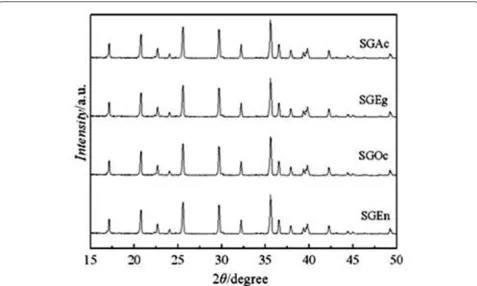
XRD patterns of the samples prepared with different complexing agents were shown in Figure 1. All the samples were pure single phase indexed with the orthorhombic Pnma space group. No evidence of dif-fraction peaks for crystalline carbon (graphite) appeared in the diffraction pattern, which indicated
that the carbon generated from the complexing agent was amorphous and that its presence did not influence the structure of LiFePO4/C. The carbon content of the samples determined by element analysis was 2.3, 4.8, 3.2, and 5.1 wt.% for SGAc, SGEg, SGOc, and SGEn, respectively.
The morphology for LiFePO4/C powders was observed on SEM, as shown in Figure 2. The SCAc consisted of non-uniform fine particles with a size range of 100 nm to 1μm, as shown in Figure 2a. We found that big par-ticles were secondary parpar-ticles composed of small size particles (around 100 nm). The unsolid aggregation state had no effect on the permeation of electrolyte between particles, and it benefited to the improvement of tap density. The particle size of SCOc was about 100 to 200 nm, as shown in Figure 2b. The small particle size of LiFePO4/C would be beneficial in reducing the diffusion length of the lithium ion inside, resulting in fast reaction and diffusion kinetics, and also benefited to the coating technique of cathode in the industrial pro-duction. There was a serious agglomeration in SCEg, and the particle of SCEn was layered as thin film struc-tures and was larger than others.
Cyclic voltammetry measurement was performed on the LiFePO4electrode at a scanning rate of 0.05 mVs-1. Figure 3 showed the cyclic voltammogram of LiFePO4/C with different complexing agents. The anodic and catho-dic peaks of SGAc appearing in the CV curves were sharp and were of better symmetry. The difference between the anodic and cathodic peaks was smaller compared to others. It was shown that the sample had good electrode reaction kinetics in the cell.
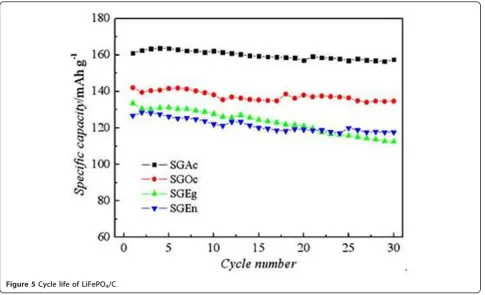
Initial charge-discharge profiles of LiFePO4/C synthe-sized by sol-gel method with different complexing agents were shown in Figure 4. All samples demon-strated a charging and discharging plateau. The poten-tial for charging is approximately 3.49 V, and the discharging potential is approximately 3.37 V, which is entirely consistent with the result from the CV test. The small voltage difference between the charge-discharge plateaus represents their good kinetics. The initial dis-charge capacity of SGAc showed 161.1 mAh g-1and was higher than that of other samples.
The cycling performance of these samples was shown in Figure 5. The cell of sample SGAc can deliver a dis-charge capacity of 161.1 mAh g-1at the first cycle. After 30 cycles, the capacity decreased to 157.5 mAh g-1, and the capacity fading rate was 2.2%.
From the above analysis, we can conclude that the electrochemical performance of LiFePO4/C prepared by sol-gel method was affected by the complexing agents. Therefore, we also explored the possible effect mechan-ism of a complexing agent on the synthesis of LiFePO4/ C by sol-gel method.
Yanget al.Nanoscale Research Letters2012,7:40 http://www.nanoscalereslett.com/content/7/1/40
In the process of the sol-gel method, gel was formed by a reaction between the Fe2+and complexing agent. There were three states which were sol, gel, and sinter-ing products in the whole process. Because the
electro-chemical properties of LiFePO4/C depended on the
particle size and its homogeneity, it was important that the gel was formed. The difference among gels was formed by using different complexing agents, so the effect mechanism of complexing agents on the synthesis of LiFePO4/C would be explained by coordinate chemis-try theory.
The stability of complex compounds formed by differ-ent complexing agdiffer-ents and metal ions was varied. Table 1 listed the cumulative stability constant of Fe2+ with various complexing agents and the discharge specific capacity, tap density, and carbon content of LiFePO4/C synthesized by sol-gel method.
According to Table 1, we can see that the discharge specific capacity of the material that was formed by the
acetic acid monodentate ligand was 161.1 mAh g-1,
which was the highest. The discharge capacity of the material that was formed by different complexing agents had a reverse relationship between the stability constant of Fe2+ and various complexing agents. That is, the higher the stability constant, the lower the discharge
capacity. Based on coordinate chemistry theory, com-plexes with a larger stability constant are more stable, and those complexes are difficult to decompose when sintering. The final product preserved the multi-ring interleaving structure, to a great extent, that lead to the poor crystallinity and low discharge capacity of the pro-duct. However, complexes with a low stability constant were unstable, and those complexes were easy to decompose when sintering at the same temperature. The average particle size of the final product was small, which was beneficial in reducing the diffusion length of the lithium ion inside, resulting in fast reaction and dif-fusion kinetics, which can increase the electrochemical properties of material.
[image:3.595.59.537.88.374.2]However, we also found that there was one exception against the above principle. The discharge capacity of the material formed by the acetic acid monodentate ligand is 161.1 mAh g-1 which was the highest, while the stability constant, logb3, of Fe2+with acetic acid (8.3) was larger than that of oxalic acid (5.22). By further analysis, we found that ethanediol, oxalic acid, and ethylenediamine were bidentate ligands. By coordi-nating with bidentate ligands, Fe2+was in an octahedral field. For the energy grade split ofd orbits, thed elec-tron configuration of the high-spin Fe2+in an octahedral
field wast2g4eg2, and the pairing electron number was 1. So, its crystal field stabilization energy [CFSE] was
CFST(o)=n1E
t2g
+n2E
eg=n1
−4Dq+n2
6Dq= 4−4Dq+ 26Dq=−4Dq
where n1 was electron number in t2g orbit, n2 was electron number inegorbit.
Acetic acid was a monodentate ligand; Fe2+ coordi-nated with three acetic acid molecules and one water molecule at the same time; so, Fe2+was in a tetrahedral field composed of three oxygen atoms provided by acetic acid and one oxygen atom provided by water. Thedelectron configuration of the high-spin Fe2+ in a tetrahedral field was eg3t2g3, whose pairing electron number was one.
So, its CFSE was
CFST(t)=n1E
t2g
+n2E
eg
= 31.78Dq
+ 3−2.67Dq
=−2.67Dq
The CFSE that high-spin Fe2+ gained from the tetra-hedral field was lower than that from the octatetra-hedral field. It is said that the stability Fe2+in the tetrahedral
field was poorer than that in the octahedral field, so the discharge capacity of the material formed with acetic acid was higher than that formed with oxalic acid.
In the process of complex decomposition, the carbon would partially produce residues in the product. The carbon content of LiFePO4/C had a direct ratio to the
stability constant of Fe2+ with various complexing
agents. The trend was consistent with the rule that the lower the stability constant was, the easier the product decomposed.
In short, complexing agents with a small stability con-stant would be chosen to format the precursor of LiFePO4/C, which would decompose easily due to poor stability when heating. Such method would beneficial in improving the electrochemical properties of the material.
Conclusions
[image:4.595.59.544.90.452.2]The LiFePO4/C was synthesized via sol-gel method by using Fe3+ as iron sources, ascorbic acid as reducing
Figure 2SEM images of LiFePO4/C samples. (a) SGAc, (b) SGOc, (c) SGEg, and (d) SGEn.
Yanget al.Nanoscale Research Letters2012,7:40 http://www.nanoscalereslett.com/content/7/1/40
reagent, and acetic acid, ethanediol, oxalic acid, and ethylenediamine as complexing agents. The LiFePO4/C synthesized with acetic acid as complexing agent has better electrochemical performance, having a discharge
[image:5.595.58.540.84.375.2]capacity of 161.1 mAh g-1 at the first cycle, and the capacity decreases to 157.5 mAh g-1 after 30 cycles. The capacity fading rate is 2.2%. According to the crystal field theory, a complexing agent with a small stability
Figure 3Cyclic voltammetry curves of LiFePO4/C.
[image:5.595.54.539.467.711.2]constant would be decomposed easily due to poor stabi-lity when heating. However, we found that the discharge capacity of LiFePO4/C synthesized with acetic acid as complexing agent was not consistent with the principle. The problem was solved by computing the CFSE of Fe2+ in a crystal field.
Acknowledgements
This work was co-supported by the Ministry of Education Key Laboratory of Synthetic and Natural Functional Molecular Chemistry, Education
Department of Shaanxi Province (2010JK765) and a fellowship from the NRF of Korea.
Author details
1Department of Chemical and Biological Engineering and Research Institute
for Green Energy Convergence Technology, Gyeongsang National University, 900 Gajwa-dong, Jinju, 600-701, Korea2Department of Applied Chemistry,
Xi’an University of Technology, Xi’an, 710048, Shaanxi, People’s Republic of China
Authors’contributions
RY carried out the experimental works on SEM, XRD, cycle testing, etc. EK participated in the cycle testing. BL participated in the design of the study. JHA participated in drafting the manuscript. All authors read and approved the final manuscript.
Competing interests
The authors declare that they have no competing interests.
Received: 19 September 2011 Accepted: 5 January 2012 Published: 5 January 2012
References
1. Padhi AK, Nanjundaswamy KS, Goodenough JB:Phospho-olivines as positive electrode materials for rechargeable lithium batteries.J
Electrochem Soc1997,144:1188.
2. Yamada A, Chung SC, Hino KK:Optimized LiFePO4for lithium battery
cathodes.J Electrochem Soc2001,148:A224.
[image:6.595.57.543.88.383.2]3. Chung SY, Bloking JT, Chiang YM:Electronically conductive phosphor-olivines as lithium storage electrodes.Nature Mater2002,2:123.
Figure 5Cycle life of LiFePO4/C.
Table 1 Effects of complexing agents on Fe2+and the characteristics of LiFePO
4/C synthesized by sol-gel method
Complexing agent Stability constant
(logb)
Discharge specific capacity (mAh g-1) Tap density (g cm-3)
Carbon content (wt.%)
Acetic acid 8.3 161.08 1.37 2.3
Ethanediol 9.67 133.53 1.16 4.8
Oxalic acid 5.22 143.04 1.23 3.2
Ethylenediamine 9.70 126.73 1.12 5.1
Stability constant of Fe2+
with various complexing agents and the discharge specific capacity, tap density, and carbon content of LiFePO4/C synthesized by
sol-gel method.
Yanget al.Nanoscale Research Letters2012,7:40 http://www.nanoscalereslett.com/content/7/1/40
[image:6.595.54.540.420.492.2]4. Ni JF, Zhou HH, Chen JT, Su GY:Effect on the electrochemical performance of lithium iron phosphate by Cr3 +ion doping.Acta Phys Chim Sin2004,20:582.
5. Kopec M, Yamada A, Kobayashi G, Nishimura S, Kanno R, Mauger A, Gendron F, Julien CM:Structural and magnetic properties of Lix(MnyFe1-y)
PO4electrode materials for Li-ion batteries.J Power Sources2009,
189:1154.
6. Zhang Y, Feng H, Wu XB, Wang L, Zhang A, Xia T, Dong H, Liu M:One-step microwave synthesis and characterization of carbon-modified
nanocrystalline LiFePO4.Electrochim Acta2009,54:3206.
7. Dong YZ, Zhao YM, Chen YH, Kuang Q:Optimized carbon-coated LiFePO4
cathode material for lithium-ion batteries.Materials Chem Phys2009,
115:245.
8. Ramana CV, Mauger A, Gendron F, Julien C, Zaghib K:Study of the Li-insertion/extraction process in LiFePO4/FePO4.J Power Sources2009,
187:555.
9. Ding YH, Su GY, Gao DS, Liu L, Wang CW:Cathode material LiFePO4
synthesized by sol-gel method.Battery Bimonthly2006,36:52. 10. Chen H, Yu WZ, Han SC, Fan CL, Xu ZY:Study on synthesis and
electrochemical performance of LiFePO4by Pechini method.Chin J Power Sources2008,32:13.
11. Kim JK, Choi JW, Chauhan GS, Ahn JH, Hwang GC, Choi JB, Ahn HJ:
Enhancement of electrochemical performance of lithium iron phosphate by controlled sol-gel synthesis.Electrochim Acta2008,53:8258.
doi:10.1186/1556-276X-7-40
Cite this article as:Yanget al.:Effect of complexing agents on the electrochemical performance of LiFePO4/C prepared by sol-gel method.
Nanoscale Research Letters20127:40.
Submit your manuscript to a
journal and benefi t from:
7Convenient online submission
7Rigorous peer review
7Immediate publication on acceptance
7Open access: articles freely available online
7High visibility within the fi eld
7Retaining the copyright to your article