© 2018, IRJET | Impact Factor value: 6.171 | ISO 9001:2008 Certified Journal | Page 3013
Railway reservation and route optimization system with
implementation
Loksai Pothineni
1, Dr. Swarnalatha P
2, Mohan Sai Ganesh K
3, Abhinava Krishna G
41,3,4 UG Student, Dept. of Computer Science and Engineering, VIT, Tamil Nadu, India
2Associate Professor, Dept. of Computer Science and Engineering, VIT, Tamil Nadu, India
---***---Abstract - In present situation railway has become the basic mode of transport to travel for longer distances. This mode of transport is more affordable and convenient for everyone to travel. To travel in railway we need reservation in advance as we may plan our journey only as per the reservation and so in case of emergency anyone can book tickets in tatkal in order to save people from agents who demand high amount of money for booking tickets in order to avoid these a platform is necessary that is our application for booking tickets as per present situation many people are hesitated to go to railway reservation counter and book their tickets so to resolve their problem an platform has been designed so that they can book their tickets anyone can directly book the tickets as per user requirements and the users can even cancel ticket and check live status of train, check live station info and checking PNR status of ticket and other additional feature which being added to this implementation is shortest route for all trains available between two stations and gives suggestion for users which train travels in shortest time between two stations. These all features will be discussed further.
Key Words: RAD model, PNR Check, Trains Between two Stations, Live Status, Shortest Route Between Stations, Booking of ticket.
1. INTRODUCTION
Railways transportation has become more demanding these days as travelling is a major priority of the people, It also helps user to easily to identify trains by its shortest path so that the user can reach their destination in easy way and quickly making it user friendly by developing a better interface. User will be able to select train between stations (Finding the train with the Shortest path).User can get live status where the train is at a particular time. User can check the PNR Status which means, whether the ticket is confirmed or is it in waiting.
User can check for the seat availability, book tickets for a train through an e-booking system, check the train route and the stations where the train goes through, has the choice to cancel his ticket. The specification in this method is that if there are many routes to the same source and destination, the user gets the minimum route to the destination which helps in saving of time to the passenger. As we are using RAD process model,by assuming the user’s requirements the application is being developed, So that most of the user requirements may be satisfied.
As we know that we are using Rapid Application Development process model and in this we are using traditional view point in which we will be trying to apply all user requirements and all the users may get use of it and nowadays whole world has become busy with electronic devices and running with time and to satisfy their needs and people who have very few experience with technology may suffer using various apps which are already in existence for them this application will be quite helpful.
2.LITERATURE SURVEY
Railways are providing important and mandatory basic facilities to the passengers like
© 2018, IRJET | Impact Factor value: 6.171 | ISO 9001:2008 Certified Journal | Page 3014 IPMIS is to relieve the pressure of queue congestion due to
the contradictions of supply and demand between people and social resources as well as achieving well ordered management of social resources[3]. The model uses input data from relevant time events of train runs calculated by a simulator. The model can be integrated into a decision support system used by operators who make decisions to change train routes or orders avoiding conflicts and delays [6].
3. METHODOLOGY
The Railway Reservation application is developed in a user friendly way to access all features, which is a type of incremental model. Each group develops a module which has different functionalities depending upon the user requirements. The design of this product utilizes a modular and a functional approach where in the entire code will be split up in different modules or functions and be called upon when required. In the application Android studio is being used in which the user requirements were assumed by us and they are developed in XML language and then all the modules are combined together using java language and these modules will be linked to API’s and so information can be provided when query is raised by the user. The major functions of the products are, acquiring and monitoring the major issues of user while booking or any other query such as the cancellation, pnr status, live status of train, train info and if there is any problem faced by user we give contact information such that they can let us know about their problems. After the development of all the required modules, then they are combined to form the required application. In addition with the normal functionalities the Shortest path optimization is aimed to give train information which reaches through the shortest route and this helps the user to save the time and help to reach their destination in the less time taken to reach their destination out of all available trains. As it is completely based on Rapid Application Development we assume the user requirements and develop the application and all requirements may not be satisfied but the requirements assumed by us will satisfy the user requirements in best manner. The User Side in the application contains the options to book a ticket, cancel ticket, check PNR status, Check Live train status, station information whereas the Server side have the options to give data to users as per the request given by user in form of API’s (Application Programming Interface).
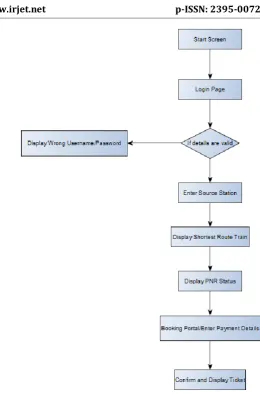
Fig -1: User Interface Flow Diagram
We all know that there various apps including all features of booking and other features may be familiar to everyone but here the application which is being developed will be new to the users who don’t have even basic knowledge on all features may utilize the application due to its friendly user interface and may utilize features and additional feature which helps users is it gives suggestion to users that which train reach in shortest time to their destination. The changes which makes our application better are included in the third part of our paper.
[image:2.595.293.554.50.445.2]© 2018, IRJET | Impact Factor value: 6.171 | ISO 9001:2008 Certified Journal | Page 3015
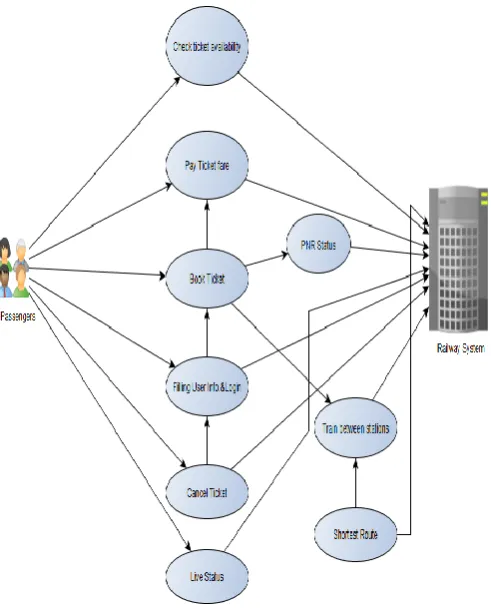
Fig -2: Overview of Application
4. COMPARATIVE STUDY
4.1 PREVIOUS WORK
IRCTC is the Indian Railway Application that is developed with the latest technology. It contains many features that are very helpful for the passengers. IRCTC is very helpful in searching trains, checking pnr status, finding the train route, status of running train, availability of seats. Ticket can also be booked through web view.
The application can easily find the trains between the stations. The fare for the different classes can also be known. There is an search option to navigate in order to check the availability of seats, running status and also the train route. We can also manage the recent searches like recent railway stations searched, recent pnr status, an recent trains of Indian Railways.
The information of passengers as well as trains are stored in databases that are managed by the local administrators. The application retrieves the data from the servers and provides the information to the passengers. Millions of passengers will be using the app. So the app must be efficient in retrieving the data.
4.2 PRESENT WORK
Although IRCTC has many advanced features but we don’t know which train reaches the destination with smallest time. By using IRCTC we can get the list of available trains
from the present location to the destination. But we don’t know which train reaches the destination in shortest time unless we compare all the trains.
In this busy world everyone wants to reach their destination as early as possible. If anyone chooses transportation buy train then they must be aware of the train which makes them to reach the destination quickly. So, we are adding an additional feature to this so that one can easily find out which is the best train available at that time to reach the destination quickly.
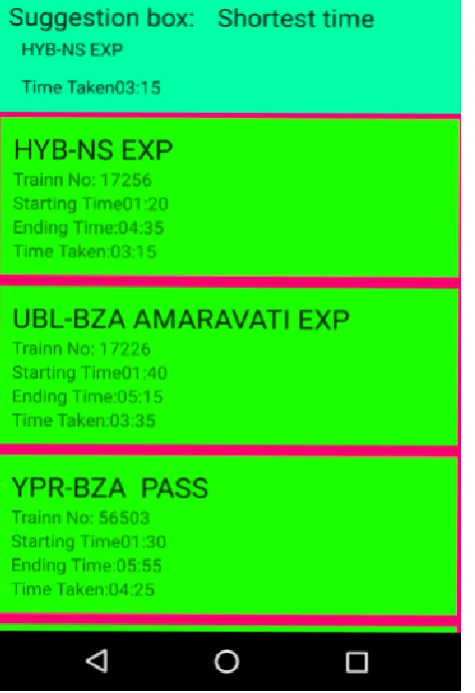
We are using sorting algorithms with some conditions. We will be sorting the all the available times of the trains. Then by selecting the present time we can know which trains are available. If the first train is not available then we move on to the next train and so on. By this one can reach the destination as early as possible. These all the sorting methods conclude that the train which is having shortest time to reach the station will have the shortest route among all available trains between the stations which the passenger wants to travel will be satisfied as in application it shows shortest time taken train on top of list in a suggestion box so that user can easily reach his destination.
5. IMPLEMENTATION
We have implemented railway application using Android through which the modules are written in XML language and all these modules are combined together using java language and some photos which represent our application and these photos show functionality of our application:
[image:3.595.44.290.81.386.2]© 2018, IRJET | Impact Factor value: 6.171 | ISO 9001:2008 Certified Journal | Page 3016 Fig-4:Search between two stations
Fig-5:Shortest time travelling train suggestion
Fig-6:PNR Check
6.RECENT TRENDS AND FUTURE WORKS
At present there are all appropriate features to find train status not so accurate and so to avoid this problem we need to include GPS system so that we can navigate train easily and in some regions like forest the signal will be lost so the trains must maintain mini signal which can be tracked by station officers which work with help of satellite and there are tracks to be lay down in future so that trains may increase users comforts by arriving the destination in shortest path and if trains use electricity or natural forms of energy to run the trains then we can save our natural resources.
[image:4.595.42.281.76.356.2] [image:4.595.46.284.386.733.2]© 2018, IRJET | Impact Factor value: 6.171 | ISO 9001:2008 Certified Journal | Page 3017 7. CONCLUSION
The main aim of our paper is to develop an application which satisfies all user requirements. The application is developed in perspective of user convenience and the friendly user interface of application which helps users without any complicated searching process and other software requirements are data security and maintainability as anyone can access with their own login so the data will be secured and the maintainance of the software will be done by the developers who will be maintain the app and so in this application with booking of ticket it also includes cancellation of ticket, pnr status of ticket, live status of train and live station info all these features will be included in this application and the additional feature which is being added to the application is the shortest time is calculated for all trains between two stations and it will suggest the train which will travel in shortest time to our destination and therefore these features will help users and the user interface is also simplified such that anyone can easily use it.
The main theme of this paper is to develop a user friendly interface for all users which helps them in all ways as per the query given by the user. This application must be useful to all the users who use this application and must satisfy their needs.
ACKNOWLEDGEMENT
This paper would be incomplete without the mention of people whose ceaseless cooperation made it possible, whose constant guidance and encouragement crowns all effort with success. We are grateful to Dr. Swarnalatha P and all the faculty members of CSE Department, Vellore Institute of Technology for their guidance, inspiration and constructive suggestions that helped us in the preparation of this report.We thank all our colleagues and friends who helped us and inspired us to do this report.
REFERENCES:
[1]B. T. T. S. Sakthi, J. J. Leo, R. Monisha and S. M. Ramesh, "Advanced train reservation and passenger intimation with safety system," International Conference on Information Communication and Embedded Systems (ICICES2014), Chennai, 2014, pp. 1-5.
[2]Ganesh K and Joy Kuri(2012), “Implementation Of A Real Time Passenger Information System”, International journal on Engineering science and management Vol. II Issue II .
[3]Ci SONG and Weimin(2010) “WU Petri Net Modeling of Information Flow in the OnlineTrain Ticket Booking System”International Conference on Automation and Logistics,Zhengzhou, August 2012.
[4]M. Dessouky, Q. Lu, J. Zhao, and R. Leachman, “An exact solution procedure to determine the optimal dispatching
times for complex rail networks,” IIE Transactions, vol. 38, no. 2, pp. 141–152, 2006.
[5]R. Lusby, J. Larsen, M. Ehrgott, and D. Ryan, “A set packing inspiredmethod for real-time junction train routing,” Computers & Operations Research, vol. 40, no. 3, pp. 713–724, 2012.
[6]Rodriguez, J, (2007). A Constraint Programming Model for Real-time Train Scheduling at Junctions.Transportation Research Part B: Methodological, Volume 41, Issue 2, pp 231-245.
[7]A.Potapovs, M. Gorobetz And A. Levchenkovb(2011) “Intelligent Electronic Embedded systems For The Protection Of Railway Transport From Accidents” Volume 4 Issue 3 September 2011.
[8]Saurabh Chatterjee And Prof. Balram Timande(2012), “Public Transport System Ticketing System Using RFID And ARM Processor Perspective Mumbai Bus Facility”, International Journal Of Electronics And Computer Science Engineering.
[9]S.Vishnuvarthani,Dr.A.Selvaraj(October 2012), “Factors Influencing the Passengers to Select Train Travel: A Study in Salem Division of Southern Railway”, International Journal of Scientific and Research Publications, Volume 2, Issue 10.
[10]Q. Xu, H. Ji, X. Li and H. Zhang, "Admission Control Scheme for Service Dropping Performance Improvement in High-Speed Railway Communication Systems," in IEEE Transactions on Vehicular Technology, vol. 65, no. 7, pp. 5251-5263, July 2016.