EPPQWCS –An Efficient Pre-Post Query
Based Web Crawling System
Vishakha Shukla, Dharmendra Roy
Dept. of Computer Science Engineering, Rungta College of Engineering and Technology, Bhilai, India
Reader, Dept. of Computer Science Engineering, Rungta College of Engineering and Technology, Bhilai, India
ABSTRACT: As deep web grows at a very fast pace, there has been increased interest in techniques that help efficiently locate deep-web interfaces. However, due to the large volume of web resources and the dynamic nature of deep web, achieving wide coverage and high efficiency is a challenging issue. Proposed approach focuses on improving the efficiency of web crawler by integration of pre-query processing approach in order to leave irrelevant query thereby enabling crawler to take out most relevant links in fast and efficient manner. Also using post-query approach Crawler achieves fast in-site searching by excavating most relevant links with an adaptive link-ranking.
KEYWORDS: Crawler, Web Crawling, World Wide Web, Depth First Search.
I. INTRODUCTION
The amount of data consumed by crawler while searching is huge. The crawler searches large amount of data that may contain lots of irrelevant information. Also a lot of time is wasted for searching relevant data among the huge amount of irrelevant results returned by crawler and user has to waste a time while crawling on web while scanning irrelevant links also. Pre/Post query processing approaches and site-based searching approach can be integrated in order to pre-processing the user query. By integration of different pre-processing approaches and link ranking approaches a lot of valuable user time is saved. Post query approach may also filter out all irrelevant information which is not necessary according to the query which is been fired, and gives the expected results. For pre-query approaches certain guidelines can be integrated with fuzzy logic:
• Implicit AND: User need not include the logical operator.
• Exact Matching: The length of the query.
• Word Variation: Provide user with option of search term variation.
• Common Word Exclusion: User need not include Stop Words like on , where and how.
• 32 Word Limit: Limit the user query length to 32 words.
• Case Sensitivity: Generally user queries are case insensitive.
• Ignoring Punctuation: User must not include characters like?,[]()@
Different strategies are being employed in web crawling. These are as follows:-
A. Focused: In this approach download pages are related to each other. It collects documents which are specific and relevant to the given topic.
B. Incremental: This technique, in order to refresh its collection, periodically replaces the old documents with the newly downloaded documents. On the contrary, an incremental approach incrementally refreshes the existing collection of pages by visiting them frequently; based upon the estimate as to how often pages change.
D. Parallel: In this approach multiple crawlers are often run in parallel, which are referred as Parallel crawlers. The crawler can be on local network or be distributed .Parallelization of crawling system is very vital from the point of view of downloading documents in a reasonable amount of time.
II.RELATED WORK
In [1] used an effective harvesting framework for deep-web interface, namely Smart-Crawler. According to the used model this approach achieves both wide coverage for deep web interfaces and maintains highly efficient crawling.In [2] major focus was on the fact that effective filters can be used to produce highly effective results on web. The filters incorporated with the used algorithms in the paper are well effective and high performance for web search, reduce the network traffic and crawling costs. The work in [5] focused on using query preproccessing using fuzzy logic and also suggested that the query-based mechanism is based on the query scope, a measure of the query specificity. The query scope is dined using probabilistic propagation mechanism on top of the hierarchical structure of concepts provided by Word Net.Also [6] focused that predictors can be generated before the retrieval process takes place, which is more practical than current approaches to query performance prediction. The approach was measured with the linear and non-parametric correlations of the predictors with Average Precision. The work in [7] used a model that focused on selective pruning framework for ensuring efficient yet effective retrieval, by appropriately setting the pruning parameters of Wand on a per-query basis, before re-ranking the results using a learned model.
III.PROPOSED ALGORITHM
The basic approach consists of following steps:
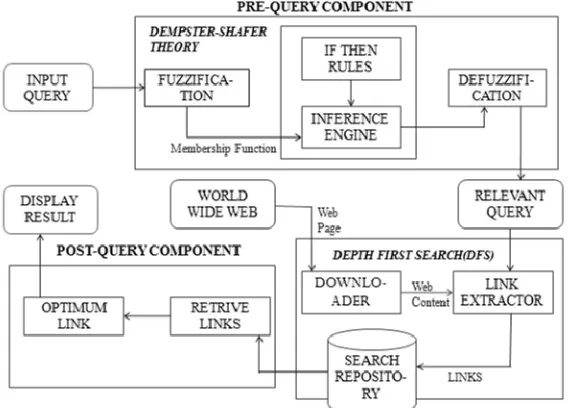
The query from the user is feeded to Pre-Query module. The relevance of the input query is first checked by
inference engine in the pre-query component.
Using the concept of fuzzy logic implemented by using IF-Then rules the result of the query relevance is returned to the user.
The relevant query is further processed by using an appropriate Web-Crawling algorithm.
The result of the crawling process is then provided to post-query module for filtering most relevant data. The final result is then displayed in front of the user.
The basic algorithm is outlined as follows:-
Start
User will input query.
Redirect query to the pre-query component.
Apply Dumpster–Shafer theory (DST).The theory allows one to combine evidence from different sources and
arrive at a degree of belief that takes into account all the available evidence. The Dempster-Shafer Theory is a method of inexact reasoning.
o Formula:
K = ∑ m1 (B).m2.(C)……… (1)
o Where, K = measure conflict between two set of masses.
m1, m2 = two set masses
B, C = two different sets
Perform Fuzzification using IF-Then Rules
o Example: Set MassA = containsAND(Query)
Set MassB = containsCommonWords (Query)
Set MassC = lengthGreaterThan32 (Query)
Set MassD = containsPunctuation(Query)
Set MassE = containsUpperAndLower(Query)
If the query probability value is greater than or equal to 0.7 then it is relevant query and then it goes to next step or else if it irrelevant then directly while display a message to user for query irrelevancy.
Formula used:
Output Query is relevant if Probability >=0.7 else Irrelevant
Through inference engine find the probability sets. And check the relevancy of the query.
o Formulation used is:
o Set K = MassA+MassB+MassC+MassD+MassE
o Where, MassA ∩MassB ∩ MassC ∩ MassD ∩ MassE = Φ
o Set Probability = (1/ (1- K))*(MassA+MassB+MassC+MassD+MassE)
o Where, K = measure of conflict between states
o Mass N = different states.
Perform crawling using DFS (Depth First Search) algorithm.
Display result of query after Post-Query processing
End
IV.SIMULATION RESULTS
The WCS (Web Crawling System): We designed an experimental system which used a traditional crawling technique, named WCS, which shares the same stopping criteria with current approach different from current approach, WCS follows the out-of-site links of relevant sites by site classifier without employing pre query and post query approaches.
EPPQWCS (Efficient Pre-Post Query Based Web Crawling System): EPPQWCS is our proposed crawling approach for harvesting deep web interfaces. Similar to WCS the proposed system uses pre and post query based techniques integrated with Fuzzy Logic based approach for efficient extraction of information for web.
Domain Name WCS (%) EPPQWCS (%)
Airfare
60
73
Auto
66
79.125
Book
59.5
67.8
Job
70
72
Hotel
69
80
Table 1:Percentage relevancy of information extracted
Figure 2: Relevancy percentage graph analysis of information on the 10000 deep web sites searching.
V.CONCLUSION AND FUTURE WORK
The approach has been currently implemented combining the approaches of DFS algorithm, Fuzzy concept and results are obtained. The Depth first search algorithm is a more useful search which starts at the root URL and traverse depth through the child URL. First, it move to the left most child if one or more than one child exist and traverse deep until no more is available. Here backtracking is used to the next unvisited node and processes are repaid in similar manner. By the use of these algorithms it makes sure that all the edges, i.e. all URL is visited at least once. In case of Fuzzy concept the Dampester Shafer Theory is implemented that is useful for implementing Pre and Post query approach. It is very efficient for search problems. As this application can be easily work in many different languages, so that it become easy for the people who are unable to understand web searching processes.
REFERENCES
1. SmartCrawler: A Two-stage Crawler for Efficiently Harvesting Deep-Web, Feng Zhao, Jingyu Zhou, Chang Nie, Heqing Huang & Hai Jin, Interfaces .IEEE Transactions on Services Computing Volume: PP Year: 2015.
2. Survey of Web Crawling Algorithms - Rahul kumar, Anurag Jain and Chetan Agrawal. Advances in Vision Computing: An International Journal (AVC) Vol.1, No.2/3, September 2014.
3. Dempster-Shafer theory for a query-biased combination of evidence on the Web- Vassilis Plachouras, Iadh Ounis. Springer-Verlag Berlin Heidelberg 2014.
0
10
20
30
40
50
60
70
80
90
WCS (%)
EPPQWCS (%)
5. Inferring Query Performance Using Pre-retrieval Predictors, Ben He and Iadh Ounis, Department of Computing Science University of Glasgow fben,[email protected].
6. A Unified Framework for Post-Retrieval Query-Performance Prediction, Oren Kurland, Anna Shtok, David Carmel, and Shay Hummel, ICTIR 2011, LNCS 6931, pp. 15–26, 2011. c_Springer-Verlag Berlin Heidelberg 2011.
7. Varying Approaches to Topical Web Query Classification , Steven M. Beitzel, Eric C. Jensen, Abdur Chowdhury,& Ophir Frieder, SIGIR’07, July 23–27, 2007, Amsterdam, The Netherlands, ACM ..
8. Survey on – Self Adaptive Focused Crawler, Ms. Pallavi Wadibhasme, & Prof. Nitin Shivale, Pallavi Wadibhasme et al, / (IJCSIT) International Journal of Computer Science and Information Technologies, Vol. 6 (1) , 2015, 218-220 .
9. Efficient Query Evaluation using a Two-Level Retrieval Process- Andrei Z. Broder, David Carmel, Michael Herscovici, Aya Soffer & Jason Zien.