© 2018, IRJET | Impact Factor value: 6.171 | ISO 9001:2008 Certified Journal | Page 3792
Influence of Hexagonal Boron Nitride on Tribological Properties of
AA2024-hBN Metal Matrix Composite
Mr. Rushikesh A. Khatavkar
1, Prof. Abhijeet K. Mandave
2, Prof. Devakant D. Baviskar
3,
Prof. Samir L. shinde
41
PG scholar, Dept. of mechanical Engineering, SKN Sinhgad institute Lonavala, Maharashtra, India
2, 3Assistant Professor Dept. of Mechanical Engineering, Vishwaniketan iMEET, Khalapur, Maharashtra, India
4
Assistant Professor, Dept. of mechanical Engineering, SKN Sinhgad institute Lonavala, Maharashtra, India
---***---Abstract-
Aim of this paper is to manufacture andTribological investigation of aluminium 2024 reinforced with hexagonal boron nitride metal matrix composite. In the present study to develop aluminium based hexagonal boron nitride (hBN) particulate MMCs with an objective to develop light weight material by using stir casting process and to obtain homogenous dispersion of ceramic material. Experiments to conduct by varying weight fraction of hexagonal Boron Nitride (hBN) 3%, 6% and 9% keep all other parameters constant and check density, hardness and wear strength of various composite samples prepared as per ASTM
standard.
Key Words:
Aluminium2024 matrix, hexagonal Boron nitride (hBN) reinforcement, stir casting technique, Al2024/ boron nitride MMC1. INTRODUCTION
This Most of the studies made in automotive and aerospace field show that the material used for engineering application should possess good mechanical with better Structural properties. The composite materials are extensively used in applications like high strength oriented situations to enhance the mechanical performance. In many applications, the widely selected base alloy for Metal Matrix Composites (MMCs) is aluminium because of its high strength to weight ratio, environmental resistance and high stiffness, highly corrosion resistant and exhibit moderate strength and finds many applications in the construction, automotive and marine fields. [1]
Now a days the particulate reinforced Al matrix composite have more importance because of their isotropic properties and low cost. The strengthening aluminum alloy by reinforcing with ceramic powder were developed better substitute of unreinforced alloy, for obtaining materials with high strength and good wear resistant. [2]
1.1 Problem Statement
The conventional engineering material have some limitations like low strength to weight ratio, Low stiffness, high density, easily prone to corrosion. Some structural metal like steel have high weight, easily corrosive and short environmental resistance.
In structural, automotive, space application mostly aluminium is used for light weight and good strength
Main problem and drawbacks of aluminium are
1. Low surface hardness and soft. 2. Low tensile strength.
3. Low toughness strength.
4. More wear rate in rubbing surfaces in contact. 5. React with chemicals like acid and alkali.
6. Change mechanical properties at elevated temperature.
1.2 Aim
We required to form new material which have high strength, light weight, available in low cost, good thermal conductive and sufficient corrosion resistance. The aluminium boron graphite (hBN) MMC satisfies above conditions and it is one of the alternative material to the traditional structural material like steel. The addition of boron Nitride particles to the aluminium matrices makes them attractive candidate materials in many automobile, aerospace, marine and high speed trains applications due to its superior properties such as low density, high wear resistance, stiffness, reliability, toughness, good combination of strength to weight ratio.
1.3 Objective
The purpose of this project is to assess the suitability of boron nitride composite to be used for the structural, transportation, automotive and construction. This assessment will include investigation current literature on this topic and also conducting some testing on aluminium and aluminium 2024/hBN to determine and compare their properties.
The main objective of this project are
1. To work on experimental wear and friction analysis of AA2024/hBN composite
© 2018, IRJET | Impact Factor value: 6.171 | ISO 9001:2008 Certified Journal | Page 3793 3. To study the microstructure, hardness, wear
strength Aluminium2024/hBN MMC.
4. To compare mechanical properties of pure aluminium and aluminium boron nitride MMC. 5. To collect research background information relating
to aluminium boron Nitride MMC.
2. LITRATURE REVIEW
Gangatharan T, Anandha Moorthy A (2016) has worked on “Enhancing the Tribological Properties of Composite Materials for Centrifugal Pump Application” Al 2024/4% wt. graphite and Al 2024/4% wt. hBN (particulate MMC was fabricated using the stir casting rote and came forward into following conclusions Al 2024/4% Hexagonal boron nitride composite will provide better dry sliding resistance than the unreinforced Al 2024 alloy and red brass (UNS C23000), This is due to the self-lubricating characteristics of the composite. Hexagonal boron nitride also acts as a solid lubricant. Wear loss and weight loss of aluminium and brass is more than composite
Yathiraj K, Chandraiah M. T,(2016) has worked on “Evaluation of Mechanical Properties of Aluminum 6061 Reinforced with Boron Nitride MMC’s using OM” prepared Aluminum 6061, hexa Boron Nitride (hBN) metal matrix composites. They prepared Al/hBN MMCs with changing 3%, 6% and 9% weight percentage of boron nitride and achieved following conclusion Increase in The wt. % of reinforcement, there is Increase in the Hardness and it is found to be 59.3 HBW for 9% of Reinforcement With increase in the wt. % of Reinforcement, There is Increase in the Ultimate Tensile Strength (UTS). Metal matrix composites of Al-6061 reinforced with Boron Nitride particulates is found to have improved tensile strength when compared to Al 6061 alloy.
Nagesh .D, Manjunath .S .H,(2016) worked on “Influence of Graphite on Mechanical Properties of Al6061-hBN-Gr Hybrid MMC’s” This paper deals with the fabrication and mechanical investigation of aluminium 6061, Hexa Boron Nitride (hBN), and Graphite(Gr) hybrid metal matrix composites. They prepared 3 composite samples of Al6061/6% hBN with 2%, 4% and 6% graphite addition on it conducted hardness, wear, density, tests and achieved following conclusion the composition (6% BN and 2% Gr) it is observed that the micrographs have less porosity due to good bonding in particles and homogeneous distribution of particulates. Composition (6% BN and 6% Gr) reinforcement have higher porosity and grain boundaries because of addition of higher percentage of particulates which leads to the higher defects in the composite. Addition boron nitride up to 6% has increased mechanical and wear properties of the composite. The overall test results containing 4% graphite shows improved properties.
M. Valsange, S.G.Kulkarni,(2014) worked on “Stir Casting used in manufacturing of Aluminium Matrix Composite”, and concluded that in stir casting process the
uniform dispersion of material mechanical stirrer blade angle should be 45° or 90 °.It should avoid avoids the agitation of the melt surface, and the formation of vortex must be avoided or minimized. Preheating of mould & reinforcements helps in reducing porosity as well as increases mechanical properties.
3. METHODOLOGY
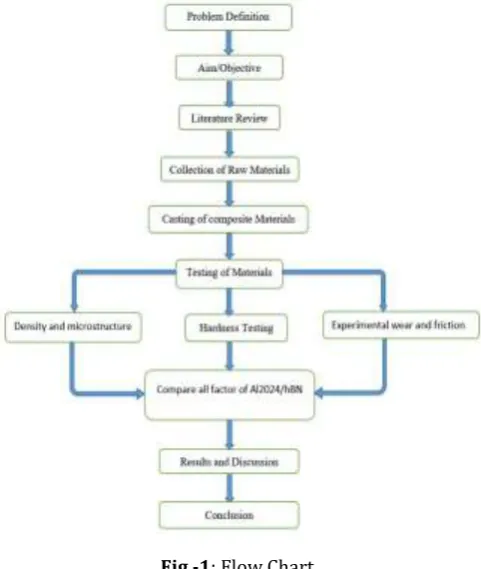
Research Methodology includes description in detail about study of coupling conventional disc material and new composite material various properties and testing.
Fig -1:Flow Chart
4. EXPERIMENTAL DETAILS
4.1. Materials
A] Aluminium 2024:- Al 2024 matrix material is used in metal matrix composites. Al2024 Purchased from special steel, Mumbai. Al2024 is used in application requiring high strength to weight ratio, good electrical and thermal conductivity, good fatigue resistant, low density etc. AA2024 density 2.78g/cc, thermal conductivity 121W/mK Composition of this alloy represent below,
Table -1: Chemical composition of the AA2024 matrix alloy (wt. %).
Element Al Cu Mg Mn Fe Si Ti Zn %
[image:2.595.315.556.232.517.2]© 2018, IRJET | Impact Factor value: 6.171 | ISO 9001:2008 Certified Journal | Page 3794 B] Hexagonal Boron Nitride (hBN):- Boron nitride has
excellent thermal and chemical stability and also high hardness. The hexa boron nitride practical size is 5-11 microns. Boron nitride powder specification was density 1.03g/cc, thermal conductivity 160-200 W/mK. hBN purchased from souvenier chemicals, Mumbai.
4.2 Experimental setup and procedure
Stir casting technique used to the preparation of Al2024/hBN composite. This stir casting furnace setup is available in Sinhgad college of Engineering pandharpur, Maharashtra. This process dispersed phase of hBN ceramic mixed with Al2024 metal matrix by using rotating mechanical stirrer. Radial Drill machine is used to rotate and change the speed of mechanical stirrer.
In this process Al2024 rod cut into small ingots and placed into the crucible, after that crucible put in resistance furnace. The melt temperature was raised up to 640 0C and it was degassing done by the addition of hexachloroethane tablets to remove hydrogen in melting aluminium alloy. [7] After that grain refiner and all clean powder is used to remove impurity in AL 2024 alloy.
Then the melt was stirred with the help of a mild steel turbine stirrer with continues stirring the preheated hBN powder added in molten alloy, before string magnesium of 1% by weight is added to improve the wettability of hBN powder. HBN powder was preheated to 2000C for three-hours to remove moisture and we also changed stirrer speed for distribution of particles in the matrix for various composition of powder.
After mixing of ceramic powder in molten metal is poured in the preheated (up to 2000C) cast iron casting mould and allowed to solidify, [8] after solidification composite cast composition was by %weight
1. Composite A- AA2024- 0%hBN 2. Composite B- AA2024- 3%hBN 3. Composite C- AA2024- 6%hBN 4. Composite D- AA2024- 9%hBN 4.3 Stir Casting Process Parameter
Stir casting process is mainly used for manufacturing of particulate reinforced metal matrix composite (PMMC). It is a primary process of composite production whereby the reinforcement ingredient material is incorporated into the molten metal by stirring. Stir casting is used for low cost composite production. The process parameters are given below,
A] Stirrer Design: It is very important parameter in stir casting process which is required for vortex formation. The blade angle and number of blades decides the flow pattern of the liquid metal. The stirrer is immersed till two third depth of molten metal. [9]
B] Stirrer Speed: Stirring speed is an important parameter to improve wettability. Vortex formation depend on Stirring speed which is responsible for dispersion of particulates in liquid metal. [9, 10] In our project stirring speeds are different for different composition which is shown in table no 2.
C] Stirring temperature: Aluminium melts around 640-650°C, at this temperature semisolid stage of melt is present. Particle distribution depends on change in viscosity. The viscosity of liquid is decreased by increasing processing temperature with increasing holding time for stirring which also promote binding between matrix and reinforcement. [10] Which is shown in table no 2.
D] Stirring Time: As stirring promote uniform distribution of reinforcement partials and interface bond between matrix and reinforcement, stirring time plays a vital role in stir casting method. Stirring times are different for different composition which is shown in table no 2.
E] Preheat temperature: Reinforcement is heated to 200°C for 180 minutes. It removes moisture as well as gases present in reinforcement.
F] Preheat temperature of mould: Porosity is the major problem in casting. In order to avoid porosity preheating of mould is good solution. It helps in removing the entrapped gases from the slurry to go into the mould. Mould is heated to 200°C for one hour.
G] Addition of Magnesium: Addition of Magnesium enhances the wettability. However increase the content above 1wt. % increases viscosity of slurry and hence uniform particle distribution becomes difficult. [9]
H] Reinforcement feed rate: Non-uniform feed rate promotes clustering of particles at some places which causes the porosity defect and inclusion defect, so to have a good quality of casting the feed rate of powder particles must be uniform. The flow rate of reinforcements measured is 1-1.2gram per second. [10]
Table -2: Stir casting process parameter
4.4 Testing of the material:
© 2018, IRJET | Impact Factor value: 6.171 | ISO 9001:2008 Certified Journal | Page 3795 100 kg loading capacity. To carry density test by using
weight displacement method and finding mass and volume of the samples of varying weight percentage of hBN.
Wear testing conducted on DUCOM wear testing machine. Dry sliding wear tests are conducted using a pin on disk tester according to ASTM: G99-95 standard. [3] For microstructure study, microscope was used and the specimens were polished by different grades of polish paper, alumina paste, and diamond paste and etched with the Keller’s reagent. [4]
5. RESULT AND DISCUSSION
5.1 Hardness Test: First to prepare a specimen for hardness test from ingots of AA2024/hBN composite and cast AA2024. To carry Hardness test on each sample at three different location and average of all reading is reported. [11]
Table -3: Rockwell B hardness result.
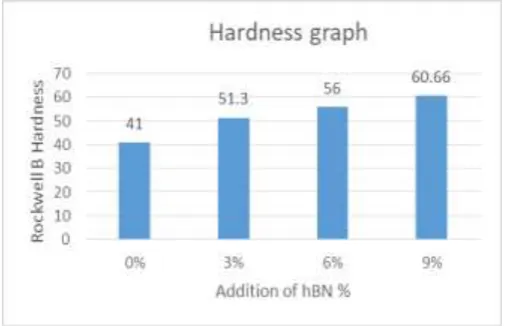
Hardness experiments were conducted for each composition and tabulated in the Table-3, it could be seen from the chart-1 that the hardness of the test specimen increased continuously up to 9% hBN composite and maximum hardness value is obtained 60.66 Rockwell B.
Chart -1: Hardness testing Graphical representation
[image:4.595.307.560.346.520.2]5.2 Density testing: Experimental Density of the Al2024/hBN specimens was obtained by the Archimedean method of weighing the specimens in water. [5]
Table -4: Experimental density test results
Experimental density test were conducted for each composition and tabulated in the Table-4, it could be seen from the chart-2 that the density of the test specimen decreases by addition of hBN reinforcement.
Chart -2: Hardness testing Graphical representation
5.3 Microstructural study
Microstructural studies were carried out to examine the distribution of hBN reinforcement. Two microstructure images are taken before etching and after etching. The grain are separated by thin black grain boundaries.
[image:4.595.35.288.546.709.2]© 2018, IRJET | Impact Factor value: 6.171 | ISO 9001:2008 Certified Journal | Page 3796 Fig -2: Optical micrographs of MMCs
5.4 Wear test
Wear test sample cut and machined from AA2024/hBN composite cast, size of specimen is 8 mm in diameter and 32 mm in height. Composite sample are then polished through metallographically. [3]
Four samples are tested for each composition, these four includes, AA2024-0%hBN, AA2024- 3%hBN, AA2024-
6%hBN, AA2024-9%hBN.The wear tests for composite cylindrical pins is conducted against oil hardened nickel steel disc with hardness of 62 HRc at room temperature.
Table -5: Input parameter for wear test. [10]
Sr.
No. Parameter low high
1 Load (N) 10 20
2 Speed (m/s) 0.5 0.5
[image:5.595.49.469.38.417.2]3 Sliding distance(m) 1000 2000 4 Test time (min) 33 16
Table-6: Wear behavior of MMCs with different composition under normal load of 10N.
From fig-3 it is observed that from wear regime, the wear resistance of 6% hBN composite is better than 3%hBN, 9%hBN composite and pure AA2024 under 10N load.
Fig -3: Variation of wear v/ s time with the addition of
hBN Reinforcement under 10N load.
[image:5.595.308.572.283.458.2] [image:5.595.301.567.511.724.2]© 2018, IRJET | Impact Factor value: 6.171 | ISO 9001:2008 Certified Journal | Page 3797 From fig-4 and fig 5 it is observed that the friction force
and coefficient of friction is minimum for 6% hBN composite as compare to 3% hBN, 9% hBN and pure AA2024 under 10N load.
[image:6.595.309.564.57.253.2]Fig -5: Variation of COF v/ s time with the addition of hBN Reinforcement under 10N load.
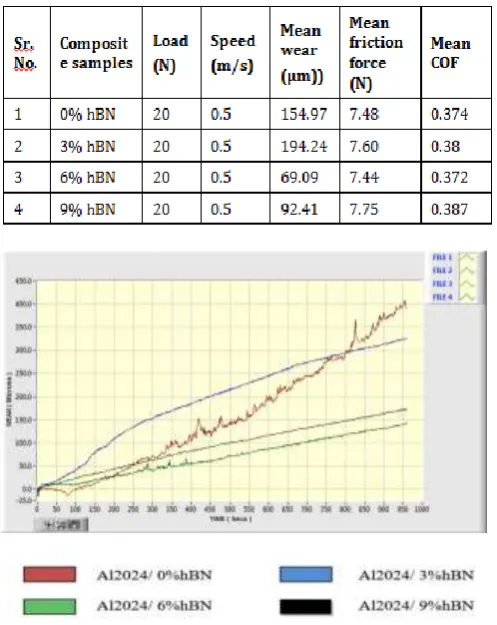
Table-7: Wear behavior of MMCs with different composition under normal load of 20N.
Fig-6: Variation of wear v/ s time with the addition of hBN Reinforcement under 20N load and 0.5m/s velocity.
From fig-6 it is observed that from wear regime, the wear resistance of 6% hBN composite is better than 3%hBN, 9%hBN composite and pure AA2024 under 20N load.
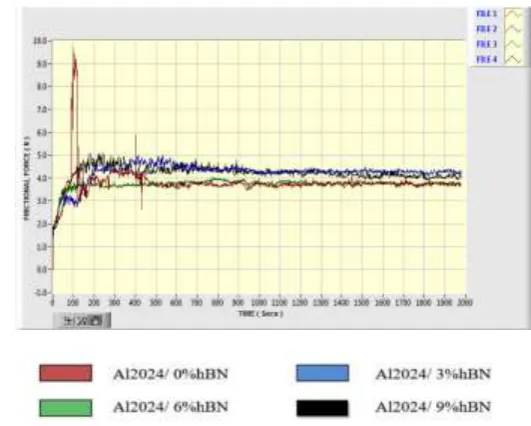
Fig-7: Variation of friction force v/ s time with the addition of hBN Reinforcement under 20N load.
From fig-7 and fig-8 it is observed that the friction force and coefficient of friction is minimum for 6% hBN composite as compare to 3% hBN, 9% hBN and pure AA2024 under 20 N load.
Fig-8 Variation of COF v/ s time with the addition of
hBN Reinforcement under 20N load.
6. CONCLUSIONS
Based on experimental result and observation of AA2024 reinforced with hexagonal boron nitride MMCs following conclusion have been made
1. Wettability of hBN was improved due to addition of 1% magnesium
2. AA2024/hBN composite have been successfully manufactured by stir casting method up to 9% hBN reinforcement. AA2024/hBN composite is found light weight than pure AA2024.
[image:6.595.38.295.138.306.2] [image:6.595.312.555.354.520.2] [image:6.595.37.286.383.696.2]© 2018, IRJET | Impact Factor value: 6.171 | ISO 9001:2008 Certified Journal | Page 3798 is Increase in the Hardness of the composite and it
is found to be 60.66 HBN for 9%of Reinforcement.
4. The density testing result show that the Increase in the wt. % of hBN reinforcement, There is decreasing density of the composite and minimum density found that 2.450 g/cm3 for 9% hBN reinforcement.
5. From the overall wear test results the 6% hBN composition shows improved wear resistance as compared to pure AA2024, 3% hBN composite and 9% hBN composite and it is found to be mean wear 215.95 µm and 69.09 µm at load 10N and 20N respectively.
6. The experimental wear testing result show that 6% hBN composite gives minimum coefficient of friction 0.373 and 0.372 at load 10N and 20N respectively.
ACKNOWLEDGEMENT
The authors of this paper are highly obliged to the Department of mechanical Engineering, SKN sinhgad institute of technology and science, lonavala, Pune. Authors are thankful to Principal, Head of the Department and the other staff of the Institute.
REFERENCES
[1] Matthews F.L., Ralwlings R.D, Composite materials
engineering ans science, Glasgow, UK, Champaman and hall, 1994.
[2] Chawla K.K, on the applicability of the
"Rule-of-Mixtures" to the strength properties of metal-matrix composites, Revista Brasileira de Física, 4(1974): pp 411-418.
[3] Gangatharan T, Anandha Moorthy A, Enhancing the
Tribological Properties of Composite Materials for Centrifugal Pump Application, (IRJET) eISSN: 2395 -0056 Issue: 03 2016p-ISSN: 2395-0072.
[4] Yathiraj K, Chandraiah M. T, Evaluation of Mechanical
Properties of Aluminium 6061 Reinforced with Boron Nitride MMC’s using OM, International Journal of Innovative Research in Science, Engineering and Technology, 10.15680 /IJIRSET. 2016. 0509031 16128.
[5] Nagesh .D, Manjunath .S .H, Influence of Graphite on
Mechanical Properties of Al6061-hBN-Gr Hybrid MMC’s, Recent Innovations in Science and Engineering - RISE 2016.
[6] M. Valsange, S.G.Kulkarni, Stir Casting used in
manufacturing of Aluminium Matrix Composite, International Journal for Research in Technological Studies| Vol. 1, Issue 9, August 2014 | ISSN (online): 2348-1439.
[7] Lindroos V.K, Talvitie M.J, Recent advances in metal
matrix composites, J. Mater. Proc. Technol. 53 (1995): pp. 273–284.
[8] Mahendra.K.V and Radhakrishna. K, Castable composites
and their application in automobiles, Proc. IMechE Vol. 221 Part D: J. Automobile Engineering, (2007): pp. 135-140.
[9] Shriyash s. Shinde, S. G. Kulkarni, Manufacturing of
aluminium matrix composite using stir casting method, international journal of innovations in engineering research and technology [ijiert], issn: 2394-3696, volume 2, issue 5, may-2015.
[10] Baradeswaran, S.C. Vettivel, A. Elaya Perumal,
Experimental investigation on mechanical behaviour, modelling and optimization of wear parameters of B4C and graphite reinforced aluminium hybrid composites, Materials and Design 63 (2014) 620–632.
[11] Md. Habibur Rahmana, H. M. Mamun Al Rashed,