© 2017, IRJET | Impact Factor value: 5.181 | ISO 9001:2008 Certified Journal
| Page 1066
CONCURRENT ENGINEERING- For Environment & Sustainability
Gangadhari Rajan Kumar
1
Department of Mechanical Engineering, Aurora Engineering College, Hyderabad, India
---***---Abstract - Design, Manufacturing Engineering has taken
the Industrialization to the saturation state. Millions of products are produced everyday around the world due to rapid industrial growth and market demands. In order to achieve the demand needs, the rate of input of output has to be equal on large scale. There is a need of alternative methods to increase the production rate with more efficiency and within less time. Production rate, quality improvement, reduction in lead time is possible by adopting concurrent Engineering. Achieving sustainable business processes in keeping view of environment also crucial for every organization in order to get long term existence and gaining profits, minimizing negative effects on environment. The concurrent Engineering is a strategy where all the activities, tasks involved in product development are done in parallel. It is a simultaneous development of product and process. Formation of cross functional teams is the main core area of concurrent engineering. Efforts have taken to present the effectiveness of concurrent engineering to manufacturing processes and environment.
Key Words: Concurrent Engineering, Manufacturing Industries, Lead time, Industrial needs, Sustainability, Environmental Management
1.INTRODUCTION
When there is demand, there should be supply. Product and process technology is a key feature to overcome the challenges of global competition. People’s taste about the product will change continuously, sometime a cheap product, sometimes an easily available product, sometimes a free product, sometimes a costly product etc. Customers are placing more emphasis on quality and reliability, at the same time looking for more good value. The speed to market is becoming a key paradigm of world-class manufacturing. To respond to this dynamic and challenging environment, manufacturers are implementing concurrent engineering concepts to reduce design cycle time and increase product value. While design for manufacturability (DFM) is core part of concurrent engineering, its concepts are based on the entire product life cycle from concept development through use and disposal. Concurrent engineering is a systematic approach to the integrated, concurrent design of products and their related processes, including manufacture and support. This approach is intended to cause the developers from the outset, to consider all elements of the product life cycle from conception to disposal, including quality, cost, schedule, and user requirements. Increase the production
rate, product design rate, a variety of products, to reduce the technical complexity, quick response to customer needs to market, improve the quality, to reduce the costs.
2. CONCURRENT ENGINEERING
Concurrent Engineering a collaborative, multidisciplinary approach and implementation of certain technologies and methods that aimed to shorten total lead time with also improved quality and market entrance capability. In traditional or sequential engineering the engineering outcomes are usually “finalized”, non-changeable, to next step, Concurrent Engineering approach tries to capture need for change in early phases using constant interaction between various departments. The feedbacks are taken from different departments and continuously need for change is identified, if needed changes are made production processes to implement the changes to product. This helps to avoid similar flaws in mass and batch productions. Concurrent Engineering collects many features of engineering technologies and new philosophies under one roof. Some of the tools for quality Function Deployment are Taguchi method or CAD/CAM integration and Collaborative Engineering are examples of elements in Concurrent Engineering.
2.1 Why Concurrent Engineering
In the present scenario only making a strong, excellent product is not sufficient for satisfying customers. We have to meet the market demands at the right time with right price. Therefore there is a need of adopting new techniques, methods to change the business processes. Decisions taken will be sooner when compared to sequential engineering. It eliminates repetition of tasks and ultimately improves company’s efficiency. It must be used as a facilitator for business strategy. Concurrent Engineering is also called as simultaneous engineering.
2.2 The Major Elements of Concurrent Engineering
© 2017, IRJET | Impact Factor value: 5.181 | ISO 9001:2008 Certified Journal
| Page 1067
Concept Development: The Front-End Process Identifying Customer Needs Establishing Product Specifications Concept Selection
Product Architecture Design for Manufacturing Effective Prototyping
The Economics of Product Development
The interaction between different functional departments is common elements to all Concurrent Engineering environments (business development, sales and marketing, design, production, purchase and also main suppliers). The challenging task for Concurrent Engineering is, the more time used to define the product. In the beginning there is need for allocation of resources of the process but decreases needs for changes later in the process where they are expensive to perform. Basically this is done through cross border interactions – overlapping of functions. Everyone must have the idea of overlapping. The main goal is to effectively using resources; usage is optimized – not wasted. There is no need to assign marketing and manufacturing to all design meetings. In the meeting or review we should link knowledge domains of different functions, which can happen for example through team involvement. Concurrent Engineering requires constant monitoring and management following with enhancing changes to environment, because the traditional engineering considers results at the end phase while concurrent engineering takes feedback from all departments at every moment.
3. CONCURRENT ENGINEERING PROCESS
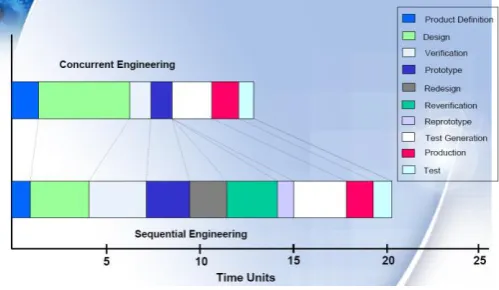
A normal sequential engineering process is described in the figure 1. In sequential engineering each functional phase goes through reviews or gates in which the phase is locked and next phase is allowed to start. This approach has three deficiencies
1) communication between expertise’s throughout the process is not supported
2) total time used per product is too long
3) Possibility to change anything is very difficult
To overcome these difficulties concurrent engineering is proposed. The basic idea of concurrent engineering depends on two pillars.
1) Start design phases before predecessor is closed
2) Efficient communication between phases.
Fig1. Sequential Engineering process
Fig.2 Concurrent Engineering process
Stoll has developed 4C’s of Concurrent Engineering [2] which help to understand the elements of Concurrent Engineering process: −
•Concurrence: Product and process design run in parallel and occur at the same time frame.
•Constraints. Process constraints are limitations or restrictions considered during part of the product design. This ensures parts that are easy to fabricate, handle, and assemble and facilitates use of simple, cost-effective processes, tooling and materials handling techniques.
•Co-ordination. Product and process are closely co-ordinated to achieve matching of the requirements for effective cost, quality, and delivery.
•Consensus. High impact product and process-decision making involve full team participation and consensus.
3.1 Implementing Concurrent Engineering [2]
It takes time to implement a superb Concurrent Engineering environment. The implementation and maintenance usually goes through small steps, needs refinement and requires time to change organizations’ culture and actual practices. Three main issues in implementation are presented as follows:
a) Commitment, Planning and Leadership:
As all successful projects a commitment from leaders is essential. This provides enough funding and allows needed
Concept design System design
Detail design Ramp up,
© 2017, IRJET | Impact Factor value: 5.181 | ISO 9001:2008 Certified Journal
| Page 1068
decisions about resource use changes to happen. A plan isneeded. The plan defines the steps to take and presents the goal. The metric must be embedded into plan and followed.
b) Continuous Improvement.
It is not some method that can be directly implemented – the variations of products and organizations are too great. Concurrent Engineering must be designed to fit the company, not vice versa. Concurrent Engineering merely sets the targets and offers philosophy to follow – actions must be defined case-by-case, benchmarking and set of known methods can of course be used. Monitoring should give data for refining the engineering – constant improvement flows a path of planning, implementing, reviewing and revising.
c) Communication and Collaboration [4]
Interactions emphasized in Concurrent Engineering require efficient ways to collaborate. Into an organization an infrastructure and information sharing environment need to be built to meet the needs of communication and collaboration. The environment development can gain from the ideas of collective intelligence and collaborative effort. Focus may be different and approaches also may be different to build the system of concurrent engineering.
The focus can consist of one or more (adapted and fulfilled) [4]
− Shorter total lead time
− Products improved overall quality − Decreased manufacturing costs − Earlier brake-even point − Life-cycle cost reduction − Better customer satisfaction
− Reduced changes / changes earlier / fewer changes after ramp-up
− Less risk of failure
− Lower risk to flop with product in general
− More predictable / accurate results / process (e.g. in feasibility)
[image:3.595.314.564.107.252.2]− Global engineering environment development
Fig. 3 How concurrent Engineering reduces time
4.
CONCURRENT
ENGINEERING
FOR
ENVIORONMENT AND SUSTAINABILITY
4.1 Sustainability:
Sustainability refers to a process or state that can be maintained indefinitely. Sustainability emerged to improve the quality of human life while living within the carrying capacity of supporting ecosystems. Industrialisation needs resources, especially raw materials, which are now concentrated mainly in poor nations. Natural resource management is the biggest challenge to sustainable development. Of the world’s largest economies, 51 are corporations, only 49 are nations. This indicates the exploitation of natural resources at larger scale.
During the development process, however there has been an uncontrolled exploitation of natural resources that has proved detrimental and has caused extensive damage to environment. Technology and development are closely associated there is need of environmental friendly technologies. Towards this an organisation effort is needed to develop and diffuse environmental friendly technologies. This is where the concurrent engineering finds it position. The outcomes of concurrent engineering for sustainability is
Immediate response to market demands Decentralised production
Better use of local resources Reduced environmental effects Improved energy efficiency
© 2017, IRJET | Impact Factor value: 5.181 | ISO 9001:2008 Certified Journal
| Page 1069
and supplies do not confer with each other. In concurrentengineering this is overcome by communication between all members of the team as critical designs are made. Everyone is welcomed to give ideas and suggestions so there is a chance of saving materials, or using recycled materials etc.
4.2 Environmental Aspects:
Environment is the source of our raw materials. Environmental aspects of a product may be included in the Quality Function Deployment. While selecting a material for a product design its environmental effect shall also be considered. For example while designing a product, the material which we have selected for manufacturing product may cause landfill or recycled its toxic behaviour, reusability etc. So when considering materials for manufacturing importance shall be given to material that will cause less negative impacts to the environment.
Design for Environment
There are three major elements of design for the environment:
• Design for environmental manufacturing • Design for environmental packaging • Design for disposal and recyclability
Design for Environmental Manufacturing
• Non-toxic processes & production materials • Minimum energy utilization
• Minimize emissions
• Minimize waste, scrap & by-products
Fig.4 product life cycle in concurrent engineering
Design for Environmental Packaging:
• Minimum of packaging materials • Reusable pallets and packaging • Recyclable packaging materials • Bio-degradable packaging materials
Design for Disposal & Recycling:
• Re-use/refurbishment of components & assemblies
• Material selection to enable re-use and minimize toxicity
• Minimum number of materials/colours to facilitate separating materials and re-use • Design for serviceability to minimize disposal of
non-working products
• Material identification to facilitate re-use • Design to enable materials to be easily separated • Design for disassembly
• Avoid use of adhesives
• Limit contaminants - additives, coatings, metal plating of plastics, etc.
4.3 Need for Concurrent Engineering and
sustainability
i. Our Environments are constantly changing ii. Actions against any change must be quick, effective,
and responsible
iii. To do the right things for the first time
iv. To reduce the reaction time and act immediately v. Continuous improvement is always needed and
concurrent engineering targets continuous improvements
vi. “Possibilities of designing products and processes so that wastes from one are used as inputs to another”
vii. Including environmental and social constraints with economic considerations to make decisions
5. FUTURE OF CONCURRENT ENGINEERING
[2]
© 2017, IRJET | Impact Factor value: 5.181 | ISO 9001:2008 Certified Journal
| Page 1070
6.CONCLUSION
Organization which is involved in long term process must consider the advantages of concurrent engineering. Initially there will be challenges, initial costs associated with establishing the system and stabilizing it. Concurrent engineering is a powerful tool for producing successes while reducing costs. Adoption of concurrent engineering to organization showed positive results like increase in market share, customer satisfaction and reduction in production lead time [5]. There are so many aspects to improve the business with concurrent engineering with green design. The current rate of industrial growth and consumption patterns will extract the natural resources by another 40 years, so there is need of alternative material arrangement methods and efficient usage, re-usage of materials. Concurrent engineering proposes to re-use, recycle materials while considers so many parameters according to supplies and consumers demands. Product designed with an environment in mind may appeal to many customers. The environment must be viewed as a design constraint, but as a chance for manufactures to use technologies to excel and become more competitive while the environment in mind.
REFERENCES
[1] Concurrent Engineering: ' Effective Deployment Strategies Prof. Unny Menon, Michael Graham,Brisbane, California 94005-1835, USA
[2] MAFAM Corporation. “Concurrent Engineering”
[3] Benny “Concurrent Engineering”, Authors stream, Galway Education Centre
[4] CAE DS “Product data management, Concurrent Engineering”