© 2017, IRJET | Impact Factor value: 6.171 | ISO 9001:2008 Certified Journal | Page 1490
Dynamic Fine-grained Access Control and Multi-Field Keyword Search in
Cloud Based EHR
Ms. A.Sivasankari
1, Ms.S.Radhika
2, Mrs. K.Ayesha
3.
1Head of the Department, Dept of Computer Science and Applications, D.K.M College for Women (Autonomous),
Vellore, Tamilnadu, India*
2Research Scholar, Dept of Computer Science and Applications,
3Assistant Prof, Dept of Computer Science and Applications, D.K.M College for Women (Autonomous),
Vellore, Tamilnadu, India*
---***---Abstract -
Electronic Health Record frameworks (EHR)are progressively conveyed inside healthcare services organizations to diminish high venture and support cost. Distributed Cloud computing has been broadly perceived as the cutting edge's registering foundation and it offers a few favorable circumstances to its clients. A Cloud-Based Electronic Health Record System (CEHRS) was outlined, executed and tried for recording, recovering, filing and refreshing of patients and other therapeutic records. The Cloud client can utilize his trait esteems and a pursuit question to locally determine inquiry ability, and a document can be recovered just when its catchphrases coordinate the question and the client's characteristic esteems can pass the strategy check. Utilizing this system, we propose a novel plan called Dynamic Fine-grained Access Control and Multi-Field Keyword Search (DFAC_MKS), which empowers dynamic refresh of Keywords and access structure over scrambled information. In the interim, it likewise bolsters the hunt capacity deviation, and accomplishes proficient access strategy refresh and additionally watchword refresh without trading off information security. To upgrade the exactness, look inquiry in Conjunctive Normal Form (CNF) over various fields. Forward and Reverse Fastening (FRF) in DFAC_MKS likewise presented her information bank for all the teaming up doctor's facilities, the middleware gives a typical stage to all the EHR frameworks between remote healing centers while a validation server stipends access to approved clients and denies unapproved clients access to records or assets on the framework. In this investigation the issue of watchword seeks with get to control over encoded information in distributed computing.
Key Words: EHR (Electronic Health Records), PHR (Personal Health Record), Keyword Search, Access Control, CNF (Conjunctive Normal Form), FRF (Forward and Reverse fastening)
I. INTRODUCTION
An Electronic Health Record (EHR) is a developing idea characterized as a methodical gathering of electronic
© 2017, IRJET | Impact Factor value: 6.171 | ISO 9001:2008 Certified Journal | Page 1491
question and permit his entrance. This plan tends to the main test by completely utilizing the calculation energy of cloud server. It likewise unravels the second test by scattering the calculation weight of ability age to the clients in the framework. Second, to empower such a system, we make a novel utilization of Hierarchical Predicate Encryption (HPE), to understand the determination of pursuit capacity. In view of HPE, we propose our plan named DFAC_MKS. It empowers the administration of both the watchword inquiry and access control over different fields, and backings proficient refresh of access strategy and catchphrases. DFAC_MKS additionally acquaints some irregular esteems with improve the assurance of client's entrance protection.
2. SYSTEM MODEL
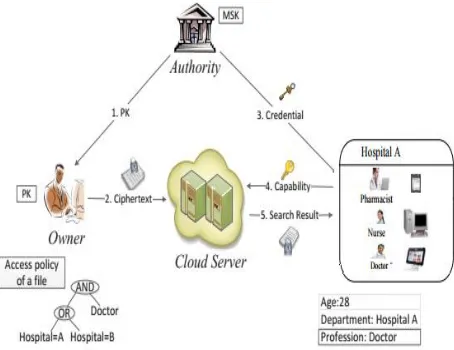
[image:2.612.51.278.465.640.2]In this paper, we consider a cloud-data-sharing system consisting of four entities, i.e., data owners, authority, data users and cloud server (shown in Figure 1). Data owners create data files, design the encrypted indices containing both keywords and access policy for each file, and upload the encrypted files along with the indices to the cloud server (step2 in Figure 1). Authority is responsible to authenticate user’s identity. It issues a set of keys as a credential to represent user’s attribute values (step 3). Data user generates a search capability according to his credential and a search query, and submits it to the cloud server for file retrieval (step 4). The Cloud server stores the encrypted data and performs search when receiving search capabilities from users (step 5).
Fig. 1: The framework of DFAC_MKS. PK is the public keys, and MSK is the master secret key that should be securely
kept. Credential is the set of keys standing for user’s attribute values. Search capability is generated by using
user’s credential and his interested query.
3. DESIGN GOALS
• Data Confidentiality and Index Privacy
:
Theinformation classification ought to be secured against the cloud server what's more, unapproved clients. File protection demonstrates the cloud server ought to be uninformed of the quality esteems in get to strategy and the catchphrases installed in the record.
• Fine-grained Access Control and Multi-Field
Keyword Search: The framework should bolster
fine-grained get to strategy and multi-field catchphrase look. In this paper, we for the most part think about the entrance arrangement and the inquiry question in Conjunctive Normal Form (CNF) over different fields. here we likewise acquainted forward and turn around tying with increment catchphrase exactness.
• Efficiency: The framework should guarantee the
proficiency for general operations in down to earth condition, for example, pursuit and inquiry capacity inference.
• Adaption to Frequent Updates: To adapt to the
situation with visit refreshes, either to get to arrangement or to catchphrases, the framework ought to give a productive refresh technique
.
4. IMPLEMENTATION
Subsequent to confirming the issues in the current frameworks and looking the upsides of the distributed computing worldview, I propose another model for the EHR frameworks for the arrangement of these issues. The proposed framework permits different human services suppliers to get to the patient record from any area safely with no limitation. This framework will incorporate all the patient records, including the therapeutic information, for instance restorative history, past surgeries, pharmaceuticals, hypersensitivities, research facility test and so forth, which can be gotten to from any area and looked into by their doctors. The doctors can refresh and alter the patient's record from anyplace with no limitation. Besides, the patient can get to his/her record on the web and can transform it whenever from anyplace.
© 2017, IRJET | Impact Factor value: 6.171 | ISO 9001:2008 Certified Journal | Page 1492
Patients can alter the entrance benefits without anyone else record as it were. The proposed Cloud Base framework can permit different approved clients to safely get to persistent record from different human services units. They will coordinate all patient records, including CT-Scan and MRT, which can be effortlessly gotten to from anyplace and can be investigated by any approved clients, yet any unapproved client isn't permitted to get to the patient's record.
In the proposed framework, I separated the patient data into two sections. One a player in the data is put away in the Cloud server database, while another piece of data is put away in the concerned medicinal services' unit databases. In any case, if the neighborhood medicinal services unit does not have its nearby EHR framework, at that point that doctor's facility will store the entire patient record in the Cloud database.
The patient data is isolated into two classifications: I) General Data, ii) Private data
I) General Data: The general data is the data that the patient and medicinal services unit need to share with anybody (e.g. name, age, contact data, any medicinal history that the concerned social insurance unit, tolerant or doctor, need to impart to some other doctor's facility).
ii) Private data: The private data is the data that the patient and the medicinal services unit don't need to impart to anybody however just upon demand and circumstance (e.g., any past medicinal history which is private and the patient what's more, medicinal services would prefer not to demonstrate it freely).
The general data would be put away on the Cloud database server while the private data would be put away on the nearby human services unit database server. The data could change from private to open whenever, when it changes from private to open then it movements to the cloud database server. All the medicinal services units must be enrolled with the Cloud database server. The Cloud database server would store the general data about the patient and data about all human services units where the patient's data is put away, while the private data about the patient is put away on the nearby database inside every single social insurance unit. The proposed framework utilities all distributed computing frameworks, consolidating them with the nearby EHR framework.
We will depict DFAC_MKS. Its primary thoughts are as takes after. To begin with, we can utilize vectors to speak to the qualities (e.g., watchwords and characteristic esteems) and the CNF articulation (e.g., get to arrangement and pursuit question). Second, we can use the appointment procedure in HPE to understand the deduction of look
capacity. Third, the scrambled list incorporates two segments to separately serve the unscrambling demands from the pursuit capacity and the certification. fourth, quick and speedy updation of record and catchphrase utilizing FRF.
A. An Introduction to HPE
Various leveled predicate encryption (HPE) is a cryptographic crude that backings appointment of predicate encryption (PE). In HPE, a mystery key for a predicate vector can unscramble the ciphertext that partners with an esteem vector if their inward item = 0. In the appointment of HPE, for a vector +1 traverse <
[image:3.612.351.552.312.360.2]>, a more prohibitive mystery key ;+ +1 can be produced with the sk~pl and ~pl+1 taken as information.
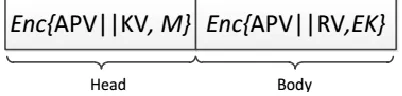
Fig. 2: The format of an encrypted index. For example, for KSAC. Build Index in Algorithm 1, M is set as IGT (i.e., the
identity element of the group GT used in HPE and is public.)
B. The Design of Index Format
As indicated by the property of HPE, we give a novel outline of the encoded file as appeared in Figure 2. The record data incorporates the predefined get to arrangement, the agent catch phrases, and the symmetric keys used to scramble the record content. To fabricate an encoded record, the information proprietor first produces the "body" segment to bolt the symmetric key EK by using the entrance strategy vector (APV) and an arbitrary vector (RV). EK is utilized as the symmetric key to encode and decrypt the file content. This body component ensures that only the users whose attribute values satisfy the access policy can recover EK for file decryption. The recovery of EK performed by the unauthorized user will be rejected by APV and the cloud server’s attempt to obtain EK by stealthily using the authorized user’s search capability will be refused by RV.
© 2017, IRJET | Impact Factor value: 6.171 | ISO 9001:2008 Certified Journal | Page 1493 Forward and backward chaining
• Inference with Horn clauses can be done through the forward chaining or backward chaining algorithm.
• Both directions for inference are very natural.
• Deciding entailment with Horn clauses can be done in time that is linear in the size of the knowledge base. • Forward chaining (data-driven reasoning) examines the body of which rules is satisfied by the known facts and adds their heads as new facts to the knowledge base. • Every inference is essentially an application of Modus Ponens.
• This process continues until the given query q is added or until no further inferences can be made.
Forward chaining is a sound and also a complete inference algorithm
• Backward chaining is a form of goal-directed reasoning • We aim at showing the truth of a given query q by considering those implications in the knowledge base that conclude q (have it as the head)
• By backward chaining one examines the whether all the premises of one of those implications can be proved true • Backward chaining touches only relevant facts, while forward chaining blindly produces all facts
• One can limit forward chaining to the generation of facts that are likely to be relevant to queries that will be solved by backward chaining
ALGORITHM 1: Index Building Algorithm
1. Initialize
2. For int i=0;i< files.lenght; i=files.next do 3. While !eof do
4. If !stopword then
5. Sub-key=keyword.subtring(0,3); 6. Bucket==keyword.subtring(0,1); 7. Enc-sub-key=encryption(sub-key); 8. Goto (bucket)
9. If (bucket.contains(en-sub-key)) && (!bucket.contains(file-id))then
10. Frequency++;
11. Add to hash map ( enc-sub-key, fileid, frequency) 12. Else Set frequency=1;
13. Add hash map to bucket (enc-sub-key, file-id, frequency)
14. Set frequency =1;
15. Add hasp map to bucket (enc-sub-key, fileid, frequency)
16. End if 17. End if
18. Move to next character 19. End while
20. End for
5. CONCLUSION
The cloud base EHR framework arrangement, which could store a colossal measure of information and with no stress of control of EHR for neighborhood social insurance units. In this paper, the idea of Master key generation is utilized to scramble and store the substance in the cloud. An effective Forward and Reverse Fastening record building calculation is intended for quick also cost proficient record recovery from the cloud. The Master key age calculation where just the ace key is refreshed with each denial or enrollment change, keeping the current gathering individuals private and open keys unaltered. This approach lessens the storage room of the file document and key size.
Promote this convention can be improved to other type of content and interactive media records. The speedier index building calculation can be investigated to recovery records proficiently. We at that point use HPE to understand this structure and present DFAC_MKS. DFAC_MKS understands the fine-grained get to control and multi-field catchphrase look, empowers productive refresh of both access approach and keywords, and ensures client's authentication security.
REFERENCES
[1] Zhirong Shen, Jiwu Shu, and Wei Xue. Keyword search with access control over encrypted data in cloud computing. In Proc. of IEEE/ACM IWQoS, 2014.
[2] Jiwu Shu, Zhirong Shen, and Wei Xue. Shield: A stackable secure storage system for file sharing in public storage. Journal of Parallel and Distributed Computing, 74(9):2872–2883, 2014.
[3] MA Tinghuai, ZHOU Jinjuan, TANG Meili, TIAN Yuan, ALDHELAAN Abdullah, AL-RODHAAN Mznah, and LEE Sung young. Social network and tag sources based augmenting collaborative recommender system. IEICE transactions on Information and Systems,
98(4):902–910, 2015.
[4] Yongjun Ren, Jian Shen, Jin Wang, Jin Han, and Sung young Lee. Mutual verifiable provable data auditing in public cloud storage. Journal of
© 2017, IRJET | Impact Factor value: 6.171 | ISO 9001:2008 Certified Journal | Page 1494
[5] Jiwu Shu, Zhirong Shen, Wei Xue, and Yingxun Fu. Secure storage system and key technologies. In Design Automation Conference (ASPDAC), 2013 18th Asia and South Pacific, pages 376–383, 2013.
[6] Agfa (2012).Moving Digital Imaging into the Clouds, Agfa HealthCare, Mortsel-Belgium, May 2012
[7] Vishesh Ved, Vivek Tyagi, Ankur Agarwal, A.S. Pandya, Personal Health Record System and Integration Techniques with various Electronic Medical Record Systems, 2011 IEEE 13 th International Symposium on High-Assurance System Engineering, pages 91-94, 2011.
BIOGRAPHIES
Ms. A.SIVASANKARI
Head of the Department (CS),
Assistant Professor,
Dept of Computer Science and Applications, D.K.M College for Women (Autonomous), Vellore, Tamilnadu, India
Ms. S.Radhika
Research Scholar,
Dept of Computer Science and Applications, D.K.M College for Women (Autonomous), Vellore, Tamilnadu, India
Ms. K.AYESHA
Assistant Professor,
Dept of Computer Science and Applications, D.K.M College for Women (Autonomous), Vellore, Tamilnadu, India