Running head: SPONTANEOUS ANALOGISING AND EXPERTISE
The Structure and Function of Spontaneous Analogising in Domain-Based Problem Solving
Christopher R. Bearman Linden J. Ball* Thomas C. Ormerod
Lancaster University, UK
____________________________
*Corresponding author:
Department of Psychology, Lancaster University, Lancaster, UK, LA1 4YF Tel: 01524 593470
Fax: 01524 593744
Abstract
Laboratory-based studies of problem solving suggest that transfer of solution principles from an analogue to a target arises only minimally without the presence of directive hints. Recently, however, real-world studies indicate that experts frequently and spontaneously use analogies in domain-based problem solving. There is also some evidence that in certain circumstances domain novices can draw analogies designed to illustrate arguments.It is less clear, however, whether domain novices can invoke analogies in the sophisticated manner of experts to enable them to progress problem solving. In the current study groups of novices and experts tackled large-scale management
The Structure and Function of Spontaneous Analogising in Domain-Based Problem Solving
Theorists have traditionally viewed analogical reasoning as a core element of intelligent thought (Raven, 1938; Sternberg, 1977), and recent evidence suggests that it may play a central role in the retrieval of information from long-term memory (e.g., Schank, 1999), in domain-based skill
acquisition (Anderson, 1983), and in creative problem solving (e.g., Holyoak & Thagard, 1995). It is this latter area of activity that forms the focus of the present research. In problem-solving contexts analogical reasoning is typically viewed as entailing the use of “base” information from a previous problem-solving episode to facilitate attempts at problem-solving a current “target” problem. It is noteworthy, however, that the postulated importance of analogising in problem solving stands in sharp contrast to many findings concerning the nature and extent of analogical problem solving in laboratory studies. For example, pioneering experiments by Gick and Holyoak (1980, 1983) demonstrated that providing participants with a base analogue prior to them tackling a superficially different but conceptually similar target promoted only a modest increase in solution rates (i.e., to levels of 20-30%) relative to a control condition where no analogue had been presented. It was only in conditions where explicit hints were provided about the relevance of the base information to the target problem that high levels of facilitated performance arose (see also Anoli, Antonietti, Crisafulli, & Cantoia, 2001).
such as: (a) giving participants a static diagrammatic representation of the underlying solution-structure associated with the base problem (e.g., Gick & Holyoak, 1983; Pedone, Hummel, & Holyoak, 2001); (b) providing problem solvers with an abstract verbal statement summarising the underlying
conceptual nature of the base problem and its solution (e.g., Gick & Holyoak, 1983); or (c) re-presenting the base information to the participant whilst they are processing the target (Anoli et al., 2001; Gick & Holyoak, 1980). Taken together, this evidence appears to support the contention that whilst people may be good at utilising prior problem and solution information when they are directed to do so, they may be rather limited in their capacity to detect such analogous information in the first place.
Evidence for Spontaneous Analogising
when tackling an information-display problem, was readily able to bring to mind previous design experience relating to other displays that he had worked on in the past.
At a theoretical level, Sweller (1980) has argued that much of the time there is, in fact, a strong correlation between the surface features of problems and their underlying abstract solution structures. Therefore, relying on surface features to access what might be a relevant base problem may be a valuable heuristic (cf. Blessing & Ross, 1996), and one that the human cognitive system may well have evolved to operate. As a heuristic, however, it is likely to be far from foolproof, and may, on occasions, lead to attempts to map between base and target problems that, whilst appearing to be superficially similar at a surface level, in fact have no underlying conceptual association in terms of solution structures (e.g., see Novick, 1988, for relevant evidence).
Apart from the role of surface similarity in driving spontaneous analogical reasoning, other research has provided evidence for unprompted analogising when multiple analogues are presented prior to the target problem -- even when such analogues share few surface similarities to the target (see Gick & Holyoak, 1983; Catrombone, & Holyoak, 1989). This line of research is particularly interesting as it suggests that a primary mechanism
underpinning the development of domain-based expertise may well be
abstract conceptual understanding of the underlying structure of problems, and serve to enable the recognition of problem “types”; they also embody a
procedural understanding of how best to solve problems of that particular type.
Analogical Problem Solving in Real-World Contexts Recently, spontaneous analogical problem solving has started to be investigated in applied contexts. This research has particularly focused on the behaviour of experts. For example, Marchant, Robinson, Anderson, and Schadewald (1993) investigated the use of analogies in the interpretation of tax statutes in graduate students and professional lawyers. They found that both groups demonstrated high rates of transfer from domain-based structural analogues. Likewise, Clement (1988) found that science experts frequently evoked analogies when attempting to explain a concept. Most recently,
Dunbar and colleagues (e.g., Dunbar, 2001; Dunbar & Blanchette, 2001) have documented the use of analogy by immunologists and molecular biologists, finding that structural analogising was prevalent in a range of scientific activities, such as formulating hypotheses, designing and modifying
experiments, and giving explanations to other scientists. Dunbar (2001) was also able to determine the function of the analogies in his observations. When isolated, unexpected results occurred the scientists drew analogies to similar experiments, what Dunbar (2001) calls “local” analogies. However, when a series of unexpected results occurred the scientists drew more distant
type of analogical mapping appears to differ depending on the purpose for which it is drawn.
In sum, it appears that experts in applied settings are able
spontaneously to draw analogies between base and target problems. This is consistent with the widely held view that key differences between experts and novices reflect different levels of information encoding. Experts are able to encode information at a deeper, structural level, whilst novices generally encode information at a more surface or superficial level (Chi, Feltovich, & Glaser, 1981; Klein, 1999; Novick, 1988). In this way, experts solving domain-based problems are able to exploit the underlying relational structure of information much better than novices, who generally rely more on the superficial features of problem situations (Chi et al., 1981; Klein, 1998; Novick, 1988). This account of expert problem solving is also consistent with the findings of Thompson, Gentner, and Loewenstein (2000), who observed that unless management students were actively encouraged to compare base analogues in order to draw out their structural relations, their rate of transfer of an underlying concept remained low.
structural inferences from the target domain to semantically distant source domains that also possessed little superficial similarity to the target problem.
Overall, then, the extent to which domain novices are able to draw on analogies when tackling problems remains unclear, with the few existing studies showing some inconsistent findings that may well relate to
methodological aspects of the research – a point that is argued persuasively by Blanchette & Dunbar, 2000. For example, their own study that reveals good levels of structural analogising in novices adopts what they refer to as a production paradigm, whereby participants are given a target problem and asked to generate a source analogue. This contrasts with the lower levels of novice analogising in Thompson et al.’s (2000) study and most traditional laboratory-based research, which adopt what they term a reception paradigm, whereby participants have to detect a relation between source and target problems that are presented.
Our present study, then, was designed as an attempt to address further the issue of spontaneous analogising in real-world novice and expert problem solving. Our chosen domain was management science, which allows
be described as ill-defined (Van Lehn, 1989) and, in some respects, undefined, as multiple solution possibilities exist, and there is no objective metric for judging attainment of an optimal solution.
Our study involved comparisons between the frequency and structural complexity of analogising in expert and novice management practitioners. In light of observations concerning the differing functions of analogies in real-world situations, we were also alert to the possibility that management contexts might similarly be associated with analogy use aimed at attaining different practical goals. To achieve our aims, analogies first needed to be identified in the transcribed discussions of collaborating participants, and then had to be categorised using a pre-defined coding scheme. The
identification of analogies was based on a technique developed by Clement (1988), and will be considered in more detail in the method section below. The coding of analogies derived from a scheme developed by Gentner (1983) for classifying the syntactic elements of information that are mapped between base and target domains (see also Falkenhainer, Forbus, & Gentner, 1989), and is described below.
The Structure of Analogies
Like Gentner, we also view domains as being systems of objects, object-attributes and relations between objects. As such, domain knowledge can be understood as comprising propositional networks of nodes and
types advanced by Gentner (1983) is that between object-attributes versus relations. This distinction can readily be made explicit in the predicate structure. Thus object-attributes are simply predicates that take on a single argument of the form, PREDICATE (argument1), as in the following example that describes the colour of an object or entity1: BROWN (Hercules-the-dog). In contrast, relations are predicates that take on two or more arguments of the form PREDICATE (argument1, argument 2…argumentn), as in the following example: CHASE (Hercules-the-dog, Fifi-the-dog).
Under this distinction between attributes and relations, base-to-target mappings could arise at: (a) just the level of attributes and associated objects; (b) just the level of relations; or (c) a mix of both levels. Gentner (1983), however, argues that type-a and type-c mappings are best viewed as being mere appearance matches and literal similarities, respectively, rather than examples of “pure” analogies (see also Gentner & Markman, 1997). She reserves the term “analogy” for situations where there are few or no object-and-attribute mappings between base and target domains relative to many relational mappings, as in type-b. Our own research on spontaneous
object-and-attribute analogies, and the second category as relational analogies.
A second syntactic distinction advanced by Gentner (1983) is that between first-order predicates (that take objects as arguments) and higher-order predicates (that take propositions as arguments). For example, CHASE (Hercules-the-dog, Fifi-the-dog) and RUN-AWAY-FROM (Fifi-the-dog, Fifi’s-owner) are both first-order predicates, whereas CAUSE [CHASE (Hercules-the-dog, Fifi-the-dog), RUNS-AWAY-FROM (Fifi-the-dog, Fifi’s-owner)] is a second-order predicate2. It is clear that the order of a mapping has a very close association to the level of the entities that are mapped (as
The Function of the Analogies
The structure-oriented coding scheme that we have just outlined was unable to address issues relating to the purpose or goal for which analogies might be drawn in our study. The pragmatic analysis of analogical transfer was pioneered by Holyoak (1985), and since this time pragmatics have been found to constrain how ambiguity is resolved (e.g., Spellman & Holyoak, 1996) and to influence the semantic distance between base and target domains (e.g., Dunbar, 2001; Richland, Holyoak, & Stigler, 2004). It may well be, then, that the reason why the novices and experts draw analogies will
influence the form that the analogy takes, and we were alert to this issue in the present study.
To capture the function of analogies it our research it was necessary to use a second method of coding that was able to discriminate such nuances in analogy use. Since it was considered desirable to allow the functional aspects of analogies to emerge from the data rather than to pre-judge the issue, a qualitative assessment of expert and novice analogising was performed on the data in the form of a thematic analysis. Thematic analysis is a method of classifying segments of discourse that involves sorting such extracts on the basis of perceived similarities (Plummer, 1995; Smith, 1995).
Method Participants
management science at various universities around the world (11 females; 21 male), and are henceforth described as experts. Participants were not paid. The novices were analysing cases of business situations as part of their course requirements for a final-year marketing module within their management science degree course. We acknowledge that our novices were not totally naïve to the area of business management as they possessed some relevant domain knowledge. Still, they were very inexperienced in tackling business-case problems, and the relevant knowledge that they did posses was mainly in the form of analytical concepts such as the use of SWOT analysis for
considering a company’s current position. The experts we studied were
analysing cases as a part of workshops that they were involved in on the theme of “Teaching with Cases”. These experts were all post-doctoral academics employed in management schools within universities, and thus had a wealth of advanced domain knowledge. Several of had been practicing management for more than ten years, and thus surpassed the threshold that some researchers have claimed as a criterion for true expertise, though most fell short of this ten-year threshold by a few years. All of our participants, whether novices or experts, worked in collaborating groups during their case analyses.
Materials
Henderson, 1998), Groups 5 and 6 analysed “Petrol Retailing in Europe: The UK Market” (Lew, 1999), and Group 7 and 8 analysed “Delta Dairy S.A”. (Easton & Dritsas, 1992). The cases were 9 pages, 19 pages, 13 pages and 11 pages long, respectively.
The expert component of the study involved two sets of experts, those who were attending the Copenhagen workshop and those who were attending the Cranfield workshop. The Cranfield experts analysed two cases,
“Holmesafe Ltd” (Andrews, 2000) and “East Midlands Bus and Coach
Services Ltd” (Williamson, 2000), and the Copenhagen experts analysed three cases, “Graham Stewart: General Manager, A, B and C” (Erskine & Simons, 2002), “The Purchasing Co-Op” (Menor, Erskine, & Leenders, 2000), and “Jim Olson” (Leenders, 2000). All experts worked in small groups of three to five people during their initial analyses of these cases.
Procedure
The case-analysis sessions were conducted with novices at Lancaster University, UK, and with experts during two workshops held by the European Case Clearing House. One workshop took place at Cranfield University, UK and the other in the Copenhagen Business School, Denmark. These workshops were attended by participants from higher education establishments around the world and were conducted in English.
which lasted for approximately 1 hr (with the exception that two expert analyses involved only large group discussions). The large group discussions were chaired by a case leader, who kept order, wrote down points and invited contributions. Small groups were self-directed by the group members. The small group discussions allowed the participants a chance to discuss the cases in order to prepare for the large group discussion. The novices were allocated into collaborating groups of four on the basis of who the module director believed would work well together and the experts worked in self-determined groups of three to five individuals.
The aim of the case analyses was for groups to design a package of recommendations that could be implemented by one of the organisations described within the case.3 The recommendations consisted of the group’s analysis of the organisation’s problems and their solutions to those problems. At the beginning of the analysis sessions the experimenter introduced himself and requested permission to audio-tape the sessions. During the case-analysis sessions the experimenter was a passive observer who sat quietly making notes. An audio recording was made of the small and large group discussions. Analogy Extraction and Coding
and (4) ruling-out of trivial cases that involve only surface similarity (i.e., mere-appearance matches) without relational similarity.
Following Clement’s (1988) first three principles we likewise defined an analogical episode as having occurred when a participant drew a
comparison between the existing situation and a previous situation, and it could be seen that some aspects of the two situations were equivalent. We discounted analogies that: (a) were based on lectures or course materials, (b) were drawn by the Case Leader, or (c) were repetitions of previous analogies (except where the repetition was drawn to solve a different problem, or the function of the analogy changed; in these rare cases the analogies were counted as two distinct analogical episodes). Unlike Clement (1988), mere-appearance matches in the absence of any relational similarity were included in our analogy-extraction process, as we believed that analogies arising at this level could engender important insights about expert/novice differences in domain-based problem solving. Indeed, mere-appearance matches may well involve quite rich, and potentially useful, cross-domain correspondences that could progress problem solving. Such mappings, therefore, seem worthy of analysis.
Full analogy extraction was conducted by the first author, and a 15% random sample of the data was then analysed by an independent researcher. There was 95% agreement between the initial and subsequent analogy
Coding of analogy structure. Table 1 shows an analogy that was produced by a novice during a tutorial, and will serve as the basis of the following exemplification of our coding system. The verbal extract in Table 1 indicates that the participant was tackling the problem of how to achieve increased revenue for a petrol-retail company by proposing the solution of selling advertising space close to the pumps. This was based on an analogy to what other petrol stations were doing. In our formulation of the propositional structure of an extracted analogical episode it was necessary: (1) to reduce the amount of information in the episode to its core, explicit, ideational and relational constructs; and (2) to draw the minimal inferences necessary to capture missing relational constructs that were sometimes omitted in the analogical episode. Inferences to complete analogies were made infrequently, and only when they seemed logically warranted. In the extract in Table 1, for example, it was not explicitly stated in the text that “companies are selling advertising space”, but this inference was a minimal necessary inference to lend coherence to the analogical episode, and also seemed entirely legitimate in the context of the analogy, as giving the advertising space away for free would conflict with the stated company aim of increasing revenue.
(Table 1 about here)
relation, in this case ‘CAUSE’, and therefore it is an example of a relational analogy. Holyoak and Thagard (1995) identify a number of different potential higher-order relationships, including CAUSE, EXPLAIN, IMPLY, ENTAIL, PRESUPPOSE, FACILITATE, HINDER and PREVENT, although CAUSE is argued by them to be the most common, and, indeed, it was predominant in our own coding of higher-order relations within analogical episodes.
The coding formalism used here is highly similar to the propositional coding of analogies employed by Blanchette and Dunbar (2000) that involved variables, relational terms and logical connectives (e.g., and, if…then and therefore). We present an example of Blanchette and Dunbar’s (2000) coding in Table 2 in order to illustrate their analysis approach. Our analogy example presented in Table 1 could readily be reworked into Blanchette and Dunbar’s scheme by rephrasing what we include as object names into variables. The example would then read “If X sells Y, then this causes X to increase Z”, in other words “If a company sells advertising space near the petrol pumps, then this causes the company to increase its revenue”. Critically for our structure-based analysis of analogies, both Blanchette and Dunbar’s scheme and our own Gentner-based scheme would characterise this example analogy as involving a relational mapping.
(Table 2 about here)
of our coding of their structure. The way that we applied thematic analysis was to sort all identified analogical extracts systematically into distinct categories that reflected their identifiable, function-oriented similarities. We explored different ways of sorting the analogical extracts based on different ways in which their function could be viewed as similar. This was done until a coherent scheme was produced that accounted for the data (i.e., there were no episodes that remained uncategorized).
Results
An attempt was made in this study to observe real-world analogical problem solving in as natural a setting as possible, hence the reliance on ethnographic methods and the use of participants who were analysing business cases for a purpose outside of the requirements of the study. The use of these kinds of participants precluded the exertion of rigid control over the study procedures applied and the case-analysis problems examined across our expertise manipulation. However, it should be noted that whilst subtle discrepancies in both procedures and tasks would make the interpretation of any differences in observed expert and novice behaviours quite difficult, such discrepancies in procedures and tasks would arguably make the finding of expert/novice similarities more robust, since such similarities would have arisen despite procedural and task discrepancies.
Analogy Extraction
hr (SD = 4.8, range = 0-20). In addition to these analogy extracts a number of other extracts could be identified in which a base was articulated but where the target was not clearly identified in the surrounding discourse, although often the target could be inferred from earlier discussions or later solutions. Thirty-eight instances of this type of extract were produced by the novice groups, and five by the expert groups. These extracts were excluded from the analysis for reasons of conservatism as well as to maintain correspondence with Clement’s (1988) analogy-extraction scheme. Therefore, only extracts that directly encompassed a base and a target were considered in subsequent analyses.
The Structure of Novice and Expert Analogies
Only one analogy drawn by the expert groups, and two by the novice groups, involved similarity at only the relational level without there
additionally being a degree of superficial similarity at the level of object-and-attribute mappings (see Table 3 for an example of such a “pure” analogy). Thus the majority of analogies that were made by our participants were what Gentner (1983) would classify as being literal similarities.
(Table 3 about here)
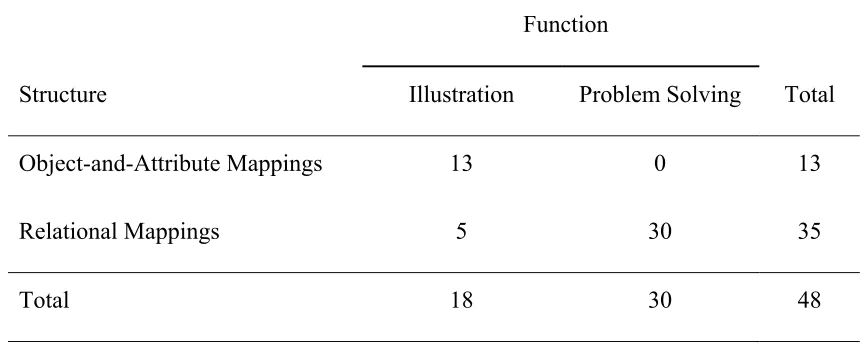
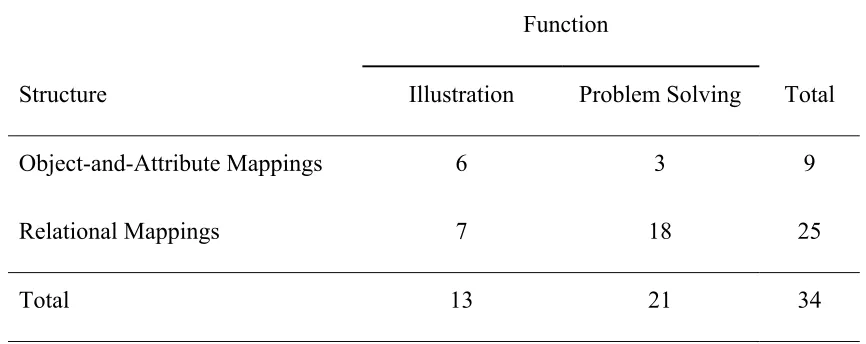
In terms of the structure of the analogical mappings that were drawn, the majority of analogies generated by both novice groups (i.e., 35 or 73%),
χ2(1) = 10.08, p = .001, and by expert groups (i.e., 25 or 73%), χ2(1) = 7.53, p = .006, were classified as involving relational mappings (see the right-most columns of Tables 4 and 5).
The complexity of the higher-order mappings was examined further in terms of whether or not the mapping involved a nested arrangement of order mappings. It was found that only 34% of the novice groups’ higher-order relational mappings were nested, compared with 60% of the expert groups’. Table 6 depicts a nested analogy that was generated by an expert. This analogy expresses the idea that one person could get some repayment back from another person (who had apparently stolen from them) by forcing the purported thief to transfer property to them. This analogy was based on the previous experience of the participant, where one company had obtained a financial return from another company by forcing that company to transfer their customer contracts.
(Table 6 about here) The Function of Novice and Expert Analogies
rather than directed at problem solving per se. In such cases, the participant generated a base situation in order to explicate the target. In Table 3, for example, a member of the case-analysis group drew parallels between the market positions of Coca Cola and Pepsi to illustrate the position faced by an oil company that was currently under consideration in the case analysis. This comparison seemed to be drawn purely for the purpose of exemplification.
Tables 4 and 5 show the overall frequency of analogies drawn by novice groups and expert groups, respectively, for the purposes of problem solving versus illustration. Just over one-third of analogies drawn by both novice groups (i.e., 18 or 39%) and expert groups (i.e., 13 or 38%) could be classified as illustrative. Although problem-solving analogies tended to dominate the analogical reasoning of our participants, statistical analyses revealed no reliable differences in frequencies: χ2(1) = 3, p = .083, for novices; χ2(1) = 1.88, p = .17, for experts.
comparison to the new brand, but in order to convey the uniqueness (and therefore desirability) of the new brand they proposed increasing its price beyond that of Moët et Chandon. Rather than just simply mapping over the price of an analogous brand, therefore, the pricing solution was instead
tailored to fit the properties of the new brand that the group wanted to convey. (Table 7 about here)
Our more refined analysis of problem-solving analogies at the level of direct base-to-target mappings versus elaborated base-to-target mappings revealed that 13 (43%) of the analogies drawn by novice groups, and 9 (43%) of those drawn by expert groups, were of the elaborated kind rather than the direct kind. Thus both forms of problem-solving analogies were fairly evenly distributed in novice and expert case-analysis behaviour.
A reliability check was undertaken that involved a second sorter independently producing a second thematic analysis of all novice and expert analogies, both in terms of the problem solving versus illustration
categorisation, and also in terms of the more detailed classification of problem-solving analogies as being elaborated or direct. The two thematic analyses were compared and a difference was scored if an extract had been placed in a different position in the two analyses. Consistency between the two coders was high, at 87% (i.e., only 7 out of 55 extracts were placed differently).
The Structure and Function of Analogies Compared
either generated object-and-attribute mappings or relational mappings. This breakdown of analogies allows a comparison to be made of the association between functional aspects of analogising and the structure of the mapping process across levels of expertise. A maximum likelihood chi-square test (Bishop, Fienberg, & Holland, 1975) exploring the structure by function interaction (collapsed across level of expertise) revealed a significant
difference between observed and expected frequencies of analogy production, G2(2) = 31.17, p < .0001. Looking at problem-solving analogies first, it is evident that participants invoked analogies that primarily involved relational mappings (exclusively so in the novice case), χ2(1) = 39.7, p < .0001. In contrast, when analogies were drawn for the purpose of illustration, novices were more likely to use object-and-attribute mappings than relational
mappings, a difference that was marginally significant, χ2(1) = 3.55, p = .059, whereas experts showed no preference in the mappings that were employed,
χ2(1) = .077, p = .78.
Discussion
Our study of novice and expert case analysis in a management context has produced a number of findings that clarify the nature and role of
analogical reasoning in real-world problem solving. First, we have demonstrated that novices working in groups are able to use analogies spontaneously to progress problem solving in a similar manner to that
analogies are structured around relational mappings compared with those that are structured around purely object-and-attribute mappings. In general, both novice and expert analogising was dominated by analogies that mapped relational structures between base and target domains. This finding demonstrates a sophistication in the application of knowledge that is not usually associated with novices (though see Blanchette & Dunbar, 2000). Third, we have found that the analogies that both expert and novices groups drew were directed toward the attainment of two main practical goals: problem solving and illustration.
The latter observation -- that analogies serve different functions -- is in line with Dunbar’s (2001) proposal that analogies may be drawn for different purposes in applied contexts (see also Blanchette & Dunbar, 2001). Moreover, our results also support Dunbar’s (2001) claim that the structure of
object-and-attribute mappings without relational mappings is intriguing. It may well be that illustrating an idea can frequently be achieved simply and effectively via a low-order correspondence between quite superficial elements of the base and target situations.
In terms of methodological aspects of our research, we note that the usual method of constructing an experiment is to have two groups who are similar in as many ways as possible except for the variables of interest (the independent variables). In real-world situations of the type that pertained in the present study, it is not always possible to create experiments with such tight control over variables. In particular, the practicalities of doing research in real-world domains means that the settings in which research data are collected are often less than ideal. Owing to the difficulty of collecting data in the present study, we admit to being unable to exert as rigorous a level of control as we would have liked over the way that our participants analysed their given cases -- or, indeed, the cases that they were presented with. As we noted earlier, however, whilst such confounds in the nature of tasks and procedures might arguably have invalidated any examination of key
results remain a valid examination of analogical reasoning in management individuals with very different levels of domain knowledge along the expertise continuum.
Overall, then, our results suggest that unprompted analogising may well be a generic problem-solving strategy that novices, like experts, are able to deploy (cf. Holland, Holyoak, Nisbett, & Thagard, 1986). We propose, however, that contextual factors arsing from the use of meaningful, real-world tasks may be critical for observing such spontaneous analogising in novices. In management domains, for example, individuals are able to draw on a wide range of personal and everyday experience that provides valuable background knowledge that can fuel analogy-based reasoning. Thus, whilst our
management novices were a long way off from being true domain experts, the sheer richness of their everyday experience may have enabled them to utilise knowledge in similar ways to how experts employ their more specialist domain-based knowledge. It seems clear that some real-world domains would allow individuals to draw more fully on everyday knowledge than others. For example, business management, political science, and creative design are all domains where a rich backdrop of non-specialist knowledge can be applied to progress solutions to problems. The extent to which the observation of
spontaneous analogical reasoning generalises across a range of applied domains is an issue that needs further empirical examination.
pure analogies, as they involved a mixture of both object-and-attribute and relational mappings. This observation is consistent with research that has found that the search for an analogy is often based on superficial features of the target information (e.g., Gentner, Ratterman, & Forbus, 1993). The result would also be predicted by the MAC/FAC model of analogy proposed by Forbus, Gentner, and Law (1995), who argue that the search for potential analogies is based on superficial problem features, with the deeper-level structure of the base and target predominantly influencing the mapping stage. Although we agree that superficial similarities between base and target situations are likely to be very important in the search process, other evidence indicates that structural similarity may also play a role in the search for a base analogue (cf. Wharton, Holyoak, Downing, Lange, Wickens, & Melz, 1994). Indeed, in the ARCS model of analogical retrieval proposed by Thagard, Holyoak, Nelson, and Gochfield (1990), structural aspects of the target can influence the search process.
References
Anderson, J. R. (1983). The architecture of cognition. Hillsdale, NJ.: Lawrence Erlbaum Associates.
Anderson, J. R. (2000). Learning and memory: An integrated approach. New York: Wiley.
Andrews, S. (2000). Holmesafe Ltd. Cranfield, UK: European Case Clearing House Collection.
Anoli, L., Antonietti, A., Crisafulli, L., & Cantoia, M. (2001). Accessing source information in analogical problem-solving. Quarterly Journal of Experimental Psychology, 54A, 237-261.
Ball, L. J., Ormerod, T. C., & Morley, N. J. (2004). Spontaneous analogising in engineering design: A comparative analysis of experts and novices. Design Studies, 25, 495-508.
Bearman, C. (2004). Cognitive strategies in the case analysis method. Unpublished PhD Thesis, Lancaster University, Lancaster, UK. Bishop, Y. M. M., Fienberg, S. E., & Holland, P. W. (1975). Discrete
multivariate analysis: Theory and practice. Cambridge, MA: MIT Press. Blanchette, I., & Dunbar, K. (2000). How analogies are generated: The roles of
structural and superficial similarity. Memory & Cognition, 28, 108-124. Blanchette, I., & Dunbar, K. (2001). Analogy use in naturalistic settings: The
Blessing, S. B. and Ross, B. H. (1996). Content effects in problem categorization and problem solving. Journal of Experimental Psychology: Learning, Memory, and Cognition, 22, 792-810.
Catrambone, R., & Holyoak, K. J. (1989). Overcoming contextual limitations on problem-solving transfer. Journal of Experimental Psychology: Learning, Memory, and Cognition, 15, 1147-1156.
Chi, M. T. H., Feltovich, P. J., & Glaser, R. (1981). Categorization and representation of physics problems by experts and novices. Cognitive Science, 5, 121-152
Cool, K., Howe, J., & Henderson, J. (1998). The champagne industry in 1993. In B. de Wit, & R. Meyer (Eds.), Strategy: Process, content and context. London: Thomson Business Park.
Clement, J. (1988). Observed methods for generating analogies in scientific problem solving. Cognitive Science, 12, 563-586.
Cullen, B. (1996). Ballygowan Springs into New Age Kisqua. In P. Kotler, G. Armstrong, J. Saunders, & V. Wong. (Eds.), Principles of marketing. Hemel Hempstead: Prentice Hall.
Dunbar, K. (2001). The analogy paradox: Why analogy is so easy in
naturalistic settings, yet so difficult in the psychological laboratory. In D. Gentner, K. J. Holyoak, & B. Kokinov (Eds.). Analogy: Perspectives from Cognitive Science. Cambridge, MA: MIT Press.
Easton, G. (1992). Learning from case studies (2nd edn.). New York: Prentice Hall.
Easton, G., & Dritsas, M. (1992). Delta Dairy S.A. Management School, Lancaster University, UK.
Engle, L. K. Holyoak, K. J., & Stigler, J. W. (2002). The role of analogy in teaching middle school mathematics. In W. D. Gray, & C. Schunn (Eds.), Proceedings of the Twenty-Fourth Annual Conference of the Cognitive Science Society (pp. 286-291). Mahwah, NJ: Lawrence Erlbaum Associates.
Erskine, J. A., & Simons, G. (2002). Graham Stewart: General Manager, A, B and C. Cranfield, UK: European Case Clearing House Collection. Falkenhainer, B., Forbus, K. D., & Gentner, D. (1989). The structure mapping
engine: Algorithm and examples. Artificial Intelligence, 41, 1-63. Forbus, K. D., Gentner, D., & Law, K. (1995). MAC/FAC: A model of
similarity-based retrieval. Cognitive Science, 19, 141-205.
Gentner, D. (1983). Structure-mapping: A theoretical framework for analogy. Cognitive Psychology, 7, 155-170.
Gentner, D., & Markman, A.B. (1997). Structure mapping in analogy and similarity. American Psychologist, 52, 45-56.
Gentner, D., Ratterman, M. J., & Forbus, K. D. (1993). The roles of similarity in transfer: Separating retrievability from inferential soundness.
Cognitive Psychology, 25, 524-575.
Gick, M. L., & Holyoak, K. J. (1983). Schema induction and analogical transfer. Cognitive Psychology, 15, 1-38.
Halford, G. (1992). Analogical reasoning and conceptual complexity in cognitive development. Human Development, 35, 193-217. Holyoak, K. J., & Koh, K. (1987). Surface and structural similarity in
analogical transfer. Memory & Cognition, 15, 332-340.
Holyoak, K. J., & Thagard, P. (1995). Mental leaps: Analogy in creative thought. Cambridge, MA: MIT Press.
Holland, J. H., Holyoak, K. J., Nisbett, R. E., & Thagard, P. R. (1986). Induction, Processes of inference, learning and discovery. Cambridge, MA: MIT Press.
Keane, M. (1987). On retrieving analogues when solving problems. Quarterly Journal of Experimental Psychology, 39A, 29-41.
Klein, G. (1998). Sources of power: How people make decisions. Cambridge, MA: MIT Press.
Leenders, M. R. (2000). Jim Olson. Cranfield, UK: European Case Clearing House Collection.
Lew, A. (1999). Petrol Retailing in Europe: The UK market. Cranfield, UK: European Case Clearing House Collection.
Marchant, G., Robinson, J., Anderson, U., & Schadewald, M. (1993). The use of analogy in legal argument: Problem similarity, precedent and expertise. Organizational Behavior and Human Decision Processes, 55, 95-119. Menor, L., Erskine, J. A., & Leenders, M. R. (2000). Purchasing Co-Op.
Newell, A. (1990). Unified theories of cognition. Cambridge, MA: Harvard University Press.
Novick, L. R. (1988). Analogical transfer, problem similarity and expertise. Journal of Experimental Psychology: Learning, Memory, and
Cognition, 14, 510-520
Pedone, R., Hummel, J. E., & Holyoak, K. J. (2001). The use of diagrams in analogical problem solving. Memory & Cognition, 29, 214-221.
Poze, A. (1983). Analogical connections: The essence of creativity. Journal of Creative Behaviour, 17, 240-258.
Plummer, K. (1995). Life story research. In J. A. Smith, R. Harre, & L. V. Langenhoven, (Eds.), Rethinking methods in psychology. London: Sage Raven, J. C. (1938). Progressive matrices: A perceptual test of intelligence.
London: H K Lewis & Co.
Richland, L. E., Holyoak, K. J., & Stigler, J. W. (2004). Analogy use in eighth-grade mathematics classrooms. Cognition and Instruction, 22, 37-60.
Rumelhart, D. E., & Ortony, A. (1977). Representation of knowledge. In R. C. Anderson, R. J. Spiro, & W. E. Montague (Eds.), Schooling and the acquisition of knowledge. Hillsdale, NJ: Lawrence Erlbaum Associates. Schank, R. C. (1999). Dynamic memory revisited. Cambridge, UK: Cambridge
University Press.
Schunn, C. D., & Dunbar, K. (1996). Priming, analogy and awareness in complex reasoning. Memory & Cognition, 24, 271-284.
Smith, J. A. (1995). Semi-structured interviewing and qualitative analysis. In J. A. Smith, R. Harre, & L. V. Langenhoven, (Eds.), Rethinking methods in psychology. London: Sage
Spellman, B. A., & Holyoak, K. J. (1996). Pragmatics in analogical mapping. Cognitive Psychology, 31, 307-346.
Sternberg, R. J. (1977). Component processes in analogical reasoning. Psychological Review, 84, 353-378.
Sweller, J. (1980). Transfer effects in a problem solving context. Quarterly Journal of Experimental Psychology, 32, 233-239.
Thagard, P., Holyoak, K. J., Nelson, H., & Gochfield, D. (1990). Analogue retrieval by constraint satisfaction. Artificial Intelligence, 46, 459-310. Thompson, L., Gentner, D., & Loewenstein, J. (2000). Avoiding missed
opportunities in managerial life: Analogical training more powerful than individual case training. Organizational Behavior and Human Decision Processes, 82, 60-75.
Van Lehn, K. (1989). Problem solving and cognitive skill acquisition. In M. I. Posner (Ed.), Foundations of Cognitive Science. Cambridge, MA: MIT Press. Wharton, C. M., Holyoak, K. J., Downing, P. E., Lange, T. E., Wickens, T. D.,
& Melz, E. R. (1994). Below the surface: Analogical similarity and retrieval competition in reminding. Cognitive Psychology, 26, 64-101. Williamson, T. (2000). East Midlands Bus and Coach Services Ltd. Cranfield,
Author Note
Footnotes
1Some of our following examples of predicate structures and analogical mappings are derived from those presented in Holyoak and Thagard (1995).
2 It should be apparent that higher-order argument structures can contain nested relations of potentially considerable complexity.
Table 1
An Analogy Produced During a Novice Group’s First Session when Focusing
on the “Petrol Retailing in Europe” Case
Analogy produced
Participant 1: “They’ve got adverts. That’s a possible suggestion -- the advertising just getting increased revenue -- is to get advertising spots by the pumps. A lot of stations are doing that, and they even have now TV screens so you get other companies advertising at your petrol station. It might be an idea to increase revenue”.
Propositional structure of the analogy
Base: CAUSE [SELLS (Company-X, Advertising-Space-Near-Petrol-Pumps), INCREASE (Company-X, Revenue)]
Table 2
An Example of the Structure of an Analogy Created by Blanchette and Dunbar
(2000) by Substituting Variables for Object Names (see Blanchette & Dunbar,
2000, p.112, Table 2)
Analogy produced
Social programs are needed If social programs are cut Then negative consequence
Therefore, don’t cut social programs
Propositional structure of the analogy
X is needed If X is eliminated
Table 3
A “Pure” Analogy Produced During a Novice Group’s Second Session when
Focusing on the “Petrol Retailing in Europe” Case
Analogy produced
Participant 1: “You know, you said the other day that Coca Cola and Pepsi are within an arm’s reach -- there's not much of a differentiation. It's the same here”.
Propositional structure of the analogy
Base: CLOSE-MARKET-POSITION (Coca-Cola, Pepsi)
Table 4
Frequency of Analogies Produced by Novices, Categorised by their Structure
and Function
Function
Structure Illustration Problem Solving Total
Object-and-Attribute Mappings 13 0 13
Relational Mappings 5 30 35
Table 5
Frequency of Analogies Produced by Experts, Categorised by their Structure
and Function
Function
Structure Illustration Problem Solving Total
Object-and-Attribute Mappings 6 3 9
Relational Mappings 7 18 25
Table 6
An Analogy Produced by an Expert (Copenhagen Study, Large Group
Discussion) when Focusing on the “Graham Stewart: General Manager, A, B
And C” Case
Analogy produced
Participant 1: “He’s been foolish not to check. He’s to try to get as much money as he can. Bring muscle along, almost illegally”.
Participant 2: “He’s already undermining us. Get him to sign the property over to us. It’s an option but it needs a lot of muscle”.
Participant 1: “We had a similar situation when a major customer closed down. We got him to sign over the contracts so we were paid by the customers”.
Propositional structure of the analogy
Base: CAUSE [GET (Company-X, Money-From-Debtor), CAUSE [FORCE (Company-X, Debtor), TRANSFER-CONTRACTS (Debtor, Company-X)] ] Target: CAUSE [GET (Person-A, Money-From-Debtor), CAUSE
Table 7
An Example from a Novice Group’s Second Session of a Participant
Producing an Elaboration of a Basic Mapping when Focusing on the
“Champagne Industry In 1993” Case
Analogy produced
Participant 1: “Another thing that we were having difficulty coming up with is an actual price, because we were thinking, ‘Shall we out-price Moët et Chandon by only a small amount, because it gives that exclusivity, and we didn't want to go for exactly the same price because we've got this unique selling point?’ So if you just did it a tiny bit more expensive, going to that bit much it's as good as and it's got this unique selling point, and it's only a tiny bit more so that it's not too much of a stretch to buy it over Moët et Chandon. So people realise that it must be better, because it's that bit more expensive, and it's got this unique selling point”.
Propositional structure of the basic analogy prior to its elaboration Base: ENABLE [AS-INDEXED-BY (Product-Quality-And-Exclusivity, High-Price), IMPLEMENT (Moët-et-Chandon, Marketing-Strategy] ] Target: ENABLE [AS-INDEXED-BY (Product-Quality-And-Exclusivity, High-Price), IMPLEMENT (Company-Y, Marketing-Strategy] ]
Propositional structure of the elaborated solution