Munich Personal RePEc Archive
Poland. The EMU entry strategy vs. the
monetary issues
Kowalski, Tadeusz and Kowalski, Pawel and Wihlborg, Clas
Poznań University of Economics, Credit Suisse, Copenhagen
Business School
2007
Online at
https://mpra.ub.uni-muenchen.de/42599/
Paweł KOWALSKI Credit Suisse, London Tadeusz KOWALSKI
Poznań University of Economics Clas WIHLBORG
Copenhagen Business School
Poland. The EMU entry strategy
vs. the monetary issues
1*Abstract: The aim of this overview article is to examine and assess monetary issues crucial for the Economic and Monetary Union (EMU) entry strategy. The optimum currency area (OCA) criteria are not used in assessing Polish suitability for the EMU, as they were not de-cisive in the process of the EMU creation. The degree of the Maastricht criteria fulfilment by the existing members on the examination date, i.e. on 1 January 1997 is analysed. Further, the official European Central Bank (ECB) and Commission position regarding the enlarge-ment of the monetary union is presented. Next, we attempt to present the rationale behind the early EMU strategy in the case of Poland. We also use data on Slovenia to demonstrate and compare different roads and attitudes to the EMU. The state of convergence of monetary and economic variables are presented and assessed. To address the issue of convergence, the ability to sustainably meet the Maastricht criteria are also considered.
Keywords: Economic and Monetary Union, EMU entrance strategy, nominal convergence, Balassa-Samuelson effect, Poland.
JEL codes: E31, E42, E65, F31, F33, N14.
1. The Maastricht criteria
In order to promote convergence between the EU countries on their way towards the EMU, monetary and fiscal criteria were stipulated in the Treaty of Maastricht in 1991. These provisions are not a simple reflection of the OCA criteria. Indeed the Maastricht criteria are not easily justifiable along the theory lines, De Grauwe (2000). Thus they reflect some arbitrariness of political decisions that led to the es-tablishment of the monetary union. The Maastricht criteria are both the outcome
1 The authors are grateful to Anna Matysek-Jedrych for splendid research assistance.
of accrued experience and of a long political bargaining process that started as early as in 1987 and was concluded during the intergovernmental conference that pre-ceded the Maastricht Summit, (e.g. see Dyson and Featherstone (1999), Arestis et al (1999) and Skrobisz (2005)).
For the sake of analytical clarity it is useful to consider separately the criteria re-lated to the monetary framework and the criteria concerning the fiscal framework. The former will be discussed in detail in this article. The latter will be addressed in a forthcoming article. The Maastricht criteria are as follows:
1.1. Monetary criteria
1.1.1. Price stability
“The achievement of a high degree of price stability [...] will be apparent from a rate of inflation which is close to that of, at most, the three best-performing Member States in terms of price stability”, TEC Article 121(1). In practice the inflation rate must not exceed by more than 150 basic points (bp) the average of the three best perform-ing European Union countries in the year precedperform-ing the examination (Protocol 24 to the TEC).
1.1.2. Interest rate
“The durability of convergence achieved by the Member State and of its participation in the exchange rate mechanism of the European Monetary System (ESM), being re-flected in the long-term interest rate levels”, TEC Article 121(1).This translates into the condition that the nominal long-term interest rate in the year prior to the ex-amination must not exceed by more than 200 bp that of the three best-performing Member States in terms of price stability (Protocol 24 of the TEC).
1.1.3. Exchange rate
“The observance of the normal fluctuation margins provided by the exchange-rate mechanism of the European Monetary System, for at least two years, without devalu-ing against the currency of any other Member State”, TEC Article 121(1). In prac-tice the participation in the EMS must be continuous and there must be no severe tensions during two years before the examination. The EMS was replaced by the Exchange Rate Mechanism II (ERM II) on 1 January 1999.
sessment is done jointly by the EC and the ECB. Based on the outcome of the as-sessment the ECOFIN takes the decision whether an applicant country meets the provisions of the Treaty.
1.2. Fiscal criteria
The treaty stipulates: ”The sustainability of the government financial position [...] will be apparent from having achieved a government budgetary position without a defi-cit that is excessive [...]”. In practice the compliance to the budgetary discipline is judged according to the two following criteria:
1.2.1. Government debt
The ratio of the government debt to the GDP must not exceed 60% in the year pri-or to the examination. However, if it is not the case, the ratio must be satisfactpri-orily diminished and must be approaching the 60% level at a reasonable pace (Protocol 24 of the TEC).
1.2.2. Annual government deficit
The ratio of the annual government deficit to gross domestic product (GDP) must not exceed 3% at the end of the year preceding the examination. If this is not the case, the ratio must have declined substantially to a level close to 3% or, alternatively, must remain close to 3% and any exceptional excess must be temporary (Protocol 24 of the TEC).
2. The Maastricht criteria – some political considerations
The Maastricht criteria came under criticism right after their draft (e.g. see Pasinetti 1998). The weak point is the arbitrariness of their level. Indeed, there is no economic reason why the debt and the deficit level should not exceed respectively 60% and 3% of the GDP2. Simultaneously, as a result of pressures from Germany concerned
about the long term sustainability of the Maastricht fiscal framework the Stability and Growth Pact (SGP) was added in 1997 in order to improve the fiscal discipline inside the EMU. Indeed the EMU member countries without the SGP rules would have little incentive to abide by the provisions of the Maastricht treaty after the successful examination and the official introduction of the common currency. The
successful entrants in the absence of the SGP could pursue excessively loose fiscal policies and thus exploit the credibility of the common currency area as a whole. In consequence, the credibility would be impaired and there would be a danger of inflation. Simultaneously, the responsible country would be affected over-propor-tionally since the ‘costs’ of its policy are pooled among all the EMU members. To prevent this ‘free riding’ phenomenon all the member countries had to commit to maintaining the budgetary discipline. Formally the SGP consists of three elements, European Commission (EC) 2004):
a political commitment by all parties involved in the SGP to the full and timely –
implementation of the surveillance process,
a regular monitoring of budget deficits done on a basis of stability and conver-–
gence programmes,
a requirement of corrective actions and, if necessary, imposition of sanctions ac-–
cording to the Excessive Deficit Procedure (EDP).
Despite the allure of robustness and impartiality, the influence of the SGP on short-term fiscal policies in practice is decisively mitigated by political considera-tions. The Commission has been merely given a monitoring and initiatory role if a member country does not comply with the Maastricht provisions (EC 2004). The sanctions enforcement decisions are taken by the Council. In consequence the mem-bers of the Council are effectively judges in their own case. They have had little in-centive to enforce sanctions since they are potential violators of the budget deficit rule some time in the future. The arbitrariness of the Maastricht criteria makes it easy to justify a breach of the budget deficit rule in the time of adverse economic developments. For these reasons the dissuasive power of the Pact is weaker than ini-tially planned as could be seen from the ECOFIN rulings on German and French deficits. In March 2005 ECOFIN and finally the European Council decided to sof-ten the SGP, Council Regulation (1055/2005). Although the two thresholds (name-ly 3% deficit and 60% public debt) have been unchanged the EDP procedure has been to a certain degree relaxed (e.g. no EDP should be launched against a member state with a negative or prolonged period of low growth). Moreover the modified SGP lists relevant factors letting a country off an EDP. This decision was welcomed by the French and German governments but was criticized by the ECB (2005a and 2005b) and the Deutsche Bundesbank.
2.1. The Maastricht criteria fulfilment in the past
Table 1. The degree of Maastricht criteria convergence on the examination date
Country Inflation rate Long-term interest rate
Exchange rate regime
Budget deficit (as % of the GDP)*
Public debt (as % of the
GDP)
Austria 1.1 5.7 Yes –1.9 63.9
Belgium 1.4 5.8 Yes 2.0 123.0
Denmark 1.6 6.3 Yes 0.5 61.3
Finland 1.3 6.0 Yes –1.5 54.1
France 1.2 5.6 Yes –3.0 59.0
Germany 1.4 5.6 Yes 2.6 60.9
Greece 5.2 9.9 Yes –4.6 108.5
Ireland 1.2 6.3 Yes 0.8 65.3
Italy 1.8 6.9 Yes –2.7 119.8
Luxembourg 1.4 5.6 Yes 3.6 6.0
Netherlands 1.8 5.6 Yes –1.2 70.3
Portugal 1.8 6.4 Yes –2.6 60.3
Spain 1.8 6.4 Yes –3.2 66.7
Sweden 1.9 6.6 No –2.0 75.0
UK 1.8 7.1 No –2.0 50.8
reference value on examination date (1 January 1997)
2.7 8.0 ERM –3.0 60.0
* A minus sign indicates a deficit. S o u r c e : European Commission (1998).
2.2. Exchange rate policy towards non EMU members
The principles of cooperation between the EMU members and other EU members were agreed by the ECOFIN in 1996. There have been some institutional changes at the beginning of the third stage, for the entry strategy the most important being the replacing of the ‘old’ ERM by a new exchange rate system (ERM II) on 1 January 1999. ERM II is an exchange rate agreement based on central rates agreed mutu-ally by all the parties: a new entrant, the EMU countries, the ECB and other ERM II member countries (ECB 2003).
ERM II has two roles (ECB 2003): firstly, by introducing the element of rigidity it fosters convergence between the EMU and a participating country, secondly, it allows for testing the equilibrium level of the exchange rate. The fluctuation corri-dor is set to +/– 15% with automatic bilateral interventions upon reaching the mar-gin of the band, provided the intervention does not conflict with the price stability objective of the European Central Bank. Simultaneously, a narrower band can be individually agreed (ECB 2003). In principle, the timing of entry into ERM II is a decision of the participating country (see the case of Sweden), however all the EU members (except for the UK and Denmark) are expected to join at some future date. What is interesting, according to the readings of the Treaty a country can be quali-fied to the third stage of the EMU against its own will (Nowak-Far 2001). Indeed the Article 122 (2) of the TEC stipulates that the ECOFIN shall decide by a quali-fied majority on a proposal from the Commission which members with a deroga-tion meet the necessary condideroga-tions and ‘abrogate the derogaderoga-tions of the Member States concerned’. However, this is only a theoretical possibility and it will not be further considered.
According to the Treaty, all the EU members are required to treat their exchange rate policy as a matter of common interest and to pursue price stability as a pri-mary objective of their monetary policy. It is noteworthy that the price stability is strongly anchored in the Act on the National Bank of Poland (NBP), that will be further discussed in section 6.2. Unilateral euroization (including a currency board system) has been excluded by the European Commission and the ECB as incom-patible with the logic and spirit of the European monetary integration, Begg et al. (2002), Solbes (2003). This is criticised as a sign of immaturity of the Euro to serve as a global currency, Bratkowski and Rostowski (2002).
3. Early entry strategy – what was the earliest possible date?
Poland and the other new EU members are treated as EMU member states ‘with a derogation’ (Art. 122 of the TEC). The principle of equal treatment applies, so an applicant country has to undergo a minimum two-year long accession process (Art. 109 of the TEC). It has been stressed by the Commission and the ECB officials that ERM II should not be considered as a mere waiting room before the full member-ship, see e.g. Weltke (2002), Trichet (2002), Solbes (2004). What more important, the sustainability of the criteria fulfilment will be considered as the paramount prin-ciple. The notion of sustainability can be interpreted as a long-term ability to abide by the Maastricht provisions. Some results of empirical research will be presented in the following sections. Inevitably however any EMU enlargement process in the future will be politically driven and to some extent arbitrary.
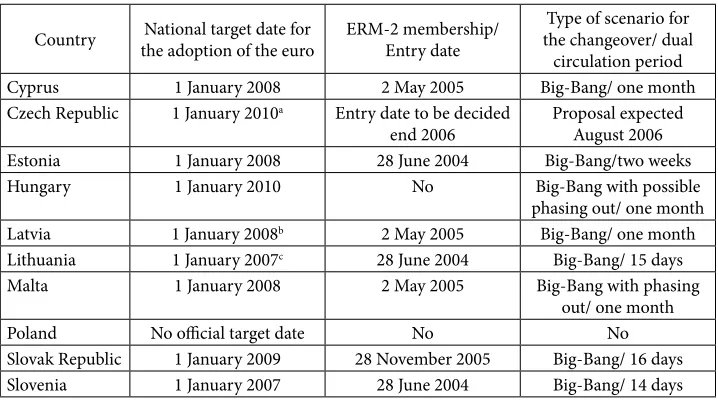
[image:8.499.71.430.359.561.2]If Poland had joined ERM II soon after the EU accession on 1 May 2004, the earliest assessment date of the criteria fulfilment would be 2006. In the case of the positive evaluation Poland could theoretically join the EMU at the earliest one year after the examination date, that is in 2007. As we know it did not materialize and the first New Member State (NMS) that was able to join the EMU was Slovenia.
Table 2. Intended EMU Membership Dates and Changeover Scenarios
Country National target date for the adoption of the euro
ERM-2 membership/ Entry date
Type of scenario for the changeover/ dual
circulation period Cyprus 1 January 2008 2 May 2005 Big-Bang/ one month Czech Republic 1 January 2010a Entry date to be decided
end 2006
Proposal expected August 2006 Estonia 1 January 2008 28 June 2004 Big-Bang/two weeks Hungary 1 January 2010 No Big-Bang with possible
phasing out/ one month Latvia 1 January 2008b 2 May 2005 Big-Bang/ one month Lithuania 1 January 2007c 28 June 2004 Big-Bang/ 15 days Malta 1 January 2008 2 May 2005 Big-Bang with phasing
out/ one month Poland No official target date No No Slovak Republic 1 January 2009 28 November 2005 Big-Bang/ 16 days Slovenia 1 January 2007 28 June 2004 Big-Bang/ 14 days
a Preliminary date. b To be postponed.
c No longer relevant after the negative assessment of the Convergence Reports of the European Commission and European Central Bank, 16 May 2006.
Furthermore Poland became the only NMS that does not have an official strategy of joining the euro area (see Table 2).
As we can see in Table 2 Slovenia and Lithuania wished to join the EMU in 2007 and Estonia, Malta Cyprus and Latvia in 2008. Bigger economies of the Czech Republic, Hungary and Slovakia declared later dates. In the next section the ratio-nale behind the early strategy will be presented.
4. Rationale behind early entry strategy
Potential costs and benefits of joining a common currency area have been well iden-tified see e.g. De Grauwe (2000), Zank (2002) and Wojcik (2005). According to the monetary view Poland loses little from relinquishing its monetary independence by entering into the EMU. Above all the loss should be associated with giving up the domestic interest rate policy. According to the monetarist stance a flexible ex-change rate does not serve as an efficient and permanent buffer against shocks and relinquishing this policy instrument does not incur additional costs, Stiglitz (1999), Buiter (1999), see more in section 7. Indeed, in a world of free capital flows do-mestic interest rate levels cannot depart permanently and considerably from global interest rate levels without increased volatility of the exchange rate, Archer (2002). In addition, upon entering into the European Union in May 2004 any EU member has to treat its monetary policy as a matter of common concern. Combined with the full liberalisation of capital flows this policy prescription restrains the monetary independence. Thus, although potentially Poland can use the monetary policy at discretion before entering into ERM II, in practice its independence has been sur-rendered earlier. At the same time, the loss of monetary policy and especially of the interest rate tool should not be very hard to swallow. Klos and Wrobel (2001) find no statistically significant reaction of output to monetary contraction in Poland. To be fair however, this result should be regarded with caution since, as the authors rightly point, there are major problems with calibration of econometric models in changing institutional framework. Besides, facts seem to contradict this finding. The restrictive interest rate policy is credited with containing inflation in Poland from 2000 onwards. This is further discussed in section 6.
comput-able general equilibrium framework calibrated for Poland using the data from year 2000. The applied model strongly simplifies reality since it only incorporates a well quantifiable effect of interest rate decrease due to a lower country risk. In the model the interest rate decrease translates into increase of aggregate demand and supply through the investment channel only. The simulations were performed for 3 sce-narios. In the base case scenario the entry into the EMU is postponed considerably and the entry date is outside the simulation period. Two other scenarios assume an early entry, one at the earliest possible date identified in the previous section i.e. in 2007 (A2007), the other three years later i.e. in 2010 (A2010). The simulation peri-od is relatively long and spans from 2004 up to 2030. The results of the simulation with respect to the GDP growth are presented in Figure 1.
The simulations predict (Figure 1) in the A2007 and A2010 scenarios a sound growth rate exceeding 4% per year, which is driven by the benefits from the European Union accession. Simultaneously both EMU accession scenarios yield a higher growth rate in the projection period than the opt-out (base case) scenario. The ear-liest possible entry into the monetary union (2007) was seen as preferable to the later entry in 2010 although the difference in growth rates is not big (Figure 1). By contrast, a small difference in annual growth rates between the opt-out scenario and the early accession scenarios accumulates over time to a substantial divergence.
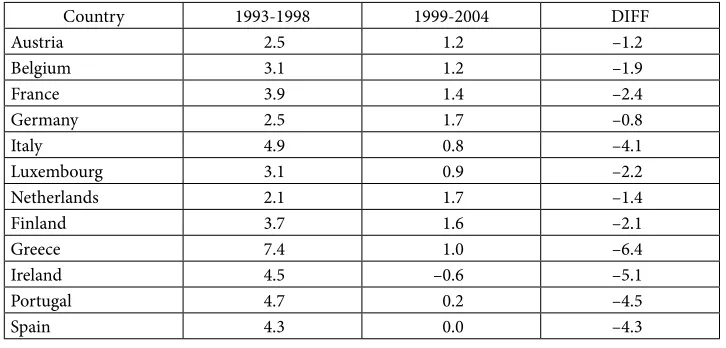
[image:10.499.73.432.236.386.2]It has to be stressed once more that the simulation captures merely the effect of lower interest rates on the GDP growth. This reduction was particularly high in the fringe countries that imported credibility entering the EMU (see Table 3). Since Poland has been having relatively high market interest rates the impact of the re-duced rates could be as strong as in the case of Spain or Ireland (Table 3). Thus the main effect was rightly predicted in the NBP report via the investment and foreign trade, mainly imports channels, Borowski et al. (2004). In reality a decrease of in-terest rates is likely to trigger other positive effects that should amplify growth rate differentials in alternative scenarios. For instance these could be higher FDI and,
Figure 1. GDP growth rate in Poland from 2004 to 2030 for different accession dates
what has been particularly important in the case of Poland, lower cost of the public debt service facilitating Poland’s structural funds absorption capacity.
Moreover, if the accession is delayed and other new members join the euro zone early the FDI inflow can be decisively restrained. Under these circumstances the Polish country risk would be naturally higher than elsewhere, reflecting the uncer-tainty about the future level of exchange rate. Without obstacles to a free movement of capital, people, goods and services potential investors are unlikely to run addi-tional and unnecessary risks. In consequence, a sizable part of potential FDI would be allocated outside Poland.
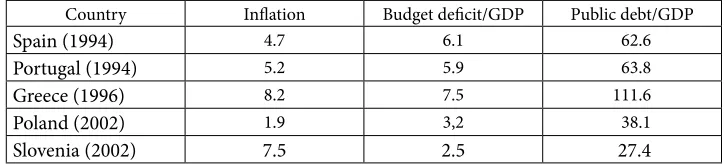
[image:11.499.69.432.103.277.2]The early entry strategy provides a strong impulse to complete necessary struc-tural reforms, Balcerowicz (2002). A clearly communicated accession schedule would facilitate justifying unpopular reforms to the public and thus make them easier to swallow to the political parities. This may play a crucial role in Poland since both the fiscal framework reform and the labour market reform are politically and so-cially difficult. In addition, it can be demonstrated that a rapid and credible reform produces a better outcome both in terms of likely short-term negative economic effects and positive expectations effects than a reform plan that stretches over time, Balcerowicz (2002). Successful fiscal reforms in Belgium and Ireland in the early 1990s are cases in point here, Borowski et al. (2004). Besides, accession costs re-lated to relinquishing monetary policy independence are only little reduced in the passage of time. The comparison of the monetary and fiscal frameworks of Spain, Portugal and Greece, Slovenia and Poland 5 years prior to Poland’s potential mon-etary union accession date shows (Table 4) that meeting the Maastricht provisions in time to qualify for an early accession date could be possible. According to all 3 criteria Poland performed stronger than any of the EMU benchmark countries.
Table 3. Real Interest Rates, Pre- and Post-EMU
Country 1993-1998 1999-2004 DIFF Austria 2.5 1.2 –1.2 Belgium 3.1 1.2 –1.9 France 3.9 1.4 –2.4 Germany 2.5 1.7 –0.8
Italy 4.9 0.8 –4.1
Luxembourg 3.1 0.9 –2.2 Netherlands 2.1 1.7 –1.4 Finland 3.7 1.6 –2.1 Greece 7.4 1.0 –6.4 Ireland 4.5 –0.6 –5.1 Portugal 4.7 0.2 –4.5
Spain 4.3 0.0 –4.3
Especially the inflation rate had been safely contained, which is often regarded as the most difficult task (Table 4). Slovenia did very well in terms of budget deficit and public debt but had a high inflation rate (Table 4). This country however man-aged to trim inflation and was ready to join the euro zone on 1 January 2007. The strategy of the inflation containment in Poland will be discussed in section 6.
We argue that the best convergence mechanism available is joining of the mon-etary union. A credible commitment to a common currency regime has a self-ful-filling character, provided monetary union members are not excessively idiosyn-cratic, Corsetti and Penseti (2002). There should be no fear of negative impact on the euro itself since all the new entrants account together for roughly 7% of GDP in the enlarged EU. Provided Poland is already sufficiently similar to the existing EMU members, the early entry could be beneficial to all the parties, Hughes and Piscitelli (2001). In the following sections issues related to long-term nominal con-vergence between Poland and the EMU countries will be discussed.
5. Convergence degree of Maastricht monetary criteria
[image:12.499.68.431.104.186.2]As can be seen from Figure 2, the inflation rate in Poland, contained temporarily in 1999, rebounded above the 10% level in 2000. Starting in 2000 the inflation rate had been declining steadily and reached the lowest level in the second half of 2003 (Figure 2). It rebound again to over 4% as a result of a strong domestic and foreign demand due to the EU membership (1 May 2004). The NBP reacted immediately and inflation rate declined again well below the Maastricht criterion (Figure 2). To a certain degree Slovenia followed the same pattern as Poland did in 1999-2000. Interestingly however later on the Slovenian disinflation was steady but less pro-nounced; the inflation rate has been compatible with the Maastricht criterion level since the end of 2005 and continued to be very close to the benchmark (Figure 2).
Table 4. Inflation, budget deficit and public debt in 5 years prior to the EMU entry date*
Country Inflation Budget deficit/GDP Public debt/GDP
Spain (1994) 4.7 6.1 62.6
Portugal (1994) 5.2 5.9 63.8
Greece (1996) 8.2 7.5 111.6
Poland (2002) 1.9 3,2 38.1
Slovenia (2002) 7.5 2.5 27.4
* Slovenia declared its intention to join the EMU on 1 January 2007 (see table 1). This country was finally accepted as the EMU member on 1 January 2008.
The most important issue within the currency union is the long term ability to maintain the inflation rate at the low level, and to, at least, maintain competitive-ness. This will be discussed in section 6.
[image:13.499.79.426.84.268.2]In Figure 3 we present a 12-month moving average yield of Polish and Slovenian government bonds at the background of the convergence criterion. Due to the size and supply, Poland’s market for these bonds is much more liquid than the Slovenian one. Over the last years the long-term market interest rates have converged consid-erably towards European levels. Poland met the interest rate criterion earlier than Slovenia. Later on, due to the surge in inflation and counteraction of the NBP, the yield on long-term bonds was again above the Maastricht level (Figure 3). It has
Figure 2. Inflation in Poland and Slovenia (HICP 12-month moving average) vs. the convergence criterion in 1999–2007
Source: Eurostat, own calculation
Figure 3. Yield on long-term Polish and Slovenian government bonds vs. the convergence criterion in 1999–2007
[image:13.499.81.423.432.595.2]become compatible again with the EMU criterion since the beginning of 2005. It has to be seen that fluctuations of the Polish bond yield were higher that the ones of Slovenia’s.
Polish zloty floats freely since 1999/2000 (Table 5). Slovenia being a small rel-atively well developed economy used to have stable macroeconomic conditions both at the beginning and in the course of transformation. It was also reflected in its exchange rate regime and led this country to the EMU membership on 1 January 2007 (Table 5). Currently Poland does not meet the Maastricht exchange rate crite-rion and will have to go through the two year period of ERM II in order to qualify for the EMU.
6. Is nominal convergence a steady-state?
Poland has made good progress towards meeting the Maastricht monetary conver-gence criteria. Above all the inflation rate has been brought to historically low lev-els. This is an important achievement, bearing in mind the inflation performance of the Polish economy during the 1990s. As a matter of fact Poland struggled to con-tain inflation after a period of hyperinflation at the beginning of the transformation period. It took almost 10 years to bring progressively the inflation rate from about 600% in 1989/1990 to 10.3% in 2000. Arguably, the disinflation path was carefully calibrated in order not to affect negatively the GDP growth by too tight monetary policy, Focus on Transition (2001). Golinelli and Rovelli (2002) performed simu-lations of the inflation response to more aggressive policy stance. For Poland they found that, even in a more aggressive scenario, the path of nominal interest rates would have been almost unchanged. Simultaneously costs to the output would be greater implying lower GDP growth rates. From 1998 the inflation rate was almost
Table 5. Exchange rate regimes in Poland and Slovenia in 1990–2007
90 91 92 93 94 95 96 97 98 99 00 01 02 03 04 05 06 07 Poland 1 3 3 3 3 4 4 5-6 6 7 7 7 7 7 7 7 7 7 Slovenia 1 1 1 1 1 1 5 5 5-6 6 6 6 6 6 6 6 6 €
1 Peg to a currency or a basket with fluctuation margins less than or equal to +/– 2.25% 2 Crawling peg with fluctuation margins of less than or equal to +/– 2.25%
3 Float with active management by monetary authorities (implicit crawling peg) 4 Crawling peg with fluctuation margins of more than +/–2.25
5 Peg to a currency or a basket with fluctuation margins of more than +/– 2.25% 6 Float with interventions
7 Free float
identical in either policy scenario. The findings of Golinelli and Rovelli (2002) confirm that no major mistakes were made in the conduct of monetary policy in Poland in the 1990s.
6.1. Review of empirical analysis of Maastricht criteria
The best and the most robust method of testing the long-term co-movement of economic variables is cointegration, Engle and Granger (1987). This technique was subsequently and extensively applied to investigate the scope of the Maastricht crite-ria convergence between the first 12 EMU members. The research results provided mixed evidence. For example, in an early and influential study Haug, MacKinnon and Michelis (2000) find only a partial long–term co-movement of the existing EMU countries. Their findings are much in line with the current evidence where Italy, Portugal and Spain were identified as countries that might encounter problems within the EMU in the long-run. Meister (2002) tested the cointegration between the new EU and the current EMU members’. Meister concentrated on economic vari-ables underlying the Maastricht criteria. For the period from 1995 until 2001 Meister found a strong convergence of Poland and the EMU countries with respect to both the interest rate and inflation. Meister notes, however, that throughout the examina-tion period Polish interest rates remained above European interest rates. According to this study Poland is deemed ready, also in terms of the exchange rate stability, to enter ERM II and start fulfilling the Maastricht exchange rate criterion.
Notwithstanding, there are three points that should be made in relation to the cointegration techniques. Firstly, as pointed out earlier in the chapter, the cointe-gration of economic variables underlying the Maastricht monetary criteria is not a sufficient condition for joining the EMU. Secondly, cointegration tests require long-term time series and the convergence of the Maastricht reference values start-ed only recently, Meister (2002). Thirdly, and what is most important, the cointe-gration of monetary variables (nominal convergence), such as price index or inter-est rate, does not tell the entire story, comp. Haug et al. (2000). In order to benefit in the long-run there should be a convergence of real sector variables, such as the productivity of labour or fluctuation of the GDP (real convergence). Some evidence for business cycle convergence between Poland and the EMU will be presented in the forthcoming article.
6.2. Role of independent central bank
class from the very beginning of the transition process. Simultaneously, there was recognition that sound institutions are a prerequisite for stabilisation and sustain-able growth, Hochreiter and Kowalski (2000). With respect to the monetary policy framework this belief was confirmed by establishing of a two-tier banking system with the independent central bank Kowalski (2000) and Hochreiter and Kowalski (2000). In 1997 a new National Bank Act, strengthening the independence of mon-etary policy institutional framework, was adopted. The institutional set-up guaran-tees political and functional (free choice of monetary policy instruments, techniques and operational targets) independence of the National Bank of Poland. According to Article 3 (1) of the Act, the basic objective of the NBP is to maintain price stabil-ity. At the same time the bank shall act in support of Government economic poli-cies, insofar as it does not constrain pursuit of the basic objective of the NBP, Act on the NBP (1997). The central role in the monetary framework in Poland is con-ferred on the Monetary Policy Council (MPC) which is solely responsible for the draft of policy guidelines and the conduct of monetary policy. In addition, the fi-nancing of the government deficit is prohibited in the Constitution, which further strengthens the independence of the institutional framework. Insofar the Maastricht provisions (in particular Articles 108 and 109 of the Treaty and the Statutes of the ESCB) guaranteeing the independence of central bank are met. In 2004 Poland along with other candidate countries introduced a number of (mostly technical) amend-ments to the NBP Act bringing closer to the acqui communataire implementation in the central banking sphere, ECB (2004, pp. 230-232). However, there is still a number of amendments that need to be implemented. Their scope is similar to that required from Slovenia, Cyprus, Malta and Lithuania, ECB (2006, pp. 60-77) and ECB (2007, pp. 73-81).
The general institutional framework with the politically and functionally indepen-dent central bank was put in place early and would be put in place even without the perspective of an early EMU entry. The institutional position of the NBP has brought in some monetary and fiscal policy coordination problems, Marszalek (2003) lead-ing to hot debates between the NBP and consecutive governments. The new mone-tary policy institutional framework introduced in 1997 strengthened the disinflation process, although as argued in the next section, economic context and a restrictive policy-mix played role as well. The anti-inflationary stance of the MPC has consid-erably increased the credibility of the NBP as inflation fighter. In fact this position was still maintained even after nominating in 2007 a new governor, who was openly a political nominee from outside the academia and central bank’s circles.
6.3. Emergence of a suboptimal policy-mix
side of the economy. The fiscal stance has been reasonably conservative since 1990 and was expected to remain so in the future, Green, Holmes and Kowalski (2001). At the beginning of 1999 the Monetary Policy Council continued to conduct loose monetary policy in order to revive the economy negatively impacted by the default of Russia in 1997. The easy monetary policy stance coincided with financial prob-lems at the Social Security Fund. The fund had to be recapitalised by the govern-ment in 1999 which brought about the increase in budget deficit by 2 percentage points of the GDP, Convergence Programme (2006, p. 24).As a result of both loose monetary and fiscal policy the inflation rate surged to more than 10% as can be seen from Figure 3. What is more important, the adverse developments on the fis-cal side came much to a surprise because they were failed to be communicated by politicians, Rozkrut (2003). It has dealt an important blow to the credibility of fis-cal authorities in the eyes of the NBP. In order to fulfil its inflation target and rein-state the equilibrium in the current account the Monetary Policy Council tightened monetary stance; its outcome was also reflected by an increase in nominal market interest rates on Figure 3. As a result, real interest rates surged and in 2000-03 a mix of a too tight monetary and too loose fiscal policy was in place. This coincided with a period of global slowdown and brought inflation down to almost 0% in July 2003. In fact this tendency continued in 2004-2007. In terms of the EU Broad Economic Guidelines it was even aggravated by the 2005 Eurostat decision to treat (along the ESA ’95 accounting scheme) annual costs of the establishment of capital-based pen-sion system (Open Penpen-sion Funds) as being outside the public finance framework. This has had a significant impact on both the deficit and public debt level and meant that Poland has become the Excess Deficit Procedure (EDP) economy.
By contrast, joining the EMU will bring about lower, European level interest rates (comp. Table 3). It is uncertain whether the reduction of real interest rates is not going to produce a counter-reaction on the real side of the economy. The economic situation in Poland has been steadily improving, driven by a strong export perfor-mance of Polish companies and surge in all components of domestic demand. This has brought some fears of inflation and made the NBP begin a series of interest rate increases. The EU membership in the case of Poland meant a clear textbook-style trade creation phenomenon. Poland not only has a higher share of exports to GDP than Spain but also enjoys trade surplus with the EU countries.
6.4. Nominal convergence as a statistical illusion?
ex-ample in Poland between 1990 and 2007 there were five major changes of exchange rate regime (comp. Table 5). The exchange rate policy evolved progressively from a dollar-based peg towards a full float, Kowalski and Stawarska (1999). What is more important, there were major changes in central banks’ operational targets. NBP used credit limits at the beginning of the period, officially targeted money supply from 1994 to 1997 and resorted to exchange rate interventions. In 1999 NBP start-ed to pursue direct inflation targeting (DIT), using interest rate and open market operations as the main tools. All these developments should be regarded as nec-essary changes in a successful transforming economy. Simultaneously, they pres-ent an obstacle to building structural models of economic variables underlying the Maastricht criteria.
The danger of a surge in inflation rate after entering the EMU exists for at least two reasons. Firstly, there may be a more pronounced operation of the Balassa-Samuelson effect, which will be considered in section 8. Secondly the introduc-tion of the euro will increase internaintroduc-tional price transparency and facilitate inter-national comparisons, thus leading to stiffer competition in the domestic market. This should be beneficial to consumers. However, may not be so if there are strong income differences between countries. The price structure in Poland, with prices of nontradables lagging considerably behind, does not fully reflect the price structure in Western Europe, comp. e.g. Egert (2007). In the long run the Polish price struc-ture will rejoin the European pattern as a result the equilibrium mechanism. To as-sure a smooth accommodation and no abrupt price increases shortly after the EMU entry, there is a need for labour market flexibility and/or mobility. Indeed, Polish and the other New Members States labor is internationally mobile and much more flexible than that from core European countries. However, as De Grauwe (2007) rightly points out the very mobility and market flexibility of labor are only neces-sary but not sufficient conditions for successful and sustainable EMU membership. Insofar, the observed inflation level in Poland may be low but does not have to re-main so in the future. Indeed there are some signs of a growing inflation pressure (see Figure 2).
7. Foreign exchange regime and a role of market expectations
rates and monetary policy in general is a relic of the ‘fine tuning fallacy’. The belief in ability to precisely steer a small open economy in the world of free capital flows has proved unrealistic and as such do not belong any more to mainstream economics. Still the old ideas often appeal to general public and as such are exploited by poli-ticians. Unfortunately the exchange rate policy belongs to one of the most abused areas. Examples of exchange rate policies in the form of rare successful devaluations are often generalized to defend the case of maintaining national currencies. National currencies are believed too important to disappear, Kenen (2000).
There is no single theory that can precisely explain the evolution of exchange rates and the unpredictable behaviour of exchange rate markets, in particular in the short run, belongs to stylized economic facts. One of the objectives of a 2-year stay in a relatively flexible ERM II is testing the exchange rate equilibrium level. In other words, during this period a fair value of the currency should be attained.
In the following section we will discuss some theories that attempt to shed light on the evolution of exchange rates and determine the equilibrium exchange rate level. The oldest and probably the most important is the Purchasing Power Parity (PPP). The PPP theory assumes the equality of tradables prices across countries and explains the movement of exchange rates by differences in expected relative infla-tion rates. The Purchasing Power Parity roughly holds in the long run. However currencies often spend long periods outside the fair value determined by the PPP. There exist a number of approaches and models to deal with these deficiencies of the PPP, Egert (2004), Rogoff (1996).
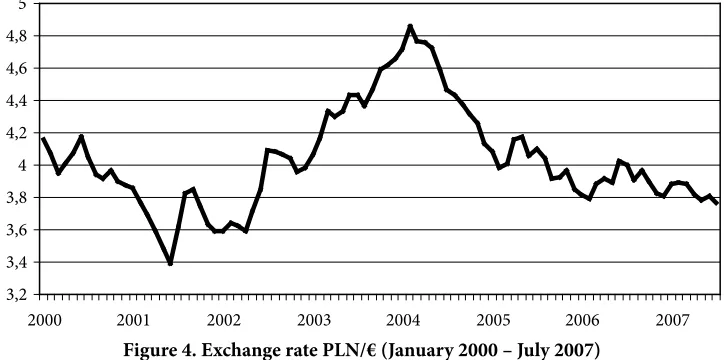
If the fiscal stance of a country is somewhat problematic the currency typically slides in anticipation of depreciation/devaluation. The depreciation/devaluation ex-pectations are often fuelled by speculation. However, they may also be fuelled by the Fundamental Equilibrium Exchange Rate (FEER) theory, Williamson (1994), Egert (2003), Marrewijk (2004). According to this theory, the equilibrium exchange rate is compatible with internal equilibrium defined as equilibrium between potential and actual output and external equilibrium defined as the level of current account deficit that can be sustainable financed by the inflow of medium or long-term investments, Borowski et al (2004), Marrewijk (2004). If economic fundamentals underlying in-ternal or exin-ternal equilibrium are expected to change, the economic consequences are being incorporated in exchange rate levels. Arguably, the recent developments of the Polish zloty/euro exchange rate are well explained by the FEER theory. The evolution of the nominal exchange rate is given in Figure 4.
wors-ening fiscal position on the market expectations. In particular the high volatility periods and subsequent sharp slumps resulted in the aftermath of budget revisions or official releases of disappointing deficit figures. The PPP theory cannot explain the evolution of the EUR/PLN exchange rate from 2002 till the end of 2003. There has been no inflation differential between Poland and the EMU (Polish inflation rate in 2003 being below the European level that would justify appreciation and not depreciation). Simultaneously, there has been no reason to fear inflation in-crease in Poland, at least prior to the entry into the EMU, given the institutional framework in place. The nominal appreciation of PLN from the beginning of 2004 onwards should be linked to a number of factors. These are the anticipation of the EU membership, increasing inflow of FDI and structural funds, remittances from Polish workers employed in the UE countries and a specific combination of mon-etary policy and productivity differences (see section 8).
According to the Maastricht exchange rate provision, the exchange rate should not experience severe tensions during 2 years prior to the examination date. The is-sue of severe tensions was addressed in the past by examining the degree of devia-tions from the central rate, by using various indicators and by considering the role played by exchange rate interventions, Borowski et al (2004, pp. 114-115). The ECB uses a daily Exchange Rate Volatility (ERV) indicator. Such volatility of EUR/PLN exchange rate during the whole period since 2000 was relatively high, Borowski et al (2004) and Jurek 2006). It was not only higher than in the NMS but also high-er than in the case of Spain, Ireland and Greece prior to their EMU membhigh-ership. This finding should not be surprising given the fact that the zloty has been float-ing freely since 1999 (see Table 5) and the Polish interbank currency market is the biggest in the NMS. In addition, on 1 October 2002 a new Foreign Exchange Act, lifting almost all restrictions on capital transactions with OECD countries, was
in-Figure 4. Exchange rate PLN/€ (January 2000 – July 2007)
Source: NBP, own calculation 3,2
3,4 3,6 3,8 4 4,2 4,4 4,6 4,8 5
[image:20.499.69.431.89.269.2]troduced. Further liberalisation was implemented prior to May 2004 in order to fulfil the requirements stipulated in Art. 56 of the TEC that reads: ”... all restrictions on the movement of capital between Member States and between Member States and third countries shall be prohibited”.
The volatility of the Greek drachma decreased considerably after its entry into the ERM II. Greek authorities stabilized the exchange rate both by interventions and high interest rate policy, Coricelli (2002), Hochreiter and Tavlas (2004). Greek experience sheds some light on challenges related to stay in ERM II, since unlike other EMU countries Greece did not take part in the first wave of the Accession. In fact the central parity set at the outset of ERM II membership is likely to become a ceiling for the future exchange rate, implying that countries will tend to be on the appreciation part of the band, Hochreiter and Tavlas (2004). Any movement above the parity (depreciation) would fuel expectations of inability to enter the euro zone. Since the currency cannot be devalued, the central bank will have to inter-vene in order to support the exchange rate. Under ERM II central banks of the ac-cession countries need to amass large amounts of foreign reserves to deter specu-lators since, judging by the Greek experience, the ECB supports interventions only if the exchange rate approaches the +/– 15% band. The central bank should keep the exchange rate in the lower section of the band through high interest rate policy as well, Hochreiter and Tavlas (2004). Both strategies were successfully applied by the Greek central bank.
From the candidate country perspective the current period of the strong euro is a good moment to start negotiations on the central rate upon the EMU accession. By agreeing on the central rate close to the current market rate, the new EU coun-tries can thus alleviate the consequences of currency appreciation policies than will have to be pursued in ERM II.
As already discussed, pegging the exchange rate implies giving up actual mon-etary policy independence. The experience of Denmark, that has agreed with the ECB on the +/– 2.25% fluctuation band, shows the practice of monetary policy con-duct in ERM II. Danish Central Bank’s interest rates must be adjusted in step with the ECB interest rates in order to achieve exchange rate stability, Jensen (2001) and Bernstein (2006).
Arguably however, the biggest obstacle in meeting the exchange rate criterion lies elsewhere. The principle of equal treatment shall be applied to ‘the EMU suitability’ assessment. As pointed out by Kenen and Meade, (2003), due to a completely differ-ent economic and institutional context brought about by the creation of the EMU nowadays, the application of the principle of equal treatment does not translate into
fixed rate arrangement without the protection of capital controls. To be conform-ing to the Treaty the new EU countries had to dismantle all the remainconform-ing capital controls on 1 May 2004. A history of exchange rate crises in the 1990s suggests that pegged exchange rate arrangements without capital controls are very dangerous and risky in a world of high capital mobility, Begg et al (2003). Simultaneously, an environment of open capital markets, limited exchange rate flexibility and ongoing structural reform is attracting capital inflows.
[image:22.499.78.426.384.642.2]A large, new EU country with a sizeable financial market is a likely target of short term financial flows. Poland has already experienced large FDI inflows and also, after 2004 in particular, a sizable amount of portfolio investments that were much more volatile (Figure 5). Portfolio capital flows are bound to increase under ERM II, Kenen and Meade, (2003) On the one hand there will be capital inflows as there is a consensus that the new member countries are going to grow quicker than the existing EMU members, Begg et al. (2003). By joining the EU these countries com-mit to abide by legal and institutional framework that guarantees a free movement of goods, services people and capital. As a result, the investment opportunities in the new EU countries will have interesting return/risk characteristics. In addition, there will be a sizable capital inflows from European structural funds. On the other hand, there will be capital outflows as residents of the new member countries search for investment opportunities abroad, Begg et al. (2003). The fact that after the EU entry, the existing EU countries will care more about the consequences of capital inflows and should be willing to support the new members in their efforts to prevent
Figure 5. FDI and portfolio investment in Poland in 2000-2007 (million of euro)
FDI mean = 648 min = – 65 max = 4063 Std.Dev. = 569 Portfolio mean = 387 min = – 1134 max = 3220 Std.Dev. = 878 Total invest. Mean = 1035 min = – 664 max = 3807 Std.Dev. = 1005
and resolve crises is of little consolation. According to the articles 119 and 120 of the TEC, the permission to reintroduce capital controls may be granted as an emergency measure to a member of the EMU with a derogation experiencing serious balance of payments problems. Following the article 120 (1) such measures must cause the least possible disturbance in the functioning of the common market and should be carefully tailored to remedy the difficulties which have arisen. Notwithstanding, it would require a political masterpiece to convince the Commission of the necessity to reintroduce capital controls. In addition, central banks prefer to use preventively the interest rate tool instead, anxious not to damage their credibility and to avoid unexpected policy moves.
If the Commission should maintain its assessment policy as declared the only realistic policy option that enables for the zloty to stay within the narrow band is the conclusion of a special agreement with the ECB. This agreement should guaran-tee a joint intervention from the ECB and the NBP at the margins of the exchange rate bands. In particular, there are two types of financing facilities available. On the one hand, the very short term financing comes into operation when the exchange rate approaches the margin of the fluctuation band. The intervention is automatic and unlimited if supported by fiscal and monetary stabilisation measures in the af-fected country. On the other hand, intra-marginal interventions can also be imple-mented unilaterally by the national central bank concerned, in coordination with the ECB, Rzeszutek (2000). The ECB can suspend the intervention in the unlikely case of danger to the price stability in the EMU. According to the readings of the ECB policy position special ‘narrow band’ arrangements can be agreed on case-by-case basis but they are deemed to be exceptional.
8. Balassa-Samuelson effect – will it be a problem?
The difficulties concerning the membership in ERM II would be much less pro-nounced, had the new EU countries been allowed to inflate more than the existing EMU countries. Essentially the B-S effect which is often responsible for stimulating the price level operates either through nominal exchange rate appreciation or an in-crease in the inflation rate. To see this we may apply a standard approach used by De Grauwe and Schnable (2005, pp. 538-541). The production conditions for tradables (T) and nontradables (NT) are expressed by two Cobb-Douglas functions:
Yi =A Ki
( ) ( )
i Ji Li 1−Ji < <Ji i=T NT0 1 , . (1)
In equation (1) Yi is the realoutput, Ai is technology and Ki and Li is fixed capital
∂
∂ = −
( ) ( )
= − = −−
Y
L A K L
Y
L Q
i i
i i i i i
i i
i i
i i
(1 J ) J J (1 J ) (1 J ) , where Q Y L
i i i
= represent
la-bor productivities in the i sectors. The real wages in these sectors are expressed as in formula (2):
(1−Ji) =
i i i i Y L W P (2)
where Wi is the nominal wage in the i-sector and Pi are respective price levels.
Assuming that WT = WNT = W, based on equation (2) we have (2a):
( ) ( ) ( ) ( ) 1 1 1 1 − − = − − = = J J J J T T T NT NT NT T T NT NT T NT NT T Y L Y L Q Q W P W P P P (2a)
and replacing c
T NT = − − ( ) ( ) 1 1 J
J , based on (2A) we get formula (3):
c Q Q P P T NT NT T
= . (3)
In the case of NMS we may assume that EMU tradable prices (PTE)are for them
exogenous and for simplicity constant and that PPP holds for tradables. Thus these goods prices (PTA)for the NMS can be expressed in the following way: PTA=E
A/E * P
TE,
where EA/E is the exchange rate against the euro of a NMS. Substituting PT in (3) by
the RHS of the above formula we get an expression showing the B-S potential im-pact on a NMS economy (4):
c Q Q P P E T NT NT TE A E = × /
. (4)
Using formula 4 and following De Grauwe and Schnable (2005, pp. 540-541) we might clearly distinguish two adjustment mechanisms within the B-S framework. The first is a situation of such NMS as Poland that is following the DIT strategy and keeps its inflation rate in line or below the EMU level. In this particular case the relative productivity gains, QT, within our assumptions will be reflected in the
nominal appreciation of a domestic currency against the euro, EA/E. Indeed, this ad-justment, from 2003/2004 onwards, can be seen on Figure 4. The second case rep-resents the situation of such NMS as Estonia that chose the currency board solu-tion. In their case (see formula 4) the relative productivity gains, QT, lead to higher
inflation in nontradables.
measurement of the B-S effect as well. The extent of the Balassa-Samuelson effect in Poland has been a subject of numerous studies with the average estimated infla-tion impact of about 1.0-1.5% for Poland, see for example Egert (2002) and (2007), Coricelli and Jazbec (2002), Mihaljek and Klau (2003) and Chmielewski (2003).
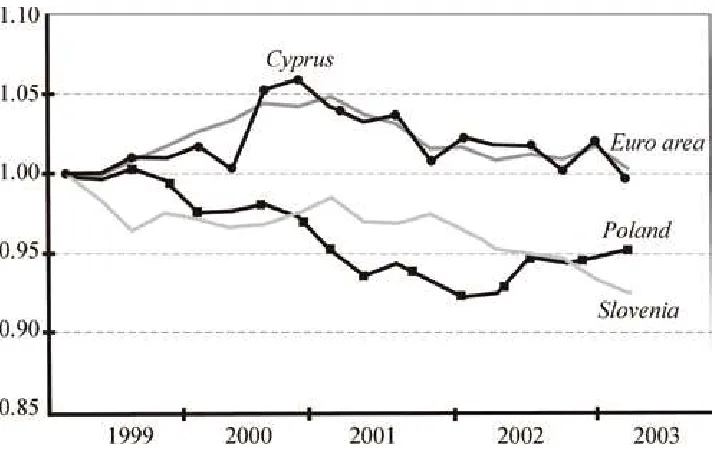
Figure 6 gives the ratio between the producer price index (PPI) and the consumer price index (CPI) in the different accession countries, EEAG Report (2004). Since PPI includes a larger share of tradables than the CPI (services play a greater role here) the operation of the B-S effect would imply a fall of the PPI/CPI ratio over time since the PPI contains mostly tradables’ prices which cannot rise above the world level. Figure 6 illustrates the differences between countries. For Poland the 5% im-pact of the B-S effect over 5 years confirms the estimates provided by the empirical research cited above. It is interesting to note that the pattern of PPI/CPI in Cyprus from 2001 onwards closely follows that of the Euro area and Slovenia.
[image:25.499.73.431.83.313.2]The relatively low level of the Balassa-Samuelson effect in Poland combined with strong commitment from the central bank to maintain the low inflation rate should enable meeting of the Maastricht price stability criterion. However, in practice the conduct of monetary policy that is compatible with both the price and exchange rate stability is tricky. As pointed out by Rosati and also by Schardax, in a country experiencing the B-S effect the inflation rate can be decomposed in two elements: ‘good’ inflation related to the Balassa-Samuelson effect and ‘bad’ inflation related to other effects, Rosati (1998) and Schardax (2001).
Figure 6. The Ratio of Tradables to Nontradables Prices (%)
The ‘good’ inflation reflecting increased productivity should not be contained by monetary policy measures since it is the natural effect that accompanies the struc-tural transformation of the economy i.e. the real convergence. The monetary policy aimed at reducing the ‘good’ inflation would slow down the catching up process. The precise assessment of the Balassa-Samuelson effect depends on the choice of price index and inflation target, see Mihaljek and Klau (2003). Given that scope of manoeuvre available to monetary authorities is limited by the Maastricht criteria, the task is difficult. If in the coming years the B-S effect amplifies, the accession to the monetary union would be possible only for a price of the GDP growth rate reduction and further nominal appreciation. Having said that however we need to remember that Poland along with other NMS became open economies and that more and more services belong to tradables whose prices are determined on the European and global market. The appreciation (comp. formula 4) would lower do-mestic inflationary pressure. In addition, as discussed in section 2.2., it is the only realistic strategy compatible with the requirements of ERM II in the case of infla-tion differentials between the applicant country and the EMU.
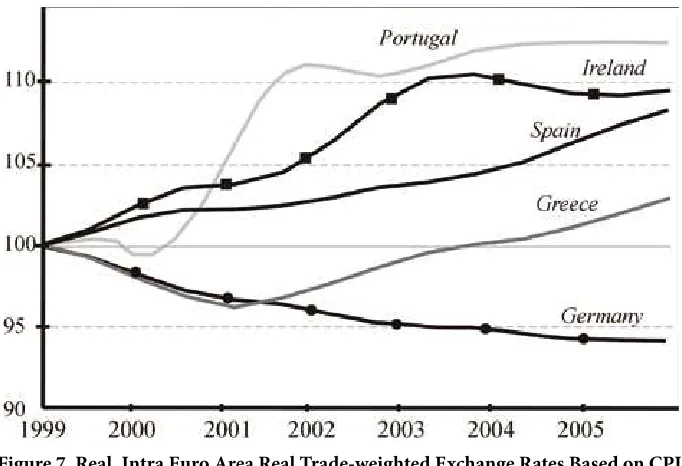
[image:26.499.79.420.366.599.2]A potential side-effect of the short-term nominal contraction needed to coun-ter-balance the B-S effect is a possible inflationary reaction after the entry into the EMU, Szapary (2001). Subdued by tight monetary policy during the nominal con-vergence process, the economy may overreact when confronted with the lower inter-est rates in the monetary union, see Table 3 and Figure 7. The resulting increase in
Figure 7. Real, Intra Euro Area Real Trade-weighted Exchange Rates Based on CPI. 1999 Q1=100
inflation could quickly jeopardize the competitive position of the country. Arguably, this happened in Portugal, Spain, Italy and Greece (Figure 7). After the entry into the EMU a considerable increase in domestic demand was not accompanied by a comparable productivity growth. In consequence there was both a higher than elsewhere inflation rate and current account deficit, particularly acute in Spain (its current account deficit in 2006 was the biggest, after the US, in world), that trans-lates inside a monetary union into an increase of total private and public debt. The situation of Ireland is different; despite its intra Euro area relative real appreciation (Figure 7) the Irish economy has been able to expand faster than the other EMU countries maintaining its competitive advantage. In order to regain international competitiveness, Portugal, Italy, Spain and Greece must resort to a difficult process of real depreciation through a combination of fiscal tightening and wage restrains. Such a set of recommendations is politically difficult not only for the current EMU countries but also for the NMS. Provided the increase of income is continued, the B-S effect can be reconcilable with maintaining international competitiveness. With the progress of the catching-up process the operation of the Balassa-Samuelson ef-fect will be less pronounced.
9. Conclusion
We have investigated the degree of Poland’s convergence to the Maastricht criteria with respect to the monetary policy framework. What might be somewhat surprising, Poland does already meet the inflation rate criterion and the interest rate criterion. Arguably some doubts remain whether the nominal convergence is a steady state despite encouraging results of empirical research. The monetary policy framework that has been put in place rests on independent monetary authorities. The institu-tional set-up, designed to exclude political interventions, has proved to be an effec-tive price stabilisation mechanism. In consequence, despite some points of concern, meeting inflation and interest rate Maastricht criteria within the timeframe dictated by the early EMU entry do not pose problems in Poland. Obviously the participation in the ERM II does pose more problems and is closely linked to the fulfilment of the fiscal criteria. Since the ERM II phase has to last two years it should be entered only when the fiscal criteria are met in a sustainable way. The fiscal criteria, at least in the case of Poland (and also of Hungary) seem to be politically difficult.
References
Act on the NBP (1997) with consecutive amendments.
Archer D. (2002), Discussion – Reflections on the OCA Criteria in the Light of EMU, Central Bank of Chile Working Papers.
Arestis P., McCauley K., Sawyer M. (1999), From Common Market to EMU – A Historical Perspective of European Monetary and Economic Integration, The Jeromy Levy Economics Institute Working Paper no. 263, p. 39.
Balassa B. (1964), The Purchasing Power Parity Doctrine: A Reappraisal, Journal of Political Economy vol. 72, pp. 584-596.
Balcerowicz L. (2002), The Way to EMU From a Candidate Country’s Perspective, in: CESifo Forum 2/2002, Panel 4, The Euro at Stake? The Monetary Union in an Enlarged Europe.
Begg D., Eichengreen B., Halpern L., Von Hagen J., Wyplosz Ch. (2003), Sustainable Regimes of Capital Movements in Accession Countries, CEPR Policy Paper no. 10, pp. 79. Bernstein N. (2006), Governor Nils Bernstein Statement, Conference on Experience with and
Preparation for the Euro, 10-12 May, Linz, pp. 7.
Borowski J. et al (2004), Raport na temat korzyści i kosztów przystąpienia Polski do strefy Euro, NBP, p. 128.
Bratkowski A., Rostowski J. (2002), The EMU Attitude Towards Unilateral Euroization, The Economics of Transition, vol. 10.
Buiter W. (1999), Optimal Currency Areas: Why Does the Exchange Rate Regime Matter? (With an Application to UK Membership of EMU), Sixth Royal Bank of Scotland Scottish Economic Society Annual Lecture.
Chmielewski T. (2003), Od kursu płynnego do Unii monetarnej – znaczenie efektu Balassy-Samuelsona dla polskiej polityki pieniężnej, Materiały i Studia NBP, nr 163, p. 76. Convergence Programme (2006), Ministry of Finance, Republic of Poland, November
up-date.
Council Regulation (1055/2005).
Coricelli F. (2002), Exchange Rate Policy During Transition to the EMU: The Option of Euroization, Economics of Transition, vol. 10 (2), pp. 405-417.
Corsetti G., Penseti P. (2002), Self-validating Optimum Currency Areas, NBER Working Paper 8783.
De Grauwe P. (2000), Economics of Monetary Union, Oxford University Press, p. 228. De Grauwe P., Schnable G. (2005), Nominal Versus Real Convergence – EMU Entry Scenarios
for the New Member States, Kyklos, vol. 58, no. 4, pp. 537-555.
De Grauwe P. (2007), The Challenge of Enlargement of the Eurozone, SUERF Annual Lecture 2007, the Austrian National Bank, 22 June.
Dyson K., Featherstone K. (1999), The Road to Maastricht. Negotiating Economic and Monetary Union, Oxford University Press.
ECB (2004), Convergence Report, ECB, Frankfurt. ECB (2006), Convergence Report, May, ECB, Frankfurt. ECB (2007), Convergence Report, May, ECB, Frankfurt.
ECB (2005b), ECB Opinions of 3 June on Amendments to Council Regulations 1466/97 and 1467/97, ECB, Frankfurt.
EEAG Report (2004), Ifo Institute.
Egert B. (2002), Investigating the Balassa-Samuelson Hypothesis in the Transition: Do We Understand what We See, BOFIT Working Paper no. 6, p. 42.
Egert B. (2003), Assessing Equilibrium Exchange Rates in CEE Acceding Countries: Can We Have DEER with BEER without FEER? A Critical Survey of the Literature, Focus on Transition number 2, pp. 38-106.
Egert B. (2007), Real Convergence, Price Level Convergence and Inflation Differentials in Europe, OeNB, Working Paper, July, p.54.
Engle R.F., Granger C.W.J. (1987), Cointegration and Error Correction: Representation, Estimation and Testing, Econometrica vol. 55, no. 2, pp. 251-276.
European Central Bank (2003), Policy Position of the Governing Council of the European Central Bank on Exchange Rate Issues Relating to the Acceding Countries, December. Gollineli R., Rovelli R. (2002), Monetary Policy Transmission, Interest Rate Rule and Inflation
Targeting in Three Transition Economies, Journal of Banking and Finance, vol. 29, issue 1, pp. 183-201.
Goodhart C. (1995), The Political Economy of Monetary Union. in Understanding Interdepen-dence, in: The Macroeconomics of the Open Economy, P.B. Kenen ed., Princeton University Press.
Green Ch., Holms M., Kowalski T. (2001), Poland: A Successful Transition to Budget Sustainability, Emerging Markets Review, vol. 2, pp. 160-182.
Gros D., Thygesen N. (1998), European Monetary Integration, Longman.
Haug A.A., MacKinnon J.G., Michelis L. (2000), EMU: a Cointegration Analysis, Journal of International Money and Finance, 19(3).
Hitiris T. (2003), European Union Economics, Pearson Education.
Ho C., McCauley R. (2003), Living with Flexible Exchange Rates: Issues and Recent Experience in Inflation Targeting Emerging Market Economies, BIS Working Papers, no. 130, p. 51. Hochreiter A., Kowalski T. (2000), Central Banks in European Emerging Market Economies
in the 1990‚ Banca Nationale del Lavoro Review, March, p. 45-70.
Hochreiter A., Tavlas G.S. (2004), On the Road Again: An Essay on the Optimal Path to EMU for the New Member States, Journal of Economic Policy Modeling, vol. 26/7, pp. 793-816.
Hughes H.A., Piscitelli L. (2001), The Endogenous Optimal Currency Area Hypothesis: Will a Single Currency Induce Convergence in Europe? Paper Presented at the Royal Economic Society Annual Conference, University of Durham, April 9-11.
Jensen H.F. (2001), Costs and Benefits of ERM II. The Danish Experience, National Bank of Poland Conference: the Polish Way to the Euro, October 22-23, pp. 252-262.
Jurek M. (2006), Próba oceny gotowości Polski do uczestnictwa w systemie walutowym obsza-ru euro, in: Współczesny pieniądz w teorii i praktyce, Z. Knakiewicz ed., Wydawnictwo Akademii Ekonomicznej w Poznaniu, Poznań, pp. 329-344.
Kenen P. (2000), Currency Areas, Policy Domains, and the Institutionalization of Fixed Exchange Rates, Centre for Economic Performance, LSE & PS, p. 60.
Klos B., Wrobel E. (2001), The Monetary Transmission Mechanism and the Structural Modeling of Inflation at the National Bank of Poland, BIS Papers, no. 8, pp. 232-251.
Kowalski T., Stawarska R. (1999), Poland’s Exchange Rate Policy in the 1990s, in: Exchange Rate Policies for Emerging Market Economies, R.J. Sweeney, C. Wihlborg, T.D. Willett eds., Westview Press, pp. 351-374.
Kowalski T. (2000), Political and Functional Independence of the National Bank of Poland,
in: Financial Reform and Institution (2000), T. Kowalski, S. Letza eds., Wydawnictwo Akademii Ekonomicznej w Poznaniu, Poznań, pp. 9-22.
Krugman P., Obstfeld M. (2003), International Economics. Theory and Policy, Prentice Hall.
Lane P.R. (2006), The Real Effects of EMU, IIIS Discussion Paper 115, p. 43. Laufer N. (1997), Die Maastricht-Kriterien: Fug oder Unfug, www.uni-konstanz.de. Mankiw G. (2003), Macroeconomics, Worth Publishers.
Marrewijk van Ch. (2004), An Introduction to International Money and Foreign Exchange Market, The University of Adelaide School of Economics Working Paper 2004-02, p. 114.
Marszałek P. (2003), Coordination of Monetary and Fiscal Policy, Poznan University of Economics Review, vol. 3, no. 2, pp. 41-52.
McKinnon R.I. (2002), Optimum Currency Areas and the European Experience, The Economics of Transition, vol. 10, no. 2, pp. 343-364.
Meister I.S. (2002), Is Eastern Europe Ready for the Euro? A Cointegration Analysis for the Maastricht Criteria, Research Memorandum WO no. 699, De Nederlandsche Bank, September.
Mihaljek D., Klau M. (2003), The Balassa-Samuelson Effect in Central Europe: a Disaggregated Analysis, BIS Working Paper no. 143, p. 21.
Nowak-Far A. (2001), Unia Gospodarcza i Walutowa w Europie, Beck, Warszawa.
Orlowski W. (2001), Can Poland Meet the EMU Convergence Criteria, The National Bank of Poland Conference Proceedings: The Polish Way to the Euro.
Pasinetti L.L. (1998), The Myth (or Folly) of the 3% Deficit/GDP Maastricht ‘Parameter’, Cambridge Journal of Economics, vol. 22, pp. 103-116.
Rogoff K. (1996), The Purchasing Power Parity Puzzle, Journal of Economic Literature, vol. 34, pp. 647-668.
Rosati D.K. (1998), Polska droga do rynku, PWE, Warszawa.
Rozkrut M. (2003), The Monetary and Fiscal Policy Mix in Poland, BIS Papers, no. 20, pp. 214-217.
Rzeszutek E. (2000), Polityka kursu zlotego – dylematy okresu przedakcesyjnego, Bank i Kredyt, vol. 7-8.
Schardax T. (2001), Konwergencja realna, realne kursy walutowe oraz inflacja w krajach Europy Srodkowo-Wschodniej, Konferencja naukowa NBP w Falentach w dniach 22-23 października, Bank i Kredyt, no. 11-12
Solans E.D. (2003), Exchange Rate Policies in the Accession Process. Speech delivered at the Conference on Alternative Exchange Rate Regimes in the Globalized World, Tallinn, 2002: cited after Kenen und Meade (2003).
Stiglitz J. (1999), Reforming the Global Economic Architecture: Lessons from Recent Crises., The Journal of Finance 54 (4), August, pp. 1508-1522.
Szapary G. (2001), Maastricht and the Choice of Exchange Rate Regime in Transition Countries During the Run-ups to EMU, ENEPRI, Working Paper no. 6, May 2001, p. 17.
Trichet J.C. (2002), The European Monetary Union and EU Enlargement, in: CESifo Forum 2/2002, Panel 4, The Euro at Stake? The Monetary Union in an Enlarged Europe. Tsoukalis L. (1997), The New European Economy Revisited, Oxford University Press. Welteke E. (2002), The Monetary Union in an enlarged Europe in: CESifo Forum 2/2002,
Panel 4, The Euro at Stake? The Monetary Union in an Enlarged Europe.
Williamson J. (1994), Estimating of Equilibrium Exchange Rates, Institute for International Economics, Washington D.C., pp. 177-244.
Wojcik C. (2005), Przesłanki wyboru systemu kursów walutowych, Wydawnictwo SGH, Warszawa, p. 88.
World Bank (2003), Toward a Fiscal Framework for Growth, A Public Expenditure and Institutional Review, World Bank.