Lancaster University Management School
Working Paper
2005/001
Process improvement in BAe Systems and the wider
aerospace sector
Barker, Stephen Gregory and Hendry, Linda
The Department of Management Science Lancaster University Management School
Lancaster LA1 4YX UK
©Barker Stephen Gregory and Hendry Linda All rights reserved. Short sections of text, not to exceed two paragraphs, may be quoted without explicit permission,
provided that full acknowledgement is given.
PROCESS IMPROVEMENT IN BAE SYSTEMS AND
THE WIDER AEROSPACE SECTOR
Dr. Stephen G. Barker
Department of Power, Propulsion & Aerospace Engineering School of Engineering, Cranfield University
Wharley End, Bedford, UK. MK43 0AL.
Dr. Linda C. Hendry*,
Department of Management Science Lancaster University Management School
Lancaster LA1 4YX. [email protected]
*corresponding author.
Brief Autobiographical notes:
Dr Stephen Barker is a Research Officer in the School of Engineering, Department of Power Propulsion and Aerospace Engineering at Cranfield University, UK. Dr. Barker holds a BSc. (Hons.) in Computer Studies, and researched Applied Engineering Process Management for his Ph.D. Currently, Dr. Barker is part of the COPE (COmplex Product Environment) research team, which investigates ‘Decomposition-Integration’ issues within Complex Product Development Programmes. Dr. Barker has previously worked as a lecturer and tutor in the fields of Network Communications and Operations Management.
PROCESS IMPROVEMENT IN BAE SYSTEMS AND
THE WIDER AEROSPACE SECTOR
Structured Abstract:
Research paper
Purpose: To research the change management processes used to implement ‘world class’
improvements in a major aerospace company, BAE SYSTEMS, and to propose a model for
process improvement in the wider aerospace sector.
Design/methodology/approach: The research was undertaken as a longitudinal study over a
period of five years. A variety of research methodologies were used at various stages of the
research including action research and observation. Semi-structured and unstructured
interviews were used to gather qualitative data along with documentary evidence of the
processes being used.
Findings: There are three key findings. Firstly, an understanding of the production stages in
the aerospace sector: future project; new product; sustain and return to work. Secondly
details of a matrix-based approach and the issues regarding its implementation in a large
organisation are discussed. Thirdly, a generic set of principles to aid process improvement in
the aerospace sector is proposed.
Research limitations/implications: Given that the study is based in one company, there are
issues regarding the generalisation of the results. A potential further research project would
entail the implementation of the proposed generic principles in another aerospace
organisation.
Practical implications: For BAE SYSTEMS, this research project aided their understanding
of the issues involved in rolling out a process improvement program in a large organisation.
Originality/value: Until recently, most of the research into process improvement had either
been universalistic or aimed at another type of industry, such as the automotive industry.
This research helps to address the specific needs of the aerospace industry.
Introduction
Many attempts have been made to create a central, well-organised method to control process
improvement and manage change within manufacturing organisations. Examples include
Total Quality Management (TQM), Business Process Re-engineering (BPR), Just-In-Time
(JIT), World Class Manufacturing (WCM) and Lean Production. As ‘new’ ideas emerge,
many companies seek to retain their competitive stance by gaining the advantages offered by
the implementation of these ideas. However, it is not always obvious as to which precise
activities a particular organisation should undertake to achieve such advantages. Thus the
research described in this paper was initiated by BAE SYSTEMS, (or British Aerospace as it
then was before the merger with Marconi in 1999), as part of their attempt to implement
WCM. In particular, they wanted a definition of WCM, which was in vogue at that time,
which would be appropriate to their industry.
The project began with a detailed review of the literature to determine the appropriateness of
previous WCM definitions, as summarised in the second section of this paper below. This
indicated that much of the previous research has tended to be universalistic in nature.
Although the automotive industry has received extensive research attention, there was little
evidence of similar interest in other manufacturing contexts. Of those who have attempted
this, Muda & Hendry (2002a, 2002b) have suggested that existing prescriptive material is not
applicable in its entirety to all industrial contexts. Whilst Muda & Hendry’s (2002a, 2002b)
work is directed largely at the Make-to-Order (MTO) manufacturing sector, it is reasonable
to hypothesise that the lack of universality which they encountered is not confined to this
sector, but is evident elsewhere within manufacturing industry.
The problem associated with universalistic research is that it ignores the unique
characteristics, present in each industrial sector, that need to be addressed if an effective
improvement programme is to be initiated. The aerospace sector is characterised by highly
advanced and complex operations. These require a highly motivated and skilled workforce,
high levels of manufacturing precision, and detailed co-ordination of resources and
manufacturing effort. In the case of BAE SYSTEMS, this co-ordination involves many
different projects, spread over several sites, and utilising different manufacturing processes,
practices and tooling. The historical development of the company that lead to this level of
identify the principles and criteria necessary for world class achievement, and the method by
which it can be instituted in such a large and complex organisation. As the research
progressed, the WCM label became less fashionable and lean thinking was becoming
increasingly widespread. Additionally, the needs of the case study organisation changed as
the merger and subsequent organisational restructuring took place. Consequently, the scope
of the project changed to become a wider process improvement project, without any specific
label. Once the research for BAE SYSTEMS was completed, an attempt was made to
generalise the findings to make them applicable to the wider aerospace sector.
After the literature review section below, the research methodology is described. The
remainder of the paper is structured around the following stages of the research. Aspects of
this research have been previously described in brief in Barker et al (2002):
• A study within BAE SYSTEMS to determine what (and how) the organisation was
currently using to structure its approach to process improvement. This included
further study within the organisation to review the implementation of this method of
process improvement;
• The derivation of a set of principles for process improvement thought to be relevant
to BAE SYSTEMS;
• The application of industrial type classifications to the existing set of principles
devised for BAE SYSTEMS to render them of use within the wider context of the
aerospace sector.
Finally, the conclusions are given, along with issues requiring further research.
Literature Review
The literature review identified five principle approaches, which had previously been taken to
developing process improvement strategy, focussing initially on WCM research:
1. the practice-oriented approach, which consisted of the Japanese approach to
manufacturing (Womack et al., 1990, 1996; Schonberger, 1986, 1996) and the concept of
‘culture excellence’ (Kanter, 1989, 1992, 1995). This approach includes the JIT concept
and Schonberger’s (1996) WCM principles, which prescribe actions such as reducing
set-up times, adopting a cellular layout and involving the workforce in strategic decision
2. the practice-performance approach, which suggested that the identification of good
practice depended on the measurement of how well it performed (Oliver et al. 1994,
1996; Harrison, 1998). Studies in this category typically compare performance of
factories, providing valuable data regarding sectors of industry and the standards attained
within them. However, they have been criticised by New & Swejczewski (1995) for
concentrating on the process sector at the expense of more sophisticated manufacturing
organisations. Additionally, these studies tend to offer little in the way of an indication as
to how poor performance can be improved, and are an unrealistic guide to improvement
for companies that are already high achievers.
3. the management ‘fad’ concept (Pascale, 1990), which suggested that all such
improvement initiatives are transitory and likely to be replaced in short order by the ‘next
big thing’.
4. the human intuition approach (Morton, 1994), which suggested that good practice is
dependant upon the ability of humans to identify and control it. Research in this category
focuses primarily on issues such as empowerment of the workforce; the concept of human
esteem and the consequent need for a change in management skills/attitudes.
5. Lean Aerospace (Graves et al., 1999; Ward et al., 2000; Ward & Graves, 2001a, 2001b),
distinguishable from the first category above as it includes early work addressed
specifically at the aerospace sector.
Much of the literature described, for example Womack’s (1990) description of Toyota’s
manufacturing approaches, or Schonberger’s (1996) set of World Class Manufacturing
(WCM) principles, does not specify industry type but tends to concentrate on the
specification of practice mainly for mass production or make to stock (MTS) operations.
Other approaches - Hanson and Voss (1993, 1995) or Oliver et al. (1994, 1996) - concentrate
on a survey approach which samples a wide variety of different organisations, but does not
tackle the individual issues of any particular one in depth. Therefore, even though a few
aerospace organisations (or their suppliers) have been studied, it has seldom been in
sufficient depth to assist in the provision of a comprehensive approach to process
improvement. Although the Lean Aerospace Initiative (LAI) may achieve this in time, it has
not done so to date (James-Moore and Gibbons, 1997). It has been implemented in the US
progressing in the UK. At present, the focus is on performance measurement in costing and
accounting systems (Ward and Graves, 2004).
Further details of the literature review summarised above are given in Barker (2003). It was
concluded that the aerospace sector has not received much attention in the process
improvement literature prior to the commencement of the research resulting from the LAI.
The research described below was carried out in parallel to that research initiative.
Methodology
The research within BAE SYSTEMS was undertaken as a longitudinal study (Saunders et al
2000) over a period of five years, studying the changes and development within the
organisation. The nature of the research methodology evolved over the duration of the study.
Initially, an action research approach was undertaken. As described by Marsick & Watkins
(1997), this approach is set apart from other forms of applied research by its focus on action,
with particular regard to promoting change within the subject of the study. At this stage, a
researcher was actively taking part in the change process to develop and implement a
matrix-based improvement approach. The matrix, described in detail below, included a definition of
World Class Manufacturing. The project involved the population of that part of the matrix as
well as active participation in the implementation of the matrix. Semi-structured interviews
were used at an early stage in the development process to determine the perceived
organisational needs and how the manufacturing processes had developed. In addition,
much documentary evidence was gathered, including various versions of the matrices used.
However, as the needs of the organisation changed, the research evolved into more of a
participant-observer (Gill & Johnson, 1997) and finally an observation research project in
which the direct involvement of the researcher in the change process lessened. This was
largely as a result of the merger and a change in management priorities, which meant that the
achievement of WCM became less of an urgent goal. Thus the research became more
focussed on insights that could be gained by observing the organisational changes taking
place. Semi-structured interviews were again used to gather qualitative data on the effects of
organisational change on the implementation of the process improvement matrices. Further
justification and description of the research methodologies employed is given in Barker
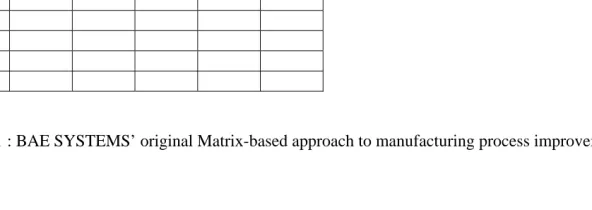
Assessing the existing BAE SYSTEMS matrix-based approach
In order to address the need for a process improvement model within the aerospace sector, it
was necessary to determine what had been attempted before by the organisation, how it had
been implemented, and how the potential users perceived it. Accordingly, the initial action
research period involved working on manufacturing process improvement initiatives within
the Military Aircraft division of BAE SYSTEMS. The findings showed that BAE SYSTEMS
had approached the problem by devising a matrix-based categorisation, sorted into six main
areas of practice: Technology, People (dealing with human resource issues), Process,
Organisational Development, Customer Satisfaction, and Performance Indicators. These
areas of practice were graded on an incrementally improving scale of achievement, rising
from ‘Learner’ level to ‘World Class’ standard. This latter nomenclature led to the initial use
of World Class Manufacturing (Keegan, 1997) as a basis for the research. This is shown in
figure 1.
Take in Figure 1
For each of the key criteria, each stage of the matrix was populated with targets intended to
attain a progressively greater level of practice and performance. For example, Technology
may include a paperless office and IT standardization in the short term, with the "virtual
office" as the long term "World Class" target, whilst for People, full personal development
plans (P.D.P.s) may be the short term goal with fully empowered employees as the long term
target. Over time, the factors affecting the process will change and hence the content of the
matrices would need to be up-dated and revised accordingly.
The matrix-based categorisation was structured in a hierarchical manner, so that a ‘generic’
matrix would control overall practice progression and performance, and under this would be
individual matrices for each of the projects – e.g. Tornado, Eurofighter/Typhoon, Joint Strike
Fighter (JSF), and Future Offensive Avionics System (FOAS). In addition, links between the
different projects were sought so as to determine how one project could learn from another.
This was achieved through the identification of a “project life cycle”, which consisted of four
distinct phases of work that was being undertaken by the organisation. These were as
Future Project: The stage at which concepts are investigated, matched to a customer need,
and demonstrated to the customer. This involves planning and design of the
“demonstrator” platform, and possibly initial manufacture of pre-production
aircraft (after an order has been secured)
Examples: JSF, FOAS (Future Offensive Avionics System)
New Product: The production phase of a new aircraft. Pre-production aircraft are built and
tested, and the final production specification is agreed, at which point the
aircraft goes into full production. This stages ends after the final batch of
aircraft is delivered
Example: Eurofighter/Typhoon
Sustaining: The business of maintaining existing aircraft in operational service.
Depending on the length of the production run, this stage may commence
before New Product ends. This is the organisation’s largest source of
business
Example: Harrier II, Hawk 2000
Legacy/RTW: This stage deals with older aircraft, which, whilst still in service, rely on
older technologies, and require ‘traditional skills’ to maintain them. Return
To Work (RTW) deals with a mid-life update, re-equipping the airframe for
an extended service life, or to perform a different function
Examples: (Legacy) Canberra, Tornado, Harrier I (RTW) Nimrod
These phases were formed into a process cycle, which charts how each phase links with the
next, thus linking the life cycle for each project, and creating a cycle through the four central
engineering businesses as shown in figure 2. Thus, one project might develop skills and
processes which can be fed forward incrementally into the next project. Furthermore, lessons
learned at, say, New Product stage of one product could be input into the same stage of future
projects to prevent the same problems from reoccurring. Using this device, the case could be
made for greater co-operation as it could be seen that if managed properly, newer projects
Take in Figure 2
The impact of the matrix-based method of controlling process improvement
The matrix-based model provided an interesting insight into the managerial issues behind
developing and implementing such an approach, especially with regard to managing the
changeover from a largely unregulated ‘ad hoc’ system to a new consolidated method. The
matrices had originally been devised by a single manager, and then revised and enhanced by
a committee of departmental engineering managers. This was done in collaboration with a
central core engineering group, which was responsible for its introduction and upkeep in use.
Initially, the matrices were piloted across a single site, addressing the sustaining phase of the
product life cycle only. A short while after implementation, interviews were carried out with
several of the engineering managers responsible for its origination, and also with some of the
senior engineers who came into contact with it. This was to gauge the reaction to the new
approach, to understand any problems with the method, and to see if hindsight provided
views on how the implementation could have been better managed. The results of this survey
were largely positive, and tended to concentrate on necessary improvements to the matrices.
These centred on the clarity and usefulness of the improvement criteria. The main objections
from the engineering work force (who had been introduced to the matrices by the
departmental managers) were that the criteria was largely vague and ambiguous (i.e. too
generic – for example, the legend ‘Benchmark results are considered to be best in class’ on
the technology matrix failed to define what was to be benchmarked, or how it was to
measured, and against what), and that it was poorly explained. This was partly to do with the
fact that there had been no consultation period during the matrices’ origination, and
consequently some of the terminology was phrased in ‘buzz-words’ (e.g. STL PDQ, meaning
‘Support Team Leader Personal Development Questionnaire), which meant little to the
engineering population. Furthermore, there were many acronyms which were not sufficiently
explained. The most significant problem however was that the criteria were not broken down
into greater detail, which meant that difficulties could be encountered when trying to apply
In addition to these faults, there were also various structural problems with the matrices.
Some information appeared at advanced stages of the matrices without anything earlier in the
development cycle to substantiate it. There were instances where criteria at a higher level
matrix failed to appear on the relevant lower level ‘detailed’ version, and also instances
where criteria appeared on the wrong matrix. These faults were corrected through a series of
seminars and meetings attended by senior and departmental managers, and when the revised
matrices were released back to site, there was general approval and opinion that this approach
would be beneficial to improve manufacturing practice.
At this point, the matrices were populated out across the other sites belonging to the Military
Aircraft division, and here further problems were encountered. These stemmed largely from
the fact that the organisational structure of the division placed individual projects (aircraft
development programmes) at different sites. Each project required often quite different
practices and techniques (so, for example, a modern state-of-the-art Typhoon would have one
set of practices, whilst an older Harrier would have another). These frequently failed to relate
to one another, and consequently (in addition to many of the issues raised at the pilot site) the
managers at the different sites claimed that one set of improvement criteria could not be
universally applied across all projects and that consequently the matrices were of little use.
Evolving the matrix-based method
One of the chief causes of issues being raised both during the pilot and also at wider site level
was the ambiguity of the process improvement criteria. Although they had been designed to
be sufficiently broad in scope so that it could be applied across the board, the matrices now
possessed insufficient detail to be widely applied. Practices in Electrical sub-systems and
Major component assembly, for instance, were likely to be significantly different, yet the
matrices prescribed one standard set of criteria.
In an effort to combat this, the matrices were redesigned. The resultant set bore very little
resemblance to their predecessors. Whereas the original set possessed a generic matrix
connecting to a set of detailed matrices (one for each of the practice streams identified on the
generic matrix), the revised matrices possessed an entirely flat organisational structure. There
was no generic matrix, and the practice streams of Organisational Development, Customer
streams, or dispensed with and dealt with by other initiatives within the organisation. This
left Technology, People, and Process as the streams deemed central to practice improvement.
Additionally, the nature of the criteria used to populate the three new matrices was altered.
Whereas previously matrix criteria had been of the ‘umbrella’ type ‘this is the aim which our
practices should achieve’, now they were more tightly constrained, and stated ‘this is the list
of things which need to be done to achieve this standard’. Thus ‘Identification and
application of leading edge technology’ became ‘A highly capable, high performance, single
pass machining process’. Moreover, the emphasis of the criteria was much more heavily
biased towards technology and technological matters. As such, engineering systems were
broken down into the various technologies (i.e. Airframe, Composites, Advanced Metallics,
Tooling etc.), which were used to drive forward improvement. This highlighted that a
significant issue in process of matrix evolution was the difficulty in attaining the right level
of descriptiveness and detail.
Unfortunately, these new matrices were never used to great effect. This was because at the
time of their introduction, the organisation merged with Marconi Electrical Systems (MES)
to form BAE SYSTEMS. As a result of this there was wholesale reorganisation and
restructuring of the aircraft manufacturing business, which led to a concentration on issues
that were non-matrix related. Furthermore, an initiative (Project Axis) was introduced
immediately prior to the merger, which changed the structure of the Military Aircraft
division. Prior to this, manufacturing had been organised on a site basis, with individual
projects being based at, and using the resources assigned to, that site. Henceforth however,
resources were assigned to the projects, which were based at whatever site was deemed to be
appropriate. This shift of emphasis from site to project focus meant that the resources at each
site that would be needed to maintain the matrices over a period of time were no longer in
place, and thus the matrices ceased to be used as a matter of policy across the entire Military
division.
Despite this, when a second period of field work was done within BAE SYSTEMS, a
surprising consensus of opinion was reached amongst the managers and engineers who were
interviewed. The merger seemed to have created a vacuum of centralised control. The new
matrices were found to still be in use by individual teams within engineering departments to
managers the matrices had ceased to be used and were being replaced by an end-to-end
‘cradle to grave’ lifecycle, the engineers stated that there was no sign of this happening.
Furthermore, there was now a lack of centralised support, which meant that all teams were
effectively acting in isolation. This would, according to the engineers, provide a significant
barrier to the reinstatement of a widespread process improvement approach.
Developing process improvement principles for BAE SYSTEMS
Despite the fact that the revised set of BAE SYSTEMS matrices ceased to be used in their
intended manner, they provided a great deal of information with regard to what would be
required of a process improvement approach for the organisation. The matrices provided a
wealth of detail relating to the needs of the organisation at the Sustaining phase of BAE
SYSTEMS’ manufacturing operation. It was possible to use this information in conjunction
with various approaches for manufacturing improvement (see for example Schonberger
(1986,1996), Morton (1994), Kanter (1992), and Bolden et al. (1997)) to identify a set of
principles for this area of operations. This was achieved by taking an interactive approach to
relating the existing details to the BAE SYSTEMS matrices. Information was sought from
engineers and managers as to the meaning and application of the criteria, which could then be
mapped against the details in the literature approaches to form suitable principles. The
research uncovered a number of instances where there appeared to be a mismatch or lack of
commonality between the matrix-based approach and the literature. Where this was the case,
the following questions were considered:
• What was meant by each item of matrix information (where that information did not
correspond to anything within the literature)
- Was it correctly worded (it might actually be in agreement with material from the
literature whilst appearing not to be)?
- Why was it included – what was it intended to achieve?
- Why was it necessary – was it actually needed?
• Was information presented by the literature, but not present in the matrix, relevant to the
aerospace sector?
These issues were raised informally with the engineers and managers who had originally
matrices had been originally devised, and whether on reflection (of those within the
organisation) it was actually relevant to practice improvement strategy. The second point
allowed an evaluation of how complete the matrices had been – the amount of information
deemed relevant to process improvement but not present within the matrices could be used as
a measure of the completeness of the matrices, and of how effective they were as a process
improvement method (notwithstanding the structural, technical and usage issues outlined
earlier). The process of discussion eventually produced a set of concepts that was both
largely common to the matrix and the literature, and deemed relevant to the aerospace sector
(by the engineers and managers). By following this process, it was possible to assemble a set
of process improvement principles for the Sustaining phase of the BAE SYSTEMS lifecycle,
by combining the matrices’ content with information from literature. This was subsequently
approved by the organisation.
In addition to producing information for the Sustaining phase of the operation, it was also
helpful to attempt to identify principles for the other three phases of BAE SYSTEMS’
manufacturing cycle: Future Project, New Product, and Return to Work. A potential issue,
however, was that the matrices had been piloted for the Sustaining phase only. Therefore a
period of observation and general unstructured discussion with manufacturing ‘facilitators’
(i.e. managers and team leaders) was undertaken to gain an understanding of the activities
and needs of the other three phases. Once this was achieved, it was then possible to map out a
set of principles for each of the remaining three phases. These principles were grouped under
the following six general headings: customer relations; use of technology; work force
relations; quality assurance; process and supplier relations. The process of devising them is
detailed in Barker (2003). The principles are described in full in figure 3. This new set of
principles reflected a need for highly skilled knowledge and practice at the earliest stage of
the life cycle (Future Project), at which point the design and flight of the demonstrator takes
place, and relations with the potential customers are initiated. This places a heavy
reliance upon the levels of technology and technological expertise possessed by the
organisation. Once the project moves into the New Product – that is to say aircraft production
– phase, the emphasis moves toward process management and enhancement. This is
complimented by stressing the integration and realisation of worth of the employee. As the
project moves into the final two stages, Sustaining and Return to Work, the emphasis moves
are often from a previous generation of manufacture. As a result, it may often prove
uneconomical to redesign the processes to enable modern manufacturing techniques to be
employed, both in terms of extreme cost, and also the variable level of business conducted.
As a result it is imperative that a high level of engineering skill is maintained in the
organisation to cope with the contingencies of the older ‘legacy’ projects in addition to the
high degree of specialisation required at the onset of project development.
Take in Figure 3
Generalising the Process Improvement Principles
As was indicated earlier, one of the main aims of the research was to provide a more general
set of process improvement principles, which could be used not only in BAE SYSTEMS, but
also within the wider aerospace industry. In order to do this, it was necessary to study the
different types of manufacturing to gauge what effect these would have upon the principles
devised for BAE SYSTEMS. There have been various attempts to define the nature of
manufacturing. Hill (1993) and Amaro et al. (1999) have provided categorisations by
manufacturing type. Hill (1993) provides a description for the various types, Design to Order,
Engineer to Order, Make to Order, Assemble to Order and Make to Stock. These definitions
are somewhat at variance with the traditional descriptions of ETO, MTO, ATO, and MTS.
This is a point highlighted by Amaro et al. (1999), who go on to provide a much more
detailed taxonomy of manufacturing classes. In this paper, the terms ETO, MTO, ATO, and
MTS are defined as follows:
• Engineer-to-Order (ETO): The product is individually tailored to a specification provided
by the customer. The design and engineering of the product is primarily the responsibility
of the manufacturer;
• Make-to-Order (MTO): The majority of the operations required to manufacture the
product is performed after receipt of the customer’s order. The product is customised to
the customer’s requirements;
• Assemble-to-Order (ATO): Although customised to a certain extent, this involves mainly
standardised manufacture and the provision of a finite number of ways in which the
product can be assembled;
and stored in readiness for use.
These definitions, in addition to that provided by Muda and Hendry (2003) were used to
identify how BAE SYSTEMS’ manufacturing life cycle could be categorised by
manufacturing type. This is shown in figure 4. It was found that the initial stage of the
project, Future Project, was largely ETO in nature, whilst the next stage, New Product, was
predominantly MTO. This was because the high level design was achieved at the first stage,
and when passed to New Product phase, the operation became the manufacture of a highly
complex product to an existing design and set of requirements. Further through the life cycle,
the manufacturing operation became largely ATO at Sustaining phase, where the
maintenance undertaken consisted of the manufacture and assembly of relatively standardised
parts. This standardisation was also evident at the Return to Work stage, where the operation
was largely MTS, being the routine maintenance of older aircraft. This final phase also
possesses an element of ETO however. This occurs where the customer requires an aircraft
redesigned to perform a different purpose (an example being the transformation of Nimrod
from Air-Sea Rescue to Airborne Early Warning). In this instance, the manufacturing process
iterates through the design and development cycle. Therefore there exists an entirely new
manufacturing lifecycle, albeit in microcosm within the Return to Works phase.
Take in Figure 4
The information provided by this analysis enabled the existing process improvement
principles to be reassessed. As before the new principles were grouped under six general
headings. To illustrate the types of change that occurred, the new versions are shown in
figure 5 (using the same format as for the original principles described in figure 3). Of much
use at this point was Muda and Hendry’s (2003, 2002a, 2002b) work, which relates
specifically to the specification of process improvement principles for small manufacturing
enterprises within the MTO field. This provided a direct comparison with the MTO areas of
the manufacturing lifecycle (New Product phase). It was found that many of Muda and
Hendry’s principles were relevant albeit not always directly. This was primarily because of
the nature of the aerospace industry. For example, whilst it is necessary to promote business
and technical ability, this must be done in a very general manner so as to avoid infringing
possible to highlight the ability to manufacture to within thousandths of an inch, it is not
possible to describe in any depth the work that has been done for previous customers.
Largely, however, Muda and Hendry’s set of MTO principles verified those devised for BAE
SYSTEMS’.
Take in Figure 5
There was comparatively little existing work on establishing principles for each of the other
manufacturing types. A degree of reliance was therefore placed upon descriptions from Hill
(1993) and Amaro et al. (1999) on the essential characteristics of the various manufacturing
types. In this way, it proved possible to judge whether criteria from the BAE SYSTEMS’
principles would be suitable for use within operations characterised by other manufacturing
types. When this analysis was carried out, existing principles were found to be reasonably
accurate for ETO, although a greater emphasis was required on reinforcing people’s
engineering skill sets, which need to be integrated into the design and manufacturing process.
The training of the employees is vital given the high levels of complexity often involved in
design and manufacture. Finally, the transfer of skills from project to project can dramatically
improve design capability throughout the organisation. The need for research into the nature
and the use of advanced and cutting edge technology was also recognised as key to a
continually evolving engineering design process. Furthermore, whereas the original
principles (figure 3) had focused on understanding the needs of the customer, the analysis of
the ETO approach at ‘Future Projects’ phase revealed the need to promote the skill sets to
advertise capability was of great importance. It was recognised that by involving the
customers in design decision making, these capabilities could be shown, whilst increasing
customer satisfaction, and reducing lead times for design and concept generation.
The ‘Sustaining’ and ‘Return to Work’ phases of manufacture have the maintenance of older
aircraft in common, and the line defining when a sustaining project becomes return to work
can often be subjective and blurred. In these phases, ATO and MTS respectively, it was
found that notable changes were required from the earlier MTO stage. Principally, these
centred on the integration of key skills to enable the organisation to maintain ‘traditional’
practices needed whilst working on older airframes, whilst removing any lesser skilled or
current engineering methods, and a close relationship with sub-contract and material
suppliers to ensure the sourcing of older components and the quality of sub-contract work.
Technology was found to be less of a driver, with human skills and abilities, and maintenance
of the engineering process being the central facets of strategy. The principles for these final
two phases were closely linked to the principles of the original classification (figure 3).
Conclusions and Further Work
The research found that the concept of a matrix-based approach to process improvement was
potentially a valid and useful method at a detailed level of operations. However, its success in
use was entirely dependant upon the quality of change management processes employed to
facilitate it. Several significant issues were identified regarding the provision of support to
enable the engineering population to use the matrices. The initial versions of the matrices
were developed without consultation with the people who would use them – i.e. the engineers
– and subsequently problems were encountered due to areas of poor description, vagueness of
practice criteria, and confusing ‘buzz word’ phrases. Broadly, the initial matrices were too
process focused and generic for the task in hand, and this caused significant problems when
attempts were made to use it across the entire Military division. One of the major issues here
was the lack of user support, for whilst meetings and forums were held, it was then left to the
managers and engineers to return to their individual sites and use the matrices relatively
unaided. Although the matrices were redesigned in the light of views from across the Military
division, the merger brought a premature end to its extensive implementation. The revised
matrices were more detailed and focused upon technology. As a consequence, the criteria
were clearer and more closely related to the manufacturing engineering activities of the
organisation. It is likely that this would have met the needs of the engineering population
more successfully than the original versions, a fact proved by the use of the matrices in
individual areas of the organisation.
At a higher level, the classification of principles developed by this research has identified
four distinct phases of operation for the aerospace sector: future project; new project;
sustaining and return to work. It has further devised sets of principles based on a combination
of literature, existing organisation methods, and knowledge gained through discussion and
observation, which are intended for use in each of the four phases. The four phases and their
In terms of future research, in order to further validate this approach, there would need to be
a further trial of the matrix-based concept in a predominantly stable manufacturing
environment. This would focus on the definition of principles and criteria, and the provision
of in depth centrally based support for the approach during its use. Additionally, there is a
need to trial the principles for manufacturing improvement developed during this research
within the matrix structure. In essence, these represent a first attempt at a definition to
include, and therefore need to be refined and adjusted over time. Therefore, in order to
determine how they can be adapted to fit differing manufacturing environments, and to
develop them over a longer duration, a period of involvement with an aerospace organisation
is necessary.
Acknowledgements
The authors wish to thank the engineers and managers of BAE SYSTEMS, particularly those
based at Salmesbury, who shared their thoughts and opinions during the research and
contributed much information to the writing of this paper. In addition, the authors would like
to acknowledge the contribution of Professor Brian Kingsman, who provided helpful
direction and valuable advice during the research project. Sadly, Professor Kingsman died in
August 2003. His contribution and encouragement have been greatly missed during the
writing of this paper.
References
Amaro G., Hendry L.C., & Kingsman B.G. (1999), “Competitive advantage, customisation and a new taxonomy for non make-to-stock companies”, International Journal of Operations and Production Management, Vol. 19, No. 4, pp. 349-371.
Barker S.G. & Hendry, L.C. (1999), “Implementing world class manufacturing engineering within the aerospace industry: A British Aerospace example”, VI international EurOMA conference proceedings, June 1999, pp837-844.
Barker, S.G., Hendry, L.C, & Kingsman, B.G., (2002), “Change Management and Process Improvement in BAE SYSTEMS”, IX international EurOMA conference proceedings, June 2002, pp87-98.
Bolden R., Waterson P., Warr P., Clegg C., Wall T. (1997), “A new taxonomy of modern manufacturing practices”, International Journal of Operations and Production
Management, Vol. 17 (11), pp. 1112-1130.
Gill J. & Johnson P. (1997), “Research Methods for Managers”, 2nd edition, Paul Chapman publishing, London.
Graves A., Breward M., Crute V., & Ward Y. (1999) “Benchmarking lean practices in the aerospace industry”, VI international EurOMA conference proceedings, June 1999
Hanson P. & Voss C.A. (1993), “Made in Britain”, IBM Consulting Group/London Business Group, London.
Hanson P. & Voss C.A. (1995), “Benchmarking best practice in European manufacturing sites”, Business Process Re-engineering Journal, Vol. 1 (1) pp. 60-74.
Harrison, A. (1998) “Manufacturing strategy and the concept of world class manufacturing”, International Journal of Operations and Production Management, Vol. 18 (4) pp.397-408.
Hill, T. (1993), “Manufacturing strategy: The strategic management of the manufacturing function”, MacMillan, Basingstoke and New York.
James-Moore, S.M. & Gibbons, A. (1997): “Is lean manufacturing universally relevant? An investigative methodology”, International Journal of Operations and Production
Management, Vol. 17 no. 9 pp. 899-911.
Kanter R.M. (1989) “When giants learn to dance: Mastering the challenges of Strategy, management and careers in the 1990s”, Unwin, London.
Kanter R.M., Stein B.A., Jick T.D. (1992) “The challenge of organisational change”, Free Press, New York.
Kanter, R.M. (1995) “World Class - Thriving locally in the global community”, Simon & Schuster, New York.
Keegan, R. (1997) “An Introduction to World Class Manufacturing”, Oak Tree Press. Marsick, V.J. & Watkins K.E. (1997), “Case Study Methods”, in Swanson R.A. & Holton
E.F. (eds.), Human Resource Development Handbook, Berrett-Koehler, pp 138-57. Morton, C. (1994) “Becoming World Class”, Macmillan, London.
Muda, S. & Hendry, L.(2002a): “Proposing a world class manufacturing concept for the make-to-order sector”, International Journal of Production Research, 40(2), 353–373. Muda, S. & Hendry, L.(2002b), “Developing a new world class model for small and medium
sized make-to-order companies”, International Journal of Production Economics, 78, 295–310.
Muda, S. & Hendry, L.(2003), “The SHEN Model: to aid performance improvement in MTO SMEs”, International Journal of Operations and Production Management, 23 (5), 470-486.
Murman E., Allen T., Bozdogan K., Cutcher-Gershenfeld J., McManus H., Nightingale D., Rebentisch E., Shields T., Stahl F., Walton M., Warmkessel J., Weiss S., Widnall S. (2002) “Lean Enterprise Value”, Palgrave, New York.
New C. & Szwejczewski M. (1995), “Performance measurement and the focused factory: empirical evidence”, International Journal of Operations and Production Management, 15 (4), 63-79.
Oliver N., Delbridge R., Jones D., & Lowe J. (1994) “World Class manufacturing: further evidence in the lean production debate”, British Journal of Management Vol. 5 Special issue June pp. S53-S63.
Pascale, R. (1990) “Managing on the edge”, Penguin, London.
Saunders M., Lewis P. & Thornhill A. (2000), “Research Methods for Business Students”, 2nd edition, Prentice Hall, London.
Schonberger, R.J. (1986) “World Class Manufacturing - The lessons of simplicity applied”, Free Press, New York.
Schonberger R.J. (1996) “World Class Manufacturing - The next decade”, Free Press, New York.
Ward Y., Crute V., & Graves A.(2000): “The use of the US Lean Enterprise Model to measure lean principles and practices in the UK aerospace industry”, Performance Measurement 2000 conference proceedings, Cambridge 2000.
Ward, Y. & Graves, A.(2001a): “Lean Performance Measurement for aerospace”, Journal of Aerospace Management, vol. 1, no. 1, pp. 85-96.
Ward, Y. & Graves, A.(2001b): “Aerospace measures up: Performance measurement challenges in the UK aerospace industry”, VIII international EurOMA conference proceedings, June 2001, pp797-803.
Ward, Y. & Graves, A.(2004): “Lean Manufacturing drives changes in costing and accounting systems: the case of the aerospace industry”, XI international EurOMA conference proceedings, June 2004, pp 911-920.
Womack J.P., Jones D.T., & Roos D. (1990) “The machine that changed the world”, Maxwell Macmillan Inc., Oxford
Learner Developer Performer Contender World Class
Technology
People
Process
Org. Dev.
Cust. Sat.
[image:22.595.155.451.99.204.2]Perf. Ind.
Legacy/RTW
???
Legacy/RTW
FOAS
Legacy/RTW JSF
Legacy/RTW EF2000
Sustain Sustain Sustain Sustain Future Future Future Future Project Project Project Project
??? FOAS JSF EF2000 EF2000 JSF FOAS ???
New Product
EF2000
New Product JSF
New Product
FOAS
New Product ???
Future Project New Product Sustaining/Return-to-Work
Customer Relations :
GET TO KNOW THE CUSTOMER MAKE CUSTOMER A PRIORITY/ ORGANISE BY CUSTOMER
MAKE CUSTOMER A PRIORITY/ ORGANISE BY CUSTOMER Conduct market research/
Customer surveys
Get close to customer & involve in design process
Offer after sales support
Predict customer requirements/ Understand customer needs
Promote customer awareness of improvements Promote customer awareness of improvements
Customer involvement in design process Obtain customer feedback/ communicate, be honest
Obtain customer feedback/ communicate, be honest
“aggressive selling”
Use of Technology:
ORGANISATION WIDE TECHNOLOGY STRATEGY
ORGANISATION WIDE TECHNOLOGY STRATEGY
ORGANISATION WIDE TECHNOLOGY STRATEGY
Group technology knowledge Process Engineering development Process Engineering development Process Engineering development ADVANCED TECHNOLOGY Maintain existing before purchase new
General automation
EDI, computer aided management & comms.
CAD/CAM, CAP techniques
Rapid Prototyping
[image:24.595.62.796.88.392.2]MRP/MRP II
Future Project New Product Sustaining/Return-to-Work
Work Force Relations:
EXPLICIT HRM STRATEGY EXPLICIT HRM STRATEGY EXPLICIT HRM STRATEGY
Clearer leadership structure/ clarify management role
Learning culture /“Invest in people” Learning culture /“Invest in people”
Close relations with unions Continual training & development, Equal opportunity
Continual training & development, Equal opportunity
Learning culture /“Invest in people” Empowerment Empowerment
Job rotation/multi-skilling/
flexible work force
Job rotation/multi-skilling/ Flexible work force
Ensure effective communication Ensure effective communication
Use of skilled contract labour / secondments Use of skilled contract labour / secondments
Quality Assurance: QUALITY STANDARDS & AGREEMENTS QUALITY STANDARDS & AGREEMENTS QUALITY STANDARDS & AGREEMENTS
TQM/Kaizen ‘Quality Functional Design’/Conformance testing/quality inspections
‘Quality Functional Design’/Conformance testing/quality inspections
‘Quality Functional Design’ Agree quality issues with customer Agree quality issues with customer
Quality training Feedback to/from operators on quality/ Quality awards
Feedback to/from operators on quality/ Quality awards
[image:25.595.63.796.88.388.2]
Future Project New Product Sustaining/Return-to-Work
Process: CONCENTRATION ON CORE
ACTIVITIES
CONCENTRATION ON CORE ACTIVITIES CONCENTRATION ON CORE ACTIVITIES
Analyse, identify, realise, need for change, reinforce & institutionalise change
Work in progress/lead time reduction, shortest throughput
Work in progress/lead time reduction, shortest throughput
Ensure mission, vision, values and objectives Engineering techniques (JIT, SPC, etc.) Engineering techniques (JIT, SPC, etc.)
Gain political sponsorship Institute importance based reporting procedure Institute importance based reporting procedure
BPR Retain data at work place Retain data at work place
Time/cost based management Time/cost based management
Supplier Relations: SINGLE SOURCING/SELECTION OF
BEST SUPPLIER(S)
SINGLE SOURCING/SELECTION OF BEST SUPPLIER(S)
SINGLE SOURCING/SELECTION OF BEST SUPPLIER(S)
Control Inventory Maintain stock levels [supply as required]
[image:26.595.59.783.84.379.2]
Return to
( MTS ) Spares & Repairs
Work
( ETO /MTO ) New lease of life
Sustain
( ATO ) MaintenanceFuture
Project
( ETO ) Demonstrator
( MTO ) Prototyping
New
Product
[image:27.595.104.473.102.393.2]( MTO ) Aircraft manufacture
Future Project (ETO) New Product (MTO) Sustaining/Return-to-Work (ATO)
Customer Relations :
GET TO KNOW THE CUSTOMER: COLLABORATE WITH THE CUSTOMER: COLLABORATE WITH THE CUSTOMER:
Conduct market research/ Customer surveys - gain feedback
Make customer a priority/ Organise by customer
Make customer a priority/ organise by customer
Predict customer requirements/ Understand customer needs
Get close to customer & involve in design process
Offer after sales support
COLLABORATE WITH THE CUSTOMER: PROMOTE IMPROVEMENT AWARENESS:
PROMOTE IMPROVEMENT AWARENESS:
Customer involvement in design process Promote customer awareness of improvements Promote customer awareness of improvements Customer contact at all design/manufacturing
levels
Obtain customer feedback/ communicate, be honest
Obtain customer feedback/ communicate, be honest
Benchmark against customer needs
ENSURE VISIBILITY OF COMPETENCIES Promote key skills and abilities
Use of Technology:
PROCESS ENGINEERING DEVELOPMENT
ORGANISATION WIDE TECHNOLOGY STRATEGY
ORGANISATION WIDE TECHNOLOGY STRATEGY
Develop technology for function Process Engineering development Process Engineering development Place emphasis on development for future
capability
EVALUATE TECHNOLOGY NEED: Maintain existing before purchase new
Continually research new concepts/levels of technology
General automation
Propagate technology and liaise continually EDI, computer aided management & comms.
CAD/CAM, CAP techniques
Rapid Prototyping
[image:28.595.65.796.90.470.2]MRP/MRP II
Future Project (ETO) New Product (MTO) Sustaining/Return-to-Work (ATO)
Work Force Relations:
EXPLICIT HRM STRATEGY EXPLICIT HRM STRATEGY EXPLICIT HRM STRATEGY
Clearer leadership structure/ clarify management role
Learning culture /“Invest in people” Learning culture /“Invest in people”
Definition of task and function Continual training & development, Equal opportunity
Continual training & development, Equal opportunity
Communication and collaboration amongst projects
Empowerment Empowerment
Learning culture /“Invest in people”/Involvement schemes
Job rotation/multi-skilling/ flexible work force
Job rotation/multi-skilling/ Flexible work force
Integration with process and technology issues Ensure effective communication Ensure effective communication
Use of skilled contract labour / secondments Use of skilled contract labour / secondments
Quality Assurance:
QUALITY STANDARDS & AGREEMENTS QUALITY STANDARDS & AGREEMENTS QUALITY STANDARDS & AGREEMENTS
‘Quality Functional Design’/TQM/Kaizen concepts
‘Quality Functional Design’/Conformance testing/quality inspections
‘Quality Functional Design’/Conformance testing/quality inspections
Integration of quality with technology and processes
Agree quality issues with customer Agree quality issues with customer
Quality training Feedback to/from operators on quality/ Quality awards
Feedback to/from operators on quality/ Quality awards
EXPLICIT HRM STRATEGY
[image:29.595.50.790.117.462.2]
Future Project (ETO) New Product (MTO) Sustaining/Return-to-Work (ATO)
Process: CONCENTRATION ON CORE
ACTIVITIES
CONCENTRATION ON CORE ACTIVITIES
CONCENTRATION ON CORE ACTIVITIES
Analyse, identify, realise, need for change, reinforce & institutionalise change
Work in progress/lead time reduction, shortest throughput
Maintain existing practices and methods
Ensure mission, vision, values and objectives Concurrent engineering techniques (JIT, SPC, etc.)
Work in progress/lead time reduction, shortest throughput
BPR - Integrate customer & business requirements
Integrate customer & business requirements Concurrent engineering techniques (JIT, SPC, etc.)
Identify & institute performance measures REDUCE FLOW OF INFORMATION Institute importance based reporting procedure, Retain data at work place Gain political sponsorship Institute importance based reporting procedure Time/cost based management Simplify the work area/ Retain data at work
place
Time/cost based management
Supplier Relations:
SELECTION OF BEST SUPPLIER(S) SELECTION OF BEST SUPPLIER(S) SELECTION OF BEST SUPPLIER(S)
Share product development concepts Communicate and trade ideas Focus on improving and maintaining supplier relations
Co-operate as much as possible Focus on improving supplier relations Single source where appropriate
Maintain stock levels [supply as req.]