Intelligent Computing Techniques for the Detection of
Sleep Disorders: A Review
Vijay Kumar Garg
Research Scholar School of Computer ApplicationsGuru Kashi University
R.K. Bansal
Professor and Dean Research School of Computer Applications
Guru Kashi University
ABSTRACT
Intelligent computing methods and knowledge based systems are well known techniques used for the detection of various medical disorders. This paper is based on the review of various intelligent computing methods that are used to detect sleep disorders. The main concern is based on the detection of sleep disorders such as sleep apnea, insomnia, parasomnia and snoring. The most common diagnostic methods used by many researchers are based on knowledge-based system (KBS), rule based reasoning (RBR), case based reasoning (CBR), fuzzy logic (FL), artificial neural network (ANN), support vector machine(SVM), multi-layer perceptron (MLP) neural network, genetic algorithm (GA), k-nearest neighbor (k-NN), hybrid neural network, bayesian network (BN), data mining (DM) and many other integrated approaches. In traditional approach questionnaire was used for the detection of various disorders that is now overcome with all above mentioned techniques to enhance the accuracy, sensitivity and specificity.
Keywords
RBR, CBR, ANN, GA, DM, FL, BN, Intelligent computing techniques
1. INTRODUCTION
Sleep plays a vital position in the tradition of neuroscience. The subject area of sleep disorders becomes very important due to their familiarity in universe (Stanley J. Swierzewski, 2011). In 1987, Klink studied that 41% of all considered subjects had at least one syndrome of disrupted sleep (Krajewski, 2007). In 2004, Young narrated that one out of 5 adults is distressed from daytime sleepiness (Jerome, 1998). Sleep apnea (Guimaraes, 2001) and narcolepsy are two problems raised due to extreme daylight sleep. These two disorders constitute a confusing or some time vital effect on regular activities. Likely, the disturbances in sleep are created by a sleep-related breathing disorder known as sleep apnea (Liu, 2008). Also, sleep disorders have many concise and long duration dreadful effects. The short living effect directs to impaired attention, impact on quality of life, less potency and chances of mishap increasing. The long-term effect of sleep distressed move towards incrementing the morbidity and mortality rate from the increasing mishaps, cardiovascular diseases, high blood pressure, bulkiness and learning disability along with discouragement (Maali, 2012). Some sleep disorders are severe enough to hamper the physical, psychological, cognitive and motor functioning of an individual. In daily life, we usually pay no attention to snoring, sleep apnea, insomnia, parasomnia, but there persistence can be serious. Therefore, early detection of sleep disorder becomes prime task. In early stage researchers uses the quantitative approach in the form of questionnaire for the detection of
various sleep disorders. But accuracy measurement is always a problem in this approach because whole questionnaire survey is dependent on total number of participants as well as questions designed for the survey. So, the researchers move towards to enhance the accuracy by using various intelligent techniques.
Kolodner. CYRUS was a demonstration of Schank’s dynamic memory model (Ian Watson and Farhi Marir, 2013). Due to contrasted advantage and disadvantage of RBR and CBR, sometimes it is difficult to solve problem independently. But, if their advantages are realized and disadvantages are eliminated then their different junctions presents considerable advantages like as BOLERO (Lopez, 1997) and MIKAS (Khan, 2003) which integrate RBR and CBR, PROTOS (Porter, 1986) and CASEY (Koton, 1988) which integrate CBR and MBR, T-IDDM (Montani, 2003) which integrate RBR, CBR and MBR and GREBE that has knowledge base consists of rule and cases related with laws for injuries to workers (Aamodt, 1994 and Lopez, 1997). The modification of hidden knowledge into precise rules would lead to loss and irregularity of knowledgeable contents (Zurada, 1992). An Alternative of such type of inference is baye's theorem that fits a probabilistic value for every measured output like as ES (Bernstein, 1995) and MES (Dragulescu, 2007 and Vinterbo, 2000). SAMOA (Mariano, 2004) is a automatic sleep apnea syndrome diagnostic system. All these systems are successful for special diseases and self-governing symptoms but fails when a person can have more than one disease and symptoms of the some diseases have same reason to grow up. Also rule-based expert system has two limitations: 1) all conditions cannot be explained by rules for various situations and 2) experiences gathered by trial and errors cannot be easily contained to the knowledge base without human effort, due to this it has low agreement rate 83.0% (Park, 2000). Therefore, ANN has entertained to implement the human intelligence. ANN has been widely used and accepted method for the diagnosis of sleep stages and its various disorders.
In some cases, GA is used to determine the number of neurons of the hidden layer. There is always a difficulty in the development of an automated system due to some uncertainties which arises as the problems increased day by day. To handle this kind of situation, FL is measured as a suitable tool like as ISSSC version 1.0 system which is helpful for medical diagnosis (Pinero, 2004).Data mining (DM) is a proficient tool and technique used for the formation of new knowledge from databases. Various techniques of DM are considered in the diagnosis of many diseases like as prediction rule for obstructive sleep apnea (Kwiatkowska, 2007).
This paper is based on the review of the different methods of detection and diagnosis of sleep diseases such as sleep apnea, insomnia, parasomnia, snoring. We have covered the methods based upon many intelligent computing techniques (ICT) and their combinations such as KBS/ RBR, CBR, ANN, GA, FL, DM. The combined methods are RBR–CBR, CBR-FL, RBR-ANN, ANN-FL, ANN-BN, ANN-GA, ANN-DM, GA-FL. Data mining methods and Expert systems (Bertha, 2012 and Yldiz, 2011) proposed for the detection of sleep disorders in have also been described in this work. Wireless technology is also playing a key role in sleep studies where many persons can acquire the advantages of diagnosis and treatment, even without creating any disturbances in patient’s normal sleep and can obtain the required data from the patients (Ventouras, 2005).
The rest of the paper has been divided into following segments. Section 2 covers various intelligent computing techniques such as ANN, Fuzzy, GA, DM and integrated models like RBR–CBR, CBR-FL, RBR-ANN, ANN-FL,
ANN-BN, ANN-GA, ANN-DM, GA-FL. Section 3 deals with the obtained results from review. Section 4 and Section 5 covers the conclusion and summary. Section 6 covers all the references used for literature review.
2. INTELLIGENT COMPUTING
TECHNIQUES
2.1 Knowledge based System (KBS) /
Rule based Reasoning (RBR)
KBS is an artificial intelligent device to offer intelligent decisions with validation. In this knowledge acquisition and representation is being done by various rules, frames and scripts. Knowledge is represented by means of cases (CBR) and IF-THEN rules (RBR). The main components of RBR are rule base and inference engine. Rule base contains a list of rules considered as knowledge base. An inference engine infers information based on the interaction of input and the rule base. A match-resolve-act cycle is performed to execute the construction system program. The main advantage of RBR is the explanation of information in the form of rules, compress representation of rules and modularity. R&K's criteria are basically based on marking events such as sleep spindle, k-complex, rapid eye movements and slow delta waves rather than background signal activities. If no marking events are found at the sleep epoch, then the event-based classification and smoothing rules cause artificial neural network with low performance. Also rule-based expert system has two limitations: 1) all situations cannot be described by rules, 2) experiences acquired by trial and errors cannot be easily contained to the knowledge base without human effort and 3) Misconception to understand the rules. A neural network system comprised the shortcomings of a rule-based expert system. The limited reliability of automated sleep scoring was overcome by hybrid neural network and rule-based expert system with agreement rate of 85.9% (Park, 2000).
CBR is the process of solving new problems based on the solutions of similar past problems. CBR based systems attempts to produce a solution to a new problem by making use of the 4R’s: Retrieve Reuse, Revise and Retain (Parka, 2000). CBR has Capability to convey specific knowledge and update the KBS whenever a new case arrives. It also helps to manage the unpredicted inputs. But there are also some limitations like as knowledge acquisition problems for unavailable or limited cases, Inference efficiency is not always good as desired, straight forward provision of explanation is missing. A few researchers have used the integrated approach of CBR and RBR for the implementation of systems to detect the sleep disorders as depicted in Table 6.
ANN has a few advantages over KBS in exhibiting a complementary approach to RBR in terms of knowledge illustration which requires a long time to construct such a system from rule based approach that extracts features from the original recordings like EEG, PSG and then make the rules according to human knowledge (Tian, 2005). ANN possesses a very attractive property for automated recognition of sleep EEG patterns which doesn’t require any elaborate classification rules or complex domain knowledge (Ventouras, 2005). ANN agreed with manual scoring of 93.3% for all scored epochs to manual scoring of arousals, a time consuming process (Sinha, 2008). The semi-automatic arousal detection system was implemented by Sorensen using FFNN (Sorensena, 2011) to overcome the limitations of manual system. The abstraction and repetitiveness of the task also direct to inaccuracies and low inter-scorer agreement (Tian, 2005) wherein no knowledge of probability distribution is required. NN is skillful in estimating the posterior probabilities, providing the base for implementing classification rules (Marcos, 2008). Automated classifier (Flores, 2000) was proposed to detect the arousal, an inexpensive and less time consuming process as compared to other approaches. In automated sleep spindle detection studies, referenced to the visual detection results ranges from 70% to 99% and false positives from about 3% to 47% (Ventouras, 2005).
ANN is efficient in the classification of non-linear and non-periodic types of signals like as sleep EEG patterns. In another report, two types of ANN: MLP and LVQ are used to classify the sleep stages in infants. Automatic sleep stage scoring in human was tried by using multilayer FFNN with the recognition rate varying from 82.3-90% (Sinha, 2008). The advantage of BiosleepTM (oxford biosignals), which uses automated neural network technique for sleep staging for ease and speed of analysis. Not bounded to R&K criteria, it offers the benefits over manual assessment (Caffarel, 2006). ANN insensitive to the distributions of the data shows similar obtained results with raw or transformed data. ANN is deft in dealing with a non-Gaussian probability density function and extreme values. Transformations are ineffective on its ability to separate space into subspaces (Becq, 2005).
k-NN is a nonparametric technique for classification assumed to have no apriori parameterized knowledge about the probability structure of the data (Ventouras, 2012) and data samples are used directly where it provides best performance (Mendez, 2009) in homogeneous and transformed data (Becq, 2005) for enough number of cells with small size which are achieved by LDA as compared to ANN (Krajewski, 2007).
LVQ, a network with supervised training showed a better adaptation to the training set with an increasing number of neurons achieving maximum classification (Golz, 2001). Normal readings are separated entirely 100% from the apneic recordings from k-NN and NN supervised learning classifiers (Mendez, 2009). The advantages of RBF networks are: simplicity of the architecture, reduction in training time and the capability to deal with unseen data. RBF networks are successfully applied for fault detection, face recognition or medical diagnosis. RBF-FCM network provided the best classification accuracy with reduced network complexity whereas RBF-KM network provided the best classification performance as compared to RBF-OLS and RBF-FCM networks, as their performances were slightly lower than that of RBF-KM (Marcos, 2008).
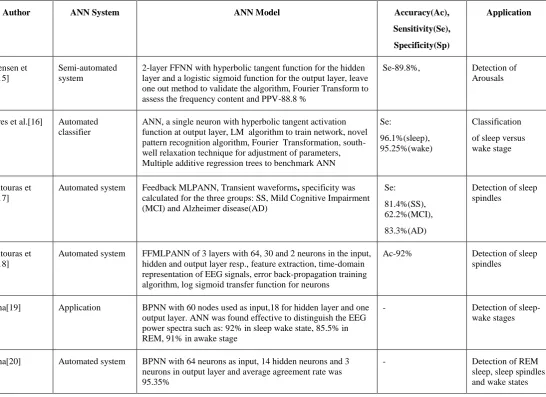
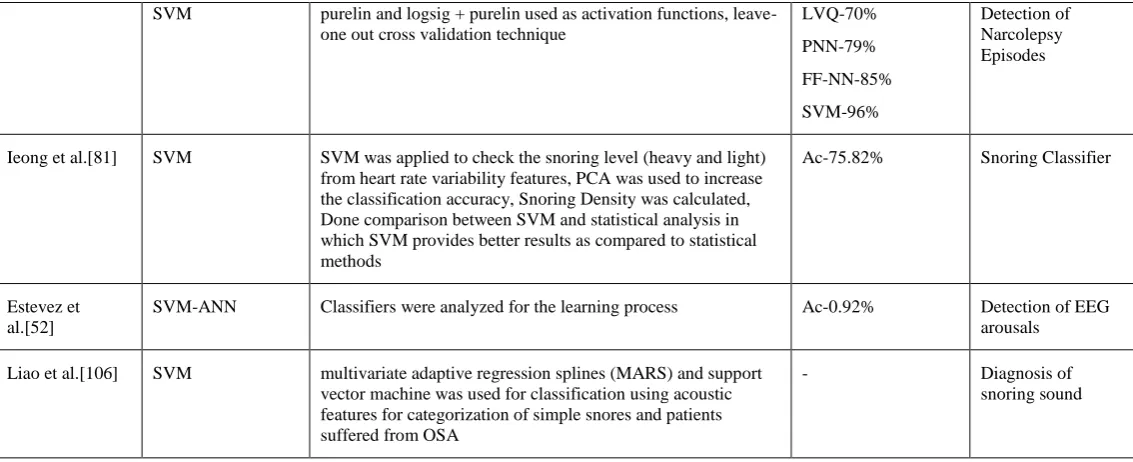
Inspite of few benefits, ANN has certain drawbacks, like the organization of NN is ambiguous. A priori information/knowledge used for the initialization purpose cannot be treated for better initialization of network parameters and the reduction of learning time period. It is incorporated rule -based expert system which could not contain all the rules due to its very low agreement rate 55.1% compared with Rule-based expert system 83.0% (Park, 2000). The visual recognition and counting of spindles is a laborious and time-consuming task for whole-night sleep EEG recordings (Ventouras, 2012). There are problems associated with mimicking a human scorer in an automated sleep spindle detection system (Ventouras, 2005). Table-1 summarizes the various ANN approaches followed in the each specific selected paper that is used in the detection and classification of sleep stages and SA, OSA, sleep spindles. ANN based analysis system is not sufficiently accurate for sleep study analysis using the R&K classification system. BiosleepTM is limited to visual inspection between pseudo-R&K hypnogram and manual scorers (Caffarel, 2006). Leave one out or classical cross-validation techniques cannot be applied when working with a large database. Classification errors reach approximately to 30% and do not improve when the number of data in the sets increases over 500 samples while using k-NN classifier and the Parzen estimator. MLP and k-NN provided good results as compared to another techniques but k-NN has a majority vote over the remaining classes. The selection of the best NN and the optimized structure of the layers are difficult and time consuming. k-NN requires space for a large amount of learning vectors in memory (Becq, 2005). The unsupervised SOM and GCS methods were understandably poorer (Golz, 2001). Among the apnea screening methods presented by de Chazal et al. is able to achieve 90% of correct classification on minute-by-minute basis. It extracts spectral features through fourier transform of both RR series and ECG morphological characteristics. In our opinion, its main weakness is in the high-dimension feature space, i.e., 88 different features. The choice of simple topology will result in a network that is incapable of learning a complex function, whereas complex topology leads to loss of generalization capability resulting in over fitting the training data. In complex structure, NN may have the ability to memorize the training set resulting in inaccurate predictions on future samples. So, early stopping technique is an alternative to it. It comprises a validation set to stop the training algorithm before the network starts learning noise in the data as part of the model leading to an estimate of the generalization error (Mendez, 2009). The best generalization performance is achieved by a network whose complexity is neither too small nor too large. RBF-KM network since increasing the size of the hidden layer did not substantially improve the accuracy. Moreover, training MLP networks with BP requires a larger number of user-dependant parameters to be a priori specified, such as learning rate, momentum or number of training epochs (Marcos, 2008). The further description can be found from the following Table 1.
method proposed by Vapnik in 1995. The idea of SVM is to construct an optimized separating hyperplane. The optimization criterion of SVM is the width of the margin among the various classes i.e. the blank space around the decision boundary defined by the distance to the nearest training patterns (Maali, 2012).
SVMs are supervised learning models associated with all learning algorithms to analyze data and recognize patterns and map data into a high dimensional space to find out a separating hyper plane with maximal margin (Diw Berlin, 2008). The advantage of SVM is that it can solve the problem of non-linear classification and no need of velocity clamping for constriction model (Maali, 2012). The kernel function is used to solve the problem of inner product calculation in high dimension, hence, a good method for non-linear classification. The kernel function must be chosen to achieve the best classification accuracy for unknown samples (Maali, 2012). The cross-validation and independent test accuracies of apneic event detection were found to be 93.3% and 92.8%, respectively. For hypopnea event these two accuracies were 90.1% and 89.6% in which sensitivity was used to optimize the SVM parameters (Koley, 2012). After testing three different kernel functions such as: RBF, Sigmoid and polynomial, it
was found that polynomial kernel shows higher performance (Maali, 2012) than others. In comparison with
GAs, PSO have fewer complicated operations. So, few parameters can be coded dependent on stochastic processes to overcome it. SVM has ability to minimize both structural and empirical risk leading to better generalization for new data classification. Fast convergence is the one limitation of PSO (Maali, 2012). Self-advising SVM significantly provides better results than traditional SVM.
[image:4.595.39.586.369.766.2]Self-advising SVM intended to deal with the ignoring of the knowledge extracted from the misclassified data. SVM is an approximate implementation method of structural risk minimization to attain low probability of generalization error. The classification performance of k-NN, PNN and linear discriminant classifiers on test data was lower than SVM. Three kernel functions are used such as: linear, polynomial and radial basis function, in which 100% accuracy is obtained using polynomial kernel function with four subsets of features similarly provided by linear functions with only two subsets of features. k-NN and PNN show poor classification performance i.e.,83% and 70%, respectively on the test data (Maali, 2012).
Table 1. Artificial Neural Network
Author ANN System ANN Model Accuracy(Ac), Sensitivity(Se), Specificity(Sp)
Application
Sorensen et al.[15]
Semi-automated system
2-layer FFNN with hyperbolic tangent function for the hidden layer and a logistic sigmoid function for the output layer, leave one out method to validate the algorithm, Fourier Transform to assess the frequency content and PPV-88.8 %
Se-89.8%, Detection of Arousals
Flores et al.[16] Automated classifier
ANN, a single neuron with hyperbolic tangent activation function at output layer, LM algorithm to train network, novel pattern recognition algorithm, Fourier Transformation, south-well relaxation technique for adjustment of parameters, Multiple additive regression trees to benchmark ANN
Se:
96.1%(sleep), 95.25%(wake)
Classification
of sleep versus wake stage
Ventouras et al.[17]
Automated system Feedback MLPANN, Transient waveforms, specificity was calculated for the three groups: SS, Mild Cognitive Impairment (MCI) and Alzheimer disease(AD)
Se:
81.4%(SS), 62.2%(MCI),
83.3%(AD)
Detection of sleep spindles
Ventouras et al.[18]
Automated system FFMLPANN of 3 layers with 64, 30 and 2 neurons in the input, hidden and output layer resp., feature extraction, time-domain representation of EEG signals, error back-propagation training algorithm, log sigmoid transfer function for neurons
Ac-92% Detection of sleep spindles
Sinha[19] Application BPNN with 60 nodes used as input,18 for hidden layer and one output layer. ANN was found effective to distinguish the EEG power spectra such as: 92% in sleep wake state, 85.5% in REM, 91% in awake stage
- Detection of
sleep-wake stages
Sinha[20] Automated system BPNN with 64 neurons as input, 14 hidden neurons and 3 neurons in output layer and average agreement rate was 95.35%
- Detection of REM
Caffarel et al.[21]
BiosleepTM ANN ANN, cohen's kappa coefficient for various combinations of sleep stages.
- Detection of SS
Liu et al. [22] ANN of ART2 ANN, ART2for the reduction of communication cost, fourier or wavelet transformation
Ac-91% Detection OSA,
narcolepsy
Norman et al.[23]
Automated system BPNN, agreement of ANN was 89% in the training set and 70.6% in the test set
- Detection of sleep
disordered breathing
Krajewski et al.[24]
Approach PCA for reducing dimensions, FFMLPNN with BP learning algorithm, one hidden layer and 5 nodes, LDA based
classification models, two-fold cross-validation reduces effort
- Detection of
sleepiness
Marcos et al.[25] Assistant tool RBF network with one hidden, one output layer and used in function approximation, time series prediction, control and classification, k-means (KM) and fuzzy c-means (FCM) clustering algorithms allow to find centre positions in an unsupervised manner, whereas the OLS(orthogonal least squares) algorithm involves supervised training of RBF networks, ROC analysis to compare the classification ability, analyze the performance of all algorithms with RBF
RBF-KM
Ac-86.1%,
Se-89.4%,
Sp-81.4%,
RBF-FCM
Ac-84.7%,
Se-86.6%,
Sp-81.9%,
RBF-OLS
Ac-85.5%,
Se-89.8%,
Sp-79.4%
Diagnosis of OSA
Golz et al. [26] Vector based NN LVQ, self-organizing feature map and growing cells structure for classification of spectral density
In general, Ac-80% but less on high dimensions data
Recognition of beginning microsleep
Mendez et al.[27]
Time varying
auto regressive model
k-NN, FFBPNN with 1 neuron at output layer (linear neural function), 3 to 30 neurons at hidden layer (logarithmic Sigmoid neural function),sequential forward selection approach for the selection of best features, Wrapper approach through Leave One Out to compute classifiers performance, LM training procedure to train NN, early stopping for validation of NN
KNN:
Ac-88%,
Se-85%,
Sp- 90%,
NN:
Ac-88%,
Se-89%,
Sp- 86%
Classification of OSA
Tian et al. [28] TDNN TDNN with 2 nodes at1 hidden layer, 3 nodes at 1 input layer and 2 nodes at 1 output layer, BP to train TDNN
Apnea:
Se-90.7%,
Sp-6.4%,
Hypopnea:
Se-80.8%,
Sp:81.4%
Detection of SA
Almazaydeh et al.[75]
FFNN Network was trained using BP learning algorithm and Spo2 signals are passed as inputs to ANN
Ac-93.3%,
Se-87.5%,
Sp-100%
Dolypona Das et al.[76]
ANN Network was trained using BP learning algorithm Spo2 and ECG signals are used for the identification of OSA
Ac-97.3154% Identification of OSA
Gabran et al.[77] Real Time Automated System
Three classification methods are implemented: LVQ,PNN and FFNN, single hidden layer was selected in all techniques, 4 neurons in input layer and one neuron in output layer, tansig + purelin and logsig + purelin used as activation functions, leave-one out cross-validation technique
Ac:
LVQ-70%
PNN-79%
FF-NN-85%
Classification of sleep
Tagluk et al.[50] ANN Bispectral: QPC, 2-D window function to reduce the variance of the bispectrum, hanning window for bisopectral calculation
NN: one input layer, two hidden layers, and one output layer. output error was measured by means of SSE, multilayer NN for classification, cross validation technique
Ac-96.15% Estimation of OSA
Becq et al. [54] Analysis Comparison of linear and quadratic classifiers, k-NN, Parzen kernels and neural networks in automatic sleep stage
classification, MLPNN trained with 8 neurons in the input layer (hyperbolic tangent transfer function) 6 neurons in the hidden layer (linear transfer function and 6 in the output layer (logarithmic sigmoid transfer function) trained by with FFBP gradient algorithm
- Scoring of SS
Lin et al.[74] WT + ANN Transformation: Wavelet transforms for the decomposition of EEG signals into delta, theta, alpha, and beta spectral components
ANN: Wavelet coefficients for training purpose, 12 neurons in Input layer, 32 neurons in hidden layer and 3 neurons in output layer, sigmoid function for the restriction of output values
Se-69.64%,
Sp-44.44%
Identification of SA
Huang et al.[83] Automated system using ANN
Fully connected neural network, BP algorithm to minimize the root MSE, analyze the accuracy over three different
approaches: 3-layer ANN(16-10-6), 4-layer ANN(16-10-8-6) and 2-layer ANN(16-6)
Ac:
3-layer-90.83%,
4-layer- 84.18%
2-layer-78.64%
Discrimination of SS
Roberts et al.[84]
Kohonen self-organising ANN
Kalman filter for the analysis of EEG signals and ANN for clustering in high dimensional space
Ac-80% Indication of
dynamics in sleep
Schaltenbrand et al.[85]
3-layer ANN 3-layer ANN was used in which 17 neurons in input layer, 10 in hidden and 6 in output layer
Ac-80.6% Analysis of human sleep
Vijaylaxmi et al.[87]
WT - ANN Features were extracted from EEG signals by discrete wavelet transform, FFMLP neural network(3-layer: 5-5-1) was used to classify the signals where supervised learning was provided by BP and average classification for 3 epochs 1000, 2000 and 3000 was 85%, 90% and 93%
Se-55.17%,
Sp-80.25%
Classification of SS
Liu et al.[91] ANN of ART2 Classification of excessive daytime sleepiness was done form normal subjects, Yoss pupil staging rule to check the wakefulness, Fourier or wavelet transforms
Ac: 91% (OSA) and 90% in narcolepsy subjects
Detection of OSA and narcolepsy
Emoto et al.[92] ANN 3-layer perceptron NN was used as second order one step predictor, linear activation function used in output layer containing 1 neuron, hyperbolic tangent function used in hidden layer, independent component analysis on connection-weight-space approach
- Snore Sound
Jane et al.[95] FF multilayer NN A detector is proposed including episodes such as: snores, sounds during inspiration and exhalation, speech and noise artifacts, 2 layer FF multilayer NN with 22 neurons in input
Se-76.1%,
Sp-82.8%
and 50 in hidden layer and 2 neurons in output layer, PPV was 75.6%
Gorur et al.[90] STFT + ANN Features were extracted by STFT and comparison was done by MLP and SVM for detection of the spindles in sleep.
Ac:
MLP-88.7%,
SVM-95.4%
Detection of sleep spindles
Berdiñas et al.[42]
ANN experts + SVM recursive feature elimination
Model was based on error correcting output code, inputs provided to the experts were the coefficients gained by a discrete wavelet decomposition, 10 different simulations and a multiple comparison procedure was used for model selection, 10 fold cross validation for error rate
Ac-90.27%±0.79 Classification of SA
Yildiz et al.[43] LS-SVM + discrete WT + fast fourier transform
LS-SVM classifier was compared with RBF, linear and polynomial kernels using 10-fold cross-validation method, Performance was optimized using hill climbing feature selection algorithm
Linear:
Ac-90%,
Se-80%,
Sp-86.7%
Polynomial:
Ac-85%,
Se-60%,
Sp-76.7%
RBF:
Ac-95%,
Se-60%,
Sp-83.3%
Recognition of OSA
Koley et al.[34] Three binary SVM leave-one-out cross-validation to evaluate the generalization ability, one-against-all strategy to train SVM, winner-takes-all for class label
- Detection of SA and
hypopnea events
Maali et al.[36] Partially connected co-operative parallel
PSO-SVM Algorithm
PSO: To tune SVM parameters and data reduction, to search space more efficiently
parallel structure: master-slave(multi-swarms) with new cooperative strategy, swarms classified to several masters and one (or more) slave, avoiding fast convergence and local optimal results
SVM: OSU-SVM package
Ac-87.93% Detection of SA
Maali at al.[38] Self-Advising(SA) SVM
PSO: To select best features subset and for tuning of SA-SVM parameters
SA SVM: Used as fitness function, particle representation by two arrays, t-test for comparison between SVM and SA-SVM
Ac-83.93% Classification of sleep apnea
Khandoker et al.[37]
SVM To train the SVM classifier, features were extracted of heart rate variability (HRV) and ECG-derived respiration (EDR) signals, leave-one-out approach used for optimal SVM parameter set
- Recognition of
obstructive sleep apnoea
Almazaydeh et al.[73]
SVM RR-interval based features of ECG signals are passed to SVM as inputs, liner kernel function for mapping of training data into kernel space, sequential minimal optimization process
Ac-96.5%,
Se-92.9%,
Sp-100%
Detection of obstructive sleep apnea
Gabran et al.[78] Portable real time prototype based on
Three classification methods were analysed: LVQ, PNN and FFNN, single hidden layer was selected in all techniques, 4 neurons in input layer and one neuron in output layer, tansig +
Ac: Automatic
SVM purelin and logsig + purelin used as activation functions, leave-one out cross validation technique
LVQ-70%
PNN-79%
FF-NN-85%
SVM-96%
Detection of Narcolepsy Episodes
Ieong et al.[81] SVM SVM was applied to check the snoring level (heavy and light) from heart rate variability features, PCA was used to increase the classification accuracy, Snoring Density was calculated, Done comparison between SVM and statistical analysis in which SVM provides better results as compared to statistical methods
Ac-75.82% Snoring Classifier
Estevez et al.[52]
SVM-ANN Classifiers were analyzed for the learning process Ac-0.92% Detection of EEG arousals
Liao et al.[106] SVM multivariate adaptive regression splines (MARS) and support vector machine was used for classification using acoustic features for categorization of simple snores and patients suffered from OSA
- Diagnosis of
snoring sound
Notes:- ANN: Artificial Neural Network, ART2: Adaptive resonance theory, BP: Back Propagation, ECG: electroencephalography, EEG: Electroencephalograms, EOG: Electrooculograms, EMG: Electromyograms, FF: Feed Forward, k-NN: k-Nearest Neighbors, LM: Levenberg-Marquardt, LS-SVM: Least squares support vector machine , LVQ: Learning Vector Quantization, MLP: Multilayer Perceptron, MSE: Mean Squared Error, OSA: Obstructive Sleep Apnea, PCA: Principal Component Analysis, PNN: Probabilistic Neural Network, PPV: Positive Predictive Value, PSO: Particle Swarm Optimization, QPC: Quadratic Phase Coupling, RBF: Radial Basis Function, ROC: Receiver Operating Characteristic, SVM: Support Vector Machine, SSE: Sum Square Error, STFT: Short Time Fourier Transform, TDN: Time Delayed Neural Network, WT: Wavelet Transform
2.3 Fuzzy Logic/Reasoning (FL)
Fuzzy set theory plays a vital role in dealing with complexities when drafting decisions in medical domain (Liang, 2011). FL is a type of probabilistic logic which deals with reasoning that is approximate rather than constant and accurate. FL variables may have a truth value that ranges in degree between 0 and 1. It has been expanded to manage the theory of partial truth, where the truth value can have range between completely true and completely false. In linguistic variables these degrees may be handled by specific functions (Riko safaric and
[image:8.595.21.588.71.302.2]Andreja Rojko (2006). Fuzzy rule based system achieved good results for some samples, but it still needs to improve its performance in all samples of recording data (Maali, 2012). It had overcome the limitations of epoch-based sleep staging by obtaining a more continuous evolution of the sleep of the patient. Avoidance of binary decisions provides soft transitions and enables concurrent characterization of the different states of sleep. The use of Mamdani-like fuzzy rules enables knowledge to be implemented in form of linguistic rules, close to human language, which facilitates knowledge acquisition, understandability and allows explanatory capabilities (Estevez, 2012). The limitation of R&K rules was the unnatural assignment of discrete stages aside doing it in a continuous manner (Estevez, 2009). A receiver operating curve (ROC) index of 0.88 was obtained for the classification of events as apneas or hypopneas (Estevez, 2009). The manual sleep classification of the patients was made by different experts with an inter-rater reliability of 71%. The clusterization process has higher results than those from the process of discretization (Pinero, 2004) as shown in following Table-2. It has many advantages like as easy reformation of rule base or fuzzy sets, ease of understanding due to the presence of output in linguistic form, easy to design due to less cost, provisions to allow conflicting inputs, arrive at steady state in a lesser time interval. On the other side, fuzzy has also limitation like as difficult construction of a model from a fuzzy system.
Table 2. Fuzzy Reasoning
Author Fuzzy Reasoning Accuracy(Ac), Sensitivity(Se), Specificity(Sp)
Application Domain
Estevez et al.[30] 111 fuzzy rules, trapezoidal fuzzy sets, defuzzification is done by the center-of-gravity method, optimal parameterization of the fuzzy sets is done by GA, Cohen's kappa index values
- Analysis of the sleep
macrostructure
Estevez et al.[31] Two layer architecture, five parameters are passed as input, trapezoidal fuzzy sets, defuzzification is done by the center-of-gravity method
Ac-95.6%, Se-95.5%, Sp-95.1%
Estevez et al.[32] Fuzzy rules, trapezoidal fuzzy sets, input and output variables are fall reduction and event desaturation, Defuzzification is done by centroid method
Se-87%, Sp-89%
Detection of apneic events in SA/ hypopnea
Pinero et al.[33] Five layer architecture, GENRUL5 and MLRUL algorithms are used for fuzzy rules, fuzzy pack, hard rule system, CBR used in inference process, fuzzy clustering
- Classification of SS
Causa et al.[29] Nonlinear algorithms + empirical-mode decomposition, Hilbert-Huang transform
Se-88.2%, Sp-89.7%
Novel tool for automated REM's
Liang et al.[82] 14 fuzzy rules are included in inference system in which 11 are referred to relationship between epochs, nine features passes as input to fuzzy system
Ac-87.05%, Se- > 87%
Detection of SS
Yadollahi et al.[86] Energy of breathing sound signals was decomposed into two segments i.e., sound and silent segments and passed as an input to the fuzzy system in which sigmoid function was used for fuzzification, correlation between proposed system and PSG was 96%
Se and sp >90% Detection of apnea and hypopnea events
2.4 Genetic Algorithm (GA)
Genetic Algorithm is a search heuristic optimization technique, which mimics the procedure of natural development. They have been exposed to find out the optimal solution for several difficult problems as an effective and suspected tool based on principles of evolutionary strategy (Maali, 2012). It is also possible to transfer the GA to existing simulation models. A classic genetic algorithm needs two terms: an inherited demonstration of the solution domain and a robustness function to assess the solution domain. They are valuable aspirant for parallelization (Maali, 2012) as depicted in following Table 3. It also provides the automatic scores
based on sleep stages (Herscovici, 2007). The main advantage of GA is that no condition to have knowledge of mathematics for understanding. It is best to use in case of huge and complex search domain. In these cases local minima of price function can be easily obtained from gradient optimization method (Herscovici, 2007). There are also some limitations of GA such as no constant optimization response time, no assurance for global optimum result, limited control over applications of GA in real time and perfect optimization problems cannot be solved by GA (Riko safaric and Andreja Rojko (2006).
Table 3. Genetic Algorithm
Author Remarks Accuracy(Ac), Sensitivity(Se), Specificity(Sp)
Application Domain
Herscovici et al.[39] GA was used to maximize the best score, iterative simulation was performed till the achievement of best genomes. Agreement rate-89%, area under curve is 88%
Se-78%,
Sp-92%
Detection of REM sleep
Sun et al.[105] 3 Questionnaires were involved to find out the OSA that was compared with logistic regression model and it was found that sensitivity and specificity of the logistic regression model were less than GA i.e.,55.6% and 57.9% respectively.
Se-81.8%-88.0%,
Sp-95%-97%
Detection of OSA
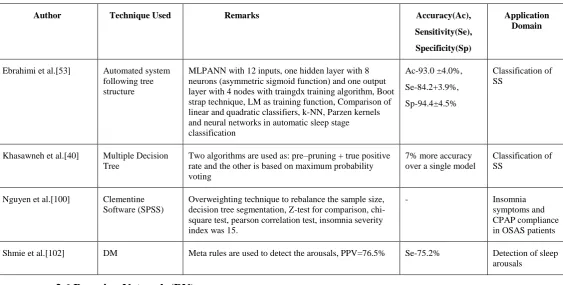
2.5 Data Mining (DM)
Data mining is the process used in knowledge discovery process for pulling out previously unidentified, unforeseen relationships and layouts (Ho Viet Lam and Nguyen Thi My Ding, 2013). DM provides offers to distinguish highly productive chunk of information covered in the expensive and huge databases. The statistics provided by DM packages are: Decision tree (C4.5, CART, CHAID), Rule induction (AQ, CN2, Recon), nearest neighbors (CBR), Clustering methods (data segmentation), Association rules. Tree-like structures are used to improve the accuracy over a single tree structure (Khasawneh, 2012). If the variation of neurons is increased in the hidden layer, then mean of accuracy is also increased and standard deviation decreased. The good performance is achieved by using the
Table 4. Data Mining
Author Technique Used Remarks Accuracy(Ac), Sensitivity(Se), Specificity(Sp)
Application Domain
Ebrahimi et al.[53] Automated system following tree structure
MLPANN with 12 inputs, one hidden layer with 8 neurons (asymmetric sigmoid function) and one output layer with 4 nodes with traingdx training algorithm, Boot strap technique, LM as training function, Comparison of linear and quadratic classifiers, k-NN, Parzen kernels and neural networks in automatic sleep stage classification
Ac-93.0 ±4.0%,
Se-84.2+3.9%,
Sp-94.4±4.5%
Classification of SS
Khasawneh et al.[40] Multiple Decision Tree
Two algorithms are used as: pre–pruning + true positive rate and the other is based on maximum probability voting
7% more accuracy over a single model
Classification of SS
Nguyen et al.[100] Clementine Software (SPSS)
Overweighting technique to rebalance the sample size, decision tree segmentation, Z-test for comparison, chi-square test, pearson correlation test, insomnia severity index was 15.
- Insomnia
symptoms and CPAP compliance in OSAS patients
Shmie et al.[102] DM Meta rules are used to detect the arousals, PPV=76.5% Se-75.2% Detection of sleep arousals
2.6 Bayesian Network (BN)
The bayesian networks provide a model for undecided reasoning, capable for handling the diagnostic problem. BNs are strong and healthy formalism that allow reasoning under uncertainty, proposing a graphical representation of statistical dependencies between domain variables (Milho, 2000).
A BN is a directed acyclic graph (DAG) i.e., the combination of various nodes which signify random variables are connected by various edges that characterize the conditional probabilistic dependency between all vertices Scott McCloskey (1999-2000). The division of every node is dependent on its parent nodes and we can say that any node Y is conditionally independent of X if there is no straight path from X to Y. So, BN is constructed to signify not only correlation but causality. It facilitates visualization of the strongest links (Winrow, 2009). A few researchers have adopted BN for analysis and diagnosis of sleep apnea as described in the following Table 5. DiBa algorithm has less complexity, soft, high resolution output,
online implementation and displays detection performance used for the detection of sleep spindles. This algorithm depends on analyzing the time-varying posterior probability to detect spindle events. This allowed us to measure the method’s receiver operating characteristic (ROC) curve by varying the likelihood threshold through all possible values. The ROC value achieved for this method is 0.98 and it is better as compared to other methods with respect to flexibility, transparency and scalability (Babadi, 2012). BN can manage partial/incomplete data sets and there is no need of pre-processing. On the other side, BN can have lagging of good classifier in the presence of wrong preceding knowledge, required a large amount of efforts to construct a network and difficult to manage constant features. Moreover, hypothesis space is also predetermined. As compared to linear classifier, Naive bayes provide better results in the identification of sleep stages with accuracy of 70% (Sloboda, 2011).
Table 5. Bayesian Network
Author Technique Used Remarks Application Domain
Winrow CJ et al.[11] BN To determine the sub-networks of linkage and loci that was not measurable in smaller data sets
Analysis of sleep-wake traits
Milho et al.[12] BN Statistical inference algorithm, java interface module, three nodes D,S,TR, handling of typical queries such as diagnostic, causal, inter-causal and mixed inferences
Sleep disorders diagnostic system
Saat et al.[13] Empirical Bayes-Poisson-Gamma Model
The assessment of parameter was done by three methods: moment (mom), maximum likelihood (mLE) and alternate method (mLM)
[image:10.595.24.587.609.759.2]Babadi et al.[14] Data Driven Bayesian Algorithm
Karhunen–Loeve transformation and Bayesian hypothesis, extraction of data-driven features by DiBa algorithm
Detection of sleep spindle
Sloboda et al.[88] Linear and naïve bayes classifiers
Extraction of respiratory signals were done by band pass filter,10 fold cross validation technique for checking errors
Identification of SS
Notes:- BN: Bayesian Network, REM: Rapid Eye Movement, SA: Sleep Apnea, SS: Sleep Stages
2.7 Integrated Computing Techniques
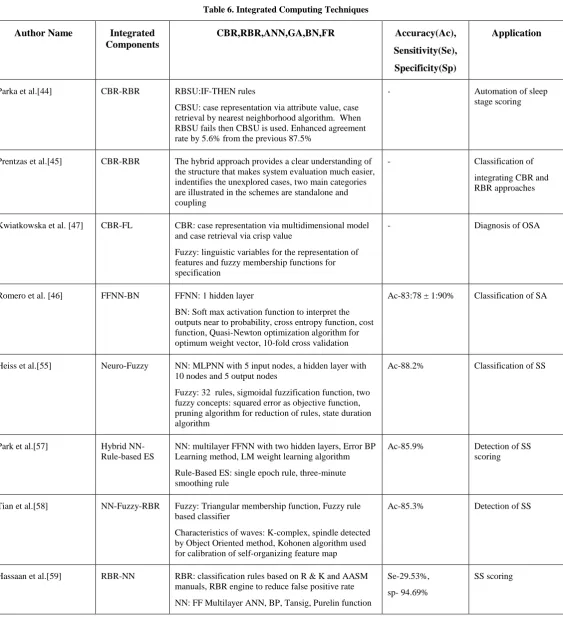
A standalone KBS system have their own benefits and limitations like as inference problem, knowledge acquisition problem etc. as already covered in Section 3.The limitations of the standalone KBS are eliminated by integrating the KBS and ICT approaches.In this section, we have covered the advantages incurred from integrated model along with their applications in the diagnosis and treatment of the sleep disorders. The combination of CBR-RBR leads to the ease of knowledge acquisition, improvement achieved in terms of accuracy, performance and efficiency. The main advantages prevailed from the integrated techniques are such as high performance on sleep disordered recordings, the justification and the learning capacity. The area of sleep stage scoring is thought to require hybrid reasoning because human experts use both rule-based knowledge and their experiences (Parka, 2000). To present the advantages of CBR in the diagnosis and treatment of OSA, the authors (Kwiatkowska, 2004) developed a small prototype system called Somnus which provides case storage and retrieval in the sleep disorders. To deal with the diversity and complexity of data, the authors had used a framework combining the fuzzy logic approach for modeling of the case features and the semiotic approach for the modeling of their measures. The user interface built in the first prototype of the Somnus system is restricted to SQL like statements providing a quick access to data but now the system is limited to handle a small group of users familiar with the database schema. The use of semio-fuzzy approach provides us a uniform representation for quantitative, qualitative features, subjective and objective measures. Even the limited cases of CBR in Somnus can be helpful for the various health providers in the field of training (Kwiatkowska, 2004). Most of the computational system are proposed in the field of sleep are only dealing with the detection system. The first application of neural network in the era of sleep is reported in (Clabian, 1996 and Clabian, 1997). BP method is considered in this case but the classification rate didn't exceed 60%. Romero (2005) had tried three different supervised learning methods such as scaled conjugated gradient (SCG), regularized scaled conjugated gradient (RSCG) and a Bayesian approach. The SCG was selected as learning algorithm for the network due to its fast convergence speed and low memory requirements and mean squared error (MSE) as cost function. But the second approach (RSCG) is opposite to SCG in which MSE with a regularization term called weight decay is used as cost function. In which only the best results was achieved by using the bayesian framework and a regularized cross-entropy function by reducing the error function (Romero, 2005). A discrete wavelet transformationwas used as a pre-processing phase to reduce and fix the number of inputs of the classifier. The selected Bayesian network has the advantage that all the learning parameters are auto-adaptive and no external-human action is needed. In previous research, not much emphasis had been located on detection and classification
perceptron (Acır, 2004). The agreement percentage was different in relation to total number of events for 406 and 553 that was 99% and 91% respectively (Maali, 2012). The results obtained in case of individual sleep stage classifier was increased from 76% to 97% (Mota, 1999). The results produced by genetic fuzzy classifier look
[image:12.595.23.587.136.754.2]similar to visual sleep staging around 84.6% in spotting of wakefulness, shallow sleep, deep sleep and rapid eye movement stages (Han, 2010). The following Table 6 depicts the whole information related to various integrated techniques.
Table 6. Integrated Computing Techniques
Author Name Integrated
Components
CBR,RBR,ANN,GA,BN,FR Accuracy(Ac),
Sensitivity(Se),
Specificity(Sp)
Application
Parka et al.[44] CBR-RBR RBSU:IF-THEN rules
CBSU: case representation via attribute value, case retrieval by nearest neighborhood algorithm. When RBSU fails then CBSU is used. Enhanced agreement rate by 5.6% from the previous 87.5%
- Automation of sleep
stage scoring
Prentzas et al.[45] CBR-RBR The hybrid approach provides a clear understanding of the structure that makes system evaluation much easier, indentifies the unexplored cases, two main categories are illustrated in the schemes are standalone and coupling
- Classification of
integrating CBR and RBR approaches
Kwiatkowska et al. [47] CBR-FL CBR: case representation via multidimensional model and case retrieval via crisp value
Fuzzy: linguistic variables for the representation of features and fuzzy membership functions for specification
- Diagnosis of OSA
Romero et al. [46] FFNN-BN FFNN: 1 hidden layer
BN: Soft max activation function to interpret the outputs near to probability, cross entropy function, cost function, Quasi-Newton optimization algorithm for optimum weight vector, 10-fold cross validation
Ac-83:78 ± 1:90% Classification of SA
Heiss et al.[55] Neuro-Fuzzy NN: MLPNN with 5 input nodes, a hidden layer with 10 nodes and 5 output nodes
Fuzzy: 32 rules, sigmoidal fuzzification function, two fuzzy concepts: squared error as objective function, pruning algorithm for reduction of rules, state duration algorithm
Ac-88.2% Classification of SS
Park et al.[57] Hybrid NN-Rule-based ES
NN: multilayer FFNN with two hidden layers, Error BP Learning method, LM weight learning algorithm
Rule-Based ES: single epoch rule, three-minute smoothing rule
Ac-85.9% Detection of SS scoring
Tian et al.[58] NN-Fuzzy-RBR Fuzzy: Triangular membership function, Fuzzy rule based classifier
Characteristics of waves: K-complex, spindle detected by Object Oriented method, Kohonen algorithm used for calibration of self-organizing feature map
Ac-85.3% Detection of SS
Hassaan et al.[59] RBR-NN RBR: classification rules based on R & K and AASM manuals, RBR engine to reduce false positive rate
NN: FF Multilayer ANN, BP, Tansig, Purelin function
Se-29.53%,
sp- 94.69%
Acir et al.[51] BPMLP-(RB- SVM)
MLP trained by BP algorithm, bipolar sigmoidal function Novel ANN method, Adaptive autoregressive model for feature extraction
Se-94.6% Automatic recognition of sleep spindles
Huang et al.[79] GA-BPN GA: To forecast the relationship between insane proportions of health examination and lifestyles, linear order crossover was adopted of rate 0.8, swap mutation procedure
BPN: To predict morbidity, sigmoid as an activation function, Total neurons of the input layer, hidden layer and the output layer are 2, 3 and 1 respectively
3-D bezier Surface is used to reflect the association between lifestyle and disease
- Application in health
management system
Bellos et al.[80] rule-based system-SVM Random Forests, ANN(MLP),Dec ision Trees, Naive bayes
DSS was analyzed on 3 databases. By applying Ist database, It was found that naïve bayes had achieved high accuracy by using Correlation-based Feature Subset Selection. From second database, Random Forest, MLP and SVM have high classification accuracy i.e., 98.75 % but by applying third database naïve bayes, MLP and SVM, all have achieved accuracy 73.08%.
MLP and SVM achieved Ac of >98%
Chronic disease management
Baile et al.[89] Combination of all classifiers
10 machine learning algorithms (AdaBoost with Decision Stump, Bagging with REPTree, and either k-NN or Decision Table) were analyzed for classification and it was found that Spo2 features provide better result as compared to ECG features.
Ac-82%,
Se-82%,
Sp-82%
Detection of real time SA and hypopnea
Maali et al.[35] Genetic-SVM (Novel system)
GA: Chromosomes are array with lengths equal to number of features, One point crossover and 10 random cells for mutation operations, fitness function
SVM: OSU-SVM package
Ac-89.26%,
Se-0.84%,
Sp-0.88%
Detection of SA
Maali et al.[41] GA-Fuzzy Fuzzy: Mamdani fuzzy rule based system, Fuzzy rules are produced by GA
GA: Three sets of chromosomes in the form of array, two cells for cross over and one for mutation
- Detection of SA/
hypopnea
Zoubek et al.[101] DM-MLPNN Two bayes rule based classifier, sequential method for feature selection
3 layers NN, hyperbolic tangent function, hidden and output layer contains 6 and 5 neurons respectively, logarithmic sigmoid function, FFBP gradient algorithm to train the net
- Classification of
sleep/wake stage
Mota et al.[103] GA-Fuzzy Fuzzy: 1 input variable per feature, 3 membership function for output variable, If-Then rules with AND operator, 10 rules in rule set
GA: Random initialization, roulette wheel for reproduction, uniform crossover operator, mutation operator
- Classifier of sleep
staging
Jo et al.[104] GA-Fuzzy Classifier
Fuzzy: 5 input and 1 output set
GA: Chromosome was conveyed as 171 bits, membership function as 75 bits and fuzzy rules selection as 96 bits, roulette wheel selection method, fitness function will be mean error rate, 0.8 cross over rate.
Ac-81.7% - 86.6%,
Se-83.9%- 86.4%,
Sp-79.6% - 87.3%
3. RESULTS AND DISCUSSION
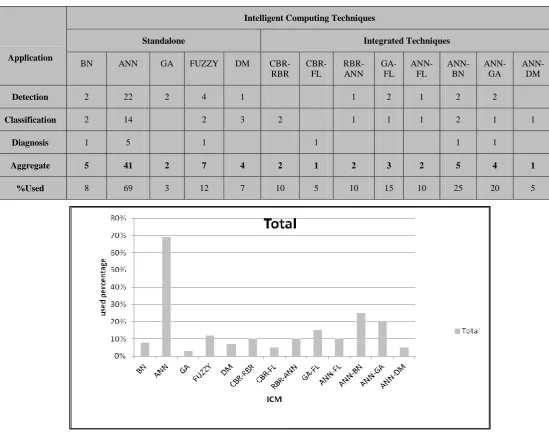
In this study, an attempt was made to study the various techniques adopted for the sleep disorders such as CBR, RBR, ANN, Fuzzy, GA, DM, BN and seven integrated methods such as CBR-RBR, CBR-FL, RBR-ANN, ANN-SVM, ANN-FL, ANN-BN, ANN-GA, GA-FL. Table-7 depicts the total number of cases in which various approaches are used for the detection, classification and diagnosis of sleep disorders. Table-9 contains the year wise information to adapt the different techniques for detection of sleep disorders. It is examined form Table 7 that in standalone category, out of 79 cases, only 5 cases of
[image:14.595.29.579.216.653.2]BN, 7 cases of FUZZY, 2 cases of GA, and major cases of ANN (41) are used in the era of sleep disorders detection, classification and diagnosis. A few cases of integrated techniques were observed in this era such as: CBR-RBR(2), CBR-FL(1), RBR-ANN(2), FL(2), ANN-BN(5), ANN-GA(4), ANN-DM(1), GA-FL(3). It is noticed that among 79 cases referring to the practice of above techniques in sleep disorders, most of the approaches, i.e., 59 are utilized by only single methodology while rest of 20 cases are positioned by integrated approach.
Table 7. Comparison of numerical measurement of different computing techniques
Application
Intelligent Computing Techniques
Standalone Integrated Techniques
BN ANN GA FUZZY DM
CBR-RBR
CBR-FL
RBR-ANN
GA-FL
ANN-FL
ANN-BN
ANN-GA
ANN-DM
Detection 2 22 2 4 1 1 2 1 2 2
Classification 2 14 2 3 2 1 1 1 2 1 1
Diagnosis 1 5 1 1 1 1
Aggregate 5 41 2 7 4 2 1 2 3 2 5 4 1 %Used 8 69 3 12 7 10 5 10 15 10 25 20 5
Fig 1: Comparison of computing methods with respect to their usage
We have also found the relative use of each technique with respect to total cases using single methodology which is represented by (m, p%), Where m is number of cases using a particular single methodology and p is percentage ratio of m (41) to total cases using single methodology (41+5+2+7+4=59) as presented in row7 (Aggregate) of Table 7. So, the relative use of ANN methodology is (69%), GA (3%), BN (8%), DM (7%), FL (12%) as
Table 8. Comparison of numerical measurement in percentage of different computing techniques
Application
Intelligent Computing Techniques
Standalone Integrated Techniques
BN ANN GA FUZZY DM
CBR-RBR
CBR-FL
RBR-ANN
GA-FL
ANN-FL
ANN-BN
ANN-GA
ANN-DM
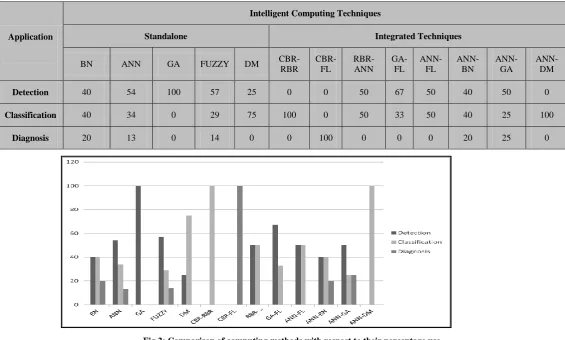
Detection 40 54 100 57 25 0 0 50 67 50 40 50 0
Classification 40 34 0 29 75 100 0 50 33 50 40 25 100
[image:15.595.17.583.87.427.2]Diagnosis 20 13 0 14 0 0 100 0 0 0 20 25 0
Fig 2: Comparison of computing methods with respect to their percentage use
In this study, we have also reckoned the relative use of diagnosis, classification and detection in each standalone methodology and integrated approaches which are presented in Table-8. The findings in Table-8 are the ratio of the every component of first column to the last component of column like 40% is the ratio of first component of first column i.e., 2 is to 5. Similarly, second and third components are 2 is to 5 and 1 is to 5. Similarly, all components in the every column of Table 8 are
obtained according to components as per computation illustrated above.
[image:15.595.43.579.558.758.2]It is noticed from figure s1 that mostly applications in sleep deploy ANN methodology and in few cases Fuzzy and BN have considered. Most of the integrated computing techniques deployed using ANN-BN and ANN-GA integration while other methodologies such as RBR-ANN, CBR-FL, ANN-FL, ANN-GA, ANN-DM, GA-FL and CBR-RBR are used in very few applications.
Table 9. Comparison of yearly numerical measurement of different computing techniques
Year
Intelligent Computing Techniques Standalone Integrated Techniques
BN ANN GA FUZZY DM
CBR-RBR
CBR-FL
RBR-ANN
GA-FL
ANN-FL
ANN-BN
ANN-GA
ANN-DM total
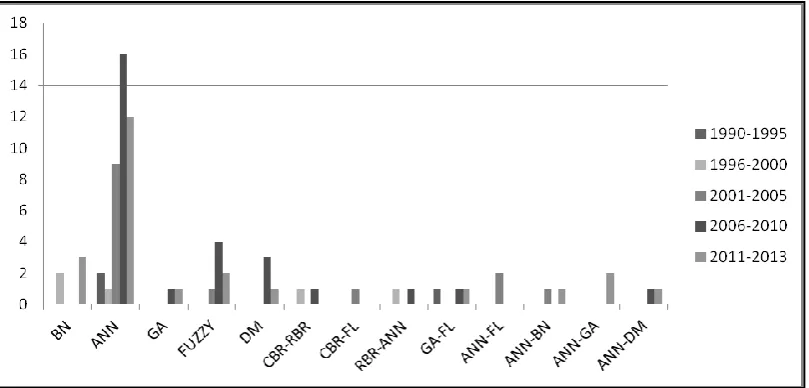
1990-1995 2 1 3
1996-2000 2 1 1 1 5
2001-2005 9 1 1 2 1 14
2006-2010 16 1 4 3 1 1 1 1 28
Fig 3: Comparison of computing methods with respect to their usage yearly
It is found from figure 2 that sleep applications deployed using GA are for detection while least for diagnosis in ANN methodology and high classification achieved using DM as they have been implemented using decision tree and association rules. In case of integrated techniques, highest classification is achieved by ANN, diagnosis by CBR-FL and detection by GA-FL.
It is observed from figure 3 that most of the applications in sleep disorders deployed using ANN in the period of 2006-2013 i.e., 16 and 12 in number respectively. Most of the implementations are done during 2006-2010 i.e., 28 and in 2011-2013, the number was 24.
4. CONCLUSION
The paper intentions are delivering a comprehensive scene in the development and deployment of various ICM in the era of sleep disorders. We have done a survey of the papers in this domain from 1991 to 2013s, covering 68 papers in the areas of sleep. It is examined that ANN approaches in particular, are widely used in the domain of sleep disorders as compared to other single technique where less reasoning is required. Integrated techniques are also used in the detection, classification of sleep disorders but as compared to single technique, their number is less. Out of 8 integrated approaches, ANN-BN and ANN-GA have been widely used percentage wise than other integrated approaches i.e. 25% and 20% respectively. From the previous past years, the trend of using fuzzy reasoning and data mining is also increasing. BN, ANN and Fuzzy are all mainly used for detection, classification and diagnosis purpose, GA is only used for detection while DM is used for both detection and classification. Our study would be helpful for the novices that may emerge their research in other medical domains.
5. SUMMARY
In this paper, we have done a review of the various intelligent computing methods and their combinations for the detection, classification and diagnosis of sleep disorders such as sleep apnea, insomnia, parasomnia and snoring. ICM comprises KBS, ANN, GA, DM, BN and FL. The integrated techniques are RBR–CBR, CBR-FL, RBR-ANN, ANN–GA, ANN-FL, ANN-GA, ANN-DM and GA-FL. The surveillance is done to explain the supreme and percentage use of different intelligent computing methods and their intra or inter combination
techniques. It is noticed that mostly ANN, GA and their integrated methods are used in the prognosis of sleep disorders.
6. REFERENCES
[1] Aamodt A., Plaza E. (1994) 'Case-Based Reasoning: Foundational Issues, Methodological Variations, and System Approaches' AI Communications. IOS Press, vol. 7, Issue 1, pp. 39-59.
[2] Acır Nurettin, Guzelis Cuneyt (2004) 'Automatic recognition of sleep spindles in EEG by using artificial neural networks' Elsevier: Expert Systems with Applications, vol. 27, Issue 3, pp. 451–458.
[3] Agarwal R. et al. (Aug. 2005) 'Detection of rapid-eye movements in sleep studies' IEEE:Transactions on Biomedical Engineering, vol.52, Issue 8, pp.1390-1396.
[4] Almazaydeh et al. (2012) 'A Neural Network System for Detection of Obstructive Sleep Apnea through SpO2 Signal Features' in: Proceedings of International Journal of Advanced Computer Science and Applications, vol.3, Issue 5.
[5] Almazaydeh Laiali et al. (March 29, 2012) 'Obstructive Sleep Apnea Detection Using SVM-Based Classification of ECG Signal Features' in: Proceedings of 34th Annual International IEEE, EMBS Conference.
[6] Babadi Behtash et al. (Februarry 2012) 'DiBa- a data-driven bayesian algorithm for sleep spindle detection' IEEE: Tansactions On Biomedical Engineering, vol. 59, Issue 2, pp. 483-493.
[7] Becq G. et al. (2005) 'Comparison Between Five Classifiers for Automatic Scoring of Human Sleep Recording' Studies in Computational Intelligence (SCI), vol. 4, pp. 113-127.
[9] Bernstein A.D.et al. (1995) 'Diagnosis and management of pacemaker-related problems using and interactive expert system' in: IEEE 17th Annual Conference on Engineering in Medicine and Biology Society, vol. 1, pp. 701–702.
[10] Bertha Guijarro-Berdinas et al. (2012) 'A mixture of experts for classifying sleep apneas' Elsevier: Expert Systems with Applications, vol. 39, pp. 7084–7092.
[11] Caffarel J et al. (2006) 'Comparison of manual sleep staging with automated neural network-based analysis in clinical practice' Springer: Medical and Biological, vol. 44, pp. 105-110.
[12] Canisius Sebastian et al. (August 20-24, 2008) 'Detection of Sleep Disordered Breathing by automated ECG analysis' in: Proceedings of IEEE EMB 30th Annual International Vancouver, British Columbia, Canada..
[13] Causa L. et al. (Sept. 2010) 'Automated Sleep-Spindle Detection in Healthy Children Polysomnograms' IEEE Transactions on Biomedical Engineering, vol. 57, Issue 9, pp.2135-2146.
[14] Clabian M, Nussbaum C, Pfutzner H. (1996) 'Artificial neural networks for apnea detection' Proc EANN, pp.601-608.
[15] Clabian M, Pfiitzner H. (1997) 'Determination of decisive inputs of a neural network for sleep apnea classification' Proc EANN, pp. 171-178.
[16] Das Dolypona, Vedanarayanan (February 2013)'Identification of Obstructive Sleep Apnea Through Spo2 and ECG Signal Features By Using an Efficient Neural Network System' International Journal of Advanced Research in Computer Science and Electronics Engineering (IJARCSEE) vol. 2, Issue 2, pp. 145-153.
[17] Diw Berlin 'Support Vector Machine' available at http://www.diw.de/documents/publikationen/73/diw_ 01.c.88369.de/dp811.pdf (accessed on 7 March 2013).
[18] Donald L. Bliwise et al. (1999) 'Correlates of the “don’t know” response to questions about snoring' am j respir crit care med., vol. 160, pp. 1812–1815.
[19] Dragulescu D., Albu A. (2007) 'Expert system for medical predictions' in: 4th International Symposium on Applied Computational Intelligence and Informatics, pp. 13–18.
[20] Ebrahimi et al. (20-25 Aug. 2008) 'Automatic sleep stage classification based on EEG signals by using neural networks and wavelet packet coefficients' in: Proceedings of 30th Annual International Conference of the IEEE on Engineering in Medicine and Biology Society, EMBS, pp.1151-1154.
[21] Emoto T. et al. (August 23-26,2007) 'Feature Extraction for Snore Sound via Neural Network Processing' in: Proceedings of the 29th Annual International Conference of the IEEE EMBS.
[22] Espie Colin A., Brooks D.Neil (June 1989) 'An evaluation of tailored psychological treatment of insomnia' Elsevier: Journal of Behavior Therapy and
Experimental Psychiatry, vol. 20, Issue 2, pp. 143– 153.
[23] Estevez Diego Alvarez et al. (3-6 Sept. 2009) 'A continuous evaluation of the awake sleep state using fuzzy reasoning' in: Proceedings of Annual International Conference of IEEE on Engineering in Medicine and Biology Society, EMBC, pp.5539-5542.
[24] Estevez Diego Alvarez et al. (April 2012) 'A method for the automatic analysis of the sleep macrostructure in continuum' Elsevier: Expert Systems with Applications, vol. 40, Issue 5, pp. 1796–1803.
[25] Estevez Diego Alvarez et al.(May 2009) 'Fuzzy reasoning used to detect apneic events in the sleep apnea-hypopnea syndrome' Elsevier: Expert Systems with Applications, vol. 36, Issue 4, pp. 7778–7785.
[26] Estevez Diego Alvarez, Bonillo V. Moret (2009) 'Model Comparison for the Detection of EEG Arousals in Sleep Apnea Patients' Springer: Bio-Inspired Systems-Computational and Ambient Intelligence, vol. 5517, pp. 997-1004.
[27] Flores A.E. et al. (Feb 2000) 'Pattern Recognition of Sleep in Rodents Using Piezoelectric Signals Generated by Gross Body Movements' IEEE: Transactions on Biomedical Engineering, vol.54, Issue 2, pp.225-233.
[28] Gabran S. R. I. et al. (August 20-24,2008) 'Real-time Automated Neural-Network Sleep Classifier Using Single Channel EEG Recording for Detection of Narcolepsy Episodes' in: Proceedings of 30th Annual International IEEE, EMBS Conference Vancouver, British Columbia, Canada.
[29] Gabran S. R. I. et al. (September 2-6,2009) 'Portable Real-time Support-Vector-Machine-Based Automated Diagnosis and Detection Device of Narcolepsy Episodes' in: Proceedings of 31st Annual International Conference of the IEEE EMBS.
[30] Golz et al. (2001) 'Application of Vector-Based Neural Networks for the Recognition of Beginning Microsleep Episodes with an Eyetracking System' in: Proceedings on the Computational Intelligence: Methods and Applications (CIMA), pp.130-134.
[31] Gorur Dilan et al. (2002) 'Sleep Spindles Detecton using Short Time Fourier Transform and Neural Networks' in: Proceedings of IEEE 2002 International Joint Conference on Neural Networks, vol.2, pp.1631-1636.
[32] Guimaraes G. et al. (2001) 'A method for automated temporal knowledge acquisition applied to sleep-relaed breathing disorders' artificial Intelligence in Medicine, vol. 23, pp. 211-237.
[33] Han G. Jo et al. (July 2010) 'Genetic fuzzy classifier for sleep stage identification' Computers in Biology and Medicine, vol. 40, Issue 7, pp. 629-634.