0095-1137/05/$08.00⫹0 doi:10.1128/JCM.43.6.2816–2823.2005
Copyright © 2005, American Society for Microbiology. All Rights Reserved.
Internal Transcribed Spacer rRNA Gene-Based Phylogenetic
Reconstruction Using Algorithms with Local and Global
Sequence Alignment for Black Yeasts and
Their Relatives
R. B. Caligiorne,
1* P. Licinio,
2J. Dupont,
3and G. S. de Hoog
4Laborato´rio de Pesquisas Clı´nicas, Centro de Pesquisas Rene´ Rachou, FIOCRUZ, Brasil, and Muse´um National d’Histoire Naturelle, Paris, France1; Departamento de Fı´sica, Universidade Federal de Minas Gerais, Minas Gerais, Brazil2;
Muse´um National d’Histoire Naturelle, Paris, France3; and Centraalbureau voor Schimmelcultures,
Utrecht, The Netherlands, and Institute of Biodiversity and Ecosystem Dynamics, University of Amsterdam, Amsterdam, The Netherlands4
Received 18 November 2004/Returned for modification 14 January 2005/Accepted 23 February 2005
Sequences of rRNA gene internal transcribed spacer (ITS) of a standard set of black yeast-like fungal pathogens were compared using two methods: local and global alignments. The latter is based on DNA-walk divergence analysis. This method has become recently available as an algorithm (DNAWD program) which converts sequences into three-dimensional walks. The walks are compared with, or fit to, each other generating global alignments. The DNA-walk geometry defines a proper metric used to create a distance matrix appro-priated for phylogenetic reconstruction. In this work, the analyses were carried out for species currently classified inCapronia,Cladophialophora,Exophiala,Fonsecaea,Phialophora, andRamichloridium. Main groups were verified by small-subunit rRNA gene data. DNAWD applied to ITS2 alone enabled species recognition as well as phylogenetic reconstruction reflecting clades discriminated in small-subunit rRNA gene phylogeny, which was not possible with any other algorithm using local alignment for the same data set. It is concluded that DNAWD provides rapid insight into broader relationships between groups using genes that otherwise would be hardly usable for this purpose.
Black yeast-like fungal pathogens are gaining importance because of their increasing incidence in often life-threatening infections in immunocompromised patients, sometimes also in otherwise healthy persons (18). The taxonomy and identifica-tion of these fungi is difficult due to a lack of phenetic char-acters and high degree of morphological plasticity. With the advent of molecular taxonomy, numerous cryptic taxa are be-ing recognized inCapronia(24),Phialophora(3, 4), Cladophia-lophora(17),Exophiala(27, 5), andRamichloridiumand Rhi-nocladiella(5).
Several comparative molecular techniques have been ap-plied to display polymorphism among strains of black yeasts. Mitochondrial DNA (13) or mitochondrial cytochrome oxidase have been used for diversity at the population level. Chitin synthase (12), in contrast, has insufficient resolution to recog-nize species but rather displays phylogenetic relationships be-tween species aggregates. The newly described species men-tioned above were invariably supported by sequence data of the internal transcribed spacer (ITS) rRNA gene region. Marked ITS differences can sometimes be found in groups that are otherwise monomorphic, such as Ochroconis (G. S. de Hoog and H.-J. Choi, unpublished data). However, the taxo-nomic value of rRNA gene ITS has been questioned, as it does not provide a sufficient level of resolution inTrichoderma(15),
Alternaria(11, 19), and other genera. It is apparent that ITS divergence rates cannot be used as a gold standard for taxo-nomic differences all over the fungal kingdom, but particular levels of divergence have been reached in some groups, among which are the black yeasts and their allies. In a number of cases (4, 5, 27) the entities found were found to coincide with phe-netic characters that had been neglected or overlooked in earlier taxonomic systems, underlining the taxonomic predic-tivity of ITS characters.
ITS divergence between black yeast species is marked, spe-cies being clearly separated by at least 1% sequence diversity (3). A major drawback of this ITS diversity in black yeasts is the large degree of divergence when the entire ascomycete familyHerpotrichiellaceae, to which they belong through Ca-proniateleomorphs (24), is compared. Such comparisons may be necessary, because morphology does not provide a priori clues to phylogenetic positions (9). Over larger phylogenetic distances, large parts of the ITS region may not be alignable with confidence (20) and therefore have been excluded from the analysis.
Recently, the algorithm DNA-Walk Divergence (DNAWD) has become available (14). The algorithm’s robustness relies on global alignment of complete sequences, which resolves the arbitrariness often associated with the precise identification of
indelmutation sites, while the integral nature of the DNA-walk still allows for the sensitivity in their occurrence. This allows for comparison of entire ITS sequences including a broad taxonomic distance range. It can be shown that a properly defined DNA-walk is the exact equivalent to the sequence
* Corresponding author. Mailing address: Laborato´rio de Pesquisas Clı´nicas, Centro de Pesquisas Rene´ Rachou, FIOCRUZ, Brazil. Phone: 553132953566. Fax: 553132953566. E-mail: rachel@cpqrr .fiocruz.br.
2816
on May 16, 2020 by guest
http://jcm.asm.org/
composition, and therefore mutations and dislocations pro-duce divergences in the walk geometry which can be measured. In this paper the DNAWD program is applied to the phyloge-netic reconstruction of black yeast strains, exploring total ITS domains of the rRNA gene. A small-subunit (SSU) rRNA gene tree is used to confirm grouping as given by ITS trees.
MATERIALS AND METHODS
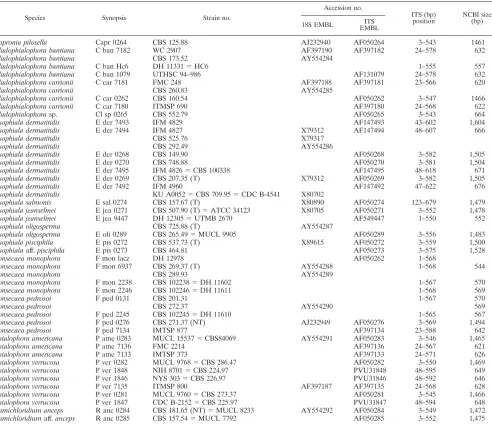
Species.A model set of strains of selected species was compared using ITS regions of the rRNA gene (Table 1). Species included were selected in such a way that both large and small phylogenetic differences, within and between genera, were available in the data set. The identity of the species was verified using a
large ITS and phenetic database available at the Centraalbureau voor Schim-melcultures, Utrecht, which contains numerous strains of all existing and recently described species, based on ex-type strains. Each species was also represented in a tree based on SSU rRNA gene sequences.
[image:2.585.49.541.89.514.2]Sequence verification.The edited sequences all have been deposited in Gen-Bank. The basic structure of the tree based on ITS and generated with conven-tional methods was verified by near-complete SSU rRNA gene sequencing of a smaller selection of strains of the same species (Table 1) plus 70 additional members of the familyHerpotrichiellaceae. SSU sequences were aligned and analyzed in an aligned database containing about 3,000 fungal sequences in the ARB package developed by W. Ludwig (www.mikro.biologie.tu-muenchen.de/ pub/ARB). The SSU tree was made with the Parsimony/ML algorithm with 100 bootstrap replications;Phaeomoniella chlamydospora(CBS 101359) was taken as outgroup.
TABLE 1. Strains analyzed with collection reference and GenBank accession numbersa(SSU numbers of those species that were also analyzed for ITS data are also mentioned)
Species Synopsis Strain no.
Accession no.
ITS (bp)
position NCBI size(bp) 18S EMBL EMBLITS
Capronia pilosella Capr 0264 CBS 125.88 AJ232940 AF050264 3–543 1461
Cladophialophora bantiana C ban 7182 WC 2907 AF397190 AF397182 24–578 632
Cladophialophora bantiana CBS 173.52 AY554284
Cladophialophora bantiana C ban Hc6 DH 11331⫽HC6 1–555 557
Cladophialophora bantiana C ban 1079 UTHSC 94–986 AF131079 24–578 632
Cladophialophora carrionii C car 7181 FMC 248 AF397188 AF397181 23–566 620
Cladophialophora carrionii CBS 260.83 AY554285
Cladophialophora carrionii C car 0262 CBS 160.54 AF050262 3–547 1466
Cladophialophora carrionii C car 7180 ITMSP 690 AF397180 24–568 622
Cladophialophorasp. Cl sp 0265 CBS 552.79 AF050265 3–543 664
Exophiala dermatitidis E der 7493 IFM 4829 AF147493 43–602 1,604
Exophiala dermatitidis E der 7494 IFM 4827 X79312 AF147494 48–607 666
Exophiala dermatitidis CBS 525.76 X79317
Exophiala dermatitidis CBS 292.49 AY554286
Exophiala dermatitidis E der 0268 CBS 149.90 AF050268 3–582 1,505
Exophiala dermatitidis E der 0270 CBS 748.88 AF050270 3–581 1,504
Exophiala dermatitidis E der 7495 IFM 4826⫽CBS 100338 AF147495 48–618 671
Exophiala dermatitidis E der 0269 CBS 207.35 (T) X79312 AF050269 3–582 1,505
Exophiala dermatitidis E der 7492 IFM 4960 AF147492 47–622 676
Exophiala dermatitidis KU A0052⫽CBS 709.95⫽CDC B-4541 X80702
Exophiala salmonis E sal 0274 CBS 157.67 (T) X80890 AF050274 123–679 1,479
Exophiala jeanselmei E jea 0271 CBS 507.90 (T)⫽ATCC 34123 X80705 AF050271 3–552 1,478
Exophiala jeanselmei E jea 9447 DH 12305⫽UTMB 2670 AF549447 1–550 552
Exophiala oligosperma CBS 725.88 (T) AY554287
Exophiala oligosperma E oli 0289 CBS 265.49⫽MUCL 9905 AF050289 3–556 1,483
Exophiala pisciphila E pis 0272 CBS 537.73 (T) X89615 AF050272 3–559 1,500
Exophialaaff.pisciphila E pis 0273 CBS 464.81 AF050273 3–575 1,528
Fonsecaea monophora F mon lacz DH 12978 AF050262 1–568
Fonsecaea monophora F mon 6937 CBS 269.37 (T) AY554288 1–568 544
Fonsecaea monophora CBS 289.93 AY554289
Fonsecaea monophora F mon 2238 CBS 102238⫽DH 11602 1–567 570
Fonsecaea monophora F mon 2246 CBS 102246⫽DH 11611 1–568 569
Fonsecaea pedrosoi F ped 0131 CBS 201.31 1–567 570
Fonsecaea pedrosoi CBS 272.37 AY554290 569
Fonsecaea pedrosoi F ped 2245 CBS 102245⫽DH 11610 1–565 567
Fonsecaea pedrosoi F ped 0276 CBS 271.37 (NT) AJ232949 AF050276 3–569 1,494
Fonsecaea pedrosoi F ped 7134 IMTSP 877 AF397134 23–588 642
Phialophora americana P ame 0283 MUCL 15537⫽CBS84069 AY554291 AF050283 3–546 1,465
Phialophora americana P ame 7136 FMC 2214 AF397136 24–567 621
Phialophora americana P ame 7133 IMTSP 373 AF397133 24–571 626
Phialophora verrucosa P ver 0282 MUCL 9768⫽CBS 286.47 AF050282 3–550 1,469
Phialophora verrucosa P ver 1848 NIH 8701⫽CBS 224.97 PVU31848 48–595 649
Phialophora verrucosa P ver 1846 NYS 303⫽CBS 226.97 PVU31846 48–592 646
Phialophora verrucosa P ver 7135 ITMSP 800 AF397187 AF397135 24–568 628
Phialophora verrucosa P ver 0281 MUCL 9760⫽CBS 273.37 AF050281 3–545 1,466
Phialophora verrucosa P ver 1847 CDC B-2152⫽CBS 225.97 PVU31847 48–594 648
Ramichloridium anceps R anc 0284 CBS 181.65 (NT)⫽MUCL 8233 AY554292 AF050284 3–549 1,472
Ramichloridiumaff.anceps R anc 0285 CBS 157.54⫽MUCL 7792 AF050285 3–552 1,475
aAbbreviations used: ATCC, American Type Culture Collection; CBS, Centraalbureau voor Schimmelcultures, Utrecht, The Netherlands; CDC, Centers for Disease Control and Prevention, Atlanta; DH, G. S. de Hoog working collection at CBS; FMC, Faculdade de Medicina, Caracas, Venezuela; IFM, Research Institute for Pathogenic Fungi, Chiba, Japan; IMTSP, Instituto de Medicina Tropical, Sa˜o Paulo, Brazil; KU, Kyushu University, Fukuoka, Japan; MUCL, Mycotheque de l’Universite´ de Louvain, Louvain-la-Neuve, Belgium; NCMH, North Carolina Memorial Hospital, Chapel Hill; NIH, National Institutes of Health, Bethesda; NYS, New York State Dept of Health, New York; UTHSC, Fungus Testing Laboratory, Department of Pathology, University of Texas Health Science Center, San Antonio; WC, Wadsworth Center for Laboratory and Research, New York. T, ex-type culture; NT, ex-neotype culture; AUT, authentic culture; Aff., with affinity to; sp., unidentified species.
VOL. 43, 2005 rRNA-BASED PHYLOGENETIC RECONSTRUCTION 2817
on May 16, 2020 by guest
http://jcm.asm.org/
ITS sequences were aligned using the BioNumerics package (Applied Maths, Kortrijk, Belgium). Due to gaps necessary for alignment, the ITS 1 domain spanned 258 positions (real lengths, 197 to 215 bp), the 5.8S gene 157 positions, and the ITS2 domain 224 positions (real lengths, 171 to 211 bp). Positions 97 to 155 and 184 to 208 (ITS1) and 456 to 484 and 541 to 631 (ITS2) could not confidently be aligned and were excluded from most of the comparisons. The same alignment was used for a comparison with different packages applying different algorithms: Phylip package (v.3.572c) (6), according to maximum like-lihood; BioNumerics according to Ward’s averaging (27), without Indels, using Kimura’s two-parameter model, distance estimation through neighbor joining using the Treecon package with Kimura’s two-parameter model (25), and Paup (23) according to parsimony. In all comparisons, insertions and deletions (indels) were not taken into account.Exophiala pisciphila(AF050273) was taken as the outgroup.
Homology analysis by DNA-walk divergence.DNA-walks are defined by in-crementing walk steps for each nucleotide in the sequence (for example, a positive step for purines and negative for pyrimidines). The DNA-walk diver-gence method (14) makes simultaneous three-dimensional walk comparisons (representing three composition skews), AG-TC, AC-TG, and AT-CG for each pair of sequences. One sequence slides against the other until the minimum squared walk difference is found, corresponding to a global alignment. This is then taken as a measure of their distance since statistically independent muta-tions andindelsincrease the mean square walk differences linearly. The resulting distance matrices are then fed to the Kitsch program of the Phylip package (v. 3.572c) (6), which generates trees with contemporary leaves.
The analyses were carried out for both the ITS1 and ITS2 regions separately, defined within the consensus limits ATCATTA to CAACAAC and TGTTGGA to AGGTTGA, respectively (Fig. 1a). The choice of the intervals was based on apparent homogeneity of sequence dissimilarities among species and can be appreciated in the DNA-walk graph of Fig. 1b. The lengths and average dissim-ilarities of the sections analyzed are also given in Fig. 1a.
RESULTS
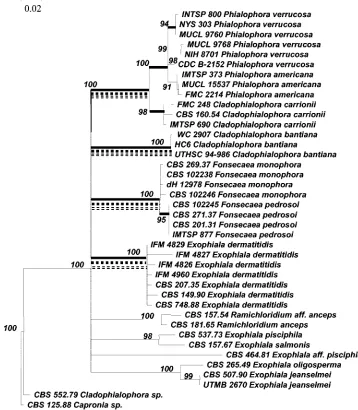
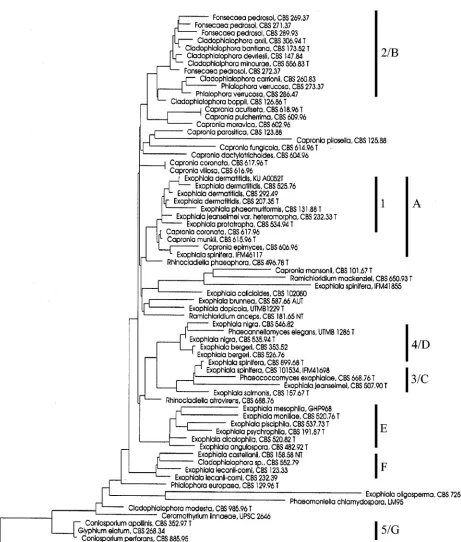
All individual species were distinguishable with ITS se-quence data with any of the algorithms applied (Fig. 2,3, 4, and 5). Using the complete ITS region, a similar unresolved struc-ture with nine clusters (A to I) was found when neighbor joining, parsimony, and Ward’s algorithms were used (Fig. 2). The mutual distances of these groups were inferred from an SSU rRNA gene tree (Fig. 3) of the herpotrichiellaceous black
yeasts, containing about 1,600 positions in 70 strains. Cluster numbering (1 to 5) in this tree was derived from a similar SSU tree published by Haase et al. (9), groups havingExophiala dermatitidis(in one)Cladophialophora bantiana(in two), Ex-ophiala spinifera(in three),Exophiala nigra(in four), and Co-niosporium perforans(in five) as core taxa. ITS groups A to C on the one hand and F plus H on the other appeared to be mutually related as they clustered within single SSU groups, while distances between remaining groups were significantly larger.
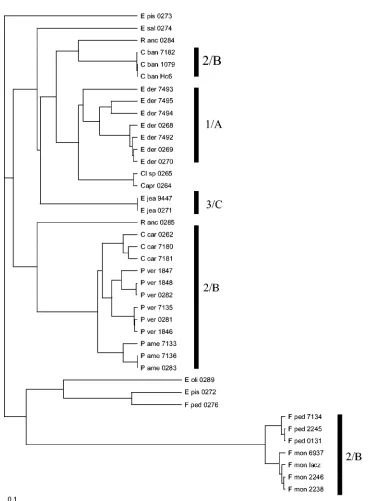
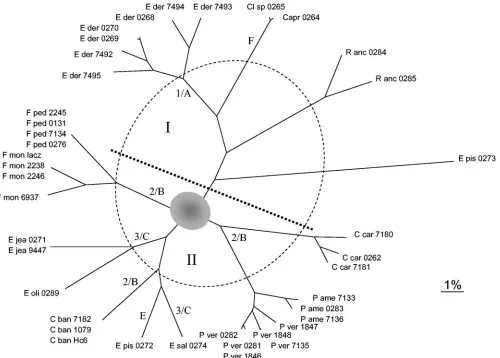
With DNA-walk, the trees based on the complete ITS region (Fig. 4) as well as that of the ITS2 domain alone (Fig. 5) recognized all species correctly. The analysis of the ITS do-main data resulted in slightly different trees when either the complete ITS region, or ITS1 or ITS2 alone were used. In the DNA-walk tree based the complete ITS domain (Fig. 4) all groups, including A to C and F and H, were clearly separated. The structure of the tree could not be linked to the distances as provided in the SSU tree (Fig. 3). In the tree based on ITS2 (Fig. 5)Fonsecaea(C),PhialophoraandCladophialophora car-rionii(A), andC. bantiana(B) were all found in an area of the tree where mutual distances between taxa were moderate, while groups D (E. dermatitidis complex), E, G, and I were more distantly related to other members of the Herpotrichiel-laceaeand mostly also to each other.
DISCUSSION
Sequencing of the rRNA genes is indispensable for species recognition in black yeasts and their allies that are causative agents of important human diseases such as chromoblastomy-cosis and phaeohyphomychromoblastomy-cosis (1, 2, 8, 21). Several species are known to have reproducible intraspecific polymorphisms in the ITS domain enabling the recognition of variants differing in virulence that are easily detected in an aligned ITS sequence
FIG. 1. a. Diagram showing ITS regions defined from strict consensus sequences used in DNAWD analysis. The mean size in base pairs and mean percent variability among species for each region are also noted. b. AT-CG DNA-walk coordinates for seven different species (P. verrucosa,
P. americana,E. dermatitidis,F. pedrosoi,E. pisciphila,C. carrioniiandC. bantiana). The ITS domains used in DNAWD analysis are also shown.
on May 16, 2020 by guest
http://jcm.asm.org/
base (16). On the other hand, considerable interspecific poly-morphisms may occur between morphologically identical spe-cies (5), as phenetically similar structures can be found all over the phylogenetic tree of theHerpotrichiellaceae(9). Sequences may show too much divergence to allow reliable alignment comparison, limiting identification of clinical samples to local BLAST searches. nBlast in GenBank for most species is insuf-ficient, since the taxonomic representation is as yet fragmen-tary. As yet no molecular marker other than ITS is available with optimal display of differences between species. For this reason the best approach is application of a comparative method that is based on ITS but is independent of alignment bias.
Our selection of species and strains analyzed is more or less representative for the hyper-variability of the ITS domains of black yeasts and allies. With growing distances between strains,
alignments quickly can no longer be done with confidence. Meaningful comparison to reveal evolutionary relationships between some of the species is then only possible when small selections of the ITS domains are taken into account, as men-tioned in Materials and Methods. Phylogenetic interpretation is strongly hampered, as trees lack any resolved substructure, being based on too low number of mutations in the small portions that are still comparable. Due to the large distance between most of the groups, the clusters were robust and remained strictly identical with any algorithm applied, partic-ularly in the lack of a hierarchical structure of main branches (Fig. 2).
[image:4.585.108.466.76.486.2]A substructure, i.e., with separate species in a more or less hierarchical ordering, was revealed with ITS in the Phialopho-ra/Cladophialophora carrioniicluster (group A) only. When the neighbor joining algorithm was applied to the complete ITS
FIG. 2. Consensus tree of 40 strains of black yeasts and related fungi based on confidently aligned rRNA gene ITS sequences, i.e., excluding positions 97 to 155 and 184 to 208 (ITS1), and 456 to 484 and 541 to 631 (ITS2), using the neighbor joining algorithm in the Treecon package with Kimura-2 correction. Bootstrap values of⬎90 from 100 resampled data sets are shown: solid bar, branches also recognized with Ward’s averaging; dotted bar, branches also recognized with UPGMA; dashed bars, branches also recognized with parsimony.
VOL. 43, 2005 rRNA-BASED PHYLOGENETIC RECONSTRUCTION 2819
on May 16, 2020 by guest
http://jcm.asm.org/
domain, which could be confidently aligned in the mentioned cluster,C. carrioniiwas found paraphyletically toPhialophora. This matches phenetic data because members of the clade share potential production of phialides and are agents of
hu-man chromoblastomycosis. These characters are also found in
Fonsecaea(group C). In the SSU tree of theHerpotrichiellaceae
published by Haase et al. (9) Fonsecaea has members of
[image:5.585.57.518.62.604.2]Cladophialophoraother thanC. carrioniias sister group species
FIG. 3. Neighbor-joining tree based on 1,660 positions of 70 SSU rRNA gene sequences generated with the ARB package.Phaeomoniella chlamydosporaCBS 101359 was used as the outgroup. Strains with numbers 1 to 5 are proven to belong to SSU groups with the same numbering indicated by vertical bars, the cluster delimitation derived from groups recognized by Haase et al. ITS groups (A to G) are superimposed, indicated with arrows.
on May 16, 2020 by guest
http://jcm.asm.org/
(cluster 2 of Haase et al.) (9).Cladophialophoraspecies other thanC. carrioniicause phaeohyphomycoses rather than chro-moblastomycoses.
In our updated SSU tree of the same family (Fig. 3) mem-bers ofFonsecaea,Phialophora, andCladophialophora(A to C) all are united in a single clade (2), showing phylogenetic co-herence of theHerpotrichiellaceae with high degrees of viru-lence. In the DNA-walk tree based on ITS2 (Fig. 5)Fonsecaea,
Phialophora, and Cladophialophora are all found in a main subdivision of the tree (II) where distances between species are
smaller than the isolated, more distantly related taxa opposite of the dotted line (I) in Fig. 5. The radial scale measures twice the percent dissimilarity in composition. Branches crossing the dotted circle (phenon circle) group about 13 species-aggre-gates with dissimilarities below 6.3%.
[image:6.585.108.483.57.558.2]With DNA-walking, the analysis of ITS domain data re-sulted in slightly different trees when either the complete ITS region (Fig. 4) or ITS2 alone (Fig. 5) was used. All trees recognized all species correctly. The question of whether the structure is phylogenetically interpretable can be verified by a
FIG. 4. Unrooted tree made with the Kitsch program in the Phylip package for construction of the DNAWD distance matrix of the entire ITS region of 40 black yeasts and related fungi. Group indications are those of the rRNA gene ITS in Fig. 2 (letters) and the SSU rRNA gene recognized by Haase et al. in Fig. 3 (numbers).
VOL. 43, 2005 rRNA-BASED PHYLOGENETIC RECONSTRUCTION 2821
on May 16, 2020 by guest
http://jcm.asm.org/
comparison with SSU rRNA gene data of the same fungi. The most comprehensive phylogenetic overview of the family is that of Haase et al. (9). These authors noted that the tree was poorly resolved but recognized five approximate clades, with
Exophiala dermatitidis,Cladophialophora bantiana,E. spinifera,
E. nigra, andConiosporium perforansas core species, as listed above. Ecologically these groups seem to be meaningful. Clade 1 is a thermophilic yeast group around the neurotrope E. dermatitidis(10), clade 2 is a group with virulent species with accent on species causing chromoblastomycosis and brain dis-ease (7), clade 3 is theE. spinifera/E. jeanselmeicomplex (5), clade 4 is a meso- to psychrophilic group ofExophialaspecies in showers and ocean waters (9), and clade 5 contains meris-tematic species inhabiting rocks (22). This ecological support for the groups suggests that this reflects the phylogeny of these groups optimally.
In the SSU tree based on our expanded and updated data set (Fig. 3) some further, ecologically defined clades can be lo-cated. ITS groups F and G are psychrophilic species similar to the fish pathogenE. pisciphila, although unexpectedlyE. sal-monisis found in E, which is a cluster of mutually distantly
related environmental species. In the SSU tree these taxa are mutually remote (Fig. 3).Exophiala oligospermais a close rel-ative ofE. jeanselmei(5) and indeed is found together with this species in ITS cluster C (Fig. 5), matching the E. spinifera
complex SSU group 3 (Fig. 3). Some dispersed strains previ-ously listed as “E. spinifera” (Fig. 3) are now known to repre-sent individual taxa, such as IFM 14855, which has been de-scribed asE. nishimurae(26).
With the DNA-walk of the entire ITS domain, no coherent substructure was recognizable. SSU-clade 2/ITS-clades A to C were found at the longest mutual distances (Fig. 4). In contrast, a major subdivision (I and II) was consistently recognized based on ITS2 alone, withE. pisciphilaCBS 464.81, represent-ing a distantly related, undescribed species, in an external position (G). Main branches I and II contained five to nine subclusters representing the individual species analyzed (Fig. 5).C. carrioniiandPhialophora(2/A) were found to be inter-related, withFonsecaea(2/C) branching off at the base; all are agents of chromoblastomycosis. Cladophialophora bantiana
[image:7.585.46.546.67.425.2](2/B) was found as well-individualized clusters paraphyletically to psychrophilicExophialaspecies (F).
FIG. 5. Unrooted tree made with the Kitsch program in the Phylip package for construction of the DNAWD distance matrix of ITS2 of 40 black yeasts and related fungi. The radial scale measures twice the percent dissimilarity in composition. Branches crossing the dotted circle (phenon circle) group about 13 species-aggregates with dissimilarities below 6.3%. The inner circle estimates large-distance dispersion and covers the most unreliable branching far away from the leaves.
on May 16, 2020 by guest
http://jcm.asm.org/
In conclusion, the DNA-walk showed consistent results in the recognition of individual species, whether these consisted of several strains or a single strain. This was achieved with the complete ITS domain as well as with rRNA gene spacers 1 and 2 separately. In addition, ITS2 alone also enabled phylogenetic reconstruction to some extent, which was not possible with any other algorithm using the same data set. DNA-walk divergence proved to be a powerful tool for the analysis of ribosomal genes and their evolutionary interpretation. The gold standard for phylogenetic interpretations is the small or large rRNA gene subunits, which in general contain more information. However, in the case of the black yeasts and their relatives, these genes often contain degrees of variability too small to resolve individual species (9). DNA-walk divergence bridges the gap between current methods of phylogenetic reconstruc-tion. Another straightforward application of this technique could be the molecular identification of the agents of phae-ohyphomycosis and chromoblastomycosis isolated in the clin-ical laboratory.
ACKNOWLEDGMENTS
Rachel B. Caligorne and Pedro Licinio acknowledge support by CNPq (Conselho Nacional de Desenvolvimento Cientı´fico e Tecno-lo´gico, Brazil).
Bert Gerrits van den Ende and Adile Cegcel are thanked for tech-nical assistance.
REFERENCES
1.Caligiorne, R. B., M. A. Resende, E. Dias-Neto, S. C. Oliveira, and V. Azevedo.1999. Dematiaceous fungal pathogens: analysis of ribosomal DNA gene polymorphism by polymerase chain reaction-restriction fragment length polymorphism. Mycoses42:609–614.
2.De Hoog, G. S., L. Sigler, W. A. Untereiner, E. Gue´ho, J. M. Uijthof, and K. J. Chung.1994. Changing taxonomic concepts and their impact on no-menclatural stability. J. Med. Vet. Mycol.32:113–122.
3.De Hoog, G. S., X. O. Weenink, and A. H. G. Gerrits van den Ende.1999. Taxonomy of thePhialophora verrucosacomplex with the description of four new species. Stud. Mycol.43:107–142.
4.De Hoog, G. S., P. Mayser, G. Haase, R. Horre´, and A. M. Horrevorts.2000. A new species ofPhialophorafrom human skin. Mycoses43:409–416. 5.De Hoog, G. S., V. Vicente, R. B. Caligiorne, S. Kantarcioglu, K. Tintelnot,
A. H. G. Gerrits van den Ende, and G. Haase.2003. Species diversity and polymorphism in theExophiala spiniferaclade containing opportunistic black yeast-like fungi. J. Clin. Microbiol.41:4767–4778.
6.Felsenstein, J.1996. Phylip (Phylogeny Inference Package), v. 3.572. De-partment of Genetics, University of Washington, Seattle, WA.
7.Gerrits van den Ende, A. H. G., and G. S. De Hoog.1999. Variability and molecular diagnostics of the neurotropic speciesCladophialophora bantiana.
Stud. Mycol.43:151–162.
8.Haase, G., L. Sonntag, Y. Van de Peer, J. M Uijthof, A. Podbielski, and B.
Krick, 1995. Phylogenetic analysis of ten black yeast species using nuclear small subunit rRNA gene sequences. Antonie Leeuwenhoek68:19–33. 9.Haase, G., L. Sonntag, B. Krick, and G. S. De Hoog, 1999. Phylogenetic
inference by SSU gene analysis of members of theHerpotrichiellaceaewith special reference to human pathogenic species. Stud. Mycol.43:80–97. 10.Hiruma, M., A. Kawada, H. Ohata, Y. Ohnishi, H. Takahashi, M. Yamazaki,
A. Ishibashi, K. Hatsuse, M. Kakihara, and M. Yoshida.1993. Systemic phaeohyphomycosis caused byExophiala dermatitidis.Mycoses.36:1–7. 11.Kang, J. C., P. W. Crous, G. R. Mchau, M. Serdani, and S. M. Song.2002.
Phylogenetic analysis ofAlternariaspp. associated with apple core rot and citrus black rot in South Africa. Mycol. Res.106:1151–1162.
12.Karuppayil, S. M., M. Peng, L. Mendoza, T. A. Levins, and P. J. Szaniszlo.
1996. Identification of the conserved coding sequences of three chitin syn-thase genes inFonsecaea pedrosoi.J. Med. Vet. Mycol.34:117–125. 13.Kawasaki, M., M. Aoki, H. Ishizaki, et al.1999. Molecular epidemiology of
Fonsecaea pedrosoiusing mitochondrial DNA analysis. Med. Mycol.37:435– 440.
14.Licinio, P., and R. B. Caligiorne.2004. Inference of phylogenetic distances from DNA-walk divergences. Physica A341:471–481.
15.Lieckfeldt, E., and K. A. Seifert.2000. An evaluation of the use of ITS sequences in the taxonomy of theHypocreales.Stud. Mycol.45:35–44. 16.Matos, T., G. Haase, A. H. G. Gerrits van den Ende, and G. S. De Hoog,
2003. Molecular diversity of oligotrophic and neurotropic members of the black yeast genusExophiala, with accent onE. dermatitidis.Antonie Leeu-wenhoek83:293–303.
17.McGinnis, M. R., S. M. Lemon, H. D, Walker. G. S. De Hoog, and G. Haase.
1999. Fatal cerebritis caused by a new species ofCladophialophora.Stud. Mycol.43:166–171.
18.Schell, W. A.1995. New aspects of emerging fungal pathogens: a multifac-eted challenge. Clin. Lab. Med.15:365–387.
19.Serdani, M., J. C. Kang, B. Andersen, and P. W. Crous.2002. Character-ization ofAlternariaspecies-groups associated with core rot of apples in South Africa. Mycol. Res.106:561–569.
20.Simmons, M. P., and J. V. Freudenstein.2003. The effects of increasing genetic distance on alignment of, and tree construction from rDNA internal transcribed spacer sequences. Mol. Phyl. Evol.26:444–451.
21.Spatafora, J. W., T. G. Mitchell, and R. Vilgalys.1995. Analysis of genes coding for small-subunit rRNA sequences in studying phylogenetics of de-matiaceous fungal pathogens. J. Clin. Microbiol.33:1322–1326.
22.Sterflinger, K., G. S. De Hoog, and G. Haase.1999. Phylogeny and ecology of meristematic ascomycetes. Stud. Mycol.43:5–22.
23.Swofford, D. L.2002. Paup. phylogenetic analysis using parsimony. version 4. Sinauer Associates, Sunderland, Mass.
24.Untereiner, W. A.2000.Caproniaand its anamorphs: exploring the value of morphological and molecular characters in the systematics of the Herpo-trichiellaceae. Stud. Mycol.45:141–149.
25.Van de Peer, Y., and R. De Wachter.1994. Treecon for Windows: a software package for the construction and drawing of evolutionary trees for the Microsoft Windows environment. Comput. Appl. Biosci.10:569–570. 26.Van Ooyen, A.2002. Theoretical aspects of pattern analysis, p. 31–45. In L.
Dijkshoorn et al. (ed.), New approaches for the generation and analysis of microbial typing data. Elsevier, Amsterdam, The Netherlands.
27.Vitale, R. G., and G. S. De Hoog.2002. Molecular diversity, new species and antifungal susceptibilities in theExophiala spiniferaclade. Med. Mycol.40:
545–556.
28.Wang, L., K. Yokoyama, M. Miyaji, and K. Nishimura.2001. Identification, classification, and phylogeny of the pathogenic speciesExophiala jeanselmei
and related species by mitochondrial cytochrome b gene analysis. J. Clin. Microbiol.39:4462–4467.
VOL. 43, 2005 rRNA-BASED PHYLOGENETIC RECONSTRUCTION 2823