Copyright © 2001, American Society for Microbiology. All Rights Reserved.
Polymorphic Internal Transcribed Spacer Region 1 DNA Sequences
Identify Medically Important Yeasts
YI-CHING CHEN,1JESSICA D. EISNER,1MIREILLE M. KATTAR,1SARA L. RASSOULIAN-BARRETT,1
KAREN LAFE,1UYEN BUI,1AJIT P. LIMAYE,1,2ANDBRAD T. COOKSON1,3* Departments of Laboratory Medicine,1Infectious Diseases,2and Microbiology,3
University of Washington, Seattle, Washington 98195
Received 11 June 2001/Returned for modification 15 August 2001/Accepted 28 August 2001
Species-specific polymorphisms in the noncoding internal transcribed spacer 2 (ITS2) region of the rRNA operon provide accurate identification of clinically significant yeasts. In this study, we tested the hypothesis that ITS1 noncoding regions contain diagnostically useful alleles. The length of ITS1 region PCR products amplified from 40 species (106 clinical strains, 5 reference strains, and 30 type strains) was rapidly determined with single-base precision by automated capillary electrophoresis. Polymorphisms in the PCR product length permitted 19 species to be distinguished by ITS1 alone, compared with 16 species distinguished by using only ITS2. However, combination of both ITS alleles permitted identification of 30 species (98% of clinical isolates). The remaining 10 species with PCR products of similar sizes contained unique ITS alleles distinguishable by restriction enzyme analysis. DNA sequence analysis of amplified ITS1 region DNA from 79 isolates revealed species-specific ITS1 alleles for each of the 40 pathogenic species examined. This provided identification of unusual clinical isolates, and 53 diagnostic ITS1 sequences were deposited in GenBank. Phylogenetic analyses based on ITS sequences showed a similar overall topology to 26S rRNA gene-based trees. However, different species with identical 26S sequences contained distinct ITS alleles that provided species identification with strong statistical support. Together, these data indicate that the analysis of ITS polymorphisms can reliably identify 40 species of clinically significant yeasts and that the capacity for identifying potentially new patho-genic species by using this database holds significant promise.
The complexity of opportunistic fungal infections is increas-ing as more patients are adversely affected by an expandincreas-ing diversity of yeasts. Invasive procedures or immunosuppression increases the risk of fungemia (24, 34), and drug-resistant strains have emerged (9, 21). AlthoughCandida albicansis still the predominate agent of nosocomial infection, serious infec-tions caused by other yeasts have increased in frequency (8, 11, 29, 34). For example, species ofCryptococcusother than Cryp-tococcus neoformans, previously considered to be nonpatho-genic saprophytes, have been reported to cause cryptococcosis (28). Adequate treatment of these infections depends on early detection and accurate identification of the pathogens. How-ever, conventional identification by evaluation of morpholog-ical and physiologmorpholog-ical characteristics can be laborious, some-times leads to incorrect classification and identification (2, 3, 13), and can be impeded by database limitations (4, 6).
To develop a rapid molecular method for identifying yeasts, we recently analyzed the length and sequence polymorphisms in the DNA of noncoding internal transcribed spacer region 2 (ITS2) of the rRNA operon (2). ITS2 region polymorphisms permitted accurate identification of over 400 clinical strains representing 34 species of pathogenic yeasts. ITS2 region PCR product length determined by automated capillary electro-phoresis permitted single-base-pair precision, with between-run standard deviations (SD) of ⱕ0.5 base, and 92% of the clinical strains examined were rapidly and correctly identified
by using only the unique length of their PCR products. The remaining 8% could be identified by either restriction endo-nuclease or DNA sequence analysis of their ITS2 region PCR products.
In this study, we investigated the length and sequence poly-morphisms in the ITS1 region and determined their diagnostic and phylogenetic utility for identification of medically impor-tant yeasts. These DNA sequences contained unique alleles for all 40 pathogenic species examined, and ITS1 alleles displayed greater interspecies variability than ITS2 region sequences. Thirty species, comprising 98% of the clinical isolates, were easily distinguished by simply determining the length of the ITS1 and ITS2 region PCR products. The remaining 10 species could be differentiated by either restriction endonuclease or DNA sequence analysis of ITS PCR products. The sequence diversity among ITS1 alleles was useful for distinguishing closely related species, particularly those that contained iden-tical DNA sequences in the D1/D2 variable domain of the 26S rRNA gene. Thus, our ITS sequence data provide a reliable means with which to rapidly identify known yeast pathogens, will facilitate the discovery of potentially novel pathogens, and establish a foundation for further expansion of an ITS se-quence database of medically important fungi.
MATERIALS AND METHODS
Yeast isolates.We examined 106 clinical strains and five reference strains (Tables 1 and 2) previously characterized genetically, morphologically, and bio-chemically in detail (2). These strains were from our clinical laboratory at the University of Washington Medical Center. Twenty-three type strains from the American Type Culture Collection (ATCC) and 7 type strains from the Cen-traalbureau voor Schimmelcultures (CBS) were also included in this study (Table 2). These 141 strains represented 40 different species of pathogenic yeasts.
* Corresponding author. Mailing address: Departments of Labora-tory Medicine and Microbiology, University of Washington, 1959 NE Pacific St., NW 120, Box 357110, Seattle, WA 98195. Phone: (206) 598-6131. Fax: (206) 598-6189. E-mail: [email protected].
4042
on May 15, 2020 by guest
http://jcm.asm.org/
Nitrate assimilation, which distinguishesPichia fabianiifromPichia veronae, was performed on a slant of nitrate agar (1.4 g of potassium nitrate, 1.6 g of yeast carbon base from Difco, 0.12 g of bromthymol blue, 16 g of Noble agar, 1 liter of distilled water [pH 5.9 to 6.0]) incubated at 30°C for about 1 week until the
agar turned from yellow or yellow-green (negative) to blue (positive).
Crypto-coccus albidusandCandida albicanswere used as positive and negative controls, respectively (17).
A hierarchical approach to building a cross-validated data set was employed when selecting isolates for molecular analyses. This was based on our observa-tions that (i) congenic strains identified according to their genetic, biochemical,
and morphological characters generally show⬎99% sequence similarity at ITS2
(2) and ITS1 (Table 2); (ii) capillary electrophoresis permits single-base-pair
precision in determining the length of PCR products, with SD ofⱕ0.5 base
[image:2.587.49.541.82.561.2]between runs; and (iii) the apparent PCR product length strongly correlates (R2
TABLE 1. Lengths of ITS1 and ITS2 region PCR products from clinical isolates and type strains
Speciesa
(no. of isolates) ITS1 PCR product length
b
(mean no. of bp) SDc(bp)
Range of product
lengths (bp) ITS2 PCR product lengthd
(mean no. of bp)
Minimum Maximum
Yarrowia lipolytica(2) 134.43 0.29 134.10 134.60 236.66
Candida rugosaT(1) 142.91 NAe NA 270.99
Candida lusitaniae(4) 143.87 0.35 143.54 144.44 251.14
Candida intermedia(1) 148.48 NA NA 255.10
Pichia ohmeriT(1) 154.01 NA NA 268.84
Candida lambica(1) 156.39 NA NA 302.18
Candida pararugosa(1)f 161.34 NA NA 269.57
Candida krusei(5) 181.44 0.64 180.39 182.27 344.61
Cryptococcus laurentiiT(1) 190.84 NA NA 362.83
Trichosporon jiroveciiT(1) 192.33 NA NA 349.89
Trichosporon cutaneumT(1) 193.72 NA NA 350.00
Trichosporon mucoides(1) 194.25 NA NA 349.30
Cryptococcus neoformans(5) 197.93 0.26 197.59 198.47 370.76
Cryptococcus humicolusT(1) 197.94 NA NA 353.17
Trichosporon inkin(1) 197.97 NA NA 353.27
Trichosporon asahii(1) 200.00 NA NA 355.87
Cryptococcus uniguttulatus(1) 208.00 NA NA 428.73
Candida utilisT(1) 213.92 NA NA 362.34
Candida dubliniensis(7)g 214.06 0.46 213.40 214.81 342.33
Candida albicans(8) 214.35 0.41 214.00 214.99 339.34
Candida tropicalis(11) 214.78 0.45 213.95 215.73 327.42
Candida freyschussiiT(1) 223.46 NA NA 347.27
Candida parapsilosis(4) 225.43 0.11 225.30 225.58 309.93
Sporobolomyces salmonicolorT(1) 227.45 NA NA 400.19
Rhodotorula rubra(7) 228.36 0.33 228.41 229.41 400.46
Rhodotorula glutinisT(1) 229.92 NA NA 390.93
Cryptococcus albidusT(1) 231.03 NA NA 403.67
Cryptococcus liquefaciens(1)h 231.39 NA NA 403.45
Cryptococcus diffluens(1)h 231.41 NA NA 403.75
Candida guilliermondii(5) 243.75 0.21 243.51 244.11 374.61
Hansenula anomala(3) 257.35 0.12 257.21 257.53 372.58
Pichia veronaeT(1) 261.44 NA NA 365.95
Pichia fabianii(1)f 265.45 NA NA 364.78
Candida zeylanoides(2) 267.72 0.29 267.27 268.03 371.65
Candida famata(2) 273.52 0.21 273.32 273.73 376.21
Endomyces fibuliger(2) 291.13 1.14 289.56 292.25 374.98
Pichia farinosa(2) 303.19 0.00 303.18 303.19 379.18
Candida kefyr(3) 305.45 0.15 305.31 305.60 427.88
Saccharomyces cerevisiae(6) 436.52 2.09 434.75 440.03 416.35
Candida glabrata(17) 475.24 0.29 474.78 475.68 413.51
aIdentification of species by biochemical, morphological, and genotypic assessment. The number of isolates analyzed is indicated in parentheses. Type strains are
designated by a superscript T.
bPCR product sizes determined by capillary electrophoresis as described in Materials and Methods.
cSD are calculated for species with two or more strains.
dITS2 PCR product lengths are from our previous study (2).
eNA, nonapplicable.
fCandida pararugosaandPichia fabianiiwere designated as isolate UWFP-348 and UWFP-345, respectively, in a previous study (2).
gThree strains obtained from the University of Texas Health Science Center at San Antonio (2).
hC. liquefaciensUWFP-357 andC. diffluensUWFP-359 were both misidentified asCryptococcus albidusby the VITEK and API systems (2).
on May 15, 2020 by guest
http://jcm.asm.org/
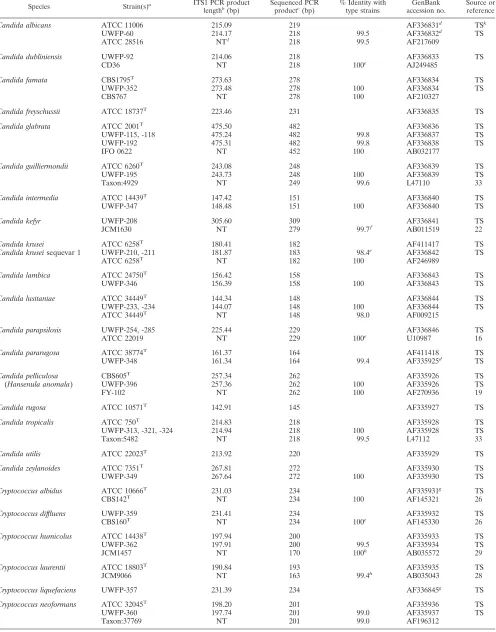
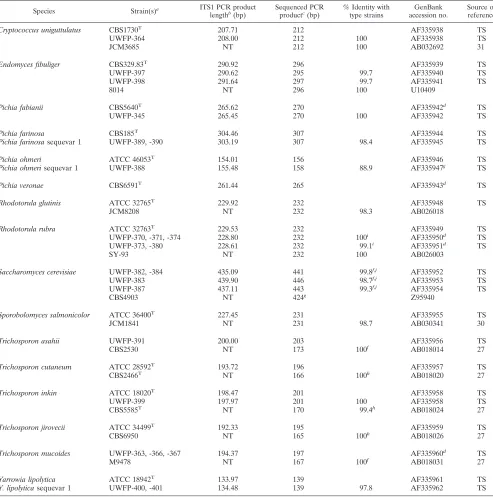
TABLE 2. Length and sequence polymorphisms of ITS1 region DNAs from clinical and type strains
Species Strain(s)a ITS1 PCR product
lengthb(bp) Sequenced PCRproductc(bp) % Identity withtype strains accession no.GenBank Source orreference
Candida albicans ATCC 11006 215.09 219 AF336831d TSk
UWFP-60 214.17 218 99.5 AF336832d TS
ATCC 28516 NTl 218 99.5 AF217609
Candida dubliniensis UWFP-92 214.06 218 AF336833 TS
CD36 NT 218 100e AJ249485
Candida famata CBS1795T 273.63 278 AF336834 TS
UWFP-352 273.48 278 100 AF336834 TS
CBS767 NT 278 100 AF210327
Candida freyschussii ATCC 18737T 223.46 231 AF336835 TS
Candida glabrata ATCC 2001T 475.50 482 AF336836 TS
UWFP-115, -118 475.24 482 99.8 AF336837 TS
UWFP-192 475.31 482 99.8 AF336838 TS
IFO 0622 NT 452 100 AB032177
Candida guilliermondii ATCC 6260T 243.08 248 AF336839 TS
UWFP-195 243.73 248 100 AF336839 TS
Taxon:4929 NT 249 99.6 L47110 33
Candida intermedia ATCC 14439T 147.42 151 AF336840 TS
UWFP-347 148.48 151 100 AF336840 TS
Candida kefyr UWFP-208 305.60 309 AF336841 TS
JCM1630 NT 279 99.7f AB011519 22
Candida krusei ATCC 6258T 180.41 182 AF411417 TS
Candida kruseisequevar 1 UWFP-210, -211 181.87 183 98.4e AF336842 TS
ATCC 6258T NT 182 100 AF246989
Candida lambica ATCC 24750T 156.42 158 AF336843 TS
UWFP-346 156.39 158 100 AF336843 TS
Candida lusitaniae ATCC 34449T 144.34 148 AF336844 TS
UWFP-233, -234 144.07 148 100 AF336844 TS
ATCC 34449T NT 148 98.0 AF009215
Candida parapsilosis UWFP-254, -285 225.44 229 AF336846 TS
ATCC 22019 NT 229 100e U10987 16
Candida pararugosa ATCC 38774T 161.37 164 AF411418 TS
UWFP-348 161.34 164 99.4 AF335925d TS Candida pelliculosa
(Hansenula anomala) CBS605
T 257.34 262 AF335926 TS
UWFP-396 257.36 262 100 AF335926 TS
FY-102 NT 262 100 AF270936 19
Candida rugosa ATCC 10571T 142.91 145 AF335927 TS
Candida tropicalis ATCC 750T 214.83 218 AF335928 TS
UWFP-313, -321, -324 214.94 218 100 AF335928 TS
Taxon:5482 NT 218 99.5 L47112 33
Candida utilis ATCC 22023T 213.92 220 AF335929 TS
Candida zeylanoides ATCC 7351T 267.81 272 AF335930 TS
UWFP-349 267.64 272 100 AF335930 TS
Cryptococcus albidus ATCC 10666T 231.03 234 AF335931g TS
CBS142T NT 234 100 AF145321 26
Cryptococcus diffluens UWFP-359 231.41 234 AF335932 TS
CBS160T NT 234 100e AF145330 26
Cryptococcus humicolus ATCC 14438T 197.94 200 AF335933 TS
UWFP-362 197.91 200 99.5 AF335934 TS
JCM1457 NT 170 100h AB035572 29
Cryptococcus laurentii ATCC 18803T 190.84 193 AF335935 TS
JCM9066 NT 163 99.4h AB035043 28
Cryptococcus liquefaciens UWFP-357 231.39 234 AF336845g TS
Cryptococcus neoformans ATCC 32045T 198.20 201 AF335936 TS
UWFP-360 197.74 201 99.0 AF335937 TS
Taxon:37769 NT 201 99.0 AF196312
Continued on following page
on May 15, 2020 by guest
http://jcm.asm.org/
TABLE 2—Continued
Species Strain(s)a ITS1 PCR product
lengthb(bp) Sequenced PCRproductc(bp) % Identity withtype strains accession no.GenBank Source orreference
Cryptococcus uniguttulatus CBS1730T 207.71 212 AF335938 TS
UWFP-364 208.00 212 100 AF335938 TS
JCM3685 NT 212 100 AB032692 31
Endomyces fibuliger CBS329.83T 290.92 296 AF335939 TS
UWFP-397 290.62 295 99.7 AF335940 TS
UWFP-398 291.64 297 99.7 AF335941 TS
8014 NT 296 100 U10409
Pichia fabianii CBS5640T 265.62 270 AF335942d TS
UWFP-345 265.45 270 100 AF335942 TS
Pichia farinosa CBS185T 304.46 307 AF335944 TS
Pichia farinosasequevar 1 UWFP-389, -390 303.19 307 98.4 AF335945 TS
Pichia ohmeri ATCC 46053T 154.01 156 AF335946 TS
Pichia ohmerisequevar 1 UWFP-388 155.48 158 88.9 AF335947g TS
Pichia veronae CBS6591T 261.44 265 AF335943d TS
Rhodotorula glutinis ATCC 32765T 229.92 232 AF335948 TS
JCM8208 NT 232 98.3 AB026018
Rhodotorula rubra ATCC 32763T 229.53 232 AF335949 TS
UWFP-370, -371, -374 228.80 232 100i AF335950d TS
UWFP-373, -380 228.61 232 99.1i AF335951d TS
SY-93 NT 232 100 AB026003
Saccharomyces cerevisiae UWFP-382, -384 435.09 441 99.8f,j AF335952 TS
UWFP-383 439.90 446 98.7f,j AF335953 TS
UWFP-387 437.11 443 99.3f,j AF335954 TS
CBS4903 NT 424g Z95940
Sporobolomyces salmonicolor ATCC 36400T 227.45 231 AF335955 TS
JCM1841 NT 231 98.7 AB030341 30
Trichosporon asahii UWFP-391 200.00 203 AF335956 TS
CBS2530 NT 173 100f AB018014 27
Trichosporon cutaneum ATCC 28592T 193.72 196 AF335957 TS
CBS2466T NT 166 100h AB018020 27
Trichosporon inkin ATCC 18020T 198.47 201 AF335958 TS
UWFP-399 197.97 201 100 AF335958 TS
CBS5585T NT 170 99.4h AB018024 27
Trichosporon jirovecii ATCC 34499T 192.33 195 AF335959 TS
CBS6950 NT 165 100h AB018026 27
Trichosporon mucoides UWFP-363, -366, -367 194.37 197 AF335960d TS
M9478 NT 167 100f AB018031 27
Yarrowia lipolytica ATCC 18942T 133.97 139 AF335961 TS
Y. lipolyticasequevar 1 UWFP-400, -401 134.48 139 97.8 AF335962 TS
aATCC, American Type Culture Collection; UWFP, University of Washington Fungal Project; CD, Cardiff Dental; CBS, Centraalbureau voor Schimmelcultures;
IFO, Institute of Fermentation; JCM, Japan Collection of Microorganisms; SY, deep sea yeast; M, Meiji Pharmaceutical; type strains are labeled with superscript T.
bPCR product length determined with capillary electrophoresis as described in Materials and Methods.
cExact number of nucleotides determined by direct sequencing of the PCR products.
dIn addition to ITS1 data listed, new ITS2 sequence data includeC. albicansATCC 11006 (AF335963).C. albicansUWFP-60 (AF335964),C. pararugosaUWFP-348
(AF335965),P. fabianiiCBS5640T(AF335967),P. veronaeCBS6591T(AF335966),R. rubraUWFP-370 (AF335969),R. rubraUWFP-373 (AF335968), andT. mucoides
UWFP-366 (AF335970).
eComplete sequence compared to ITS1 region DNA sequences from clinical strains in this study.
fPartial sequence compared to ITS1 region DNA sequences from clinical strains in this study.
gUWFP-357 and -359 were misidentified asCryptococcus albidusby the VITEK system (2). Their ITS2 sequences were identical and submitted asC. albidusunder
accession no. AF219002.
hPartial sequence compared to ITS1 region DNA sequences from type strains in this study.
iUWFP-373 and -380 had identical ITS2 sequences, and they were 99.3% similar to theR. rubratype strain. UWFP-370 had 99.5% sequence similarity to theR. rubra
type strain.
jITS1 sequence similarities between UWFP-383 and -387, UWFP-382 and -383, and UWFP-382 and -387 were 98.4, 98.9, and 99.5%, respectively.
kTS, this study.
lNT, not tested.
on May 15, 2020 by guest
http://jcm.asm.org/
⫽0.9992) with the actual number of nucleotides enumerated by direct sequenc-ing (2). Type and reference strains were characterized by directly sequencsequenc-ing ITS1 region DNA. ITS1 PCR product length polymorphisms were determined for randomly selected representatives of each of 40 species (Table 1): for 18 species, multiple isolates were characterized, and for 22 species, only single isolates were characterized for PCR product length. All length polymorphisms (Table 1) were subsequently confirmed by direct sequence analysis of, in most cases, more than one representative isolate of each species (Table 2). Among the 22 singly listed isolates in Table 1, 7 isolates represent type strains added to this study for completeness and for which no clinical isolates were available, 7 isolates
showed⬎99% sequence similarity with their respective type strains, 7 isolates
showed⬎99% sequence similarity with another sequenced clinical isolate, and 1
clinical isolate,Cryptococcus liquefaciens, was the only representative of that
species characterized by analyzing DNA sequences from ITS1 (Table 2) and ITS2 (Table 3) and the D1/D2 variable domain of the 26S rRNA gene (Table 4).
PCR and DNA sequencing.DNA was extracted from yeasts after 48 h of growth on Sabouraud’s agar and PCR amplified as previously described (2). ITS1
region DNA was amplified with 900 nM primer ITS1 (5⬘-TCCGTAGGTGAAC
CTGCGG-3⬘; GIBCO BRL, Grand Island, N.Y.), 300 nM primer ITS2 (5⬘-GC
TGCGTTCTTCATCGATGC-3⬘) (18), and the following thermocycler
param-eters: 95°C for 6 min, followed by 25 cycles at 95°C for 30 s, 55°C for 30 s, and 72°C for 30 s, followed by one final extension at 72°C for 10 min. The same parameters were used to amplify the ITS1 and ITS2 regions simultaneously as a
single product by using 300 nM ITS1 and ITS4 primers (5⬘-TCCTCCGCTTAT
TGATATGC-3⬘) (18). Similarly, 600 nM (each) NL-1 (5⬘-GCATATCAATAA
GCGGAGGAAAAG-3⬘) and NL-4 (5⬘-GGTCCGTGTTTCAAGACGG-3⬘)
(14) was used to amplify the D1/D2 variable domain of the 26S ribosomal DNA (rDNA) gene: denaturation at 94°C for 5 min was followed by 30 cycles of amplification at 94°C for 1 min, 60°C for 2 min, and 72°C for 2 min, followed by one final extension at 72°C for 7 min. Determination of the length of ITS1 PCR products by automated capillary electrophoresis and DNA sequence analysis of both the forward and reverse strands of PCR products (listed in Table 2) were performed as previously described (2).
Sequence similarity and phylogenetic analyses.DNA sequences were assem-bled, edited, and subjected to phylogenetic analyses as described previously (2). Sequence similarities were expressed as the percentage of nucleotide differences
determined by pairwise sequence comparisons.Saccharomyces cerevisiaewas
used as the outgroup instead ofPneumocystis carinii(2): the ITS1 sequence of
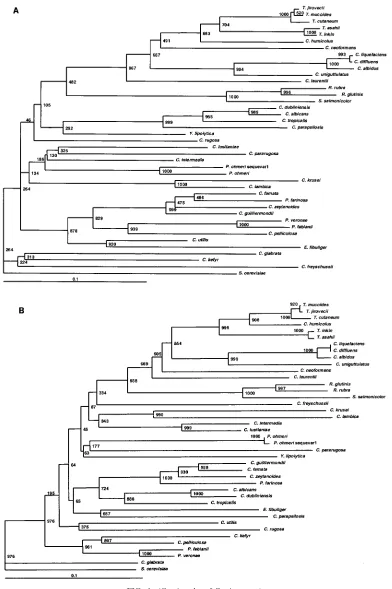
S. cerevisiaeis distant from all the other sequences (exceptCandida glabrata) and thus forms a natural outgroup. The branching order of the neighbor-joining (23) dendrograms (Fig. 1) was evaluated with 1,000 bootstrap analyses by using the SEQBOOT program in the PHYLIP software package (version 3.573) (J. Felsenstein, Department of Genetics, University of Washington, Seattle; http: //evolution.genetics.washington.edu/phylip.html).
RESULTS
To determine if DNA polymorphisms in the ITS1 region contained diagnostically useful information, we analyzed single PCR products that had been amplified from 141 strains of yeasts, including 30 type and 5 reference strains. Each product contained the 3⬘ end of the 18S rDNA gene, the entire ITS1 region, and the 5⬘ end of the 5.8S rDNA gene. The PCR product length was analyzed for each strain by capillary elec-trophoresis under denaturing conditions (Table 1), a method that rapidly provides single-base-pair precision, low run-to-run variation, and an excellent correlation (R2⫽0.9992) with the actual number of nucleotides enumerated by direct sequencing (2). To confirm the specificity of length polymorphisms and identify species-specific ITS1 alleles, the forward and reverse strands of ITS1 region PCR products from 79 strains were directly sequenced (Table 2).
ITS1 sequence polymorphisms.ITS1 PCR product lengths determined by capillary electrophoresis ranged from 134.43 bp (Yarrowia lipolytica) to 475.24 bp (C. glabrata) with intraspecies strain variation generally less than 0.5 bp, except forCandida krusei(SD⫽0.64 bp),Endomyces fibuliger(SD⫽1.14 bp), and
S. cerevisiae (SD ⫽ 2.09 bp) (Table 1). Similar intraspecies strain variation was observed among ITS2 alleles forCandida dubliniensis, Candida tropicalis, andS. cerevisiae (2), but the distribution of ITS2 region PCR product lengths among all tested species was more limited and ranged from 236.66 to 428.73 bp (Table 1). Of 40 species examined, 19 could be identified based solely on the apparent length of their ITS1 PCR products (species listed individually in Table 1).
[image:5.587.45.543.93.266.2]Direct DNA sequence analysis of the ITS1 region PCR products (Table 2) confirmed a close correlation of the appar-ent ITS1 PCR product lengths measured by capillary electro-phoresis with the actual product length (2) and revealed spe-cies-specific ITS1 DNA sequences for all 40 pathogenic species examined. Intraspecies sequence variability was detected among clinical strains and between clinical and type strains
TABLE 3. Species with similar ITS region PCR product lengths are distinguishable by species-specific ITS1 and ITS2 DNA sequences or restriction fragments of the ITS1-ITS2-region
Species Length (bp) % Sequence similarity Restriction fragment size(s)
b(bp)
ITS1 ITS2a ITS1 ITS2a BsaHI HincII
T. jiroveciiT(A) 192.33 349.89 A A 527 49/478
T. cutaneumT(B) 193.72 350.00 98.0, B 97.7, B 529 53/74/102
T. mucoides(C) 194.25 349.30 97.0, 97.5 99.4, 97.2 528 528
C. humicolusT 197.94 353.17 84.6 85.2 535 535
T. inkin 197.97 353.27 350/189 539
C. dubliniensis 214.06 342.33c 93.2 92.1 457/84 541
C. albicans 215.09 338.63c 536 536
S. salmonicolorT 227.45 400.19 80.6 83.7 612 612
R. rubraT 229.53 400.00 41/575 616
C. albidusT(A) 231.03 403.67 A A 621 621
C. liquefaciens(B) 231.39 403.45 96.2, B 98.0, B 621 363/258
C. diffluens(C) 231.41 403.75 96.6, 99.6 98.0, 100 621 363/258
aData from reference 2.
bRestriction enzyme analyses of PCR products containing ITS1 plus 5.8S rRNA gene plus ITS2 sequences.
cThese isolates can be distinguished by using ITS2 length polymorphisms (Table 1) but are included here because of the difficulty of phenotypic identification (2).
on May 15, 2020 by guest
http://jcm.asm.org/
(Table 2). Nucleotide insertions or deletions in the ITS1 region were observed between type and clinical strains ofC. albicans
andE. fibuliger, as well as among clinical strains ofE. fibuliger
andS. cerevisiae. For these species, this variation accounts for the SD of ⱖ0.5 bp observed for the PCR product lengths measured by capillary electrophoresis (Table 1). Similar nucle-otide insertions and deletions were found previously in the
ITS2 regions of type and clinical strains ofC. glabrataandC. tropicalis, as well as among clinical strains ofC. tropicalisandS. cerevisiae(2). Conspecific strains examined among a total of 79 isolates in this study, including 30 type strains and 5 reference strains, generally displayedⱖ99% sequence similarity (Table 2). Together with the 53 new species-specific diagnostic alleles identified (Table 2), these data provide two important
mea-TABLE 4. Comparing three diagnostic loci for identifying unusual isolates
Group and
strain(s)a
Identity by biochemical
testsb
Actual identity by genetic
analysesc
Sequence similarity among clinical
and type strains (%)d Accession
no. from this study for 26S
ITS1 ITS2 26S
Group 1
UWFP-208 C. kefyr C. kefyr 99.7 98.4 100 AF335978
Group 2
ATCC 6258T C. krusei C. krusei
UWFP-210, -211 C. krusei C. krusei 98.4 100 100 AF335979
Group 3
ATCC 10571T C. rugosa C. rugosa(A) A A A
UWFP-348 C. rugosa C. pararugosa(B) 69.5, B 62.8, B 63.7, B AF335972 ATCC 38774T C. pararugosa C. pararugosa(C) 68.9, 99.4 61.1, 100 63.7, 100 AF421856
Group 4
ATCC 10666T C. albidus C. albidus(A) A A A AF335982
UWFP-359 C. albidus C. diffluens(B) 96.6, B 98.0, B 97.0, B AF335981 UWFP-357 C. albidus C. liquefaciens(C) 96.2, 99.6 98.0, 100 97.3, 99.5 AF335980
Group 5
ATCC 32045T C. neoformans C. neoformans 100 AF335984
UWFP-360 C. neoformans C. neoformans 99.0 99.0 99.5 AF335983
Group 6
CBS185T P. farinosa P. farinosa 100 AF335974
UWFP-389, -390 P. farinosa P. farinosasequevar 1 98.4 100 99.7 AF335973
Group 7
ATCC 46053T P. ohmeri P. ohmeri 100 AF335976
UWFP-388 P. ohmeri P. ohmerisequevar 1 88.9 99.6 100 AF335975
Group 8
ATCC 32765T R. glutinis R. glutinis(A) A A A AF335985
ATCC 32763T R. rubra R. rubra(B) 90, B 91, B 94.3, B AF335986
UWFP-370 R. glutinis R. rubra(C) 90, 100, C 90, 99, C 94.3, 100, C AF335986 UWFP-373, -380 R. glutinis R. rubra(D) 90, 99, 99 91, 99, 100 94.3, 99.8, 99.8 AF335987
Group 9
ATCC 18942T Y. lipolytica Y. lipolytica 100 AF335977
UWFP-400, -401 Y. lipolytica Y. lipolyticasequevar 1 97.8 100 100 AF335977
Group 10
UWFP-345 Unknowne P. fabianii(A) A A A AF335971
CBS5640T P. fabianii P. fabianii(B) 100, B 100, B 100, B
CBS6591T P. veronae P. veronae(C) 90.1, 90.1 94.1, 94.1 100, 100
Group 11
UWFP-363, -366, -367 Unknowne T. mucoides 100 100 99.7 AF335988
aType strains are designated by a superscript T.
bAPI and VITEK systems, supplemented by conventional methods, were used to perform biochemical tests (2).
cIdentification confirmed byⱖ99% 26S rDNA gene sequence similarity with type strains and published sequences. Published sequences used for similarity
comparison are given in parentheses as follows:C. kefyr(no. U94924T),C. krusei(no. U76347T),C. pararugosa(no. U62306T),C. albidus(no. AF075474T),C. diffluens
(no. AF075502T),C. liquefaciens(no. AF181515T),C. neoformans(no. AF075484T),P. farinosa(no. U45739T),P. ohmeri(no. U45702T),R. glutinis(no. AF070430),
R. rubra(no. AF189960T),Y. lipolytica(no. U40080T),P. fabianii(no. U73573T),P. veronae(no. U73576T), andT. mucoides(no. AF075515T). Sequences from this study
are identical with published 26S sequences except as follows: there was 99.8% similarity to published sequences for strains ofC. pararugosa(UWFP-348),R. glutinis
(ATCC 32765T), andR. rubra(UWFP-373 and -380); 99.7% similarity for strains ofP. farinosa(UWFP-389 and -390) andT. mucoides(UWFP-363, -366, and -367);
and 99.5% similarity forC. neoformans(UWFP-360).
dITS1 and ITS2 sequence similarities were compared among clinical and type strains from our study, except forC. kefyr, C. krusei, andT. mucoides, which were
compared to published sequences:C. kefyr(JCM1630 for ITS1 [AB011519], taxon 4911 for ITS2 [L47107], NRRL Y-8281Tfor 26S [U94924]),C. krusei(NRRL Y-5396T
for 26S [U76347]), andT. mucoides(M9478 for ITS1 and ITS2 [AB018031], CBS7625Tfor 26S [AF075515]).
eClinical strains UWFP-345, -363, -366, and -367 were unidentifiable by routine automated biochemical methods. Strain UWFP-345 has 100% 26S sequence identity
withP. fabianiiandP. veronae. However, ITS sequence comparison clearly identified this strain asP. fabianii, which was concordant with its positive nitrate assimilation
test. Strains UWFP-363, -366, and -367 were identified by their 100% ITS2 sequence identity withT. mucoidesin the ITS2 study (2).
on May 15, 2020 by guest
http://jcm.asm.org/
[image:6.587.46.540.84.515.2]sures of the diagnostic utility of ITS1 sequences for identifying medically important yeasts.
Complementary ITS1 and ITS2 polymorphisms. Twenty-one species in Table 1 comprise five groups with nearly iden-tical ITS1 PCR product lengths, yet 11 of these species can be
identified if their ITS2 PCR product lengths are also deter-mined: Candida rugosa, Candida lusitaniae; Pichia ohmeri,
[image:7.587.98.490.68.657.2]Candida lambica,Cryptococcus laurentii,Cryptococcus neofor-mans,Candida utilis,C. dubliniensis,C. albicans,C. tropicalis, and Rhodotorula glutinis. Notably, C. rugosa, P. ohmeri, C. FIG. 1. (Continued on following page.)
on May 15, 2020 by guest
http://jcm.asm.org/
neoformans,C. laurentii, andC. utiliscould only be identified by using a combination of ITS1 and -2 length polymorphisms (Table 1) (2). That is, neither ITS PCR product length alone permitted unambiguous identification. ITS2 length polymor-phisms alone identified 16 species of yeasts (2) compared with 19 identified by using ITS1 alone (Table 1). However, the com-bination of ITS1 and ITS2 length polymorphisms accurately identified 30 species of yeasts (Tables 1 and 2). The isolation rate of these 30 species in our clinical laboratory, which serves a spectrum of patients ranging from primary to tertiary care and provides reference laboratory services for five Western states, indicates that⬎98% of clinical isolates from our labo-ratory could be identified by ITS length polymorphisms.
The remaining 10 species (Table 1) included four groups that could not be distinguished by ITS region PCR product lengths (Table 3). These isolates could be readily and accu-rately identified by DNA sequence analysis of either ITS allele
(Table 3) or restriction endonuclease analysis of the PCR product containing both ITS1 and ITS2 (Table 3). Two excep-tions wereCryptococcus liquefaciensandCryptococcus diffluens. These closely related species (7) contained identical ITS2 alleles (Table 3) (2), provided indistinguishableBsaHI and
HincII restriction analyses from their ITS1 and -2 PCR prod-ucts, and displayed phenotypic characteristics ofCryptococcus albidusby routine automated biochemical methods and there-fore were only distinguishable by the DNA sequences of their ITS1 alleles (Table 3).
Identification of unusual isolates.In a previous study (2), we observed⬎98% concordance between biochemical and ITS2 genotypic identifications validated with over 400 clinical iso-lates. However, four clinical isolates could not be readily iden-tified by automated biochemical systems (UWFP-345, -363, -366, and -367). Six additional clinical isolates (UWFP-348, -357, -359, -370, -373, and -380) had questionable designations:
FIG. 1. (A) ITS1 sequence-based phylogenetic tree of 41 clinically significant yeast species. A consensus neighbor-joining dendrogram with 1,000 bootstrap replicates was based on 419 aligned positions of complete ITS1 sequences with adjacent partial sequences of 18S and 5.8S rRNA genes. GenBank accession numbers of sequences generated in this study are presented in Table 2. Numbers at the nodes indicate the bootstrap values. Lower bars indicate relative genetic distance. (B) ITS2 sequence-based phylogenetic tree of 42 clinically significant yeast species. Consensus neighbor-joining dendrogram with 1,000 bootstrap replicates was based on 432 aligned positions of complete ITS2 sequences with adjacent partial sequences of 5.8S and 26S rRNA genes. The sequences ofC. albicans(no. L28817) andC. parapsilosis(no. U10988), as well as our sequences used for tree building, were previously published (2). Accession numbers of additional ITS2 sequences generated in this study are shown in Table 2 (footnoted). (C) 26S sequence-based phylogenetic tree of 41 clinically significant yeast species. Consensus neighbor-joining dendrogram with 1,000 bootstrap replicates was based on 565 aligned positions of the D1/D2 region of the 26S rRNA genes. Sequences of the following organisms (accession numbers in parentheses) were retrieved from GenBank:C. albicans(no. U45776),C. dubliniensis(no. U57685),C. famata(no. U45808),
C. freyschussii(no. AF017242),C. glabrata(no. U44808),C. guilliermondii(no. U45709),C. intermedia(no. U44809),C. kefyr(no. U94924),C. krusei
(no. U76347),C. lambica(no. AF020435),C. lusitaniae(no. U44817),C. parapsilosis(no. U45754),C. pararugosa(no. U62306),C. pelliculosa(no. U74592),C. rugosa(no. U45727),C. tropicalis(no. AB034689),C. utilis(no. U73570),C. zeylanoides(no. U45832),C. diffluens(no. AF075502),
C. humicolus(no. AF189836),C. laurentii(no. AF075469),C. liquefaciens(no. AF181515),C. uniguttulatus(no. AF075468),E. fibuliger(no. U40088),P. fabianii(no. U73573),P. veronae(no. U73576),S. cerevisiae(no. U44806),S. salmonicolor(no. AF070439),T. asahii(no. AF105393),
T. cutaneum(no. AF075483),T. inkin(no. AF105396),T. jirovecii(no. AF105398), andT. mucoides(no. AF075515). Sequences of the following organisms (accession numbers in parentheses) are from this study:C. albidus(no. AF335982),C. neoformans(no. AF335984),P. farinosa(no. AF335974),P. ohmeri(no. AF335976),P. ohmerisequevar 1 (no. AF335975),R. glutinis(no. AF335985),R. rubra(no. AF335986), andY. lipolytica
(no. AF335977).
on May 15, 2020 by guest
http://jcm.asm.org/
[image:8.587.102.487.74.345.2]their identity predicted by biochemical characteristics was clearly not concordant with their ITS2 genotype. The identity of these 10 isolates was established in Table 4, which includes analysis of the hypervariable D1/D2 region of the 26S rRNA gene (5, 13). These data confirm the utility of ITS sequences for correctly identifyingC. rugosaandC. pararugosa(Table 4, group 3),C. albidus,C. diffluens, andC. liquefaciens(group 4),
R. glutinisand R. rubra(group 8),P. fabianii and P. veronae
(group 10), andT. mucoides (group 11). Notably,P. veronae
andP. fabianiihave identical D1/D2 hypervariable sequences and could only be identified by using ITS alleles (Table 4, group 10).
Table 4 also contains analyses of isolates with ITS1 (Table 2) or ITS2 (2) alleles that showed ⱕ99% sequence similarity between type and clinical strains or among clinical strains. Interestingly, the newly designatedC. diffluensandC. liquefa-ciens(7) strains share 99.6, 100, and 99.5% sequence similarity at ITS1, ITS2, and the 26S rRNA hypervariable loci, respec-tively (Table 4, group 4). Although⬎99% similarity is gener-ally typical of conspecific strains (2, 5, 13, 27), Table 4 provides several examples where this may not be the case:Candida kefyr
(row 1), C. krusei (row 2), P. farinosa (group 6), P. ohmeri
(group 7), andY. lipolytica(group 9). Because species delin-eation now encompasses the integration of both physiological and genotypic characteristics, we use the term “sequevar” to distinguish clinical isolates with the following characteristics: one diagnostic allele ⬍99% similar to the type strain while biochemical and two (or more) other diagnostic loci (defined asⱖ99% similar) concur for the designation of a particular species—e.g.,P. farinosaITS1 sequevar 1,P. ohmeriITS1 se-quevar 1, andY. lipolyticaITS1 sequevar 1 (Table 4, groups 6, 7, and 9). It is possible that further investigation(s) will confirm these as new species, considering the similarity of the three diagnostic loci examined for C. diffluens and C. liquefaciens
(Table 4). Furthermore, ITS2 sequevars, such as forC. keyfr
(Table 4, row 1), may also exist. Together, these data indicate that ITS analyses are useful for distinguishing closely related clinical isolates.
Phylogenetic analysis.In addition to discriminating among closely related species, we sought to determine if ITS1 alleles could accurately indicate the relationships among distantly re-lated taxa. Phylogenetic trees were constructed with ITS1, ITS2, and 26S sequences (Fig. 1A, B, and C, respectively). Dendrogram topologies derived from the three sets of se-quences were highly similar. Similar to the 26S tree, high boot-strap values were observed at the deep branches separating the heterogeneous ascomycetous yeasts and the different clades of the basidiomycetous yeasts. Within each clade, the relation-ships among species of monophyletic taxa with statistically well-supported peripheral branches were generally concordant between all three markers. Moreover, closely related species with identical 26S sequences could be separated by ITS se-quences with strong bootstrap support (e.g.,P. veronaeandP. fabiani) and species with identical ITS2 sequences could be separated by examining their ITS1 alleles (e.g.,C. diffluensand
C. liquefaciens). We therefore conclude that ITS loci could be used for taxonomic placement and to infer phylogenetic rela-tionships of previously undescribed species and novel patho-gens isolated in the clinical laboratory.
DISCUSSION
DNA-based methods have been used successfully to charac-terize pathogenic yeasts and provide evidence of novel species (1, 2, 5, 7, 10, 12, 14, 25, 27–29, 31). We have established an ITS database that provides accurate identification of at least 40 species of medically important yeasts. Nineteen of these can be rapidly identified by capillary electrophoresis to determine ITS1 PCR product lengths alone, compared with 16 identified by using ITS2 alone (Table 1). The use of both alleles identi-fied 30 species (Table 1), including 4 species that could only be unambiguously designated by using both ITS alleles (see Re-sults). Our diagnostic library of ITS length polymorphisms is validated with over 400 clinical strains (Tables 1 and 2) (2), and together, the ITS1 and -2 length polymorphisms identify ⬎98% of the isolates received by our clinical laboratory.
The direct sequence analysis of 79 isolates confirmed the accuracy of estimating PCR product lengths by capillary elec-trophoresis (2) and provided 53 new diagnostic ITS1 alleles from a well-characterized group of clinical isolates with con-cordant biochemical analysis-, ITS1-, and ITS2-based identifi-cations (Table 2). ITS1 alleles showed species specificity and permitted 40 species of pathogenic yeasts to be unambiguously identified by restriction endonuclease or DNA sequence anal-ysis of ITS1 region PCR products (Tables 2 and 3). In combi-nation with sequences from ITS2 (55 alleles total from refer-ence 2 and Table 2) and the D1/D2 hypervariable region of the 26S rRNA gene, unusual clinical isolates were also readily identified (Table 4). Together with the ITS1 alleles, the addi-tional ITS2 and D1/D2 region sequences from this study pro-vide a total of 67 new diagnostic alleles (Table 2, footnoted, and Table 4).
Data from three diagnostic loci, the D1/D2 hypervariable region of the 26S rRNA gene, ITS1, and ITS2, allowed ambig-uous biochemical and genotypic designations to be clarified (Table 4). In this respect, we found ITS1 to be most useful, because it distinguished among closely related isolates with identical sequences at either the 26S rRNA gene or ITS2 loci. Similarly, others have found ITS sequences particularly useful for distinguishing among closely related yeasts (5, 12, 14, 27, 28, 31). Furthermore, our data indicating that ATCC 11066 (originally designatedCandida stellatoidea) isC. albicans (Ta-ble 2) agrees with other molecular data (20) thatC. stellatoidea
does not merit species status (15, 32). Although we observed intraspecies ITS allelic variation, as has been reported previ-ously (2, 27), conspecific strains generally demonstratedⱖ99% sequence similarity (Table 2). This result is in agreement with studies including other loci and large numbers of diverse iso-lates (2, 5, 12, 14, 27, 28). However, the possibility exists for exceptions to this benchmark (Table 4), because the converse argument implies thatⱕ99% sequence similarity connotes dif-ferent species: for example,Cryptococcus diffluensand C. liq-uefaciensdemonstrate⬎99% similarity at three diagnostic loci (Table 4 [see also Results and reference 7]). To facilitate accurate reporting of genetic data and to maintain the integrity of public databases for the purposes of identifying clinically significant yeasts, we use the term “sequevar” to indicate iso-lates that differ at one locus (ⱕ99% sequence similarity) but share two (or more) loci (ⱖ99% similarity) concordantly with biochemical and morphological indicators for a particular
on May 15, 2020 by guest
http://jcm.asm.org/
cies designation. Clearly, additional investigation will be nec-essary to accurately determine the species relationships among taxa containing such isolates.
The data in Table 4 indicate the utility of ITS sequences for distinguishing among closely related yeasts, and we also deter-mined the relevance of ITS sequences for establishing the relationships among distantly related taxa. The phylogenetic relationships observed in the ITS1 and ITS2 trees were highly concordant with those inferred from 26S rDNA sequences (Fig. 1). ITS2 and ITS1 were better than 26S at resolving the taxonomic position ofCryptococcus humicolus. In agreement with our data, this species has been previously shown to belong to theTrichosporonclade by analysis of 18S rDNA and ITS sequences (29), as well as 26S rDNA (10). In the ascomycetous group, Pichia species were polyphyletic in all three dendro-grams. These results are concordant with the data of Kurtzman et al., who also showed thatPichiaspecies are polyphyletic and widely distributed among the ascomycetous yeasts based on 26S rDNA phylogenies (13). Thus, our data confirm that ITS1 and ITS2 regions are not only phylogenetically informative, as shown by other investigators (5, 28, 29, 31), but are also useful in distinguishing closely as well as distantly related taxa (Fig. 1). By extrapolation, an expanded ITS sequence database could be used for taxonomic placement and to infer phyloge-netic relationships of previously undescribed species and novel pathogens. Ready access to these species-specific DNA se-quences, amplified with universal primers, predicts that array-based hybridization schemes will become useful diagnostic tools in the clinical microbiology laboratory.
REFERENCES
1.Baleiras Couto, M. M., B. Eijsma, H. Hofstra, J. H. in’t Veld, and J. M. B. M. van der Vossen.1996. Evaluation of molecular typing techniques to assign
genetic diversity among Saccharomyces cerevisiaestrains. Appl. Environ.
Microbiol.62:41–46.
2.Chen, Y. C., J. D. Eisner, M. M. Kattar, S. L. Rassoulian-Barrett, K. LaFe, S. L. Yarfitz, A. P. Limaye, and B. T. Cookson. 2000. Identification of medically important yeasts using PCR-based detection of DNA sequence polymorphisms in the internal transcribed spacer 2 region of the rRNA
genes. J. Clin. Microbiol.38:2302–2310.
3.Dooley, D. P., M. L. Beckius, and B. S. Jeffrey.1994. Misidentification of clinical yeast isolates by using the updated Vitek Yeast Biochemical Card.
J. Clin. Microbiol.32:2889–2892.
4.el-Zaatari, M., L. Pasarell, M. R. McGinnis, J. Buckner, G. A. Land, and I. F. Salkin.1990. Evaluation of the updated Vitek yeast identification data
base. J. Clin. Microbiol.28:1938–1941.
5.Fell, J. W., T. Boekhout, A. Fonseca, G. Scorzetti, and A. Statzell-Tallman.
2000. Biodiversity and systematics of basidiomycetous yeasts as determined by large-subunit rDNA D1/D2 domain sequence analysis. Int. J. Syst. Evol.
Microbiol.50:1351–1371.
6.Fenn, J. P., H. Segal, B. Barland, D. Denton, J. Whisenant, H. Chun, K. Christofferson, L. Hamilton, and K. Carroll.1994. Comparison of updated Vitek Yeast Biochemical Card and API 20C yeast identification systems.
J. Clin. Microbiol.32:1184–1187.
7.Fonseca, A., G. Scortzetti, and J. W. Fell.2000. Diversity in the yeast Cryp-tococcus albidusand related species as revealed by ribosomal DNA sequence
analysis. Can. J. Microbiol.46:7–27.
8.Gilfillan, G. D., D. J. Sullivan, K. Haynes, T. Parkinson, D. C. Coleman, and N. A. Gow.1998.Candida dubliniensis: phylogeny and putative virulence
factors. Microbiology144:829–838.
9.Gleason, T. G., A. K. May, D. Caparelli, B. M. Farr, and R. G. Sawyer.1997. Emerging evidence of selection of fluconazole-tolerant fungi in surgical
intensive care units. Arch. Surg.132:1197–1201.
10.Gueho, E., L. Improvisi, R. Christen, and G. S. de Hoog.1993. Phylogenetic
relationships ofCryptococcus neoformansand some related basidiomycetous
yeasts determined from partial large subunit rRNA sequences. Antonie
Leeuwenhoek63:175–189.
11.Irobi, J., A. Schoofs, and H. Goossens.1999. Genetic identification of
Can-didaspecies in HIV-positive patients using the polymerase chain reaction
and restriction fragment length polymorphism analysis of its DNA. Mol.
Cell. Probes14:401–406.
12.Kurtzman, C. P.2000. Four new yeasts in thePichia anomalaclade. Int. J.
Syst. Evol. Microbiol.50:395–404.
13.Kurtzman, C. P., and C. J. Robnett.1998. Identification and phylogeny of ascomycetous yeasts from analysis of nuclear large subunit (26S) ribosomal
DNA partial sequences. Antonie Leeuwenhoek73:331–371.
14.Kurtzman, C. P., and C. J. Robnett.1997. Identification of clinically
impor-tant ascomycetous yeasts based on nucleotide divergence in the 5⬘end of the
large-subunit (26S) ribosomal DNA gene. J. Clin. Microbiol.35:1216–1223.
15.Kwon-Chung, K. J., J. B. Hicks, and P. N. Lipke.1990. Evidence that
Candida stellatoideatype II is a mutant ofCandida albicansthat does not
express sucrose-inhibitable␣-glucosidase. Infect. Immun.58:2804–2808.
16.Lin, D., L. C. Wu, M. G. Rinaldi, and P. F. Lehmann.1995. Three distinct
genotypes withinCandida parapsilosisfrom clinical sources. J. Clin.
Micro-biol.33:1815–1821.
17.Lodder, J. (ed.).1970. The yeasts: a taxonomic study, 2nd ed. North-Holland Publishing Company, Amsterdam, The Netherlands.
18.Lott, T. J., R. J. Kuykendall, and E. Reiss.1993. Nucleotide sequence
analysis of the 5.8S rDNA and adjacent ITS2 region ofCandida albicansand
related species. Yeast9:1199–1206.
19.Masih, E. I., I. Alie, and B. Paul.2000. Can the grey mould disease of the
grape-vine be controlled by yeast? FEMS Microbiol. Lett.189:233–237.
20.McCullough, M. J., K. V. Clemons, and D. A. Stevens.1999. Molecular and
phenotypic characterization of genotypicCandida albicanssubgroups and
comparison withCandida dubliniensisandCandida stellatoidea. J. Clin.
Mi-crobiol.37:417–421.
21.Metzgar, D., A. van Belkum, D. Field, R. Haubrich, and C. Wills.1998. Random amplification of polymorphic DNA and microsatellite genotyping
of pre- and posttreatment isolates ofCandidaspp. from human
immunode-ficiency virus-infected patients on different fluconazole regimens. J. Clin.
Microbiol.36:2308–2313.
22.Nagahama, T., M. Hamamoto, T. Nakase, and K. Horikoshi.1999. Kluyvero-myces nonfermentanssp. nov., a new yeast species isolated from the deep sea.
Int. J. Syst. Bacteriol.49:1899–1905.
23.Oda, Y., M. Yabuki, K. Tonomura, and M. Fukunaga.1997. A phylogenetic
analysis ofSaccharomycesspecies by the sequence of 18S–28S rRNA spacer
regions. Yeast13:1243–1250.
24.Pfaller, M. A., S. A. Messer, A. Houston, M. S. Rangel-Frausto, T. Wiblin, H. M. Blumberg, J. E. Edwards, W. Jarvis, M. A. Martin, H. C. Neu, L. Saiman, J. E. Patterson, J. C. Dibb, C. M. Roldan, M. G. Rinaldi, and R. P. Wenzel.1998. National epidemiology of mycoses survey: a multicenter study
of strain variation and antifungal susceptibility among isolates ofCandida
species. Diagn. Microbiol. Infect. Dis.31:289–296.
25.Reiss, E., K. Tanaka, G. Bruker, V. Chazalet, D. Coleman, J. P. Debeaupuis, R. Hanazawa, J. P. Latge, J. Lortholary, K. Makimura, C. J. Morrison, S. Y. Murayama, S. Naoe, S. Paris, J. Sarfati, K. Shibuya, D. Sullivan, K. Uchida, and H. Yamaguchi.1998. Molecular diagnosis and epidemiology of fungal
infections. Med. Mycol.36(Suppl. 1):249–257.
26.Scorzetti, G., I. Petrescu, D. Yarrow, and J. W. Fell.2000.Cryptococcus adeliensissp. nov., a xylanase producing basidiomycetous yeast from
Antarc-tica. Antonie Leeuwenhoek77:153–157.
27.Sugita, T., A. Nishikawa, R. Ikeda, and T. Shinoda.1999. Identification of
medically relevantTrichosporonspecies based on sequences of internal
tran-scribed spacer regions and construction of a database forTrichosporon
iden-tification. J. Clin. Microbiol.37:1985–1993.
28.Sugita, T., M. Takashima, R. Ikeda, T. Nakase, and T. Shinoda.2000.
Intraspecies diversity ofCryptococcus laurentiias revealed by sequences of
internal transcribed spacer regions and 28S rRNA gene and taxonomic
position ofC. laurentiiclinical isolates. J. Clin. Microbiol.38:1468–1471.
29.Sugita, T., M. Takashima, R. Ikeda, T. Nakase, and T. Shinoda.2000.
Phylogenetic and taxonomic heterogeneity ofCryptococcus humicolus by
analysis of the sequenes of the internal transcribed spacer regions and 18S
rDNA, and the phylogenetic relationships ofC. humicolus,C. curvatus, and
the genusTrichosporon. Microbiol. Immunol.44:455–461.
30.Takashima, M., and T. Nakase. 2000. Four new species of the genus
Sporobolomycesisolated from leaves in Thailand. Mycoscience41:357–369. 31.Takashima, M., and T. Nakase.1999. Molecular phylogeny of the genus
Cryptococcusand related species based on the sequences of 18S rDNA and
internal transcribed spacer regions. Microbiol. Cult. Coll.15:35–47.
32.Wickes, B. L., J. E. Golin, and K. J. Kwon-Chung.1991. Chromosomal
rearrangement inCandida stellatoidearesults in a positive effect on
pheno-type. Infect. Immun.59:1762–1771.
33.Williams, D. W., M. J. Wilson, M. A. O. Lewis, and A. J. C. Potts.1996. Identification of Candida species in formalin fixed, paraffin wax embedded oral
mucosa by sequencing of ribosomal DNA. Mol. Pathol.49:M23–M28.
34.Wright, W. L., and R. P. Wenzel.1997. Nosocomial Candida. Epidemiology,
transmission, and prevention. Infect. Dis. Clin. N. Am.11:411–425.