Optimization of Two Phase Framework in
Cognitive Radio Network Using Hybrid Access
Strategy
Arthi1, Agnes Sahaya Rani2, Keerthika3, Ms. Savitha Gopalan4
1, 2, 3
Student, 4Assistant Professor, Electronics and Communication Engineering, Jeppiaar SRR Engineering College, India
Abstract: Spectrum access strategy plays an important role in cognitive radio networks. The cognitive radio networks cannot
achieve a maximal throughput by using the existing techniques like overlay, underlay strategies which are applied to multi-channel Cognitive Radio Network (CRN). To overcome this problem we propose a hybrid access strategy which comprises Complete Hybrid Access Strategy (CHAS) with sleep node and active node concept. There are two user namely primary users and secondary users. Primary users are licensed users and the secondary users are called unlicensed users. Two phase optimization frame work is formulated, which takes sensing channel allocation, sensing time allocation and power allocation into consideration to maximize the gross average throughput in multichannel CRN. In sensing phase CHAS is proposed which improves the performance parameters like throughput, bandwidth and channel sensing. In transmission phase sleep node and active node concept is proposed that increases the network parameters like delay, average packet loss and energy consumption. The experimental results are simulated using Network Simulator 2 (NS2) software and performance parameters are analysed. Keywords: CRN, CHAS, Sleep node, Active node, Sensing phase, Transmission phase, NS2.
I.INTRODUCTION
The adaptability to wireless communication is the main goal of cognitive radio and it is achieved through dynamic spectrum access. The performance is achieved in wireless communication and the frequency spectrum utilization is enhanced. Spectrum sensing, spectrum management, spectrum mobility are the major functionalities of cognitive radio system. The information about the target radio spectrum is provided by spectrum sensing and it is utilized by cognitive radio user. The spectrum management is used to exploit the information obtained from spectrum sensing to make decision on spectrum access. The spectrum mobility will control the changes in target spectrum and operational frequency is changed accordingly. The cognitive radio is flexible and efficient and open opportunity to enable a wide variety of emerging applications. This section presents a brief view on how cognitive radio would support for spectrum optimization.
[image:2.612.111.518.517.709.2]II.BLOCKDIAGRAM
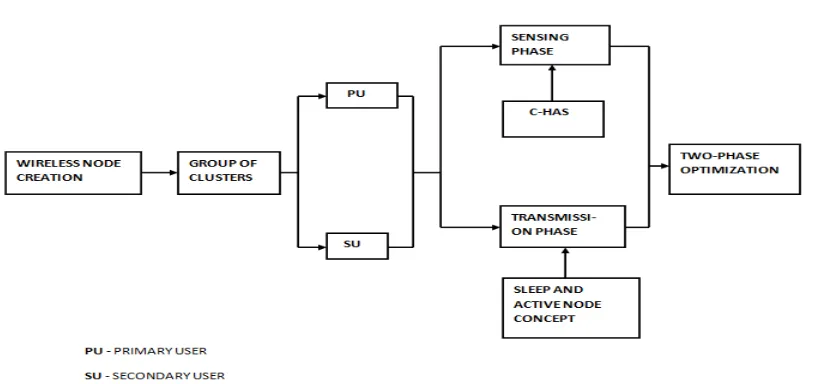
A mobile Ad-Hoc network created in NS2 software consists a collection of nodes that are separated into regions or clusters according to frequency range. These nodes communicate with each other without any central infrastructure. As described earlier, CRN consist of two users namely, Primary User (PU) and Secondary User (PU).The SU has two phases -sensing phase and transmission phase. In sensing phase, in order to optimize the sensing time, throughput CHAS algorithm is proposed. In transmission phase, energy consumption and delay is optimized using the sleep and active node concept with AODV (Ad hoc On Demand Vector) routing protocol. Hence an effective end to end communication is achieved through the proposed system.
III. OPTIMIZATIONOFSENSINGPHASE
Sensing phase is one of the most important factors to be considered in the field of Cognitive Radio Networks. The available spectrum is sensed using CHAS spectrum sensing algorithm in CR network .In this phase, the user detects whether the spectrum is idle or occupied by detecting the energy of the spectrum. This energy detection is used to reduce computational and implementation complexities.
The spectrum sensing is based on the assumption that the transmission rates R01n, R11n, R10n and R11n are fixed among channels. We assume the transmission powers P1n and P2n are fixed in each channel and the channel gains are fixed. Xn denotes the sensing outcome, which is defined as the transmission power. Yn(Xn) denotes the function of transmission power for n number of channels.
A. CHAS Algorithm
Step 1: Initialization Arrange channels in the descending order based on the 'idle' probability of channel 'n' denoted as n(0) and calculate the minimal sensing time min, n;
Step 2: Set X0=0 , y0(X0)= Step 3: for n=0 to N do
Step 4: Calculate E{yn+1(Xn+1)} and update the sensing time n+1. Step 5: if yn(Xn)>=max.E[yn+1(Xn+1)],then break;
Step 6: End if .
Step 7: Calculate yn+1(Xn+1) Step 8: End for. Set N1=n; Here,
n(0) - Idle probability of channel 'n'. Xn - Sensing Outcome of nth channel. Rk - average transmission rate.
yn(Xn) - average power of n channels calculated as,
Yn(Xn) = ( + )
The channel n’s reward yn(Xn) should be compared with the next channel’s maximal expected reward sequentially, denoted as max. E[yn+1(Xn+1)], where E [yn+1(Xn+1)] is formulated as follows,
E [yn+1(Xn+1)] = E [yn(Xn)] + Δyn+1;
If yn(Xn) >max.E[yn+1(Xn+1)], the sensing operation will stop at channel n,N1 = n denotes the channel is idle. Otherwise, the channel n+1 will be sensed.
n - the channel to be sensed
N-total number of channels in a spectrum. N1 is the required channel for transmission.
IV. OPTIMIZATIONOFTRANSMISSIONPHASE
A. Sleep Node And Active Node Concept
Hence a routing protocol has to be followed in order to share the information. AODV (Ad hoc On Demand Vector)is the most possibly preferred protocol which supports ad-hoc networks.
Fig. 2.A sample source and destination node creation diagram
From the source node 's' to destination node 'd', there are ‘M’ number of paths, and the average packet delay is denoted as Di, the cost function for routing path selection ‘F’ was expressed as,
The average delay of data packets conform to the following relationship:
Where, λ is the packet arrival rate, μ is the packet transmission rate, and μ ≥ λ. Hence, by finding the lowest cost F, it is very efficient that both the cost and the energy are optimised in this phase.
2) Energy Sensing: The energy of the current source node is assumed as threshold value. After selecting the neighbouring node, the energy of that node is detected. The detected energy is compared with the threshold value. The energy of the node is to be greater than that value. Hence a conditional probability is formed to check whether the randomly selected neighbouring node's energy is suitable to transmit the signal via the node. If the energy is less than the threshold value, next neighbouring node is to be chosen. This process continues until we reach the destination node.
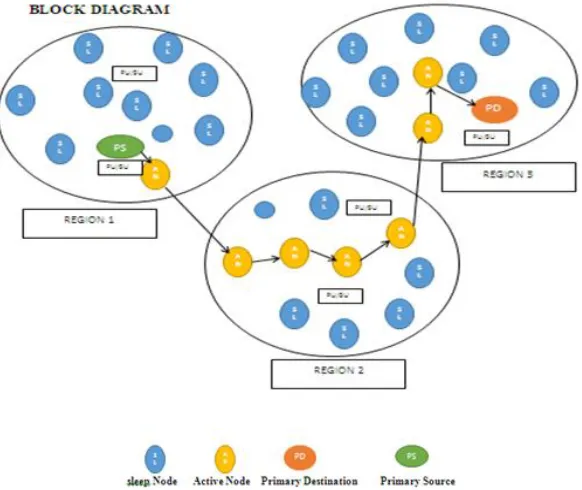
[image:4.612.156.447.472.717.2]From the figure, initially the source node accesses the neighbouring node and checks whether the energy is sufficient to transmit he signal via the node. If the energy is sufficient, the node is activated and rest of the nodes will be in sleep mode. Now the particular node is set as temporary source node. The neighbouring nodes of temporary source node are identified and the process continues until the destination node is reached.
The advantage of using this concept is, the energy consumed by the whole process is less because the nodes that come via transmission path are activated. Other nodes are kept in sleep state. Another advantage is the error rate of transmitted signal minimized.
3) Transport layer: Transport layer plays a vital role in host to host packet delivery service for Ad Hoc Wireless Network. The transport protocols like TCP and UDP act as the best effort service that offer a reliable, connection oriented byte stream service in the MANET network. Flow control mechanism allows the receiver to limit how much data a sender can transmit at a given time. QPSK allows multiple application programs on any host to simultaneously carry with their peers. Congestion control mechanism keep the sender safe from overloading network.
[image:5.612.147.481.302.554.2]The process of initiating and acknowledging a TCP connection can be established through a 3 way handshake signal . After a connection is being set, data transfer begins. All established virtual networks are shut by declining the connection after transmission. A simple transmission concepts used by UDP in the absence of handshaking signals in order to guarantee data integrity. The datagrams approached in UDP is unordered or it might be duplicated. This makes UDP a more compatible protocol with a characteristic of broadcasting and multicasting packets to all local networks and subscribers.
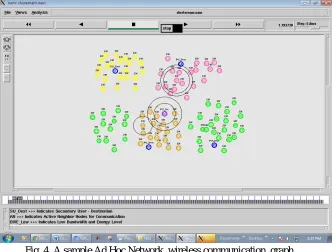
Fig. 4 A sample Ad Hoc Network wireless communication graph
V. RESULTSANDDISCUSSION
A. Simulation Software
NS2 is an object oriented and event driven by open source simulator that basically runs on linux . It fundamentally works at packet level, thereby providing substantial support for running various routing protocols like TCP, UDP, FTP, etc. Therefore it simulates wired and wireless networks. The major function of NS2 is to schedule the events sequentially , for network creation , for setting up routing ,creating transport connection and traffic. It is written in C++,with the contribution of OTcl interpreter as a frontend.
B. Simulation Parameters
Parameters Value
Simulator Ns-2.28
Network Area 1000*1000
Number Of Secondary Users 10,20,25,30(Default),40
Simulation Time 200 S
Packet Size 512bytes
Traffic Type Cbr
Speed 0-5 M/S
Sending Rate 10kbps
Initial Energy Randomly Chosen(750-760j)
Transmission Power 1.15w
Reception Power 1.0w
Ideal Power 0.8w
Number Of Licensed Users 10 Number Of Nodes Created 100
Pu Modelling On/Off Model
C. Simulation Outputs
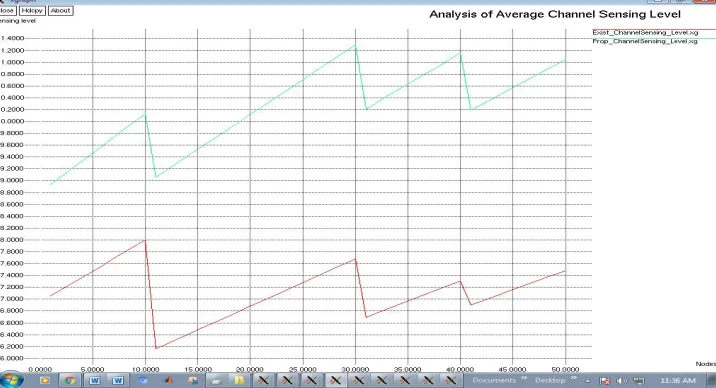
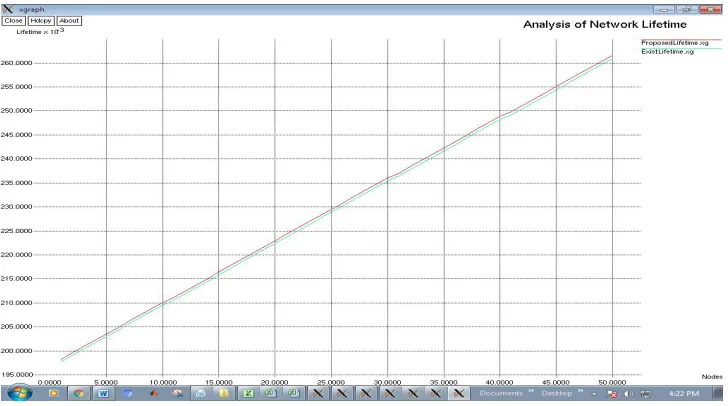
[image:6.612.157.455.75.259.2]The following figures illustrate the performance of network parameters and shows how the end to end communication is improved in the proposed system while comparing with existing system. . The initial sensing level measured in proposed system is 8.4kbps whereas in existing system it is 6.8kbps. The average packet data loss where it is measured as 96kb and the number of packets lost would be 10. This is lesser than that of the existing system where loss rate is 102kb and packet loss is nearly 25.
Fig. 5. Analysis of Channel Sensing Level
[image:6.612.136.494.337.531.2]Fig. 7. Analysis of Average Packet Rate Loss
Fig. 8. Analysis of Network Lifetime
[image:7.612.120.494.539.715.2]VI. CONCLUSIONS
The complete hybrid access strategy in a multi-channel CRN smart home environment and a two-phase optimization framework to maximize the gross average throughput has been proposed. In the sensing phase to find the optimized number of sensing channels and sensing times, first proposed a GAS, in which not all of the channels need to be sensed. Under the conditions some channels have sufficient low idle probabilities or the total number of channels is large. Then proposed a CHAS in which all the channels are sensed. In the transmission phase, the transmission powers are optimized using the sleep and active node concept. In the newly proposed algorithm, the CHAS is used in which static sensing method is modified as dynamic sensing method and performance parameters are considered. The computational complexities are analysed and simulations are used for convergence analysing. Hence in the proposed algorithm, the simulated results indicate that the performance is increased considerably while comparing to the existing mechanism.
REFERENCES
[1] F.Richard Yu, Cognitive Radio Mobile Ad Hoc Networks, Germany: Springer, 2011.
[2] X.Tan, H.Zhang, Q.Chen and J.Hu , Opportunistic Channel Selection Based on Time Series Prediction in Cognitive Radio Network, ser. Lecture Notes in Winley Transactions on Emerging Telecommunication Technology, 2014, vol. 25,no 11,pp. 1126-1126.
[3] Mahdi Zareei, Ehab Mah Moud Mohamad, Mohammad Hossein Anisi, “On Demand Hybrid Routing For Cognitive Radio Ad Hoc Network,” IEEE Access ., vol. 4, Nov. 2016.
[4] Anupam Kumar Yadav, Sandeep Sharma, “Cognitive Radio Spectrum Sensing,” in 3 rd International Conference on computing For Sustainable Global Development , 2016.
[5] Zhuan Ye, Alan Dok, Neiyer Correal, Spyros Kyperountas, Qicai Shi, “Dynamic Allocation of Spectrum Sensing Resources in Cognitive Radio Networks,” U.S. Patent 8428632b2, Apr. 23, 2013.
[6] Chao Yang, Wei Lou, Yuli Su, Shengli Xie, Rong Yu, “On Throughput Maximization In Multi –Channel Cognitive Radio Network Via Generalized Access Strategy”, DOI 10.1109, 2016.
[7] (2018) The IEEE website. [Online]. Available: http://www.comsot.org/
[8] Haitao Zhao (2018) IEEE homepage on COMSOT. [Online]. Available: http://www.comsot.org/commage/cfp/multi-channel-cognitive-radio-ad-hoc-networks/
[9] G.Sanjeev, “Spectrum Sensing Technique For Cognitve Radio Application,” Ph.D. Eng. thesis, Indian Institute of Science, Bangalore, India, Jan. 2016. [10] J. Padhye, V. Firoiu, and D. Towsley, “A stochastic model of TCP Reno congestion avoidance and control,” Univ. of Massachusetts, Amherst, MA, CMPSCI
Tech. Rep. 99-02, 1999.