Isolates in Italy: Results of the First Cross-Sectional Countrywide
Survey
Luigi Principe,aAurora Piazza,bTommaso Giani,cSilvia Bracco,aMaria Sofia Caltagirone,bFabio Arena,cElisabetta Nucleo,b Federica Tammaro,cGian Maria Rossolini,c,d,eLaura Pagani,bFrancesco Luzzaro,aAMCLI-CRAb Survey participants
Microbiology and Virology Unit, Department of Laboratory Medicine, A. Manzoni Hospital, Lecco, Italya; Department of Clinical, Surgical, Diagnostic and Pediatric Sciences, Section of Microbiology, University of Pavia, Pavia, Italyb; Department of Medical Biotechnologies, University of Siena, Siena, Italyc; Department of Experimental and Clinical Medicine, University of Florence, Florence, Italyd; Clinical Microbiology and Virology Unit, Department of Laboratory Medicine, Careggi University Hospital, Florence, Italye
Carbapenem-resistantAcinetobacter baumannii(CRAb) is emerging worldwide as a public health problem in various settings. The aim of this study was to investigate the prevalence of CRAb isolates in Italy and to characterize their resistance mechanisms and genetic relatedness. A countrywide cross-sectional survey was carried out at 25 centers in mid-2011. CRAb isolates were re-ported from all participating centers, with overall proportions of 45.7% and 22.2% among consecutive nonreplicate clinical iso-lates ofA. baumanniifrom inpatients (nⴝ508) and outpatients (nⴝ63), respectively. Most of them were resistant to multiple antibiotics, whereas all remained susceptible to colistin, with MIC50and MIC90values of<0.5 mg/liter. The genes coding for
carbapenemase production were identified by PCR and sequencing. OXA-23 enzymes (found in all centers) were by far the most common carbapenemases (81.7%), followed by OXA-58 oxacillinases (4.5%), which were found in 7 of the 25 centers. In 6 cases, CRAb isolates carried bothblaOXA-23-likeandblaOXA-58-likegenes. A repetitive extragenic palindromic (REP)-PCR technique,
mul-tiplex PCRs for group identification, and multilocus sequence typing (MLST) were used to determine the genetic relationships among representative isolates (nⴝ55). Two different clonal lineages were identified, including a dominant clone of sequence type 2 (ST2) related to the international clone II (sequence group 1 [SG1], SG4, and SG5) and a clone of ST78 (SG6) previously described in Italy. Overall, our results demonstrate that OXA-23 enzymes have become the most prevalent carbapenemases and are now endemic in Italy. In addition, molecular typing profiles showed the presence of international and national clonal lin-eages in Italy.
A
cinetobacter baumanniihas emerged in recent years as a lead-ing cause of nosocomial infections, especially in intensive care units (ICUs), becoming a public health problem of major concern in several countries (1). Of note, cases of community-acquired infections are also increasingly reported (2). The ability of the organism to survive in the environment during prolonged periods of time, combined with its innate resistance to desiccation and disinfectants, makeA. baumanniidifficult to eradicate in the clin-ical setting (3).The extensive use of antimicrobial chemotherapy, particularly carbapenems, has contributed to the emergence of carbapenem-resistantA. baumannii(CRAb), which usually exhibits a multi-drug-resistant (MDR) phenotype (4). For critically ill patients with MDR infections, therapeutic options are limited, and colistin remains the last resource for treatment (5). Carbapenem resis-tance is mostly associated with the production of carbapenem-hydrolyzing class D-lactamases, including the acquired OXA-23, OXA-24, OXA-58, OXA-143, OXA-235, and the intrinsic OXA-51 enzyme (6,7). The significant contribution of OXA-type carbapenemases inA. baumanniihas been emphasized, particu-larly when blaOXA genes are associated with ISAba sequences, which provide strong promoters for their expression (3). Com-parative typing of the outbreak strains ofA. baumanniifrom geo-graphically scattered European hospitals has demonstrated the occurrence of three successful clones originally named European clones I to III, which were renamed as international clones (ICs) I to III, with worldwide distribution. In addition to these major
clones, a wide geographic distribution of some other clones has been reported (1). Multilocus sequence typing (MLST) analysis conducted on 496A. baumanniistrains isolated from around the world identified 17 clones, considering both clonal complexes (CCs) and sequence types (STs), distributed also in European countries, with six clones apparently restricted to Europe (8).
In Italy, hospital outbreaks caused by CRAb isolates have been repeatedly reported during the last years. CRAb isolates were found to be mostly related to the production of OXA-58 carbap-enemases and belong to IC-II, while strains genetically related to IC-I and IC-III were found to be less common (9–12). More re-cently, CRAb isolates from Italy were characterized by different STs (e.g., ST1, ST2, ST4, ST20, ST78, ST95, ST109, ST196, and ST197) and sequence groups (SGs) (including SG1, SG2, SG5, and SG6), thus highlighting the presence of international and national clonal lineages in Italy (13–15). A high proportion of carbap-enem-resistantAcinetobacterspecies among the bloodstream
iso-Received3 February 2014Returned for modification3 March 2014
Accepted3 June 2014
Published ahead of print11 June 2014
Editor:P. H. Gilligan
Address correspondence to Francesco Luzzaro, [email protected]. Copyright © 2014, American Society for Microbiology. All Rights Reserved.
doi:10.1128/JCM.00291-14
on May 16, 2020 by guest
http://jcm.asm.org/
lates in Italy was recently reported by the EARS-Net surveillance system, which has been monitoring Acinetobacterresistance in Europe since 2012 (16).
In this work, we report the results of the first countrywide cross-sectional survey, promoted by the Italian Society of Clinical Microbiologist (AMCLI) and carried out in mid-2011, to investi-gate the prevalence of CRAb isolates in Italy and to characterize the most common resistance mechanisms. The genetic relatedness of CRAb isolates was also studied in order to trace the epidemio-logic evolution of these strains.
MATERIALS AND METHODS
Study design.Twenty-five clinical microbiology laboratories from 23 Italian cities, distributed across the national territory, participated in the study (Fig. 1). Each laboratory collected consecutive nonreplicate clinical isolates ofA. baumanniithat exhibited MICs for imipenem and/or mero-penem ofⱖ8 mg/liter from any type of clinical specimen, with the excep-tion of surface and rectal swabs, during the period of 15 May to 30 June 2011. Both inpatients and outpatients were included in the study. Outpa-tients were defined as paOutpa-tients not hospitalized at the time of specimen collection. Isolates from patients living in nursing homes were excluded from the analysis. The collected isolates were sent to reference laboratories for confirmation of both species identification and carbapenem MICs, and for characterization of the carbapenem resistance mechanisms and analysis of clonal relatedness. For each isolate, information on the clinical specimen and type of ward (for isolates from inpatients) were provided. Moreover, each participating laboratory provided information on the to-tal number of consecutive nonreplicate clinical isolates ofA. baumannii
observed during the collection period.
Characterization of bacterial isolates.Bacterial identification and antimicrobial susceptibility testing were carried out by the collecting lab-oratories using either the Phoenix automated microbiology system (Bec-ton Dickinson Diagnostic Systems, Sparks, MD, USA) or the Vitek 2
sys-tem (bioMérieux, Marcy l’Etoile, France). Confirmatory identification was carried out by matrix-assisted laser desorption ionization–time of flight (MALDI-TOF) mass spectrometry (Vitek MS; bioMérieux), fol-lowed by the detection ofblaOXA-51-likealleles (17). Confirmatory MIC
testing for imipenem and meropenem was carried out by Etest (bioMéri-eux). All collected isolates confirmed to be resistant to imipenem and/or meropenem according to the EUCAST breakpoints (18) were considered to be CRAb isolates for the purpose of this study and were evaluated for the presence of carbapenem resistance mechanisms. For the purpose of antimicrobial susceptibility evaluation, the CRAb MICs of ampicillin-sulbactam, trimethoprim-sulfamethoxazole, ceftazidime, cefepime, imi-penem, meroimi-penem, doriimi-penem, amikacin, gentamicin, levofloxacin, colistin, and tigecycline were determined by a reference broth microdilu-tion method using a TREK Sensititre custom panel (TREK Diagnostic Systems, Cleveland, OH). When available, the MIC data were interpreted according to the current EUCAST breakpoints (18). In the case of cefepime, ceftazidime, and ampicillin-sulbactam, the results were evalu-ated according to CLSI criteria (19). Statistical differences were deter-mined using as the chi-square test, and confidence intervals (CI) were calculated by the Stata statistical software (release 13; College Station, TX, USA) as parameters.
PCR analysis for carbapenem resistance determinants.PCR assays were carried out by using specific primers to identifyblaKPC,blaIMP,
blaVIM,blaGIM,blaSIM,blaDIM,blaAIM,blaNDM,blaOXA-23-like,blaOXA-24-like,
blaOXA-51-like,blaOXA-58-like, andblaOXA-143-likegenes (20–22). The pres-ence of ISAba1elements adjacent toblaOXA-51-likegenes was also investi-gated, as previously described (23).
Molecular typing by REP-PCR, multiplex PCRs, and MLST. REP-PCR was carried out using theAcinetobacterkit of the DiversiLab micro-bial typing system (bioMérieux). The extraction of DNA was performed by the UltraClean microbial DNA isolation kit (Mo Bio Laboratories, Inc., Carlsbad, CA, USA). DNA fragment separation and detection were ob-tained by the Agilent 2100 Bioanalyzer (Agilent Technologies, Santa Clara, CA, USA), and the results were analyzed and interpreted using the FIG 1Location of the laboratories participating in the survey (n⫽25). 1, Milan; 2, Varese; 3, Lecco; 4, Turin; 5, Novara; 6, Genoa; 7, Sanremo; 8, Verona; 9, Bolzano; 10 to 11, Modena; 12, Florence; 13, Siena; 14, Perugia; 15, Ancona; 16, Rome; 17, Pescara; 18, San Giovanni Rotondo; 19, Lecce; 20, Naples; 21, Avellino; 22, Cosenza; 23, Palermo; and 24 and 25, Catania. The presence of OXA-23 and/or OXA-58 determinants (as well as other mechanisms) is also indicated. The map was generated using Magic Maps version 1.4.6.
on May 16, 2020 by guest
http://jcm.asm.org/
[image:2.585.139.473.65.314.2]2100 expert software. Pearson’s correlation coefficient for measuring sim-ilarity and the unweighted-pair group method using average linkages (UPGMA) for clustering were used. Isolates were defined as genetically related whenⱖ90% similarity was found between them (24). Represen-tatives of the major European clones I (A. baumanniistrain RUH 875) and II (A. baumanniistrain RUH 134) were used as controls.
Two multiplex PCRs designed to selectively amplify group 1 or group 2 alleles of theompA,csuE, andblaOXA-51-likegenes were performed. The
allelic profiles were determined as described previously (25,26). Multilo-cus sequence typing (MLST) ofA. baumanniiisolates was performed us-ing the primers and conditions described on the Institut Pasteur website (http://www.pasteur.fr/recherche/genopole/PF8/mlst/Abaumannii.html). Sequence types (STs) were assigned using the same MLST website.
RESULTS
Proportions of CRAb isolates from inpatients and outpatients. During the study period (15 May to 30 June 2011), a total of 571 consecutive nonreplicate clinical isolates ofA. baumanniiwere isolated at the 25 Italian laboratories participating in the survey (inpatients,n⫽508; outpatients,n⫽63) (Table 1). Overall, 246 isolates (43.1%) were confirmed as CRAb (inpatients,n⫽232; outpatients,n ⫽14), with the proportion of CRAb organisms being significantly higher among isolates from inpatients (45.7%; 95% CI, 41.4 to 50%;P⫽0.38) than among those from outpa-tients (22.2%; 95% CI, 13.7 to 33.9%;P⫽0.0014). CRAb organ-isms were found in all the 25 participating centers (Fig. 1), al-though the overall proportions ranged from 9.1 to 100%. The isolates were mostly obtained from the lower respiratory tract, followed by skin and soft tissue, urine, and blood. Of note, blood isolates from inpatients showed the highest proportion of CRAb (54%; 95% CI, 40.4 to 67%;P⫽0.17). Concerning the intrahos-pital distribution, most isolates were obtained from ICUs (109 [47.0%]), whereas the remaining isolates were from medical (86 [37.1%]) and surgical wards (37 [15.9%]) (Table 2). Focusing on CRAb organisms obtained from the lower respiratory tracts of ICU patients, these isolates showed the highest proportion versus other specimen types (56.0%) compared to those obtained from medical and surgical wards (34.9 and 37.8%, respectively).
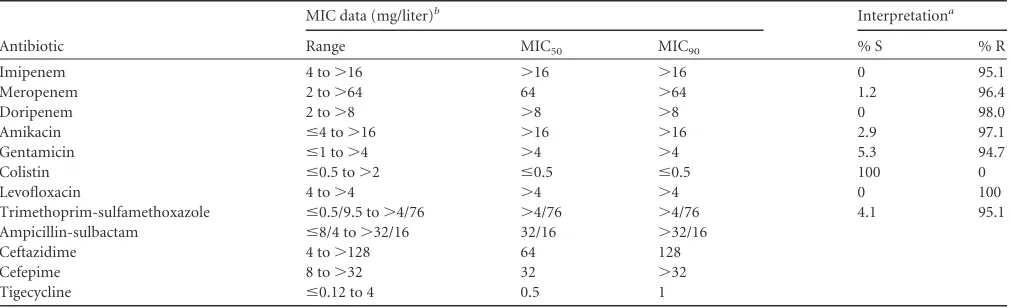
Antimicrobial susceptibility of CRAb.The susceptibility re-sults, including MIC range, MIC50, and MIC90, are summarized in
Table 3. Most isolates showed combined resistance to
carbapen-ems, fluoroquinolones, and aminoglycosides (amikacin and gen-tamicin), while all of them were susceptible to colistin. Of note, a small proportion of CRAb isolates showed an MIC value lower than the CLSI resistance breakpoint for ceftazidime, cefepime,
and ampicillin-sulbactam (4.1, 18.3, and 19.9%, respectively). In the case of tigecycline, for which EUCAST or CLSI breakpoints are not available, the MIC50and MIC90values wereⱕ0.5 mg/liter and 1 mg/liter, respectively.
Carbapenem resistance mechanisms inA. baumannii
iso-lates.Carbapenemase determinants were detected in the vast ma-jority of CRAb (227/246 [92.3%]) isolates. OXA-23 enzymes (found in all centers) were by far the most common acquired carbapenemases (201/246 [81.7%]), followed by OXA-58 oxacil-linases (11/246 [4.5%]), which were detected in 7 of 25 centers
(Fig. 1). With respect to the different hospital areas, the
propor-tions of OXA-23 enzymes were 73% in surgical wards, 82.6% in medicine, and 84.5% in ICUs. Overall, no significant differences were observed depending on the ward of hospitalization or spec-imen type (data not shown). Of note, 6 CRAb isolates carried both blaOXA-23-likeandblaOXA-58-likegenes. Twenty-one isolates (found in 10 centers equally distributed across the country) were positive for the presence of an ISAba1genetic element upstream from the residentblaOXA-51-likegene. The mechanism(s) of carbapenem re-sistance was not identified in 19 of 246 (7.7%) isolates. The car-bapenem MIC values for these isolates were as follows: imipenem MIC50and MIC90,⬎16 mg/liter (MIC range, 16 to⬎16 mg/liter), and meropenem MIC50and MIC90, 32 and 64 mg/liter, respec-tively (MIC range, 16 to⬎64 mg/liter).
Genetic relationships among carbapenem-resistantA. bau-manniiisolates.Based on different antimicrobial susceptibility profiles, carbapenem resistance determinants, and geographic distribution, 47 CRAb isolates from inpatients were chosen as representatives and characterized by REP-PCR, as well as multi-plex PCRs for group identification, together with 8 representative CRAb isolates obtained from outpatients. A subset of isolates was also characterized by MLST.
As shown inFig. 2, molecular typing by REP-PCR revealed the presence of two different clonal lineages, with the dominant clone being related to IC-II. Three major subgroups, however, were dis-tinguishable within the dominant clone when setting the cutoff value to 95% similarity. Interestingly, most outpatients were grouped into a single subgroup within the dominant clone. Mul-tiplex PCRs identified three different sequence groups (SGs), in-cluding SG1, SG4, and SG5. MLST revealed that these isolates were consistently from ST2.
Three isolates obtained from centers located in Naples, Cata-nia, and Genoa (the Genoan isolate was from an outpatient) be-TABLE 1Numbers and proportions of carbapenem-resistant
Acinetobacter baumanniiisolates obtained from different clinical sources
Source
Isolates from inpatients
Isolates from outpatients
No. CRAb (no. [%]) No. CRAb (no. [%])
Blood 50 27 (54.0) 1 0 (0.0)
Lower respiratory tract 214 105 (49.1) 10 0 (0.0)
Urine 72 35 (48.6) 21 7 (33.3)
Skin and soft tissue 112 40 (35.7) 31 7 (22.6)
Othera 60 25 (41.7) 0 0 (0.0)
Total 508 232 (45.7) 63 14 (22.2)
a
[image:3.585.297.544.86.183.2]Other includes vascular catheters, various biological fluids (e.g., pleural, peritoneal, and cerebrospinal fluid), and the upper respiratory tract.
TABLE 2Numbers and proportions of carbapenem-resistantA. baumanniiisolates obtained from different wardsa
Source Medical ward Surgical ward ICU
Blood 13 (15.1/48.2) 5 (13.5/18.5) 9 (8.2/33.3)
Lower respiratory tract
30 (34.9/28.6) 14 (37.8/13.3) 61 (56.0/58.1)
Urine 20 (23.3/57.1) 3 (8.1/8.6) 12 (11.0/34.3)
Skin and soft tissue 21 (24.4/52.5) 9 (24.3/22.5) 10 (9.2/25.0)
Otherb 2 (2.3/8.0) 6 (16.2/24.0) 17 (15.6/68.0)
Total (no. [%]) 86 (37.1) 37 (15.9) 109 (47.0)
aData are no. (proportion [%] within the specimen type/proportion [%] within the
hospitalization ward) (i.e., the ward in which the patients were hospitalized at the time the culture was obtained), unless otherwise stated.
b
Others includes vascular catheters, various biological fluids (e.g., pleural, peritoneal, and cerebrospinal fluid), and the upper respiratory tract.
on May 16, 2020 by guest
http://jcm.asm.org/
[image:3.585.39.287.89.199.2]longed to a previously described national clonal lineage (27). MLST and SG analyses revealed that these isolates belong to ST78 and SG6. Notably, different carbapenem resistance determinants were detected in these isolates, including the overexpression of blaOXA-51associated with the ISAba1genetic element (Catania and Genoa) and the simultaneous presence ofblaOXA-23andblaOXA-58 genes (Naples).
DISCUSSION
This survey was conducted in 25 Italian centers distributed across the country in order to take an overall picture ofA. baumanniiin both hospitalized and community patients. All clinical isolates identified asA. baumanniiduring the survey were included in the study and investigated to evaluate both epidemiologic features and antibiotic resistance phenotypes; however, for specimens from nonsterile sites, we could not distinguish between infection and colonization based on the clinical data provided by participat-ing centers. Focusparticipat-ing on carbapenems, CRAb isolates comprised 45.7% of allA. baumanniiisolates from Italian hospitals during the survey. Similarly, a recent study (2008 to 2009) in 16 countries (14 of which are in Europe) reported an overall rate of imipenem-resistant strains of 48.9% (28). A lower rate (34%) was observed from the National Healthcare Safety Network (NHSN) surveil-lance system from U.S. hospitals between 2006 and 2008 (29). In another U.S. survey, however, nonsusceptibility to carbapenems increased from 22% in 2002 to 52% in 2008 (30). In 2012, data on Acinetobacterspp. were included for the first time in the EARS-Net surveillance report (16), showing a high percentage of CRAb (83.3%; 95% CI, 78 to 88%) isolates, as well as combined resis-tance to multiple antibiotics (78%) for the Italian centers. That report, however, analyzed only invasive isolates recovered from hospitalized patients. In our survey, carried out during 2011 in different centers, the proportion of CRAb organisms among blood isolates was lower (54%) than that reported in the EARS-Net data. Furthermore, due to a limited number of invasive iso-lates, our data showed a broad confidence interval (95% CI, 40.4 to 67%) that might account for this difference. It is to be noted that colistin fully maintained its activity against CRAb isolates, and tigecycline was characterized by low MIC50and MIC90values (0.5 and 1 mg/liter, respectively).
From an epidemiological point of view, our data demonstrate
that similarly to carbapenem-resistantEnterobacteriaceae(CRE), CRAb organisms are commonly found in Italy, with a widespread distribution across the national territory. To date, no guidelines have been issued in Italy to preventAcinetobacterinfections, but the present findings suggest to implement them as soon as possi-ble. Compared with the results obtained by the CRE nationwide surveillance (carried out simultaneously in the same Italian cen-ters), CRAb organisms appear to have a hospital diffusion com-parable to that of carbapenem-nonsusceptible Klebsiella pneu-moniaeisolates (232 versus 234, respectively) (31). Notably, a high number of CRAb isolates were from the lower respiratory tracts of ICU patients, whereas blood isolates accounted for a number lower than the CREs (27 versus 40, respectively). Similarly to CREs, however, CRAb isolates were not restricted to ICU settings but affected all major hospital areas, a finding that should be care-fully considered when planning infection control strategies. Over-all, similar numbers of carbapenem-resistant isolates were found among outpatients (14 CRAb versus 21 CRE isolates). However, A. baumanniiobtained from outpatients was mainly from skin and soft tissue specimens, butK. pneumoniaewas mostly from urine specimens.
In this nationwide survey, carbapenem resistance inA. bau-manniiwas primarily associated with the OXA-23 enzyme (found in all centers), which was the most commonly acquired carbapen-emase. On the contrary, OXA-58 oxacillinases, previously re-ported to be prevalent in Italy (10,13,14), were detected in few centers even though they were distributed across the country. Taken together, our results agree with the described worldwide dissemination of theblaOXA-23-like genes (32) and highlight the recent evolution of CRAb organisms in Italy, with isolates belong-ing to IC-II now almost exclusively carrybelong-ing theblaOXA-23 deter-minant. A progressive change fromblaOXA-58 toblaOXA-23 gene carriage had been already observed among IC-II CRAb isolates responsible for ICU outbreaks in the main hospitals in central Italy, withA. baumanniistrains producing OXA-23 appearing in 2007 (33).
[image:4.585.41.547.77.231.2]In our survey, the coexistence ofblaOXA-23-likeandblaOXA-58-like genes was found in 6 isolates obtained from inpatients hospital-ized at 5 different centers. A similar finding was previously re-ported (14,34), but the potential clinical implications remain un-known, and further investigations are needed to clarify this point. TABLE 3Susceptibility results obtained from carbapenem-resistantA. baumanniiisolates (n⫽246)
Antibiotic
MIC data (mg/liter)b Interpretationa
Range MIC50 MIC90 % S % R
Imipenem 4 to⬎16 ⬎16 ⬎16 0 95.1
Meropenem 2 to⬎64 64 ⬎64 1.2 96.4
Doripenem 2 to⬎8 ⬎8 ⬎8 0 98.0
Amikacin ⱕ4 to⬎16 ⬎16 ⬎16 2.9 97.1
Gentamicin ⱕ1 to⬎4 ⬎4 ⬎4 5.3 94.7
Colistin ⱕ0.5 to⬎2 ⱕ0.5 ⱕ0.5 100 0
Levofloxacin 4 to⬎4 ⬎4 ⬎4 0 100
Trimethoprim-sulfamethoxazole ⱕ0.5/9.5 to⬎4/76 ⬎4/76 ⬎4/76 4.1 95.1
Ampicillin-sulbactam ⱕ8/4 to⬎32/16 32/16 ⬎32/16
Ceftazidime 4 to⬎128 64 128
Cefepime 8 to⬎32 32 ⬎32
Tigecycline ⱕ0.12 to 4 0.5 1
aMICs interpreted according to EUCAST criteria (18). S, susceptible; R, resistant. b
Values separated by slashes are the respective concentrations of drugs in the indicated combination.
on May 16, 2020 by guest
http://jcm.asm.org/
CRAb isolates in most cases were found to belong to IC-II, whereas other clonal lineages were sporadically detected. This pic-ture appears to be the most common in both the United States and Europe (8,35). Molecular epidemiology surveys conducted in the United States on CRAb isolates obtained from 1995 to 2008 showed that IC-II isolates had spread to many centers as early as 1996 and became the dominant lineage (35, 36). Interestingly, strains assigned to IC-II are known to form biofilms and adhere to abiotic surfaces more efficiently than strains assigned to IC-I (mainly characterized by elevated resistance to desiccation). The association of biofilm formation with the ability to acquire differ-ent antimicrobial resistance determinants might have favored their spread and persistence in the hospital environment (37).
In Italy, the IC-II appears to be widely distributed since 2004, even though different clones and STs have often been described
(13–15). Noteworthy, a single clone of CRAb belonging to the
IC-II/ST2 lineage was most recently reported in an ICU in Pal-ermo, Sicily (11). Our results demonstrate that this evolution oc-curred at a countrywide level, with the ST2 clone able to dissemi-nate in Italian hospitals. Similarly, a high predominance of the ST2 clone was recently reported in several European countries, including Poland, Romania, Latvia, and the Czech Republic (38– 41). In these cases, however, interesting differences were observed among countries with respect to the associated carbapenem resis-tance determinants, thus demonstrating a multidirectional evolu-tion of the IC-II/ST2 clonal lineage. It is worth noting that most outpatients were grouped into a single subgroup within the dom-inant clone. This finding, together with the low rate of carbap-enem resistance, seems to confirm the different origins of these isolates.
ThreeA. baumanniiisolates belonged to the ST78 clone, pre-viously known as the SMAL clone or the Italian clone, and are now assigned to the worldwide clone 6 (1,42). The ST78 genotype was first reported from Naples in 2006 and then detected in several Italian hospitals, as well as in other Mediterranean countries (34). Similarly to ST2, ST78 strains have been shown to have a higher adherence to both biotic and antibiotic surfaces, with ST78 also showing an elevated resistance to desiccation (37,42). Our survey demonstrates that ST78 strains acquired different resistance de-terminants, which may contribute to the persistence of this geno-type in Italian hospitals.
In conclusion, our data indicate that resistance to carbapenems is more and more common amongA. baumanniiisolates, and they demonstrate that the OXA-23 enzyme has become the most prev-alent carbapenemase, which is now endemic in Italy. This further evolution of carbapenem-resistantA. baumannii strains con-firms the need to continuously monitor this worrisome bacterial pathogen.
ACKNOWLEDGMENTS
We thank bioMérieux and Becton Dickinson for their contributions in supporting the transport of isolates from the collecting laboratories to the reference laboratories.
The participants in the AMCLI-CRAb Survey (the first Italian survey on carbapenem-resistantA. baumannii, promoted by the Italian Society of Clinical Microbiologists) were G. Gesu (Niguarda Ca’ Granda Hospital, Milan), A. Toniolo (Circolo and Fondazione Macchi University Hospital, Varese), R. Serra (San Giovanni Battista [Molinette] Hospital, Turin), B. Pini (Alessandro Manzoni Hospital, Lecco), G. Fortina (Maggiore Hos-pital, Novara), M. Mori (Galliera HosHos-pital, Genoa), P. A. Dusi (Azienda Sanitaria Imperiese Hospital, Sanremo), R. Fontana (Borgo Roma Uni-FIG 2Molecular typing of representative CRAb isolates by REP-PCR
(Diver-siLab microbial typing system; bioMérieux). The participating centers, se-quence groups, and carbapenem resistance determinants are also indicated. Isolates AB09C09, AB06C15, AB05C14, AB23C16, AB12C89, AB15C13, AB07C05, and AB06C03 were obtained from outpatients.
on May 16, 2020 by guest
http://jcm.asm.org/
[image:5.585.41.289.64.674.2]versity Hospital, Verona), R. Aschbacher (Azienda Sanitaria dell’Alto Adige, Bolzano), M. Sarti (Sant’Agostino Estense Hospital, Modena), F. Rumpianesi (Modena University Hospital, Modena), P. Pecile (Careggi University Hospital, Florence), G. M. Rossolini (Santa Maria alle Scotte University Hospital, Siena), A. Mencacci (Santa Maria della Miseri-cordia University Hospital, Perugia), E. Manso (Torrette University Hos-pital, Ancona), M. Tronci (San Camillo Forlanini HosHos-pital, Rome), P. Fazii (Santo Spirito Hospital, Pescara), M. Labonia (IRCCS Casa Sollievo della Sofferenza Hospital, San Giovanni Rotondo), M. Pizzolante (V. Fazzi Hospital, Lecce), G. Amato (A. Cardarelli Hospital, Naples), P. Buonopane (San Giuseppe Moscati Hospital, Avellino), C. Giraldi (An-nunziata Hospital, Cosenza), P. G. Conaldi (Mediterranean Institute of Transplantation [ISMETT], Palermo), and S. Stefani (Policlinico and Vit-torio Emanuele University Hospitals, Catania).
REFERENCES
1.Zarrilli R, Pournaras S, Giannouli M, Tsakris A.2013. Global evolution of multidrug-resistantAcinetobacter baumanniiclonal lineages. Int. J. An-timicrob. Agents41:11–19.http://dx.doi.org/10.1016/j.ijantimicag.2012 .09.008.
2.Eveillard M, Kempf M, Belmonte O, Pailhoriès H, Joly-Guillou ML.2013. Reservoirs ofAcinetobacter baumanniioutside the hospital and potential involvement in emerging human community-acquired infections. Int. J. Infect. Dis.17:802– 805.http://dx.doi.org/10.1016/j.ijid.2013.03.021. 3.Roca I, Espinal P, Vila-Farrés X, Vila J.2012. TheAcinetobacter baumannii
oxymoron: commensal hospital dweller turned pan-drug-resistant menace. Front. Microbiol.3:148.http://dx.doi.org/10.3389/fmicb.2012.00148. 4.Perez F, Hujer AM, Hujer KM, Decker BK, Rather PN, Bonomo RA.
2007. Global challenge of multidrug-resistantAcinetobacter baumannii. Antimicrob. Agents Chemother.51:3471–3484.http://dx.doi.org/10.1128 /AAC.01464-06.
5.Kempf M, Rolain J-M.2012. Emergence of resistance to carbapenems in
Acinetobacter baumanniiin Europe: clinical impact and therapeutic op-tions. Int. J. Antimicrob. Agents39:105–114.http://dx.doi.org/10.1016/j .ijantimicag.2011.10.004.
6.Patel G, Bonomo RA.2013. “Stormy waters ahead”: global emergence of carbapenemases. Front. Microbiol.4:48.http://dx.doi.org/10.3389/fmicb .2013.00048.
7.Higgins PG, Pérez-Llarena FJ, Zander E, Fernández A, Bou G, Seifert H. 2013. OXA-235, a novel class D-lactamase involved in resistance to carbapenems inAcinetobacter baumannii. Antimicrob. Agents Che-mother.57:2121–2126.http://dx.doi.org/10.1128/AAC.02413-12. 8.Karah N, Sundsfjord A, Towner K, Samuelsen Ø.2012. Insights into the
global molecular epidemiology of carbapenem non-susceptible clones of
Acinetobacter baumannii. Drug Resist. Updat.15:237–247.http://dx.doi .org/10.1016/j.drup.2012.06.001.
9.Mendes RE, Spanu T, Deshpande L, Castanheira M, Jones RN, Fadda G.2009. Clonal dissemination of two clusters ofAcinetobacter baumannii
producing OXA-23 or OXA-58 in Rome, Italy. Clin. Microbiol. Infect. 15:588 –592.http://dx.doi.org/10.1111/j.1469-0691.2009.02770.x. 10. D’Arezzo S, Principe L, Capone A, Petrosillo N, Petrucca A, Visca P.
2011. Changing carbapenemase gene pattern in an epidemic multidrug-resistantAcinetobacter baumanniilineage causing multiple outbreaks in central Italy. J. Antimicrob. Chemother.66:54 – 61.http://dx.doi.org/10 .1093/jac/dkq407.
11. Mammina C, Palma DM, Bonura C, Aleo A, Fasciana T, Sodano C, Saporito MA, Verde MS, Calà C, Cracchiolo AN, Tetamo R. 2012. Epidemiology and clonality of carbapenem-resistantAcinetobacter bau-manniifrom an intensive care unit in Palermo, Italy. BMC Res. Notes 5:365.http://dx.doi.org/10.1186/1756-0500-5-365.
12. Brigante G, Migliavacca R, Bramati S, Motta E, Nucleo E, Manenti M, Migliorino G, Pagani L, Luzzaro F, Viganò FE.2012. Emergence and spread of a multidrug-resistantAcinetobacter baumanniiclone producing both the carbapenemase OXA-23 and the 16S rRNA methylase ArmA. J. Med. Microbiol.61:653– 661.http://dx.doi.org/10.1099/jmm.0.040980-0. 13. Migliavacca R, Espinal P, Principe L, Drago M, Fugazza G, Roca I, Nucleo E, Bracco S, Vila J, Pagani L, Luzzaro F.2013. Characterization of resistance mechanisms and genetic relatedness of carbapenem-resistantAcinetobacter baumanniiisolated from blood, Italy. Diagn. Microbiol. Infect. Dis.75: 180 –186.http://dx.doi.org/10.1016/j.diagmicrobio.2012.11.002. 14. Mezzatesta ML, D’Andrea MM, Migliavacca R, Giani T, Gona F,
Nu-cleo E, Fugazza G, Pagani L, Rossolini GM, Stefani S.2012. Epidemi-ological characterization and distribution of carbapenem-resistant Acin-etobacter baumanniiclinical isolates in Italy. Clin. Microbiol. Infect.18: 160 –166.http://dx.doi.org/10.1111/j.1469-0691.2011.03527.x. 15. Carretto E, Barbarini D, Dijkshoorn L, van der Reijden TJ, Brisse S,
Passet V, Farina C, ASPI Acinetobacter Study Group.2011. Widespread carbapenem resistantAcinetobacter baumanniiclones in Italian hospitals revealed by a multicenter study. Infect. Genet. Evol.11:1319 –1326.http: //dx.doi.org/10.1016/j.meegid.2011.04.024.
16. European Centre for Disease Prevention and Control.2013. Surveillance report: antimicrobial resistance surveillance in Europe 2012.Annual report of the European Antimicrobial Resistance Surveillance Network (EARS-Net).ECDC, Stockholm, Sweden. http://ecdc.europa.eu/en/publications /Publications/antimicrobial-resistance-surveillance-europe-2012.pdf. 17. Turton JF, Woodford N, Glover J, Yarde S, Kaufmann ME, Pitt TL.
2006. Identification ofAcinetobacter baumannii by detection of the
blaOXA-51-likecarbapenemase gene intrinsic to this species. J. Clin. Micro-biol.44:2974 –2976.http://dx.doi.org/10.1128/JCM.01021-06.
18. European Committee on Antimicrobial Susceptibility Testing. 2014. Breakpoint tables for interpretation of MICs and zone diameters, version 4.0. EUCAST, Basel, Switzerland.http://www.eucast.org/fileadmin/src/media/P DFs/EUCAST_files/Breakpoint_tables/Breakpoint_table_v_4.0.pdf. 19. CLSI.2014. Performance standards for antimicrobial susceptibility
test-ing; 24th informational supplement. CLSI document M100-S24. Clinical and Laboratory Standards Institute, Wayne, PA.
20. Poirel L, Walsh TR, Cuvillier V, Nordmann P.2011. Multiplex PCR for detection of acquired carbapenemase genes. Diagn. Microbiol. Infect. Dis. 70:119 –123.http://dx.doi.org/10.1016/j.diagmicrobio.2010.12.002. 21. Woodford N, Ellington MJ, Coelho JM, Turton JF, Ward ME, Brown S,
Amyes SG, Livermore DM. 2006. Multiplex PCR for genes encoding prevalent OXA carbapenemases inAcinetobacterspp. Int. J. Antimicrob. Agents27:351–353.http://dx.doi.org/10.1016/j.ijantimicag.2006.01.004. 22. Higgins PG, Lehmann M, Seifert H.2010. Inclusion of OXA-143 primers
in a multiplex polymerase chain reaction (PCR) for genes encoding prev-alent OXA carbapenemases inAcinetobacterspp. Int. J. Antimicrob. Agents35:305.http://dx.doi.org/10.1016/j.ijantimicag.2009.10.014. 23. Turton JF, Ward ME, Woodford N, Kaufmann ME, Pike R, Livermore
DM, Pitt TL.2006. The role of ISAba1in expression of OXA carbapen-emase genes inAcinetobacter baumannii. FEMS Microbiol. Lett.258:72– 77.http://dx.doi.org/10.1111/j.1574-6968.2006.00195.x.
24. Saeed S, Fakih MG, Riederer K, Shah AR, Khatib R.2006. Interinstitu-tional and intrainstituInterinstitu-tional transmission of a strain ofAcinetobacter bau-manniidetected by molecular analysis: comparison of pulsed-field gel electrophoresis and repetitive sequence-based polymerase chain reaction. Infect. Control Hosp. Epidemiol.27:981–983.http://dx.doi.org/10.1086 /507286.
25. Turton JF, Gabriel SN, Valderrey C, Kaufmann ME, Pitt TL.2007. Use of sequence-based typing and multiplex PCR to identify clonal lineages of outbreak strains ofAcinetobacter baumannii. Clin. Microbiol. Infect.13: 807– 815.http://dx.doi.org/10.1111/j.1469-0691.2007.01759.x. 26. Towner KJ, Levi K, Vlassiadi M, ARPAC Steering Group.2008. Genetic
diversity of carbapenem-resistant isolates ofAcinetobacter baumanniiin Europe. Clin. Microbiol. Infect.14:161–167.http://dx.doi.org/10.1111/j .1469-0691.2007.01911.x.
27. Giannouli M, Cuccurullo S, Crivaro V, Di Popolo A, Bernardo M, Tomasone F, Amato G, Brisse S, Triassi M, Utili R, Zarrilli R.2010. Molecular epidemiology of multidrug-resistantAcinetobacter baumannii
in a tertiary care hospital in Naples Italy, shows the emergence of a novel epidemic clone. J. Clin. Microbiol.48:1223–1230.http://dx.doi.org/10 .1128/JCM.02263-09.
28. Nordmann P, Picazo JJ, Mutters R, Korten V, Quintana A, Laeuffer JM, Seak JC, Flamm RK, Morrissey I, COMPACT Study Group.2011. Com-parative activity of carbapenem testing: the COMPACT Study. J. Antimicrob. Chemother.66:1070 –1078.http://dx.doi.org/10.1093/jac/dkr056. 29. Kallen AJ, Srinivasan A. 2010. Current epidemiology of
multidrug-resistant Gram-negative bacilli in the United States. Infect. Control Hosp. Epidemiol.31(Suppl 1):S51–S54.http://dx.doi.org/10.1086/655996. 30. Mera RM, Miller LA, Amrine-Madsen EH, Sahm DF.2010.
Acinetobac-ter baumannii2002–2008: increase of carbapenem-associated multiclass resistance in the United States. Microb. Drug Resist.16:209 –215.http://dx .doi.org/10.1089/mdr.2010.0052.
31.Giani T, Pini B, Arena F, Conte V, Bracco S, Migliavacca R, AMCLI-CRE Survey Participants, Pantosti A, Pagani L, Luzzaro F, Rossolini
on May 16, 2020 by guest
http://jcm.asm.org/
GM.2013. Epidemic diffusion of KPC carbapenemase-producing Kleb-siella pneumoniaein Italy: results of the first countrywide survey, 15 May to 30 June 2011. Euro Surveill.18:pii⫽20489.http://www.eurosurveillance .org/ViewArticle.aspx?ArticleId⫽20489.
32. Mugnier PD, Poirel L, Naas T, Nordmann P.2010. Worldwide dissem-ination of the blaOXA-23carbapenemase gene ofAcinetobacter baumannii. Emerg. Infect. Dis.16:35– 40.http://dx.doi.org/10.3201/eid1601.090852. 33. Di Popolo A, Giannouli M, Triassi M, Brisse S, Zarrilli R. 2011. Molecular epidemiological investigation of multidrug-resistant Acineto-bacter baumanniistrains in four Mediterranean countries with a multilo-cus sequence typing scheme. Clin. Microbiol. Infect.17:197–201.http: //dx.doi.org/10.1111/j.1469-0691.2010.03254.x.
34. Higgins PG, Dammhayn C, Hackel M, Seifert H.2010. Global spread of carbapenem-resistantAcinetobacter baumannii. J. Antimicrob. Che-mother.65:233–238.http://dx.doi.org/10.1093/jac/dkp428.
35. Adams-Haduch JM, Onuoha EO, Bogdanovich T, Tian GB, Marschall J, Urban CM, Spellberg BJ, Rhee D, Halstead DC, Pasculle AW, Doi Y. 2011. Molecular epidemiology of carbapenem-nonsusceptible Acineto-bacter baumanniiin the United States. J. Clin. Microbiol.49:3849-3854.
http://dx.doi.org/10.1128/JCM.00619-11.
36. Higgins PG, Janßen K, Fresen MM, Wisplinghoff H, Seifert H.2012. Molecular epidemiology ofAcinetobacter baumanniibloodstream isolates obtained in the United States from 1995 to 2004 using rep-PCR and mul-tilocus sequence typing. J. Clin. Microbiol.50:3493–3500.http://dx.doi .org/10.1128/JCM.01759-12.
37. Giannouli M, Antunes LCS, Marchetti V, Triassi M, Visca P, Zarrilli R. 2013. Virulence-related traits of epidemicAcinetobacter baumanniistrains belonging to the international clonal lineages I–III and to emerging
phe-notypes ST25 and ST78. BMC Infect. Dis.13:282.http://dx.doi.org/10 .1186/1471-2334-13-282.
38. Izdebski R, Fiett J, Hryniewicz W, Gniadkowski M.2012. Molecular analysis ofAcinetobacter baumanniiisolates from invasive infections in 2009 in Poland. J. Clin. Microbiol.50:3813–3815.http://dx.doi.org/10 .1128/JCM.02271-12.
39. Bonnin RA, Poirel L, Licker M, Nordmann P.2011. Genetic diversity of carbapenem-hydrolysing-lactamases inAcinetobacter baumanniifrom Romanian hospitals. Clin. Microbiol. Infect.17:1514 –1530.http://dx.doi .org/10.1111/j.1469-0691.2011.03539.x.
40. Saule M, Samuelsen Ø, Dumpis U, Sundsfjord A, Karlsone A, Balode A, Miklasevics E, Karah N.2012. Dissemination of a carbapenem-resistant
Acinetobacter baumanniistrain belonging to international clone II/ sequence type 2 and harboring a novel AbaR4-like resistance island in Latvia. Antimicrob. Agents Chemother.57:1069 –1072.http://dx.doi.org /10.1128/AAC.01783-12.
41. Nemec A, Krízová L, Maixnerová M, Diancourt L, van der Reijden TJ, Brisse S, van der Broek P, Dijkshoorn L.2008. Emergence of carbap-enem resistance inAcinetobacter baumanniiin the Czech Republic is as-sociated with the spread of multidrug-resistant strains of European clone II. J. Antimicrob. Chemother.62:484 – 489.http://dx.doi.org/10.1093/jac /dkn205.
42. Nucleo E, Steffanoni L, Fugazza G, Migliavacca R, Giacobone E, Na-varra A, Pagani L, Landini P.2009. Growth in glucose-based medium and exposure to subinhibitory concentrations of imipenem induce bio-film formation in a multidrug-resistant clinical isolate ofAcinetobacter baumannii. BMC Microbiol.9:270 –274.http://dx.doi.org/10.1186/1471 -2180-9-270.