http://dx.doi.org/10.4236/jcc.2015.311001
Foreign Fiber Image Segmentation Based on
Maximum Entropy and Genetic Algorithm
Liping Chen, Xiangyang Chen, Sile Wang, Wenzhu Yang, Sukui Lu School of Computer Science and Technology, Hebei University, Baoding, China
Received August 2015
Abstract
In machine-vision-based systems for detecting foreign fibers, due to the background of the cotton layer has the absolute advantage in the whole image, while the foreign fiber only account for a very small part, and what’s more, the brightness and contrast of the image are all poor. Using the traditional image segmentation method, the segmentation results are very poor. By adopting the maximum entropy and genetic algorithm, the maximum entropy function was used as the fitness function of genetic algorithm. Through continuous optimization, the optimal segmentation thre-shold is determined. Experimental results prove that the image segmentation of this paper not only fast and accurate, but also has strong adaptability.
Keywords
Foreign Fibers, Image Segmentation, Maximum Entropy, Genetic Algorithm
1. Introduction
The foreign fibers in cotton refer to those non-cotton fibers and dyed fibers, such as polypropylene fiber silk, hemp, feathers, colored line, colored cloth, hairs and so on. Though very low content of foreign fibers in cotton, the presence of foreign fibers will seriously affect the quality of the final cotton textile products, as they may debase the strength of the yarn, they are not easy to be dyed, and this will lead to great economic loss for the cotton textile enterprises [1]. Therefore, fast and accurate measurement of foreign fibers in lint cotton enterprises is an urgent problem. Using machine vision technology to identify and measure the foreign fiber is an effective and feasible solution. The basis and key of the measurement of the foreign fiber content is the foreign fiber’s classification, and the image segmentation is the premise and guarantee of the classification of the foreign fiber.
The current threshold segmentation method, according to the threshold selection criterion function types, can be divided into maximum entropy method [3], maximum inter-class variance (Otsu) method, cross entropy me-thod [4], minimum error meme-thod, fuzzy entropy meme-thod and so on [5]. How to determine the optimal threshold is the key of the threshold segmentation method. Since the maximum entropy method does not require a priori knowledge, it is widely used in image segmentation. But the maximum entropy method is through exhaustive search of global optimal solution, it is very complex and slow. In recent years, due to the fast random search ca-pability, genetic algorithm (GA) has been successfully applied in many fields, such as image processing, ma-chine learning, parameter optimization and so on [6] [7]. In this paper, through combine GA with maximum en-tropy method, we realized the fast segmentation of the foreign fibers.
The remainder of this paper is organized as follows. Section 2 presents the maximum entropy method and the GA briefly. Section 3 provides the proposed algorithm in detail. Results and discussions are followed in Section 4. Section 5 declares the conclusion.
2. Methodology
2.1. Maximum Entropy
Maximum entropy algorithm is a segmentation method which based on the histogram of the image [8]. Let x be the gray level of the image (from 0 to L), p(x) is the probability of the pixel which gray level is x in the image, then the entropy of the image is represented as:
1
( ) lg ( ) L
x
H p x p x
=
= −
∑
(1)Let the segmentation threshold is t, which will divide the image into two parts: target A and background B. Assuming that the gray values which less than the threshold of the pixels belong to the target A, the gray values which greater than or equal to the threshold of the pixels belong to the background B, then the probability of pixels in the image are related to target A and background B respectively is:
Target A: 1 0 t a i i p p − =
=
∑
(2)Background B: 255 b i i t p p =
=
∑
(3)The entropy of the target region and the background region are respectively defined as:
1
0
( ) ( ) lg( )
t
a i a i a
i
H t p p p p
−
=
= −
∑
(4)255
( ) ( ) lg( )
b i b i b
i t
H t p p p p
=
= −
∑
(5)The entropy of the whole image is defined as:
( ) a( ) b( )
H t =H t +H t (6)
The greater the value of function H(t), the more information of the target and background represent, the more accurate the target and the background area. The global optimal threshold (let it be t*) is the value which make
H(t) take the maximum value, that is, t* can be expressed as:
arg max ( )
t∗= H t (7)
2.2. Genetic Algorithm
solution with large probability. In addition, GA does not require the evaluation function to be monotone, so GA is very suitable for real-time processing, which is not only easy to implement, but also has strong robustness. The basic idea of the algorithm is first encoding the problem to be solved into a string (named chromosome). Each chromosome is a solution to the being solved problem. Next, GA calculates the fitness value of each indi-vidual in a group of chromosomes, then chromosomes with higher fitness are selected for crossover and muta-tion operamuta-tion and then produce a new generamuta-tion with higher fitness. At last, the relative optimal solumuta-tion is ob-tained by continuous iteration.
3. Foreign Fiber Image Segmentation Based on Maximum Entropy
and Genetic Algorithm
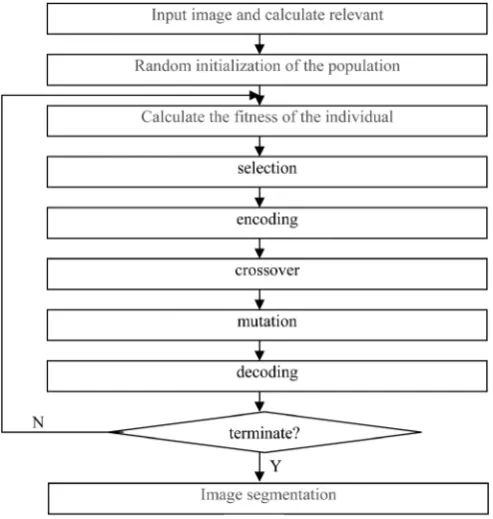
Through analysis the cotton foreign fiber images, it is found that the background of the cotton layer has the ab-solute advantage in the whole image, while the target is very small (Figures 2(a)-5(a)). Furthermore, the brightness and contrast of the image are all poor. Using the traditional image segmentation method (e.g. Otsu), the segmentation results are very poor. Therefore, we adopt the maximum entropy threshold method in this pa-per. However, the essence of the maximum entropy method is to obtain the maximum value of the objective function (Equation (6)) in the gray space, the computation of the algorithm is very large, and it takes much more time. In order to reduce the complexity of the algorithm, we combine GA with the maximum entropy in the for-eign fiber image segmentation. The maximum entropy function was used as the fitness function of GA. By con-tinuous optimization, the optimal segmentation threshold is determined. The flow chart of the algorithm was shown as Figure 1.
3.1. Encoding and Design Fitness Function
[image:3.595.191.438.444.704.2]Encoding a solution of a problem into a serial of genes, called chromosome, is very important when using GA. Various encoding methods have been proposed for particular problems to provide effective implementation of GA, such as binary encoding, real number encoding, integer or literal permutation encoding, or general data structure encoding [9]. In our research, we chose the binary encoding method. Since the gray level of the foreign fiber image has 256 gray level, so encoding the segmentation threshold with 8 binary string, and take the entro-py function of Equation (6) as the fitness function.
3.2. Population Initialization
The initial population for evolution is created randomly. Individual in the initial population is equivalent to the candidate solution in the solution space. If the population size is too large, the computational complexity is high; if the scale is too small, the search space is limited, the search may stop at the immature stage. Therefore, the population number is set to 20, the maximum number of iterations is set to 100.
3.3. Selection Operation
The selection operation, also known as the copy operation, is to determine which individual is genetic and which individual is eliminated. The common methods include roulette wheel method, the elite preservation strategy and the order selection method. As the crossover and mutation operations are performed, the optimal solution can be easily lost in an intermediate step. So we adopted the method of 10% elite strategy and 90% roulette wheel. Individuals with the largest fitness directly into the next generation, which can guarantee that the algo-rithm converges to the global optimal solution; the remaining 90% of the individuals are selected according to the fitness proportionate. The larger the fitness of the individual, the greater the probability of being selected. The probability of the individual i is selected to the next generation group is:
1
n
i i i
i
P F F
=
=
∑
(8)where n is the population size, Fi is the fitness of the individual i.
3.4. Crossover Operation
Commonly used crossover operations include single-point crossover, double-point crossover, multi-point cros-sover, etc. In our research, we chose the single-point crossover operator, the crossover probability is 0.8 and 0.6 respectively.
3.5. Mutation Operation
According to the mutation probability, the individual's value is replaced by some other gene values, which can increase the diversity of the population, and can also improve the local search ability of GA. Various mutation operations have been introduced by researchers, such as inversion mutation, neighbor exchange mutation, etc. We chose inversion mutation in our research.
3.6. Probability of Crossover and Mutation
The probabilities of crossover and mutation, denoted by Pc and Pm, affect seriously the search ability and con-vergence speed of GA [10]. For the standard GA, Pc and Pm are all fixed. But in the early stage of evolution, the individual difference is bigger, so we should increase Pc and reduce Pm in order to accelerate the evolution process and at the same time reducing the amount of calculation. In the later stage of evolution, the individual difference is small, so Pm should be reduced and Pc should be increased to avoid local optimal solution.
For the proposed algorithm, Pc is 0.8 during the first 50 generations of the evolution, so as to search the op-timal solution as soon as possible. In the second part of the evolution, Pc is 0.6. The mutation probability Pm is calculated by:
0 2
0
log ( 1)
m
m m
P g f f
P
P f f
+ ≥
=
≤
(9)
where Pm0 is the initial mutation probability; f is the fitness of the parent chromosome; f is the average fitness of the chromosomes in the current population [11].
3.7. Terminate Criterion
number is larger than the value, check the difference between the average fitness of the current population and the average fitness of the last generation whether less than a minimum value ε (here ε = 0.0001), once the condi-tion is satisfied, the iteracondi-tion terminates.
4. Results and Discussions
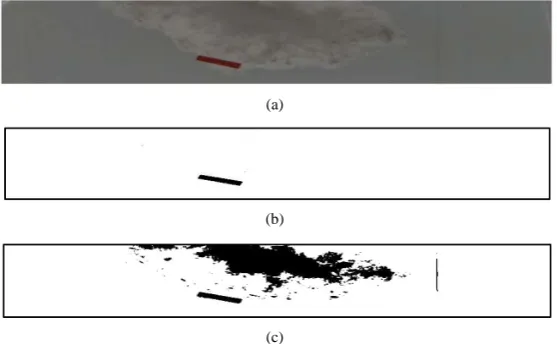
In order to verify the effectiveness of the paper’s algorithm, we collected 60 foreign fiber images which include 5 foreign fibers such as hair, feather, hemp rope, polypropylene, cloth and so on. The image is 128 × 4096 size. The experiments are performed on over Matlab7.1 platform. We compared the results of the paper’s method with the results of the Otsu’s method. Figures 2-5 show a part of the experimental results.
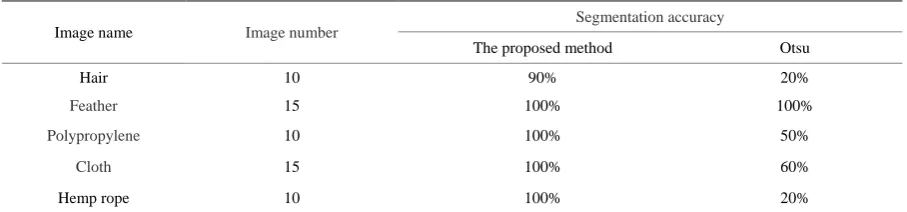
It can be seen from Figures 2(a)-5(a), for the original image, the cotton layer background occupies the abso-lute advantage in the whole image, while the foreign fiber only accounts for a very small part, and the contrast of the image is very low. Therefore, in many cases, the target cannot be separated from the background by using the Otsu method (e.g. Figures 2-4). For Figure 2(c) and Figure 3(c), although the target was segmented, but part of the background was divided into the target too. The foreign fiber of Figure 4 was not extracted at all. So the reliability of the Otsu is very poor. In contrast, this paper’s method works well in most cases. The extraction of the target is accurate and complete. Table 1 lists the statistical segmentation results of 60 foreign fiber images with two different methods.
(a)
(b)
[image:5.595.177.451.308.481.2](c)
Figure 2. (a) Color image of polypropylene fiber; (b) The result of the pa-per’s method; (c) The result of Otsu.
(a)
(b)
(c)
[image:5.595.175.454.521.693.2](a)
(b)
[image:6.595.173.454.84.260.2](c)
Figure 4. (a) Color image of hemp rope; (b) The result of the paper’s method; (c) The result of Otsu.
(a)
(b)
[image:6.595.173.455.301.478.2](c)
Figure 5. (a) Color image of feather; (b) The result of the paper’s method; (c) The result of Otsu.
Table 1. Caparison of the segmentation results by two different methods.
Image name Image number Segmentation accuracy
The proposed method Otsu
Hair 10 90% 20%
Feather 15 100% 100%
Polypropylene 10 100% 50%
Cloth 15 100% 60%
Hemp rope 10 100% 20%
[image:6.595.87.541.531.637.2]5. Conclusions
Due to the low brightness, low contrast and small proportion of the target of the foreign fiber images, we adopted the image segmentation based on maximum entropy and genetic algorithm. Experimental results show that the adopted algorithm is more accurate than the traditional Otsu method, and the speed is fast and adaptable, which meets the real-time requirements of the foreign fiber detection system.
Next work: for the detection of white foreign fibers (such as plastic sheeting, plastic film, etc.), the accuracy of the segmentation algorithm is poor, there is still to be further improved.
Acknowledgements
The authors thank Hebei Natural Science Foundation (F2015201033), the Ministry of Science and Technology of the People’s Republic of China (2013DFA11320), for their financial support.
References
[1] Yang, M.H. (2014) Hazards and Prevention of Foreign Fiber in Cotton. Jiangsu Textile, 4, 44-46. (In Chinese with English Abstract)
[2] Zhang, Y.J. (2013) Image Engineering (II) Image Analysis. Tsinghua University Press, Beijing.
[3] He, Z.J. and Wang, H.F. (2010) Chinese Word Sense Disambiguation Based on Maximum Entropy Model with Feature Selection. Journal of Software, 21, 1287-1295. http://dx.doi.org/10.3724/SP.J.1001.2010.03591
[4] Wu, Y.Q. and Zhang, X.J. (2011) Two-Dimensional Symmetric Cross-Entropy Image Thresholding. Journal of Image and Graphics, 16, 1393-1401.
[5] Wu, Y.Q., Meng, T.L. and Wu, S.H. (2015) Research Progress of Image Threshold Methods in Recent 20 Years (1994- 2014). Journal of Data Acquisition and Processing, 30, 1-23.
[6] Ou, P. and He, D. (2011) 2-D Maximum Entropy Method of Image Segmentation Based on Genetic Algorithm. Jour-nal of Computer Simulation, 1, 294-297.
[7] Guo, M.S. and Liu, B.H. (2008) 2-D Maximum Entropy Method in Image Segmentation Based on Chaos Genetic Al-gorithm. Computer Technology and Development, 18, 101-104.
[8] Cao, J.N. (2012) Review on Image Segmentation Based on Entropy. Pattern Recognition and Artificial Intelligence, 25, 958-959.
[9] Zhang, C.Q., Zheng, J.G. and Qian, J. (2011) Comparison of Coding Schemes for Genetic Algorithms. Application Research of Computers, 28, 819-822.
[10] Cao, D.Y. and Cheng, J.X. (2010) A Genetic Algorithm Based on Modified Selection Operator and Crossover Operator.
Computer Technology and Development, 20, 44-51.