Citation:
Ferrandez, RM and Kekale, T and Devins, DM (2016) A Framework for Work-Based Learning: Basic Pillars and the interactions between them. Higher Education, Skills and Work-based Learning, 6 (1). ISSN 2042-3896 DOI: https://doi.org/10.1108/HESWBL-06-2014-0026
Link to Leeds Beckett Repository record: http://eprints.leedsbeckett.ac.uk/1695/
Document Version: Article
The aim of the Leeds Beckett Repository is to provide open access to our research, as required by funder policies and permitted by publishers and copyright law.
The Leeds Beckett repository holds a wide range of publications, each of which has been checked for copyright and the relevant embargo period has been applied by the Research Services team.
We operate on a standard take-down policy. If you are the author or publisher of an output and you would like it removed from the repository, please contact us and we will investigate on a case-by-case basis.
A Framework for Work-Based Learning: Basic Pillars and their Interactions
Abstract:
Purpose: European policy is placing an increasing emphasis on involving employers and labour market institutions in the design and delivery of higher education programmes that match curricula to current and future needs of the economy. The aim of this paper is to investigate the curriculum development process for work-based learning (WBL) programmes and to connect it to the basic pillars, organizational and pedagogical strategies and key moments that enable higher education institutions to foster students’ learning, employability and innovation.
Design/methodology/approach: Case studies of 14 European WBL programmes in Higher Education are reported using interviews and document analysis. The development of a final framework and examples of practice are based on them.
Findings: Drawing on the concept of institutional capital, a framework for the development of WBL programmes which includes three basic pillars (Human Capital, Relationship Capital and Structural Capital) is proposed. Interactions between these pillars are necessary to enhance learning quality (Doctrine), provide authentic experiences (Authenticity) and respect the ways of developing and delivering WBL in Higher Education Institutions (Culture).
Research limitations/implications: While selecting a small sample of cases on a basis of ‘good practices’, some important pitfalls have not been discussed. Thus, rather than promoting a definitive theory, we promote a framework of issues that at least should be taken into account in different stages of planning, delivery, and reflection of WBL learning programmes.
Originality/value: 14 case studies from programmes recognized in 6 European countries and the development of an original WBL programme planning, delivery & evaluation framework that can also be used as a checklist for the HEIs organizing work-based learning programmes
Keywords: work-based learning; higher education, curriculum development, student’s learning, market needs, organisational practice.
Paper type; Research paper
Introduction
education and facilitating access to education and learning. According to these statements, curricula should involve employers and labor institutions, and must respond quicker to the changing needs of the economy. The problem with implementing such work-based learning (WBL) is that higher education systems have been slow to adapt their activities in general, and their curricula especially, to these changes (EC, 2012). Despite the benefits for students, organizations and society from WBL that are becoming increasingly recognized (Cedefop, 2013) there remains considerable resistance to changing traditional university curricula largely based on massification and “pure contents” (Nowotny et al. 2001) into more flexible and individual curricula influenced by the needs of the current or future labour market. The benefits of WBL may not beso evident in the short term as they may become in medium to long term and crossing the boundaries between higher education and industry brings new challenges to academia . This paper draws on the experiences and results of a project funded by the Erasmus LLP programme. The Work-Based Learning as an Integrated Curriculum (WBLIC) project engaged seven partners from six European countries and sought to develop a framework to support the development of WBL in different member states. 14 case studies were developed to inform the development of a a framework thatwould be useful for higher-education institutions and their stakeholders in planning WBL programmes.
Some conceptual considerations
WBL is a multidimensional and somewhat contested term. For the purposes of this article, we have used a definition of WBL adapted from Garnett (2005) where WBL is viewed as a learning process which focuses university level thinking upon work (paid or unpaid) in order to facilitate the recognition, acquisition and application of individual and collective knowledge, skills and abilities to achieve specific accredited outcomes of significance to the learner, their employer and the university.
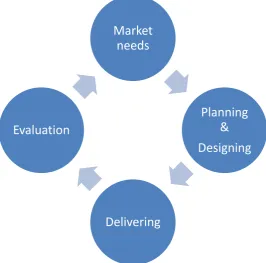
Our starting point for the development of the Framework wasthe classic cycle used to describe curriculum and programme planning and delivery (Contreras, 1991). This framework has been adapted to incorporate an external labour market perspective where the needs of industry and employers grew in influence and sometimes acted as the key drivers of programme development.
key role that employers and other external stakeholders in the economy play in the development of WBL (Figure 1).
INSERT Figure 1
In this article we further develop our analysis and draw on the case studies from across Europe to emphasize the learning of the student (Brennan & Little, 1996, Raelin, 2008) and to highlight the key role that the interactions between the elements of institutional capital play in the successful development and delivery of WBL.
.
The following sections will try to emphasize the different strategies described in the cases, collected in order to facilitate all the elements raised by Garnett paying special attention to those related to the student learning opportunities as it is the main goal of this paper. Initial framework
Case study methodology
The applied nature of the study influenced the design of the research methodology and a pragmatic approach (Tranfield and Starkey 1998) to research following practitioners or policy makers’ agendas, in contrast to ‘pure’ areas where research is largely dictated by the linear and logical development of an academic agenda was adopted for this study. Whilst this may be challenged from various philosophical perspectives, the strengths of this approach, including its ability to help to understand the nature of the problem and triangulate data (Creswell 2003) as well as providing an insight into ‘what works’ (Patton 1990), were key factors in the selection of this approach.
to which employers influence the development and delivery of the curriculum throughout the cycle.
Interviews were conducted with at least one interviewee from each stakeholder group and potentially several from some groups (such as students and employers) contributed to the case studies. The discussion guides were designed to be used flexibly and the duration of interviews ranged from under an hour to almost two hours. Interviews were digitally recorded and a written summary in english of the key issues from each interview was produced. In addition to primary data collection, the case studies collected relevant secondary data (e.g. curricula design guidelines, course specifications) and drew on other secondary sources to inform the development of the case studies as appropriate. Each case study was written up in a common format (typically 3,000-4,000 words in length) Comparisons are possible following the two basic case study methodologies (Caïs, 1997): Case comparison (longitudinal) and variables (stages of the cycle) comparison (cross-cases). The first one illustrates the “natural story” of the programme making it possible to understand the decisions inside its own context. The second allows us to compare among the cases the key differentiating factors associated with WBLIC. In this article we have used both methodologies putting the focus on the learning opportunities provision and paying attention to the organizational strategies that illustrate this provision. For that purpose, we must build a new framework that facilitates the data analysis. Nevertheless, it must be taken into account that the main goal of this article is not to compare the practices, but to contrast them against what the literature informs us is a good practice. Cases collected
The countries selected naturally differ somewhat concerning their university systems. Given that the UK has a much longer history of WBL than the other case countries, it comes as little surprise that the largest number and the most elaborate WBL
arrangements can be found there, followed by examples from Germany (In Germany, ‘work‐integrated learning’ seems to be the more widely used term), while in the other countries examples of WBL in higher education tend to be quite rare. However,
Austria, Germany and Finland have a dual system of Universities, some are more traditionally oriented and some more vocationally oriented (Universities of Applied Sciences, Fachhochschulen). In the latter, work‐based learning is quite widely practiced, and the traditional Universities are picking up some of the models,
Spain has mostly traditional Universities, although some smaller Universities connect University and Vocational programmes. When talking about work‐based learning in Spain, it almost exclusively refers to work placements. Spanish universities increasingly incorporate work placements into their curricula, although this trend is a relatively recent one.
Work‐based learning (through placements) in undergraduate (Bachelor’s) courses is mainly a problem of funding – it is considered expensive and thus it is mainly provided at Master’s degree level. A new higher education law, which is currently being prepared, is expected to promote the division of HEI into research and non‐research universities, and to increase the involvement of companies in university education (e.g. through mandatory work placements). Likewise, Poland has a history of strong ties between universities and the industry, but the cooperation was abandoned at the end of the
Communist era. In recent years though, attempts have been made to improve the
cooperation between HE and the labour market, e.g. through forming partnerships
between HEIs and employers. However, there is a need to make these partnerships more sustainable and systematic. HEI in Poland have currently little familiarity with the use of work‐based learning to develop professional skills.
Thus, we have four distinctive groups of countries with different orientations to WBL. In the UK, WBL has been discussed and also practised for decades. Germanistic countries (Germany and Austria among our cases) – and since 15 years ago also Finland – run a dual HE system with a traditional and a more WBL‐oriented “Applied Science” University
structure. The communistic countries used to have a very practically oriented,
specialised universities (e g railway universities, mining universities, agricultural
universities etc) but the connection between work and academic learning has been mostly dissolved in the 1990s and early 2000s and is slowly being restructured. Finally, the discussion is starting and the early stages of implementation are being tested in Southern‐European Latin countries, such as Spain, where the traditional University seems still to exist in its purest form.
Country Course/Qualification Institution Work based element
Austria
BSc Mechatronics and Management
University of Applied Science, Upper Austria
Subject overarching project and thesis
BA Social Work University of Applied Science, Vienna
Practicums in year 1, 2 and 3 (20 weeks in total)
Production Technology and Organisation (Bachelor)
FH Joanneum
University of Applied Science
Czech Republic
PG dip/Masters in Modern Railway Vehicles
Czech Technical University in Prague
Involvement of employers in practical projects, lectures, and short term practical training. Masters in Mechanical
Engineering with specialisation in management and economics of enterprise -
Czech Technical University in Prague
Lectures provided by managers of
companies, reflexive project work and learning
England
Masters in Strategic Communication
Leeds Metropolitan University
Majority of the learning undertaken through reflexive project work BA Business Leadership and Corporate Management Northumbria University
1st year in HEI, year 2 and 3 largely at work
Work Based Integrative Studies (variety of levels)
University of Chester Mostly at work, reflexive learning
Finland Company Clinic (variety of levels)
Vaasa University of Applied Sciences
Research and
development project (variable up to 50% of a programme) Germany Prozesstechnik
(Bachelor)
University of Applied Science, Aachen
Variable
Poland BA Applied
Informatics
Cracow University of Economics (CUE)
Placement 120 hours. 15hr/week probation in companies for best graduates
Spain
Industrial Engineering in Processes and Products
(undergraduate)
IMH/Universidad del Pais Vasco
Company
placements in year 1,2 and 3
Innovation and Development of Business Project (Master) Florida Universitaria (Universitat de Valencia)
As illustrated in the table above, the case studies reflect a range of programmes across a variety of disciplines, at different levels, on WBL elements that vary in timing, nature and intensity (some of these cases are briefly described in Ferrández-Berrueco and Kekäle, 2014). Some universities have developed a strategic approach to the management and development of WBL programmes at the institutional level. This approach is illustrated by the Work-Based Integrative Studies Programme developed in the University of Chester, in the UK, where the curriculum development process is based on pre-validated module templates and a streamlined validation process for bespoke modules commissioned and designed on a collaborative basis by employers and learners working in partnership with the university. In more traditional programmes, the majority of WBL elements involve at least one period of placement for the student however the duration, and location may vary considerably. For example the Production Technology and Organisation Programme in Austria draws on the cooperative model pioneered in the United States and based on alternating periods of three months in work and three months in the classroom in the first two years and then 6 months in work and in the classroom for the remaining time. Whilst stimulated by the interest of interactions between a member of the acadame and a major local employer the programme now includes a range of large and small employers in the region. The Bachelor of Industrial Engineering in Spain placement periods are typically three days in the company and two days on campus although once per month the student spends three days in the classroom and two days in the company to reflect a shift in emphasis towards theory. The final year of the programme includes a twelve-week placement in a company outside Spain. In some of the case study programmes, the Masters in Strategic Communication for example, the students are full time employees of a very large organisation and attend the university infrequently. This programme is based on a curriculum that is negotiated between the employee (learner), employer and university and is a dynamic form of university based WBL provision (Willis and McKie, 2011).
These examples illustrate the diversity of practice that only scratch the surface of the richness of WBL curricula. Many programmes have an element of Recognition of Prior Learing, use a variety of forms of delivery, use non-traditional teaching staff and have different forms of assessment procedures and this diversity presents a significant challenge to the development of an overarching framework to embrace the different forms of WBL and programme characteristics.
The Basic Pillars
not sure of all this unless there was a proof or evidence that guaranteed that a practice enhanced learning opportunities for students. Here is where we need to go deeper this initial framework finding out which basic elements are contained in each stage.
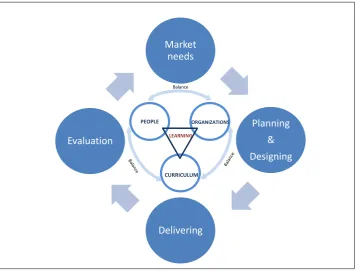
Thus, if we make a quick definition of each of the initial stages we will find that we are talking always about at least one of these elements that work as basic pillars in the Garnett’s (2005) definition of WBL: Participating organizations, Programme structure, and People involved.
In this way, the Market need stage deals with the external organizations labour force demands. The Planning and designing stages are related to the relationship between the internal (HEI) and external participating organizations in order to develop an integrated programme. Delivering and evaluation always reference the programme and they are carried out by all the agents (People) involved in the programme.
The balance between these pillars is actually which builds the programme assuring that the all the Garnett requirements are taken into account and, because of that, also responsible to facilitate learning. So, talking about WBL, the developing cycle must leverage these three pillars in order to maximize the interaction among them, so that also students’ learning can be maximized (Fig.2).
PUT FIGURE 2 ABOUT HERE
The next pages will explain these key elements as a way to help programme developers to organize a WBL programme practices and decide whether they are really good for WBL.
As it has been said, the decisions made about the Basic Pillars will produce specific interactions. The main goal of a programme developer team should be to maximize these interactions since learning depends on them.
The three Basic Pillars are an inseparable part at developing any HEI programme based on WBL principles.
Participating organizations
Two main types of organizations take part on Work Based Learning. Their interaction and the quality of their relationship are essential on building a WBL programme (Whittington & Ferrández-Berrueco, 2007).
p.64). Otherwise, there is no integration. Higher Education Institution, then, is the coordinator of the work-based learning. It is the main responsible for the programme to work well and responsible of awards. Ultimately, it is the responsible of guaranteeing the standards and facilitating learning. HEI can provide access to a range of conceptual bases, premises for procedures an access to norms associated with a particular occupation. Moreover, academic settings can provide experiences in which to reflect upon this knowledge, and what is experienced in other settings, such as those where practice is conducted. (Billet, 2009, p.838).
Cases report different examples of how this relationship is established and who takes the initiative, In the case of Strategic Communications in the UK and the Modern Railway Vehicles in the Czech Republic, it was the external organisation which initiated the relationship , while in most other cases, is the HEI.
At the same time, cases also show different levels of the company’s involvement from a simple interaction in which companies are simply guests and do not have a real role in the curriculum design to a total integration in which Companies and HEI work side by side. These different levels of involvement cannot be always attributed to contextual issues as regulations or flexibility and can be attributed to the tradition and practice of HEIs.
For example, the Spanish cases provide an illustration of companies taking part in the Social Council of the universities. And as member of this Council they should approve all the programmes, but most of times they are not part of the design body, which usually is carried out by university academic staff. “So we don’t feel really represented in the study programmes we are approving”. Nevertheless, both Spanish cases come from Consortiums or Foundations where universities and companies are part of the same body. Programme structure
In this sense, we have to mention that all the cases collected, respond to a certain group of programmes in which WBL was not a tradition. That is, Teaching and Health areas were discarded as they were assumed to be aware of the importance of WBL as they have a traditional focus on this type of teaching and the intention of the WBLIC project was in part to promote WBL in those areas where such integration is not so evident and traditional. The project was particularly interested in examples where the skills and abilities valid for the employer were integrated with the HE critical thinking skills and subject knowledge characteristic of HE curriculum. Thus, the definition used for integrated curriculum was adapted from Cedefop (2010) “A document (or a collection of documents) and process providing the framework for developing and delivering learning experiences which matches learner and employer/labour market needs”. Thus, in all the concepts and modalities of WBL, the main differentiating factor is the extent to which employers/practitioners influence the development and delivery of the curriculum. In any case, the important issue at this point is the needed contact between theory and practice, wherever and whenever it takes place.
People Involved
The third basic pillar in the Framework consists of the people involved in the planning and conduct of the programme. It is related to all the agents directly involved in WBL: students, company tutors and academic staff; all the human resources. They are who ultimately make the learning and the integration possible (Zabalza, 2011). The main difference with a traditional programme is the inclusion of strong relationships with people outside the HEI institution. For example, one of the Austrian cases mentioned “The integration of work based learning into the curriculum is not the sole responsibility of the development team(…). Members of the development teams are also invited to contact members of the study programme overarching expert teams.
Students are the reason why the WBL programme exists. The success of the whole programme depends on how the programme is able to engage the students with work activities and make them learn about and through work activities (Billet, 2009 p.289). Tutors and academic staff, on the other hand, are the facilitators. Students need to be guided by expert practitioners. (Burke et al. 2009, p.30).
Defining the interactions
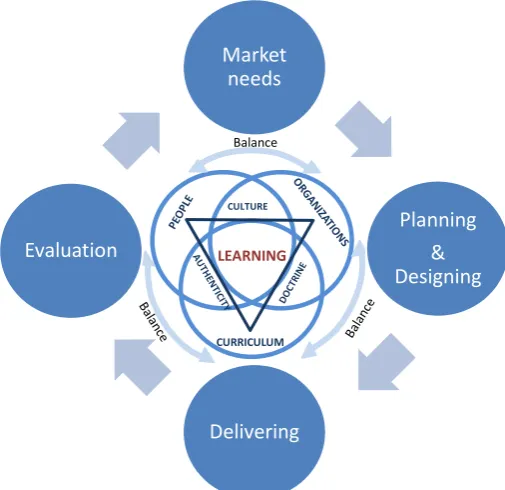
Following with the building of a new framework, the second group of elements required must be specifically related to the learning opportunities provision and how they have been considered in all the organizational stages of the development cycle. All these elements are reported in the literature about WBL, but they never have been put together in the same framework. They appeared on putting the student’s learning opportunities in the centre of the initial framework and rereading the cases under that scope. As a result, we saw that none of the basic pillars work alone but, combining between them. That is, we are dealing here with the interaction between the basic pillars; (see Figure 3). As can be understood from the Figure, learning is at its highest when maximizing the intersections, thus, in order to build a good WBL programme we have to pay special attention to them. Here is where we can really distinguish the good practices as balancing the pillars increases the programme quality.
PUT FIGURE 3 ABOUT HERE
The first interaction takes place between the Organizations and the Programme. We have called it Doctrine. It has to do with the importance of always remembering the main goal of the programme, to maximize the students’ learning opportunities. (Zabalza, 2004). In order to define a good practice we should put balanced emphasis between these two basic pillars. Inability to do so may either lead to too much importance placed the programme plan (Forgetting the Market needs) as usually happens in traditional programmes,or too much emphasis into the organizations’ needs (Forgetting the student’s needs) as it happens when a company, for example, only collaborates in a programme for “propaganda” aims.
Authenticity charactericesthe interaction between the Programme and People. The idea is to provide students with real work environment, and put them to do real-world work (Smith, 2011, p. 250). Tutors have the key role in ensuring the authenticity of the assessed work(McEwen et al. 2010 p.72). Risks of unbalancing the programme in this interaction again include either putting too much emphasis on the programmedetails (Forgetting the market and students’ needs) or putting too much importance on the people, leading to excessive clientelism or academicism.
Towards a new Framework
Once we have defined all the new elements included in the framework, we will try now to explain how they work in terms of studying good practice. For that, we will follow the natural path of the development cycle (longitudinal methodology, Caïs, 2001). In the process, we will discuss these new elements where they must be especially considered emphasizing the balance moments between pillars as the space for the good practices. We also will include some illustrative examples from our 14 cases.
Thus, starting by the Market need, the Programme planning starts when Participating organizations get into contact with each other. Through this contact the Programme is designed and it is the product where the understanding of the student background (Doctrine) must prevail. The delivery stage follows, and in this stage the academic staff, tutors and students (People) are the main resource. The Authenticity of experiences designed in the Programme depends on them, and is essential for the success of a quality WBL programme. The last stage of the cycle, Evaluation, is carried out between the People involved, and this stage is the moment for reflection upon how different expectations (Culture) have been met in the programme. Participating organizations meet again and considering the voices of the stakeholders they implement the improvements. But, at the same time, this Culture is part of the Participating organizations, so it influences the planning and designing stages.
Market need
As it was stated before, on talking about WBL, Market need should be the trigger. That is, there should be recognized a lack of skills or competencies detected in the labour market. This lack of skills is reported either by potential students (People) who need to enhance their qualifications, or by employers (Participating organizations). It makes sense to identify any HEI effort towards that goal as a good practice. Thus, we have an example of good practice of market need detection from the People pillar: The Production Technology and Organisation Programme was developed due to the identification of a potential market for this type of course from the interactions between members of the acadame and industry already working in the area. The market need can also be detected from the Participating organizations direction. As an example of this, we can mention the Spanish case of Master in innovation, where the Valencian Business Confederation expressed a demand related to the need to create a postgraduate programme to cover the growing need of innovation in the Valencian business sector.
organization (employer, intermediary, or social partner representing the interests of a group of employers) as a partner in the planning the learning activities that will cover those needs. Thus, good practices will appear on the establishment and maintenance of such partnership developing a joint point of view from interaction to integration (Whittington & Ferrández-Berrueco, 2007). Some examples are reported from a Business Bachelor study case from Finland: “Every department has a discussion forum where the department staff meets a selection of company representatives from the region and discusses their needs and future plans. Simultaneously, the employees of the university can ventilate their ideas on course development with the corporate partners”. Another example comes from Spain (in the field of Industrial engineering) “At the beginning of the course year, the person in charge of external relations for the programme contacts to the surrounding companies in order to ask about their training and staff needs”.
Between Organizations and Programme (Doctrine): Designing the programme
Although all the parts involved take some advantage of working together (Whittington & Ferrández-Berrueco, 2007), the programmes must and have to be designed in order to maximize the learning opportunities to students (Zabalza, 2004, Nixon et al. 2006). This is the idea behind the doctrine concept. Nevertheless, it is not always easy to get. Companies have other goals and must perceive a clear advantage or benefit, otherwise they will not be really involved From Germany we have found a very good example in this sense: “A prerequisite of the employers is that work cannot be neglected; for as much as the employers are interested in training their staff with the ultimate motive to raise loyalty to the company, likewise little they are willing to cut working hours. The most important challenge for the planning was thus to keep the workload manageable for the students and compliant enough to satisfy the recognition standards.” One of the Finnish cases report a solution to this issue finding a mutual benefit from the collaboration: “The students can apply theory to companies’ problems, and the university can also help especially SMEs with e.g. market research or product development”
How can learning opportunities be enhanced in the programme design? WBL is the learning for work, at work, and through work (Brennan and Little, 1996 in Burke, 2009 p17). But not everything has to be learnt at work; theory is also important (Brennan &Little, 1996, in Burke, et al. 2009 p.17). It is now time to capture on paper the guidelines agreed in the previous stage. It is also time to get the full integration between the employer and the HEI and translate this integration into the contents and approach of the programme. Being partners on designing the programme, the employer would feel as a partner in also really helping the student. Besides, the course could thus better meet the employers’ needs (McEwen et al. 2010, p.74).
this, in one of the Austria cases, (social work) students are expected to complete three practical work-life periods throughout their studies. These practical periods shall take place all in different institutions, but ideally also in three different fields of social work, to enable students to gain a more holistic experience of the different circumstances of real-life social work.
Secondly, the team should include within their programme considerations on the nature of higher education, and how best to prepare for, position, sequence, and identify the most appropriate duration of practice experiences, as well as consider support for learning from those practice experiences on such higher education. Thus, a case from the UK (health care) was especially designed as a flexible programme. The programme needed to be co-created anew each time it was run. It needed to be built in flexibility to accommodate new content as the context demands of each cohort required.
Thirdly, the team must identify what kinds of experiences might best develop, sustain and utilize students’ personal epistemologies, including their critical engagement and reflection. In this sense, another UK case, for instance, states “The programme overall has great flexibility in allowing the students to shape the assignments to support an area that is of particular interest to them”
Next, we report some important key points identified in the case studies, to be taken into account on designing the programme, using the concept of doctrine as basis. Alignment of teaching and learning activities (Smith, 2011)means that the activities in the practice programme must be deliberately designed and connected to the theory and vice-versa. For instance, in one of the Spanish cases, “integration is evident (…) as most of the practical work which the student has to carry out along the master is integrated into the real role of the student as a professional in the company”. Or, as in another case from Finland: “When the company sees that they have a task that suits any of the courses, and after the teacher has accepted the task as suitable for the theory that has is the goal of the course, the company and the Company Clinic coordinator (on behalf of the university) sign an agreement for the task to be solved by the students in the class…”
visits, so they know what (and when during the academic year) kind of tasks they can suggest”
Assessment with integrative learning objectives. The integrative learning outcomes are the key objectives (Smith, 2011, p.259) of WBL, so, assessment ought to be aligned to integrative activities. HEI staff considers that, for students to obtain the most value, they needed to be able to link theory and practice and integrate work undertaken at university with their work in the employer’s organization (McEwen et al. 2010 p.74). For instance, in an engineering programme in Austria, “Module coordinators are responsible for bringing all teachers of the module and all groups together in order to create exams, wherein all knowledge and experience covered by the module can be assessed. These forms of coordination are especially relevant for all teachers, to create a basic understanding of which topics should be covered within all modules and all groups”. Literature informs about the agreement between the academic and practitioner assessors of assessment standards, so that they reflect the levels of student achievement within the WBL context. These assessors can include external examiners who operate beyond the tripartite student-tutor and HEI staff (McEwen et al. 2010 p.71). Many examples found in the case studies emphasize this point. For instance, in Spain, in the Master in Innovation “There is an Advisory Board. It is an expert team coming from different areas related to business development. They have to advise the student in the project planning and execution in those areas directly related to their expertise area; to assess regularly the project progress and the assessment of the Master.”
From the designing to the delivery the programme
Work-based learning especially requires integration between theory and practice. In a WBL sense, any programme is something experienced by learners as an invitation to change (Billet, 2009, p.835). Despite the clear practical scope and focus to workplace in the programme, it is extremely dangerous to forget about the theoretical contents. In such a case the programme becomes a simply reproductive programme closer to a company training section than a HEI programme. A good practice in this sense was reported in Austria: “Courses of practical exercises are therefore always offered in parallel with traditional lectures, especially in any application field”.
Delivering the programme: Between Programme content and People (Authenticity) Work-based learning must take place in real, or at least well reproduced, work situations. Practice settings provide a range of experiences that are authentic in terms of enactment of an occupation in particular work situations (Billet, 2009, p.838). Some key strengths of learning through workplace experiences are (a) Access to authentic work activities; (b) Observation and listening; (c) Access to more experienced co-workers and (d) Practice (Billet, 2009, p.837).
For increasing the effect of this Authenticity some considerations must be taken into account so that the balance between Programme and People can be guaranteed. Firstly, experiences provided, although being real, are not learnt uniformly by students. Learning depends on previous experiences. Consequently it is important to consider both the provision of experiences and individuals’ taking up of those experiences (Billet, 2009, p.835). Thus, a UK programme manager reports the following good practice: “The philosophy of the programme is one of self-directed learning, allowing participants to explore areas of professional interest to develop evidenced based practice and new ways of thinking within the mobility sector”
Secondly, experiences are also goal-directed (Burke et al, 2009, p.24). This means that practice periods must be developed to enable learning of something that has been previously planned. A Spanish case reports: “Once a term (that is 5-6 visits along the programme), the academic company tutor goes to the company in order to make an assessment along with the student and the company tutor. All three sign a document where the assessment and new objectives for the student are established.”
individual contact between teachers and students is encouraged at any time of the study programme.”
Assisting individuals to develop the capacities to realize their vocational ambitions includes the understanding the goals for occupational preparation, as well as how integration of experiences in both academic and practice settings can contribute to generating occupational expertise (Billet, 2009, p.831). Here, a programme manager in Spain says that their “students have a personal tutor (Senior Advisor) who helps to solve any academic problem apart from supervising the whole work that student is going to carry out along the master as well as supervises the Master Thesis.”
People: a central element in the Delivery and Evaluation of the programme
On delivering a programme, a new element appears. We have called it People. With this general term we mean the students, company/employer tutors and academic staff. This does not mean that these stakeholders are not at all relevant in the previous stages, but we consider their role in the earlier stages is more related to an organization perspective. In the later stages of the programme, as “users”, their roles are more evidently those of individuals. Good practices in this pillar are detected when all the programme actors are involved in delivering and evaluation.
Communication is related to the accessibility (Smith, 2011). McEwen et al (2010, p. 79) noted that the three way communication between the academic tutor, students, and the company/employer tutor is particularly important. A good example of this practice was found in Spain: “After this, the whole cohort (of students), conducted by the pedagogical tutor, negotiate and decide which competencies are going to be worked, how much time is going to be spend on each and the methodology (visits, seminars, etc.) there is a special budget for this. The analysis is individual, but the response is collective. Once the student is allocated in a Company, this company, the HEI and the student define in a tripartite the profile with the basic competencies required at the end of the programme. This profile becomes a learning contract and it is signed by the three parts”.
Between People and Organizations (Culture): Reflection and improvement
Culture is, in our framework, the intersection between People and Participating organizations. Same people behave in different way depending on the context, habits, expectations, and so on. In this way, this intersection to a certain degree determines the specific behavior of an organization. Different cultures will provoke different results in terms of reflection and improvement. For example, McEwen et al. (2010) found that academic staff was concerned that employers would have neither sufficient time nor knowledge about “critical reflection” to encourage it among students. (…) some employers consider that it was the role for the university to develop skills of reflection in students, but with their support(McEwen et al. 2010 p.69). Thus, some practices that try to solve this problem are addressed to train company tutors in the skill of critical reflection. Sometimes the critical reflection is carried out mainly from the HEI, as in the following response from Spain: “once a month students stay at HEI three days and only two in the company. This is the reflection day, and here they talk and share experiences”. More related to the beginning of the cycle, we find an element of Induction and preparation processes (Smith, 2011).It deals with the cultural preparation of students for the work ahead (in pedagogical and practical sense), dealing with the student allocation, documentation, keeping relationships with industry partners, etc. The following practical examples are reported in Austria: “The preparatory and debriefing phases are very important for those students who will travel abroad, and are much more than for those who will remain in Austria. It consists of dealing with intercultural differences are issued, as well as main problematic areas in the target regions (typical diseases and their treatment or pre-immunization, how to deal with critical situations, how to handle impressions of total poverty, etc.). De-briefing then means again as well content-wise de-briefing (reflection on what was done in practice) and organizational feedback (possibilities to enhance the information provided before the stay abroad).” An UK programme reported: “This module (‘Skills and Approaches for Work Based Learning’) is designed to help prepare the ground for work-based experiential learning and the accumulation of academic credit for this purpose. It usually follows the Self Review module.”
(McEwen et al. 2010 p.71, Zabalza, 2011). This is illustrated by a practice in UK: “The tutor team comprises of experienced practitioners within the sector and every tutor completes additional training to ensure they can offer appropriate academic guidance and support to learners.”
Working the “Public” and “private” space (Harris et al. 2010) is difficult because student can challenge the efficacy or even the appropriateness of the learning experience in a “private space”. That is, it is sometimes not seen as appropriate that experienced employees allow students to critique or challenge their culture or practices. An example of this issue from the UK: The fact that the HEI have a sound understanding of workplace learning in terms of the pressures it puts on employees/students and the co-delivery organizations, as well as an understanding of the notion of ‘reflexive practice’ and how that fits, is key. Such an approach works well in terms of workplace learning since it forces the employee/student to consider what they are learning in the context of their daily activities in the workplace. Companies and Universities have their own learning support structures. Integrating these structures may help to alleviate the stress and/or improve the learning process (Smith, 2011, p.252). It is the structural capital, and it has to do with the combination of all the organizational and human resources in order to foster and facilitate learning among all the parties (Felce, 2010). We refer to one of our case examples from Germany, where all learning resources are provided by the FH Aachen or the Academy, the employers usually provide working hours and the technical requirements like plants or laboratories. Another programme reported the following from Austria: “Some “bridge courses” are offered in subjects with complex theoretical content before the official start of the study programme, and many students (especially those who are older than the average student)) use them to “get into a studying and learning mode” again. (…) Another important form of learning support relates to preparation for exams. If some students approach course lecturers or the study programme leader, and state that they need additional support in preparation for exams, usually supportive courses are offered as consequence to that”.
Students’ Engagement is related to how students engage with and learn through what they are afforded (Billet, 2009, p.831, Raelin, p.18). There is a need to focus on preparing students as agentic learners as part of their professional preparation (Billet, 2009, p.838). An example from the UK: a Self Review and Negotiation of Learning module requires students to engage in a process of personal review and then negotiate an outline learning pathway (‘approved studies’) based on their personal and professional development needs. This is typically the first module a student will take on their WBIS study route, enabling them to engage in the process of programme planning, typically including the formulation of a claim for the accreditation of prior learning.
experiences between students. The programme had to be designed to allow space for this kind of interaction, but which uses that exchange of experience to contribute to the learning of the whole student group”.
Conclusions
Higher education institutions should, in order to better match the needs of changing society, weave in their education programmes also the view of the workplaces. Using as starting point the programme development cycle for work-based learning (WBL) programmes, the aim of this paper was to build a new framework that let us go deeper trying to find the basic elements that enable to find the best practices in order to develop a good WBL programme spotlighting the learning as the main goal. In this article, the Framework was completed with case studies from 14 best-practice work-based learning programmes.
In all the cases reported, university and labour market have been working in partnership. Depending on many contextual factors (tradition, regulations, flexibility, etc.) this partnership was more or less integrated, but in any case, all the cases collected evidenced some elements that highlighted WBL as the main strategy in the curriculum design, delivery and evaluation. These elements were the 3P’s, Participating organizations, People involved, and Programme structure. This seems to hold no matter what kind of Higher Education system the WBL experiment is connected to, at least in European scale. Nevertheless, although these elements were always present, there are evident differences in the cases that show different levels of curriculum integration. So, we can say they were WBL experiences, but what we are not able to decide is which are better in terms of student’s learning opportunities (Brennan & Little, 1996, Raelin, 2008) or significance (Garnett, 2005). In other words, how to distinguish a “practice” from a “good practice” in WBLIC?
Our proposal to answer that question is based on the balance of the common principles, as an unbalance treatment would bring out other goals apart from provide the best learning opportunities.
practices) to use in order to design a programme based on WBL under the Garnett’s (2005) perspective.
In spite the different educational systems and contextual differences among the countries involved, there is among the practices reported ample evidence that all the elements pointed out in this article are indeed critical and they appear in all the cases reported. That does not mean that all the practices are fully interchangeable among countries. For example, some organizational decisions cannot be made in all the cases, as regulations do not allow their application. But many other are, above all related to pedagogical decisions. So the next steps will carry us to discuss in different contexts what is and what is not applicable.
Related to the limitations of this research, the cases are all European, and it is possible they are culturally biased. They are also selected by a few individuals nationally, which may bring another bias. We have, however, attempted to cover at least to some degree the most important Higher Education system ideal-types of Europe; the British WBL tradition, the Fachhochschule system, the Southern-European traditional Universities, and the Post-Communist systems. Our coverage in these is naturally a narrow selection, but case studies are a good way in bringing forth new theories or frameworks, while they cannot bring statistically significant conclusive evidence on these theories. Thus, this report must be seen as a proposal, rather than a definite statement, on what makes a good work-based learning programme in Universities. Therefore, despite our pride in these results, we aim to continue the research on a bigger sample and a more decisive research approach.
References
Billet, S. (2009): Realizing the educational worth of integrating work experiences in higher education. Studies in Higher Education, 34 (7), (827-843).
Brennan, J. & Little, B. (1996) A review of Work-based learning in Higher Education. Sheffield; Department for Education and Employment.
Bruges Communiqué (2011) Supporting vocational education and training in Europe. Luxembourg: Publications office of the European Union. (http://ec.europa.eu/education/library/publications/2011/bruges_en.pdf)
Bucharest Communiqué (2012) Making the Most of Our Potential: Consolidating the European Higher Education Area. EHEA Ministerial Conference.(http://www.ehea.info/Uploads/(1)/Bucharest%20Communique%202012(2)
Burke, L.; Marks-Maran, D.J.; Ooms, A.; Webb, M. & Cooper, D. (2009) Towards a pedagogy of work-based-learning: perceptions of work-based-learning in foundation degrees. Journal of Vocational Education & Training, 61 (1), (15-33).
Caïs, J. (1997) Metodología del análisis comparativo. Volumen 21 de Cuadernos Metodológicos, Centro de Investigaciones Sociológicas (Madrid).
Cedefop (2010) Learning outcomes approaches in VET curricula: a comparative analysis of nine European countries. Luxembourg. Publications Office
http://www.cedefop.europa.eu/EN/Files/5506_en.pdf
Cedefop (2013) Benefits of vocational education and training in Europe for people, organisations and countries. Luxembourg: Publications office. http://www.cedefop.europa.eu/EN/Files/4121_en.pdf
Contreras, J, (1991) Enseñanza, Curriculum y Profesorado. Madrid: Akal
Creswell, J.W. (2003) Research Design. Qualitative, Quantitative, and Mixed Methods Approaches. 2nd Edition. London. Sage Publications.
Doughty, R.; Harris, T & Mclean, M. (2006) Tripartite assessment of learners during practice placements in midwifery pre-registration programmes. In S. Roodhouse, M. Bowley & S. Brown (Eds.) Putting Work-based learning into practice, Proceedings of the University Vocational Awards Council Annual Conference, York, November.
EC (2012) Bologna Implementation Report. Retrieved from http://www.ehea.info/Uploads/(1)/Bologna%20Process%20Implementation%20Report. pdf
Felce, A. (2010) Towards a Context-engaged Approach to Work-based Learning. Learning and Teaching in Higher Education, Issue 4-1,(20-35)
Ferrández-Berrueco, R. & Kekäle, T. (2014) Relationship Between Labour Market and University. Work-Based Learning Experiences in Europe. ICERI2014 proceedings. Sevilla, November.
Garnett, J. (2005): University Work Based Learning and the Knowledge Driven Project en Rounce, K. & Workman, B. (Eds.): Work Based Learning in Healthcare. Chichester: Kingsham
Garnett, J., Workman, B., Beadsmore, A. and Bezencenet, S. (2008) Developing the structural capital of higher education systems to support work-based learning programmes in Work-based learning: Workforce development: Connections, frameworks and processes . York. The Higher Education Academy.
Harris, L.; Jones, M. & Coutts, S. (2010) Partnership and learning communities in work-integrated learning: designing a community services student placement programme. Higher Education Research & Development, 29 (5), (547-559).
Helle, L.; Tynjälä, P. & Olkinuora, E. (2006) Project-Based Learning in Post-secondary Education – Theory, Practice and Rubber Slingshots. Higher Education 51 (287-314) Mcewen, L.; O’Connor, K. M.; Williams, C & Higson, H. (2010) Engaging employers as partners in work-based learning assessment: proposal for a quality enhancement framework. Learning and Teaching in Higher Education, 4 (2), (62-89).
Nixon, I.; Smith, K.; Stafford, R. & Camm, S. (2006) Work-based learning: illuminating the higher education landscape. The Higher Education Academy. Final Report. (Retrieved from: http://www.jisctechdis.ac.uk/assets/was%20York%20-%20delete%20this%20soon/documents/ourwork/tla/web0597_work_based_learning_ill uminating_the_higher_education_landscape.pdf)
Nowotny, H.; Scott, P. & Gibbons, M. (2001) Re-Thinking Science: Knowledge and the Public in an Age of Uncertainty. Polity, Cambridge, UK.
Patton, M.Q. (1990) Qualitative Evaluation and Research Methods. Newbury Park, CA. Sage.
Raelin, J.A. (2008) Work-based learning; bridging knowledge and action in the workplace. San Francisco. Jossey-Bass
Smith, C. (2012) Evaluating the quality of work-integrated learning curricula: a comprehensive framework. Higher Education Research & Development. Vol. 31, No. 2, (247-262)
Stewart, T.A. (1997) Intellectual Capital: The New Wealth of Organizations. New York. Doubleday
Webber, R. (2005) Integrating work-based and academic learning in international and crosscultural settings. Journal of Education and Work. 18 (4), (473-487)
Tranfield, D. and Starkey, K. (1998), The nature, social organization and promotion of management research: towards policy, British Journal of Management, 9, pp. 341-53 Willis, P. and McKie, D. (2011) Outsourcing public relations pedagogy: Lessons from innovation, management futures, and stakeholder participation. Public Relations Review, 37 (5), pp. 466-469.
Zabalza, M. (2004) Condiciones para el desarrollo del practicum. Profesorado: revista de currículum y formación del profesorado, 8 (2), (1-22).
Figure 1: Conceptual Framework: Developing a WBL Programme
Market
needs
Planning
&
Designing
Figure 2: Conceptual Framework and the Basic Pillars
Market needs
Planning & Designing
Delivering Evaluation
PEOPLE
LEARNING
ORGANIZATIONS
CURRICULUM
Figure 3. Conceptual Framework, Basic Pillars andIntersections between them LEARNING
CURRICULUM
CULTURE Balance
Market needs
Planning &
Designing