
Density functional analysis of (E)Penta-1,3-diene
under external electric field using gold electrodes
K. Selvaraju
1, S.Palanisamy
2, P.Jayalakshmi
3, B.Jothi
41-4
Department of Physics, Kandaswami Kandar’s College, Velur-638182, Namakkal Dt., India.
Abstract: A conducting molecular wire, thiol substituted (E)Penta-1,3-diene has been studied under applied electric fields (EFs) ranging from zero to 0.26 VÅ-1using gold electrodes with density functional theory (DFT). Variation in atomic charges of the molecule for various EFs has been compared with MPA and NPA methods. The HOMO-LUMO gap (HLG) of the molecule calculated from quantum chemical calculations have been compared with density of states (DOS) spectrum, which shows that HLG decreases from 2.39 eV to 1.5 eV as the field increases. The increase of applied field increases the dipole moment of the molecule from 0.02 debye to 10.96 debye.
Key words: Atomic charges, HOMO-LUMO, Molecular orbital analysis, Density of states, Electric dipole moment.
I. INTRODUCTION
The capability to exploit single molecules that function
as self-contained electronic devices has encouraged researchers
to minimize electronic circuit elements in semiconductor
industry [1-3]. Based on computation and modeling, one can
propose numerous different mechanisms that take place when
electrons transfer through nanoscale molecules which can be act
as molecular wires [3]. Generally, a molecular wire refers to a
linear chain of π-type molecular structure used to connect two electronic components in molecular electronic devices [3,4]. For
electronic transport through molecules, one should familiar with
the following key factors: the highest occupied molecular
orbitals (HOMO) and the lowest unoccupied molecular orbitals
(LUMO), similar to the valence band and the conduction band
in solid state materials, respectively, but with discrete energy
levels caused by quantization
effects in constricted dimension of a molecule. The difference in
HOMO and LUMO is known as HOMO-LUMO gap (HLG).
The molecules exhibits smaller HLG (~ 2 eV) have more charge
transfer ability [5]. Normally, conjugated molecules have
smaller HLG with more electrical conductance, hence, act as
efficient molecular wires [5,6]. In the present study, the
electrical characteristics of (E)Penta-1,3-diene (Fig. 1), a
conjugated molecule with HLG 2.39 eV, has been studied under
various external electric field with thiol as linker using gold
electrodes. C(1) C(2) C(3) C(4) C(5)
S(1) S(2) Au(2)
Au(1)
II. COMPUTATIONAL DETAILS
The Au and thiol substituted (E)penta-1,3-diene
molecule has been optimized for the zero field and applied field
of five biasing steps (0.05, 0.10, 0.15, 0.21 and 0.26 VÅ-1) by
Density Functional Theory (DFT) method using Gaussian09
program package [7-9]. A combination of Becke’s three
parameters exchange function and Lee, Yang and Parr
gradient-corrected correlation function (B3LYP hybrid function) is
applied for whole DFT calculation along with LANL2DZ (Los
Alamos National Laboratory of Double Zeta) basis set, which
provide effective core potential and the detailed description of
the effect of heavy metal atoms in the molecule [10]. The
GaussSum program has been used to determine the density of
states (DOS) at various levels of applied EFs [11]. The variation
in bond lengths, variation of atomic charges and variation in
energy levels of the molecule for various levels of applied EFs
have been plotted by using Origin and GAUSSVIEW [9]
software.
III. RESULTS AND DISCUSSION
A. Atomic charges
The bonding capability of a molecule depends on the
electronic charge on the chelating atoms. Most electronic
modeling programs calculate the charges by the Mullikan
population analysis (MPA) method [12,13], because it is simple
to do so. The natural population analysis (NPA) relies upon the
wave function. It is a widely used method to determine the
atomic charge distribution and this scheme corresponds to the
occupancy of the so-called natural orbitals, which is based on a
weighted symmetry orthogonalization procedure [13-15].
Specifically, this method treat the charges located at the atomic
sites only and provides better charge distribution. Hence, in the
present study, we have calculated the atomic charges by both
MPA and NPA methods. Further, both models predict almost
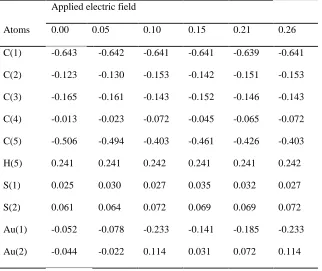
negative charge for all C-atoms in the molecule. The MPA
charges of all Catoms for zero field vary from 0.643 to
-0.013e. When the applied field increases, The charges of all
C-atoms vary with increase of field and the maximum variation
observed is 0.103e. However, the charge of H-atoms remains the
same (~0.241e) for various fields. The linker atoms on either
ends S(1) and S(2) possess slightly different MPA charges for
zero field; as the field increases, the charge of S(1) vary
between 0.025 and 0.035e whereas, the charge of S(2) increases
from 0.061e to 0.072e. For the zero field, the charge of Au atom
at either ends are slightly different (-0.052 to - 0.044e). As
the field increases, the charge of Au atom in the L-end increases
to -0.233e, whereas, the charge of the same Au atom present at
the R-end increases to -0.114e. The MPA charges for the zero
and various applied EFs of the molecule are presented in Table
1.
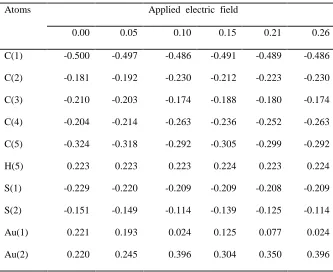
For the zero field, the NPA charge for all C-atoms are found
negative; further, the charges vary with the increase of field,
whereas the charge of H-atoms remains same (~0.223e). The
NPA charges of linker S(1) and S(2) atoms vary for various
applied EFs, the maximum observed variation of S(1) and S(2)
are 0.021e and 0.037e respectively. For the applied field, the
charge of Au-atom at the L-end decreases gradually from 0.221
to 0.024e, while at the R-end, the charge increases from 0.220 to
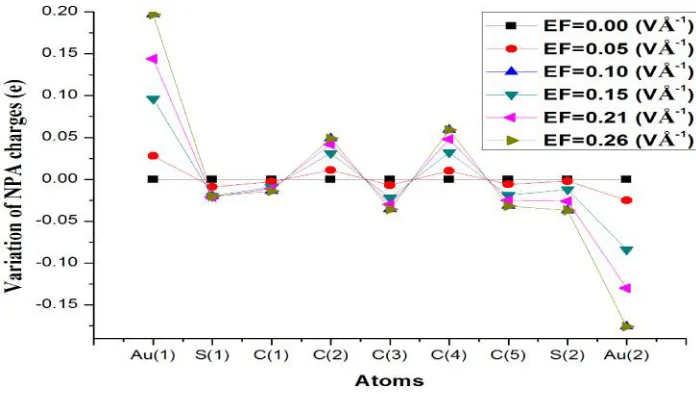
atoms at both ends show large variation of MPA as well as NPA
charges for the various applied EFs (Fig.2 & Fig.3). Hence, it is
concluded that thiol and gold atoms are more sensitive than
carbon and hydrogen atoms for the applied EFs. The difference
of NPA charge distribution for zero and various applied EFs is
[image:4.612.136.513.199.386.2]listed in Table 2.
Fig. 2 Variation of MPA charges of the molecule for the zero and various applied EFs.
[image:4.612.138.486.430.627.2]Table 1 MPA atomic charges (e) of the molecule for various applied EFs (VÅ-1).
Applied electric field
Atoms 0.00 0.05 0.10 0.15 0.21 0.26
C(1) -0.643 -0.642 -0.641 -0.641 -0.639 -0.641
C(2) -0.123 -0.130 -0.153 -0.142 -0.151 -0.153
C(3) -0.165 -0.161 -0.143 -0.152 -0.146 -0.143
C(4) -0.013 -0.023 -0.072 -0.045 -0.065 -0.072
C(5) -0.506 -0.494 -0.403 -0.461 -0.426 -0.403
H(5) 0.241 0.241 0.242 0.241 0.241 0.242
S(1) 0.025 0.030 0.027 0.035 0.032 0.027
S(2) 0.061 0.064 0.072 0.069 0.069 0.072
Au(1) -0.052 -0.078 -0.233 -0.141 -0.185 -0.233
Table 2 NPA Atomic charges (e) of the molecule for various applied EFs (VÅ-1).
Atoms Applied electric field
0.00 0.05 0.10 0.15 0.21 0.26
C(1) -0.500 -0.497 -0.486 -0.491 -0.489 -0.486
C(2) -0.181 -0.192 -0.230 -0.212 -0.223 -0.230
C(3) -0.210 -0.203 -0.174 -0.188 -0.180 -0.174
C(4) -0.204 -0.214 -0.263 -0.236 -0.252 -0.263
C(5) -0.324 -0.318 -0.292 -0.305 -0.299 -0.292
H(5) 0.223 0.223 0.223 0.224 0.223 0.224
S(1) -0.229 -0.220 -0.209 -0.209 -0.208 -0.209
S(2) -0.151 -0.149 -0.114 -0.139 -0.125 -0.114
Au(1) 0.221 0.193 0.024 0.125 0.077 0.024
Au(2) 0.220 0.245 0.396 0.304 0.350 0.396
B. Molecular orbital analysis
Atomic orbitals of different atoms combine to create
molecular orbitals. Electrons in these molecular orbitals belong
to the molecule as whole. When two atomic orbitals are added
together, a set of lower energy bonding orbitals as well as a set
of higher energy anti-bonding orbitals are created [16,17]. The
molecular orbital that is highest in energy that contains electrons
is called the highest occupied molecular orbital (HOMO). The
molecular orbital that is lowest in energy that does not contain
electrons is called the lowest unoccupied molecular orbital
(LUMO) [18,19]. The applied EF partially localizes the frontier
orbitals (HOMO and LUMO) of the molecules, which are
opposite to each other. For the applied field (0.00 - 0.26 VÅ-1),
HOMO-LUMO Gap (HLG) decreases from 2.39 to 1.50 eV.
Fig. 4 illustrates the various energy levels, HOMO-1, HOMO,
LUMO and LUMO+1 of the molecule for various applied EFs,
which show the decrease of HLG with the increase of field.
The electronic density of states (DOS) is a key property
to analyse the solid state as well as nano scale electronics [20].
To the study of nanoscale structures, the number and density of
electronic states is given for arbitrary dimensions [21]. Here, the
HLG is determined by plotting DOS spectrum using GaussSum
program [11]. Fig. 5 [(a)-(f)], shows the density of states (DOS)
various applied EFs. Here, the hybridization of the molecular
level with that of the electrode broadens the DOS peaks. At zero
field, the DOS peaks are in minima, indicates the discrete
molecular level with HLG, 2.39 eV, further increase of field to
0.26 VÅ-1, both HOMO (green line) and LUMO (blue line)
levels approach each other and their gap decreases to 1.50 eV.
The molecule exhibit almost symmetric variations in energy
levels for applying reverse EF. Hence, the electrical
conductance of the molecule does not depend on the direction of
external EFs. The large decrease of HLG at higher applied EF
sustain more electron conduction through the molecule, hence,
the Au substituted (E)penta-1,3-diene molecule can act as an
[image:7.612.188.461.266.431.2]efficient molecular nanowire.
Fig 4. Energy level diagram of Au and S substituted (E)penta-1,3-diene molecule for the zero and various applied EFs.
[image:7.612.155.455.472.635.2](a) EF=0.00 VÅ-1 (b) EF=0.05 VÅ
-1
(c) EF=0.10 VÅ-1
(d) EF=0.15 VÅ-1
(e) EF=0.21 VÅ-1
(f) EF=0.26 VÅ-1
[image:8.612.82.568.110.625.2]C. Molecular dipole moment
Even though the total charge on a molecule is zero, the
nature of chemical bonds is such that the positive and negative
charges do not completely overlap in most molecules. Such
molecules are said to be polar because they possess a permanent
dipole moment [22,23]. Even if there is no permanent dipole
moment, it is possible to induce a dipole moment by the
application of an external electric field. When the molecule
subjected to external EF, the field polarizes the molecule, which
leads to change the dipole moment of the molecule [24,25].
Nowadays, numerous theoretical quantum chemical calculations
of dipole moment of the molecules have been reported, which
shows that the dipole moment of the molecule increases with the
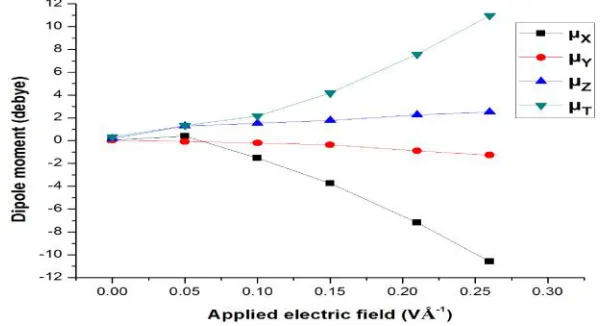
increase of field [25,26]. Here, the dipole moment of the
molecule has been calculated for zero as well as various applied
EFs. Fig. 6 shows the variation of molecular dipole moment for
various applied EFs. The molecular dipole moment for zero bias
is 0.02 debye, which increases almost linearly with the increase
of field. The molecule becomes highly polarized for the higher
field (0.26 VÅ ); the polarization induces to have high
molecular dipole moment 10.96 debye for the increase of field,
which are in good agreement with the reported values.
IV. CONCLUSION
The present theoretical study on thiol substituted
(E)Penta-1,3-diene molecular wire describes the electrical
characteristics for zero and various external applied fields. As
the field increases, the variations of atomic charges calculated
from MPA and NPA methods are found to be systematic and
almost uniform. When the field increases from 0.00 to 0.26 VÅ
-1, the hybridization of molecular levels broadens the DOS and
decreases the HLG from 2.39 to 1.50 eV. The decrease of band
gap at the high field indicates that this molecule exhibit more
electrical conductivity. The applied EF polarizes the molecule,
in consequence of that the dipole moment of the molecule
increases from 0.02 to 10.96 debye. The analysis of MPA and
NPA atomic charges and molecular orbital analysis of the
molecule allow to understand the molecule at electronic level
for zero and various applied EFs.
REFERENCES
1. Emily A. Weiss, Michael R. Wasielewski, Mark A. Ratner, Molecules asWires: Molecule-Assisted Movement of Charge and Energy, Top Curr Chem, Springer (2005).
2. M. P. Samanta, W. Tian, and S. Datta, Electronic conduction through organic molecules, Physical review B, 53:12, (1996) 7626-7629.
3. I. M. Grace et al., Electron transport through single molecular wires, Materials Science-Poland, 22:4, (2004), 507-512.
4. É. Bayard, S. Hamel, A. Rochefort, Hydrogen bonding and
π-stacking in highly organized arenes-based molecular wire, Organic Electronics, 7:3 (2006) 144–154.
5. Eldon Emberly and George Kirczenow, Electrical conductance of molecular wires, Nanotechnology 10 (1999) 285–289.
6. Y. Zhang et al., Ab initio investigations of quaterthiophene molecular wire under the interaction of external electric field Journal of Molecular Structure: THEOCHEM 802 (2007) 53–58.
8. J.M. Seminario, P. Politzer, Moleculer Density Functional theory: A tool for Chemistry, Elesvier, New York (1995).
9. M.J. Frisch, G.W. Trucks, H.B. Schlegel, G.E. Scuseria, M.A. Robb, J.R. Cheeseman, J.A. Montgomery, Jr., T. Vreven, K.N. Kudin, J.C. Burant, J.M. Millam, S.S. Iyengar, J. Tomasi, V. Barone, B. Mennucci, M. Cossi, G.Scalmani, N. Rega, G.A. Petersson, H. Nakatsuji, M. Hada, M. Ehara, K.Toyota, R. Fukuda, J. Hasegawa, M. Ishida, T. Nakajima, Y. Honda, O. Kitao, H. Nakai, M. Klene, X. Li, J. E. Knox, H.P. Hratchian, J.B. Cross, C. Adamo, J. Jaramillo, R. Gomperts, R.E. Stratmann, O. Yazyev, A.J. Austin, R. Cammi, C. Pomelli, J.W. Ochterski, P.Y. Ayala, K. Morokuma, G.A. Voth, P. Salvador, J.J. Dannenberg, V.G. Zakrzewski, S. Dapprich, A.D. Daniels, M.C. Strain, O. Farkas, D.K. Malick, A.D. Rabuck, K. Raghavachari, J.B. Foresman, J.V. Ortiz, Q. Cui, A.G. Baboul, S. Clifford, J. Cioslowski, B.B. Stefanov, G. Liu, A. Liashenko, P. Piskorz, I. Komaromi, R.L. Martin, D.J. Fox, T. Keith, M.A. Al- Laham, C.Y. Peng, A. Nanayakkara, M. Challacombe, P.M.W. Gill, B. 47 Johnson, W. Chen, M.W. Wong, C. Gonzalez, and J.A. Pople, Gaussian Inc, P. A. Pittsburgh, (2009).
10. Yue Yang, Michael N. Weaver, and Kenneth M. Merz, Jr.,
Assessment of the “6-31+G** +LANL2DZ” Mixed Basis
Set Coupled with Density Functional Theory Methods and the Effective Core Potential: Prediction of Heats of Formation and Ionization Potentials for First-Row-Transition-Metal Complexes, J. Phys. Chem. A, 113, (2009), 9843–9851.
11. N.O. Boyle, GaussSum, Revision 2.1, http://GaussSum.sf.net.
12. C. Campana, B. Mussard, T.K. Woo, J. Chem. Theory Comput. 5 (2009) 2866-2878; R.S. Mulliken, J. Chem. Phys. 23, (1955),1833.
13. F. Martin, H. Zipse, Charge distribution in the water molecule—A comparison of methods, J. Comput. Chem. 26 (2005) 97–105;
14. G. Rajalakshmi et al., Understanding the NAN bond cleavage and the electrostatic properties of isoniazid drug
molecule via theoretical charge density study Computational and Theoretical Chemistry 966 (2011) 259–
264
15. Wiberg, K. B. and Rablen, P. R. Comparison of atomic charges derived via different procedures. J. Comput. Chem., 14:12, (1993), 1504–1518.
16. Bobadova-Parvanova and Galabov, Ab Initio Molecular-Orbital Study of Hydrogen-Bonded Complexes of Carbonyl Aliphatic Compounds and Hydrogen Fluoride, J. Phys. Chem. A, 102, (1998) 1815-1819.
17. Lu et al., Molecular Orbital Analysis in Evaluation of Electron-Transfer Matrix Element by Koopmans’ Theory,J. Phys. Chem. A, 108, (2004) 4125-4131.
18. X. Yin et al. Theoretical analysis of geometry-correlated conductivity of molecular wire Chemical Physics Letters 422 (2006) 111–116.
19. Yuri A. Berlin, Alexander L. Burin, Mark A. Ratner, DNA as a molecular wire, Super lattices and Microstructures, 28:4, (2000), 241-252.
20. J. Jang et.al., Density-of-States Based Device-Circuit Co-Design Platform for Solution-Processed Organic Integrated Circuits, SID DIGEST, (2013), 1051-1054.
21. Gerardo G Naumis, The density of states and first spectral moments of a quasiperiodic lattice, J. Phys.: Condens. Matter, 11 (1999) 7143–7153.
22. C. Desfrancoihs,. Abdoul-carimce. , Adjouri N. Khelifa and J. P. Scherma, Dipole Binding to a Strongly Polar Molecule and its Homogeneous Clusters: Magic Distribution of Acetonitrile Cluster Anions, Europhys. Lett., 26:l, (1994) pp. 25-30.
23. Deutsch et al., Electrostatic Properties of Adsorbed Polar Molecules: Opposite Behavior of a Single Molecule and a Molecular Monolayer, J. AM. CHEM. SOC. 129, (2007), 2989-2997.
moment of selected monosaccharide molecules, Natural Science, 4, (2012), 276-285.
25. K. Selvaraju, M. Jothi, and P. Kumaradhas, A Charge Density Analysis on Quarter Thiophene Molecular Nanowire Under Applied Electric Field: A Theoretical Study, J. Comput. Theor. Nanosci., 10:2, (2013), 1-11.
![Fig. 5 [(a)-(f)] shows the density of states (DOS) of Au and S substituted (E)penta-1,3-diene for the zero and various applied EFs.](https://thumb-us.123doks.com/thumbv2/123dok_us/8587387.862816/8.612.82.568.110.625/shows-density-states-substituted-penta-diene-various-applied.webp)
