5
IV
April 2017
Technology (IJRASET)
Experimental Investigation and Material
Formation of Aluminium With Graphite
R Ashwin Chakravarthy1, K Veera Pandian2
Anna University-Sir ISSAC Newton College of Engineering and Technology -Nagapattinam
Abstract: the goal of this work is to automotive applications in terms of environmental, social, economic and technical aspects by establishing a set of quantifiable measures for design for sustainability that can be applied to. In the present scenario, about 40% of the world’s oil consumption of nearly 75 million barrels of oil per day that is 96% of the world’s transportation systems depend on petroleum-based fuels and products, with the global transportation systems.
Previous studies on materials choice in automotive bodies have always found steel to be the most cost-effective option at the production volumes looked at both composite and aluminium alternatives, but steel was found in the overwhelming majority of vehicle models.
With the significant implications of aluminium for vehicle light-weighting and thereby improved fuel efficiency, these results come at a time when theyare in very much need for the environment. The future vehicles/cars will handle better, offer improved acceleration, braking and cornering, be lighter and more fuel efficient, and cause less pollution to the environment. But the sole objective is not only light weight at any price. Safety and style, technical feasibility, environmental impact and affordability, are also the vital factors.
Therefore, this process for enhancing the body panel quality by integration of materials in metal matrix components or poly matrix component. In addition to that, graphite material is added to it increasing the span and composite of the respected material.
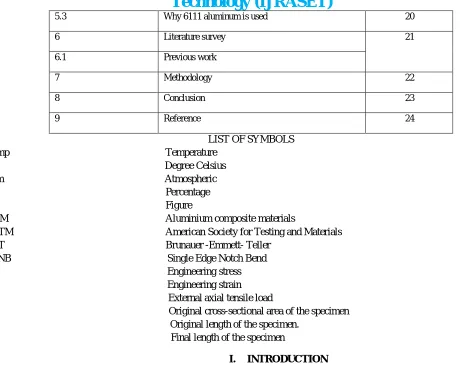
TABLE OF CONTENTS
CHAPTER NO TITLE PAGE NO
I Abstract 1
1 Introduction
4 1.1 Introduction of composite materials
Technology (IJRASET)
5.3 Why 6111 aluminum is used 20 6 Literature survey 21 6.1 Previous work
7 Methodology 22
8 Conclusion 23
9 Reference 24
LIST OF SYMBOLS
Temp Temperature
˚C Degree Celsius
Atm Atmospheric % Percentage
Fig Figure
ACM Aluminium composite materials
ASTM American Society for Testing and Materials BET Brunauer -Emmett- Teller
SENB Single Edge Notch Bend
σE Engineering stress
εE Engineering strain
PE External axial tensile load
Ao Original cross-sectional area of the specimen Lo Original length of the specimen.
Lf Final length of the specimen
I. INTRODUCTION
A. Introduction of composite material
A composite material is a material system composed of two or more macro constituents that differs in chemical composition and shape and which are insoluble in each other whose combination produces aggregate properties that are different from those of its constituents .the history of material back to early 20th century .In 1940, fiber glass was first used to reinforce epoxy combination of different materials which yield a product with superior properties. It is possible to combine several different material in a single composite into a single product. Aluminium is an isotropic material which means it has the same materials in all directions. Composites are anisotropic which means they have different properties depending on the direction of the fibre vs the direction on the applied loading.
Composites are built in layers called ply’s that are stacked laid up to form a laminate. Each layer has fibres that run in defined direction, because of the layer the properties are different in plane vs through the thickness.
Composites are very strong and stiff, yet very light in weight so ratios of strength–to weight and stiffness-to weight are several time stronger than the steel. Fatigue properties are generally better than for common engineering metal. Toughness is often stronger too composites can be designed that to not corrode like steel. Possible to achieve combination of properties not attainable with metals,ceramics or polymers alone.
Composites materials are generally expensive. Manufacturing method for shaping composite material often slowly and costly. Properties of many important composites are anisotropic – the properties differs depending on the direction in which they are measured – this may be an advantage or disadvantage. Many of the polymers based composites are subject to attack by chemicals or solvents , just the polymers themselves are susceptible to attack.
[image:3.612.55.521.66.432.2]Technology (IJRASET)
have larger electrical response to hydrostatic compression than phase alone. A two phase composite material exhibits a product property if the output from one phase acts as an input for other phase.
B. The theory of composites
The common metals are composites. The polycrystalline nature becomes evident in the roughness of the surface when one breaks a road of metal. A wonderful meteorite collection is showcased in the American Museum of Natural History. Composites are prevalent in both nature and among engineered materials. A shape of memory metal is Marten site which has a laminar type structure that is comprised of alternating layers of the two types of marten sites. Sandstones are aggregates of crystals. Construction materials such as wood and concretes are also composites and also fiberglass and lightweight carbon fiber composites have found applications ranging from the sports equipment to the aerospace industries.
We study about composites because they often combine the sttributes of the constituent materials. By combining a compliant isotropic material that has low bulk and shear moduli with a stiff isotropic material that has bulk and shear moduli one can produce an elasticity isotropic composite that effectively has the bulk modulus of the compliant phase and the shear modulus of the stiff phase.
C. Classification of composite materials
1) Traditional composites– Composite materials that occur in nature or have been produced by civilizations for many years. These have been the traditional composites for ages.
2) Synthetic composites - Modern material systems normally associated with the manufacturing industries, in which the components are first produced separately and then combined in a controlled way to achieve the desired structure, properties, and part geometry.
3) A short introduction into the linear mechanics of deformable solids with anisotropic material behaviour are the types.
4) The mechanical behaviour of composite materials as unidirectional reinforced single layers or laminated composite materials, the analysis of effective moduli, some basic mechanisms and criteria of failure.
5) The modelling of the mechanical behaviour of laminates and sandwiches, general assumptions of various theories, classical laminate theory (CLT), effect of stacking of the layers of laminates and the coupling of stretching, bending and twisting, first order shear deformation theory (FOSDT), an overview on refined equivalent single layer plate theories and on multi-layered plate modelling,Nearly all composite material consists of phases.
6) There are primary phases – forms the matrix within which the secondary phases is imbedded.
7) Secondary phases – imbedded phases some time referred to as a reinforcing agent ,because it usually serves to strengthen the composite
D. General information- history
The history of the light metal industry, is one of notable and ever accelerating expansion and development as that of many other industries in this century, there are few people today who are not familiar with at least some modern application of aluminum and its alloys.
The part it plays in our everyday life is such that the metal was still a comparative amity and it is difficult to realize that a century ago. Due to its affinity for oxygen the excellent corrosion resistance of pure aluminium is large and this results in the production of a very thin but tenacious oxide film which covers the surface as soon as a freshly-cut piece of the metal is exposed to the atmosphere.
Practically every type of surface finish for the metal this oxide coating is of great significance in the production. It is of course, the basis of the technique of anodic oxidation in its varied forms is what probably the most corrosion-resistant finish of all, namely, that group of finishes which gets involved.
There is a common belief that graphite's lubricating properties are solely due to the loose intermellar coupling between sheets in the structure. However, it has been shown that in a vacuum environment like the outer space the graphite is a very poor lubricant. This observation led to the hypothesis that the lubrication is due to the presence of fluids between the layers like as air and water, which are naturally adsorbed from the surroundings.
This studies by hypothesis has been refuted showing that air and water are not absorbed. Recent studies suggest that an effect called super lubricity can also account for graphite's lubricating properties.
Technology (IJRASET)
most corrosion-resistant finish of all is of course, the basis of what is probably, namely, that group of finishes which involves the technique of anodic oxidation in its varied forms.
Here, the natural film is, in effect, greatly thickened and strengthened by electrochemical means. In the production of other finishes on the other hand, special techniques have had to be evolved to effect this.
II. MATERIALS SELECTION IN AUTOMOTIVES
Today, a typical family vehicle weighs about 1400kg with iron and steel accounting for the majority of this weight. However, the new trends in vehicle light weighting aim not only to enhance vehicle fuel efficiency, but also to improve its driving performance while lowering its emissions at the same time. This can be achieved to a high degree through the use of lighter weight materials like aluminium and plastics.
Based on a national study, a ten percent reduction in vehicle weight translates to a 5% increase in miles per gallon. This in turn means that a sizable savings in gasoline and the accompanying emissions will be achieved with an annual build of 15 million passenger vehicles.
Technologies and demands Regulatory constraints on energy consumption have influenced vehicle development for over three decades. With recent rises in oil prices due to increasing demand and unrest in the Middle East, and the increased prominence of global warming and other environmental concerns in the popular press, technological advances to improve vehicle efficiency are becoming increasingly important to competitiveness in the global automobile market.
One key technical design strategy for improving vehicle efficiency is the reduction of vehicle mass, or light-weighting. Vehicle light-weighting not only enhances fuel efficiency, but also lowers vehicle emissions and improves driving performance. Light-weight subsystems such as hoods and deck lids are already employed throughout the industry to achieve small Light-weight savings. However, significant improvements in vehicle efficiency will require larger changes in mass. A primary target for this mass reduction is the body, whose standard steel version comprises 20–25% of total vehicle curb weight. The main strategic approaches for reducing weight in the body parts is material substitution.
Fig.1: Aluminium roll Fig.2: Aluminium hollow rod
At present, alternative materials are most competitive in low volume production where tooling, rather than materials most affects unit cost. Aluminium could reduce body weight by up to 40%. Weight reduction also improves overall performance and handling. 10% weight loss can reduce acceleration time from 0 to 100 kmph by 8%. Research using finite element and design sensitivity analysis shows that a 20% or greater reduction in body weight can be achieved by combining new material.
III. LIGHT WEIGHT MATERIALS
The Weight reduction of automobile parts may lead to higher fuel economy. Among all the techniques related to increased fuel economy, weight reduction plays a major role since 30% weight reduction gives 15-20% greater fuel economy. It is based on simple logic that an engine has to work less to accelerate and move the light parts.
Another advantage of weight reduction through lighter materials is minimization of overall CO2 reduction. The weight of the materials depends on their density. Steel having density 7850 kg/m3 contributes more weight than a composite having density 1470 kg/m3. Lighter materials can lead better performance of vehicle like acceleration and handling.
Technology (IJRASET)
Force = mass X acceleration.
Fig.3: Density of different materials.
Here, reduction in mass results in less force to accelerate the things. Another advantage of lowering weight at the top of vehicle i.e. roof, results in lowering the centre of gravity of vehicle. This reduces the risk of vehicle rollover and improved vehicle performance other than fuel economy.
Light weighted parts gives less load to suspension system of vehicle with reduction in noise and vibration. Light weighted materials gives automobile engineer to design a vehicle with more luggage space and capacity that can be moved by the same engine.
Technology (IJRASET)
A. Recycling
Drawing on these latest developments, this study uses process-based cost modelling to gain insights into the cost-feasibility of a new fibre-reinforced composite body-in-white against the existing steel design. The results show that the potential for fibre-reinforced composite bodies-in-white to be competitive against steel is greater than it has been in the past.
Fig.5: Flowchart of recycling
IV. GRAPHITE-AN OVERVIEW
The structure of graphite consists of many layers which is parallel to the basal plane of hexagonally linked carbon atoms. In the graphite structure only three of the four valence electrons of carbon form regular covalent bonds with adjacent carbon atoms. Strong chemical bonding force exists within the layer planes.
At the same time, the weak forces between layer planes account for the tendency of graphitic materials to fracture along planes, the formation of interesting compounds and lubricating, compressive and many other properties of graphite. The structure of graphite has been determined through such methods as X-ray diffraction, transmission electron diffraction, these methods are highly sophisticated and generally require very expensive with a highly skilled operator.
This is normally beyond the scope of testing or analysis is more research oriented, no standard methods will be presented. Graphite are also highly isotropic with respect to their respect structure and properties. This means that the properties vary depending on which directions they are being measured in.
Technology (IJRASET)
Fig.6: The crystal structure of graphite
The structure of graphite with regard to interlayer spaings and crystallite size does change with temperature. The apparent density will be influenced by temperature during globalization process. Generally, the higher the graphitization temperature , the higher the density will become. There are alos other factors which may also continue to this but there is an appreciable density increase as you go from 2000˚C to 3000˚C. There is no recognized ASTM standard for measuring the porosity of manufactured graphites at this present scenario. One of the mainly widely used methods is mercury porosimetry. Two other methods in use are gas adsorption by the BET technique and direct image analysis of the microstructure.
The mercury porosimetry technique is the method used for the data reported in graphite literature. The below graphs show the rate in which apparent density and closed porosity is being compared for graphite and the rest of the other graph shows how pore diameter and density is compared for the graphite material.
Fig.7: closed porosity vs density, pore diameter vs density
Graphite have electrical resistivity values that fall in the range of most conventional graphite. Graphite’s have a range from around 450Ὠ in or tool steels which range from 7.1 to 7.5. The standardized method of measuring the resistivity of graphite sample is described in ASTM standard.
Technology (IJRASET)
the resistance decreases. And also the modulus of elasticity varies for the many different grades available.
A. Properties of graphite
Since phonons propagate quickly along the tightly-bound planes the acoustic and thermalproperties of graphite are highlyanisotropic, but are slower than to travel from one place to another. Graphite's high thermal stability and electrical conductivity facilitate a widespread uses. In which these uses are electrodes and refractories in high temperature processing of the materials applications. However, atmospheres containing oxygen graphite readily oxidizes to form co2 at temperatures of 700 °c and above.
Graphite is an electric conductor, which is useful in many applications asarc lamp electrodes. It can also conduct electricity due to the vast electron delocalization within the carbon layers. This phenomenon is called as aromaticity. These valence electrons are able to conduct electricity as they are free to move. However, primarily the electricity is conducted within the plane of the layers. The conductive properties of powdered graphite allows its use as pressure sensor in carbon microphonesGraphite powder are valued in industrial applications for a purpose of self-lubricating and drylubricating properties in materials.
There is a common study that graphite's lubricating properties are due to the loose intermellar coupling between sheets in the structure of the material. Such as in technologies for use in space it has been shown that in a vacuum environment, graphite is a very poor lubricant. This kind of observation led to the hypothesis that the lubrication is due to the presence of fluids between the layers like as air and water, which are naturally adsorbed from the environment. This important past study has been refuted by studies showing that air and water are not absorbed. But in present studies suggest that an effect which is called as super lubricity can also account for properties of graphite's lubricating. The tendency for use of graphite is limited to facilitatepitting corrosion in somestainless material and also to promote galvaniccorrosion between dissimilar metals because of its electrical conductivity. It is mainly corrosive to aluminum in the presence of moisture in vacuum state. For this reason, theair force banned its use as a lubricant in aluminum aircrafts, and discouraged its use in automatic weapons containing aluminum. Aluminum parts may facilitate corrosion if graphite marks on in vacuum state. Hexagonal boron nitride an another high-temperature lubricant aldso has the same molecular structure as graphite. It is sometimes called white graphite, due to some of its properties.
When a large number of crystallographic defects can bind these planes together, lubrication properties lost for graphite and becomes as a material that is known as pyrolytic graphite. Its properties are also highly anisotropic, and diamagnetic, making it float in mid-air above a strong magnet. It is an isotropic turbostatic if this is made in a fluidized bed at 1100–1300 °c then, and is used in mechanical heart valves for blood contacting devices like and this is called pyrolytic carbon, and is not diamagnetic. Pyrolytic graphite, and pyrolytic carbon are very different materials but are often confused.
Due to their shear-planes natural and crystalline graphite are not often used in pure form as structural materials, brittleness and inconsistent mechanical properties.
B. Why graphite is used
One of the most versatile non-metallic minerals in the world is Graphite.
1) An excellent conductor of heat and electricity
2) The natural strength and stiffness is highest of any material.
3) Strength and stability to temperatures in excess of 3,600 °C is maintained.
4) One of the lightest of all reinforcing agents.
5) It has high natural lubricity.
6) Chemically inert with a high resistance to corrosion.
Technology (IJRASET)
V. DEVELOPMENT OF ALUMINUM
The chief alloying constituents are graphite, copper, magnesium, silicon, manganese, nickel and zinc are being added to aluminum are. All of these constituents are used to increase the strength of pure aluminum.
Fig.9: Aluminium alloys Fig.10: Aluminium alloys
There are two classes of alloys in present scenario. The first are the 'cast alloys' which are cast directly into their desired forms by one of three methods, the method are sand-casting, gravity die casting or pressure die casting, while the second class is the 'wrought alloys', that are cast in ingots or billets and in which hot and cold worked mechanically into extrusions, forgings, sheet, foil, tube and wire.
2000 series (al-cu alloys) are the main classes of alloys are that in which are high-strength materials used mainly in the aircraft industry, the 3000 series (al-mn alloys) used mainly in the production in canning industry, the 5000 series (al-mg alloys) which are used for structural and architectural applications for modifications, the most common extrusion alloys which are the 6000 series (al-mg-si alloys) and are used particularly in the building industry, and the 7000 series (al-zn-mg alloys) which are again high strength alloys for aircraft and military vehicle applications.
Factors such as the mechanical and physical properties required for the alloy used in any particular application will depend on, the material cost and the service environment involved. If a finishing treatment is to be applied, then the suitability of the alloy for producing the particular finish desired will be an additional factor to be taken into account.
A wide variety of alloys is the great benefit of aluminum is that mixing of different mechanical and protection properties is available, and these, together with the exceptional range of finishes which can be used, make aluminum a very versatile material.
Fig.11: Hollow rod Fig.12: Aluminium bar
A. Types of aluminum
1) 6111 aluminium and 2008 aluminium alloy are widely used for manufacturing of external automotive body panels, with 5083 and 5754 used for inner body panels.
2) The vehicle hoods have been manufactured from the various 2036, 6016, and 6111 alloys.
3) Truck and trailer body panels have used 5456 aluminium for manufacturing of body parts
Technology (IJRASET)
5) The vehicle wheels have been casted from A356.0 aluminium or formed 5xxx sheet.
6) For vehicle we can just choose to heat-treat it to a strength and replace a steel part that just happened to not be as strong. But you can also just add gauge that will make the material much thicker]. Aluminium being a third when compared to dense of steel, we can have three times the thickness before you have the same weight as steel. So in a lot of cases, we found chances of profit and eco-friendly
B. Cost for repairing aluminium versus steel
Aluminium always is more expensive than steel on any day, but a couple of things we’ve come to understand are:
As said many vehicles every year actually need heavy repair, but even when it comes to replacing panels, the fact that you can just grind out the rivets and not have disturbance to the base metal and just pop in a new panel, studies are done that is very pretty simple and elegant.
So we’re very much concerned about it and we’re preparing to make this very accommodating to the customer.
Fig.13:Car hood
C. Why 6111 aluminium is used
1) The premiere aluminium alloy used for automotive panelling is the 6111. Corrosion resistance and precipitation hardening are the favourable characteristics in this.
2) Age hardening, also called Precipitation hardening, is a heat treatment technique used to increase the yield strength of malleable materials, including most structural alloys of aluminium, magnesium, nickel, and some steels and stainless steels. It is known to cause yield strength anomaly providing excellent high-temperature strength in super alloys.
3) Aluminium has a better properties for dent and ding resistance.
4) Many vehicles every year actually need heavy repair, but even when it comes to replacing panels, the matter that you can just grind out the rivets and not have disturbance to the base metal and just pop in a new panel, studies say that’s pretty simple and elegant.
VI. LITERATURE SURVEY
Technology (IJRASET)
Partnership for a New Generation of Vehicles (PNGV). It is conventional wisdom within the industry that the use of polymer matrix composites in automobile structures cannot be defended on an economic basis.
2) A 1995 study by IBIS Associates and the Rocky Mountain Institute, based on GM’s ultralight BIW concept car, argued that concerns over economic viability may be misplaced.
3) A 1999 study by the Rocky Mountain Institute has suggested that polymer composite BIW alternatives may be well suited to platforming goals by providing a cheaper and more easily contoured solution for the customized elements not part of the shared platform. The work presented in this paper differs from previous studies in several ways:
4) It is based on, up-to-date detailed data collection with resin and fibre suppliers, equipment suppliers, component producers, and Ford, General Motors, and Daimler-Chrysler
5) It applies new component and assembly modelling techniques
6) It evaluates the competitiveness of polymer composites against real North American car production volumes.
7) It looks at how platform sharing changes the competitive position of polymer composites in BIW applications.
VII. METHODOLGY
The method of manufacturing the sheets involved in this is stirring of aluminium and graphite. The manufacture of these materials is comprised of two costs: fabricating the parts and assembling the parts. The costs associated with each step are derived from a combination of engineering principles and empirical data for manufacturing practices. Factor inputs include design specifications, materials parameters, processing parameters, and production parameters. Variable costs include energy, materials and direct labour. After these materials are made hardness test, compressibility test, tensile test and impact test are conducted and the compared with the existing material.
VIII. CONCLUSION
The present automobiles today are made of over 63% iron and steel by weight. With the rising energy and environmental concerns, as well as increases in electronics and other features on-board vehicle systems, the concept of vehicle light-weighting continues to be a prominent concern for vehicle manufacturers. Fibre-reinforced polymer composite technologies offer a way of light weighting the vehicle, the changes are both to increase fuel economy and to allow for the addition of other vehicle systems in the upcoming year.
Previous studies have suggested that polymer composite uni-bodies could potentially have economic viability at low production volumes. However, these studies are not up-to-date on the latest design and process technology of the present days, and fail to include platforming considerations. Several advances have occurred in fiber reinforced polymer composite body-in-white design, component processing, and assembly technology are being introduced in today’s world for an eco-friendly use.
Improving more on these latest developments, it uses process-based cost modelling to gain or attain insights into the cost-feasibility of a new fiber-reinforced composite body-in-white against the existing steel design of today’s modern vehicles. The results of these show that the potential for fiber-reinforced composite materials is to be competitive against steel is greater than it has been in the past.
Moreover, the potential cost-competitiveness of composites does not eliminates. Considering these actions, the model results suggest that approximately 41% of car models and 8% of the cars produced in the US and Canada in 2003 could have bought out cheaper if manufactured with a glass fiber-reinforced composite rather with than a steel uni-body. For another 31% of vehicles, glass fibre may be more competitive for the parts of the uni-body not included in the manufacturing of the vehicle.
A. In future work of project is to create a metal forming of aluminium with graphite. And to analysis the temperature and static structure .
REFERENCES
[1] Burkes DE, R Prabhakaran, T Hartmann, JF Jue, and FJ Rice. 2010a. “Properties of DU–10 wt% Mo alloys subjected to various post-rolling heat treatments,” Nuclear Engineering and Design 240:1332– 1339.
[2] Snelgrove JL, GL Hofman, MK Meyer, CL Trybus, and TC Wiencek. 1997. “Development of very-high-density low-enriched-uranium fuels,” Nuclear Engineering and Design 178:119–126.
[3] Burkes DE, T Hartmann, R Prabhakaran, J Jue. 2010b. “Microstructural characteristics of DU–xMo alloys with x = 7–12 wt%,” J. All. & Comp., 479[1-2].
[4] Metals Handbook, 9th ed., Mechanical Testing, Vol. 8. [5] N. Dowling, Mechanical Behavior of Materials, Prentice Hall.
[6] ASTM and TS Standards.
Technology (IJRASET)
[8] Samuel R. Low, Rockwell Hardness Measurement of Metallic Materials,2001
[9] Sharma Deepak, AshuYadav, Prof.NabiHasen, Strength Determination Of Aluminium At Different Temperatures, IJCSMS International Journal of Computer Science & Management Studies, , August 2011, Vol. 11 Issue 02.
[10] WilfriedWunderlich, Morihito Hayashi, Thermal Cyclic Fatigue Analysis of Three Aluminium Piston Alloys, International Journal of Material and Mechanical Engineering, 2012, PP- 57-60