Defining and Evaluating a Core Genome Multilocus Sequence
Typing Scheme for Genome-Wide Typing of
Clostridium difficile
Stefan Bletz,
a,bSandra Janezic,
c,dDag Harmsen,
eMaja Rupnik,
c,dAlexander Mellmann
a,baInstitute of Hygiene, University Hospital Münster, Münster, Germany
bNational Reference Center for Clostridium difficile, Münster Branch, Münster, Germany
cNational Laboratory for Health, Environment and Food, Maribor, Slovenia
dUniversity of Maribor, Faculty of Medicine, Maribor, Slovenia
eDepartment of Periodontology and Restorative Dentistry, University Hospital Münster, Münster, Germany
ABSTRACT
Clostridium difficile
, recently renamed
Clostridioides difficile
, is the most
common cause of antibiotic-associated nosocomial gastrointestinal infections
world-wide. To differentiate endogenous infections and transmission events, highly
dis-criminatory subtyping is necessary. Today, methods based on whole-genome
se-quencing data are increasingly used to subtype bacterial pathogens; however,
frequently a standardized methodology and typing nomenclature are missing. Here
we report a core genome multilocus sequence typing (cgMLST) approach developed
for
C. difficile
. Initially, we determined the breadth of the
C. difficile
population based
on all available MLST sequence types with Bayesian inference (BAPS). The resulting
BAPS partitions were used in combination with
C. difficile
clade information to select
representative isolates that were subsequently used to define cgMLST target genes.
Finally, we evaluated the novel cgMLST scheme with genomes from 3,025 isolates.
BAPS grouping (
n
⫽
6 groups) together with the clade information led to a total of
11 representative isolates that were included for cgMLST definition and resulted in
2,270 cgMLST genes that were present in all isolates. Overall, 2,184 to 2,268 cgMLST
targets were detected in the genome sequences of 70 outbreak-associated and
ref-erence strains, and on average 99.3% cgMLST targets (1,116 to 2,270 targets) were
present in 2,954 genomes downloaded from the NCBI database, underlining the
rep-resentativeness of the cgMLST scheme. Moreover, reanalyzing different cluster
sce-narios with cgMLST were concordant to published single nucleotide variant analyses.
In conclusion, the novel cgMLST is representative for the whole
C. difficile
popula-tion, is highly discriminatory in outbreak situations, and provides a unique
nomen-clature facilitating interlaboratory exchange.
KEYWORDS
Clostridium difficile
, cgMLST, whole-genome sequencing, typing
C
lostridium difficile
, recently renamed
Clostridioides difficile
, is an anaerobic,
Gram-positive, endospore-forming rod-shaped bacterium and the most common cause of
antibiotic-associated nosocomial gastrointestinal infections in Europe and the United
States (1, 2). Over the last decades, severe
C. difficile
infections (CDI) have been
increasingly detected in hospitals, making
C. difficile
an important nosocomial
patho-gen. CDI develop either from endogenous colonization under selecting conditions such
as an antibiotic treatment or from an exogenous source, i.e., spores from the
contam-inated environment (3).
Several methods are described for
C. difficile
typing, of which PCR ribotyping is
currently becoming a gold standard worldwide (1, 4). For an initial grouping of strains,
multilocus sequence typing (MLST) (5, 6) and toxinotyping (7) are also widely used
methods. For highly discriminatory subtyping of strains, which is necessary in the case
Received20 December 2017Returned for modification15 January 2018 Accepted28 March 2018
Accepted manuscript posted online4 April 2018
CitationBletz S, Janezic S, Harmsen D, Rupnik M, Mellmann A. 2018. Defining and evaluating a core genome multilocus sequence typing
scheme for genome-wide typing ofClostridium
difficile. J Clin Microbiol 56:e01987-17.https:// doi.org/10.1128/JCM.01987-17.
EditorDaniel J. Diekema, University of Iowa College of Medicine
Copyright© 2018 American Society for
Microbiology.All Rights Reserved.
Address correspondence to Alexander Mellmann, [email protected].
crossm
on May 16, 2020 by guest
http://jcm.asm.org/
of a suspected outbreak, these methods are sometimes complemented with
pulsed-field gel electrophoresis (PFGE) or multilocus variable-number tandem-repeat (VNTR)
analysis (MLVA) (4); both methods are able to differentiate among closely related
isolates. Except for MLST, where a central database hosting the typing nomenclature is
in place, the interlaboratory exchange of such typing data is hampered by the lack of
a publicly available database ensuring a unique nomenclature and—in the case of PCR
ribotyping and PFGE— by difficulties to standardize the interpretation of DNA banding
patterns (4, 8).
Nowadays, sequence-based typing approaches using whole-genome sequence
(WGS) data are overcoming these obstacles. Several studies on various bacterial species
have already shown that WGS-based typing, based either on single nucleotide variants
(SNVs) (9, 10) or on gene-by-gene allelic profiling of core genome genes, frequently
named core genome MLST (cgMLST) (11–13), currently represents the ultimate tool for
strain subtyping. Moreover, it was recently shown in an international ring trial that
cgMLST is highly reproducible (14).
For
C. difficile
, initial studies also confirmed the general applicability of WGS-based
typing (9, 15, 16). Nevertheless, the broad use of WGS-based typing of
C. difficile
is still
hampered by the lack of standardized nomenclature (17); this has already been
established for other pathogens (18–21) and would facilitate interlaboratory exchange
of data.
Therefore, to obtain the basis of a standardized nomenclature for WGS-based
C.
difficile
typing, we defined a novel
C. difficile
cgMLST scheme covering the genetic
diversity within the
C. difficile
population based on well-characterized reference strains
and subsequently challenged this scheme using a diverse set of strains from sporadic
cases and outbreak investigations.
MATERIALS AND METHODS
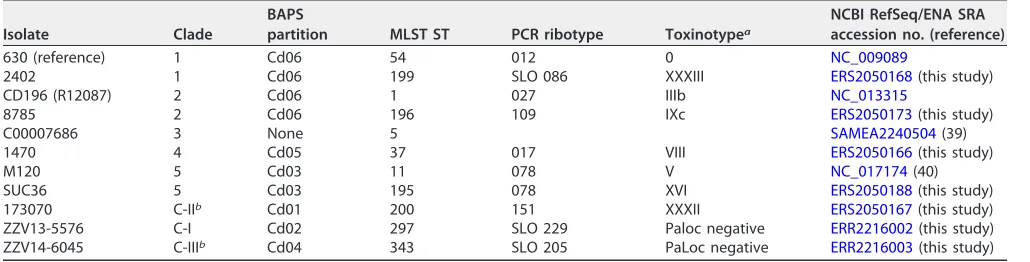
C. difficilestrains and genomes.All strains and genome sequences used for the development of the novelC. difficilecgMLST scheme are listed in Table 1. The isolates were selected by covering the whole diversity ofC. difficileorganisms, i.e., representative isolates for each clade (downloaded fromhttps:// pubmlst.org/cdifficile/) and— based on a Bayesian analysis of the genetic population structure (BAPS; see below) using all available MLST sequence types (STs) as input data—randomly selected representative isolates for each BAPS partition were included (17, 22). The well-definedC. difficilestrain 630 (23) was used as the reference sequence during cgMLST target definition. Moreover, the NCBI RefSeq sequences ofC. difficilestrains CD196 and M120 were used.
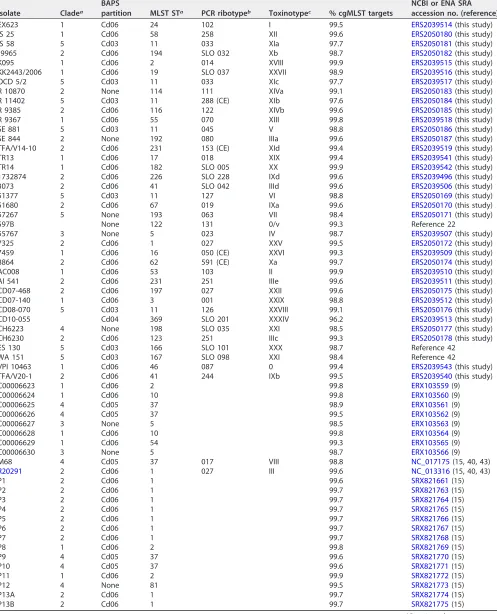
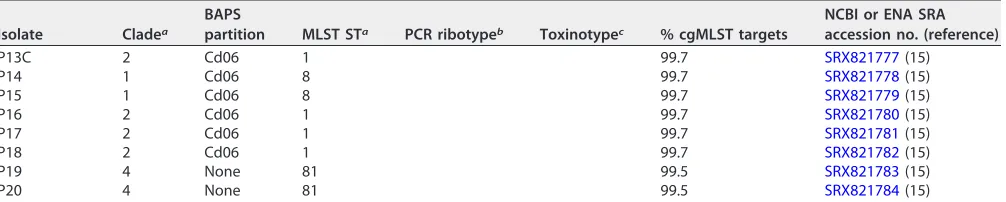
[image:2.585.40.555.83.214.2]For subsequent evaluation of the scheme, we used two different sets of isolates/genome sequences: first, a total of 70 well-definedC. difficileisolates (Table 2) were used comprising (i) the reference strains of all published toxinotypes (n⫽38) to cover the diversity of toxigenic strains (7), (ii) isolates from two published clusters (n⫽8) as examples to rule in or out nosocomial transmissions (9), and (iii) isolates detected during a surveillance study for infection control (n⫽24) (15). As a second set for evaluation of the cgMLST scheme, we downloaded 268 assembled genome sequences from the NCBI database (ftp://ftp.ncbi.nih.gov/genomes/) and sequence reads (only data generated with any Illumina sequencing platform) from 3,482C. difficileisolates from the NCBI Sequence Read Archive (SRA) that were available until 21 October 2015 and were assembled prior to use.
TABLE 1List ofClostridium difficileisolates and genomes used for cgMLST target definition
Isolate Clade
BAPS
partition MLST ST PCR ribotype Toxinotypea
NCBI RefSeq/ENA SRA accession no. (reference)
630 (reference) 1 Cd06 54 012 0 NC_009089
2402 1 Cd06 199 SLO 086 XXXIII ERS2050168(this study)
CD196 (R12087) 2 Cd06 1 027 IIIb NC_013315
8785 2 Cd06 196 109 IXc ERS2050173(this study)
C00007686 3 None 5 SAMEA2240504(39)
1470 4 Cd05 37 017 VIII ERS2050166(this study)
M120 5 Cd03 11 078 V NC_017174(40)
SUC36 5 Cd03 195 078 XVI ERS2050188(this study)
173070 C-IIb Cd01 200 151 XXXII ERS2050167(this study)
ZZV13-5576 C-I Cd02 297 SLO 229 Paloc negative ERR2216002(this study) ZZV14-6045 C-IIIb Cd04 343 SLO 205 PaLoc negative ERR2216003(this study)
aToxinotypes in accordance with recent update onC. difficiletoxinotyping (7). bPutative new lineage (41).
on May 16, 2020 by guest
http://jcm.asm.org/
TABLE 2List of 70C. difficileisolates and genomes (toxinotypes and cluster/outbreak isolates) for evaluation of the novel cgMLST scheme
Isolate Cladea
BAPS
partition MLST STa PCR ribotypeb Toxinotypec % cgMLST targets
NCBI or ENA SRA accession no. (reference)
EX623 1 Cd06 24 102 I 99.5 ERS2039514(this study)
IS 25 1 Cd06 58 258 XII 99.6 ERS2050180(this study)
IS 58 5 Cd03 11 033 XIa 97.7 ERS2050181(this study)
J9965 2 Cd06 194 SLO 032 Xb 98.7 ERS2050182(this study)
K095 1 Cd06 2 014 XVIII 99.9 ERS2039515(this study)
KK2443/2006 1 Cd06 19 SLO 037 XXVII 98.9 ERS2039516(this study)
OCD 5/2 5 Cd03 11 033 XIc 97.7 ERS2039517(this study)
R 10870 2 None 114 111 XIVa 99.1 ERS2050183(this study)
R 11402 5 Cd03 11 288 (CE) XIb 97.6 ERS2050184(this study)
R 9385 2 Cd06 116 122 XIVb 99.6 ERS2050185(this study)
R 9367 1 Cd06 55 070 XIII 99.8 ERS2039518(this study)
SE 881 5 Cd03 11 045 V 98.8 ERS2050186(this study)
SE 844 2 None 192 080 IIIa 99.6 ERS2050187(this study)
TFA/V14-10 2 Cd06 231 153 (CE) XId 99.4 ERS2039519(this study)
TR13 1 Cd06 17 018 XIX 99.4 ERS2039541(this study)
TR14 1 Cd06 182 SLO 005 XX 99.9 ERS2039542(this study)
1732874 2 Cd06 226 SLO 228 IXd 99.6 ERS2039496(this study)
3073 2 Cd06 41 SLO 042 IIId 99.6 ERS2039506(this study)
51377 5 Cd03 11 127 VI 98.8 ERS2050169(this study)
51680 2 Cd06 67 019 IXa 99.6 ERS2050170(this study)
57267 5 None 193 063 VII 98.4 ERS2050171(this study)
597B None 122 131 0/v 99.3 Reference 22
55767 3 None 5 023 IV 98.7 ERS2039507(this study)
7325 2 Cd06 1 027 XXV 99.5 ERS2050172(this study)
7459 1 Cd06 16 050 (CE) XXVI 99.3 ERS2039509(this study)
8864 2 Cd06 62 591 (CE) Xa 99.7 ERS2050174(this study)
AC008 1 Cd06 53 103 II 99.9 ERS2039510(this study)
AI 541 2 Cd06 231 251 IIIe 99.6 ERS2039511(this study)
CD07-468 2 Cd06 197 027 XXII 99.6 ERS2050175(this study)
CD07-140 1 Cd06 3 001 XXIX 98.8 ERS2039512(this study)
CD08-070 5 Cd03 11 126 XXVIII 99.1 ERS2050176(this study) CD10-055 Cd04 369 SLO 201 XXXIV 96.2 ERS2039513(this study) CH6223 4 None 198 SLO 035 XXI 98.5 ERS2050177(this study)
CH6230 2 Cd06 123 251 IIIc 99.3 ERS2050178(this study)
ES 130 5 Cd03 166 SLO 101 XXX 98.7 Reference 42
WA 151 5 Cd03 167 SLO 098 XXI 98.4 Reference 42
VPI 10463 1 Cd06 46 087 0 99.4 ERS2039543(this study)
TFA/V20-1 2 Cd06 41 244 IXb 99.5 ERS2039540(this study)
C00006623 1 Cd06 2 99.8 ERX103559(9)
C00006624 1 Cd06 10 99.8 ERX103560(9)
C00006625 4 Cd05 37 98.9 ERX103561(9)
C00006626 4 Cd05 37 99.5 ERX103562(9)
C00006627 3 None 5 98.5 ERX103563(9)
C00006628 1 Cd06 10 99.8 ERX103564(9)
C00006629 1 Cd06 54 99.3 ERX103565(9)
C00006630 3 None 5 98.7 ERX103566(9)
M68 4 Cd05 37 017 VIII 98.8 NC_017175(15, 40, 43)
R20291 2 Cd06 1 027 III 99.6 NC_013316(15, 40, 43)
P1 2 Cd06 1 99.6 SRX821661(15)
P2 2 Cd06 1 99.7 SRX821763(15)
P3 2 Cd06 1 99.7 SRX821764(15)
P4 2 Cd06 1 99.7 SRX821765(15)
P5 2 Cd06 1 99.7 SRX821766(15)
P6 2 Cd06 1 99.7 SRX821767(15)
P7 2 Cd06 1 99.7 SRX821768(15)
P8 1 Cd06 2 99.8 SRX821769(15)
P9 4 Cd05 37 99.6 SRX821770(15)
P10 4 Cd05 37 99.6 SRX821771(15)
P11 1 Cd06 2 99.9 SRX821772(15)
P12 4 None 81 99.5 SRX821773(15)
P13A 2 Cd06 1 99.7 SRX821774(15)
P13B 2 Cd06 1 99.7 SRX821775(15)
(Continued on next page)
on May 16, 2020 by guest
http://jcm.asm.org/
BAPS.To determine the overallC. difficilespecies variation, we used Bayesian Analysis of Population Structure (BAPS) version 6.0 (17, 24, 25). Sequences of all MLST STs available as of 31 March 2016 (n⫽
347 STs) were downloaded from the MLST website (https://pubmlst.org/cdifficile/) (6), and all allelic gene sequences per locus were multiply aligned using MUSCLE (26) and finally concatenated for each ST. BAPS was carried out using the clustering of linked molecular data functionality. Ten runs were performed, setting an upper limit of 30 partitions. Admixture analysis was performed using the following parameters: minimum population size considered, 1; iterations, 50; number of reference individuals simulated from each population, 50; and number of iterations for each reference individual, 10.
DNA extraction, whole-genome sequencing, and assembly.Prior to sequencing, the isolates were cultured anaerobically for 48 h at 37°C on Columbia blood agar plates (Oxoid, Wesel, Germany) and DNA was extracted using a fast glass bead method (27). Sequencing libraries were prepared using Nextera XT chemistry (Illumina Inc., San Diego, CA) for a 250-bp paired-end sequencing run on an Illumina MiSeq sequencer. Samples were sequenced to aim for minimum coverage of 120-fold using Illumina’s recom-mended standard protocols. The resulting FASTQ files were de novo assembled using the SPAdes assembler version 3.11 (28) integrated in Ridom SeqSphere⫹software (29) (version 5.0 beta; Ridom
GmbH, Münster, Germany) using the following SPAdes parameters: k, automatic selection based on read length and mismatch careful mode turned on.
cgMLST target gene definition.To determine the cgMLST gene set, a genome-wide gene-by-gene comparison was performed using the cgMLST target definer (version 1.4) function of SeqSphere⫹(Ridom
GmbH) with relaxed parameters (ⱖ80% gene sequence identity and 100% gene sequence overlap) reflecting the high diversity withinC. difficile. These cgMLST target definer parameters comprised the following filters to exclude certain genes of the C. difficile strain 630 reference genome (GenBank accession numberNC_009089.1) from the cgMLST scheme: a “minimum length filter that discards all genes that are shorter than 50 bases,” a “start codon filter that discards all genes that contain no start codon at the beginning of the gene,” a “stop codon filter that discards all genes that contain no stop codon, more than 1 stop codon or if the stop codon is not at the end of the gene,” a “homologous gene filter that discards all genes that have fragments that occur in multiple copies in reference genome (with identity ofⱖ90% and more than 100 bases overlap),” and a “gene overlap filter that discards the shorter gene from the cgMLST scheme if the two genes affected overlap more than 4 bases.” The remaining genes were then used in a pairwise comparison with BLAST version 2.2.12 (parameters used were word size 11, mismatch penalty⫺1, match reward 1, gap open costs 5, and gap extension costs 2) with the queryC. difficilechromosomes. All genes of the reference genome that were common in all query genomes with a sequence identity ofⱖ80% and 100% overlap (with the default parameter stop codon percentage filter turned on; i.e., more than 80% of the query genomes do not contain internal stop codons) formed the final cgMLST scheme.
Evaluation of the cgMLST target gene set.To evaluate the representativeness and the discrimi-natory power of the novelC. difficilecgMLST target gene set, we used the above-mentioned genomes (Table 2; see also Tables S3 and S4 in the supplemental material). To ensure the sequence quality of the downloaded genomes/reads prior to further analyses, only isolates with a coverage of ⱖ50 and a consensus base count that deviated at most ⫾10% from the median consensus base count were included. A well-defined cgMLST scheme should result, on average, in 97.5% extracted cgMLST target genes (30). To extract the cgMLST genes, the default parameters were used in the SeqSphere⫹software:
(i) for processing options, “Ignore contigs shorter than 200 bases”; (ii) for scanning options, “Matching scanning thresholds for creating targets from assembled genomes” with “required identity to reference sequence of 90%” and “required alignment to reference sequence with 99%”; and (iii) for BLAST options, word size 11, mismatch penalty⫺1, match reward 1, gap open costs 5, and gap extension costs 2. In addition, the target genes were assessed for quality, i.e., the absence of frameshifts and ambiguous nucleotides. A core genome gene was considered a “good target” only if all of the above-listed criteria were met, in which case the complete sequence was analyzed in comparison to the reference sequence. Alleles for each gene were assigned automatically by the SeqSphere⫹software to ensure a unique
[image:4.585.43.546.83.184.2]nomenclature. The combination of all alleles in each strain formed an allelic profile that was used to generate minimum spanning trees (MST) using the parameter “pairwise ignore missing values” during distance calculation.
TABLE 2(Continued)
Isolate Cladea
BAPS
partition MLST STa PCR ribotypeb Toxinotypec % cgMLST targets
NCBI or ENA SRA accession no. (reference)
P13C 2 Cd06 1 99.7 SRX821777(15)
P14 1 Cd06 8 99.7 SRX821778(15)
P15 1 Cd06 8 99.7 SRX821779(15)
P16 2 Cd06 1 99.7 SRX821780(15)
P17 2 Cd06 1 99.7 SRX821781(15)
P18 2 Cd06 1 99.7 SRX821782(15)
P19 4 None 81 99.5 SRX821783(15)
P20 4 None 81 99.5 SRX821784(15)
aMLST STs were in accordance to theC. difficileMLST database (https://pubmlst.org/cdifficile/), and clades were determined in this study (see Table S1). bPCR ribotypes were in accordance to recent publications (7, 40).
cToxinotypes were given in accordance with the recent update onC. difficiletoxinotyping (7).
on May 16, 2020 by guest
http://jcm.asm.org/
In order to maintain backwards compatibility with classicalC. difficileMLST, the sequences of the seven genes comprising the allelic profile of the MLST scheme were extracted separately from the genome sequences and queried against theC. difficileMLST database in order to assign STsin silicousing the SeqSphere⫹software that queries the respective gene sequences, compares them with the allele
library of each of the seven MLST target genes, and assigns alleles and STs.
Accession number(s).All raw reads generated and/or contig sequences were submitted to the European Nucleotide Archive (http://www.ebi.ac.uk/ena/) under accession number PRJEB23450. The NCBI accession numbers for the sequences determined for this study areERR2216002, ERR2216003, ERS2039496, ERS2039506, ERS2039507, ERS2039509 to ERS2039519, ERS2039540 to ERS2039543, ERS2050167toERS2050178, andERS2050180toERS2050188(see Tables 1 and 2).
RESULTS
To develop a cgMLST scheme that sufficiently covers the diversity of the species
C.
difficile
, we initially determined— besides the known partitioning into clades—the
diversity using BAPS. This approach based on 347 STs resulted in six partitions
com-prising 306 STs; 41 STs were not assigned to any BAPS group (Table S1). Based on this
grouping, 11 genome sequences, including that of
C. difficile
strain 630 (Table 1), were
used to define the cgMLST scheme. Their comparison resulted in selection of 2,270
genes out of 3,756 genes present in strain 630 (50.4% of the 630 strain chromosome
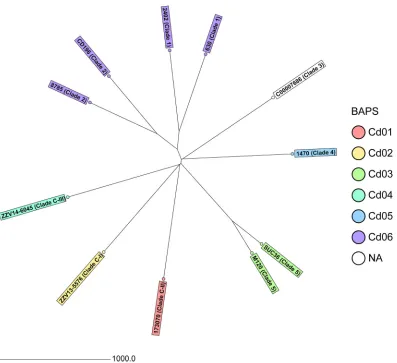
nucleotides) (Table S2). Figure 1 illustrates the diversity of the 11 isolates used for
cgMLST target definition.
This novel cgMLST scheme was then challenged with different sets of strains (Table
2; see also Table S3). Out of the genomes of the 38 reference strains of all published
FIG 1Neighbor-joining tree of the 11C. difficileisolates used for cgMLST target definition based on cgMLST target genes with pairwise ignore missing values. In addition to the sample name, the clade is given and the BAPS partitions are colored. The distance is given as the number of cgMLST genes.
on May 16, 2020 by guest
http://jcm.asm.org/
[image:5.585.45.442.68.431.2]toxinotypes, 2,184 to 2,268 cgMLST targets (mean, 99.1%; median, 99.4%) could be
extracted. Similarly, for the two published outbreaks, all isolates contained 2,237 to
2,267 cgMLST targets (mean, 99.5%; median, 99.7%), underlining the
representative-ness of the cgMLST scheme.
Moreover, we investigated the publicly available genome sequences from the NCBI
(
n
⫽
268 assembled
C. difficile
genomes and reads from 3,482 isolates of the SRA). We
first determined the median of the consensus base count (4,150,084 bp) and included
only genomes of isolates in the analysis that exhibited
⫾
10% of the median consensus
base count. Furthermore, genomes of isolates with coverage
⬍
50-fold were excluded
as well as NCBI assembled genomes, which also existed as SRA isolates. In total, we
finally included 2,954 publicly available genomic data in our final analysis. Summarized
from Table S4, on average 99.3% cgMLST targets were detected (median, 99.6%; 1,116
to 2,270 targets). Figure S1 illustrates the population structure and relationship to
classical MLST STs.
To further ascertain the representativeness of our approach, especially using BAPS,
we determined the ST distribution and percentage of isolates from the 2,954 isolates
that were not grouped into any of the BAPS groups. After exclusion of 33 isolates with
an unknown ST, only 9 of the 41 STs that were not assigned to any BAPS group were
present in 123 (4.2%) isolates. Of these 123 isolates, however, all had, on average 98.8%
cgMLST targets (Table S4).
After confirmation of the representativeness of the novel cgMLST scheme, we
analyzed the capability of the scheme to differentiate among closely related isolates
from outbreak investigations. We reanalyzed different scenarios from the literature
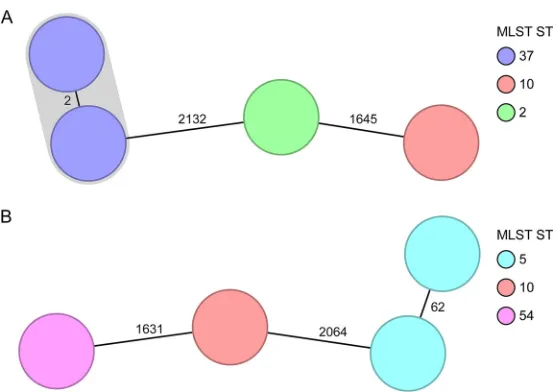
comprising short- and long-term scenarios (9, 15). In Fig. 2, two short-term
spatiotem-poral clusters spanning 17 to 22 days illustrate two typical clinical scenarios: while Fig.
2A shows that a clonal spread was detected among two isolates differing in only two
cgMLST targets, Fig. 2B indicates that a transmission could be ruled out, as the
suspected isolates belonged to the same ST type but differed in 62 cgMLST targets.
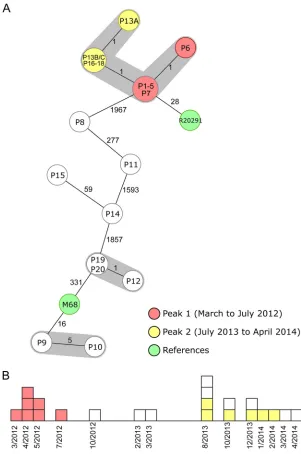
These findings were in accordance with the published SNV analysis (9). Figure 3 shows
the cgMLST typing results from a recent long-term outbreak investigation in a Chinese
hospital from 2012 to 2014 (15). Two peaks (March to July 2012 and August 2013 to
February 2014) of a clonal spread were recognized; again, our reanalysis using cgMLST
FIG 2Minimum-spanning tree of two spatiotemporal clusters (9). Each node represents a unique cgMLST allele profile. The numbers on connecting lines display the number of differing alleles between the genotypes (line length not to scale). The different nodes are colored by the MLST ST, and closely related genotypes (ⱕ6 different cgMLST alleles) are shaded. (A) Short-term cluster of four cases, where one transmission event was epidemiologically confirmed (2,244 to 2,265 cgMLST target genes [mean, 99.5%] were analyzed). (B) Short-term cluster of four cases, where a clonal transmission was ruled out (2,237 to 2,265 cgMLST target genes [mean, 99.1%] were analyzed).on May 16, 2020 by guest
http://jcm.asm.org/
[image:6.585.67.346.68.264.2]corroborated the previous findings that these peaks were linked and belonged to the
same outbreak clone. Based on these results, we finally defined the threshold, i.e., the
maximum number of differing alleles for isolates that are likely to belong to the same
clone, as
ⱕ
6 alleles. Isolates sharing genotypes within this threshold are then grouped
within the same cluster type (CT) (21).
DISCUSSION
Here we describe the establishment of a novel cgMLST scheme for
C. difficile
, the
most common cause of antibiotic-associated gastrointestinal infections worldwide.
FIG 3Minimum-spanning tree and epidemiological curve illustrating a long-term spatiotemporalC. difficilecluster with two identified peaks (15). The 22 cluster isolates are colored according to their peaks, and the two reference strains are marked in green. (A) Minimum-spanning tree of the reanalyzed sequences based on cgMLST targets. Each node represents a unique allelic profile, and the size of the nodes represents the number of isolates. The numbers on connecting lines are the numbers of differing alleles between the genotypes (not to scale), and closely related genotypes (ⱕ6 different cgMLST alleles) are shaded; 2,243 to 2,267 cgMLST target genes (mean of 99.6% of all cgMLST targets) were analyzed. All isolates of peaks 1 and 2 belonged to ST1. (B) Epidemiological curve. Each box represents one isolate, and boxes are colored according to their peak affiliation.on May 16, 2020 by guest
http://jcm.asm.org/
[image:7.585.53.354.70.524.2]Based on a collection of isolates that represent the diversity of
C. difficile
organisms, we
were able to construct a robust cgMLST scheme that contains 2,270 targets. This is in
concordance with a previous estimate of the number of
C. difficile
core genes, where—
depending on the number of strains and their characteristics—a range of 600 to 3,000
target genes were predicted (31).
Until today, SNV analysis was mainly reported for
C. difficile
WGS comparisons of
circumscribed clinical or epidemiological settings (9, 15, 16). In this study, SNV results
were calculated in comparison to a reference sequence among all strains included; any
addition of strains would result in novel SNV results, which could lead to conflicting
results, as SNV typing does not rely on a fixed nomenclature but is (re)calculated as
soon as a novel strain is added. In contrast, cgMLST allows an easy curation of allelic
data in a central database, which is a prerequisite for ensuring a universal typing
nomenclature as already shown nearly 2 decades ago for “classical” MLST (32). The
recently established database (
http://www.cgmlst.org/
) currently hosts (November
2017) the nomenclature for cgMLST schemes of nine different species (18–21, 33, 34),
enabling a uniform typing nomenclature for thousands of genes using next-generation
sequencing. The allele-based approach comprises another advantage in comparison to
SNV-based approaches: it treats both a mutation that creates an SNV and a
recombi-nation that is likely to introduce multiple SNVs as a single evolutionary event (12, 19).
Thereby, it compensates for recombination (32), which is helpful for a better definition
of genetic relationships in bacteria with higher recombination rates, like
C. difficile
(35).
The subsequent evaluation of the novel cgMLST scheme employing a diverse
collection of isolates as well as strains from clearly defined outbreak situations
con-firmed the representativeness of the novel scheme, i.e., the typeability (36) (99.3% of all
cgMLST targets were successfully extracted from all 2,954 publicly available genomic
data) and its ability to type all strains with sufficient discriminatory power to
differen-tiate even among closely related isolates within nosocomial clusters. The high
discrim-inatory power combined with a standardized typing nomenclature, which is crucial for
outbreak investigations to facilitate comparison with historical data (12, 19, 37),
en-abled us to differentiate among epidemiologically related isolates detected during
short- and long-term scenarios. Clonal transmissions as well as accidental
spatiotem-poral clusters could be exactly resolved (Fig. 2 and 3). Even isolates detected more than
1 year apart were still grouped together differing in
ⱕ
3 alleles (Fig. 3), which is in line
with previous observations that expected 0 to 3 SNVs among transmitted samples
within 1 year (16). Moreover, Eyre et al. suggested a threshold of
ⱖ
10 SNVs for
genetically distinct isolates (16); analogously, we would suggest—adding a
2-fold-higher threshold as determined by our data as a precaution—a threshold of
ⱖ
7 alleles
difference for isolates being unrelated and
ⱕ
6 alleles for isolates that are likely to
belong to the same clone. Nonetheless, it has to be noted that typing efforts should
always be evaluated in the context of the epidemiological situation.
When introducing novel typing approaches, backward comparability with previous
typing methods and a high level of typeability, i.e., the representativeness of a method
for any sample in a population, are always great demands. Backward comparability is
possible for MLST, in which the ST can be easily extracted from the WGS data
in silico
,
and clustering of cgMLST genotypes is concordant to MLST STs (Fig. S1). However, only
limited backward comparability is possible with PCR ribotyping, currently the most
widely used typing method for
C. difficile
. Due to the repetitive nature of the ribosomal
operon (part of which is the internal transcribed spacer [ITS] region that is the target
region for PCR ribotyping), PCR ribotypes cannot be extracted from draft genomes with
any current methodology. To some extent, a correlation of PCR ribotypes and STs is
known (38). To assign a PCR ribotype to a new cgMLST cluster, a representative strain
would need to be PCR ribotyped. With respect to typeability, we have chosen the BAPS
partitioning approach (17, 24, 25) to create an unbiased overview of the population
diversity and subsequently randomly selected representative isolates for the cgMLST
target definition and sequenced them to achieve highest sequence quality. Another
on May 16, 2020 by guest
http://jcm.asm.org/
way would be to analyze all available data from public databases; however, the quality
is frequently unknown.
In summary, here we present the cgMLST typing scheme for
C. difficile
with a
discriminatory power comparable to that of SNV analysis. The new scheme offers an
excellent typing platform that enables local and international comparison of
C. difficile
isolates and could hence contribute to both better detection or clarification of
out-breaks and a deeper understanding of the spread of
C. difficile
lineages.
SUPPLEMENTAL MATERIAL
Supplemental material for this article may be found at
https://doi.org/10.1128/JCM
.01987-17
.
SUPPLEMENTAL FILE 1,
PDF file, 0.1 MB.
SUPPLEMENTAL FILE 2,
XLSX file, 0.1 MB.
SUPPLEMENTAL FILE 3,
XLSX file, 0.1 MB.
SUPPLEMENTAL FILE 4,
XLSX file, 0.8 MB.
SUPPLEMENTAL FILE 5,
CSV file, 14.5 MB.
SUPPLEMENTAL FILE 6,
PDF file, 0.4 MB.
ACKNOWLEDGMENTS
We thank Ursula Keckevoet and Isabell Höfig (Münster) for skillful technical
assis-tance.
M.R. and S.J. were partially supported by the Slovenian Research Agency, grant
J4-8224.
D.H. is one of the developers of the Ridom SeqSphere
⫹software mentioned in the
article, which is a development of the company Ridom GmbH (Müenster, Germany) that
is partially owned by him. The other authors have declared no conflict of interests.
REFERENCES
1. Martin JS, Monaghan TM, Wilcox MH. 2016. Clostridium difficile
infection: epidemiology, diagnosis and understanding transmission. Nat Rev Gastroenterol Hepatol 13:206 –216.https://doi.org/10.1038/ nrgastro.2016.25.
2. Lessa FC, Mu Y, Bamberg WM, Beldavs ZG, Dumyati GK, Dunn JR, Farley MM, Holzbauer SM, Meek JI, Phipps EC, Wilson LE, Winston LG, Cohen JA, Limbago BM, Fridkin SK, Gerding DN, McDonald LC. 2015. Burden of
Clostridium difficileinfection in the United States. N Engl J Med 372: 825– 834.https://doi.org/10.1056/NEJMoa1408913.
3. Ofosu A. 2016.Clostridium difficileinfection: a review of current and emerging therapies. Ann Gastroenterol 29:147–154.https://doi.org/10 .20524/aog.2016.0006.
4. Knetsch CW, Lawley TD, Hensgens MP, Corver J, Wilcox MW, Kuijper EJ. 2013. Current application and future perspectives of molecular typing methods to studyClostridium difficileinfections. Euro Surveill 18:20381. https://doi.org/10.2807/ese.18.04.20381-en.
5. Rupnik M, Braun V, Soehn F, Janc M, Hofstetter M, Laufenberg-Feldmann R, von Eichel-Streiber C. 1997. Characterization of polymorphisms in the toxin A and B genes ofClostridium difficile. FEMS Microbiol Lett 148: 197–202.https://doi.org/10.1111/j.1574-6968.1997.tb10288.x.
6. Griffiths D, Fawley W, Kachrimanidou M, Bowden R, Crook DW, Fung R, Golubchik T, Harding RM, Jeffery KJ, Jolley KA, Kirton R, Peto TE, Rees G, Stoesser N, Vaughan A, Walker AS, Young BC, Wilcox M, Dingle KE. 2010. Multilocus sequence typing ofClostridium difficile. J Clin Microbiol 48: 770 –778.https://doi.org/10.1128/JCM.01796-09.
7. Rupnik M, Janezic S. 2016. An update onClostridium difficile toxinotyp-ing. J Clin Microbiol 54:13–18.https://doi.org/10.1128/JCM.02083-15. 8. Jenke C, Harmsen D, Weniger T, Rothganger J, Hyytia-Trees E,
Bielasze-wska M, Karch H, Mellmann A. 2010. Phylogenetic analysis of enterohe-morrhagicEscherichia coliO157, Germany, 1987–2008. Emerg Infect Dis 16:610 – 616.https://doi.org/10.3201/eid1604.091361.
9. Eyre DW, Golubchik T, Gordon NC, Bowden R, Piazza P, Batty EM, Ip CL, Wilson DJ, Didelot X, O’Connor L, Lay R, Buck D, Kearns AM, Shaw A, Paul J, Wilcox MH, Donnelly PJ, Peto TE, Walker AS, Crook DW. 2012. A pilot study of rapid benchtop sequencing ofStaphylococcus aureusand
Clos-tridium difficile for outbreak detection and surveillance. BMJ Open 2:e001124.https://doi.org/10.1136/bmjopen-2012-001124.
10. Turabelidze G, Lawrence SJ, Gao H, Sodergren E, Weinstock GM, Abu-bucker S, Wylie T, Mitreva M, Shaikh N, Gautom R, Tarr PI. 2013. Precise dissection of anEscherichia coliO157:H7 outbreak by single nucleotide polymorphism analysis. J Clin Microbiol 51:3950 –3954.https://doi.org/ 10.1128/JCM.01930-13.
11. Mellmann A, Harmsen D, Cummings CA, Zentz EB, Leopold SR, Rico A, Prior K, Szczepanowski R, Ji Y, Zhang W, McLaughlin SF, Henkhaus JK, Leopold B, Bielaszewska M, Prager R, Brzoska PM, Moore RL, Guenther S, Rothberg JM, Karch H. 2011. Prospective genomic characterization of the German enterohemorrhagicEscherichia coliO104:H4 outbreak by rapid next generation sequencing technology. PLoS One 6:e22751.https://doi .org/10.1371/journal.pone.0022751.
12. Maiden MC, Jansen van Rensburg MJ, Bray JE, Earle SG, Ford SA, Jolley KA, McCarthy ND. 2013. MLST revisited: the gene-by-gene approach to bacterial genomics. Nat Rev Microbiol 11:728 –736.https://doi.org/10 .1038/nrmicro3093.
13. Willems S, Kampmeier S, Bletz S, Kossow A, Kock R, Kipp F, Mellmann A. 2016. Whole-genome sequencing elucidates epidemiology of nosoco-mial clusters ofAcinetobacter baumannii. J Clin Microbiol 54:2391–2394. https://doi.org/10.1128/JCM.00721-16.
14. Mellmann A, Andersen PS, Bletz S, Friedrich AW, Kohl TA, Lilje B, Ni-emann S, Prior K, Rossen JW, Harmsen D. 2017. High interlaboratory reproducibility and accuracy of next-generation-sequencing-based bac-terial genotyping in a ring trial. J Clin Microbiol 55:908 –913.https://doi .org/10.1128/JCM.02242-16.
15. Jia H, Du P, Yang H, Zhang Y, Wang J, Zhang W, Han G, Han N, Yao Z, Wang H, Zhang J, Wang Z, Ding Q, Qiang Y, Barbut F, Gao GF, Cao Y, Cheng Y, Chen C. 2016. Nosocomial transmission ofClostridium difficile
ribotype 027 in a Chinese hospital, 2012–2014, traced by whole genome sequencing. BMC Genomics 17:405.https://doi.org/10.1186/s12864-016 -2708-0.
16. Eyre DW, Cule ML, Wilson DJ, Griffiths D, Vaughan A, O’Connor L, Ip CL, Golubchik T, Batty EM, Finney JM, Wyllie DH, Didelot X, Piazza P, Bowden R, Dingle KE, Harding RM, Crook DW, Wilcox MH, Peto TE, Walker AS.
on May 16, 2020 by guest
http://jcm.asm.org/
2013. Diverse sources ofC. difficileinfection identified on whole-genome sequencing. N Engl J Med 369:1195–1205. https://doi.org/10.1056/ NEJMoa1216064.
17. Corander J, Marttinen P, Siren J, Tang J. 2008. Enhanced Bayesian modelling in BAPS software for learning genetic structures of popula-tions. BMC Bioinformatics 9:539. https://doi.org/10.1186/1471-2105-9 -539.
18. Ruppitsch W, Pietzka A, Prior K, Bletz S, Fernandez HL, Allerberger F, Harmsen D, Mellmann A. 2015. Defining and evaluating a core genome multilocus sequence typing scheme for whole-genome sequence-based typing ofListeria monocytogenes. J Clin Microbiol 53:2869 –2876.https:// doi.org/10.1128/JCM.01193-15.
19. Leopold SR, Goering RV, Witten A, Harmsen D, Mellmann A. 2014. Bacterial whole-genome sequencing revisited: portable, scalable, and standardized analysis for typing and detection of virulence and antibi-otic resistance genes. J Clin Microbiol 52:2365–2370.https://doi.org/10 .1128/JCM.00262-14.
20. Kohl TA, Diel R, Harmsen D, Rothganger J, Walter KM, Merker M, Weniger T, Niemann S. 2014. Whole-genome-basedMycobacterium tuberculosis
surveillance: a standardized, portable, and expandable approach. J Clin Microbiol 52:2479 –2486.https://doi.org/10.1128/JCM.00567-14. 21. de Been M, Pinholt M, Top J, Bletz S, Mellmann A, van Schaik W, Brouwer
E, Rogers M, Kraat Y, Bonten M, Corander J, Westh H, Harmsen D, Willems RJ. 2015. Core genome multilocus sequence typing scheme for high-resolution typing of Enterococcus faecium. J Clin Microbiol 53: 3788 –3797.https://doi.org/10.1128/JCM.01946-15.
22. Knetsch CW, Terveer EM, Lauber C, Gorbalenya AE, Harmanus C, Kuijper EJ, Corver J, van Leeuwen HC. 2012. Comparative analysis of an ex-pandedClostridium difficile reference strain collection reveals genetic diversity and evolution through six lineages. Infect Genet Evol 12: 1577–1585.https://doi.org/10.1016/j.meegid.2012.06.003.
23. Riedel T, Bunk B, Thurmer A, Sproer C, Brzuszkiewicz E, Abt B, Gronow S, Liesegang H, Daniel R, Overmann J. 2015. Genome resequencing of the virulent and multidrug-resistant reference strainClostridium dif-ficile630. Genome Announc 3(2):e00276-15.https://doi.org/10.1128/ genomeA.00276-15.
24. Cheng L, Connor TR, Siren J, Aanensen DM, Corander J. 2013. Hier-archical and spatially explicit clustering of DNA sequences with BAPS software. Mol Biol Evol 30:1224 –1228. https://doi.org/10.1093/ molbev/mst028.
25. van Tonder AJ, Mistry S, Bray JE, Hill DM, Cody AJ, Farmer CL, Klugman KP, von Gottberg A, Bentley SD, Parkhill J, Jolley KA, Maiden MC, Brueggemann AB. 2014. Defining the estimated core genome of bacte-rial populations using a Bayesian decision model. PLoS Comput Biol 10:e1003788.https://doi.org/10.1371/journal.pcbi.1003788.
26. Edgar RC. 2004. MUSCLE: multiple sequence alignment with high accu-racy and high throughput. Nucleic Acids Res 32:1792–1797.https://doi .org/10.1093/nar/gkh340.
27. Koser CU, Fraser LJ, Ioannou A, Becq J, Ellington MJ, Holden MT, Reuter S, Torok ME, Bentley SD, Parkhill J, Gormley NA, Smith GP, Peacock SJ. 2014. Rapid single-colony whole-genome sequencing of bacterial patho-gens. J Antimicrob Chemother 69:1275–1281.https://doi.org/10.1093/ jac/dkt494.
28. Bankevich A, Nurk S, Antipov D, Gurevich AA, Dvorkin M, Kulikov AS, Lesin VM, Nikolenko SI, Pham S, Prjibelski AD, Pyshkin AV, Sirotkin AV, Vyahhi N, Tesler G, Alekseyev MA, Pevzner PA. 2012. SPAdes: a new genome assembly algorithm and its applications to single-cell sequenc-ing. J Comput Biol 19:455– 477.https://doi.org/10.1089/cmb.2012.0021. 29. Jünemann S, Sedlazeck FJ, Prior K, Albersmeier A, John U, Kalinowski J, Mellmann A, Goesmann A, von Haeseler A, Stoye J, Harmsen D. 2013. Updating benchtop sequencing performance comparison. Nat Biotech-nol 31:294 –296.https://doi.org/10.1038/nbt.2522.
30. Higgins PG, Prior K, Harmsen D, Seifert H. 2017. Development and
evaluation of a core genome multilocus typing scheme for whole-genome sequence-based typing ofAcinetobacter baumannii. PLoS One 12:e0179228.https://doi.org/10.1371/journal.pone.0179228.
31. Knight DR, Elliott B, Chang BJ, Perkins TT, Riley TV. 2015. Diversity and evolution in the genome of Clostridium difficile. Clin Microbiol Rev 28:721–741.https://doi.org/10.1128/CMR.00127-14.
32. Maiden MC, Bygraves JA, Feil E, Morelli G, Russell JE, Urwin R, Zhang Q, Zhou J, Zurth K, Caugant DA, Feavers IM, Achtman M, Spratt BG. 1998. Multilocus sequence typing: a portable approach to the identification of clones within populations of pathogenic microorganisms. Proc Natl Acad Sci U S A 95:3140 –3145.
33. Antwerpen MH, Prior K, Mellmann A, Hoppner S, Splettstoesser WD, Harmsen D. 2015. Rapid high resolution genotyping ofFrancisella tula-rensisby whole genome sequence comparison of annotated genes (“MLST⫹”). PLoS One 10:e0123298.https://doi.org/10.1371/journal.pone .0123298.
34. Moran-Gilad J, Prior K, Yakunin E, Harrison TG, Underwood A, Lazarovitch T, Valinsky L, Luck C, Krux F, Agmon V, Grotto I, Harmsen D. 2015. Design and application of a core genome multilocus sequence typing scheme for investigation of Legionnaires’ disease incidents. Euro Surveill 20: 21186.https://doi.org/10.2807/1560-7917.ES2015.20.28.21186. 35. Scaria J, Ponnala L, Janvilisri T, Yan W, Mueller LA, Chang YF. 2010.
Analysis of ultra low genome conservation inClostridium difficile. PLoS One 5:e15147.https://doi.org/10.1371/journal.pone.0015147.
36. van Belkum A, Tassios PT, Dijkshoorn L, Haeggman S, Cookson B, Fry NK, Fussing V, Green J, Feil E, Gerner-Smidt P, Brisse S, Struelens M, European Society of Clinical Microbiology and Infectious Diseases (ESCMID) Study Group on Epidemiological Markers (ESGEM). 2007. Guidelines for the validation and application of typing methods for use in bacterial epide-miology. Clin Microbiol Infect 13(Suppl 3):S1–S46. https://doi.org/10 .1111/j.1469-0691.2007.01732.x.
37. Schmid D, Allerberger F, Huhulescu S, Pietzka A, Amar C, Kleta S, Prager R, Preussel K, Aichinger E, Mellmann A. 2014. Whole genome sequencing as a tool to investigate a cluster of seven cases of listeriosis in Austria and Germany, 2011–2013. Clin Microbiol Infect 20:431– 436.https://doi .org/10.1111/1469-0691.12638.
38. Janezic S, Rupnik M. 2015. Genomic diversity of Clostridium difficile
strains. Res Microbiol 166:353–360.https://doi.org/10.1016/j.resmic.2015 .02.002.
39. Eyre DW, Fawley WN, Best EL, Griffiths D, Stoesser NE, Crook DW, Peto TE, Walker AS, Wilcox MH. 2013. Comparison of multilocus variable-number tandem-repeat analysis and whole-genome sequencing for investiga-tion ofClostridium difficiletransmission. J Clin Microbiol 51:4141– 4149. https://doi.org/10.1128/JCM.01095-13.
40. Kurka H, Ehrenreich A, Ludwig W, Monot M, Rupnik M, Barbut F, Indra A, Dupuy B, Liebl W. 2014. Sequence similarity ofClostridium difficilestrains by analysis of conserved genes and genome content is reflected by their ribotype affiliation. PLoS One 9:e86535.https://doi.org/10.1371/journal .pone.0086535.
41. Janezic S, Potocnik M, Zidaric V, Rupnik M. 2016. Highly divergent
Clostridium difficilestrains isolated from the environment. PLoS One 11:e0167101.https://doi.org/10.1371/journal.pone.0167101.
42. Elliott B, Squire MM, Thean S, Chang BJ, Brazier JS, Rupnik M, Riley TV. 2011. New types of toxin A-negative, toxin B-positive strains among clinical isolates ofClostridium difficilein Australia. J Med Microbiol 60: 1108 –1111.https://doi.org/10.1099/jmm.0.031062-0.
43. He M, Sebaihia M, Lawley TD, Stabler RA, Dawson LF, Martin MJ, Holt KE, Seth-Smith HM, Quail MA, Rance R, Brooks K, Churcher C, Harris D, Bentley SD, Burrows C, Clark L, Corton C, Murray V, Rose G, Thurston S, van Tonder A, Walker D, Wren BW, Dougan G, Parkhill J. 2010. Evolu-tionary dynamics ofClostridium difficileover short and long time scales. Proc Natl Acad Sci U S A 107:7527–7532.https://doi.org/10.1073/pnas .0914322107.