Evaluation of the Revised Ceftaroline Disk Diffusion
Breakpoints When Testing a Challenge Collection of
Methicillin-Resistant
Staphylococcus aureus
Isolates
Helio S. Sader,aPaul R. Rhomberg,aTimothy B. Doyle,aRobert K. Flamm,aRodrigo E. Mendesa
aJMI Laboratories, North Liberty, Iowa, USA
ABSTRACT We assessed ceftaroline disk diffusion breakpoints for Staphylococcus aureuswhen applying revised Clinical and Laboratory Standards Institute (CLSI) cef-taroline MIC breakpoints. Disk-MIC correlation was evaluated by testing a challenge
collection (n ⫽ 158) of methicillin-resistant S. aureus (MRSA) isolates composed of
106 randomly selected isolates plus 52 isolates with decreased susceptibility to
cef-taroline (MIC, 1 to 16 g/ml). Disk diffusion was performed with 30-g disks and
Mueller-Hinton agar from 2 manufacturers each. Revised CLSI susceptible
(S)/suscep-tible dose-dependent (SDD)/resistant (R) MIC breakpoints of ⱕ1/2 to 4/ⱖ8 g/ml
were applied. The disk breakpoints that provided the lowest error rates were CLSI
S/R breakpoints ofⱖ25 mm/ⱕ19 mm, with no very major (VM) or major (Ma) errors
and with minor (Mi) error rates of 0.0% for ⱖ2 doubling dilutions above the I or
SDD (ⱖI ⫹ 2), 22.1% for I or SDD plus or minus 1 doubling dilution (I ⫾ 1), and
2.3% for ⱕ2 doubling dilutions below the I or SDD ⱕI ⫺ 2 (overall Mi error rate,
16.5%). No mutation in the penicillin-binding protein 2a (PBP2a) was observed in 5
of 15 isolates with a ceftaroline MIC of 2 g/ml; 3 of 11 isolates with a ceftaroline
MIC of 1g/ml exhibited mutations in the penicillin-binding domain (PBD; 1 isolate)
or in the non-PBD (2 isolates). All isolates except 1, with a ceftaroline MIC ofⱖ4g/
ml, showed ⱖ1 mutation in the PBD and/or non-PBD. In summary, results from the
disk diffusion method showed a good correlation with those from the reference broth microdilution method. Our results also showed that the ceftaroline MIC
distri-bution of isolates with no mutations in the PBP2a goes up to 4 g/ml, and
refer-ence broth microdilution and disk diffusion methods do not properly separate wild-type from non-wild-wild-type isolates.
KEYWORDS MRSA, ceftaroline, disk diffusion
C
ategorical breakpoints of antimicrobial susceptibility tests are initially defined forreference broth microdilution or agar dilution methods by correlating microbio-logical and clinical outcomes with MIC data for the infecting organisms (1). According to the Clinical and Laboratory Standards Institute (CLSI) guidelines (2), disk diffusion breakpoints are established after MIC breakpoints have been determined by plotting a scattergram of the zone of inhibition diameters versus MIC values for isolates tested by both methods. Because of the inherent variation of these susceptibility testing meth-ods, the correlation between MIC and zone diameter is not completely linear. Thus, the zone of inhibition diameter interpretative criteria that provide the lowest intermethod error rates (or discrepancy rates) are selected using a statistical method, the denomi-nated error rate-bounded method (1, 3, 4). It is important to note that the discrepancy rates, i.e., very major (VM), major (Ma), and minor (Mi) error rates, are directly propor-tional to the percentage of isolates with MIC values in the range of plus or minus 1 doubling dilution of the breakpoints (2). Therefore, the performance of the disk
Received9 May 2018 Returned for modification12 June 2018 Accepted18 September 2018
Accepted manuscript posted online26 September 2018
CitationSader HS, Rhomberg PR, Doyle TB, Flamm RK, Mendes RE. 2018. Evaluation of the revised ceftaroline disk diffusion breakpoints when testing a challenge collection of methicillin-resistantStaphylococcus aureus isolates. J Clin Microbiol 56:e00777-18.https:// doi.org/10.1128/JCM.00777-18.
EditorNathan A. Ledeboer, Medical College of Wisconsin
Copyright© 2018 Sader et al. This is an open-access article distributed under the terms of theCreative Commons Attribution 4.0 International license.
Address correspondence to Helio S. Sader, [email protected].
crossm
on May 16, 2020 by guest
http://jcm.asm.org/
diffusion test will vary according to the susceptibility of the organism collection to the antimicrobial agent being tested.
Methicillin resistance inStaphylococcus aureusis mediated by the horizontal
acqui-sition of the staphylococcal cassette chromosome (SCC) that carries the mecAallele,
which encodes an alternative penicillin-binding protein 2a (PBP2a). -Lactam
com-pounds act by binding to “native” PBPs and inhibiting the transpeptidation reaction
required during peptidoglycan synthesis. However, most-lactam molecules have a
poor binding affinity for PBP2a, which, once acquired, functionally complement the transpeptidation reaction and allows cell wall biogenesis to proceed in the presence of
these-lactams (5, 6).
The SCCmecelement (SCCmec) plays an important role in the antimicrobial
resis-tance characteristics, molecular epidemiology, and evolution of methicillin-resistantS.
aureus(MRSA). The most common SCCmectypes reported worldwide are types I to V.
The SCCmectype influences the activity (MIC value) of the-lactams and the resistance
patterns to antimicrobial agents of other classes (7–9).
Ceftaroline fosamil, the prodrug of the active metabolite ceftaroline, is a broad-spectrum cephalosporin approved in 2010 by the U.S. Food and Drug Administration (FDA) and in 2012 by the European Medicines Agency (EMA) for the treatment of community-acquired bacterial pneumonia (CABP) and acute bacterial skin and skin structure infections (ABSSSIs). Ceftaroline has high affinity for PBP2a while maintaining
high affinity for other essentialS. aureusPBPs (6), and because of its high affinity to
PBP2a, ceftaroline is active against MRSA. However, as for other-lactam compounds,
ceftaroline potency (MIC value) against MRSA varies according to the SCCmectype.
Among MRSA isolates with SCCmectypes I to IV, the lowest ceftaroline MIC values are
observed with isolates carrying SCCmectype IV, followed by types II, III, and I (8).
Since a relatively small number of pandemic MRSA clones have caused a majority of MRSA infections worldwide and a few specific clones tend to disseminate and
predom-inate in a geographic region (10–12), the in vitroactivity of ceftaroline may vary by
geographic region based on the SCCmec types of clones that predominate in a
particular region. Data from the SENTRY Antimicrobial Surveillance Program for isolates consecutively collected worldwide in 2016 and 2017 show ceftaroline susceptibility (S) rates against MRSA of 95.1% in the United States, 88.7% in Europe, 77.8% in the Asia-Pacific region, and 74.7% in Latin America (Table 1). Data from the SENTRY program also show important variations in ceftaroline susceptibility rates among countries from the same region (data on file; JMI Laboratories).
Although clinical efficacy data in patients with MRSA displaying a ceftaroline MIC of
ⱖ2 g/ml are very limited, results from more recent
pharmacokinetic/pharmacody-namic (PK/PD) studies have indicated that ceftaroline MIC breakpoints should be reevaluated (13–15). Furthermore, results from a phase 3 randomized controlled non-inferiority trial have shown that ceftaroline fosamil at 600 mg administered every 8 h with 2-h infusions was effective and well tolerated in the treatment of patients with complicated skin and skin structure infections and can provide adequate exposure
againstS. aureus, with ceftaroline MIC values ofⱕ4g/ml (13, 15, 16). Thus, the CLSI
has recently reevaluated ceftaroline breakpoints based on microbiology, PK/PD, and clinical data generated after the current breakpoints were established and has changed
[image:2.585.41.547.84.162.2]susceptible (S)/intermediate (I)/resistant (R) MIC breakpoints fromⱕ1/2/ⱖ4g/ml to
TABLE 1Summary of ceftaroline activity tested against MRSA stratified by geographic region in the SENTRY program, 2016 to 2017
Isolate region or group (no. tested)
No. (cumulative %) of isolates inhibited at ceftaroline MIC (g/ml) of:
% S % SDD % R
0.25 0.5 1 2 4 8 16
North America (5,454) 177 (3.2) 2,967 (57.6) 2,042 (95.1) 265 (99.9) 3 (100.0) 95.1 4.9 0.0
Europe (1,497) 44 (2.9) 622 (44.5) 662 (88.7) 169 (100.0) 88.7 11.3 0.0
Latin America (495) 3 (0.6) 173 (35.6) 194 (74.7) 116 (98.2) 9 (100.0) 74.7 25.3 0.0
Asia-Pacific (666) 8 (1.2) 305 (47.0) 205 (77.8) 105 (93.5) 37 (99.1) 1 (99.2) 5 (100.0) 77.8 21.3 0.9
All isolates (8,112) 232 (2.9) 4,067 (53.0) 3,103 (91.2) 655 (99.3) 49 (99.9) 1 (99.9) 5 (100.0) 91.2 8.7 0.1
on May 16, 2020 by guest
http://jcm.asm.org/
susceptible/susceptible dose-dependent (SDD)/resistant MIC breakpoints of ⱕ1/2 to
4/ⱖ8g/ml (17). The main objective of this investigation was to assess ceftaroline disk
diffusion breakpoints for S. aureus when applying the revised CLSI ceftaroline MIC
breakpoints. Secondary objectives included (i) assessing the influence of the disk and Mueller-Hinton agar reagents on the performance of the disk diffusion test and (ii) characterizing a subset of MRSA isolates and evaluating the ability of susceptibility testing methods to segregate wild-type (defined here as MRSA isolates with absence of mutations in PBP2a) from non-wild-type populations.
MATERIALS AND METHODS
Organism collection.A total of 158 MRSA isolates were evaluated in this investigation. The organism collection comprised a subset of 106 MRSA isolates that were randomly selected from a collection of 1,596 MRSA clinical isolates recovered from non-U.S. countries during the SENTRY program for 2016 and a subset of 52 clinical MRSA isolates with elevated ceftaroline MIC values (1 to 16g/ml) that were included to provide a better evaluation of the categorical agreement between results from disk diffusion and broth microdilution methods. Ceftaroline susceptibility and resistance rates according to the revised CLSI breakpoint criteria (17) were 62.0% and 3.8%, respectively, with 34.2% of isolates categorized as susceptible dose dependent.
Antimicrobial susceptibility testing.Isolates were tested for susceptibility to ceftaroline by refer-ence broth microdilution and disk diffusion methods, as described by the CLSI (18, 19), and susceptibility interpretations were based on the 2019 CLSI document M100 (17). The MIC panels were manufactured at JMI Laboratories (North Liberty, IA, USA), and the organisms were tested in cation-adjusted Mueller-Hinton broth (Becton, Dickinson and Company, Franklin Lakes, NJ, USA). Ceftaroline powder was obtained from Allergan, Inc. (Patheon API Services, Florence, SC, USA).
Each isolate was tested by the disk diffusion method using ceftaroline 30-g disks from 2 manufac-turers (disks A and B) and cation-adjusted Mueller-Hinton agar (MHA) from 2 manufacmanufac-turers (MHA 1 and 2). Thus, there were 4 zone diameter values for each MIC value. Ceftaroline 30-g disks were obtained from Hardy/MAST (disk A) and Becton Dickinson-BBL (disk B), and MHA was obtained from Remel (MHA 1) and Becton Dickinson-BBL (MHA 2). All VM, Ma, and selected minor errors were repeated.S. aureus ATCC 29213 and ATCC 25923 were tested in each experiment, and all quality control (QC) values were within the expected range.
Data analysis.Ceftaroline breakpoints ofⱕ1/2 to 4/ⱖ8g/ml (S/SDD/R) for MIC andⱖ25/20 to 24/ⱕ19 mm (S/SDD/R) for disk diffusion were applied as established by the 2019 M100 CLSI document (17). Discrepancy rates between MIC values and zone diameter test results were calculated according to the CLSI M23 document (2). Discrepancies involving false-susceptible disk results were defined as VM errors, whereas false-resistant disk diffusion results were defined as Ma errors. Discrepancies involving the intermediate (I) category were defined as Mi errors. Optimal disk breakpoints were determined by the error rate-bounded method according to CLSI M23 document (2) using a software developed by JMI Laboratories based on the dBETS software (3). In brief, the proposed zone diameter breakpoints were adjusted until discrepancy rates, i.e., VM, Ma, and Mi errors, were held to a minimum (2). Error rates were considered acceptable at⬍10% for VM and Ma and⬍40% for Mi for the population of MICs in the I or SDD plus or minus 1 doubling dilution (I⫹1 to I⫺1, or I⫾1), at⬍2% for VM and⬍5% for Mi for the population of MICsⱖ2 doubling dilutions above the I or SDD (ⱖI⫹2), and at⬍2% for Ma and⬍5% for Mi for the population of MICsⱖ2 doubling dilutions below the I or SDD (ⱕI⫺2) (2). Differences in mean disk diffusion diameters between disk and broth types were tested using analysis of variance (ANOVA) and Tukey’s honestly significant difference (HSD) test.
Molecular characterization of selected isolates.A total of 51 isolates were submitted for whole-genome sequencing, including all 25 isolates with ceftaroline MIC results ofⱖ4g/ml. In addition, 15 of 35 isolates with ceftaroline MIC results of 2g/ml and 11 of 54 isolates with a ceftaroline MIC of 1g/ml were randomly selected for molecular characterization. Genomes were sequenced on a MiSeq sequencer (JMI Laboratories). Genomic DNA of isolates was extracted using the Thermo Scientific KingFisher Flex magnetic particle processor (Cleveland, OH, USA) and used as input material for library construction. DNA libraries were prepared using the Nextera XT library construction protocol (Illumina, San Diego, CA, USA) according to the manufacturer’s instructions. Sequences were assembled using SPAdes 9.3.0, and the assembled genomes were subjected to a proprietary pipeline to determine the SCCmectype and multilocus sequence type (ST). In addition, the respective mecA, pbp4, and lytD sequences, where alterations were previously associated with decreased susceptibility to ceftaroline, were extracted and screened for predicted amino acid alterations compared with control isolates that had the same SCCmec type and lineage background (i.e., ST). MRSA isolates with no mutations in the PBP2a were defined as wild-type MRSA for the purposes of this investigation (5, 6).
RESULTS
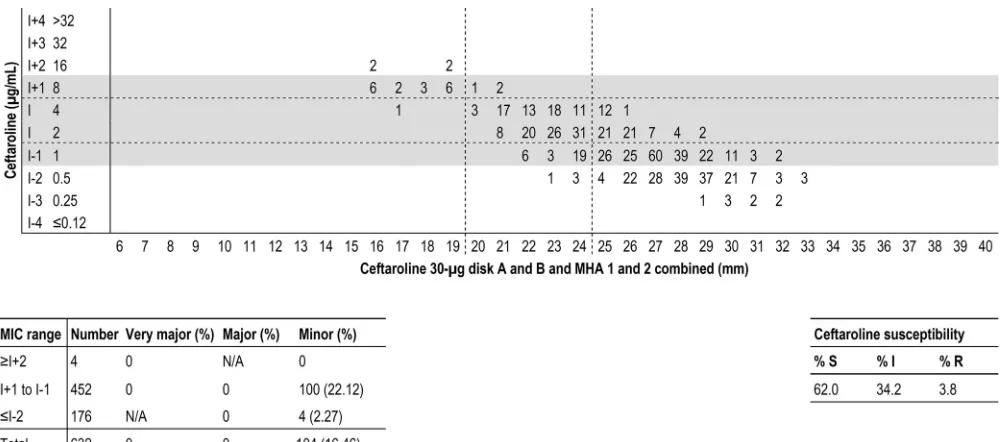
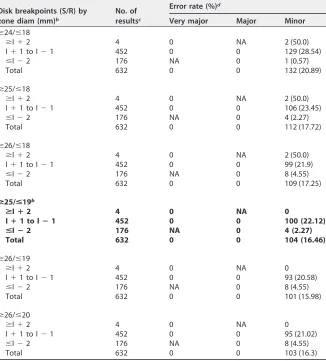
The disk breakpoints that provided the lowest error rates wereⱖ25 mm/ⱕ19 mm
for S/R, with no VM or Ma errors and with Mi error rates of 0.0% forⱖI⫹2, 22.1% for
I ⫾ 1, and 2.3% for ⱕI ⫺ 2 (overall Mi error rate, 16.5%; Fig. 1). Of note, the
CLSI-acceptable minor error rates are⬍5% forⱖI⫹2 andⱕI⫺2, and⬍40% for I⫾
on May 16, 2020 by guest
http://jcm.asm.org/
1 (2). Error rates would increase slightly if either the S or the R disk breakpoint would move 1 mm upward or downward (Table 2).
When the results were stratified according to disk and MHA manufacturers, the mean, geometric mean, and median values for zone diameters varied approximately 2 mm between disk A and disk B, independent of the MHA used, and this difference was
statistically significant (P⬍0.001). No significant difference was observed between the
zone of inhibition diameter results from the 2 MHA manufacturers when using the
same disk manufacturer (data not shown). Of note, all inhibition zones for QC strainS.
aureus ATCC 25923 were within CLSI-acceptable ranges (26 to 35 mm), with mean values of 28.3 mm (disk A and MHA 1) to 31.7 mm (disk B and MHA 2) and an overall mean value of 29.8 mm (data not shown). Furthermore, when error rates were analyzed for each disk separately, both disks displayed acceptable error rates, with no major or very major errors, and they had minor error rates of 0.0%, 14.2%, and 4.5% for disk A
and 0.0%, 29.6%, and 0.0% for disk B atⱖI⫹2, I⫾1, andⱕI⫺2, respectively (data
not shown).
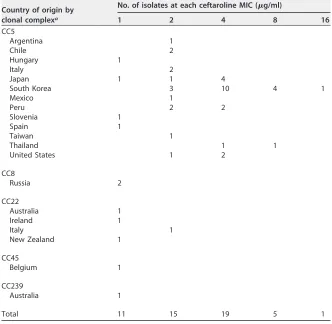
The majority of isolates selected for molecular characterization belonged to clonal complex 5 (CC5) (43/51 [84.3%]) and were associated with 8 STs (Table 3). The remaining isolates belonged to CC4 and 4 STs. Among CC5 isolates, the majority (39/43
[90.7%]) showed ceftaroline MIC values ofⱖ2g/ml (nonsusceptible), while most of
those belonging to other CCs (7/8 [87.5%]) displayed ceftaroline MIC results at ⱕ1
g/ml (Table 3). In addition, most isolates (26/40 [65.0%]) exhibiting ceftaroline MIC
values ofⱖ2g/ml were recovered from countries in the Asia-Pacific region (Japan,
South Korea, Taiwan, and Thailand).
The most common SCCmectype observed among the 51 characterized isolates was
type II (n⫽34 [66.7%]), followed by types I (n⫽9 [17.6%]), IV (n⫽7 [13.7%]), and III
(n ⫽ 1 [2.0%]). Ceftaroline-nonsusceptible isolates (MIC, ⱖ2 g/ml) were mainly
SCCmec types II (30 of 40 [75.0%]) and I (9 of 40 [22.5%]), whereas
ceftaroline-susceptible isolates were mainly SCCmectypes IV (6 of 11 tested [54.5%]) and II (4 of 11
tested [36.4%]; data not shown).
Table 4 shows alterations detected in the PBP2a of selected isolates. Among those isolates having a wild-type sequence for PBP2a, the ceftaroline MIC results varied
FIG 1Scattergram comparing the results of ceftaroline broth microdilution MIC values (in micrograms per milliliter) and disk diffusion zone diameters (in millimeters) for a 30-g disk when testing all MRSA isolates (632 results for 158 isolates). Each isolate was tested with ceftaroline disks from 2 manufacturers (disk A and disk B) and in Mueller-Hinton agar from 2 manufacturers (MHA 1 and MHA 2). Horizontal and vertical broken lines indicate ceftaroline breakpoints (CLSI). The table at the bottom displays the number of isolates tested and very major, major, and minor error rates for each category.
on May 16, 2020 by guest
http://jcm.asm.org/
[image:4.585.44.548.69.290.2]between 1 and 4g/ml, with a modal MIC of 1g/ml. The ceftaroline MIC range was
also 1 to 4g/ml when testing MRSA isolates demonstrating alterations within the
allosteric site (non-penicillin-binding domain [nPBD] residues 27 to 326), with a modal
MIC value of 2 g/ml. Those MRSA isolates with alterations at the allosteric and
transpeptidase (PBD) sites showed a ceftaroline modal MIC value of 4g/ml, as did
those isolates with mutations at the transpeptidase site only. R130C alterations in LytD were observed in all MRSA isolates from South Korea (ST5-MRSA-II), and these results likely reflect a polymorphism associated with that clone. Other isolates showed wild-type sequences for LytD. Most isolates (33/51 [64.7%]) showed an upstream sequence
ofpbp4consistent with reference control strains. A total of 12 isolates had deletions
within this upstream region, which was previously associated with decreased
suscep-tibility to ceftaroline and other -lactam agents (20). Another 6 isolates had a minor
number of nucleotide alterations compared to the control strains (Table 4). In addition,
isolates exhibiting ceftaroline MIC values of 4 to 16g/ml did not tend to have PBP2a
mutations with alterations in the upstream region ofpbp4(3/25 [12.0%]), while those
MRSA isolates with MIC results of 1 to 2g/ml had greater chances (15/26 [57.7%]) of
[image:5.585.44.370.94.455.2]having alterations in both sequences (Table 4).
TABLE 2Error rates for possible 30-g disk breakpoints when applying current CLSI MIC breakpointsa
Disk breakpoints (S/R) by zone diam (mm)b
No. of resultsc
Error rate (%)d
Very major Major Minor
ⱖ24/ⱕ18
ⱖI⫹2 4 0 NA 2 (50.0)
I⫹1 to I⫺1 452 0 0 129 (28.54)
ⱕI⫺2 176 NA 0 1 (0.57)
Total 632 0 0 132 (20.89)
ⱖ25/ⱕ18
ⱖI⫹2 4 0 NA 2 (50.0)
I⫹1 to I⫺1 452 0 0 106 (23.45)
ⱕI⫺2 176 NA 0 4 (2.27)
Total 632 0 0 112 (17.72)
ⱖ26/ⱕ18
ⱖI⫹2 4 0 NA 2 (50.0)
I⫹1 to I⫺1 452 0 0 99 (21.9)
ⱕI⫺2 176 NA 0 8 (4.55)
Total 632 0 0 109 (17.25)
>25/<19b
>Iⴙ2 4 0 NA 0
Iⴙ1 to Iⴚ1 452 0 0 100 (22.12)
<Iⴚ2 176 NA 0 4 (2.27)
Total 632 0 0 104 (16.46)
ⱖ26/ⱕ19
ⱖI⫹2 4 0 NA 0
I⫹1 to I⫺1 452 0 0 93 (20.58)
ⱕI⫺2 176 NA 0 8 (4.55)
Total 632 0 0 101 (15.98)
ⱖ26/ⱕ20
ⱖI⫹2 4 0 NA 0
I⫹1 to I⫺1 452 0 0 95 (21.02)
ⱕI⫺2 176 NA 0 8 (4.55)
Total 632 0 0 103 (16.3)
aBreakpoints ofⱕ1g/ml for susceptible, 2 to 4g/ml for susceptible dose dependent, andⱖ8g/ml for
resistant.
bS, susceptible; R, resistant, I, intermediate. Values in bold indicate breakpoints and error rates for current
CLSI disk breakpoints (CLSI M100 [17]).
cThe total of 632 refers to 4 disk results for each of the 158 isolates (4⫻158). dNA, not applicable.
on May 16, 2020 by guest
http://jcm.asm.org/
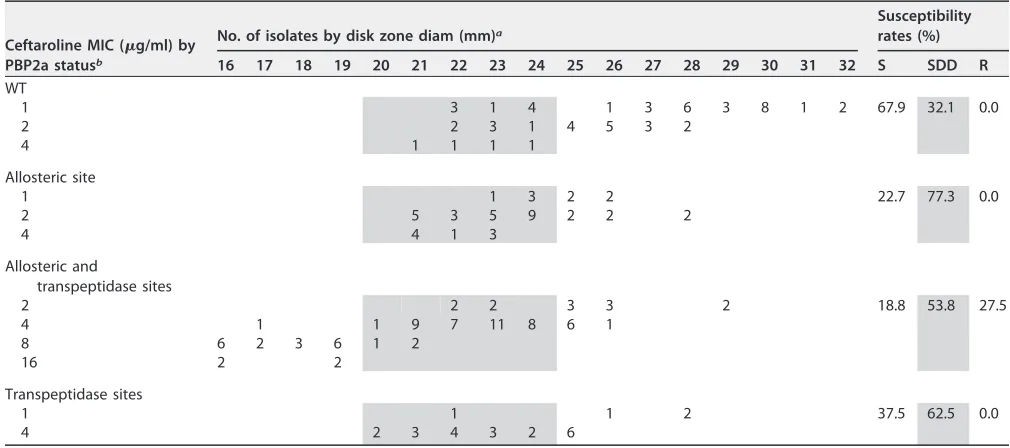
When ceftaroline was tested by disk diffusion against strains showing a wild-type sequence for PBP2a, 67.9% of results were categorized as S and 32.1% as SDD (Table 5). A total of 22.7% of disk diffusion results were categorized as S and 77.3% as SDD when tested against those isolates having PBP2a alterations in the allosteric site, while 81.2% of disk diffusion results for isolates carrying PBP2a alterations at both the allosteric and transpeptidase sites and 62.5% of disk diffusion results for isolates carrying alterations at the transpeptidase site were categorized as ceftaroline nonsusceptible. Furthermore,
all ceftaroline-resistant isolates (MIC, ⱖ8 g/ml) exhibited alterations at both the
allosteric and transpeptidase sites (Table 5).
DISCUSSION
Accurate antimicrobial susceptibility testing is essential for the proper treatment of bacterial infections. Although disk diffusion testing is rarely used for routine susceptibility testing in the United States and western European countries, it is still commonly used in many geographic regions, especially in developing countries. Furthermore, disk diffusion testing represents an important tool for testing recently approved antimicrobial agents, since the inclusion of novel agents on commercial antimicrobial susceptibility systems may take several years after their approval for clinical use (21).
We evaluated the correlation between MIC and disk diffusion zone diameters using a collection of MRSA isolates heavily biased toward ceftaroline nonsusceptibility, which had 71.5% of isolates (113/158) with ceftaroline MIC values at the breakpoint dilutions
[image:6.585.40.372.95.419.2](1 to 8g/ml). The results of this investigation showed that error rates were acceptable
TABLE 3Distribution of MRSA lineages and country of origin according to the ceftaroline MIC value
Country of origin by clonal complexa
No. of isolates at each ceftaroline MIC (g/ml)
1 2 4 8 16
CC5
Argentina 1
Chile 2
Hungary 1
Italy 2
Japan 1 1 4
South Korea 3 10 4 1
Mexico 1
Peru 2 2
Slovenia 1
Spain 1
Taiwan 1
Thailand 1 1
United States 1 2
CC8
Russia 2
CC22
Australia 1
Ireland 1
Italy 1
New Zealand 1
CC45
Belgium 1
CC239
Australia 1
Total 11 15 19 5 1
aClonal complex 5 (CC5) represented by ST5 (29 isolates), ST105 (n⫽2), ST125 (n⫽1), ST228 (n⫽3), ST518
(n⫽1), ST764 (n⫽5), ST1110 (n⫽1), and ST2883 (n⫽1); CC8, ST8; CC22, ST22; CC45, ST45; and CC239, ST239.
on May 16, 2020 by guest
http://jcm.asm.org/
and generally low even when a very challenging organism collection was used. It is important to note that the zone diameters observed with disk A were generally 2 mm lower than those observed with disk B, independent of the MHA used. Despite this
difference, all inhibition zones for QC strainS. aureusATCC 25923 were within
CLSI-TABLE 4Correlation of ceftaroline MIC result with alterations detected in PBP2a and the upstream region ofpbp4among isolates selected for further molecular characterization
PBP2a wild type or mutation (CC)a
No. of isolates at each ceftaroline MIC (g/ml)Alteration observed atpbp4b
1 2 4 8 16
WT (CC5, CC8, CC22, CC45, CC239) 84Del,4mutations 53WT,2Del 1WT
N146K (CC5, CC239) 1WT 1Del
K565N (CC5)c 1G105T
E246G (CC22) 1Mutations
E150K (CC5) 1Del 51Del,4WT 2WT
N146K, L357I (CC5) 1WT
N146K, L357I, I563T (CC5) 2WT 2WT
A228V, L357I, I563T (CC5) 6WT
N146K, L357I, M411I, I563T (CC5) 1WT
E447K (CC5) 52Del,3WT
N104K, V470I (CC5) 1WT
K146N, E239K, E447K (CC5) 1Del 1WT
N104K, V117I, E447K, I563T, S649A (CC5) 4WT 1WT
Location of alteration in PBP2a
Allosteric site 2 7 2
Allosteric and transpeptidase sites 3 11 5 1
Transpeptidase site 1c 6
Total 11 15 19 5 1
aPBP2a, penicillin-binding protein 2a; WT, wild type; allosteric site represented by amino acid residues 27 to
326; transpeptidase domain represented by residues 327 to 668. Ceftaroline breakpoints ofⱕ1 (susceptible)/2 to 4g/ml (shaded cells; susceptible dose dependent)/ⱖ8g/ml (resistant) for MIC were applied as established by the CLSI (17).
bDel, deletion in the region upstream ofpbp4; a single G105T alteration in the position 105 upstream of pbp4. Mutations are represented by several nucleotide alterations within 400 bp upstream ofpbp4.
[image:7.585.42.374.93.319.2]cK565N alteration at PBP2a.
TABLE 5Correlation of ceftaroline MIC, disk zone results, and PBP2a alterations detected among isolates selected for further molecular characterization
Ceftaroline MIC (g/ml) by PBP2a statusb
No. of isolates by disk zone diam (mm)a
Susceptibility rates (%) 16 17 18 19 20 21 22 23 24 25 26 27 28 29 30 31 32 S SDD R
WT
1 3 1 4 1 3 6 3 8 1 2 67.9 32.1 0.0
2 2 3 1 4 5 3 2
4 1 1 1 1
Allosteric site
1 1 3 2 2 22.7 77.3 0.0
2 5 3 5 9 2 2 2
4 4 1 3
Allosteric and
transpeptidase sites
2 2 2 3 3 2 18.8 53.8 27.5
4 1 1 9 7 11 8 6 1
8 6 2 3 6 1 2
16 2 2
Transpeptidase sites
1 1 1 2 37.5 62.5 0.0
4 2 3 4 3 2 6
aFour zone diameter results are shown for each MIC value (2 manufacturers for ceftaroline disks and 2 manufacturers for Mueller-Hinton agar).
bWT, wild type. Allosteric site represented by amino acid residues 27 to 326; transpeptidase domain represented by residues 327 to 668. Ceftaroline breakpoints ofⱖ25 mm
(susceptible)/24 to 20 mm (shaded cells; susceptible dose dependent)/ⱕ19 mm (resistant) for disk diffusion method were applied as established by the CLSI (17).
on May 16, 2020 by guest
http://jcm.asm.org/
[image:7.585.39.544.489.713.2]acceptable ranges, and error rates were within acceptable ranges for both disk reagents when the results were analyzed for each disk reagent separately.
This study showed that CC5 isolates were dominant among the
ceftaroline-nonsusceptible group (MIC, ⱖ2 g/ml), and these isolates originated mostly from
countries in the Asia-Pacific region. A high prevalence of the CC5 lineage among MRSA isolates causing infections in Asian countries, as well as among isolates displaying
ceftaroline MIC values ofⱖ2g/ml, has been reported by other investigators (6, 22, 23),
and these results suggest that isolates belonging to this lineage may possess compet-itive survival advantages over other MRSA lineages under selective pressure in the hospital environment (24).
Isolates having a wild-type PBP2a exhibited ceftaroline MIC results (1 to 4g/ml)
that overlapped with those carrying single (1 to 4g/ml) or multiple (2 to 16g/ml)
mutations; although overlapping MIC results were observed, the ceftaroline modal MIC values for wild-type and PBP2a mutant strains were very distinct. While wild-type
isolates had ceftaroline modal MIC results of 1g/ml, isolates with PBP2a alterations
demonstrated modal MIC values of either 2 or 4g/ml, depending on the mutation
position (allosteric versus transpeptidase sites). Nevertheless, despite distinct modal MIC results, the overlapping MIC values between isolates with wild-type molecular results and those with nucleotide/amino acid alterations (non-wild type) challenge the separation between these 2 groups by the reference broth microdilution and disk diffusion methods. It is also important to note that 4 molecularly characterized isolates
with wild-type sequences for PBP2a and the upstream region ofpbp4showed
repro-ducible ceftaroline MIC values of 2 to 4g/ml, suggesting that other mechanisms for
decreased susceptibility may be present.
The analysis of the correlation (or lack thereof) between disk inhibition zones and PBP2a alterations clearly showed that the disk diffusion test was also not able to satisfactorily separate the group of isolates with no molecular alterations from those with alterations, or between those having alteration(s) at different regions. Overall, among isolates having alteration(s) at both allosteric and transpeptidase sites and isolates having alteration(s) at the transpeptidase domain, 18.8% and 37.5% were categorized as susceptible by the disk diffusion method, respectively. In contrast, 0.0% and 14.3% (1 isolate with a K565N mutation) were categorized, respectively, as sus-ceptible by the broth microdilution method (Tables 4 and 5).
The molecular results and the interpretation of the results presented here are important cofounding variables with regard to their alterations or combinations, and the location (nPBD versus PBD) of any alteration(s) should be considered wild type (6). Several examples presented here illustrate scenarios where wild-type MRSA isolates
had ceftaroline MIC results of 2 to 4 g/ml in the SDD category, while an isolate
carrying an alteration at the PBD of PBP2a (K565N) had a reproducible ceftaroline MIC
value of 1g/ml. Several PBP2a alterations detected here were reported previously and
were associated with isolates having ceftaroline MIC results ofⱖ2g/ml (6, 25–27).
However, the relevance of PBP2a mutations, such as K565N (ceftaroline MIC of 1g/ml
and zone diameters ranging from 22 to 28 mm), at the transpeptidase site remains unknown. The K565 residue is located far from the transpeptidase pocket, and it is unlikely that a variation at this position impacts ceftaroline binding. The isolate
showing a K565N mutation also had a nucleotide substitution upstream of thepbp4
gene, which could result in higher expression of this gene and, consequently, the
ceftaroline MIC value (1 g/ml) at the end of the wild-type distribution (20, 25).
Therefore, the broth microdilution method correctly characterized this isolate as sus-ceptible, and 3 out 4 disk diffusion results were also correctly assigned as susceptible. In summary, the results from the disk diffusion method showed a good correlation with those from the reference broth microdilution method, with low discrepancy rates, when testing ceftaroline against a challenge collection of MRSA isolates. Furthermore, the results of this investigation corroborate those of previous publications by showing that the ceftaroline MIC distribution of wild-type MRSA isolates, i.e., isolates with no
mutations in PBP2a, goes up to 4 g/ml, and reference broth microdilution or disk
on May 16, 2020 by guest
http://jcm.asm.org/
diffusion methods do not properly separate wild-type from non-wild-type populations using current breakpoints (6, 25, 26).
ACKNOWLEDGMENTS
This study was supported by Pfizer.
All authors are employees of JMI Laboratories and were paid consultants to Pfizer in connection with the development of this paper. JMI Laboratories contracted to perform services in 2017 for Achaogen, Allecra Therapeutics, Allergan, Amplyx Pharmaceuticals, Antabio, API, Astellas Pharma, AstraZeneca, Athelas, Basilea Pharmaceutica, Bayer AG, BD, Becton, Dickinson and Co., Boston, CEM-102 Pharma, Cempra, Cidara Therapeutics, Inc., CorMedix, CSA Biotech, Cutanea Life Sciences, Inc., Entasis Therapeutics, Inc., Geom Therapeutics, Inc., GSK, Iterum Pharma, Medpace, Melinta Therapeutics, Inc., Merck & Co., Inc., MicuRx Pharmaceuticals, Inc., N8 Medical, Inc., Nabriva Therapeutics, Inc., NAEJA-RGM, Novartis, Paratek Pharmaceuticals, Inc., Pfizer, Polyphor, Ra Pharma, Rem-pex, Riptide Bioscience, Inc., Roche, Scynexis, Shionogi, Sinsa Labs, Inc., Skyline Antiin-fectives, Sonoran Biosciences, Spero Therapeutics, Symbiotica, Synlogic, Synthes Bio-materials, TenNor Therapeutics, Tetraphase, The Medicines Company, Theravance Biopharma, VenatoRx Pharmaceuticals, Inc., Wockhardt, Yukon Pharma, Zai Laboratory, and Zavante Therapeutics, Inc. There are no speakers’ bureaus or stock options to declare.
REFERENCES
1. Turnidge J, Paterson DL. 2007. Setting and revising antibacterial suscep-tibility breakpoints. Clin Microbiol Rev 20:391– 408.https://doi.org/10 .1128/CMR.00047-06.
2. Clinical and Laboratory Standards Institute. 2018. Development ofin
vitrosusceptibility testing criteria and quality control parameters, 5th ed.
CLSI document M23Ed5E. Clinical and Laboratory Standards Institute, Wayne, PA.
3. DePalma G, Turnidge J, Craig BA. 2017. Determination of disk diffusion susceptibility testing interpretive criteria using model-based analysis: development and implementation. Diagn Microbiol Infect Dis 87: 143–149.https://doi.org/10.1016/j.diagmicrobio.2016.03.004.
4. Metzler CM, DeHaan RM. 1974. Susceptibility tests of anaerobic bacteria: statistical and clinical considerations. J Infect Dis 130:588 –594.https:// doi.org/10.1093/infdis/130.6.588.
5. Hartman BJ, Tomasz A. 1984. Low-affinity penicillin-binding protein associated with beta-lactam resistance inStaphylococcus aureus. J Bac-teriol 158:513–516.
6. Lahiri SD, McLaughlin RE, Whiteaker JD, Ambler JE, Alm RA. 2015. Molecular characterization of MRSA isolates bracketing the current EUCAST ceftaroline-susceptible breakpoint forStaphylococcus aureus: the role of PBP2a in the activity of ceftaroline. J Antimicrob Chemother 70:2488 –2498.
https://doi.org/10.1093/jac/dkv131.
7. Chua K, Laurent F, Coombs G, Grayson ML, Howden BP. 2011. Antimi-crobial resistance: not community-associated methicillin-resistant
Staph-ylococcus aureus(CA-MRSA)! A clinician’s guide to community MRSA–its
evolving antimicrobial resistance and implications for therapy. Clin In-fect Dis 52:99 –114.https://doi.org/10.1093/cid/ciq067.
8. Castanheira M, Sader HS, Farrell DJ, Mendes RE, Jones RN. 2012. Activity of ceftaroline-avibactam tested against gram-negative organism popu-lations, including strains expressing one or more beta-lactamases and methicillin-resistant Staphylococcus aureus carrying various SCCmec types. Antimicrob Agents Chemother 56:4779 – 4785.https://doi.org/10 .1128/AAC.00817-12.
9. Liu J, Chen D, Peters BM, Li L, Li B, Xu Z, Shirliff ME. 2016. Staphylococcal chromosomal cassettes mec (SCCmec): a mobile genetic element in methicillin-resistantStaphylococcus aureus. Microb Pathog 101:56 – 67.
https://doi.org/10.1016/j.micpath.2016.10.028.
10. Robinson DA, Enright MC. 2003. Evolutionary models of the emer-gence of methicillin-resistant Staphylococcus aureus. Antimicrob Agents Chemother 47:3926 –3934.https://doi.org/10.1128/AAC.47.12 .3926-3934.2003.
11. Harris SR, Feil EJ, Holden MT, Quail MA, Nickerson EK, Chantratita N, Gardete S, Tavares A, Day N, Lindsay JA, Edgeworth JD, de Lencastre H, Parkhill J, Peacock SJ, Bentley SD. 2010. Evolution of MRSA during
hospital transmission and intercontinental spread. Science 327: 469 – 474.https://doi.org/10.1126/science.1182395.
12. Arias CA, Reyes J, Carvajal LP, Rincon S, Diaz L, Panesso D, Ibarra G, Rios R, Munita JM, Salles MJ, Alvarez-Moreno C, Labarca J, Garcia C, Luna CM, Mejia-Villatoro C, Zurita J, Guzman-Blanco M, Rodriguez-Noriega E, Na-rechania A, Rojas LJ, Planet PJ, Weinstock GM, Gotuzzo E, Seas C. 2017. A prospective cohort multicenter study of molecular epidemiology and phylogenomics ofStaphylococcus aureusbacteremia in nine Latin Amer-ican countries. Antimicrob Agents Chemother 61:e00816. https://doi .org/10.1128/AAC.00816-17.
13. Das S, Li J, Gonzalez J, Melnick D, Zhou D, Iaconis JP, Lahiri SD. 2015. Ceftaroline fosamil 600 mg every 8 h for the treatment of ABSSSI due to
Staphylococcus aureuswith ceftaroline MICs of 4 mg/L, poster A-455.
55th Intersci Conf Antimicrob Agents Chemother (ICAAC), 17 to 21 September 2015, San Diego, CA.
14. Iaconis JP, Critchley I, Zhou D, Li J, Das S. 2015. Ceftaroline fosamil 600 mg every 12 h (q12h) can provide adequate exposure against
Staphy-lococcus aureuswith ceftaroline MICsⱕ2 mg/L in ABSSSI, poster A-456.
Intersci Conf Antimicrob Agents Chemother (ICAAC), 17 to 21 Septem-ber 2015, San Diego, CA.
15. LI J, Singh R, Ambler JE. 2015. Probability of target attainment (PTA) and pharmacokinetic/pharmacodynamic (PK/PD) breakpoint for ceftaroline fosamil 600 mg every 12 h and every 8 h againstStaphylococcus aureus, poster P1384. 25th Eur Cong Clin Microbiol Infect Dis (ECMID), 25 to 28 April 2015, Copenhagen, Denmark.
16. Dryden M, Zhang Y, Wilson D, Iaconis JP, Gonzalez J. 2016. A phase III, randomized, controlled, non-inferiority trial of ceftaroline fosamil 600 mg every 8 h versus vancomycin plus aztreonam in patients with complicated skin and soft tissue infection with systemic inflammatory response or underlying comorbidities. J Antimicrob Chemother 71: 3575–3584.https://doi.org/10.1093/jac/dkw333.
17. Clinical and Laboratory Standards Institute. 2019. Performance standards for antimicrobial susceptibility testing: 29th informational supplement. CLSI document M100Ed29E. Clinical and Laboratory Standards Institute, Wayne, PA.
18. Clinical and Laboratory Standards Institute. 2018. Performance standards for antimicrobial disk susceptibility tests; 13th ed. CLSI document M02Ed13E. Clinical and Laboratory Standards Institute, Wayne, PA. 19. Clinical and Laboratory Standards Institute. 2018. Methods for dilution
antimicrobial susceptibility tests for bacteria that grow aerobically; ap-proved standard, 11th ed. CLSI document M07Ed11E. Clinical and Lab-oratory Standards Institute, Wayne, PA.
20. Henze UU, Berger-Bachi B. 1996. Penicillin-binding protein 4
on May 16, 2020 by guest
http://jcm.asm.org/
duction increases beta-lactam resistance inStaphylococcus aureus. An-timicrob Agents Chemother 40:2121–2125.
21. Humphries RM, Hindler JA. 2016. Emerging resistance, new antimicrobial agents . . . but no tests! The challenge of antimicrobial susceptibility testing in the current US regulatory landscape. Clin Infect Dis 63:83– 88.
https://doi.org/10.1093/cid/ciw201.
22. Mendes RE, Deshpande LM, Smyth DS, Shopsin B, Farrell DJ, Jones RN. 2012. Characterization of methicillin-resistant Staphylococcus aureus strains recovered from a phase IV clinical trial for linezolid versus van-comycin for the treatment of nosocomial pneumonia. J Clin Microbiol 50:3694 –3702.https://doi.org/10.1128/JCM.02024-12.
23. Ko KS, Lee JY, Suh JY, Oh WS, Peck KR, Lee NY, Song JH. 2005. Distribu-tion of major genotypes among methicillin-resistantStaphylococcus au-reusclones in Asian countries. J Clin Microbiol 43:421– 426.https://doi .org/10.1128/JCM.43.1.421-426.2005.
24. Nielsen KL, Pedersen TM, Udekwu KI, Petersen A, Skov RL, Hansen LH,
Hughes D, Frimodt-Moller N. 2012. Fitness cost: a bacteriological expla-nation for the demise of the first interexpla-national methicillin-resistant
Staphylococcus aureusepidemic. J Antimicrob Chemother 67:1325–1332.
https://doi.org/10.1093/jac/dks051.
25. Lahiri SD, Alm RA. 2016. Identification of non-PBP2a resistance mecha-nisms inStaphylococcus aureus after serial passage with ceftaroline: involvement of other PBPs. J Antimicrob Chemother 71:3050 –3057.
https://doi.org/10.1093/jac/dkw282.
26. Alm RA, McLaughlin RE, Kos VN, Sader HS, Iaconis JP, Lahiri SD. 2014. Analysis ofStaphylococcus aureusclinical isolates with reduced susceptibility to ceftaroline: an epidemiological and structural perspective. J Antimicrob Chemother 69:2065–2075.https://doi.org/10.1093/jac/dku114.
27. Sanchez EH, Mendes RE, Sader HS, Allison GM. 2016. In vivo emergence of ceftaroline resistance during therapy for MRSA vertebral osteomyeli-tis. J Antimicrob Chemother 71:1736 –1738.https://doi.org/10.1093/jac/ dkw001.