Developing a New Curing Technique-‘Drip Curing’
Kanchan Ambekar1,K.U. Gandhare2
1 ,2
Civil Department, TSSM’s Bhivarabai Sawant College Of Engineering & Research, Narhe
Abstract:It is said in civil engineering field that water worth Rs1 saves concrete worth Rs99 it means a concrete worth Rs99 if not cured with water worth Rs1, it is worth less. So sometimes it happens that concrete and other structures in which cement is used like brickwork, plaster, PCC etc. may not get its required strength due to lack of water for curing over a specified time. Curing is at most essential if cement structure is to perform as per its design the intended functions for the designing life of the structure. While excessive use of water in short time, which is not essential may lead to the escalation of the construction cost due to excessive water use for curing use. For curing setting of cement is exothermic reaction it emits heat during the setting period. It needs water in the proportion to the heat generated to take away the heat from concrete. At site, practically water for curing is given by a flexible pipe, throwing water at a high speed due to powerful pumps resulting in bouncing back the water from the concrete structure. This watering is done twice or thrice a day, which is absolutely insufficient. And again due to the high speed requirement of construction, sometimes slabs are casted with a span of 12 to 15 days keeping the formwork of the lower floors as it is. And in this case it is not possible even to approach the concrete structure and cure it. The overall aim of this paper is to develop a new technique for curing using which concrete and other cement structures gets the required amount of water in a continuous manner with minimum water wastage. The mechanism used in Israel, where there is scarcity of water to provide only and only requires quantity of water to the plants is drip irrigation and in this project the same technique is used for curing purpose. Compressive strength test was conducted on concrete blocks cured with different methods of curing (spraying method, immersion method and drip cuing method). Test results indicate that compressive strength of the concrete cured with drip curing method was comparatively much higher than the spray cured blocks (normally used type of curing on site) and along with the increase in strength of concrete, the water saved from using his method is considerably more, with easy to use application method.
Keywords: Drip curing, compressive strength, water conservation, on site application, total cost.
I. INTRODUCTION
cement structure are not reached due to negligence or shortage of water and bad curing practices followed in most of the cases, leading to a weak concrete or cement structures though appropriate money is spent for cement.
II. RESEARCH SIGNIFICANCE
A. By this simple curing method the strength of concrete increases by almost 30-40% than the normal strength achieved by traditional method of curing.
B. Due to increase in strength, factor of safety implied to the concrete design can be reduced and hence final design of structure can be done with reduced cross-sectional areas of structural members, ultimately saving on the cost of construction.
C. In water scared areas, water can be used in a very controlled manner avoiding the excess fruitless spraying of water. At the same time with minimum quantity of water maximum strength can be achieved.
D. For external plastering, which has to face all the weather conditions, systematic drip curing increases the strength of plaster, minimizes the major and minor cracks and makes it tough and solid to face the extreme weathers like very hot sun, too cold and extreme rains. Since there is little seepage of water through the plaster, rusting of steel components is avoided and protected. Water leakage inside a building is also reduced to a significant limit.
E. This system can be used repeatedly for many times and for many projects, and so the operational cost is very negligible as compared to total cost of construction.
F. This system can be installed by any layman. No skilled worker is required to install it. Once fitted it cures the structure for all curing period it requires. The pressure of pumps fitted to supply the water can be adjusted, lowered or increased according to the discharge required at the end point of curing. In the initial stage of setting of concrete or cement structure requires more water and at the time of final setting it requires less water. Water discharge can be adjusted as per the requirement by just increasing or decreasing the pressure of the pump.
G. Water being the most important raw material required for construction, with proper handling and supplying through drip cure method, gives a great boost to the strength to all cement related structures.
III. OBJECTIVES
A. To find the different strengths of concrete cubes cured with different curing methods like spraying method, drip curing method and immersion method.
B. To measure the quantity of water used by traditional spraying method (commonly used curing method on site) for curing and quantity of water required by drip cure method.
C. To study the water requirement for the entire span of curing of concrete of 28 days and water consumed with change in quantity as per requirement at site using drip cure method and establishing the fact that water required for excellent curing (if supplied properly) is much less than traditional method. And hence saving the water and reduce wastage of water.
D. Implementing a semi-automatic system to reduce the human errors.
E. To find and establish the effectiveness of drip curing method in structural members like column, beam, slab, plaster etc. also to find practical implementation of this system of drip curing and to find out the practical problems for implementation and ways to resolve it.
F. To control the curing in controlled manner and reducing the dependency for curing on unskilled labours and also occurrence of no curing due to holidays of labours.
G. To increase the continuous contact between water and concrete.
H. To find the increase in cost of construction caused due to use of drip curing method.
IV. EXPERIMENTAL DETAILS
A. Experiment on Strength on Concrete Cube of Strength M25 by Different Curing Method
B. Experiment on Calculating the Quantity of Water Required by Different Methods
for this experiment the drip pipes were connected to a small overhead water tank at 3m head specially erected to supply water by gravity. The compressive strength was calculated by comparing three different types of curing namely; Immersion method, spraying method, drip curing. From 24 cubes 8 cubes in every method 4 were cured for 7 days and the other 4 for 28 days. Then these cubes were tested using compression testing machine.
V. TEST METHODOLOGY
A. Submerging in Water Bath
Submerging concrete in water is the ideal way of curing. In this concrete cubes are submerged into the water tank till the curing period gets over and every time the buckets are toped up with water to compensate the loss of water due to exothermic reaction of concrete. First 4 blocks are removed from water after seven days and remaining 4 blocks after 28 days. In this the concrete gets in contact with the water for almost all the time and thus the water requirement for the concrete is satisfied 100%. So the strength obtained is maximum. But this method is practically impossible to apply practically on/at project site since the concrete members are in huge quantity and at various heights. To submerge them in water is totally impractical and impossible. And hence desired strength as per the IS standard is not obtained by the concrete members practically.
Figure no 1:- cube submerged in a bucket full of water.
B. Spraying
spraying can be done in early morning when there is no other activity at site. But once the other activities like formwork of next proposed structure, brickwork, plaster gets started, there is a movement of labors at site and so practically very less spraying is done in these working hours as it becomes hurdle for the labors doing other activities and so it is avoided. Almost all spraying is done manually and there is a great scope of human error. There are very few controlling methods of keeping the track record of curing by spraying at site. So the curing of concrete and the strength of concrete is almost at mercy of the non-skilled labor, availability of electricity, availability of abundant water and many other things.
Figure no 2:- Spraying on a concrete cube.
C. Drip Curing
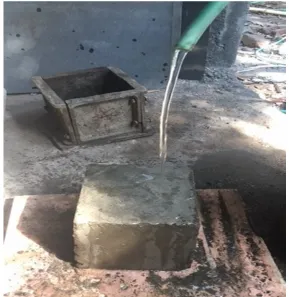
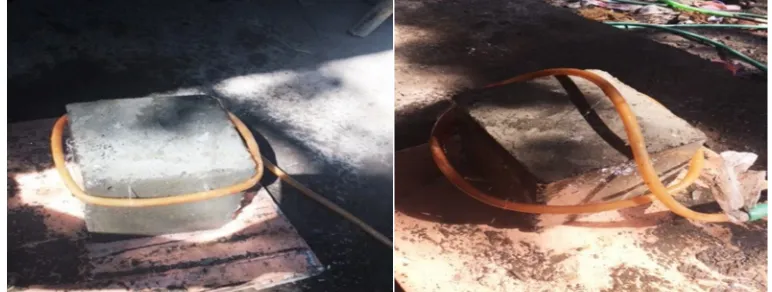
Figure no 3:- Curing of concrete block using drip curing
[image:6.612.100.511.291.397.2]1) Test Results for Immersion Method for 7 and 28 days:
[image:6.612.93.516.574.680.2]Table no1:-Compressive strength of cubes cured for 7 days using immersion method
Table no2:-Compressive strength of cubes cured for 28 days using immersion method
2) Test results for Spraying Method for 7 and 28 Day:
Table no3:-Compressive strength of cubes cured for 7 days using spraying method
Identification mark Age of curing (days)
Compressive Strength (N/mm2)
Average compressive strength
(N/mm2)
G1 28 24.22
G2 28 24.67
G3 28 24.54 24.59
G5 28 24.93
Identification mark Age of curing (days)
Compressive Strength (N/mm2)
Average compressive strength
(N/mm2)
F1 7 16.70
F2 7 16.58
F3 7 17.10 16.79
F4 7 16.81
Identification mark Age of curing (days)
Compressive Strength (N/mm2)
Average compressive strength
(N/mm2)
H1 7 12.71
H2 7 12.59 12.65
H3 7 12.52
Table no4:-Compressive strength of cubes cured for 28 days using spraying method
[image:7.612.100.509.291.408.2]3) Test Results for Drip Curing Method for 7 and 28 Days :
[image:7.612.47.509.434.719.2]Table no5:-Compressive strength of cubes cured for 7 days using drip curing method
Table no6:-Compressive strength of cubes cured for 28 days using drip curing method Identification mark Age of curing
(days)
Compressive Strength (N/mm2)
Average compressive strength
(N/mm2)
J1 28 21.22
J2 28 20.92
J4 28 21.63 21.33
J5 28 21.57
4) Comparison of the Three Methods:
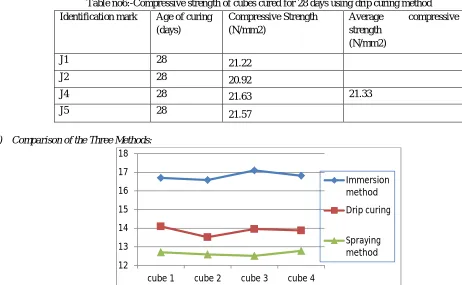
Figure no4:- Strength of concrete for 7 days curing 12 13 14 15 16 17 18
cube 1 cube 2 cube 3 cube 4
Immersion method
Drip curing
Spraying method Identification mark Age of curing
(days) Compressive Strength (N/mm2) Average compressive strength (N/mm2)
I1 28 19.27
I2 28 19.53 19.51
I3 28 20.07
I4 28 19.17
Identification mark Age of curing (days)
Compressive Strength (N/mm2)
Average compressive strength
(N/mm2)
K1 7 14.10
K3 7 13.52 13.86
K4 7 13.95
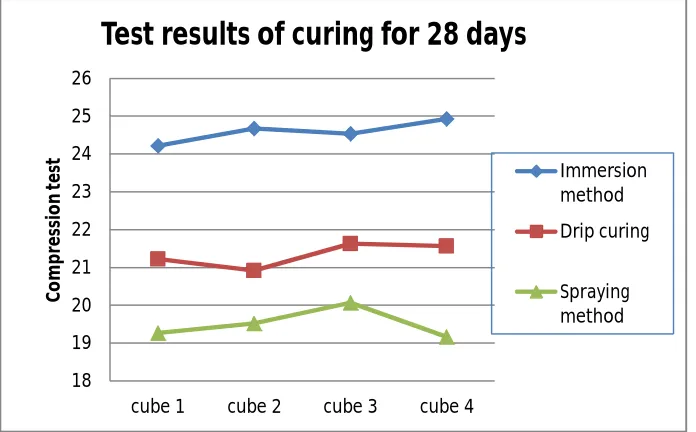
Figure no5:- Strength of concrete for 28 days curing
VI. COSTING
A. Effect on Strength
The results of compressive strength have been presented in tables and in the graphical representation of average compressive strength versus curing age for different methods of curing used in the experiment. In the curing methods mentioned above, the compressive strength of concrete is observed to be increasing with age. The highest compressive strength at all ages was produced by immersion (water) curing. The average compressive strength of immersion water cured concrete was 16.29N/mm2 and 23.29N/mm2 at 7 and 28 days respectively. Sprinkling method produced a compressive strength of 14.43N/mm2 and 20.51N/mm2 at 7 and 28 days respectively. Drip curing method produced a compressive strength in between of immersion curing and spraying curing but nearer to immersion curing 16.03N/mm2 and 22.98N/mm2 at 7 and 28 days respectively. Practically speaking in comparison with two practical methods of curing i.e. drip curing and spraying method, the development of higher compressive strength in drip curing method is credited to sufficient and continuous supply of water and moisture, which were maintained to continue the hydration of cement. As we can see that immersion of concrete is not feasible on site so the best option is Drip curing.
B. Effect on Quantity of Water
Theproject of 180sq.m plinth area per floor with 9 columns is considered for calculations
Normally on site water consumed for curing is dependent on the type of motor used, pipe size etc. On site spraying method is used to cure the concrete and using 0.5hp motor pump and 1” pipe water is sprinkled on the surface of the concrete say for 1 hour, twice/thrice a day. The standard discharge of the water is 1930 LPH for 6m head. It decreases with increase in head. It reaches up to 325 LPH for 28m head. Therefore taking an average of 17m head it is approximately 1170LPH.
The water required for drip curing is less as compared to spraying method. We have to use mains, sub-mains and secondary drip pipes to form the network of drip curing. Different types of drip pipes can be used for different parts of building. For e.g. porous hoes systems has a minute holes everywhere on the pipe and so can be use full for laying over the slabs as against pre-installed emitters system has holes only in one line with uniform distance in between they are most suitable for drip curing for columns, beams, plastering etc. The water discharge from the drip pipes curing is as follows as per the company standards with some specified pressure from pumps. Water required for spraying method considering 1 hour spraying thrice a day is 1170x3 = 3510 liters per day
1) Pre-Installed Emitters System: a) For ½”pipe, 1m length-7.58LPH b) For ¼”pipe, 1m length-12.42LPH
18 19 20 21 22 23 24 25 26
cube 1 cube 2 cube 3 cube 4
C o m p re ss io n t e st
Test results of curing for 28 days
Immersion method
Drip curing
2) Porous Soaker Hose Systems:
a) For ¼”pipe, 1m length-4.95LPH
The discharge from the drip pipe, considering the average of pre-installed emitter system 1/4'” and porous soaker hose system is 8.68LPH. But this is for irrigation purpose with full water head pressure of pumps for a supply of water to crops for a limited period. At our site this is not required by observation the controlling knob was so adjusted that to keep the entire concrete surface continuously wet it was observed that 1000 lit tank is emptied in 2 days period. And so per day consumption was about 500 lit. So the quantity of water required is 500LPD and hence the water saved by using drip cure method is 3010 LPD.
C. Effect on Cost:
1) A project of 180sq.m plinth area of g+5. Additional cost required for materials and installation of the system.
2) The length of pipe required for columns is approximately 63.72m for 9 columns and for beams it is 36.31m. Total length of pipe required is approximately 100.03m.
3) The price of pipe is Rs4437/- for 500m length of pipe. So the price of pipe for 100 m is Rs888/- Adding 30% for taxes and wastage it
888x1.3 = Rs1154/-
4) Considering the mains of ½” of 10m @ Rs20 per m that is Rs200/-
5) Special separate water tank of 1000lit @ Rs6 per liter that is for Rs6000 / lit. 6) The installation cost will be approximately 3 labors a day coming to Rs1200/-. 7) The total capital cost is Rs8554/-.
8) Considering this set up to be used at least for 10 times the cost per single application is Rs855/- 9) Amount of money saved due to saving wastage of water.
10) The cost of a tanker for 8000ltr of water is Rs1000. Therefore if we save 3010LPD water the money saved per day will be Rs376/-
11) With almost 1/3 water consumption the acquired strength of concrete is more by almost 10 %.
12) The valuation of cost of increase in strength of concrete is nearly impossible but it is definitely a gain in life and stability of structure.
[image:9.612.148.462.470.724.2]VII. APPLICATION
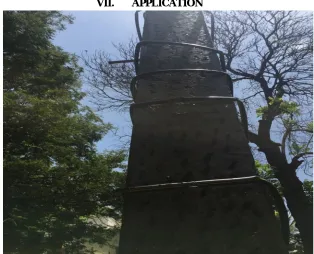
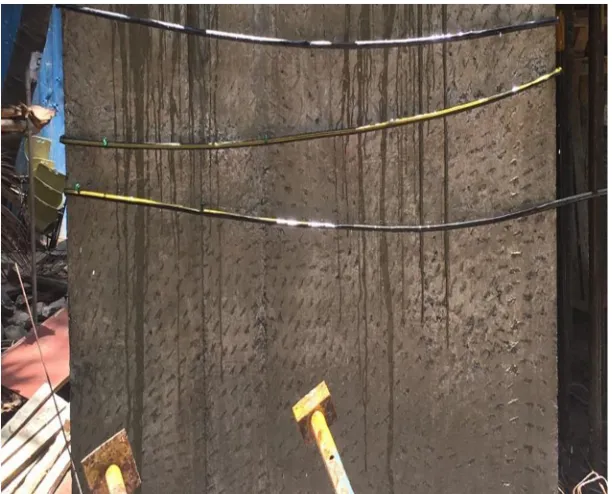
Figure no 7:- Drip curing applied on a lift shaft on site
VIII. CONCLUSION
A. The immersion method showed the highest compression strength. But we cannot keep concrete structure immerged in the water bath so the second best method i.e. Drip curing is feasible to be used.
B. Practically drip curing is the most effective method of curing. It produced the highest level of compressive strength practically at site. This is due to nonstop supply of required water to cool down the exothermic reaction of concrete, resulting from greater degree of cement hydration reaction uniformly.
C. As in the drip curing the water spreads over the area giving the concrete to absorb water and fulfill its water requirement. D. As in case of sprinkling of water the water rushes over the block and the contact time with concrete is very less. Total 3010
liters per day water can be saved by using drip curing method for curing.
E. The amount required for a project of 180sq.m plinth area considering this system will be re used for all 5 floors of the same project and also considering that whole system can be used for one more project, the one-time installing expenses of drip curing is used for 10 times the slab area, since the expenses for 1 floor is calculated as Rs855/-.
F. The amount saved by saving water is Rs375/- per day.
G. In the cities where there is water scarcity, without compromising with the quality and strength of concrete we can achieve the results with very less quantity of water.
REFERENCES
[1] A. Bentur and C. Jaegermann, “Effect of cring and compositin on the properties of the outer skin of concrete,” Journals of matrials in civil engineering, Vol 3, No 4,November @ ASCE.
[2] Dan ye M.ASCE, Chang-Seon Shon M.ASCE, Anal K. Mukhopadhyay “New performance based approch to ensure quality curing during construction,” ASCE Journal of materials in civil engineering july 2010.
[3] M.S.Shetty “Concrete Technology” theory and practice. S. Chand & company Pvt. Ltd. [4] Neville A. M.& Brooks Concrete Technology. Longman Scientific.
[5] N.R. Shattaf, A.M. Alshamshi and R.N. Swamy “Curing/Environment effect on pore structure of blended cement concret,” journal of materials in civil engneering (ASCE) september 2001.