6
I
January 2018
Privacy Access for MongoDB
Neha Titre1, Antara Bhattacharya2
1,2
Computer Science & Engineering, RTMNU
Abstract: Space, Time and Privacy is the key important for data management systems. The NoSQL data management system has highly compress data with non relational database management systems, which often support data management of web applications, still do not provide support. It consists of the enhancement of the MongoDB level based access control model with privacy keys for security and monitor. The proposed monitor is easily used into any MongoDB deployment control with high protection for data security.
Keywords: Privacy, NoSQL data, MongoDB, privacy keys, data security.
I. INTRODUCTION
The NoSQL data management are non relational databases to provide high security for database operations for several servers. The platforms are getting increasing by companies and organizations for the efficiency of handling high volumes of heterogeneous and unstructured data. Although NoSQL datastores can has a high volume of personal and sensitive information, up to now the majority of these systems with poor privacy and security protection. The research contributions started to study the issues, but they have targeted security aspects. We are not aware of any work for privacy-aware access control for NoSQL systems, but believe that, similar to what has been for privacy policies. With to begin to solve this issue, by proposing an approach for the secured data policy capabilities into MongoDB, NoSQL datastore proposed for relational DBMSs, privacy access control is urgency for NoSQL data management system. However, different from relational databases, where all existent systems to the same data model and query language, NoSQL data management operate with different languages with data models. The different makes the general approach to have of privacy-aware access control into NoSQL data management system a very important goal. That is stepwise approach is to
define with a general solution. As such, in this, we start focusing on: 1) a single data management, and 2) rules for privacy policies.
The problem by focusing on MongoDB, which, according to the DB Ranking, 2 ranks, the most popular NoSQL data Management. MongoDB a document-oriented data model. Data are made as documents, namely records, possibly data collections that are stored into a database [1]. The several privacy-aware access controls proposed for relational DBMSs to give the characteristics of privacy policies to be supported [2]
1) The privacy policies require rule based With mechanisms, as different data user can have different privacy requirements on their data[8]
2) The purposes for data should be accessed with those for which they are stored is having as the key for condition to grant the access is thus the important of any privacy policy. As the fine grained purpose policies have been selected as the target policy type. MongoDB has a role-based access control model which supports user management, and access control at collection level. However, no support is provided for purpose policies. This work we extend MongoDB with the support for purpose policy specification and
enforcement at document. The rule level at which the MongoDB model operates, integrating the required support for purpose related concepts [9]. This model we have developed an efficient enforcement monitor, called Mem means MongoDB enforcement
monitor, has been designed to operate in any MongoDB deployment. The client/server system of a MongoDB deployment, a MongoDB server front end interacts, through message exchange, with multiple MongoDB clients. Mem operates as a proxy in between a MongoDB server and its clients, monitoring and possibly altering the flow of messages that are exchanged by the counterparts [3].
Access control is enforced by means of MongoDB message rewriting. More precisely, either Mem simply forwards the intercepted message to the respective destination, or injects additional messages that encode commands or queries [10]. In case the intercepted message encodes a query, Meme writes it in such a way that it can only access documents for which the specified policies are
satisfied. The integration of Mem into a MongoDB deployment is straightforward and only requires a simple configuration. No
II. LITERATURESURVEY
A new approach to the index selection problem for data mining. The method has the creation of indexes as well as the type of each index. This in more precise index recommendations that not only to create ascending and descending indexes, but also special indexes supported by the database system[10,12]. The Mining of queries results in candidate indexes for which virtual indexes are created. The approach does not have modifications of the database system, the generically applicable. Evaluations of the scalability are given for different workloads for document-based NoSQL database MongoDB[5].The new approach is to store and index datasets in, distributed databases. To demonstrate the performance improvement, the so-called general machine problem between measurements of two satellites that differ in orbits with measurement cycles. For the purpose of measurements are matched within a specified maximum spatial and time offset [11]. The steps from a single-threaded approach using a SQL database to a
multi-threaded using the NoSQL database MongoDB[4,13]. An observation of the atmosphere is the most important subject areas to have
necessary knowledge about meteorological and chemistry data which influence climate change effect. With several remote sensing campaigns are performing around the world and a huge amount of data has gathered and processed. To enable efficient processing and monitoring of the collected data, the sophisticated and effective methods and tools are needed. A lot of powerful databases and storage tools are available, that allow the management of big data, the best solution for this is to use for best fitting tool[3]. in the database and threshold2. The size of the tables can be easily retrieved from any DBMS, and the DBA can provide the value of the thresholds within the suggested best ranges or can accept the value which is provided by the tool[14]. This technique will help reduce the functions and difficulty of a DBA of a large database to choose a good set of indexes for a workload of queries. Also this technique has the advantage that it can be used with any database having an optimizer capable of outputting its choice of indexes for a given workload [5].
III.RESEARCHMETHODOLOGYTOBEEMPLOYED
Map Reduce operations are defined reducing the data size. The execution time is less on the number of documents that are
effectively processed. The security level for data in each user when varying the policy rule. The considered selectivity range of rule takes into account policy with method of filtering effect [16]. The general approach to the rule of privacy-aware access control into NoSQL data stores a very important goal. Users are only allowed to execute for access purposes for which they have a proper authorization. Purpose authorizations are granted to users as well as to roles. The data storage and network transfer format for documents, simple and fast. Recommendation of index type for proposed indexes. Using frequent item set as a method to build a certain order of combined indexes out of fields of each frequent query. Use of query optimizer to select the final recommended
indexes. Our approach to create virtual indexes which removes any modification in the database. Applying the approach to a
document-based NoSQL database. A typical setting involves two users: one that gets information from the other that is either to share (only) the requested information. Consequently, there is a tension between information sharing and privacy. On the one hand, sensitive data needs to be kept confidential; on the other hand, data owners may be willing, or forced, to share information. Integrity and authentication is necessary while it is clear that safety-critical applications require authentication, it is still wise to use it even for the rest of applications. However, authentication alone does solve the problem
[image:3.612.105.494.525.721.2]
IV.IMPLEMENTATION
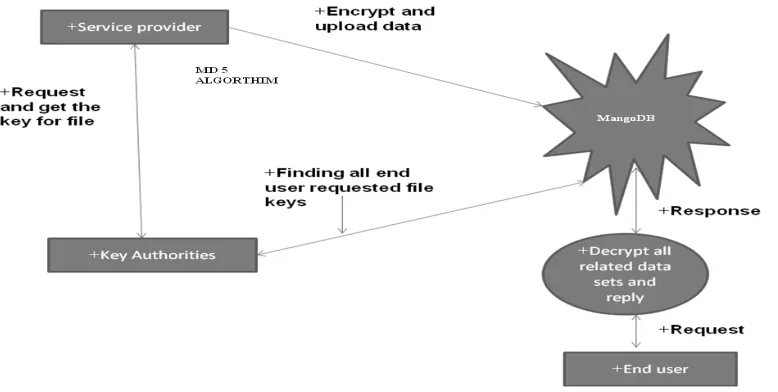
TheMD5 is an algorithm is used to verify data integrity through the creation of a 128-bitmessage digest from data input that is claimed to be as unique to that specific data as a fingerprint is to the unique individual In order to protect sensed data and communication ex-changes between sensor nodes it is important to guarantee the secrecy of messages. In the sensor network case use of symmetric cryptography as asymmetric or public key cryptography is considered too expensive. The encryption protects against outside attacks, it does not protect against inside attacks/node has, as an attacker can use recovered cryptographic key material to successfully participate in the secret communications of the network. While confidentiality give the security of communications inside the network it does not prevent the misuse of data reaching the base station. So, confidentiality must also be coupled with the right control system so that only authorized users can have access to important information. The MongoDB model is characterized by the concepts of privilege, data resource, and user. It regulates the access to document collections on the basis of the granted to roles. The basic scheme introducing fine grained purpose access control at document level. A models a set of
actions that access a data resource. The resource can be a collection, a set of collections, a set of databases, whereas actions are a subset of the predefined MongoDB data management, administrative, and review functions [17]. The role models a set of privileges to be assigned to users. Roles definition is with the principles of the proposed NIST standard [6]. Roles are hierarchically organized and a role can extend other roles inheriting their privileges. The privileges that are granted to a role is the union of the privileges for each role from which r descends. MongoDB includes a set of predefined roles and allows administrators to introduce custom
roles by means of administrative functions. The element user models a user that interacts with MongoDB for the execution of data manipulation operations, administrative. When a role is assigned to a user, the user receives the authorization to execute all the actions specified by the associated with the role on the specified data resources. We have enhanced the MongoDB model with
additional conceptual elements, instrumental to support purpose access control. The key element of the enhanced model is the concept of purpose, which is used to specify the reasons for which documents can be accessed, and to declare the reasons for which users to accessing them. The union of the purposes considered for an application forms the purpose set Ps. The purposes for which a document can be accessed are denoted as intended purposes. The intended purpose set specified for a document d is a set of that
groups the identifiers of the purpose elements of Ps which specify the reasons for which the access is allowed. Data mining discovers hidden relationships in data. It is part of a wider process called “knowledge discovery”. Knowledge discovery using data mining tools does not completely eliminate there is a need for knowing business, understanding the data with statistical methods. It also does not include for the clear patterns of knowledge. Data mining has divided into three categories:
A. Data Discovery
The process of searching the database to find hidden patterns.
B. Data Predictive Modelling
Includes the process of discovering patterns in databases and use them to predict the future.
We observed that the decentralized approach induces performance overheads due to the additional read and write requests to the global storage for acquiring and releasing locks. Therefore, we evaluated an alternative approach of using a dedicated service for
conflict detection. In the service-based approach, the conflict detection service maintains in its primary memory the information
required for conflict detection. A transaction in its commit phase sends its read/write sets information and snapshot timestamp value to the conflict detection service. We designed this service to support conflict detection for the basic-SI model and the cycle prevention/detection approaches for sterilisable transaction. Based on the particular conflict [18]detection approach, the service checks if the requesting transaction conflicts with any previously committed transaction or not. If no conflict is found, the service obtains a commit timestamp for the transaction and sends a ‘commit’ response to the transaction process along with the commit timestamp, otherwise it sends ‘abort’. Before sending the response, the service updates the transaction’s commit status in in the TransactionTable in the global storage [15].
V. CONCLUSIONS
Purpose concepts and related give mechanisms to regulate the access at document level on the basis of purpose and key based policies. An enforcement monitor, called Mem, has been designed to implement the proposed security. Meme operates as a between MongoDB user and a MongoDB server, and enforces access control by monitoring and possibly manipulating the flow of exchanged
VI.ACKNOWLEDGMENT
The heading of the Acknowledgment section and the References section must not be numbered.
Causal Productions wishes to acknowledge Michael Shell and other contributors for developing and maintaining the IEEE LaTeX style files which have been used in the preparation of this template. To see the list of contributors, please refer to the top of file IEEETran.cls in the IEEE LaTeX distribution.
REFERENCES
[1] Agrawal, J. Kiernan, R. Srikant, and Y. Xu. Hippocratic databases. In28th International Conference on Very Large Data Bases (VLDB), 2002. [2] K. Browder and M. A. Davidson. The Virtual Private Database in Oracle9iR2. Technical report, 2002. Oracle Technical White Paper. [3] J. Byun and N. Li. Purpose based access control for privacy protection in relational database systems.The VLDB Journal, 17(4), 2008. [4] R. Cattell. Scalable SQL and NoSQL Data Stores. SIGMOD Rec., 39(4):12–27, May 2011.
[5] A. Cavoukian. Privacy by Design: leadership, methods, and results. In S. Gutwirth, R. Leenes, P. de Hert, and Y. Poullet, editors, European Data Protection: Coming of Age. Springer, 2013.
[6] F. Chang, J. Dean, S. Ghemawat, W. C. Hsieh, D. A. Wallach, M. Burrows, T. Chandra, A. Fikes, and R. E. Gruber. Bigtable: A distributed storage system for structured data. ACM Transactions on Computer Systems (TOCS), 26(2):4, 2008.
[7] P. Colombo and E. Ferrari. Enforcement of purpose based access control within relational database management systems. IEEE Transactions on Knowledge and Data Engineering (TKDE), 26(11), 2014.
[8] P. Colombo and E. Ferrari. Enforcing obligations within relational database management systems. IEEE Transactions on Dependable and Secure Computing (TDSC), 11(4), 2014.
[9] P. Colombo and E. Ferrari. Efficient enforcement of action aware purpose-based access control within relational database management systems. IEEE Transactions on Knowledge and Data Engineering, 27(8), 2015.
[10] P. Colombo and E. Ferrari. Privacy aware access control for big data: A research roadmap. Big Data Research, 2015.
http://dx.doi.org/10.1016/j.bdr.2015.08.001.
[11] D. Ferraiolo, R. Sandhu, S. Gavrila, D. Kuhn, and R. Chandramouli. Proposed NIST standard for role-based access control. ACM Transactions on Information and System Security (TISSEC), 4(3), 2001.
[12] Y. Guo, L. Zhang, F. Lin, and X. Li. A solution for privacy preserving data manipulation and query on NoSQL database. Journal of Computers, 8(6):1427– 1432, 2013
[13] [13] M. Kabir, H. Wang, and E. Bertino. A role-involved conditional purpose-based access control model. In M. Janssen, W. Lamersdorf, J. Pries-Heje, and M. Rosemann, editors, E-Government, E Services and Global Processes, volume 334 of IFIP Advances in Information and Communication Technology, pages 167–180. Springer Berlin Heidelberg, 2010.
[14] M. E. Kabir and H. Wang. Conditional purpose based access control model for privacy protection. In ADC 2009. [15] B. Klimt and Y. Yang. The Enron corpus: a new dataset for email classification research. In Machine learning: ECML 2004.
[16] D. Kulkarni. A fine-grained access control model for key-value systems. In Proceedings of the third ACM conference on Data and application security and privacy, pages 161–164. ACM, 2013.
[17] N. Leavitt. Will NoSQL databases live up to their promise? Computer, 43(2), Feb 2010.