5
VIII
August 2017
A Comparative Analysis On Image Denoising
Using Different Median Filter Methods
Sandeep Kumar1, Munish Kumar2, Rashid3, Neha Agrawal4
1Electronics & Communication, Sreyas Institute of Engineering & Technology, India 2Electronics & Communication DCRUST Murthal, Sonepat Haryana, India
3Electronics & Communication Sreyas Institute of Engineering & Technology Hyderabad, India 4Department of R & D Dreamtree Infotech Pvt. Ltd, Gwalior, India
Abstract: In denoising, separation of noise from signal is a main issue, but with improved filter elimination of noise becomes easier. In this paper nonlinear median filter is used for multi resolution condition, once in full resolution and afterward with half resolution, denoising turns out to be greater. This method is a nonlinear model and is observed to be helpful in removing Impulse noise, Gaussian and Speckle noise. Further, it is recommended that utilization of a nonlinear adaptive median filter (AMF) delivers more satisfying picture with better denoising. The experimental results are based on the parameters likes Peak Signal Noise Ratio (PSNR) and Structural Similarity Matrix (SSIM). It is demonstrated that the enhanced strategy gives a high level of noise removal while protecting the edges and other data in the picture. This research is based on threshold calculation which enhances the PSNR of the framework when contrasted with combination of Discrete Wavelet Transform & Adaptive Median Filter (DWT-AMF) and other median based methods.
Keywords— PSNR; Adaptive Median; Structural Similarity Matrix; Gaussian Noise; Impulse Noise; Speckle Noise; Median Filter; Discrete Wavelet Transform
I. INTRODUCTION
In computer vision, image processing turned out to be a necessary field in daily life applications such as computer tomography, satellite television, face recognition, license plate recognition (LPR), magnetic resonance imaging (MRI) and geographical information systems etc [1-2]. Denoising during image processing is a great challenge in various applications such as spatial domain that refers to a plane digital image in which manipulation is done directly on image pixels and frequency domain refers to the study of mathematical functions or signals with respect to frequency rather than time [2]. Images are used in various areas such as education and medical but a certain amount of noise always exhibits during image processing which degrades the quality of image. An image gets corrupted by noise during acquisition, transmission or during reproduction. Several reasons by which noise can be produced by storage media device, digital camera, sensor or scanner. Reproduction of image from noisy signal is a great challenging task. Image denoising techniques may used to remove the most of the unwanted information from an image. Image denoising technique is used to improve the quality of the image from the noisy image. Noise may be classified such as impulsive noise, AWGN, and speckle noise etc. Here researchers focuses on AWGN model only Using the denoising techniques, we reduce the noise level as well as most of the edges of image and information much as possible [3].
II. LITERATURESURVEY
Syed et al. [7] presented an algorithm to reduce noise from grayscale images. It is improved AMF algorithm in which firstly evaluate median value without taking noisy pixels in window processing. After the maximum window processing, if noise free median value not occurs, then replace it with the last processed pixel value. The result of this algorithm performance is better from
other nonlinear filters while preserving image quality and information the noise removing level up to 90%.
Jiang et al. [8] presented a self-organizing map (SOM) technique to processed MRI imaging. During the formation of images in MRI technique, generally, images are corrupted by Rician noise. Rician noise is highly nonlinear, non-additive signal dependent noise different from common image noise. It is a very difficult to feature to separate noise from the signal. The use of proposed SOM Algorithm is carefully applied to consider Rician noise feature to get accurate MRI image processing, the final result is a novel method for denoising and segmentation.
Malini.S et al. [10] presented a new denoising algorithm for gray and color image. The use of nonlinear median filters in multi resolution environment, one with full resolution and then with half resolution, gives better image denoising and visual quality. This algorithm works simply compared to other, and equally well for gray and color images. It is useful in removing impulse noise as well Gaussian and SN.
Dhanushree et al. [11] presented AMF and adaptive wavelet thresholding shrinkage technique for image de-noising. The noisy image is passed through pre-processing MF to remove the noise and two level DWT is applied which is passed through post-processing median filter to remove noise. Finally, Bays thresholding shrinkage is applied to all sub-bands to obtain a de-noised image. The Inverse DWT is applied to reconstruct the image. The Image quality is measured in terms of the PSNR and is observed that the proposed method obtains better PSNR compared to the existing method.
Panetta et al. [12] shows picture denoising as trying issue in imaging frameworks, particularly imaging sensors. In spite of different research, the calculation has been to diminish it. This algorithm presented another idea of grouping to-arrangement similitude. This likeness measure is a proficient technique to assess the substance closeness for pictures, particularly for edge data. The approach varies from conventional picture preparing procedures, which depend on pixel and piece similarity.
Xiaofeng et al. [13] presented a new method to reduce noise in ultra sound medical images. In this method enhance original median filter by use of directional suit templates instead of the symmetrical template to fit the directions of edges and textures. To determine which directional template should be used, a local direction filter was proposed. The simulation result of proposed work on the synthetic image is better in removing noise from ultra sound images. The PSNR value of proposed is better from other wiener and median filter.
III. PROBLEMSTATEMENT
Before Digital pictures corrupted inferable from camera detecting component, despicable correspondence interface and so on is stick stuffed with driving impulses. This impulse noise devastates the crucial information inside the picture and yield picture turns out as an obscured with unrecognizable edges. The photo would now have the capacity to not be helpful in any approach and it can't be valuable to observe any critical data from it. This drawback may be settled by applying a nonlinear filter (NLF) to the photographs. The main praised NLF is MF. In MF, focus fragment is replaced by the center of its neighboring pixels. This can with advance restore the photo, the issue with MF is that it clouded the photo, however applying MF every single portion paying little mind to whether it's spoiled or not is replaced by standard so it obliterates the sides of the digital picture. So a crisp out of the case new kind of MF indicated to as move MF zone unit made inside which standard is associated solely with the defiled pixels while keeping uncorrupted pixels since it is you. The fundamental objective is to support the standard of the denoised picture using PSNR for various thickness of noise. This research presents a way that utilizations three approach to recover the degraded picture.
A. Noise Detection B. Noise Filtering
C. Discrete Wavelet Transform
IV. TYPESOFNOISE
A. Additive White Gaussian Noise (AWGN))
The AWGN or amplifier is independent at each pixel and with signal intensity. In gray scale image as I = d + n
Where I is the input image function, d is degraded by AWGN n.
B. Speckle Noise (SN)
This is also referred as multiplicative noise which is found normally in most imaging applications. In SN, noise issues in between random interference and coherent returns.
I = d × n Where n is multiplicative noise.
V. FILTERINGTECHNIQUE
A. Discrete Wavelet Transform (DWT)
waves, called wavelets, of varying frequency and confined duration. It supplies each frequency and spatial description of an image. The wavelet change into decomposes the image into three spatial instructional materials, i.e. Vertical, horizontal and diagonal. It decomposes the image into special frequency stages corresponding to the low frequency, middle frequency, and high frequency. The magnitude of DWT coefficients is excessive in the lowest bands (LL) at every stage of decomposition and is least for other high bands [4].
B. Median Filter (MF)
MF is a nonlinear digital filtering method, generally used to remove noise. In filtering of noise, edges are preserved. The output value of median nonlocal filter is the middle element of sorted pixel array value of the filtering window. Median is calculated by first sorting all pixels values from surrounding neighboring hood into numeric order and then replacing the pixel being considered with the median pixel value. The major issue with median filtering is hard to compute and relatively expensive and slow [5-6].
123 125 126 130 140
122 124 126 127 135
118 120 150 125 134
119 115 119 123 133
111 116 110 120 130
Neighborhood values: 115, 119, 120, 123,124, 125, 126, 127, 150 Median value: 124
C. Adaptive Median Filtering (AMF)
The AMF has been presented to evaluate the noisy pixel in an image. The evaluation of pixel as noise is done by comparing every pixel in an image to its surrounding neighbor pixels. The window size of the neighborhood is modifiable, as well as the threshold for the comparison. Those pixels that are different from its neighbors and are not structurally aligned to its surrounding pixel are defined as impulse noise. Such noisy are exchanged with pixels of the neighborhood by the median value of a pixel that clears noise detection test [6].
VI. RESULTANALYSIS
A. Take any image M X M which is represented by where IM denotes the pixel values of an image. B. Assume k X k be filtering window size “W” which is obtained using dividing of an image.
C. Denote IM (X) the intensity value of image IM at pixel location x. For 8-bit gray images, the value of dmax = 0 and dmin = 255. Impulse noise is as follows:
(1)
Where dx is uniformly distributed in [dmax, dmin] and k shows the level of impulse noise.
D. Let represents a noisy image which is obtained by adding AWGN and SN k to original image IM then it can be said
that:
(2)
F. Let the gray levels of any pixel value, in any window ( ) of size k, are denoted by and it becomes after arranging in increasing or decreasing manner and k is even or odd:
(3)
G. Using Eq. (3), it has a kxk matrix. The gray level at any pixel (i, j) is denoted by X(i, j)
(3)
H. In this step, estimate the sum of rows and columns of W are utilized for threshold calculation in this research which prompts proficient noise detection. In each W, Ymin (minimum) and Ymax (maximum) are assessed which are utilized to sudden changes distinguish in pixel values. With a specific end goal to estimation threshold, as a matter of first importance, the components midpoints in singular rows and columns are and of W which is computed using this equation.
(4) (5)
I. This '' 2k’’, different sum values will be helpful for finding Ymin and Ymax. It is given by:
. (6)
. (7) J. Now, checked noisy pixels at of W using comparing it with & . If value lies among and
then it is denoted by noise free pixel otherwise noisy and it is replaced by median value.
. (8)
If found as noisy, then noise removal method is applied to this pixel, and W is moved to the next pixel location. For noise filtering step, calculate the median of the W which has been helping to alter the gray intensity of the found noisy pixel.
K. Reconstruct the matrix using inverse DWT after applying AMF.
L. Mean square error (MSE) - It is used to find the sum of the squares of the "errors", between the input image and output image. )2 (9)
Where M, N denoted pixel values in the input image, represent input image pixels, represent denoised image pixels.
M. Peak Signal to Noise Ratio (PSNR) - It is used to estimate the robustness of denoising w.r.t. the noise. With the presence of noise, the image will be degrading the quality of the image. The image quality of output and input image is estimated. It is given by
PSNR = 10 * log (P2 / MSE) (10)
N. Where p= maximum value in input image.
O. Structural Similarity Matrix (SSIM) -It estimates the similarity measure between the input image and output image.
(11)
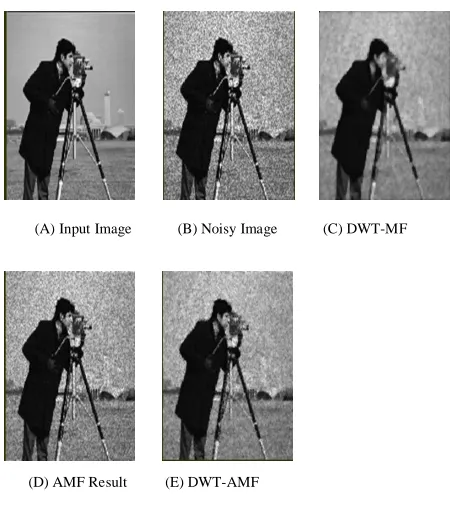
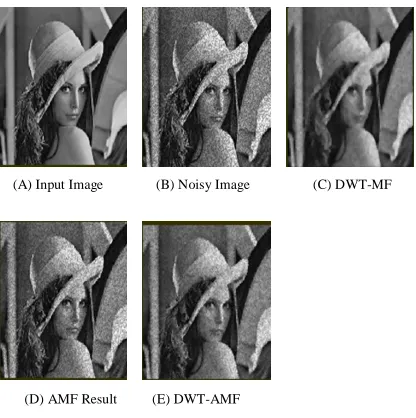
The experimental results are based on test gray scale image of the cameraman, Barbara, and Lena. This simulation is based on MATLAB software. The density of impulse noise, AWGN and SN are maintained in the image by using standard MATLAB function.
Fig. 1.Original grayscale of 8-bit per pixel.
Fig. 2.Image (a) Result on Impulse Noise with 40% noise density
Fig. 3.Image (a) Result on Gaussian Noise with 30% noise density
(A) Input Image (B) Noisy Image (C) DWT-MF
(D) AMF Result (E) DWT-AMF
(A) Input Image (B) Noisy Image (C) DWT-MF
(D) AMF Result (E) DWT-AMF
Fig. 4.Image (a) Result on Speckle Noise (standard)
Fig. 5.Image (b) Result on Speckle Noise (standard)
(A) Input Image (B) Noisy Image (C) DWT-MF
(D) AMF Result (E) DWT-AMF
(A) Input Image (B) Noisy Image (C) DWT-MF
[image:7.612.185.410.437.691.2]Fig. 6.Image (c) Result on Speckle Noise (standard)
TABLE I. PSNR (DB)VALUES OF DIFFERENT FILTERS FOR BARBARA IMAGE DEGRADED BY DIFFERENT
NOISE
Noise DWT - Median Filter Adaptive Median Filter DWT-AMF Method [6]
Impulse [40%] 35.1384 25.7221 45.4676
Gaussian [30%] 30.4546 11.8181 22.9338
[image:8.612.74.534.356.716.2]Speckle 40.0286 20.9505 40.0263
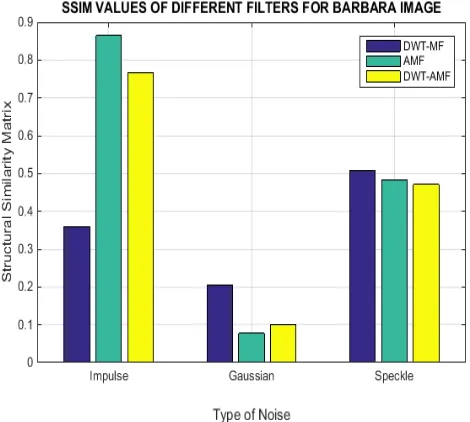
TABLE II. SSIM VALUES OF DIFFERENT FILTERS FOR BARBARA IMAGE DEGRADED BY DIFFERENT NOISE
Noise DWT -Median Filter Adaptive Median Filter DWT-AMF Method [6]
Impulse [40%] 0.3599 0.8643 0.7679
Gaussian [30%] 0.2063 0.0775 0.1006
Speckle 0.5083 0.4842 0.4707
Fig. 7.PSNR values of different filters for barbara image
(A) Input Image (B) Noisy Image (C) DWT-MF
Fig. 8.SSIM values of different filters for barbara image
In this Fig. 7 and Fig. 8 blue bar shows that DWF-MF value, green shows that AMF PSNR value and yellow shows that DWT-AMF PSNR. It performed on Barbara image.
TABLE III. PSNR COMPARISON BETWEEN SEVERAL METHODS FOR CAMERAMAN IMAGE DEGRADED BY DIFFERENT NOISE
Noise DWT - Median Filter Adaptive Median Filter DWT-AMF Method [6] Impulse [40%]
38.2221 25.626 49.874
Gaussia n [30%]
32.93 11.725 25.471
[image:9.612.90.535.357.671.2]Speckle 43.3482 21.3744 45.245
TABLE IV. SSIM VALUES OF DIFFERENT FILTERS FOR CAMERAMAN IMAGE DEGRADED BY DIFFERENT NOISE.
Noise DWT-Median Filter Adaptive Median Filter DWT-AMF Method [6] Impulse [40%]
0.3943 0.9105 0.8545
Gaussia n [30%]
0.206 0.0778 0.0967
Speckle 0.5971 0.4597 0.4832
VII. CONCLUSION
REFERENCES [1] Jadhav P. B., Dr. Sangale. S. M., “Image Denoising Techniques”, IJARCSSE, 2015.
[2] Sandeep Kumar, Sukhwinder Singh, and Jagdish Kumar, “A Study on Face Recognition Techniques with Age and Gender Classification”, In IEEE International Conference on Computing, Communication and Automation (ICCCA), 5th-6th May 2017.
[3] Parmar, Jignasa M., and S. A. Patil. "Performance evaluation and comparison of modified denoising method and the local adaptive wavelet image denoising method." The IEEE International Conference on Intelligent Systems and Signal Processing (ISSP), pp. 101-105, 2013.
[4] Agrawal, K., and Rajesh Singh. "A Survey: Digital Watermarking with its Applications Using Different Methods." International Journal of Digital Contents and Applications, Vol. 2, No. 1, pp. 17-24, 2015.
[5] Vijayalakshmi, A., C. Titus, and H. Lilly Beaulah. "Image Denoising for different noise models by various filters: A Brief Survey." International Journal of Emerging Trends & Technology in Computer Science (IJETTCS), Vol 3, No. 6, 2014.
[6] Sandeep Kumar, Sukhwinder Singh & Jagdish Kumar, “Automatic Face Detection Using Genetic Algorithm for Various Challenges”, International Journal of Scientific Research and Modern Education, Volume 2, Issue 1, Page Number 197-203, 2017.
[7] Jubair, Md Imrul, Md Mizanur Rahman, Syed Ashfaqueuddin, and Imtiaz Masud Ziko. "An enhanced decision based adaptive median filtering technique to remove Salt and Pepper noise in digital images."The IEEE 14th International Conference on Computer and Information Technology (ICCIT), pp. 428-433, 2011.
[8] Jiang, Danchi. "A SOM algorithm based procedure for MRI image processing under significant Rician noise." The IEEE 3rd Australian Control Conference
(AUCC), pp. 14-19, 2013.
[9] Lu, Zhenzhen, Weiyu Liu, Dahai Han, and Min Zhang. "A PDE-based Adaptive Median Filter to process UV detection image generated by ICCD." The IEEE International Conference on Audio, Language and Image Processing (ICALIP), pp. 543-546, 2014.
[10] Malini, S., and R. S. Moni. "Image Denoising Using Multiresolution Analysis and Nonlinear Filtering." The IEEE Fifth International Conference on Advances in Computing and Communications (ICACC), pp. 387-390, 2015.
[11] Dhanushree, V., and M. G. Srinivasa. "Image de-noising using median filter and DWT adaptive wavelet threshold." IOSR Journal of VLSI and Signal Processing, Vol. 5, 2015.
[12] Panetta, Karen, Long Bao, and Sos Agaian. "Sequence-to-Sequence Similarity-Based Filter for Image Denoising." IEEE Sensors Journal, Vol 16, No. 11, pp. 4380-4388, 2016.