University of Huddersfield Repository
Zeng, Wenhan, Jiang, Xiang, Scott, Paul J., Xiao, Shaojun and Blunt, Liam
A Fast Algorithm for the High Order Linear and Nonlinear Gaussian Regression filter
Original Citation
Zeng, Wenhan, Jiang, Xiang, Scott, Paul J., Xiao, Shaojun and Blunt, Liam (2009) A Fast
Algorithm for the High Order Linear and Nonlinear Gaussian Regression filter. In: Proceedings of
the 9 th international conference of the european society for precision engineering and
nanotechnology. euspen, San Sebastian, Spain, pp. 356359. ISBN 9780955308260
This version is available at http://eprints.hud.ac.uk/id/eprint/3980/
The University Repository is a digital collection of the research output of the
University, available on Open Access. Copyright and Moral Rights for the items
on this site are retained by the individual author and/or other copyright owners.
Users may access full items free of charge; copies of full text items generally
can be reproduced, displayed or performed and given to third parties in any
format or medium for personal research or study, educational or notforprofit
purposes without prior permission or charge, provided:
•
The authors, title and full bibliographic details is credited in any copy;
•
A hyperlink and/or URL is included for the original metadata page; and
•
The content is not changed in any way.
For more information, including our policy and submission procedure, please
contact the Repository Team at: [email protected].
A Fast Algorithm for the High Order Linear and Nonlinear
Gaussian Regression filter
W. Zeng1, X. Jiang1, P. J. Scott2, S. Xiao1, L. Blunt1
1Centre for Precision Technologies, School of Computing and Engineering, University of Huddersfield, Huddersfield, HD1 3DH, UK
2
Taylor Hobson Ltd, 2 New Star Road, Leicester, LE4 9JQ, UK
Abstract
In this paper, the general model of the Gaussian regression filter, including both the
linear and nonlinear filter of zeroth, second order, has been reviewed. A fast
algorithm based on the FFT algorithm has been proposed and tested for its speed and
accuracy. Both simulated and practical engineering data have been used in the testing
of the proposed algorithm. Results show that with the same accuracy, the processing
times of the second order linear and nonlinear regression filters for a typical 40,000
points dataset have been reduced to under 0.5second from the several hours of the
traditional convolution algorithm.
1 Introduction
The Gaussian filter has been defined as the standard filtering technique for surface
roughness extraction [1]. However, a number of shortcomings have hampered its
practical application in industry including: (1) the measured profile is truncated due
to the boundary effect, especially when the measured data is not much long than the
cutoff wavelength; (2) it is unsuitable for surface with relatively large form
components; and (3) it is unable to handle measurement outliers or residual profiles
with non-Gaussian distributions. To address the boundary effect and form removal
issues with the traditional Gaussian filtering, Brinkman and Bodschwinna [2] have
proposed a Gaussian regression filtering technique with the extension of up to second
order polynomial form. Furthermore, by introduce a weighted iteration procedure, the
Gaussian regression filter can obtain robust results against outliers and non-Gaussian
distributions. Seewig [3] has given the discrete expression of the linear and nonlinear
However, the algorithm for the Gaussian regression filter is very slow if the
convolution method is used directly, especially in the cases of the first or second
order form removal, making the algorithm impractical for industrial application. In
this paper, the general model of the Gaussian regression filter has been reviewed and
a fast algorithm based on the FFT method has been proposed and tested.
2 General Gaussian Regression filter for profile analysis
Without considering the form removal, the general model of the zeroth order
Gaussian regression filter can be described by the solution of the following
minimisation problem:
(
)
0 ( ) ( ) ( ) ( )
l
w x
z w x s x d Min
ρ ξ − ξ− ξ→
∫
(1)The resulted mean line w x( ) of the filtered profile is the deviations to the measured
profile z( )ξ weighted by the Gaussian function s(ξ−x) over the whole measured
length l. The functionρ( )⋅ is the error metric function of the estimated residual, in the
case of 2
( ) :x x
ρ = is the least squares function and integration limits are expanded up
to −∞ < < ∞ξ , the regression filter is then equal to the phase correct filtering
according to ISO11562. In order to analysis profiles with significant form
components, it is assumed that the form component f( )ξ in the neighbourhood of a
random point x can be adequately approximated by a second order polynomial curve
within the measured length. Thus the equation (1) can be extended to include form
removal as:
(
)
(
)
1 2 2 1 20 ( ), ( ), ( )
( ) ( ) ( ) ( )( ) ( )
l
w x x x
z w x x x x x s x d Min
β β
ρ ξ − −β ξ− −β ξ− ξ− ξ→
∫
(2)By zeroing the partial derivations in directions of w, 1
βand 2
β , the resulting mean profile with the form component can be obtained as:
1
2
( ) 0
( ) 1
( ) 2
A B C w x F
B C D x F
C D E x F
β β ⎡ ⎤ ⎡ ⎤ ⎡ ⎤ ⎢ ⎥ ⎢ ⎥ ⎢= ⎥ ⎢ ⎥ ⎢ ⎥ ⎢ ⎥ ⎢ ⎥ ⎢ ⎥ ⎢ ⎥ ⎣ ⎦ ⎣ ⎦ ⎣ ⎦ (3) Where , 0
( ) l ( ) ( )
A x =
∫
δ ξ ξs −x dξ, 0( ) l ( )( ) ( )
B x =
∫
δ ξ ξ−x sξ−x dξ,2 0
( ) l ( )( ) ( )
C x =
∫
δ ξ ξ−x sξ−x dξ, 30
( ) l ( )( ) ( )
4 0
( ) l ( )( ) ( )
E x =
∫
δ ξ ξ−x sξ−x dξ,0
0( ) l ( ) ( ) ( )
F x =
∫
δ ξ zξ ξs −x dξ,0
1( ) l ( ) ( )( ) ( )
F x =
∫
δ ξ zξ ξ−x sξ−x dξ, 2 02( ) l ( ) ( )( ) ( )
F x =
∫
δ ξ zξ ξ−x sξ−x dξ.with δ( )x =ρ'
( )
x x. Whenρ( ) :x =x2, δ( )x =2 is a constant at all points, then thefilter is thelinear regression filter. When ρ( )x is selected as other functions, such as
the L1 norm, Huber, Cauchy, and Tukey functions, it’s a nonlinear regression filter,
whereδ ξ( ) has different values at different points.
3 Fast algorithm
Solving equation (3) directly for each individual point is extremely time-consuming
and inefficient. A reasonable way is to pre-calculate all the A, B, C, D, E, F0, F1, F2
respectively from the whole length of profile, and then solve the linear equations
point by point to get the mean profile. However, if convolution in the time domain is
used directly to calculate the A, B, C, D, E, F0, F1, F2, the algorithm is still very
slow. Thus, a method based on the FFT algorithm in the frequency domain is
proposed by the authors to speed up the calculation of the above intermediate results
as following:
( ) ( ( ( )) ( ( )))
A x =IFT FTδ x FT s x , B x( )=IFT FT( ( ( ))δ x FT xs x( ( )))
2
( ) ( ( ( )) ( ( )))
C x =IFT FT δ x FT x s x , 3
( ) ( ( ( )) ( ( )))
D x =IFT FT δ x FT x s x ,
4
( ) ( ( ( )) ( ( )))
E x =IFT FTδ x FT x s x ,F0( )x =IFT FT( ( ( ) ( ))δ x z x FT s x( ( ))),
1( ) ( ( ( ) ( )) ( ( )))
F x =IFT FTδ x z x FT xs x ,F2( )x =IFT FT( ( ( ) ( ))δ x z x FT x s x( 2( ))),
Where, δ( )x =ρ'( )x x, 0< <x l and FT(.) &IFT(.) are the forward and inverse
Fourier transforms respectively.
4 Experiments
To evaluate the algorithm, simulated and measured profiles have been used to test the
second order linear and nonlinear Gaussian regression filtering respectively. Both
convolution and FFT algorithms have been conducted on those profiles with the aim
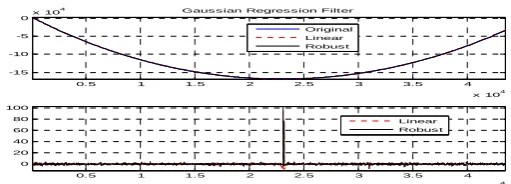
of comparing speed and accuracy. Figure 1 is a simulated profile (43000 pts) with
significant form component and a noticeable pip in the middle of the profile. Figure 2
outlier spikes. The convolution algorithms need several hours to get the results, while
the fast algorithms proposed only need several hundred milliseconds in all cases.
0.5 1 1.5 2 2.5 3 3.5 4
x 104
-15 -10 -5
0x 10
4 Gaus sian Regress ion Filter
Original Linear Robust
0.5 1 1.5 2 2.5 3 3.5 4
x 104
0 20 40 60 80 100
[image:5.595.168.424.72.164.2]Linear Robus t
Figure 1: simulated data (up: original and mean profile; down: residual profile)
2000 4000 6000 8000 10000 12000 14000 16000 18000
-1400 -1200 -1000 -800
Gaus sian Regres s ion Filter
Original Linear Robust
2000 4000 6000 8000 10000 12000 14000 16000 18000
-300 -200 -100 0
[image:5.595.164.426.187.279.2]Linear Robust
Figure 2: measured profile (up: original and mean profile; down: residual profile)
5 Conclusions
In this paper, the authors have reviewed the linear and nonlinear Gaussian regression
filters of zeroth, second order. Fast algorithms based on the FFT method have also
been proposed. Experiments have shown that the new algorithms have improved the
speed significantly and achieved similar compatible accuracy.
6 Acknowledgement
The authors would like to thank the EPSRC in the UK for support fund to carry out
this research work under its programme EP/F032242/1.
References:
[1] ISO 11562 1996 Geometrical Product Specification (GPS) – Surface texture:
Profile method – Metrological characteristics of phase correct filters
[2] Brinkmann S, Bodschwinna H 2001 Accessing roughness in three-dimensions
using Gaussian regression filter, Int. J. of Mach. Tools & Manuf. 41 2153-2161
[3] Seewig J 2005 Linear and robust Gaussian regression filters, Journal of Physics: